







Abstract
Photovoice is a participatory action research method that was founded on mobilizing communities toward action. However, there is limited research detailing the action stages of photovoice that are meant to follow the initial research. In this article, we describe the action stage of a youth photovoice project conducted at the planning phase of a Community Health Needs Assessment of the Latino community in North Philadelphia. In collaboration with local leaders, we utilized photovoice to prioritize the health needs identified in the assessment. We announced a request for proposals and launched twelve, 1-year, community catalyst grants in the amount of US$50,000 each. While grants were funded and implemented, the participants continued to exhibit their findings in Philadelphia City Hall and engage with city policymakers. We developed a health policy workshop where Philadelphia youth beyond the original photovoice participants could learn advocacy skills and policy research to develop a proposal addressing a priority health need identified through photovoice. This workshop was expanded into a year-round program where participants can be matched with a career mentor, engage in professional development sessions, and continue to refine and advocate for their policy proposal. We found that successful action planning stemmed from setting goals several steps ahead of the current stage of action while enhancing the ability to center community voice in guiding action forward. Photovoice influenced decision-making throughout each of the steps taken toward action. Future research should recognize and describe action planning as a central tenet of photovoice methodologies.
Keywords
Background
In their landmark article, Wang and Burris (1997) highlight photovoice as a method to stimulate social change through reflection on community assets and barriers, fostering dialogue that shares knowledge, and engaging policy makers. Engagement of participants in the research process can empower communities, provide a space to process experiences, and be more rewarding than traditional studies that lead to publications rarely accessible to communities (Evans-Agnew & Rosemberg, 2016). Photovoice can generate collective dialogue between stakeholders and build community capacity as crucial steps toward policy change (Strack et al., 2010). Previous photovoice initiatives have taken steps toward social action by hosting photo exhibitions, developing advocacy campaigns, and enhancing individual empowerment to continue engaging in community development (Catalani & Minkler, 2010). Although higher rates of photovoice participation have demonstrated improved community dialogues that imply an intention to act (Catalani & Minkler, 2010), there is limited research detailing how photovoice has impacted communities through steps taken toward action (Lofton & Grant, 2020). In this brief, we describe the action component of a photovoice project conducted in the Latino community in North Philadelphia in 2019 to demonstrate how this method can and should extend beyond photo exhibitions and into continued community engagement and actionable steps toward making change.
According to census estimates, 15.2% of Philadelphia’s population identifies as Hispanic or Latino (U.S. Census Bureau, 2019). When comparing the health and social measures of the Latino community in North Philadelphia with the entire city of Philadelphia, this community has higher rates of asthma (28.6% vs. 21.5%), diabetes (22.9% vs. 13.85), lack of insurance (24.2% vs. 12.9%), people without a high school diploma or general educational development (GED; 36.2% vs. 8.0%), unemployment (12.7% vs. 5.8%), and people living below 100% federal poverty line (45.5% vs. 24.6%; Dafilou, 2019). These numbers showcase pervasive disparities across numerous levels that require investigation and action.
The Philadelphia Collaborative for Health Equity (P-CHE), an organization powered by Jefferson Health, a local health care system, with a mission to improve health equity in Philadelphia, aimed to invest in North Philadelphia. In 2018, P-CHE and Jefferson Health had limited relationships with this community. We aimed to execute a Community Health Needs Assessment (CHNA) to establish the highest priority health needs in the community while developing strong partnerships with local organizations and residents. The CHNA required by the Internal Revenue Service (IRS) of 501(c)3 nonprofit hospitals integrates input from the communities they serve with that from the local public health department and the hospital’s leadership (Internal Revenue Service, 2020). Using geographical information systems and census data, we mapped the Latino population density in North Philadelphia and selected the five zip codes that best encompassed this population as the geographical boundaries for the CHNA. This CHNA involved secondary data analysis and key stakeholder interviews where community organizations across multiple sectors were asked to join a community advisory group (CAG). In December of 2019, the CAG was presented with options for how community members should be engaged in the assessment, and they elected to host focus groups for adults (ages 19–65) and older adults (ages above 65), and photovoice for youth (ages 18 and below; Dafilou, 2019).
Purpose and Aims
We conducted a youth photovoice project in North Philadelphia’s Latino community as part of a comprehensive CHNA, which aimed to establish the highest priority health needs within this community as defined by this community. The project is ongoing but began in October 2018 (Figure 1). So far, we have completed an exhibit, allocated grants, and are now developing and delivering health policy workshops for youth in Philadelphia. This article will describe how the power of photovoice research can be amplified to engage community members in action to address identified health priorities and center community voice throughout this work.

Timeline for North Philadelphia CHNA and Youth Photovoice
Photovoice
Methods
This study received Institutional Review Board approval, using photovoice methodology adapted from the landmark article from Wang and Burris (1997). Three partner organizations volunteered from the CAG to each recruit up to 20 Latino youth participants (ages 14–18) from five zip codes in North Philadelphia to participate in photovoice. With inductive reasoning and the SHOWeD questioning strategy, we explored youth participants’ perceptions of the assets and barriers to health in their community and facilitated their prioritization of the health needs identified (Shaffer, 1979).
Outcomes
This photovoice project resulted in 10 major themes, titled and defined by the participants (n = 34) with numerous subthemes, titled and defined by researchers. Definitions can be found in the Codebook in Supplemental Appendix A. The themes and subthemes were analyzed under the World Health Organization’s conceptual framework for action on the social determinants of health (Solar & Irwin, 2010) and are displayed in Figure 2. Many of the themes participants defined focused on the ways in which different environmental, social, and cultural factors can affect their community’s and individual health. We selected this framework because it fit well with the youth’s explanations for how structural and social determinants of health can feed forward into one another and affect health outcomes.
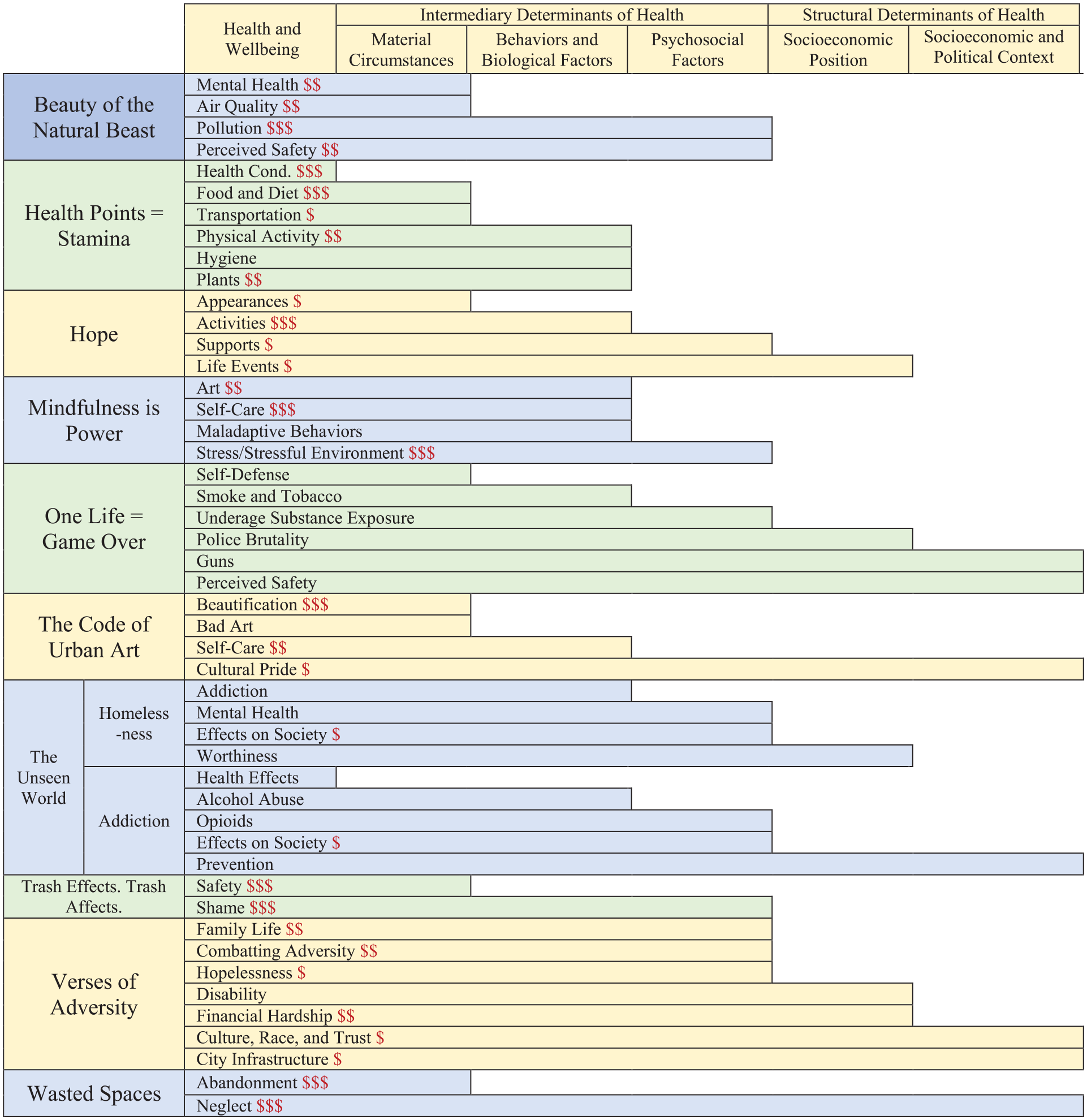
Photovoice Themes Organized by World Health Organization Social Determinants of Health Framework
Prioritization
Methods
The CAG adapted the Hanlon method of prioritization (Hanlon, 1954) to rank 11 high priority health needs, which encompassed themes identified by participants in both the CHNA’s focus groups and photovoice project. The CAG selected five criteria they found most important in prioritizing the health needs and assigned a weight to each. Each member of the CAG (n = 24) completed the revised Hanlon method sheet displayed in Figure 3 for each of the 11 high priority health needs. Their scores were averaged for each criterion, weighted based on the criterion’s assigned weight, and summed for a final score out of five. Health needs that scored above 4.0 would be considered the top priorities.
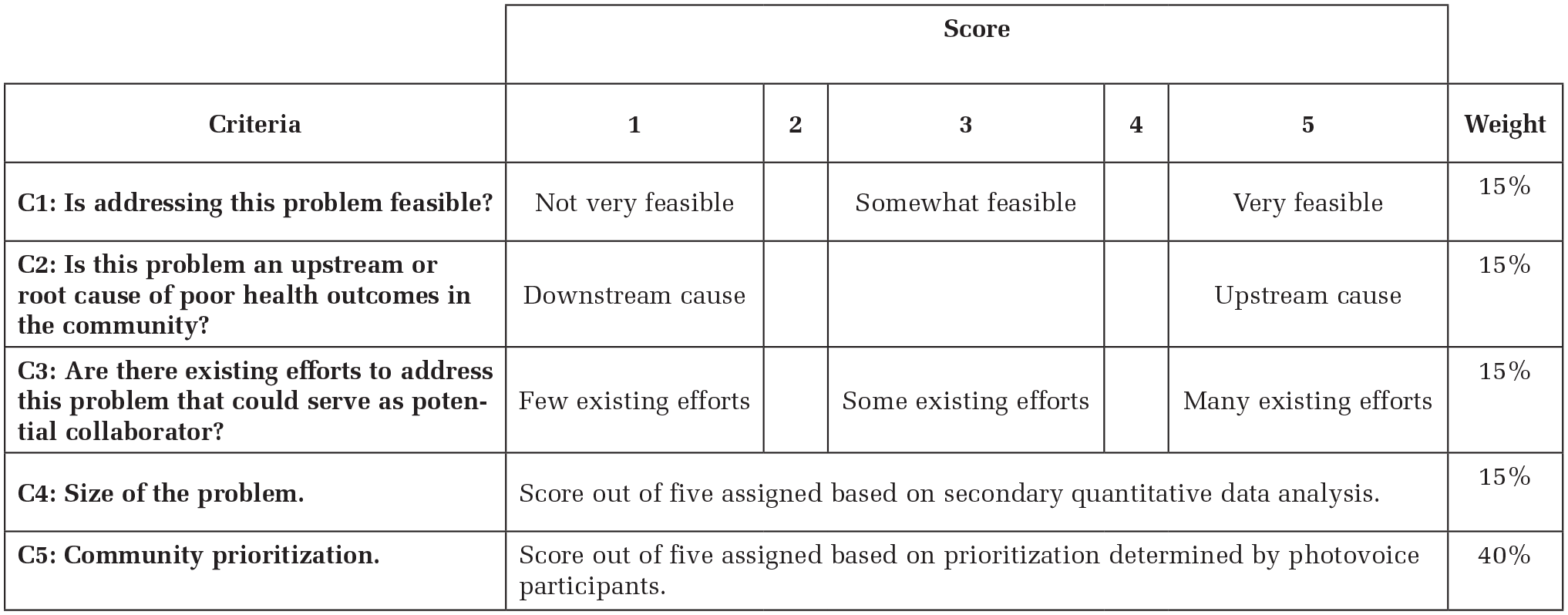
Adapted Hanlon Method of Prioritization
Outcomes
The CAG weighted photovoice participants’ prioritization at 40% of the final score, with the other four criteria (size, feasibility, upstream cause, and existing collaborations) at 15% each. The top priorities that scored greater than 4.0 were (a) mental health; (b) trauma, safety, and violence; (c) housing; and (d) built environment.
Photovoice Exhibition
Methods
At the first photovoice exhibition, youth presented their findings at a community event attended by the participants and their families, the CAG, senior leadership from Philadelphia hospitals, and elected officials at the city and state levels. Over the following year, the exhibit was installed at the Jefferson Trauma Training Conference, Jefferson College of Population Health, and at Philadelphia City Hall. Youth led formal presentations at the Jefferson Trauma Training Conference (n = 6) and the American Public Health Association’s Annual Meeting (n = 3), and informal meetings to share photovoice data with city stakeholders.
Outcomes
During the first photovoice exhibition, P-CHE leadership shared the top priorities. We announced a request for proposals for 12 grants of US$50,000 each (US$600,000 total, funded by the Lindy Family Foundation through P-CHE), to be invested into the community to fund 1-year pilot programs that address the top priorities. As the proposals were submitted and awarded, photovoice project participants reported feeling valued by having actionable steps after the first exhibition through their conference presentations. During the City Hall installation, city councilmembers and their staff approached P-CHE leadership about how to collaborate on policy change around the top priorities, which led to the development of the health policy workshops.
Community Grants
Methods
A panel of 15 unaffiliated grant reviewers was assembled to include local community leaders and subject experts in the four top priorities. All reviewers convened to witness the exhibit and worked collaboratively to rank the grant applications, the top 12 of which would be funded. Reviewers were asked to give greater consideration to proposals that addressed photovoice findings.
Outcomes
Twelve, US$50,000 grants were funded, aimed to primarily address at least one of the four top priorities, but many addressed a range of health needs identified through photovoice. Photovoice themes and subthemes that proposals addressed are marked in Figure 2. Photovoice participants (n = 28) were recruited to participate in several of the funded programs, including building a community park, developing a community-centered trauma training curriculum, and forming a housing trust. P-CHE worked with grantees during the COVID-19 pandemic to provide technical assistance and extend deadlines as needed.
Beyond these grants, members of the CAG reported meeting new partners through this collaboration and have partnered with them to secure additional grant funding using photovoice data published in the CHNA. Researchers themselves have returned as volunteers to aid in the action stages and report securing scholarship funding to continue engaging in this work.
Health Policy Workshop
Methods
P-CHE surveyed photovoice participants to determine which top priority they wanted to address with a policy intervention. P-CHE developed an interactive policy and advocacy training workshop that aimed to teach policy and advocacy concepts and skills through participant-led research, culminating in the development of a policy proposal addressing the elected health need. This workshop was conducted online for 25 hours over 2 weeks in July 2020 and was evaluated using a pre- and postsurvey (n = 15).
Outcomes
Participants elected to address the built environment, specifically the excessive littering and illegal trash dumping in their neighborhoods. Evaluation of the workshop suggested that participants improved policy and advocacy knowledge and agency among participants. Participants proposed a policy in two parts. First, they suggested starting a city program stipulating that 40% of households on a block sign a petition stating that their block needs to be cleaned and they are committed to keeping it clean. Upon submitting this petition, the city and the community will organize a joint effort to clean the block and the city will add and maintain a trashcan on the block, if one does not already exist. Second, participants asked for increase funding for city sanitation positions to support the efforts their proposal would add. Engaged city councilmembers expressed support for the proposal, but changes have yet to be implemented. The workshop is being extended into a youth-led policy lab where participants will collaborate to move the described policy proposal forward with support from P-CHE and engaged city councilmembers. In this extension, participants are also matched with career mentors and participate in monthly professional development sessions with focuses on skills they request. The policy lab also received continuation funding from local donors who had seen this photovoice exhibit to recruit more youth.
Discussion
Photovoice is often described as a process ending at a photo exhibit (Sutton-Brown, 2014). Wang and Burris’s (1997) original methods include social action as a central principle of photovoice practice; however, it is not uncommon for some to describe the methodology as ending at the photo exhibit (Sutton-Brown, 2014). Setting photo exhibition as the endpoint of a photovoice project limits its potential as a research method and a community intervention.
Researchers who take an intentional approach to action planning around the problems identified in their photovoice project might find the most success in enacting change (Lofton & Grant, 2020). This research team found that by planning several steps ahead of each stage, we were able to center participants and their community in decision-making processes throughout each stage. For example, during the CHNA, we were able to advocate for funding the community grants while leaving the focus areas of the grants to be determined by community voice. When the grants were implemented, the team worked with recipients on developing strong evaluation plans and on securing funding to continue building capacity and seeking sustainability beyond their 1-year proposals. We found that as we progressed, the community assumed ownership of the work and focused on fostering measurable change around the top priorities.
Implications for Research and Practice
Researchers should recognize intentional action planning as an essential component of photovoice practice, centering community voice throughout. Our experiences in this project suggest that policy workshops can be a way to advance the CHNA process and optimize community agency. To expand the evidence base around the potential photovoice holds for change, future iterations should apply innovative action stages beyond exhibition.
Supplemental Material
sj-docx-1-hpp-10.1177_15248399211059810 – Supplemental material for Action Beyond Exhibition: Amplifying Photovoice Through Social Action After a Community Health Needs Assessment in Philadelphia
Supplemental material, sj-docx-1-hpp-10.1177_15248399211059810 for Action Beyond Exhibition: Amplifying Photovoice Through Social Action After a Community Health Needs Assessment in Philadelphia by Caleb Dafilou, Maria F. Arisi, Vincent Pepe, Martin Hehir, John McKeegan, Felicia Rinier and Rickie Brawer in Health Promotion Practice
Footnotes
Authors’ Note:
The authors would like to thank the Providence Center, HUNE Incorporated, Esperanza Incorporated, and the Philadelphia Collaborative for Health Equity (P-CHE) East North Philadelphia Community Advisory Group for their continued support on this work; Jean Wallace for her incredible work in grant administration and program evaluation; Dr. Jack Ludmir, Erin Morton, Abby Cabrera, Susana Suarez, and Kristine Pham for their work on the photovoice project; and Dr. Rosemary Frasso for her continued guidance in qualitative research methods. This work was supported by the Lindy Family Foundation.

References
Supplementary Material
Please find the following supplemental material available below.
For Open Access articles published under a Creative Commons License, all supplemental material carries the same license as the article it is associated with.
For non-Open Access articles published, all supplemental material carries a non-exclusive license, and permission requests for re-use of supplemental material or any part of supplemental material shall be sent directly to the copyright owner as specified in the copyright notice associated with the article.
