







Abstract
Objectives. To increase the scale and efficacy of health promotion practice, culturally responsive approaches to well-being are needed in both communication and practice innovation. This mixed-methods evaluation sought to identify specific mechanisms used in a promising practice model and offers a potential theoretical framework to support public health programs in integrating culture and social justice into communication and intervention programs. Study Design. Rooted at the intersection of ethnographic and phenomenological worldviews, this mixed-methods, retrospective process evaluation used publicly available empirical and experiential data centered on the arts, science, and social justice to identify critical mechanisms used and incorporate them into an emergent theoretical framework. Method. The retrospective process evaluation used an ethnography-informed approach combined with scientific literature reviews. To integrate adjacent ideas into the emergent theoretical framework, a phenomenologically informed theme development approach was used. Results. The evaluation resulted in a five-step framework, called MOTIF, with the potential to be utilized in diverse situational and geographic contexts. Data that surfaced from related literature reviews revealed adjacent mechanisms from positive psychology, critical consciousness theory, and innovation design that were incorporated into the emergent framework. Conclusion. MOTIF may offer a culturally responsive public health communication and innovation process capable of promoting health equity through the cultivation of relationships between artists, community participants, and public health agencies and researchers who collectively endeavor to craft innovative solutions for population health and well-being.
Keywords
Background
Although many sectors play roles in moving society toward the necessary conditions for communities to be healthy, public health is essential as a strategic organizer of the efforts (Desalvo et al., 2017). However, public health’s inability to communicate optimally is keeping communities unhealthy (Castrucci, 2020). To deepen the impact of health promotion practice, a culturally responsive process for communication and innovation is required. The arts may offer a path forward.
While much is known about the arts’ transformative power, understanding of particular mechanisms and their causal relationships to various health outcomes is still evolving. The World Health Organization reports that the arts contribute to promoting good health and preventing a range of mental and physical health conditions arising across the life-course (Fancourt & Finn, 2019). Scoping reviews in the United States suggest creative arts are potential tools for addressing collective trauma, racism, social exclusion, and other public health priorities aligned with social justice (Sonke et al., 2019).
From the NAMES Project AIDS Memorial Quilt to the founding of Black Lives Matter and beyond, many artists and arts educators have a shared history of incorporating social justice goals into their creative practice (Jasper, 2008; Osorio, 2018; Silva, 2012). Similarly, public health scholars increasingly focus on the mediating role of social justice in public health outcomes (Tobin & Teitelbaum, 2019). Even the American Medical Association now recognizes race as a social, not biological, construct, and views racism as a public health crisis (O’Reilly, 2020). The ability to recognize, analyze, and act against oppressive political, economic, and social forces shaping society, referred to as critical consciousness (Freire, 1972), potentially offers a collaborative opportunity between health promotion practice and the creative arts to innovate across many health equity fronts ranging from environmental infrastructure to commerce (Prevention Institute, n.d.).
Moving Toward a Culturally Responsive Approach
Billboards for drug sniffing dogs, cheap lawyers, and gun shows. Signs advertising cash for people’s homes and diabetes strips. Though zip codes may differ across the United States, implicit and explicit racial animus is a significant factor in systematic underresourcing of Black neighborhoods who also know what it is like to forcibly endure these messages in their lives. This was the case for Louisville, Kentucky’s Smoketown neighborhood, and the spark for One Poem at a Time (OPAAT).
OPAAT, a creative placemaking (Markusen & Gadwa, 2010) initiative by the arts organization IDEAS xLab, combined public health science with poetry, photography, collective action, and culturally responsive communication to help remediate harm to community well-being being caused by rapacious commerce. According to Hannah Drake, Chief Creative Officer of IDEAS xLab, activist, and artist with four generations of family history in Smoketown, OPAAT was born from the belief that the power is in the people. The impetus for OPAAT was initiated after Drake’s trip to Dakar, Senegal, where she experienced firsthand how transformative it was to see herself reflected in the world. “In every space I entered, from the statutes in churches to the billboards on buildings, I finally saw myself reflected back,” said Drake. “When people see themselves it is empowering.”
Founded by formerly enslaved people after the Civil War, Smoketown is Louisville’s first and oldest historically Black neighborhood. Smoketown is rooted in a rich history of artistic expression, community pride, culture, and innovation that dates to the 1850s. However, years of segregation and other race-based policies had lasting, negative impacts on the well-being of Smoketown residents. A history of racial oppression created both seen and unseen barriers. For instance, although Smoketown sits directly adjacent to the highest concentration of health, hospital and physician services in Kentucky, Smoketown does not benefit from the good health outcomes and life expectancy (Kelly Pryor et al., 2017) that such proximity should offer.
To contextualize OPAAT’s planned arts activities within public health science (Lock, 2000), IDEAS xLab collaborated with community and public health partners to conduct a Health Impact Assessment (HIA; Edmonds et al. 2017). OPAAT was one of three core program elements analyzed in the HIA. The HIA process surfaced research linking outdoor billboard advertising and land use policy to health disparities (Kwate, 2014; Kwate & Lee, 2007), which, in turn, brought a heightened focus for OPAAT partners to understanding the relationship between commercial practices and community well-being.
OPAAT launched by bringing community stakeholders together with municipal and state government leaders on a historic poetry walk. To make visible the places and people comprising Smoketown’s cultural memory, poets were stationed to perform at community sites. Positive cultural relationships, identities, and expectations were reflected on an inaugural cycle of “poetry billboards” that had been placed in juxtaposition to existing negative billboards. The poetry billboards contained historical and contemporary images of Smoketown’s people and places, paired with one-line poems created with community members and expressing a culturally empowered neighborhood focused on guiding its own health and economic narratives.
Evaluation Aims and Objectives
The aim of this mixed methods, retrospective evaluation was to identify specific mechanisms and processes used in OPAAT. The objective was to offer health promotion practitioners, in diverse geographic and situational contexts, an iterative model to (1) identify well-being priorities and cultural assets within communities, (2) determine which priorities are ready for action, (3) craft creative ideas for addressing priorities with existing cultural assets, and (4) co-create actions with community participants to move toward health equity.
Method
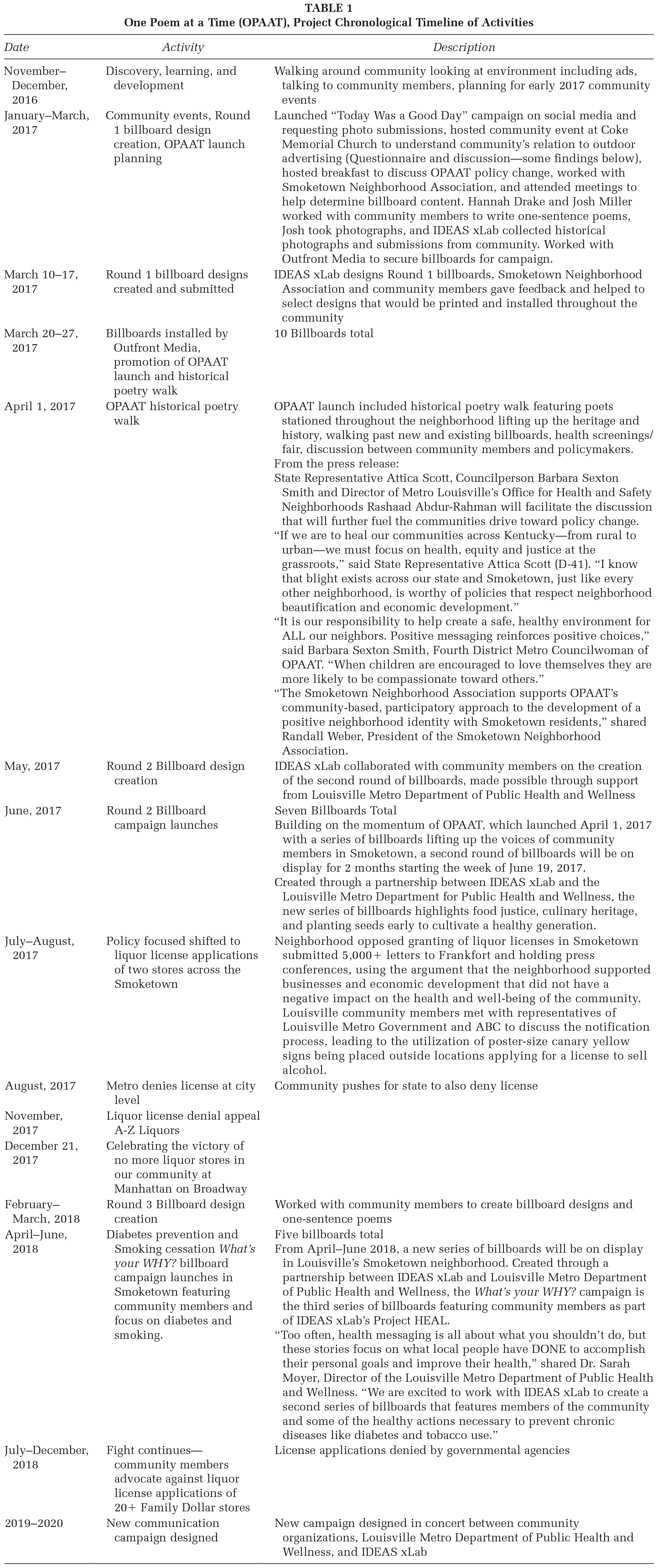
An ethnographic-informed approach was used in the retrospective analysis. To describe and interpret sociocultural processes, publicly available quantitative data (Arno & Rock, 2014; Edmonds et al., 2017; Kelly Pryor, et al., 2017) was merged with publicly available qualitative data from IDEAS xLab’s archives. Qualitative archival data included media reports and artifacts (e.g., photographs, poems, videos, essays). All quantitative and qualitative data were provided by IDEAS xLab and organized according to activities listed in Table 1.
One Poem at a Time (OPAAT), Project Chronological Timeline of Activities
The research team also conducted gray literature field scans and a scientific literature review in accordance with PRISMA (Preferred Reporting Items for Systematic Reviews and Meta-Analyses) guidelines. To guide the scientific literature search of published peer-reviewed articles toward cultural-responsivity, the PEN-3 culture model (Airhihenbuwa, 1990) was utilized. Ultimately, three main domains were selected for a systematic review: (1) hope, (2) sense of belonging, and (3) trust. These three domains were chosen due to a few common factors: (1) the domain was translated into a quantitative metric or index, (2) studies utilizing the metric measured the domain’s impact on well-being, and (3) the researchers could identify a link between the PEN-3 cultural domains and the domain being evaluated. The researchers used key search terms to identify potential articles. Queried databases included PubMed, PsycINFO, EMBASE, and CENTRAL databases and returned 812 articles. In the final analysis, the domains of hope and belonging were deemed most actionable within the context of OPAAT.
Finally, a phenomenologically informed theme development approach surfaced two additional models that were incorporated into the final research product. The two models are Ginwright’s Radical Healing approach for Black youth (Ginwright, 2010) and Seligman’s (2011) positive psychology approach for human flourishing. Both models contain critical mechanisms illuminating OPAAT’s naturally occurring design process and have been shown in research to mediate well-being across the breadth and scope of ecological models (Richard et al., 2011) used in health promotion.
Results
Prior to beginning analysis (Figure 1), the evaluation team made two foundational assumptions. First, “people and communities have the best insights into their situations” (Pavlish & Pharris, 2012). Second, fostering place-based opportunities for situational reorientation toward health equity was a shared goal of artists, public health, and community participants. The reviewed data from IDEAS xLab, together with the grey and scientific literature, revealed the following themes.
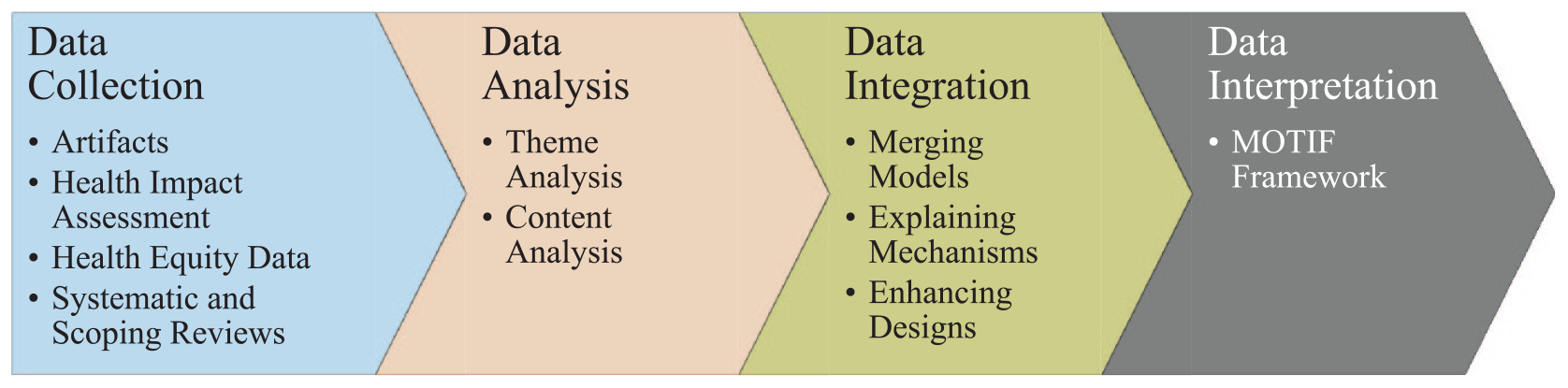
Evaluation Process Utilized to Develop MOTIF
Agentic Mechanisms Are Required for Culturally Responsive Well-Being
The literature revealed three potential mechanisms for culturally responsive well-being within health promotion practice frameworks. The first is self-determination theory, which posits that increases in an individual’s sense of autonomy, competence, and relatedness predict higher self-motivation levels (Ryan & Deci, 2000). For example, researchers utilized self-determination theory to explore predictors of motivation for physical activity (S. Berg et al., 2020), medical adherence (Bruzzese, et al., 2014; Fu et al., 2019), caregiver support (Badr et al., 2015), relationships among psychological constructs (Oliver et al., 2010), student performance as related to teachers’ educational styles (Engbers et al., 2015), and within leader–follower employment contexts (Diao et al., 2019). When one reports higher levels of autonomy, competence, and relatedness, they also experience greater emotional regulation, a sense of security, and a greater sense of fulfillment (La Guardia et al., 2000; Milne et al., 2008).
Second, hope theory, defined as the perceived capability to derive pathways to desired goals, helps motivate individuals via agentic thinking (Snyder, 2002). At the individual level, hope has been shown to have a significant impact on mental health and physical health (Berendes et al., 2010; C. J. Berg et al., 2008; Hirsch & Sirois, 2016; Kortte et al., 2012; Munoz et al., 2018). Hope increases positive health behaviors engagement (C. J. Berg at al., 2008; Feldman & Sills, 2013) and decreases engagement in risky health behaviors (Cheavens et al., 2006).
Third, a sense of belonging is related to an individual’s positive physical health and health behaviors (Cheavens et al., 2006; Hale et al., 2005; Munoz et al., 2018) as well as depression and hopelessness (Fisher et al., 2015). At a societal level, a sense of belonging has been associated with better mental health in Black, indigenous, and lesbian/gay/bisexual communities (C. J. Berg et al., 2008; Hill, 2009; Hunter et al., 2017; Rostosky et al., 2018).
A Social Justice Orientation Can Support Culturally Responsive Innovation
Ginwright’s (2010) radical healing model for Black youth demonstrates the potential power of a social justice orientation for culturally responsive innovation. Ginwright’s focus on agency, where Black youth are not defined by their oppressors, also seems to align with other bodies of research that note the subjective, culturally mediated components of well-being (Ryan & Deci, 2001). Here, culture may also be most impactful when understood as a community asset.
When guided by a social justice orientation, working with artists and culture workers can help health promotion practitioners identify collaborative opportunities for creating novel approaches to health equity that extend beyond public health’s traditional “needs-based” methods (Winder, 2003). However, because artistic practices can differ so widely, it is important to have an organizing framework. Because it fosters a greater sense of cultural authenticity, the PEN-3 culture model (Iwelunmor et al., 2014) offers one such organizing structure for cultural responsiveness in health practice innovations. Furthermore, in the contemporary public health context, evidence suggests that innovation may also benefit by incorporating antiracist intellectual frameworks and actions within all innovation agendas (Ford & Airhihenbuwa, 2010).
Transdisciplinary Approaches to Well-Being May Expand Opportunities for Public Health Innovation
Health promotion practice is a complex balance between optimizing the experience of those for whom the benefit is intended and the functioning of public health and well-being science. On this front, public health innovation is often hindered due to funding constraints and lack of training in human-centered design, creativity science, and rapid prototyping (Lister et al., 2017). Ryan and Deci place well-being on two fronts. The first is hedonic, or seeking pleasure and avoiding pain. The second is eudaimonic, or skill acquisition, self-actualization, and the experience of meaning. These two views are sometimes divergent and, other times, complementary (Ryan & Deci, 2001). Because of this dichotomy, public health practice should align with methodologies acknowledging the promotion of well-being as a comprehensive and iterative, human-centric process. Here, the arts appear useful for centering public health efforts on the voice of those for whom the benefit is intended. A replicable framework for systematically sustaining such innovation efforts is critical. Of the available process innovation frameworks reviewed, the double-diamond design process (Design Council, 2019) seems most promising. While not perfect, it supports a systematic design analysis with double diverge–converge phases reinforcing the importance of participant’s voice to guide the innovation process, similar to member checking in qualitative research (Birt et al., 2016).
Data Integration and Interpretation
The data integration process resulted in a five-step theoretical framework. Drawing from a widely deployed artistic device for understanding recurring, narrative elements with symbolic significance, the framework is called MOTIF. Steps outlined in MOTIF are cumulative, though not necessarily linear in the application.
The 5-Step MOTIF framework is (1) Map policies creating social toxins, (2) Orient toward cultural responsiveness through arts, (3) Translate actions to align with cultural well-being science, (4) Iterate agentic narratives, and (5) Foster continued well-being. The arts serve as a mechanism for action, understanding, and connection within and between each step (Figure 2).
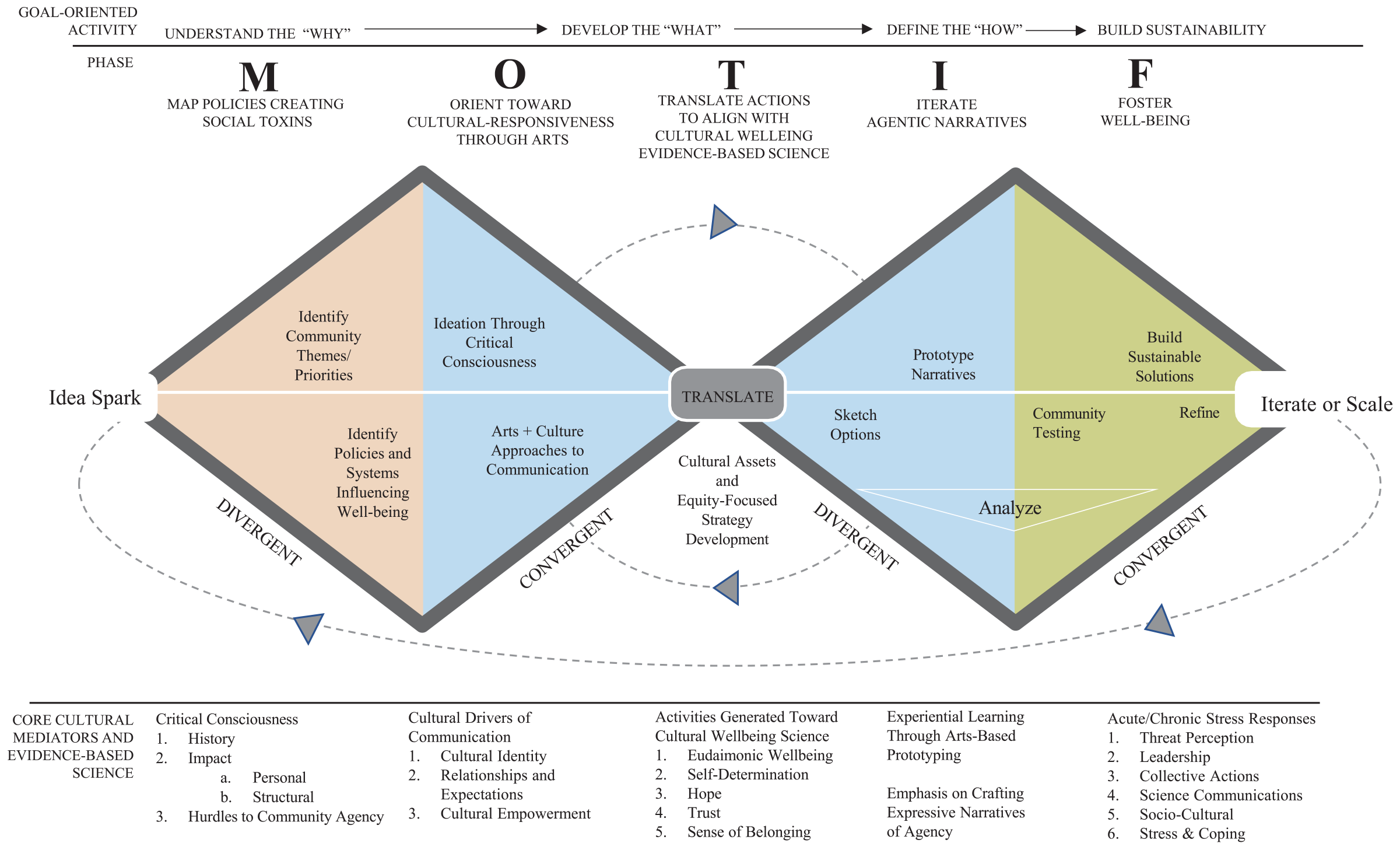
MOTIF Innovation Framework
M: Map Policies That Create Social Toxins
This first step in MOTIF is divergent, understanding community histories, priorities, policies, and systems that have influenced well-being over time. Similar to how environmental toxins, such as air or water pollution, negatively impact health, social toxins are also harmful (Garbarino, 1995). Historical and ongoing structural policies allowing for rapacious commerce can lead to such social toxins and prove harmful to community well-being (Cohen et al., 2003; Hillier et al., 2009; Lejano et al., 2012; Lopez-Pumarejo & Bassell, 2009; Lowery & Sloane, 2014; Mohai et al., 2009; Moore et al., 2009; Morello-Frosch et al., 2001; Northridge et al., 2003; Romley et al., 2007). Arts activities in this step should aim to identify the structural reasons “why” different social toxins exist in a community and the ways in which such toxins impact personal and community well-being.
O: Orient Toward Cultural Responsiveness Through Arts
“Just change the signs. Change each message on the billboards, one poem at a time,” said Drake. That was her arts-based, culturally responsive idea that led to the creation of OPAAT. To realize the idea, Smoketown residents worked with Drake and the IDEAS xLab team to share words and concepts they wanted to see realized, such as hope, history, resilience, strength, love, worthiness. Poetry was used to facilitate a collective form of convergent ideation and to nurture the development of new coalitions between artists, community participants, and public health professionals to take collective action. This included an explicit focus on crafting culturally resonant communication.
T: Translate Actions to Align With Cultural Well-Being Science
This is a critical transition point in MOTIF which may determine whether collaborative work gains the “stickiness” necessary to become an iterative, sustainable process. Ideas explored in previous steps are transformed into tangible actions, and actions are integrated into a cultural well-being framework (e.g., hope, belonging, trust, compassion, eudaimonic well-being, creativity). Importantly, this step should shift the focus from a retrospective “why” something happened and orient participants toward crafting “what” should come next. In OPAAT, poetry became a tool for championing positive commerce and claiming agency over the process.
I: Iterate Agentic Narratives
“You are worthy. Worthy of everything!” read one OPAAT billboard poem. This poem signals the next divergent phase of rapid prototyping within MOTIF. Here, artists, public health practitioners, and community participants seek to discover the different ways “how” change can happen within the chosen focus area. For example, beyond billboards, how might a community change other health-harming commercial narratives such as those created by the prevalence of liquor stores?
Shortly after the launch of OPAAT, two new liquor stores attempted to open in Smoketown. Community leader Nachand Trabue utilized the HIA report and OPAAT’s media presence as part of her efforts to mobilize people in writing government officials to deny approval of the liquor license applications. Thousands of letters were submitted within weeks and the liquor stores did not open. At this point, OPAAT expanded beyond its original focus on outdoor advertising to support community-initiated advocacy focused on changing notification procedures for new liquor sales license applications. The collective action resulted in a new administrative process by Metro Louisville Government that applicants place a large canary yellow sign outside the building applying for the new license. This process now helps to alert community members to act, either for or against the license, within the regulatory timelines. Implementing this new process also changed how some city council members notify their constituencies of commercial activities with potentially harmful effects on community well-being.
F: Foster Continued Well-Being
The final step in MOTIF focuses on building sustainability, refining community prototypes through testing, and, when and where it makes sense, moving toward replication and scalability. While difficult to identify specific arts mechanisms at play during this final step in OPAAT, the diffusion of innovation (Rogers, 2003) exhibited by the community suggests a significant opportunity for arts to ignite or support sustainable change.
Discussion
Culture, health, and well-being are deeply connected. The biomedical model with which Western culture diagnoses and defines health is a cultural construct (Napier et al., 2014). There is also a growing recognition in public health that well-being reflects culture (Hanlon et al., 2011). Culture is a dynamic process that informs individual perceptions of well-being and how diverse groups make sense of what they experience in their lives (Kagawa, 2012). The multidimensional cultural identity constructs (e.g., race, gender, sexual orientation, class, age-group, work cohort, etc.) that Americans use to define themselves all inform how health and well-being are understood and experienced by diverse communities. Therefore, to place culture at the center of health promotion is “to recognize that the forest is more important than the individual tree” (Iwelunmor et al., 2014, p. 2).
As seen in OPAAT, an arts-supported framework can foster culturally responsive communication leading to meaningful, transdisciplinary, collaborative innovation. As public health grapples with the complex challenges faced at the intersection of science and social justice, incorporating cultural responsiveness across the breadth of the ecological model is critical. From 2017 to 2020, OPAAT included four different advertising cycles, more than 30 positive billboard installations, centered on community voices. Cycles 2 through 4 were partnered with the Louisville Metro Department of Public Health and Wellness and community members, focusing on childhood lead poisoning prevention, diabetes, and smoking cessation. The fourth cycle also included digital, web-based ads. According to IDEAS xLab, these culturally responsive digital ads performed 233% above the industry standard for viewer engagement when compared to other health promotion campaigns. To view the full series of OPAAT billboards over time, visit https://www.ideasxlab.com/opaat
Community well-being is a multidimensional, evergreen process operating as a collective muscle that diverse groups with different skills co-create and train together. The more the muscle is used, the more effective it becomes. MOTIF potentially offers a pathway for artists, public health professionals, and communities to devise culturally responsive ways of innovating together. As America navigates a sea-change of culture shifts requiring large-scale behavior change of systems, MOTIF may additionally offer an opportunity to incorporate many of the positive, health-promoting benefits arising from participation in the creative arts even as innovation happens. Areas that seem particularly suited for arts-based support are threat perception and management, leadership cultivation, collective decision making, science communication, stress, and coping (Bavel et al., 2020).
Implications for Practice
Artists Can Help Communities Understand How Policies Affect Well-Being
Artists can offer public health practice an experiential learning approach for deep community scans of (1) historical policies; (2) social toxicity (personal): hopelessness, fear, shame, uncertainty, violence, loss of control; (3) social toxicity (structural): poverty, family dislocation, lack of access to health care, racism, homophobia, classism, lack of quality educational opportunities; (4) negative media narratives that use the power of commercial media to define communities in ways harmful to their well-being; and (5) dominant research narratives that center on an “academic gaze” of a community instead of centering on the community voice and self-determination.
Artists May Act as Catalysts for Increasing Community Agency and Action
In educational settings, students who utilize arts-based tools to augment traditional educational instruction exhibit more experimentation with different ideas, better cope with complexity, and exhibit other beneficial forms of subjective well-being (Chemi & Du, 2018). Similarly, arts-based tools can support critical consciousness and help people to see and act with personal agency in the world (Ginwright, 2010). The importance of agency, or the ability of a person to have control over their life, is central to the human experience (Bandura, 2001).
Limitations and Future Directions
There is an inherent “messiness” implicated when trying to align divergent processes (e.g., art-making, social justice) with convergent processes (e.g., scientific evidence) in a way that meets the end goals of multiple stakeholders. However, there is one priority research area for which MOTIF may offer a particularly useful framework. It is that of understanding how cultural contexts mediates the prevailing assessment modalities and theories of creativity (Kaufman & Sternberg, 2019), especially as they relate to well-being. MOTIF is intended as a beginning, not definitive, framework for public health to consider using as a guide in arts-based collaborations and culturally responsive innovation toward health equity. MOTIF’s transdisciplinary approach potentially offers the advantage of building speed and reflexivity into culturally responsive translational science.
While MOTIF offers roadmap, many variables exist that may affect the outcomes experienced. For instance, there is currently no consistency in how artists are trained for the type of work outlined herein. Therefore, before undertaking such work in any community, it is recommended that health practitioners first engage a wide range of artists to understand how individual practices and disciplines may vary. This engagement will support the documentation of different artistic practices and their effectiveness in a diverse range of situational context and organizational typologies. For instance, one approach used by IDEAS xLab in OPAAT included mapping artistic practices into the screening and scoping phases of a traditional HIA. This process offered a bridge for understanding and coding various artistic practices into familiar, evidence based, public health formats already in use by policymakers and health equity advocates. Finally, within the fiduciary constraints placed on agencies by funders, it is also important to acknowledge creative and cultural work, as work, requiring compensation.
Conclusion
Culturally responsive approaches to health promotion practice are primed for transdisciplinary innovation. Artists can play important roles in uncovering and communicating the deep, multidimensional narratives held in the places and spaces where people live, work, learn, pray, and play. The arts-inspired framework proposed by MOTIF offers public health practitioners an iterative process for crafting transdisciplinary solutions, both creative and bold. “People often ask why OPAAT worked,” said Drake.
This strategy worked because communities that have been marginalized want to be seen and heard. Seeing them and hearing them means they are valued and that they have a voice in their community. That they have influence in their space. That something they said can shift the atmosphere. That they can impact things in their community. That is the power of positive messaging. We have the power to change our communities, One Poem at a Time.
Footnotes
Authors’ Note:
Theo Edmonds is cofounder of IDEAS xLab. Josh Miller is a cofounder of IDEAS xLab. Hannah Drake is Chief Creative Officer at IDEAS xLab. Additionally, many of the coauthors were directly involved in the development of One Poem at a Time and are currently or have been previously, employed or contracted by IDEAS xLab or the University of Louisville. This report was guided by and developed with the assistance of IDEAS xLab as part of the National Science Foundation Center for Health Organization Transformation. This work supported in part by the National Science Foundation under Grant No.1738359. Any opinions, findings, and conclusions or recommendations expressed in this material are those of the author(s) and do not necessarily reflect the National Science Foundation’s views.
Supplement Note:
This article is part of the Health Promotion Practice supplement, “Arts in Public Health.” The supplement includes exciting projects, strategies, frameworks, practices, and places that advance health through the arts. The Society for Public Health Education is grateful to the University of Florida Center for the Arts in Medicine and ArtPlace America for providing support for the issue. The entire supplement issue is available open access at  .
.
References
Supplementary Material
Please find the following supplemental material available below.
For Open Access articles published under a Creative Commons License, all supplemental material carries the same license as the article it is associated with.
For non-Open Access articles published, all supplemental material carries a non-exclusive license, and permission requests for re-use of supplemental material or any part of supplemental material shall be sent directly to the copyright owner as specified in the copyright notice associated with the article.
