







Abstract
The Standards of Practice for Health Promotion in Higher Education (Standards of Practice), is a guiding document for the field of Health Promotion. This article, written by Standards of Practice revision authors, highlights important wording, content, and structure within the current edition of the document. By understanding the importance and rationale of these elements, readers will understand how the Standards of Practice illustrates current and future trends in the field.
Keywords
Introduction
The American College Health Association’s (ACHA) Standards of Practice for Health Promotion in Higher Education (Standards of Practice), available on the ACHA website, outlines ideals for the field and lays the groundwork for the future of Health Promotion in higher education (ACHA, 2019). Although designed for college health, these standards have broader applicability to the entire field of Health Promotion. This article illustrates the benefit of having standards for a field and describes key elements of the Standards of Practice, helping readers understand the importance of these components for the future of Health Promotion.
Overview of the Standards of Practice
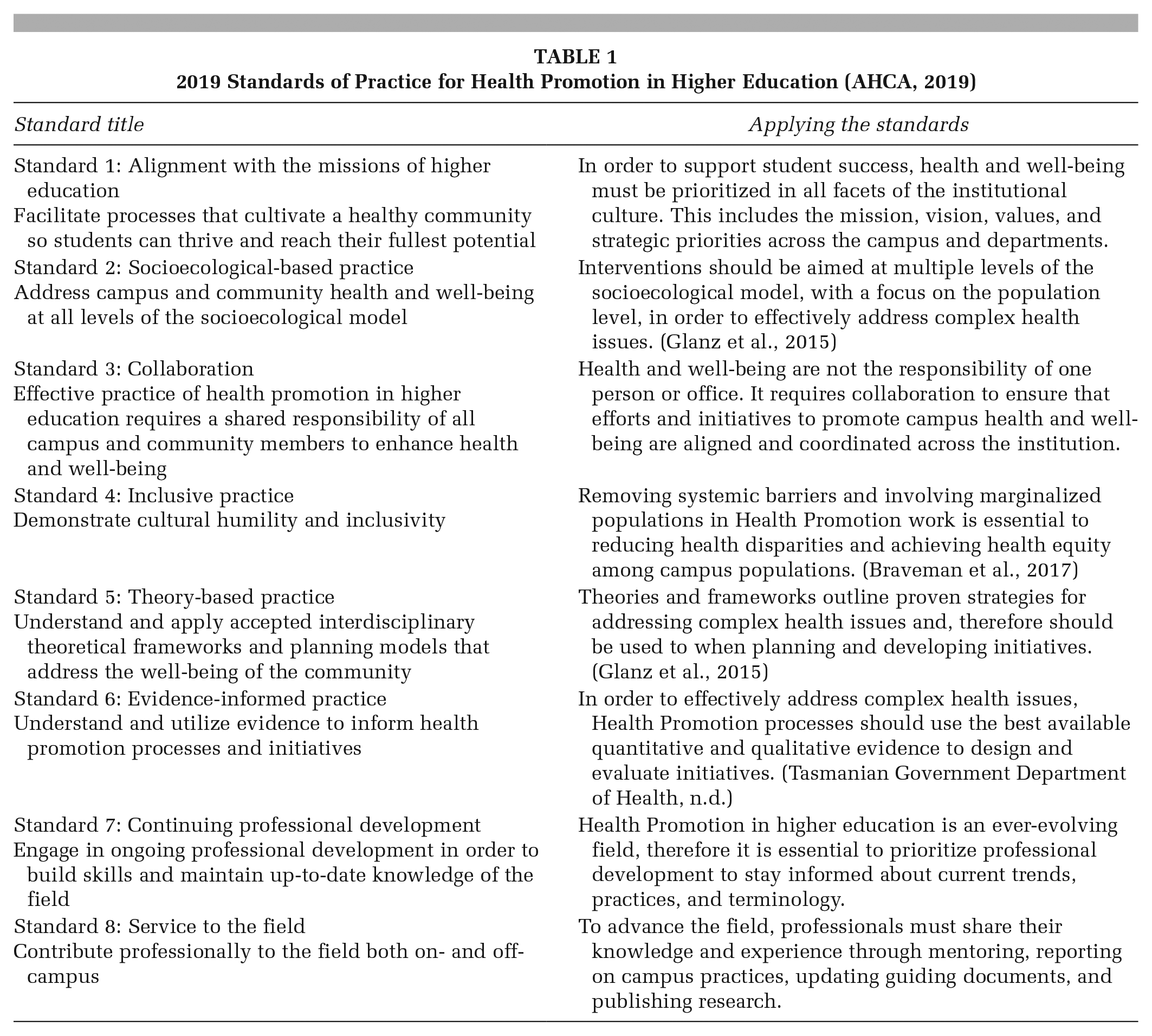
The Standards of Practice includes a narrative opening, individual standards, a glossary of terms, and a list of resources. The introduction of the document shares background information about the field and frames how to view the standards, while the glossary of terms establishes a common understanding of key terminology. The essence of the document is the eight standards, each including substandards that help professionals translate them into practice. The standards emphasize critical processes within Health Promotion that could be applied to a variety of settings, even though the specific application of this document is college health. The standards, with applications, are in Table 1.
2019 Standards of Practice for Health Promotion in Higher Education (AHCA, 2019)
The importance of the Standards of Practice
The Standards of Practice has historically been used as a tool to guide the way college Health Promotion professionals work. Having a set of standards helps practitioners better understand and effectively implement Health Promotion processes. This can be critical for new professionals or those who want to better understand the field. Furthermore, the document can be used to guide planning efforts and evaluate how work is done. Higher education administrators can also use the Standards of Practice to advocate for the essential role of Health Promotion in college settings.
The Standards of Practice is unique for the field because it uses standards and substandards to outline strategies for effective Health Promotion work. The standards serve as an ideal to strive toward, it is not expected that an institution or professional will address every standard and substandard.
Relevance to the broader health promotion field
Although the Standards of Practice is focused on Health Promotion in higher education, it has relevance for professionals outside of a college setting. It can serve as a model of the benefits of having standards within a field, to unite and guide those who work in various settings. Understanding the importance of the concepts outlined below can guide all who do Health Promotion work. For example, terminology is important to advance all of Health Promotion, not only college health. Although the language and examples within the Standards of Practice are specific to college health, concepts, such as cultural humility and professional development, are not.
The importance of a revision process
The original Standards of Practice was published in 2001 (ACHA, 2001). Since that time, the field of Health Promotion as well as concepts and terminology has evolved. Therefore, a process for revision and updates is essential to keep Health Promotion resources relevant. Within ACHA’s Health Promotion section, experts in the field review and revise the document periodically to ensure it reflects best practices. Most recently, six professionals with extensive knowledge and experience working in Health Promotion in higher education came together for the fourth edition update published in 2019. In addition to their own expertise, they solicited feedback from professionals in college health throughout the revision process to gather additional perspectives.
Key elements within the Standards of Practice
There are several sections, word choices, and areas of focus with the Standards of Practice that are essential to better understand Health Promotion in higher education and the future of the field. These elements are outlined below.
Audience
Although the primary audience for the Standards of Practice is Health Promotion professionals, the document is also intended to include those who may deliver Health Promotion processes but do not have the formal training, such as health care or student affairs professionals. Therefore, the Standards of Practice provides context about the nuances of doing this work and the importance and challenges of Health Promotion processes. The document also gives administrators a foundation to advocate for the resources necessary for effective Health Promotion work.
Introduction and Glossary Included in the Standards of Practice
Given the wide audience for which the Standards of Practice is written, the glossary and introduction provide important context about Health Promotion.
As the field of Health Promotion evolves, it is critical for those within and outside the field to understand the importance of trained professionals leading Health Promotion processes, when possible. In addition, understanding the complexities of this work will help those who advocate for more resources bolster their case for making Health Promotion a priority. Thus, the introduction includes background about Health Promotion, and the specific training and expertise of professionals within this field (ACHA, 2019).
Having standardized language is critical for effectively collaborating with partners toward shared goals, as outlined in the Standards of Practice. To establish common terminology for those working to advance health and well-being, the glossary defines terms most important for readers within and outside of the field.
Guiding Principles
The “guiding principles” serve as an overarching lens, representing a set of underlying values, that are essential for applying each standard to Health Promotion in higher education. The document includes three “guiding principles”: ethical practice, cultivating well-being and student success, and community-based approach (ACHA, 2019).
The inclusion of “cultivating well-being and student success” as a guiding principle establishes the connection between well-being and goals of higher education, such as retention, and the important role Health Promotion plays in achieving these outcomes (ACHA, 2016).
“Community-based approach” highlights that to do the population-level work that is necessary for Health Promotion processes, we must work with the impacted population, which can extend beyond geographic borders, and include populations such as alumni networks and local community members.
The last guiding principle emphasizes that to effectively impact health and well-being, the work of Health Promotion in higher education must be done in an ethical manner.
The Role of Prevention
While the Standards of Practice reflects the importance of environmental change and working at all levels of the Socioecological Model, it is critical to highlight that these efforts are intended to both prevent negative outcomes and promote healthy behaviors.
Although in many public health contexts, prevention is described as “primary,” “secondary,” and “tertiary,” some argue that Health Promotion professionals should not use these terms. The focus on “primary prevention” in the Standards of Practice ensures that those working in Health Promotion in higher education prioritize the approach of “taking action before a problem arises in order to avoid it entirely, rather than treating or alleviating its consequences” (Cohen & Chehimi, 2010, p. 5). Because “secondary” and “tertiary prevention” focus on early detection and reducing effects of existing health conditions, these terms are excluded to emphasize the importance of “primary prevention” instead (Cohen & Chehimi, 2010).
Health Promotion professionals also use the terms “universal,” “selected,” and “indicated” to describe prevention without using “primary,” “secondary,” and “tertiary” (Springer & Phillips, 2007). Since each set of terms signifies something distinctly different, professionals should use them together to most accurately describe prevention. “Primary,” “secondary,” and “tertiary” describe whether to intervene before or after a health challenge occurs, whereas “universal,” “selected,” and “indicated” refer to populations on which to focus (Cohen & Chehimi, 2010; Springer & Phillips, 2007). Therefore, the terms “universal,” “selected,” and “indicated” are used to further delineate “primary prevention” as prioritizing the entire population (universal), prioritizing populations who may be at higher risk for specific health behaviors or health conditions (selected), or prioritizing individuals known to be at high risk based on health behaviors (indicated) (Springer & Phillips, 2007). Using both sets of terminology emphasizes the importance of preventing negative health outcomes from occurring, regardless of which populations Health Promotion processes may prioritize.
This terminology will also help others within and outside of college health understand that “primary prevention” should be the focus of Health Promotion work.
Emphasis on Professional Development and Service to the Field
As the field grows, it is important for Health Promotion professionals to continue learning how best to meet their population’s needs. “Continuing Professional Development” emphasizes the importance of that continued growth, helping professionals advocate for resources that provide growth opportunities. “Service to the Field” pushes professionals to give back with publications, presentations, research, mentorship, and leadership to help the field and its practitioners grow. Thus, both concepts are included in the Standards of Practice, acknowledging their importance to the future of Health Promotion (ACHA, 2019).
Inclusive Practice and Cultural Humility
It is important that Health Promotion practices be inclusive to advance health and well-being. To emphasize this, Standard 4 is called “Inclusive Practice.” The language of “inclusive practice” signifies the need to go beyond simply having more diverse populations included in the work, to shifting the processes and practices so these populations can thrive (Martinez-Acosta & Favero, 2018). The term “cultural competency” is intentionally excluded as it implies finite knowledge, and the potential to master another culture or identity, whereas inclusive practice illustrates the importance of not just knowing about different cultures, but integrating the needs and assets of all populations into Health Promotion work (Tervalon & Murray-Garcia, 1998). This distinction is important to the field as mastery of another culture could lead to individuals speaking on behalf of marginalized populations, instead of continuing to learn about their lived experiences. The term “cultural humility” better captures a process of lifelong learning and growing (Tervalon & Murray-Garcia, 1998). Using the terms “inclusive practice” and “cultural humility” advances the field by emphasizing the importance of inviting marginalized populations to the conversation and continuously working to meet the needs of diverse campus populations.
The term equity is also used intentionally instead of equality. The term “equality” refers to treating everyone fairly and providing the same resources to all. While important, it does not address the systemic barriers many populations face when trying to improve health and well-being. Instead, the standard emphasizes the importance of Health Promotion professionals advocating for inclusive policies that reduce inequities and better acknowledges that these inequities shape students’ health and well-being before, during, and after matriculation at institutions of higher education (Braveman et al., 2017). As such, this standard focuses on building more equitable, not just equal, processes, an important advancement for the field.
Evidence-Informed Versus Evidence-Based Practice
Both “evidence-based” and “evidence-informed” are terms used in the Health Promotion field. Although some professionals prefer the former, “evidence-informed” is widely accepted and more accurately reflects Health Promotion work.
“Evidence-based” practice indicates that there is published research on a particular topic or Health Promotion strategy (Glanz et al., 2015). However, research-based data are not always available for Health Promotion processes. “Evidence-informed” practice allows the use of the best available quantitative and qualitative evidence to design and evaluate initiatives (Tasmanian Government Department of Health, n.d.). Therefore, “evidence-informed” practices may be used when substantiation of effectiveness is not available, or when effectiveness is shown in a different population. In addition, it acknowledges the challenges associated with linking interventions to outcomes and includes unpublished efforts that show promising effects.
Health and Well-Being
The terms “health and well-being” capture the current terminology and the trend toward a more holistic view of health. Well-being not only considers physical and mental health, but also how individuals perceive their life and the multitude of individual and environmental factors that may be associated with well-being (Centers for Disease Control and Prevention, 2018). Given the broader view of well-being and its increased focus at institutions of higher education, it is important to incorporate both “health” and “well-being.”
Conclusion
The Standards of Practice serves as a guiding document for professionals working in Health Promotion in higher education and contributes to the future directions of the field. This article demonstrates the importance of concepts, terminology, and elements of the Standards of Practice to the current needs, as well as the future of Health Promotion. Understanding the importance of this document is relevant to the broader field of Health Promotion, not only the subset working with college populations.
