







Abstract
The present study sought to identify psychosocial factors associated with recent gambling (gambling within the past 30 days). The 2016, 2018, and 2020 Parents’ Institute for Drug Education (PRIDE) data sets were pooled and analyzed, consisting of 108,690 adolescents in 13 local public schools. A sizable percentage (13.1%) of adolescents reported gambling in the past 30 days. Multiple logistic regression analyses found differences based on demographic factors, previous substance use, and psychosocial factors. Adolescents at highest risk were male, non-White, in high school; sold drugs; and participated in violent activities in the past 30 days. The study also found worrying rates of substance use. Findings from the present study can inform harm reduction efforts, prevention messaging, and clinical interventions related to adolescent gambling.
Introduction
Current prevalence estimates demonstrate adolescents gamble at a higher rate than adults (Calado et al., 2017; Dowling et al., 2017). In addition, previous research (Volberg et al., 2010) estimated the number of adolescents who report pathological gambling could be higher than that of U.S. adults. Furthermore, several reports have demonstrated the prevalence of past-year gambling from 18.6% to as high as 73.0% among U.S. adolescents (National Research Council, 1999; Zhai et al., 2020). Due to scoring errors and methodological flaws, however, there have been inconsistencies in the measurement and prevalence of gambling activity among adolescents (Derevensky et al., 2003; Dowling et al., 2017; Shaffer & Korn, 2002).
Risk factors that place adolescents at elevated risk of gambling include being male, having poor mental health (i.e., depression), using alcohol or other drugs, and engaging in delinquent behaviors (Dowling et al., 2017; Winters & Anderson, 2000). For example, a recent study of youth in Connecticut found that compared with nongamblers, adolescents who reported past-year gambling were more likely to engage in substance use. Furthermore, adolescents who participated in gambling reported higher delinquent behaviors (e.g., carrying weapons, dating violence; Zhai et al., 2020). Furthermore, compared with nongamblers, adolescent gamblers are more likely to report educational impairment, legal complications, and hygiene problems (Dowling et al., 2017; Griffiths, 2011). These behaviors may continue into adulthood, may predict future substance use and mental health problems, and can cause severe legal and financial consequences (Grant et al., 2010).
Existing theoretical frameworks to explain why adolescents gamble at higher rates than adults highlight the combination of environmental and psychological stimuli. For example, Jessor’s Problem Behavior Theory (PBT; Jessor, 1987), a psychosocial framework for explaining the emergence of risk behaviors (e.g., drug use, gambling), may explain why one engages in gambling. PBT consists of antecedent-background variables (e.g., peer influence), social-psychological variables (e.g., personality influence, perceived environment, system), and social behavioral variables (e.g., risk behaviors) and it is hypothesized that all these structures work in accordance to influence risk behavior among developing adolescents.
Gambling tendencies and behaviors among adolescents can go unnoticed (Derevensky, 2012; Potenza et al., 2019) and may increase the prevalence of mental health disorders/addictive tendencies among emerging adults. Furthermore, initiatives to prevent gambling are still scarce, and in public health, prevention is at the forefront of harm reduction (Dickson-Gillespie et al., 2008). Therefore, examining the most recent data to estimate adolescent gambling behaviors is needed to effectively inform program development and behavioral health messaging. Guided by Jessor’s Problem Behavior Theory, the present study sought to identify potential correlates of recent gambling among a large sample of youth in a metropolitan area.
More specifically, I examined the following research questions:
Methods
Pride Survey
I analyzed the 2016, 2018, and 2020 Parents’ Institute for Drug Education (PRIDE) survey data. The PRIDE survey is a biannual assessment of seventh- to 12th-grade adolescents assessing risk behaviors, demographic variables, and substance use activity in the United States. Each state conducts their own survey and makes the data publicly available. The response rate was 74.9%. The pooled sample consisted of 108,690 adolescents in 133 public and private schools located in eight counties within the Greater Cincinnati area. The Coalition for a Drug-Free Greater Cincinnati recruited students from middle and high schools. Participation in surveys from both schools and students was voluntary. I obtained data for the present analyses from the Prevention First for Cincinnati website.
Survey Administration
The PRIDE research team handed out surveys to participants, in which teachers agreed for their classrooms to participate in the study. Previous literature found the PRIDE survey questions regarding gambling and substance use to be valid (Metze, 2000; Reiland Consultants, 2018), to be reliable (test–retest coefficients from .814-.851; Metze, 2000), and to have a high interrater agreement (80%) regarding survey question content between survey responders (Craig & Emshoff, 1987). Adams (1994) also compared PRIDE survey estimates with the Monitoring the Future survey and found similar estimates between the surveys.
Measures
Dependent Variable
The PRIDE Survey defined gambling as “betting anything of value (money, watch, soda, etc.) on a game or event.” I used 11 questions assessing past-30-day gambling: “In the past 30 days, did you participate in any of the following activities: (1) ‘Played scratch-offs?’ (2) ‘Played lottery tickets (Powerball or Megabucks)?’ (3) ‘Played pull tabs or “paper” games other than lotteries?’ (4) ‘Played dice or coin flips?’ (5) ‘Played cards (poker, etc.)?’ (6) ‘Bet on a sport?’ (7) ‘Bet on a horse/dog race?’ (8) ‘Bet on games of personal skill (bowling, video games, dares, etc.)?’ (9) ‘Played bingo for money?’ (10) ‘Bet money over the internet?’ and (11) ‘Bet money in other ways?’” For this study, a dichotomous variable was created (1 = “Participated in any form of gambling in the past 30 days,” 0 = “Did not participate in any form of gambling in the past 30 days”).
Independent Variables
Substance use
I assessed past 30-day use of illicit drugs, considering this is a major influence on the development of risk behaviors (Jessor, 1987). Here, illicit drug use consisted of cannabis, synthetic cannabis, bath salts, hallucinogens (e.g., LSD (Lysergic acid diethylamide), PCP (phenylcyclohexyl piperidine), and cocaine. We chose these variables due to previous research showing a relationship between illicit substance use and gambling (Chaumeton et al., 2011; Zhai et al., 2020).
Psychosocial factors
To assess psychosocial factors (past 30 days), I utilized the following questions: (a) “Do you take part in gang activities? (1 = ‘Yes,’ 0 = ‘No’),” (b) “In general, how often do you experience stress in daily life? (1 = ‘One or more days,’ 0 = ‘No days’),” and (c) “Have you ever been in trouble with the police? (1 = ‘Yes,’ 0 = ‘No’).” These are also in accordance with the peer environment, which is a major influence in the development of risk behavior (Jessor, 1987).
Covariates
I used the following as covariates for the models: participant’s age (12–13 years old, 14–15 years old, 16–17 years old), sex assigned at birth (male, female), race (White, African American, Hispanic, and Other/Mixed Race), and grade level (seventh–12th grade). Here, “Other and/or Mixed Race” was a combination of Native Island Pacific and Native American adolescents. In Jessor’s (1987) model, these are known as antecedents and can be important variables to examine when investigating risk behavior.
Data Analysis
Missing data were less than <3% and excluded from all analyses. I also excluded participants who did not provide complete responses (n = 160). Sampling weights for the present data set were not available, considering the locality of the participants. To make the results generalizable across the city, I created sampling weights using a poststratification raking procedure to adjust for these issues (Battaglia et al., 2004; Deville et al., 1993). I used rakes based on age (three categories), race (four categories), and grade level (three categories). I used demographic data from the 2016–2020 U.S. Census to create the sampling weights for the raking procedure.
Due to the complex sampling design, I ran Rao-Scott F tests to assess bivariable relationships. In addition, I built logistic regression models to determine conditional associations between substance use/psychosocial factors and gambling, controlling for covariates. Finally, I used Taylor linearization series estimation methods to provide accurate standard errors. I conducted all analyses in Stata (v. 15.1) with the appropriate survey commands (Heeringa et al., 2010). I set the level of significance at p < .05. I did not control for multiple comparisons (Rothman, 1990).
Results
Demographics and Gambling Prevalence
A total of 108,690 participated in the study (see Table 1). Of these individuals, 13.1% reported that they had gambled within the past 30 days. The top three gambling behaviors reported by adolescents within the past month were personal skill games (e.g., video games, dares; 15.3%), card games (14.1%), and scratch-offs (12.2%).
Recent Gambling Behaviors Among Adolescents
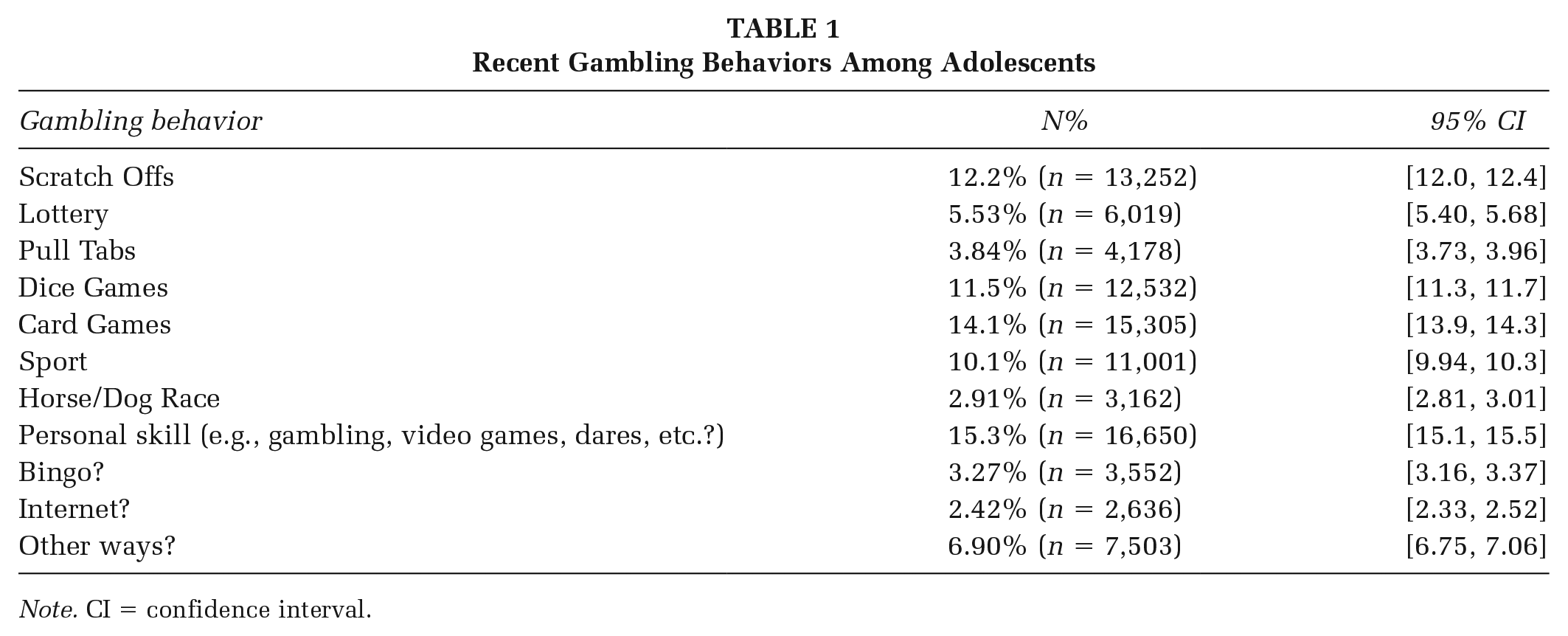
Note. CI = confidence interval.
Multivariate Logistic Regression Model
Compared with females, males had higher odds of gambling in the past 30 days (adjusted odds ratios [aOR]: 1.45, 95% confidence interval [CI]: [1.23, 1.78]; see Table 2). African American (aOR: 1.04, 95% CI: [1.01, 1.95]) and Hispanic participants (aOR: 2.34, 95% CI: [1.67, 2.56]) had higher odds of gambling than White adolescents. Adolescents in ninth/10th (aOR: 1.92, 95% CI: [1.80, 2.13]) and 11th/12th (aOR: 1.55, 95% CI: [1.24, 1.93]) gambled more in the past 30 days when compared with seventh-/eighth-grade adolescents. Use of alcohol (aOR: 4.95, 95% CI: [4.09, 6.67]), cigarettes (aOR: 2.65, 95% CI: [2.46, 3.06]), cannabis (aOR: 3.76, 95% CI: [2.53, 4.02]), prescription drugs (aOR: 1.34, 95% CI: [1.21, 2.14]), vapor products (aOR: 2.84, 95% CI: [2.44, 3.31]), and opioids (aOR: 3.00, 95% CI: [2.34, 3.27]) was significantly associated with gambling behaviors. Compared with those who did not participate in risky activities, adolescents who participated in gang activity (aOR: 6.59, 95% CI: [5.98, 7.12]) or have been in trouble with the police (aOR: 4.39, 95% CI: [3.10, 5.43]) had higher odds of participating in gambling activities. Adolescents who experienced stress more than once (aOR: 2.34, 95% CI: [1.39, 3.87]) were associated with a higher gambling participation rate than those who were not stressed.
Psychosocial Factors Associated With Recent Gambling Among Adolescents
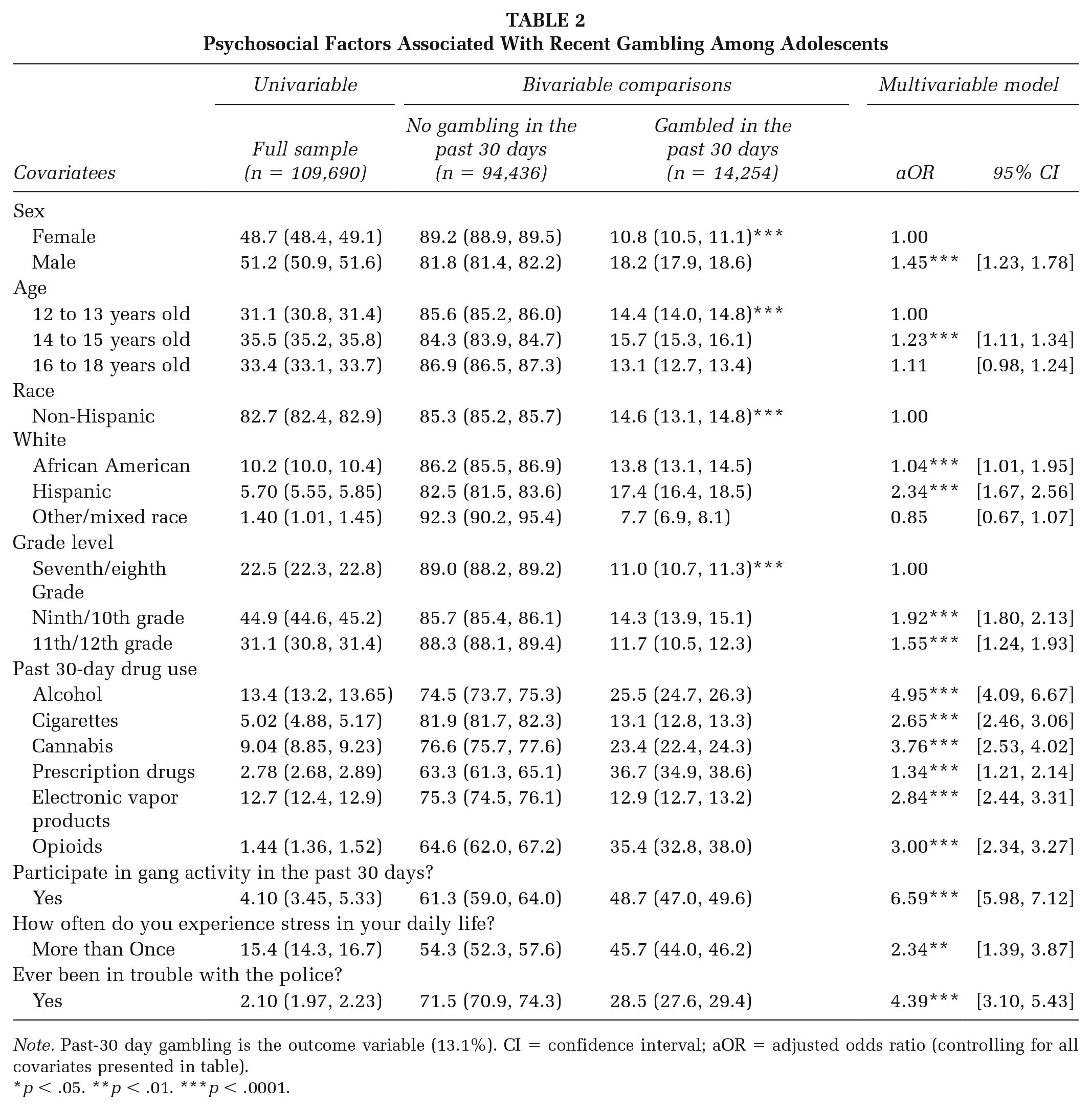
Note. Past-30 day gambling is the outcome variable (13.1%). CI = confidence interval; aOR = adjusted odds ratio (controlling for all covariates presented in table).
p < .05. **p < .01. ***p < .0001.
Discussion
Adolescent gambling is often ignored and tends to be unaddressed until later adulthood (Derevensky, 2012). The present study sought to inform behavioral efforts by analyzing a large sample of youth and identifying psychosocial factors associated with recent gambling behaviors. An estimated one in seven youth (13.1%) gambled in the past 30 days, higher than previous estimates (Calado et al., 2017). These results align with recent research suggesting a more permissive view on gambling among youth. In addition, the increased access in different forms (e.g., online, mobile) gambling may explain said behaviors (Webroot, 2021).
Results also showed that males were more likely to gamble than females, corroborating existing research (Chaumeton et al., 2011). Gambling is perceived by many to be a risky behavior. Males, in general, tend to be more likely than females to engage in risky behaviors, possibly partially due to a belief that participating in these behaviors makes them appear more “manly” (Martins et al., 2004). Males also tend to be more impulsive than females (Weafer & de Wit, 2014), which may heighten their reactions to gambling and thus increase their likelihood of gambling involvement. Specifically related to adolescents, previous research has similarly found male adolescents to be more likely to gamble than female adolescents (Barnes et al., 2009).
Compared with 12- to 13-year-olds, 14- to 15-year olds were at higher risk of recent gambling. Gambling behaviors tend to increase as one gets older (Derevensky, 2012) and as gambling opportunities start to increase. It has long been theorized that adolescence is a developmental period in one’s life accompanied by the stress of personal and life changes (Siddique & D’Arcy, 1984). Perhaps some adolescents may gamble to relieve stress encumbered in this period by “escaping” (Jacobs, 1989). Teaching adolescents the possible harms of gambling (e.g., loss of money, self-control) and showing them the negative aspects of gambling should be incorporated into problem gambling interventions and educational programs.
African American and Hispanic adolescents were more likely to report recent gambling than White adolescents. Caler and colleagues (2017) found that Hispanic individuals were more likely to be high-risk gamblers. One explanation could be that ethnic minorities may perceive gambling as an escape from poverty (Schissel, 2001). Compared with White populations, ethnic minorities report less annual income (Simms et al., 2009). Moreover, in some cultures, gambling is seen as an innocuous activity. Thus, engagement in these behaviors is culturally accepting (Raylu & Oei, 2004).
Concomitant drug use and gambling have been well established (Derevensky, 2012; Duenas et al., 2020; Winters & Anderson, 2000). Lifetime substance use rates among gamblers may be as high as 28% to 50% (Welte et al., 2001). One study of youth in New York found that 17% of youth reported gambling, and of that 17%, the same percentage reported binge drinking (Barnes et al., 2009). Results confirm these claims in showing a high rate of substance use (e.g., vaping products, opioid use) among current gamblers. In addition, I found that electronic vapor products were associated with an increased risk of gambling, which may corroborate other studies suggesting that vaping products are associated with impulsive behavior (Grant et al., 2019). These drugs may heighten the excitability of gambling, creating a more stimulating experience (Derevensky, 2012). Targeting harmful gambling behaviors early (e.g., drug education efforts) in adolescence may prove helpful in preventing addiction.
The present study found that participating in gang activities, experiencing stress for one or more days, and have ever been in trouble with the police were all associated with increased involvement in recent gambling. Previous research has found that these risk factors are significant predictors of future gambling initiation (Derevensky, 2012). Within gangs, certain mores, ideals, and behaviors may increase the risk for destructive addictive behaviors (e.g., gambling, substance use; Hennigan & Spanovic, 2012). Monitoring of adolescents by parents and teaching adolescents about positive peers may reduce the onset of gambling behaviors. Specifically, if parents met their child’s peers and approved of them, they may be more likely to engage in positive health promotion activities and connectedness. Given that one of the antecedents toward risk behaviors is an adolescent’s environment, the incorporation of positive peer networks may buffer against initiating with negative peers.
Limitations
Surveys responses were self-reported; therefore, under-/overreporting of answers may be present. In addition, survey data were only current in Cincinnati, so that location bias may be present. Thus, the generalizability of the study findings is limited. Future studies should assess gambling behaviors among a national sample.
Conclusion
The present study estimated the prevalence of adolescent gambling and associated risk factors among adolescents. Results indicated that those at highest risk of recent gambling were male, non-White, older, participated in gang activity, and reported past 30-day substance use. Further research is warranted to identify causal relationships associated with gambling to inform treatment and prevention programs more thoroughly. Nevertheless, these findings can bolster harm reduction efforts and clinical interventions.
Implications for Practice
The present study has several implications for research policy and prevention. First, greater than one in 10 adolescents reported past 30-day gambling. Given the addictive nature of gambling (Barnes et al., 2009), screening for potential symptoms of gambling behavior remains at the forefront of prevention efforts. Furthermore, the use and creation of additional gambling measures may indicate new and emerging behaviors necessary for harm reduction efforts (Blinn-Pike et al., 2010). Moreover, these screening measures may highlight several co-morbid behaviors (e.g., drug use) associated with increased gambling.
Since the data included 2020, the year of the COVID-19 pandemic, the worst pandemic since the early 20th century, researching the nature of gambling among adolescents during COVID and after COVID is essential to health practitioners. Furthermore, preliminary evidence suggests a high gambling prevalence during COVID (Brodeur et al., 2021). Therefore, understanding gambling and its co-morbid nature is essential for intervention programs and the implementation science aspects.
Moreover, educating adolescents about the harms of substance use (e.g., potential addiction, bodily injury) and the relationship between substance use and harmful gambling should be incorporated into harm reduction efforts. Providing adolescents with an open discourse to examine and discuss the pros and cons of gambling may be beneficial in reducing harmful gambling behaviors among youth. Educational programs focused on gambling among adolescents should be evaluated and delivered to students to increase their knowledge of gambling behaviors and consequences. Studies have been conducted to assess an array of gambling curricula among youth. They have found that teaching developing individuals the unprofitability aspect of gambling, the signs/symptoms of gambling, and skills such as problem-solving and decision-making may help prevent the initiation of gambling behaviors (Davis, 2004; Keen et al., 2017; Lupu & Lupu, 2013). Furthermore, regulation on the licensing, design, and placement of gambling products is needed to curtail current and future problem gambling initiation.
