







Abstract
American Samoa and the Federated States of Micronesia (FSM) are two small Pacific Island nations that have some of the highest noncommunicable disease (NCD) mortality rates in the world. Supported by church leaders to address obesity as an NCD risk factor, American Samoa, and Chuuk and Kosrae States of FSM selected the implementation of healthy beverages as a nutrition intervention through a water- and coconut water-only pledge in church events. The consumption of water and coconut water was tracked. Across 105 church events in the three jurisdictions, the count of water bottles before and after events decreased from 142.8 to 22.3, the number of coconuts before and after events decreased from 19.6 to 1.2, and cups of water before and after events decreased from 52.9 to 7.6. The promotion of healthy beverages in church settings holds promise in the Pacific as a feasible, accessible, and culturally responsive nutrition approach, given limited access to other nutritional alternatives, e.g., fresh fruits and vegetables. Supplemental health promotion messaging to maintain knowledge and attitudes about healthy is recommended for future scaling up.
Keywords
Background
American Samoa and the Federated States of Micronesia (FSM) are two small island nations that are part of the United States Affiliated Pacific Islands (USAPIs), Pacific jurisdictions with economic, historical, and political relations with the U.S. American Samoa is a middle-income U.S. territory in the South Pacific, and the FSM is a low-middle-income freely associated sovereign country in the Western Pacific (World Bank, 2022). The FSM comprises four states: Chuuk, Kosrae, Pohnpei, and Yap.
Challenging social determinants of health (SDOH), including poverty, lower educational attainment, economies dependent on higher-income countries, rapid Westernization after World War II, and limited human resources persist in these three jurisdictions (Central Intelligence Agency [CIA], 2022; Scanlan, 2018; Secretariat of the Pacific Regional Environmental Program [SPREP], 2010). These challenges contribute to noncommunicable diseases (NCDs)—cardiovascular, cancers, and diabetes—as the leading causes of death in these jurisdictions with high behavioral risk factors. In American Samoa, 93.5% of adults aged 25–64 reported being overweight or obese, with 33.4% of the population having diabetes compared with a U.S. prevalence of 10.5% (American Samoa Government, 2018; Centers for Disease Control and Prevention [CDC], 2020b). In Chuuk, FSM, the prevalence of Type 2 diabetes is 35.4%, three times higher than the U.S. prevalence, with diabetes as the leading cause of death. In Kosrae, FSM, the leading causes of death are metabolic syndromes, and the state’s diabetes prevalence (29.4%) is almost three times higher than in the U.S. (Ichiho et al., 2013; Kosrae State Government, 2019).
The Pacific region is undergoing nutrition transitions to high-energy-dense diets of prepared and processed food, away from traditional food, as a result of colonization, Westernization, and economic development (Yamanaka et al., 2022). Meals now consist of imported refined foods including, white rice, fatty meats, and other processed foods, while neglecting traditional foods (Englberger et al., 2011).
Strong cultural importance surrounding community celebration with food further compounds unhealthy food consumption. In the Pacific, an abundance of food is integral to community gatherings (I. Shomour, personal communication, September, 2015). In addition, foods high in calories or carbohydrates (e.g., fatty meats, pancakes, pastries, starchy foods) are served at community events including church gatherings (Figures 1 and 2). These considerations have resulted in recommendations for policies promoting access to healthy local food to address the obesity epidemic in the USAPI (Englberger et al., 2011; Yamanaka et al., 2022).
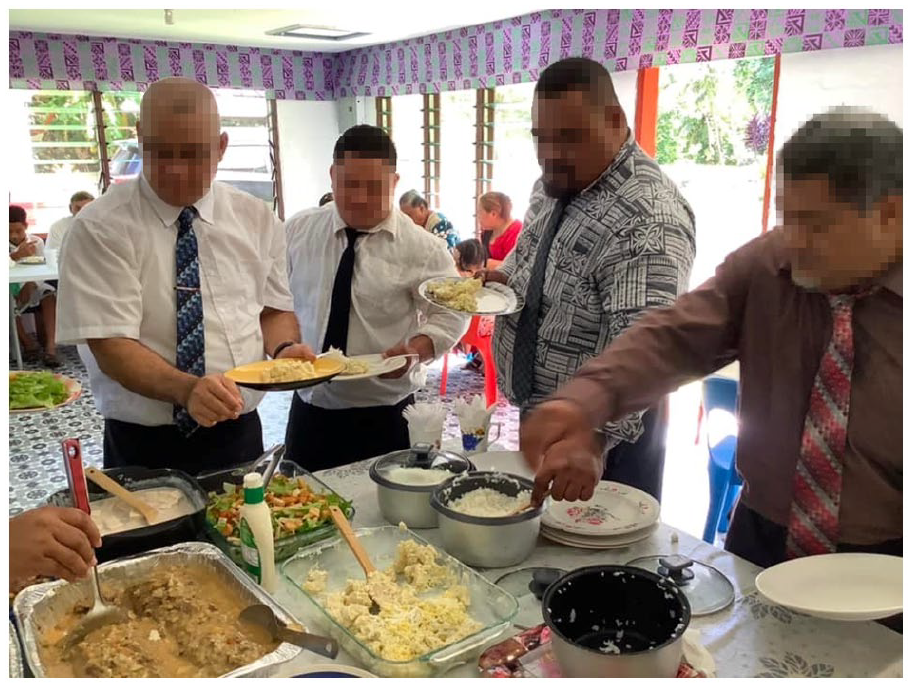
American Samoan church potluck
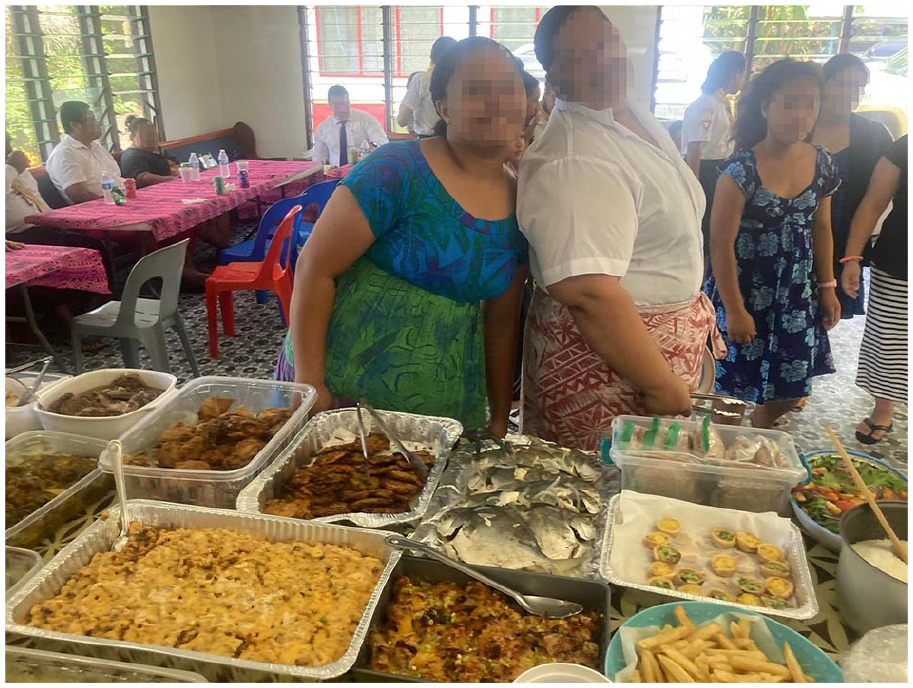
Unhealthy foods at church celebration
Proposed Practice Innovation
The University of Hawaii (UH), Department of Family Medicine and Community Health received a Centers for Disease Control and Prevention (CDC) Racial and Ethnic Approaches to Community Health (REACH) grant funding to collaborate with USAPI jurisdictions to implement healthy policy, systems, and environmental changes (CDC, 2020a; O’Toole et al., 2022). Details on the aims and scope of this grant funding are available in O’Toole et al. (2022). Discussions during the grant proposal development stage revealed that basing a nutrition intervention on healthy local foods in environments where availability of such food, along with reliance on imported food and traditionally generous servings at community gatherings, would be challenging. Thus, the intervention to promote water- and coconut water-only consumption was identified as culturally relevant and feasible to implement.
Decreasing sugar-sweetened beverage (SSB) consumption is a PSE strategy to prevent chronic disease (Korn et al., 2021). (Malik & Hu, 2022). Decreasing SSB consumption may target poor nutrition in the Pacific as SSBs are linked to obesity, Type 2 diabetes mellitus, cardiovascular diseases, and some cancers. Community-level approaches to increase water intake among children in the Pacific have been implemented with promising resutls in addressing childhood obesity (Malik & Hu, 2022).
The Pacific sites chose churches as the settings to promote healthy beverage consumption. Churches reach a large majority of the Pacific populations as most in these communities attend church, including for community social gatherings (Creevey, 2022; U. S. Department of State, 2019). This healthy nutrition intervention builds on limited interventions to decrease SSBs in the Pacific and responds to recommendations to limit SSBs availability in public spaces, such as not making SSBs the default beverage choice (Korn et al., 2021).
Coconuts are abundant across the Pacific. Increasing both water and coconut water consumption in churches could be cost-effective, reach large segments of the population, and facilitate change without disrupting cultural tradition. Across all three jurisdictions, water costs less (U.S.$0.50) if not the same as soda (U.S.$0.50–U.S.$0.75), and less than other types of SSBs like iced tea/coffee or sports drinks (up to U.S.$2.00 in Kosrae). While fresh coconut cost U.S.$0.50 in the two FSM states, it costs an average of U.S.$2.00 in American Samoa.
Aims
This article will describe a pilot healthy nutrition PSE change implemented in three Pacific Islands, its formative evaluation, and proof of concept results. Specifically, we aim to present the formative feasibility and accessibility of an innovative, community created water-, and coconut water-only beverage policy in churches in American Samoa, Kosrae, and Chuuk. Such approaches have not been implemented in these locations. This intervention innovatively balanced the scientific evidence to potentially reach the majority of the population, while being culturally and socioeconomically compatible with communities.
Description of Intervention
In all three jurisdictions, church leaders are well-respected and hold influence over their congregation. A majority of the Pacific population attend church, which serves as a setting for community gatherings beyond worship, for example, bingo nights, social events (World Culture Encyclopedia, n.d.). The REACH Local Project Assistant (LPA) built partnerships with church leadership, who were critical to the implementation of the healthy beverage interventions because they provided awareness and education regarding healthy beverages as a feasible nutrition intervention. For example, meetings with church leaders and other champions were critical in gathering support and writing the healthy beverage policies. REACH LPAs also collaborated with community organizations to help implement the healthy beverage intervention. Local community organizations obtained pledges from church leaders to serve only water and coconut water at all church events. In total, 87 churches in American Samoa, 4 churches in Kosrae, and 19 churches in Chuuk agreed to implement the healthy beverage intervention.
Water was served in individual bottles or in coolers. Coconut water was served naturally, consumed through a straw.
Evaluation Approach and Intended Outcomes
We evaluated the change in healthy beverage consumption by measuring the volume of water served at church events that decreased. Tracking the volume of water and coconut water consumed entailed counting the number of water bottles and coconuts initially available at an event and then again after the event. Tracking water that was provided in water coolers entailed identifying the number of cups of water initially served before and the number of cups left after a church event. The volume of healthy beverage consumed was measured (numbers of water bottles and coconuts and number of cups of water) and were aggregated each of the three years the data were recorded. We conducted bivariate analysis between years to examine statistically significant changes in the numbers of healthy beverages consumed over the years.
Community members and leaders selected an evaluation approach that was the most feasible and relevant for tracking health beverage consumption. Prior to piloting the PSE change, attendees were consuming SSBs in addition to large portions of high fat, processed, and refined foods (Figures 1 and 2) at church events; measuring consumption of healthy beverages provided the pilot and proof of concept results that the intervention was feasible and met community needs. Indeed, stakeholders considered this evaluation approach sufficiently valid, especially because evidence that church attendees were even consuming healthier beverages represented progress as a new health promotion strategy.
Across the three jurisdictions, LPAs tracked healthy beverage consumption at a total of 105 church events, with an average of 105 parishioners attending an event. Water and coconut water at churches in all jurisdictions showed significant decreases in volume before and after an event according to actual use measures (p = .000). On average across the jurisdictions before and after a church event, the number of water bottles, number of coconuts, and cups of water decreased from 142.8 to 22.3, 9.6 to 1.2, and 52.9 to 7.6 respectively. Through the pilot PSE intervention, parishioners at participating churches consumed approximately 19,340 healthy beverages as opposed to the sugar-sweetened beverages being consumed previously.
Implications for Practice
Churches serve as an integral change agent in health promotion and may serve as critical settings for PSE programs. In the Pacific churches served SSBs, for example, because it was economical. The LPAs worked within cultural and traditional norms to propose a feasible healthy beverages PSE change intervention so that church leadership would support changes in church settings. In American Samoa, the REACH LPA and UH REACH team met regularly with the different church leaders from the multiple religious denominations. As a result, all leaders actively supported the project, were outspoken that the healthy beverage pledge needed to be enforced at all religious gatherings, and provided regular guidance to the REACH LPAs on how to implement and monitor the healthy beverage policy they signed for their church constituents. We were able to substitute healthy options—water and coconut water—that had similar price points and to demonstrate initial successful uptake holding promise for future healthy nutrition PSE changes in the Pacific.
Next Steps
We will report on results on community knowledge and attitudes about healthy beverages and policies from communications campaigns implemented in the three locations in future papers and evaluation. Scaling up of healthy beverage policies widely across organizations in the USAPI combined with planned media campaigns using communication channels that have a wide reach in communities should be further explored with rigorous evaluations, especially tracking dose measures (Korn et al., 2021). Future interventions should use multi-level implementation research study designs (e.g., experimental, quasi-experimental, mixed methods) (Hwang et al., 2020) to rigorously evaluate the efficacy of healthy beverage interventions (Korn et al., 2021). Systematic and rigorous efforts to evaluate healthy beverage consumption and PSE interventions would strengthen future health promotion research, policy, and practice.
Lessons Learned
This healthy beverage intervention, implemented in different church settings in three Pacific locations, provides lessons learned for future practice, research, and policy. Initial pilot outcomes suggest that parishioners will consume healthy beverages at church events in the Pacific with a PSE change to replace SSBs. Focusing on the affordability of healthy and culturally relevant beverage options also helped earn buy-in for church leaders.
To our knowledge, this is the first article describing a healthy beverage intervention for adults in USAPI jurisdictions. This proof of concept demonstrates the feasibility of the Pacific REACH projects to implement strategies to increase the consumption of healthy beverages at church settings. Keeping feasibility in mind and giving faith leaders and community members the authority to choose a tracking and evaluation method created buy-in and ownership to complete proof of concept implementation. While perhaps more informative, a more robust evaluation design may not have encouraged the same degree of buy-in from the community and faith leaders.
This PSE change intervention holds promise for more widespread implementation in healthy beverage consumption. Scaling up of healthy beverages policies within organizations in the USAPI, along with planned media campaigns using communication channels that have a wide reach in communities, and systematic rigorous evaluation designs are recommended to further sustain PSE changes.
