







Abstract
Since the start of the COVID-19 pandemic, wastewater surveillance hasemerged as a critical tool for tracking the spread of the severe acute respiratory syndrome coronavirus 2 (SARS-CoV-2) virus and other pathogens in communities throughout the United States. In 2020, the Centers for Disease Control and Prevention (CDC) launched the National Wastewater Surveillance System (NWSS), which partners with state, local, tribal, and territorial health departments to develop and implement wastewater collection and analysis systems and to share data. In 2022, the CDC established the first two NWSS Centers of Excellence to lead its implementation and coordination efforts—one in Colorado (Colorado CoE) and one in Houston (Houston CoE). As the NWSS expands, it is becoming more important to support the training needs of jurisdictions at different stages of developing their wastewater surveillance infrastructure. To evaluate these needs, the Colorado CoE and Houston CoE conducted a needs assessment study of NWSS-funded public health agencies and public utilities departments located in the United States using surveys developed by the Colorado CoE. The results of the surveys showed that although some training needs were universal, it will be most beneficial to develop training modules tailored to the needs of entities that operate wastewater surveillance programs of various sizes, workforce experience levels, and at different stages in the infrastructure development process.
Keywords
Background
During the COVID-19 pandemic, wastewater surveillance emerged as a critical tool for monitoring the spread of the SARS-CoV-2 virus in communities throughout the United States and informing subsequent public health interventions (Gagliano et al., 2023; National Academies of Sciences, Engineering, and Medicine, 2023). Recognizing the need for a national infrastructure to capitalize on the benefits of wastewater surveillance, the Centers for Disease Control and Prevention (CDC) launched the National Wastewater Surveillance System (NWSS) in September 2020. The NWSS partners with state, local, tribal, and territorial health departments to develop and implement wastewater collection and analysis systems and to share data (Hoar et al., 2022; Kirby et al., 2021; National Academies of Sciences, Engineering, and Medicine, 2023). In August 2022, the CDC established the first NWSS Centers of Excellence (CoEs) to serve as leaders in the implementation and coordination of its wastewater surveillance efforts. As of July 2023, the NWSS supports wastewater surveillance programs in 53 jurisdictions (46 states, 5 cities/counties, and 2 territories). As the network expands, the NWSS is using wastewater surveillance to monitor other pathogens of public health importance such as influenza A, respiratory syncytial virus, and others (Hoar et al., 2022; Mercier et al., 2022; National Academies of Sciences, Engineering, and Medicine, 2023).
Purpose
Wastewater monitoring is a relatively novel approach to disease surveillance; therefore, many jurisdictions are still in the early phases of designing and implementing their programs (Aparna et al., 2023; National Academies of Sciences, Engineering, and Medicine, 2023). Jurisdictions at different stages of this process may have different needs that can be addressed through targeted workforce education efforts. To ascertain the training needs of various NWSS jurisdictions, the Colorado CoE (a partnership between the Colorado Department of Public Health and Environment and the University of Denver) and Houston CoE (a partnership between the Houston Health Department, Houston Public Works, and Rice University) conducted a needs assessment study of NWSS-funded public health agencies (PHAs) and associated public utilities departments in their respective CoE regions, as conceptualized by, and using surveys developed by, the Colorado CoE.
Methods
Survey Instruments
The Colorado CoE conceptualized the project and developed two needs assessment survey instruments—one for Public Health Agencies (PHAs) and one for public utilities departments. The PHA survey contained 25 questions, and the utilities survey contained 24 questions.
The PHA survey included questions about the respondent’s length of experience working in wastewater surveillance, the structure of the PHA’s wastewater surveillance program, how the PHA analyzes and shares its wastewater data, and training needs and preferences.
The utilities survey followed the same format as the PHA survey and included questions about respondent’s length of experience working in wastewater treatment, the wastewater sampling procedures, how the utility shares wastewater data with an affiliated PHA, challenges faced by the utility, and training needs.
Survey Dissemination
The Colorado CoE and Houston CoE deployed the surveys using Qualtrics, an online survey tool. Email invitations were sent to points-of-contact identified by a project manager at the NWSS for PHAs and by a program director at the Water Environment Federation (WEF) for public utilities departments.
The invitation emails explained the purpose of the needs assessment, the intended use of survey results, and a request that only one representative from each PHA and/or public utilities department was needed to respond on behalf of their respective agency. The response period for the PHA survey was from December 2022 through January 2023 for the Colorado CoE and February 2023 for the Houston CoE. The response period for the utilities survey was from December 2022 through January 2023 for the Colorado CoE and the month of April 2023 for the Houston CoE.
All procedures associated with both needs assessment surveys were reviewed and approved by Rice University’s Institutional Review Board for the Houston CoE’s survey. The Colorado CoE’s Institutional Review Boards declared the needs assessment was exempt from review because the needs assessment was considered public health surveillance with no protected health information, as it was a training needs assessment for organizations and not individuals.
Survey Data Analysis
Responses were cleaned using the following exclusion criteria: incomplete responses, responses that declined the consent to participate, and responses from the same entity. If multiple responses were received from the same entity, the responses from only one survey were included.
Descriptive statistics were performed in aggregate and stratified based on the number of sampling sites and/or the respondent’s level of experience working in wastewater surveillance (PHA surveys) or wastewater treatment (utility surveys). PHAs were categorized based on size (small PHA: PHAs with <5 and 5–24 sampling sites; large PHA: PHAs with 25–49 and 50+ sampling sites) and respondent’s level of experience (less experience: PHA respondent with <5 and 5–24 months of experience; more experience: PHA respondent with 25–35 and 36+ months of experience). Utilities were categorized based on respondent’s level of experience (less experience: utility respondents with 0–3 and 3–6 years of experience; more experience: utility respondents with 6–9 and 10+ years of experience).
Data were graphically assessed using R software (version 4.1.3) to determine if experience level or agency size was associated with different training needs.
Results
PHA Surveys
The PHA survey was disseminated to 54 NWSS-funded PHAs in the United States. Six PHAs declined the consent to participate, and three provided incomplete responses, yielding a combined response rate of 83.3%—a strong result compared to the average survey response rate of less than 50% (Story & Tait, 2019). The majority of included responses were from state-level health departments (93.3%); the remainder were local-level (e.g., city and county) health departments. PHA survey respondents represented jurisdictions that serve small populations of less than one million (n = 5), medium populations of one to five million (n = 19), and large populations of greater than five million (n = 21) (United States Census Bureau, 2020). The majority of respondents (84.4%) had a wastewater surveillance system in place at their PHA.
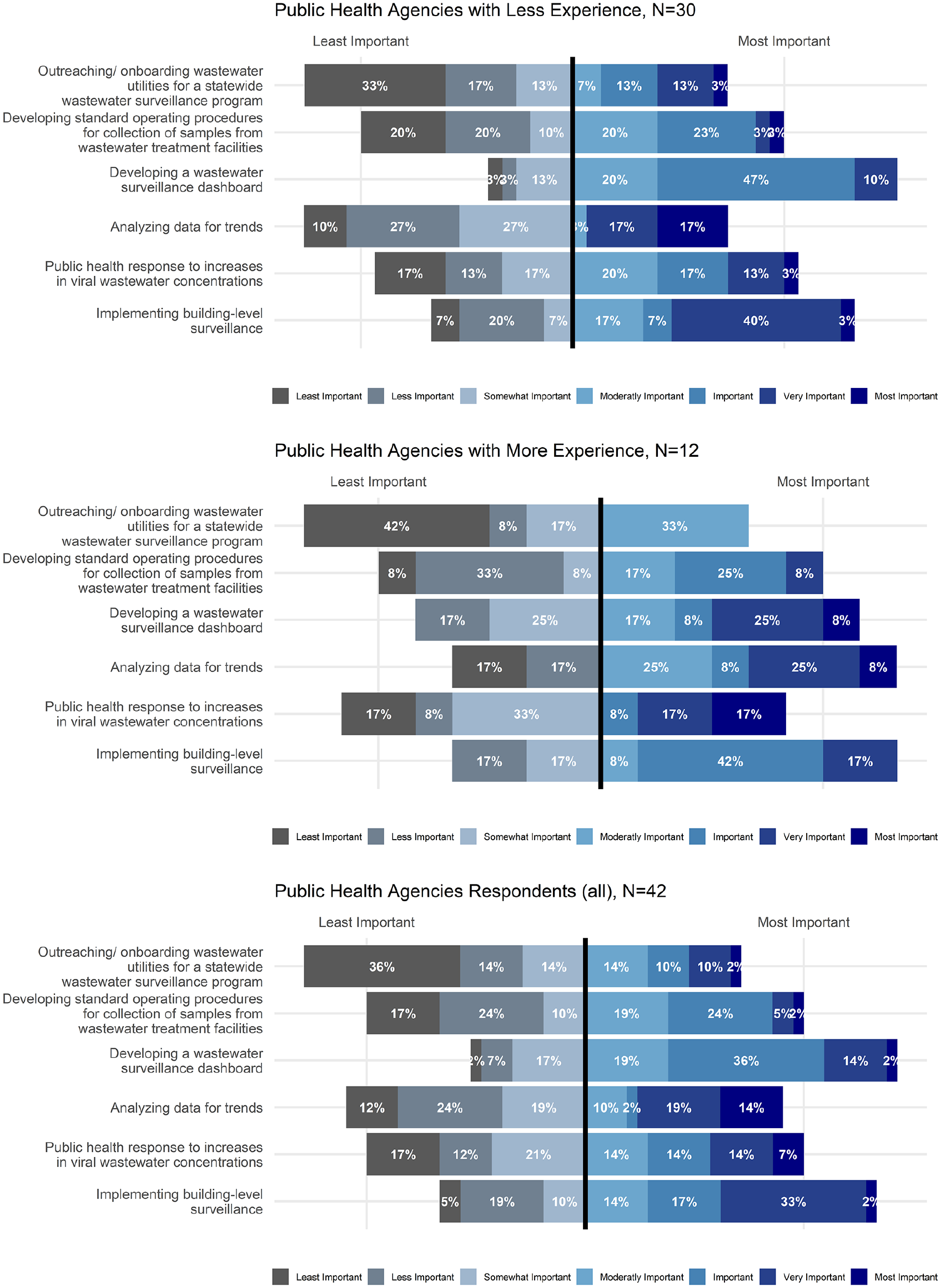
Responses were stratified based on the number of sampling sites monitored and stratified based on the respondent’s level of experience (Figure 1).
Public Health Agency Respondents’ Ranking of Training Needs
Utilities Surveys
The utilities survey was disseminated to 164 potential respondents representing 51 unique states and territories. A total of 51 responses were returned, yielding a 31.1% response rate. All respondents accepted the consent to participate, and all worked for local-level (e.g., city and county) utilities departments.
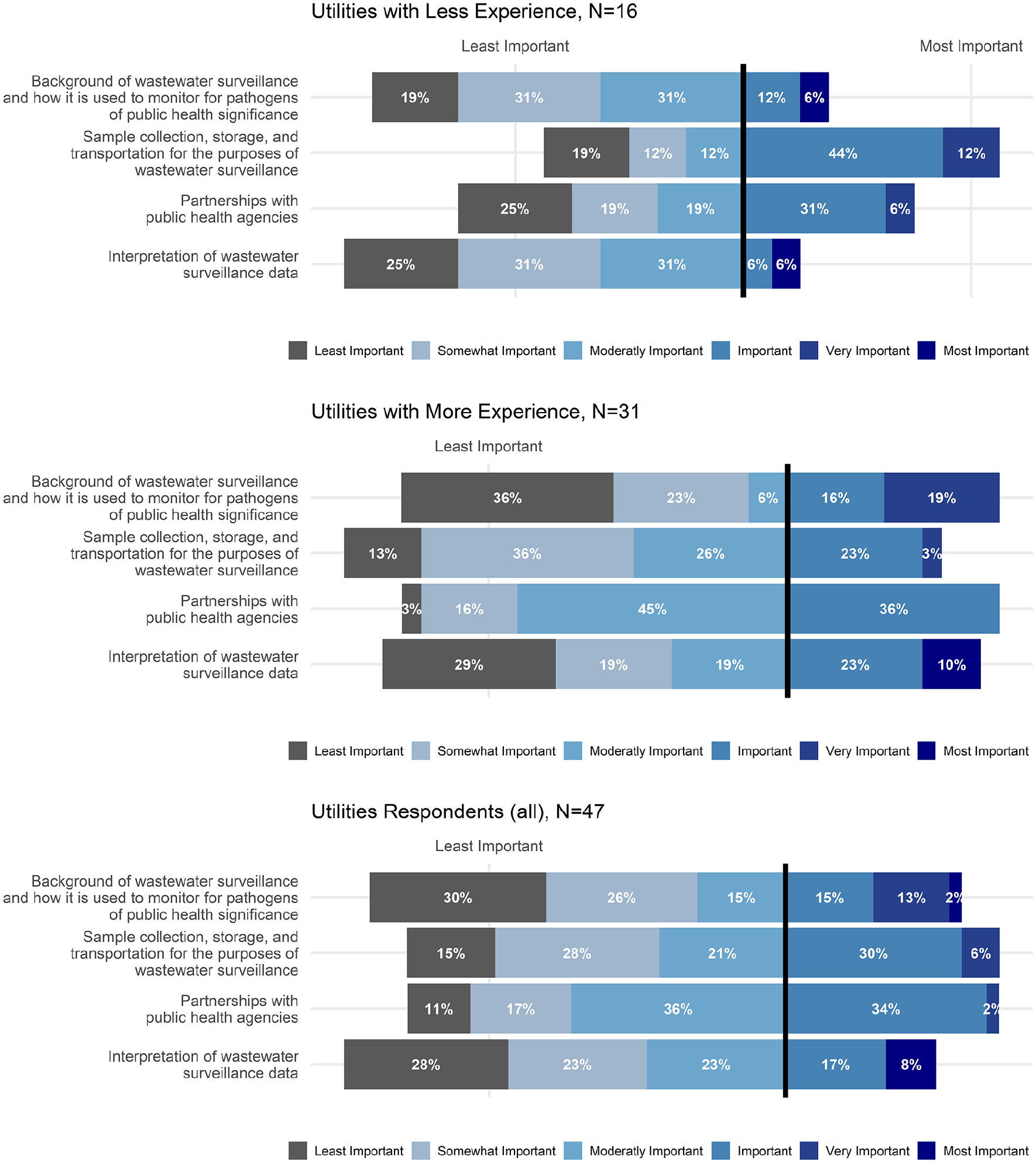
Survey responses were stratified by the respondent’s level of experience to determine whether the length of time a person worked in wastewater treatment played a role in their perception of the utility’s training needs (Figure 2).
Utility Respondents’ Ranking of Training Needs
Discussion
The findings from these needs assessment surveys provide a detailed understanding of the training needs of jurisdictions that conduct wastewater surveillance, from both a public health and a utilities perspective.
PHA Surveys
Responses to the PHA surveys showed clear patterns when stratified by the number of sampling sites and respondents’ level of experience. Large PHAs were more likely to conduct trend analyses and use wastewater results to inform public health interventions. Similarly, a larger proportion of PHA survey respondents with more experience in wastewater surveillance reported that they were “comfortable” or “very comfortable” interpreting wastewater surveillance trends, as opposed to respondents with less experience. These results indicate that larger PHAs and those with a more experienced workforce operate wastewater surveillance programs that are likely to be further along in the development process than those operated by smaller PHAs or those with a less experienced workforce.
In terms of training needs, different patterns emerged between small and large PHAs. Small PHAs prioritized training centered around developing wastewater surveillance dashboards and implementing building-level surveillance, indicating that these jurisdictions are likely in the earlier stages of developing their wastewater surveillance programs. In contrast, large PHAs identified analyzing wastewater data for trends and formulating public health responses as high-priority training needs. Differences in training needs also emerged when PHA respondents were stratified by experience level. PHA respondents with less experience ranked developing a wastewater surveillance dashboard as their highest priority training needs. In contrast, PHA respondents with more experience identified analyzing data for trends as the most important training needs. Formulating public health responses based on wastewater data is an activity more likely to be pursued by more established wastewater surveillance programs due to the challenges posed by the novelty of wastewater surveillance and subsequent non-standardization of practices, lack of training, equipment, and funds, and infrastructure differences unique to individual communities (McClary-Gutierrez et al., 2021; Xiao et al., 2022).
Utilities Surveys
Certain notable trends emerged from the utilities survey responses when they were stratified by the respondent’s level of experience. Regardless of experience level, the majority of utilities survey respondents reported feeling “comfortable” or “very comfortable” interpreting wastewater surveillance trends. Interestingly, though, the largest proportion of respondents stating that they were only “moderately comfortable” or “could use some help” interpreting wastewater surveillance trends had the highest experience levels. A possible explanation for this result is that respondents with more experience have a greater awareness of existing gaps in their wastewater surveillance knowledge. Not surprisingly, respondents with more experience placed greater emphasis on training focused on interpreting wastewater surveillance data than respondents with less experience. Those with less experience designated sample collection, storage, and transportation as a more important training need than respondents with more experience. Both groups of respondents ranked partnerships with PHAs as the second most important listed training need. As with the PHA survey, these differences likely reflect varying stages of wastewater surveillance system development.
Implications for Practice
The results from this need assessment study can be used to guide the development of training modules tailored to the needs of PHAs and utilities that operate wastewater surveillance programs of various sizes, workforce experience levels, and at different stages of the development process. Training is particularly important for public health professionals at PHAs, where experience in wastewater surveillance was measured in months (0–36+ months), not years, indicating that even the most experienced PHAs are relatively new to the field. However, our results also indicate that certain training needs cut across these categories (Table 1). For example, PHAs of all sizes indicated a desire for education about developing public health interventions in response to increases in pathogen concentrations and developing a wastewater surveillance dashboard. Similarly, regardless of their level of experience, utilities survey respondents identified developing partnerships with their local PHAs as an important training need. These results suggest that developing a modular curriculum with subject matter organized by size or experience level that can be accessed by entities at any stage of development may be the most effective way to address the unique training needs of the country’s growing network of wastewater surveillance programs.
Top Training Needs of Respondents (Excluding “Other”), Stratified by Size (PHAs), and Respondents’ Level of Experience (PHAs and Utilities)

Wastewater surveillance is a technology that is still in its infancy, with innovations being made on a regular basis. Testing is expanding to target an ever-growing list of infectious diseases. New technologies like digital polymerase chain reaction (PCR) are becoming more common and address problems with traditional PCR due to interference caused by environmental waste in water supplies (Polo et al., 2020). The COVID-19 pandemic highlighted the importance of understanding and addressing the diverse backgrounds and training needs required of the PHA workforce to successfully address current and emergent public health needs (Balio et al., 2023). Providing the requisite training support to PHA and utility workers at new and existing wastewater surveillance programs, whether someone is an epidemiologist, health education specialist, or director of wastewater operations, can capitalize on these exciting developments and ensure a permanent place for wastewater surveillance in the public health toolkit. More importantly, a robust national wastewater surveillance system will result in earlier assessments of emerging threats, more targeted public health interventions, and better overall preparedness for future public health emergencies.
Footnotes
Authors’ Note:
CDC NWSS Team, Water Environment Federation—Wastewater Surveillance Program, Public health agency respondents, Wastewater utility respondents, This article was funded in part by the Colorado National Wastewater Surveillance System Centers of Excellence, which is supported by the Epidemiology and Laboratory Capacity for Infectious Disease Cooperative Agreement through the Centers for Disease Control and Prevention (Grant No. NU50CK000552), and the Houston National Wastewater Surveillance System Centers of Excellence, which is supported by the Epidemiology and Laboratory Capacity for Infectious Disease Cooperative Agreement through the Centers for Disease Control and Prevention (Grant No. NU50CK000557)
