







Abstract
Engaging adolescents and young adults in food justice initiatives is a powerful tool to address the complex landscape of food-related inequities. Youth Market is a paid 8-week summer internship in Northern Manhattan that engages 16- to 22-year olds in managing a farm stand, leading nutrition workshops, and distributing food to families experiencing food insecurity. Through a positive youth development lens, the program aims to empower interns to become ambassadors of healthy food access in their community, while supporting their personal health and career goals. Matched, de-identified, pre–post online surveys of Summer 2021 and 2022 interns and a 1-year follow-up survey of Summer 2021 interns used Likert-type scale and open-ended questions to assess program satisfaction and perceived knowledge, attitudes, and self-efficacy regarding nutrition behaviors, food insecurity resources, and community connectedness. Pre–post results (n = 35) demonstrated high program satisfaction and statistically significant increases in interns’ self-reported fruit and vegetable consumption, confidence in ability to share information about healthy eating and food insecurity resources, and sense of community connectedness. Longitudinal results (n = 13) showed some significant improvements from baseline. Youth Market demonstrates a valuable model for youth engagement in paid work to promote community access to healthy food, improve knowledge and resource-sharing related to nutrition and food insecurity, and support youth career development.
Keywords
The food justice movement aims to address the ways in which both the industrial food complex and alternative food movements perpetuate inequities rooted in structural racism, limiting access to nutritious, culturally relevant, and affordable foods (Alkon & Norgaard, 2009; Horst et al., 2017). Across the United States, this includes many interconnected food system issues that predominantly impact communities of color, particularly the copious availability of less-nutritious foods linked to a higher prevalence of chronic conditions (e.g., diabetes, obesity, cardiovascular disease; Alkon & Norgaard, 2009; Horst et al., 2017).
Issues related to food justice and nutrition-related morbidity are prevalent in Washington Heights and Inwood (Manhattan Community District 12), adjacent neighborhoods in New York City’s (NYC) Northern Manhattan. In this culturally and socioeconomically diverse community, 68.5% of residents identify as Hispanic/Latino (compared to 29.2% of all NYC residents) and 32.3% of households receive Supplemental Nutrition Assistance Program (SNAP) benefits (versus 22.4% of all NYC households) (Hunter College New York City Food Policy Center, 2022). In addition, this community was significantly impacted by both the direct health sequelae of the COVID-19 pandemic and the economic aftermath of lost wages, food supply disruptions, and increased food insecurity (Hollis-Hansen et al., 2022). One survey of NYC households (with oversampling of low-income, Black and Hispanic households) reported increases in food insecurity prevalence from 57.8% pre-pandemic to 66.8%, with higher odds among respondents with children and those with chronic health conditions (Mazzeo et al., 2023).
Leveraging community assets to address the complex landscape of food-related inequities is key, which includes engaging adolescents and young adults (AYAs) in food justice initiatives through a positive youth development approach (Hinkle et al., 2018). This approach fosters adolescents’ ability to reach their full potential to thrive and contribute to society, rather than a deficit-focused emphasis on defraying negative risks (Damon, 2004). Youth engagement in food justice is a powerful tool to empower AYAs to channel their creativity and problem-solving skills into achieving sustainable impacts for their communities and their own well-being (Freedman et al., 2011; Hinkle et al., 2018; Leung et al., 2017). Often, community engagement opportunities are unpaid, limiting participation for many AYAs (Grant-Smith & McDonald, 2018). Furthermore, developing a health care workforce reflective of the racial, cultural, and socioeconomic diversity of the community it serves is an important aspect of multilevel approaches to combatting health disparities (Duffus et al., 2014).
Youth Market is a paid 8-week summer internship that engages 16- to 22-year-olds in food justice work in Northern Manhattan. Through a positive youth development lens, our mission is to empower interns to become ambassadors of community healthy food access, while supporting their personal health and career goals. The program aims to (a) improve interns’ nutrition knowledge and behaviors, (b) increase interns’ knowledge about neighborhood food disparities and food insecurity resources, and (c) enhance interns’ sense of community connectedness.
While there are some examples of paid youth internships in the food justice sphere, most of these small programs were not evaluated using formal statistical analysis (Charbonneau et al., 2014; Rogers et al., 2020), and few surveyed participants longitudinally (Sonti et al., 2016). More information is needed to understand the specific areas in which these programs achieve change, and whether their impact is sustained. Thus, we aimed to build upon the existing literature by utilizing pre–post surveys and a 1-year follow-up survey to evaluate the impact of Youth Market on interns’ perceived knowledge, attitudes, and self-efficacy regarding nutrition, food insecurity resources, and community connectedness.
Methods
Program Structure
Information inviting AYAs ages 16 to 22 to apply for the 8-week internship (July–August 2021 and 2022) was distributed to schools and community programs that partner with NewYork-Presbyterian (NYP), a large academic medical center. The program is funded through a community partnership arm of the medical center and additional grants. Applicants underwent phone interviews; those who met age eligibility and demonstrated strong commitment were accepted. Interns attended a 6-hour orientation, and under the supervision of two dietitians, they managed two farmstands adjacent to two primary care clinics. Interns sold affordable seasonal produce sourced from nearby upstate NY farms and were responsible for market set-up and breakdown, pricing, and customer engagement. Proceeds were donated to a local food pantry. Other activities included conducting bilingual (English/Spanish) nutrition workshops and cooking demonstrations at GrowNYC Greenmarkets (2023) based on the “Just Say Yes! To Fruits and Veggies” curriculum (New York City Department of Health and Mental Hygiene, 2019), and packaging emergency food for local families experiencing food insecurity (Figure 1). Interns earned a $2400 stipend, and each week were required to work shifts at one of the Youth Market farmstands, attend 2-hour didactics (led by dietitians), and attend at least one other activity (15-hours total weekly).
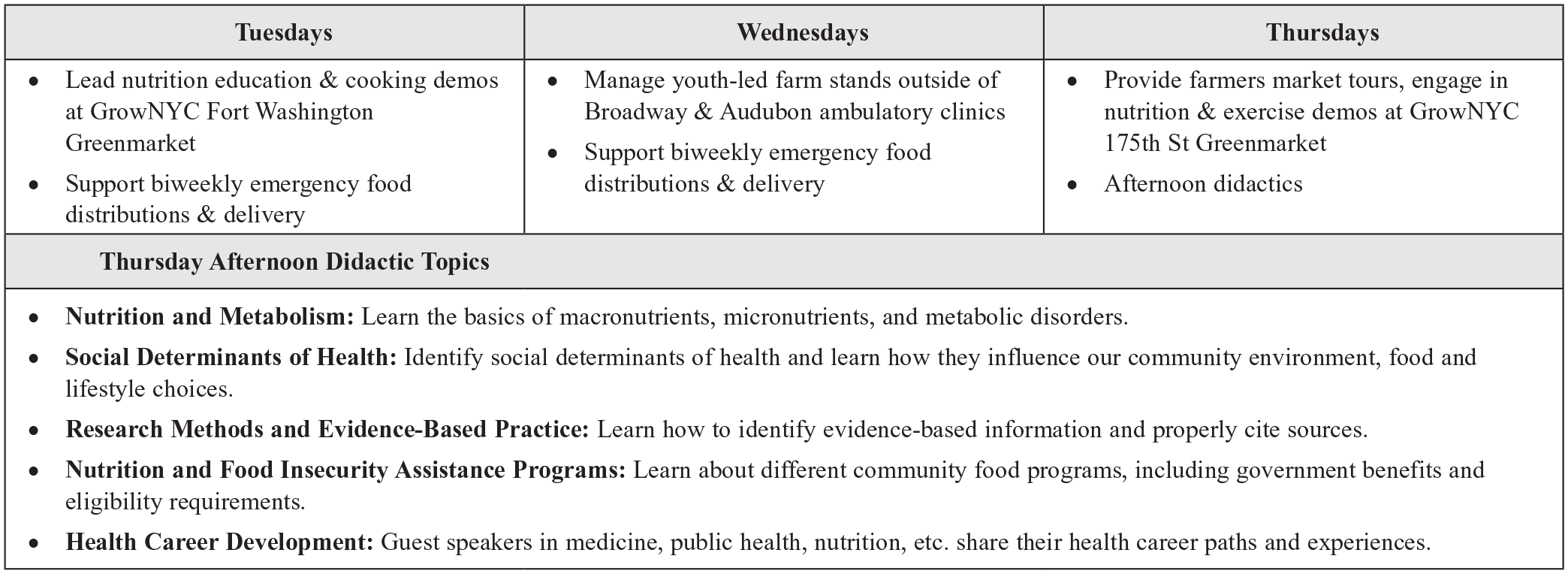
Youth Market Intern Weekly Activities and Didactics, Summers 2021–2022
Program Surveys
Interns were emailed links to anonymously complete the pre-survey on orientation day and the post-survey within 2-weeks of program conclusion. Summer 2021 interns received a link to anonymously complete the longitudinal survey during a 3-week period in August 2022 (1-year later). Surveys were purpose-built for evaluating Youth Market based on program aims, evaluations of similar programs (Charbonneau et al., 2014; Hung, 2004; Sonti et al., 2016), and a brief review of dietary assessments (National Cancer Institute, 2021). Pre, post, and longitudinal questions were equivalent to allow for comparison of quantitative data using 5-point Likert-type scales. Open-ended questions assessed perceptions and experiences at each timepoint. Survey completion was voluntary and not required for program participation or stipend payment. Interns under 18-years-old assented to participation and a parent/guardian provided informed consent. Participants aged 18 and older provided informed consent. Approval was obtained from the Institutional Review Board of Columbia University Irving Medical Center under expedited review (IRB-AAAS0839).
Sociodemographics
Participants self-reported age, education, race, ethnicity, and gender. They indicated career interests from a list of 10 fields (e.g., nutrition/dietitian, health care/medicine, education, sciences/engineering, social work, etc.).
Nutrition and Food Insecurity–Related Knowledge and Self-Efficacy
Participants self-rated their level of knowledge about “health consequences of obesity” and confidence regarding ability to “cook vegetables” and “share information about healthy eating with friends/family” on a 5-point scale. Higher scores indicated a greater degree of self-rated knowledge and confidence. Similarly, interns self-rated their knowledge about “disparities in food quality between neighborhoods” and “community resources available to people experiencing food insecurity,” and confidence regarding “ability to give advice on resources to someone experiencing food insecurity.”
Self-Reported Fruit, Vegetable, and Sugar-Sweetened Beverage (SSB) Consumption
Participants reported average number each of fruit and vegetable servings eaten per day on a 5-point scale from zero (1) to 4+ per day (5); higher scores indicated greater consumption. They also reported how often they drink juice, soda, or other SSBs on a 5-point scale from several times per day (1) to rarely (5); this item was reverse-scored, with higher scores indicating lower consumption.
Community Connectedness Attitudes
Participants indicated on a 5-point scale their agreement with three statements regarding connection to their community (e.g., “I feel connected to my community”); higher scores indicated more positive attitudes.
Program Satisfaction
On the post-survey, participants rated their overall level of program satisfaction on a 5-point scale from not at all satisfied (1) to extremely satisfied (5) and were asked if they would recommend the internship to a friend (yes/no).
Open-Ended Questions
On the pre-survey, participants answered the open-ended question: “What attracted you to apply for the Youth Market internship? What are you most looking forward to about working with the program this summer?.” On the post-survey, they were asked: “What was the most important skill you developed while participating in this program?”; “What was your favorite/least favorite part of participating in this program and why?”; “What changes would you suggest to improve the internship experience?”; and “Is there anything else you would like to share with us about your experience with the program this summer?.” Finally, the longitudinal survey asked: “Looking back on your experience, what was the most important skill or knowledge you developed from your participation in this program?” and “Can you give an example of how this program or program staff have impacted your personal or career development?.”
Data Analysis
Matched, de-identified surveys were administered in English using Qualtrics© 2020 (Qualtrics, Provo, UT). Summer 2021 and 2022 results were pooled. Wilcoxon signed-rank test was used to analyze differences between pre–post survey item scores using SAS® Software v 9.4 (SAS Institute Inc., Cary, NC). We used a nonparametric test because the data are not normally distributed in this small sample. Longitudinal surveys were matched to pre-surveys for comparative analysis also using Wilcoxon signed-rank test. Open-ended responses were reviewed and classified into common themes using thematic analysis by two authors.
Results
Participants
Thirty-nine total interns participated in Summers 2021 and 2022 (63 initially applied), with a 100% program completion rate. All responded to the pre-survey, and 35 (90%) responded to the post-survey (the four who did not respond to the post-survey were dropped from analysis). The majority of interns were 16 to 18 years old (65.7%), and self-identified as cis-gender female (80%) and as having Hispanic ethnicity (91%; Table 1). Most participants indicated interest in pursuing careers in healthcare, public health, or nutrition (66%).
Intern Sociodemographic Data for Summers 2021 & 2022 Combined (n = 35)

Pre–Post Surveys
Interns demonstrated a significant increase in self-rated knowledge about health consequences of obesity (p < .001) and confidence in ability to cook vegetables (p = .003) and share information about healthy eating with friends/family (p < .001; Table 2). They also reported a median increase of one more fruit (p < .001) and one more vegetable eaten per day (p < .001) but did not significantly change SSB consumption (p = .22).
Results of Intern Pre–Post Surveys, Summers 2021 & 2022 (n = 35)

Wilcoxon Signed Rank Test Analysis
Bolded p values are significant at p < .05, *p < 0.01, **p < .001.
Interns reported a significant increase in self-rated knowledge of neighborhood food disparities (p < .001) and food insecurity resources (p < .001), and confidence in ability to give advice on food insecurity resources (p < .001; Table 2). They also demonstrated a significant increase in self-reported feelings of community connection (p = .001) and positive feelings about their community (p = .03), but did not report a significant increase in feeling capable of making change in their community (p = .05).
Of note, we adjusted the family-wise error rate using the Bonferroni adjustment. Most items remained significant well below this more conservative cut-off, except for positive feelings about their community.
Longitudinal Follow-Up at 1-Year
Thirteen of the 20 Summer 2021 interns responded to the 1-year follow-up survey (65% response rate; Table 3). Sociodemographic characteristics of those who responded were comparable to the majority characteristics of the cohort.
Summer 2022 Longitudinal Survey Compared to Summer 2021 Intern Pre-Survey (n = 13)

Wilcoxon Signed Rank Test Analysis
Bolded p values are significant at p<.05, *p< 0.01, **p<.001.
For nutrition-related items, there was only significant improvement from the pre-survey for confidence in ability to share healthy eating information (p = .03; Table 3). There was significant improvement across all three food insecurity items: knowledge about neighborhood food disparities (p < .001) and food insecurity resources (p < .001), and confidence in ability to give food insecurity resource advice (p < .001). Interns demonstrated significant improvement on all three community connectedness items: positive feelings about their community (p <.001), feeling connected to their community (p = .03), and feeling capable of making change (p = .02). However, the latter two community connectedness items and confidence in ability to share healthy eating information lost significance after applying the Bonferroni adjustment.
Interns’ Perspectives
Across the pre, post, and longitudinal surveys, three overlapping themes were evident from interns’ responses to open-ended questions: personal and shared nutrition knowledge, community engagement, and professional development.
Personal and Shared Nutrition Knowledge
On the presurvey, several interns voiced a desire to learn about nutrition for their own health and to share with others. One intern wrote: What attracted me to apply was simply the want to learn more about nutrition and how I can keep a healthy lifestyle. I am looking forward to working with families and spreading knowledge to my community. (Intern #3-2021)
At program conclusion, responses shifted focus to how interns applied knowledge of healthy lifestyle behaviors, for example: Most of the things that I learned help me make adjustments to my day-to-day life and [I] was very excited to [share] what I’ve learned with friends and family. (Intern #1-2022)
At 1-year follow-up, interns continued to incorporate this knowledge into their lives: I’ve learned to build a healthy relationship with food, in ways that’s good for me and benefits me. (Intern #6-Longitudinal) I learned how to make healthy meals that tasted good but also provided healthy proteins. I was able to familiarize myself with various salads that are healthy and beneficial to the human body! (Intern #9-Longitudinal)
Community Engagement
Among reasons for participating interns shared on the presurvey, there was a clear desire to serve their community and share information about available resources, particularly related to food insecurity. For example: I was interested in being able to learn how to teach others about food, and about resources available within the neighborhood they might not have been aware of. I am most looking forward to getting to know people within healthcare and helping community members who are going through food insecurity. (Intern #2-2021) I wanted to have experience working at a job that serves my community since that is what I want to do in the future. I am most looking forward to learning about the resources available to my community. (Intern #8-2022)
At program conclusion, it was evident that interns had very positive experiences interacting with and teaching nutrition to community members. One intern reflected: My favorite part [was] the Tuesday food market tents because I got to learn a new lesson each time and immediately share it with others. There’s a certain pleasure that comes with sharing knowledge and being able to in perhaps “small” acts give back to the community. (Intern #7, 2021)
Longitudinally, interns underscored the lasting impact of their community resource knowledge: I feel I have become more comfortable speaking about topics relating to food insecurity in my community. (Intern #5-Longitudinal) I was able to bring up community resources with others in my personal life. (Intern #7-Longitudinal)
Professional Development
On the post and longitudinal surveys, interns discussed program aspects that were personally beneficial, describing increased confidence and skills in communication and teamwork: The biggest skill I earned is working as a team. (Intern #8-Longitudinal) I also enjoyed working with different people and further [strengthened] my communication skills with all kinds of people who came to buy products from us. (Intern #2-2022)
Interns also highlighted the positive impact of relationships with both peers and program staff on their ability to work with others and develop professionally, including tangible sources of support (e.g., recommendation letters, career guidance): Our two bosses were a great team and I appreciate that they offer to support us in our future plans. That shows they truly care about us. I will miss this internship it was very inspiring. (Intern #5-2021) I just really liked being able to work with people that were around my age group and learning more from them and the people who are leading. (Intern #11-2022)
At follow-up, interns similarly reflected on how the program promoted their career interests: This program has given me the opportunity to develop new skills such as how to educate others/community. Those skills have helped me to get out of my comfort zone and apply to new positions in the dietetics and nutrition field. (Intern #10-Longitudinal) I definitely feel like I know more about what type of career I want to pursue in the future that I wasn’t sure about before I started this internship. (Intern #4-Longitudinal)
Program Satisfaction
On the post-survey, 89% of participants rated their internship satisfaction as “very” or “extremely satisfied,” and 100% would recommend it to a friend. Interns described enjoying the program and expressed appreciation, for instance: Thank you for allowing me to be a part of this experience, it has truly been enriching and helpful towards my life. (Intern #10-2021)
Interns also discussed some dissatisfaction, such as difficulty working in hot weather, unpredictable customer flow (sometimes slow), and scheduling issues. They provided constructive feedback for improvement, including suggestions for activities, didactic topics, and using QR codes to share recipes and health information with customers, for example: I would suggest us going on trips to the farms that we are [receiving] the fruits and vegetables from. Also at the youth market tents I think we should put on a little music to engage our audience a little more, it’s the summer and we are youth selling the fruits and vegetables. . .it would improve the environment feel. (Intern #20-2021)
This feedback was incorporated into planning for subsequent summers.
Discussion
This article describes the design of the NYP Youth Market internship and the results of intern evaluations, adding to growing evidence of investment value in youth food justice programming. Importantly, this internship was paid, and program components were grounded in a positive youth development approach to benefit both the interns and the community they served. Like other such programs (Charbonneau et al., 2014; Hung, 2004; Rogers et al., 2020), the sample size was small. However, we leveraged a pre–post matched design in which interns demonstrated statistically significant gains across all programmatic aims.
Although accurate assessment of dietary behaviors is difficult, interns self-reported a significant pre–post increase in fruit/vegetable intake, corresponding to a median increase from approximately one serving each of fruits and vegetables per day to two servings of each per day. However, we did not demonstrate improvement from baseline at 1-year follow-up in fruit/vegetable consumption, which points to the fact that maintaining healthy food behaviors requires consistent availability and support at the household and community levels. Perhaps a primary driver of interns’ initial behavior change was having direct access to fresh produce during the program, signifying the need to improve produce availability in this community. In contrast, we did not demonstrate a significant change in sugar-sweetened beverage consumption (the subject of one intern-led nutrition workshop). However, interns self-reported average SSB intake of approximately once per day to a few times per week, lower than nationally representative survey estimates of adolescent SSB intake (33% reported drinking 2 or more per day; Haughton et al., 2018). In addition, not finding a change in SSB consumption suggests that pre–post improvement in fruit/vegetable intake was not merely a reflection of interns reporting a socially desirable answer.
One strength of our Youth Market is the longitudinal assessment. Among the subsample of interns who completed the 1-year follow-up survey, there were some gains from baseline, specifically for confidence in ability to share information about healthy eating, and across the domains of food insecurity resource-sharing and community connectedness. One of the few similar programs that longitudinally surveyed participants is the East New York Farms (ENYF) Project, a 9-month urban agriculture internship in Brooklyn that trained 13- to 18-year olds in farming, food justice education, and leadership development (Hung, 2004; Sonti et al., 2016). In open-ended responses, ENYF alumni described improved knowledge of eating fresh produce, communication skills, and desire to engage in their community (Sonti et al., 2016). Interestingly, at follow-up, Youth Market interns reported a significant increase in feeling capable of making change in their community, which was not significant at program conclusion. This perhaps indicates longer-term program impacts that are difficult to capture short-term, consistent with literature on the longitudinal benefits of youth community involvement for future civic and economic engagement (Hinkle et al., 2018).
The open-ended responses provide additional context for the quantitative findings in the interns’ own voices and illustrate alignment with our mission to support positive youth development. Interns reported personal growth in their ability to engage in teamwork, communicate effectively, and explore career opportunities. They also reflected on their ability to share information about healthy food behaviors and food insecurity resources, becoming ambassadors of this knowledge beyond their summer interactions with farmstand customers and illustrating the quantitative findings of improved confidence in these abilities. Similarly, the Food Empowerment Education and Sustainability Team (FEEST) program—which engages 12- to 25-year olds in King County, WA in leading community meals, school garden, and cafeteria projects—reported improvement in participants’ self-efficacy in contributing to community change (Charbonneau et al., 2014). Particularly in the context of witnessing major health and economic uncertainty during the COVID-19 pandemic, Youth Market interns expressed eagerness to contribute to their community as a major driver of participation. Their positive reflections on customer engagement and emergency food distributions directly support the quantitative findings of increased feelings of community connectedness.
These findings are based on self-reported data from a purpose-built survey instrument administered to a small sample. Particularly given the lower response rate for the longitudinal survey, nonresponse bias is possible. Given that interns were recruited via schools and community programs that partner with NewYork-Presbyterian, there is a possible element of selection bias, as these youth may have a relatively high level of health engagement through these associated entities. Therefore, it is unclear if the program would have the same impact on the general youth population in our catchment area. Furthermore, it is difficult to objectively assess dietary intake and account for all potential covariates in uncontrolled settings such as this small program; however, we were primarily interested in participants’ perceptions. Despite these limitations, our results provide constructive evidence that may be useful to health promotion practitioners planning and evaluating similar programs.
Implications for Research
Future research should evaluate the scalability of similar programs so that more AYAs can benefit, particularly given the importance of opportunities that are paid so that underserved youth can have access. Long-term follow-up of interns’ career and health behavior outcomes would also be valuable. Furthermore, research examining the reciprocal impact on community members who interact with such programs could help to ensure community needs are being addressed, drive sustainable funding for similar programs, and bolster the case for expansion of these efforts.
Implications for Practice
Given the importance of addressing food justice through community engagement and diverse workforce development, the internship’s positive impact on youth participants supports ongoing investment in such programs. We recommend that health promotion practitioners seek funding support that allows youth participants to be paid. Practitioners should use evaluation tools to incorporate youth participant feedback into program planning. Accordingly, we recommend hiring interns to return as “senior interns” in future summers, further strengthening efforts at peer mentorship and leadership skill development.
Conclusion
Youth Market demonstrates a valuable model of young adult engagement in a paid internship to promote healthy food access in a culturally and socioeconomically diverse urban community. Interns worked to improve their knowledge and ability to share nutrition and food-insecurity resources with others and cultivated their future careers. Next steps include enhancing the program based on intern feedback, for example, offering field trips to the farms sourcing the produce.
Supplemental Material
sj-docx-1-hpp-10.1177_15248399241285493 – Supplemental material for Youth Market: Evaluation of a Paid Summer Internship to Promote Food Justice in Northern Manhattan
Supplemental material, sj-docx-1-hpp-10.1177_15248399241285493 for Youth Market: Evaluation of a Paid Summer Internship to Promote Food Justice in Northern Manhattan by Julen N. Harris, Kyle E. Murray, Carey A. Jernigan, Ana Escalante Rodriguez and John C. Rausch in Health Promotion Practice
Footnotes
Authors’ Note:
The authors would like to acknowledge Emma Hulse, Dodi Meyer and Andres Nieto for their support of the Youth Market, and Susan Rosenthal for her assistance with editing the manuscript. Youth Market is supported and funded through NYP’s Choosing Healthy & Active Lifestyles for Kids (CHALK) program, the NYP Summer Youth Experience Program, and a grant from the Joan Ganz Cooney Diabetes Prevention Program.
Ethics Approval
Approval was obtained from the Institutional Review Board of Columbia University Irving Medical Center on April 5, 2021 via expedited review (IRB-AAAS0839).

References
Supplementary Material
Please find the following supplemental material available below.
For Open Access articles published under a Creative Commons License, all supplemental material carries the same license as the article it is associated with.
For non-Open Access articles published, all supplemental material carries a non-exclusive license, and permission requests for re-use of supplemental material or any part of supplemental material shall be sent directly to the copyright owner as specified in the copyright notice associated with the article.
