







Abstract
Eastern North Carolina (ENC) residents have higher rates of type 2 diabetes, lower life expectancy, less physical activity (PA), and higher food insecurity than the rest of North Carolina. Black individuals in ENC may face health disparities due to systemic and societal barriers to PA and a nutritious diet; modifiable behaviors that may improve overall health. The purpose of this study was to explore the lived experiences of rural Black women who live in ENC and who meet the criteria for overweight and obesity in the context of PA and healthful diet promotion. Photo-elicitation was used to explore this population’s specific experiences with PA and nutrition, including barriers and facilitators, through photos and focus groups. Participants (N = 14; 43.5 ± 8.7 years old; body mass index (BMI) = 34.6 ± 5.9 kg/m2) were Black women in the rural Southeastern United States. Recruitment strategies included community outreach, listservs, social media, and word of mouth. Using photos submitted, our team conducted focus groups and completed content analyses to identify themes to tailor the development of a future health promotion program for Black women. Overarching themes were (a) Reframing the Mindset, (b) Accountability, and (c) Cultural Relativity. Findings demonstrate that Black women living in rural areas desire culturally relevant PA and nutrition programming focusing on healthy lifestyles versus weight loss. Future practice and research should utilize these findings to develop and examine the health impact of a health promotion program designed for Black women by Black women on PA levels, diet quality, and quality of life.
Keywords
Background
Eastern North Carolina (ENC) residents have higher rates of type 2 diabetes, lower life expectancy, less physical activity (PA), and higher food insecurity than the rest of North Carolina (County Health Rankings, 2024). Black individuals in ENC may face health disparities due to systemic and societal barriers to PA and a nutritious diet, both of which are modifiable behaviors that may improve overall health. It is critical to explore this population’s lived experiences with PA and nutrition. In this study, we used photo-elicitation to explore the lived experiences of rural Black women who live in ENC and who meet the criteria for overweight and obesity in the context of PA and healthful diet promotion. To our knowledge, no prior research has utilized photo-elicitation within the explicit context of PA and healthful diet promotion with this priority population.
Methods
The study used photo-elicitation and focus groups; data collection occurred during the COVID pandemic (Fall 2021).
Research Team
The research team was primarily comprised of people of color; undergraduate research assistants were Black and were supervised by a Black female graduate student.
Recruitment
Participants were eligible if they identified as a Black woman between the ages of 25 to 64 with a body mass index (BMI) ≥ 25 kg/m2, living in the same county in the Southeast United States. Participants were recruited via flyers within the community (e.g., grocery stores), email listservs, social media (e.g., Facebook), community events (e.g., health fairs), and word of mouth.
Procedures
The East Carolina University Institutional Review Board approved the study procedures (Figure 1). Participants provided informed consent and completed a Qualtrics demographics questionnaire, which included age, height, weight, education, and PA and nutrition behaviors. Portions of the study were completed asynchronously and virtually to ensure participant safety during the pandemic. In Session 1 (asynchronous, virtual), participants were provided an overview and were asked to take three to five pictures of facilitators and barriers to PA and nutrition that they encountered in their daily lives. Prior to Session 2, research participants emailed their photos to the Research Coordinator.
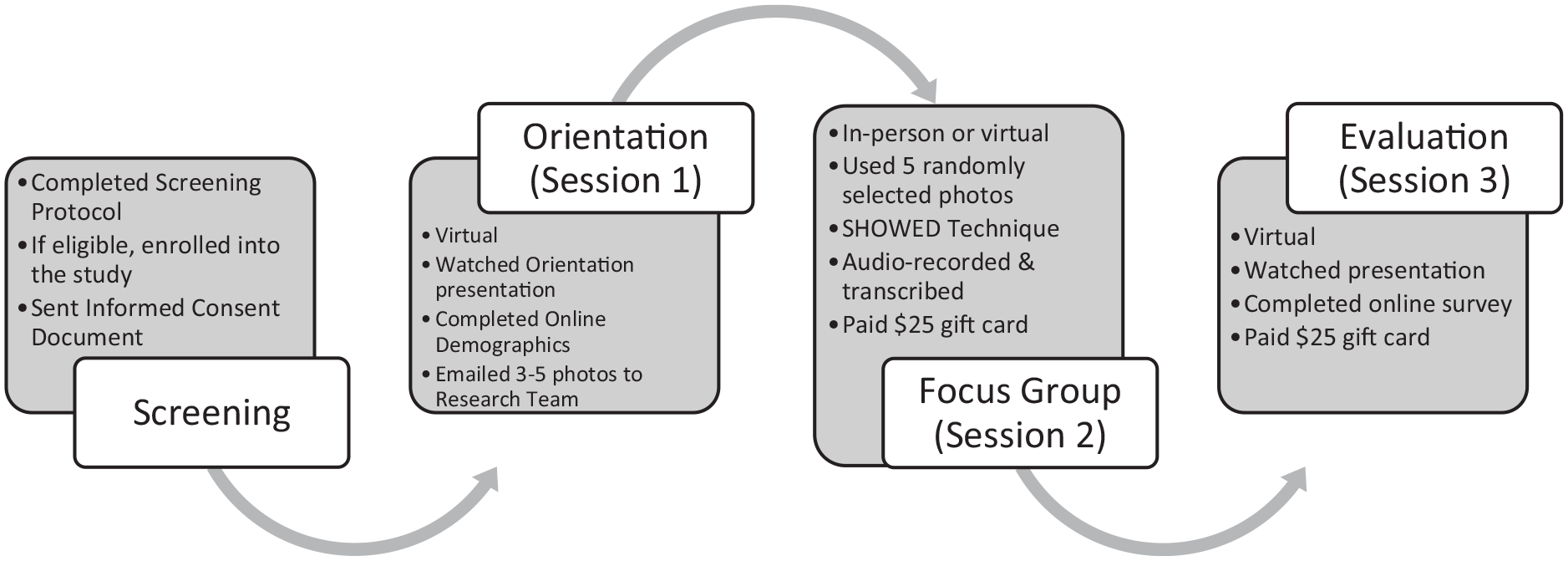
Soul FOOD Study Flow
Session 2 was either an in-person or a synchronous virtual focus group. Three focus groups were conducted: 2 in-person (October 2021 & November 2021) and 1 virtual (November 2021). The third focus group was moved online due to increasing COVID-19 cases and risk. For each focus group, each participant sent the research team three to five photos that represented personal facilitators and barriers to PA and nutrition; 53 photos were submitted during the study. Examples of photos are found in Figure 2. Prior to the focus group, researchers used an online random number generator to select five photos to discuss from the pool of photos sent in by that date’s focus group participants; 15 photos were shown over the course of the study. Due to the random generator, researchers could not guarantee every participant would have a photo selected for discussion. With each photo shown individually, the facilitator used the SHOWeD technique (Shaffer, 1980), which required the focus group facilitator to ask participants the following questions, with the selected photo as context: (a) What do you See here? (b) What is Happening here? (c) How does this relate to Our lives? (c) Why does this situation, concern, or strength Exist, and (d) What can we Do about it? This process was repeated for each photo for each focus group. Each session was audio-recorded; the research team took notes as well.

Selected Images From Soul FOOD Representing the Three Themes
In Session 3 (asynchronous, virtual), participants were provided a presentation of the emergent themes and potential program preferences. Session 3 content was informed by the themes and preferences that emerged during the focus groups. After viewing the asynchronous presentation, participants completed a Qualtrics survey about program preferences, including days and times of program delivery and method of program delivery (e.g., virtual or in-person), along with PA and nutrition topics they would like to see discussed in a PA and nutrition program specifically for Black women living in a rural community. This information was used to develop a health education program with activities incorporating the themes that emerged during the focus groups.
Data Analysis
Descriptive, demographic statistics were analyzed using SPSS 28 (Armonk, NY: IBM Corp). Verbatim focus group data were analyzed using procedures derived from Braun and Clarke (2021).
Results
Focus groups ranged from three to six participants (N = 14; BMI = 34.6 ± 5.9 kg/m2, 43.5 ± 8.7 years, and 82% Bachelor’s degree or higher). None of the women reported meeting the 2018 Physical Activity and Public Health Guidelines nor did any report eating more than five servings of fruits or vegetables per day.
As shown in Table 1, three major themes emerged from the focus groups: (a) reframing the mindset, (b) accountability, and (c) cultural relativity. Participants discussed the strengths, barriers, and challenges of each theme within the context of PA and nutrition promotion.
Additional Quotations From Black Women in Rural Eastern North Carolina

For reframing the mindset, discussion was the messaging surrounding PA and nutrition. Participants stressed weight loss was the message they received about PA and nutrition from numerous sources including health care providers, family and friends, and social media. Participants shared that reframing the mindset to think of those behaviors as actions to improve quality of life are more impactful than a conversation about weight loss alone. One woman stated, “It’s always about weight loss. I like the way I look. I just want to manage my health better and have more energy.” Another participant stated, “I will say sometimes the focus on weight loss turns people away because if people are you know, severely obese or overweight they feel like, okay, I’m never going to get to there.” Participants reported the theme’s strength took the focus on PA and healthy nutrition away from appearance to other aspects of wellness, including mental health, quality of life, and satisfaction of life. Challenges included the messages of weight loss perpetuating social media and mass media along with fat bias from health care providers. Participants wanted more body-inclusive messaging from health care providers and other sources (e.g., Instagram). One participant reported, “I think inclusivity is really, really important.”
For accountability, there was discussion regarding the socialization aspect of PA and nutrition and how social support is critical. One participant reported, “I want someone who does it with me; someone who gets me. I do so many things on my own; I need some help.” Another participant discussed her experience being active with a fellow Black woman, “And so I can say that the atmosphere, the accountability, it was the ‘girl what time are we going to the gym today’ and I can never imagine that for myself, but we literally we were linking up to go to the gym and I was snatched.”
Participants revealed the strengths were the sense of community and belongingness that one found by being surrounded by other Black women who wanted to lift each other up. A major challenge was the lack of time and opportunity to engage in social support with each other. One woman reported, “everyone is in their own little clique, so I’m already feeling some kind of way.” Other participants agreed finding their people to hold them accountable was challenging, particularly in spaces where they did not feel welcome.
For cultural relativity, discussion was around lack of representation of Black women in traditional PA and nutrition programming. One participant stated, “When you see people doing this, you don’t see people who look like me. They don’t understand my hair, my values, my culture. My community.” Another participant noted, “One of my things, you know that I would think would help me is to have some type of gym that’s inclusive of you know of Black females.” Strengths included building a community solely for Black women by Black women and recognizing the role one’s culture, core values, and the unique intersectionality of gender and race play in PA and nutrition promotion. Challenges included the systematic oppression and biases, which influence Black women’s representation in PA and nutrition promotion spaces.
When examining participant preferences, participants favored a virtual, synchronous program. Participants wanted the program to start after 5:30 pm to accommodate women who worked, to be recorded, and sent to all participants to accommodate women who worked second or third shifts and to be a long-term resource. Participants desired Facebook and Instagram social media accounts for participants with the hashtag #BestOfMe to reflect the holistic aspect of PA and a nutritious diet. Participants preferred buddy activities for social support (e.g., grocery shopping with a friend), culturally tailored PA (e.g., dance classes using hip hop music), and culinary support (e.g., healthy modifications of cultural staples).
Discussion
This study contributes to the understanding of the lived experiences of PA and healthful diet engagement among Black women, living in ENC with BMIs ≥ 25.0 kg/m2. Three major themes emerged: (a) reframing the mindset, (b) accountability, and (c) cultural relativity.
The first theme, reframing the mindset, is similar to work found in the wellness programming literature focusing on holistic health, well-being, and appropriate messaging (Foster et al., 2022; Langille et al., 2011; Matoff-Stepp, 2012). The second theme, accountability, extends the findings found within the health behavior change literature (Bland & Sharma, 2017; Das & Evans, 2014; Dlugonski et al., 2017) and demonstrates that successful PA and nutrition programming for Black women (Bland & Sharma, 2017) should incorporate this strategy. The last theme, cultural relativity, is a long-utilized and critical cornerstone for a variety of health promotion programs, especially for racially minoritized, cis-hetero populations (Chandler et al., 2022; Rikard et al., 2012; Robbins et al., 2015; Sosa et al., 2016). Future studies should examine the feasibility, acceptability, and effectiveness of tailored PA and nutrition promotion programs that utilize a holistic wellness perspective, incorporate social support for accountability, and are culturally relevant to rural Black women.
Strengths
The research team was primarily comprised of people of color; visual representation within the team may have encouraged participants to share their experiences without fear of judgment. The methodology of photo-elicitation allowed participants to share their lived experiences and voices to inform health promotion program design through photos. Thus, the resulting PA and healthful nutrition promotion program was truly for Black women by Black women.
Limitations
Data were collected from Black women living or working in the same rural ENC county. Black women from suburban and urban communities and other rural communities may have different perceptions of PA and nutrition promotion; researchers should incorporate their lived experiences and voices into future studies. There were a limited number of participants along with a modified study protocol (e.g., virtual and in-person focus groups) due to the COVID-19 pandemic. Moving forward, researchers should develop research protocols allowing for a variety of methods for data collection, including face-to-face and virtual options to amplify this population’s lived experiences and voices for optimum health promotion impact. Finally, only Black women with BMIs ≥ 25.0 kg/m2 were enrolled; future research should prioritize all Black women to understand weight-neutral perspectives (Ulian et al., 2018) as study findings demonstrate Black women’s health encompasses many different factors other than weight.
Conclusions and Implications for Practice
Black women experience disparities in PA and nutrition rates that negatively impact their health and quality of life. These significant and unjust racial disparities continue to exist for a variety of reasons, including the absence of tailored PA and healthful nutrition interventions for specific populations such as rural Black women. The primary practical implication of our work is rooted in the benefits of photo-elicitation methodology. Using photos, our team elicited dialogue on health and wellness from participants; clinicians and health educators in diverse settings can use a similar approach to better understand the lived experience and perspectives of the people they serve. Our findings suggest that PA and nutrition programming should incorporate holistic perspectives, social support, and cultural relativity to improve PA and diet behaviors in rural Black women. Future research and practice should build on these findings to develop and examine the health impact of health promotion programs designed for Black women by Black women on PA levels, diet quality, and quality of life.
