







Abstract
Kentucky has the highest cancer incidence rate and second highest cancer mortality rate in the United States, and the Appalachian region of the state experiences a disproportionate cancer burden. Cancer-related advocacy, a movement that strives to provide support to cancer patients, families, and organizations, along with policy creation, could help address this disparity by enhancing cancer-related prevention and control efforts. The University of Kentucky Markey Cancer Center’s Appalachian Career Training in Oncology (ACTION) Program partners with the American Cancer Society Cancer Advocacy Network (ACS CAN) to involve Appalachian Kentucky high school and undergraduate students in cancer advocacy activities at the Kentucky State Capitol in Frankfort. By meeting with state legislators, students are able to share stories regarding cancer’s influence on their community and propose possible solutions. One notable outcome from ACTION’s cancer advocacy activities is a proclamation from Kentucky Governor Andy Beshear declaring October as “Cancer Education and Prevention Month.” ACTION students say their participation in advocacy activities equipped them with new communication skills, empowered them to participate in future advocacy activities, and encouraged them to believe their words and actions can create meaningful change. Similar advocacy activities and partnerships can be implemented in other regions burdened with elevated cancer rates to improve cancer control and prevention efforts.
Keywords
The overall cancer-related mortality rate in the Appalachian region of the United States is 184 per 100,000 people, which is 10% higher than the national rate of 168 per 100,000 people (“Creating a culture of health in Appalachia: Disparities and bright spots,” n.d.). While Kentucky itself experiences elevated cancer incidence and mortality rates compared with other states (State Cancer Profiles, 2025), the Eastern, Appalachian portion of the state faces one of the highest cancer burdens in the nation with a cancer mortality rate of 227 per 100,000 people (“Creating a culture of health in Appalachia: Disparities and bright spots,” n.d.). Many factors contribute to these disparities including health behaviors, such as alcohol and tobacco use, inadequate access to screening and preventive services, and social and structural factors including environmental exposure, low education attainment, and low-income levels (“2021 Kentucky cancer needs assessment: The story of cancer in Kentucky,” 2022; Robertson et al., 2023). One factor that has the potential to influence cancer rates in Appalachian Kentucky is health advocacy, which is defined as providing support for patients and participating in community activities to improve health. In particular, cancer advocacy involves providing support for cancer patients and the organizations assisting them. The University of Kentucky Markey Cancer Center, an NCI-designated Comprehensive Cancer Center, serves as a conduit for cancer advocacy throughout the state. In this practice note, we describe a program at the Markey Cancer Center that involves Appalachian Kentucky high school and undergraduate students in cancer advocacy activities. The goal of sharing this unique facet of the program is to provide cancer centers, providers, and local organizations with a framework for getting students to advocate for cancer-related change in their communities.
Description of Advocacy Initiatives
The University of Kentucky Markey Cancer Center’s Appalachian Career Training in Oncology (ACTION) Program engages Appalachian Kentucky high school and undergraduate students in 2 years of cancer-related education. In addition to providing students with opportunities for cancer research and clinical shadowing, the program is unique in its ability to engage students with cancer advocacy activities. The American Cancer Society Cancer Action Network (ACS CAN) is a national organization that strives to reduce cancer burden by advocating for evidence-based legislation. Each year, ACS CAN hosts a Cancer Action Day at the state capitol in Frankfort, Kentucky. ACTION participants attend the event each year with the goal of drawing attention to and providing solutions for the high cancer burden in Appalachian Kentucky. Prior to the event, many students speak personally with members of their community who have been affected by cancer, allowing them to get a better picture of the barriers their communities face regarding cancer diagnosis, prognosis, and treatment. ACS CAN schedules meetings for students with their state representatives based on their home counties. Students attend these meetings in groups and have a pitch ready to discuss with their representative. One challenge that can limit student participation is that Cancer Action Day occurs during the week when students have classes and other academic as well as co- and extra-curricular responsibilities. To address this, many high school teachers and college professors give students an excused absence to participate.
Ultimately, through Cancer Action Day, students bring their perspective directly to state representatives, thus highlighting their firsthand account of the cancer crisis in Appalachia. Not only are the students passing on powerful Appalachian stories, but they are also working directly with legislators to discover and implement solutions to the high cancer incidence and mortality rates in their hometowns.
Student Perspectives
Three ACTION Program undergraduate students (O.T., K.J., and R.S.) who attended Cancer Action Day provided their perspectives from before, during, and after the advocacy activity. Students prepared for their pitch by reading about relevant policies and practicing professional communication skills, such as the hook, line, and sinker method. Students used this strategy, taught to them by an ACS CAN staff member, to capture and maintain representatives’ attention while delivering their cancer-related pitch. During Cancer Action Day, students felt nervous, yet excited. One student stated that she was “truly amazed at the opportunity to be in the capitol building with boots on the ground, advocating for life-changing policies.” After participating in the event, students felt “empowered and optimistic,” which contributed to their willingness to participate in future advocacy activities. In addition, discussions with legislators led students to believe they could create lasting change. When asked about her conversation with her representatives, one student said, They were invested in our personal stories related to tobacco and cancer, which made it seem like they were trying to put a face to the legislative problem. It was reassuring to know that our representatives did care about us on a more personal level and were receptive to change.
Finally, the program opened students’ eyes to the impact of young people’s actions and words on their communities and the state at large. One student stated, “I felt that my voice, although small on its own, might play an important role when combined with the other advocating voices.” Another student echoed that sentiment, saying, “When it is evident that youth are showing up because they care and want change, it creates a new attitude in the minds of the legislators.”
Successes
Students greatly value their participation in the advocacy activities and believe it contributes to their growth as future health care professionals. Students developed communication skills, were empowered to participate in future advocacy activities, and were enlightened regarding the power of their voices to create meaningful change. A previous study examined the effect of Cancer Action Day on ACTION high school students and produced similar findings—students learned of the impact their personal stories can make, thus fueling their enthusiasm regarding future advocacy activities (Hudson et al., 2021). When considered in conjunction, the experiences of the ACTION undergraduates and high school students demonstrate the positive impact such advocacy activities can have on Appalachian Kentucky students’ advocacy perceptions, preparedness, and future participation.
Another notable outcome from ACTION’s advocacy work is a proclamation from Kentucky Governor Andy Beshear designating October as “Cancer Education and Prevention Month” (Figure 1). This proclamation, which was the result of a meeting between Kentucky Lieutenant Governor Jacqueline Coleman and the ACTION high school students, was designated on October 2, 2024. The proclamation highlights Kentucky’s official commitment to cancer education and early intervention with the goal of alleviating disease burden in the Commonwealth.
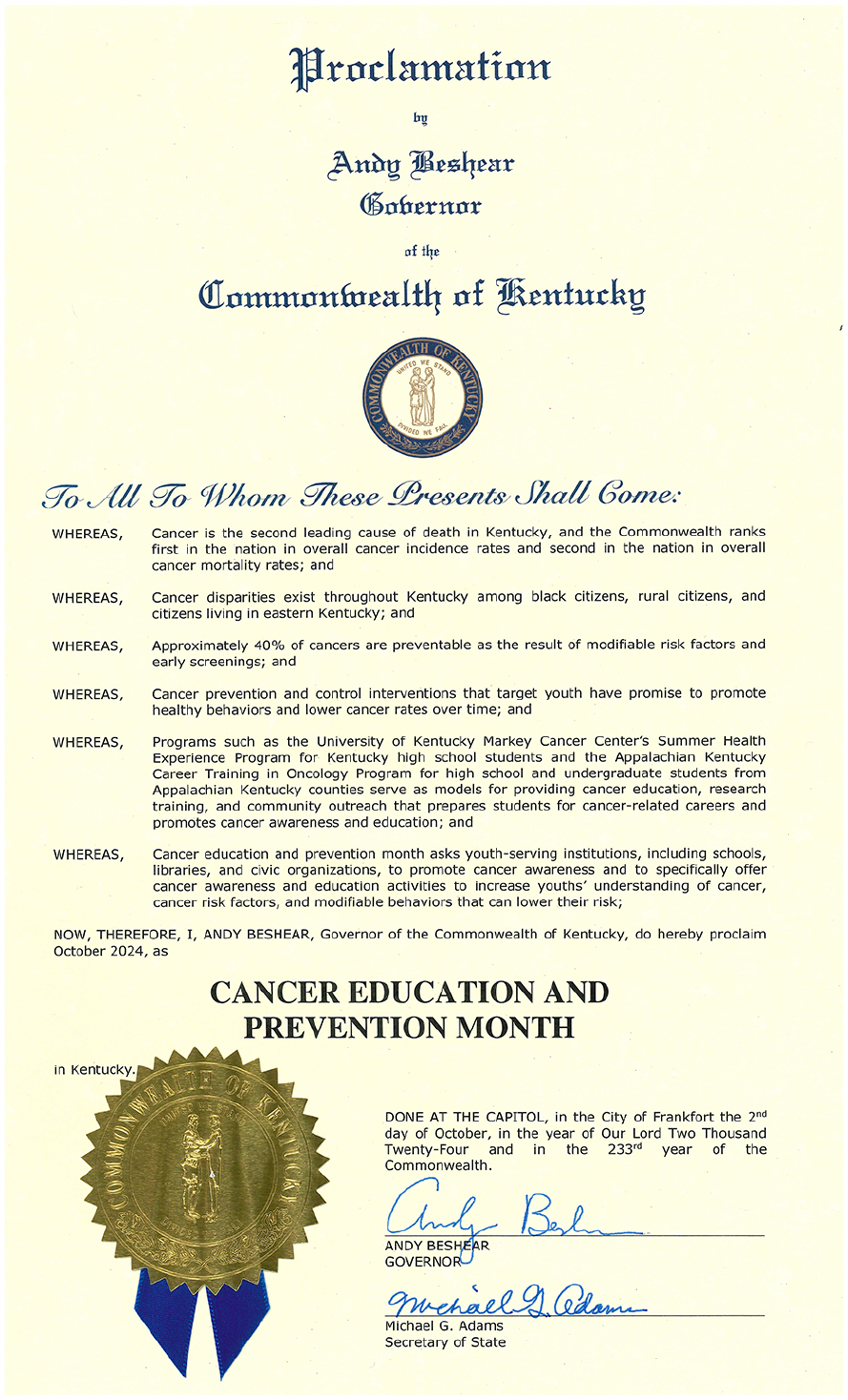
A Unique Success From ACTION’s Cancer Advocacy Activities Is a Proclamation From Kentucky Governor Andy Beshear Designating October as “Cancer Education and Prevention Month”
By providing a framework for Appalachian Kentucky high school and undergraduate students to connect with state representatives, ACTION’s advocacy activities have provided students with necessary skills and confidence to draw attention to Kentucky’s cancer crisis and begin discussions to create meaningful change through education.
Implications for Practice
Increasing legislators’ awareness of the cancer burden is a critical first step toward reducing its impact. ACTION’s framework for cancer advocacy has the potential to open long-standing lines of communication between Appalachian citizens and their representatives. Appalachian students bring a unique perspective to these conversations by providing firsthand accounts of cancer’s impact on their communities, placing them in an ideal position to identify problems and propose solutions. By partnering these students with representatives who are knowledgeable regarding legal and legislative processes, ACTION’s advocacy activities foster an environment that can create positive change while also developing crucial skills for students. Future advocacy activities could include involving students in city council meetings to suggest local solutions to the cancer crisis. Ultimately, ACTION’s advocacy approach could be replicated in other regions.
Footnotes
Authors’ Note:
The University of Kentucky Markey Cancer Center’s Research Communications Office assisted with manuscript preparation. This study was supported by the University of Kentucky’s Appalachian Career Training in Oncology (ACTION) Program (R25 CA221765) and the Markey Cancer Center’s Cancer Center Support Grant (P30 CA177558).
