







Abstract
Gun violence is a critical public health issue in the United States and is a leading cause of death among youth and young adults. Firearm-related injury and death disproportionately impact racial and ethnic minoritized youth. Critical to addressing gun violence as a public health issue is researching the etiology of gun violence, as well as developing and testing violence prevention strategies. In response to the growing need for gun violence prevention efforts, the Illinois Department of Human Services established the Office of Firearm Violence Prevention in 2021. With that funding included the development of Training and Technical Assistance Services (TTAS) centers to assist organizations in developing, implementing, and evaluating gun violence prevention initiatives. This paper examines the strategies of one TTAS center in Illinois, which collaborated with 20 social service agencies and community-based organizations to provide tailored training and technical assistance and support. This TTAS center conducted needs assessments, offered training and technical assistance, and engaged in collaborations with other TTAS centers providing similar support. In this article, we highlight strategies (e.g., delivering an array of trainings, developing and utilizing needs assessments, consultation sessions) as well as barriers (e.g., difficulties engaging organizations and ensuring attendance at trainings). This article concludes with recommendations for future TTAS initiatives, emphasizing the need for better infrastructure, clearer communication, and more robust support from state agencies. This study underscores the importance of TTAS centers in supporting gun violence prevention initiatives, particularly in the context of increased demands on social services following the COVID-19 pandemic.
Keywords
Gun violence is a pervasive public health concern in the United States. As elevated in the U.S. Surgeon General (2024) Advisory, firearm injuries are the leading cause of death among children and adolescents. Firearm-related injury and death disproportionately impact youth and young adults, men, and racial and ethnic minoritized populations. The impact of firearm-related injury is immense: those who survive firearm-related injuries may experience long-term physical injury or disability, illness and medical conditions, and mental health problems. Gun violence also impacts those who are connected to the victim, including their families and communities, while also having a substantial economic impact (Centers for Disease Control and Prevention [CDC], 2024). Thus, given the prevalence, disparities, and adverse impacts, the prevention of gun violence is paramount.
Despite gun violence being a persistent public health crisis, federal funding for firearm violence and injury prevention research only resumed in fiscal year 2020 after a more than 20-year freeze. These appropriations allow for researchers to better understand the etiology of firearm-related violence, injury, and death, all of which would inform prevention and intervention efforts with federal funding (Weir, 2021). Recent research has highlighted risk factors for firearm violence (Sanchez et al., 2020), as well as evaluations of gun violence prevention initiatives, including Community Violence Interventions (CVIs; Altheimer & Tobey, 2024). The CVIs address the needs of the community (including needs stemming from systemic racism, community disinvestments, historical trauma), using evidence-based strategies, informed by and in collaboration with community residents and stakeholders. Some of these strategies include street outreach and violence interruption programs, hospital-based violence intervention programs, and environmental change. As more funding becomes available for these approaches to be implemented and evaluated, we will continue to learn more about their impact in reducing gun violence.
Statewide initiatives to prevent gun violence are also emerging as funding and research builds. For example, in Illinois, the 2021 passage of the Reimagine Public Safety Act (430 ILCS 69) established the Office of Firearm Violence Prevention (OFVP) within the Illinois Department of Human Services (IDHS). As of 2022, only five states had firearm violence prevention agencies inside state government (Center for Gun Violence Solutions, 2022). After the OFVP was established in Illinois, about $250 million in state funding was allocated to support organizations statewide who were providing gun violence prevention efforts while also supporting new organizations and efforts that were established with this funding (IDHS, 2023).
The Need for Training and Technical Assistance Support
The COVID-19 pandemic significantly increased the burden on social services and community-based organizations. Nonprofits across the United States faced a “perfect storm” of decreased revenue and heightened demand for services. Individual donations plummeted, social distancing led to canceled fundraising events, and fees for services and memberships declined sharply (Kuenzi et al., 2021). This decrease in revenue resulted in reduced employee hours, pay cuts, furloughs, and layoffs, which reduced the workforce and increased workloads for remaining employees. Salamon and Newhouse (2020) estimate that 1.6 million nonprofit jobs were lost between March and May 2020, and a full recovery could take years. The National Council of Nonprofits reports that 79% of nonprofits identified salary compensation and competition as primary factors preventing them from filling open positions. In addition, 23% reported that difficulties finding child care are impacting recruitment and retention (National Council of Nonprofits, 2023).
The increase in firearm violence, combined with a decrease in the human service sector’s capacity to respond, underscores the need for Training and Technical Assistance Services (TTAS). These initiatives can support nonprofits and strengthen their efforts during the industry’s recovery. TTAS can enhance the capacity to serve communities by providing specialized training and equipping staff with additional skills. Moreover, TTAS can help adapt evidence-based practices to diverse communities, foster collaboration and networking, support navigation of legal and policy frameworks related to firearm prevention, and assist organizations in building or efficiently allocating resources. Finally, TTAS can gather data to continue vital research on the impact of firearm violence and evaluate the effectiveness of prevention and recovery programs.
Strategies From One TTAS Center
This article highlights the strategies and lessons learned from one of the TTAS centers funded by the OFVP at IDHS. TTAS centers were established to provide various support services to grantees working in communities, including establishing or delivering new programs, conducting needs assessments, building evidence through evaluation, and developing internal infrastructure systems to support overall agency operations.
As a TTAS center, we aimed to build genuine partnerships with each organization, avoiding the common reality of engaging solely as “Ivory Tower” academics. We collaborated with 20 social service agencies across Illinois to identify how interventions and services could be adapted for diverse populations. In addition, members of our team provided individualized assistance based on the unique needs of each organization. Our team consisted of academics in specialized areas (e.g., Motivational Interviewing, Trauma-Informed Care, working with refugee populations) and experts in violence prevention. This diversity of skill sets and expertise allowed us to respond flexibly to the varied needs of each organization, rather than employing a one-size-fits-all approach.
The strategies we employed as TTAS centers included (a) conducting needs assessments to identify training and workshop opportunities and (b) offering individualized consulting and providing an array of training webinars, in-person sessions, and workshops. Throughout the development and delivery of trainings and technical assistance, we were guided by the results of the needs assessments and collaborations with other TTAS centers.
Needs Assessments
To assess and be responsive to organizational needs throughout the funding period, the team conducted surveys and checked-in regularly with organizations requiring more hands-on technical assistance. In the first few months of the project, three TTAS centers serving Greater Illinois (GI-TTAS) collaboratively designed and administered needs assessment surveys to grantees. There were two separate surveys: one for administrative and leadership staff and one for frontline staff. Each survey was administered via Qualtrics, a secure online platform.
First, in the administrative and leadership staff survey, we assessed for trainings that their organization would be interested in receiving. In addition, we assessed for organizational capacity, leadership, operational practices, financial planning, and program implementation and evaluation. Together, this information allowed us to match organizational training requests and needs in these domains with trainings and technical supports. Second, we administered a survey to frontline staff to assess for practitioner development and training needs, supervision and program practices, partnerships, and competencies in violence prevention efforts.
After leadership and frontline staff completed their needs assessment surveys, members of each GI-TTAS met with each organization individually to review their results and training requests. These needs assessments served as the framework for suggesting training sessions and personalized technical assistance. Organizations who required additional technical assistance and supports also participated in monthly check-in meetings with their training and technical assistance providers.
Consulting, Trainings, and Technical Assistance
Based on the grant specifications and expressed needs of grantees, a collection of trainings and technical assistance supports were offered to gun violence prevention grantees. These trainings covered topics including (a) best practices for engaging high-risk populations, (b) mentoring, caregiver involvement, life skills, and employment, (c) trauma-informed screening and assessment, (d) train-the-trainer on community-level trainings, (e) Cognitive Behavior Therapy, (f) conflict mediation training, (g) trauma-informed training, (h) evidence-based program development and implementation, (i) data use and management, (j) human resources, staff management, and supervision, (k) community organization, (l) building collaborations, and (m) racial equity and implicit bias training. Table 1 shows the brief descriptions of trainings provided under these grant-specified topics. During the approximately 12 months of time after the needs assessments were conducted, a total of 26 trainings were held and 221 consultation sessions were held; 80 individuals were trained, engaging 15 of the 20 grantee organizations.
OFVP Grant-Specified Training Topics and Our TTAS Offerings
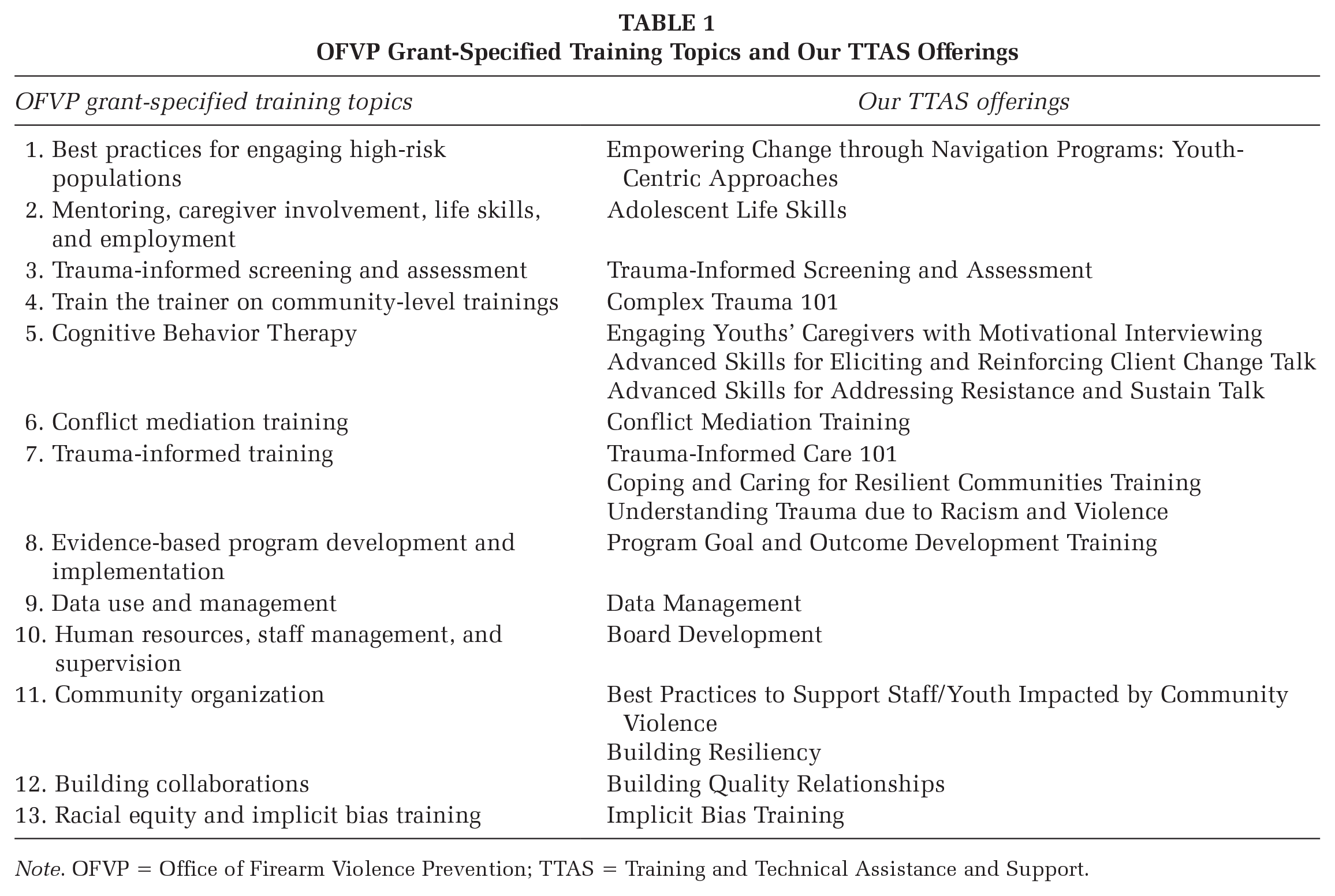
Note. OFVP = Office of Firearm Violence Prevention; TTAS = Training and Technical Assistance and Support.
Collaborations With Other TTAS Centers
Finally, the team also engaged with other TTAS centers. This was an opportunity to identify shared resources, provide and receive referrals for consulting and trainings, learn and share best practices, and build a community of TTAS providers to keep a pulse on the current state of gun violence prevention efforts taking place throughout Illinois. Throughout the entire 18-month grant period, our center met with other TTAS centers approximately 28 times.
Lessons Learned
As an inaugural OFVP initiative, the TTAS centers provided support to numerous grants conducting gun violence prevention initiatives across Illinois. In reflection of our strategies and engagement, we discuss lessons learned from this initiative and offer recommendations for future implementation:
First, needs assessments were helpful in guiding the trainings and support we could offer organizations, but we found it difficult to engage all grantees. Of the grantees assigned to our TTAS, several were in the initial stages of their organizational development, and some were still hiring frontline staff and other necessary positions for program implementation. Thus, they were not ready to commit to training and technical assistance. Others expressed wanting every training, which included a portfolio of over 26 unique trainings. It was necessary to follow up with those organizations to prioritize their training needs. A recommendation we pose to the OFVP is to include a resource mapping of training and technical support needs within the grant application so that TTAS centers have a better sense of where the organizations are developmentally, as well as what their needs are. Including this in the application would also reduce the ask for the grantees to complete a survey that may feel burdensome.
During training implementation, we encountered limited attendance. Training and workshops were offered both in-person and online. However, there was a mixed response from organizations on preferences. Some organizations preferred the training to be offered online, as it allowed their employees to attend more easily within their schedules and reduced the burden of travel and other logistical challenges. However, other organizations expressed online fatigue from the increase in online trainings and meetings during the pandemic. Both the in-person and online trainings had low attendance. Even among those who specifically requested in-person sessions, turnout was limited. Occasionally, offering training in one location attracted participants from nearby organizations, but this was not always effective. Since organizations were spread across Illinois, travel often proved difficult or inconvenient, impacting overall attendance. In addition, grantees were not required in their contracts to attend training, which might have increased attendance. Given the challenges with attendance and participation, we recommend that requirements to attend trainings are specified to grantees.
Organizations were assigned to a TTAS based on geography and organizational preferences, which introduced barriers. Although the OFVP provided guidance on types of trainings required to be offered, we found that organizations had specific training and technical assistance needs that were not offered by their regional TTAS center. To address this training gap, collaboration with other TTAS centers who could fulfill the needed training was critical. Although collaboration between TTAS centers was helpful, organizations did not always interact with their assigned center and expressed confusion about who their center contact was. More infrastructure to clarify the TTAS centers, contacts, and training offerings is needed so that organizations have a clearer sense of what is offered and who they can regularly connect with.
Conclusion
This article presented strategies of one TTAS in Illinois that was funded to support organizations receiving state funding to implement gun violence prevention initiatives. Our TTAS was successful in learning about organizational needs through needs assessments, delivered 26 trainings to 221 individuals and 15 organizations, led consultation sessions, and collaborated with other TTAS centers in Illinois. However, our TTAS (and TTAS centers more broadly) faced implementation challenges, which we reflect on in this article, also proposing recommendations and considerations for future TTAS initiatives. The need for TTAS centers is substantial given that gun violence is a public health concern and that the pandemic increased burdens on social services and community-based organizations. However, to be successful in the provision of TTAS, state agencies need to continue building out infrastructure to support these centers and grantees.
Footnotes
Authors’ Note:
This research was supported by a grant from the Office of Firearm Violence Prevention (OFVP) at the Illinois Department of Human Services (IDHS), awarded to Drs. Doug Smith, Rachel Garthe, and Ebonie Epinger. This project was supported, in whole or in part, by federal award number SLT-3381 awarded to the State of Illinois by the U.S. Department of the Treasury and under grant(s) from the State of Illinois, Department of Human Services. Points of view or opinions in the document are those of the author and do not necessarily represent the official position or policies of the Illinois Department of Human Services. A special note of gratitude to project staff and trainers who were essential to this work, including Dr. Shongha Kim, Dr. Moses Okumu, Dr. Cortney VanHook, Haley Miller, and Karen Simms. We also acknowledge the collaboration and support our team had with other Training and Technical Assistance Centers in the Greater Illinois and Chicago areas also funded by this grant program, particularly Illinois Collaboration on Youth (ICOY) and Alternatives.
