







Abstract
Pedestrian injuries and fatalities are pervasive, often preventable, and globally recognized. Road safety is an international, national, and local concern that affects billions of people, particularly those who live in underserved communities and with poor transportation accessibility and road safety infrastructure. Since 2005, the evidence-based WalkSafe pedestrian education program has been implemented annually across elementary public schools. This is the first study conducted on WalkSafe with a focus on knowledge acquisition by elementary students and retention of safety concepts by middle schoolers. Data were collected from a total of 3,621 elementary students at 36 participating schools and 1,112 middle schoolers at 29 middle schools using a student survey. The correct percentage of Kindergarten post- and Grade 3 post-survey responses significantly improved in 10 of the 11 survey items. Middle schoolers (
Keywords
Since 1981, unintentional motor vehicle traffic accidents have been one of the leading causes for injuries and fatalities in children and adolescents aged 5 to 19 years old (Centers for Disease Control and Prevention, 2023; Smart Growth America, 2020). At the national level, there are about two children 0 to 19 years old being injured or killed while walking every hour (Safe Kids Worldwide, 2020). At the state level, Florida is one of the two most dangerous states for pedestrians and bicyclists, with urban settings ranking first for pedestrian-related injuries and fatalities with a population of 200,001 and above (National Highway Traffic Safety Administration, 2022); and this trend continues. This national public health problem has been addressed by multiple safety policies, initiatives, and research-based practices.
Effective and sustainable pedestrian school-based education is one of the primary prevention practices that the literature has highlighted as contributing to safety awareness, knowledge, and behavior in children. As a safety primary prevention evidence-based program (Delouche et al., 2019), the WalkSafe program has focused on fostering pedestrian awareness, knowledge, and safety behaviors in children by providing professional training to school administrators and educators and implementing and evaluating its 3-day curriculum in elementary and K-8 centers.
Studies on pedestrian school-based safety education programs, like WalkSafe, have indicated that the combination of professional training and student safety education has a positive effect in pedestrian safety awareness and increases children’s knowledge (Delouche et al., 2019; Kendi & Johnston, 2023; Kirley et al., 2023). However, limited comprehensive research has been conducted on pedestrian safety vocabulary and concepts learned and reinforced through the exposure to an annual pedestrian safety education intervention from Kindergarten to Grade 5, and its impact over time. Furthermore, a limited amount of literature is available on the internalization process of pedestrian safety attitudes and behaviors (Kirley et al., 2023; Livingston et al., 2011; Zare et al., 2019), and lasting learning impact from childhood to adolescence.
Intervention
WalkSafe conceptual framework is based on national health and safety standards and guidelines specified by the Safe Routes to School, now a 6-E model (Lieberman et al., 2020), the Centers for Disease Control and Prevention (2014), including main components of the Whole School, Whole Community, Whole Child model, and the U.S. Department of Health and Human Services (2018) physical activity guidelines. The 3-day WalkSafe curriculum has three developmentally appropriate versions divided by grade levels: K-Grade 1, Grades 2 to 3, and Grades 4 to 5. Day 1 of implementation is conducted in the regular classroom in which the teacher introduces students to pedestrian safety vocabulary and concepts. Day 2 is implemented in the Physical Education (PE) classroom in which safety information is reinforced and students participate in outdoor pedestrian safety simulations and related physical education exercises led by the PE teacher. Day 3 of implementation is developed in the Art classroom or regular classroom in which students display creative illustrations of safety knowledge learned during Day 1 and Day 2. Ideally, students should be exposed to WalkSafe on an annual basis throughout elementary school (K-5). In partnership with school districts and elementary schools, WalkSafe is implemented and evaluated annually using a formative and process evaluation approach to assess its fidelity of implementation and impact.
Purpose
The purpose of this quantitative study was to evaluate the acquisition and retention of pedestrian safety knowledge in elementary and middle school students through the WalkSafe pedestrian injury prevention program. The primary outcome was student knowledge by Kindergarten and Grade 3 students on pedestrian safety, including vocabulary, safety concepts, and traffic signs and signals from the WalkSafe curriculum, as well as sustained knowledge of WalkSafe information acquired in elementary school by middle schoolers (Grades 6–8). A secondary outcome was student satisfaction with the WalkSafe program by Kindergarten and Grade 3 students. This study also explored pedestrian safety behaviors of middle schoolers. Results of this study aimed to guide the actualization and improvement of the school-based WalkSafe curriculum, report on pedestrian safety practices that positively affect both knowledge and behavior in children, and identify implications for future research, practice, and policy on effective school-based road safety interventions.
Method
As part of the annual evaluation of the WalkSafe program, a questionnaire study of WalkSafe was designed, conducted, and analyzed at the classroom level. This is the first study conducted on WalkSafe with a focus on knowledge acquisition by kindergarteners and Grade 3 students and retention of safety concepts by middle schoolers (Grades 6–8). The primary outcome for this study was the number of correctly answered questions on a student survey of 11 items. The items were a mix of multiple choice and true/false questions, with illustrations added for younger participants. The primary analysis was a comparison of the difference in average number correct before and after the WalkSafe intervention. Outcome was both an increase in knowledge and knowledge retention. Kindergarteners completed a pre-post test through which an increase in knowledge was compared resulting directly from the intervention. A second analysis compared Kindergarten and Grade 3 post tests with Grades 6 to 8 test results to determine if knowledge was retained after the conclusion of administering WalkSafe in Grade 5.
Sample
Sample size for this study was determined both by feasibility and preliminary estimates of expected post scores within each grade for the knowledge retention analysis which was anticipated to be the smaller of the two effects. Power was not guaranteed but the primary goal was to determine estimates of effect for a fully powered study and possible other contributing factors. Both knowledge increase and retention were explored in the form of school characteristics, including school grade, percentage of free or reduced lunch, and student aggregated demographics. A total of 36 elementary schools were selected from three regions of the participating district: north (9), central (15), and south (12). Among the 36 selected elementary schools, 33 of them were classified as Title I schools serving a highly culturally, ethnically, and/or racially diverse student population (98%) and located in underserved communities (89%), in which 17 schools were classified as high-risk and 19 schools as low risk based on road crashes and fatalities in the area. For the middle school sample, 29 middle schools/K-8 centers were selected representing the district’s regions: north (12), central (9), and south (8). Of the 29 selected schools, 18 were Title I schools, 12 of which were identified as located in high-risk areas for road crashes and fatalities. On average, 96% of middle school students came from culturally, ethnically, and/or racially diverse backgrounds with an average of 77% of the students living in underserved communities.
Data Collection and Analysis
A WalkSafe Student Survey was created to collect pre- and post-data. Classroom teachers administered this paper and pencil survey. The survey included information on grade level and 11 questions on WalkSafe knowledge. In addition, the post elementary survey included four satisfaction questions, and the middle school survey had eight additional questions related to pedestrian safety behaviors, such as Question (Q)14: “I use headphones when crossing the street” and Q15: “I use the phone to text and/or talk when crossing the street.”
In this study, 1,843 pre-surveys and 1,289 post-surveys from kindergarteners, 1,778 post-surveys from Grade 3 students; and 1,112 post-surveys from middle school students, respectively. Data analysis for this descriptive research study was conducted at the classroom level. Pre- and post-surveys were administered to the same group of students in Kindergarten and Grade 3 classrooms at the selected 36 elementary schools. Surveys were administered as part of the WalkSafe curriculum assessment before and after its implementation. Students in the selected classrooms that were in attendance on the day of the assessment took the surveys, but they also had the option to opt-out of the survey. Knowledge assessment was based on the correct percentage of each question and the number of correctly answered questions before and after the intervention. Data analysis was conducted using Microsoft Excel and R statistical computing software. A p-value less than .05 was considered to be statistically significant. The Wilcoxon test was performed when data was not normally distributed for total score comparison (see Tables 1, 2, and 5). A chi-square test was conducted when data was categorical, and it was used to test the significance for each survey question (see Tables 1, 2, and 5).
Kindergarten Pre and Post WalkSafe Student Survey Comparison
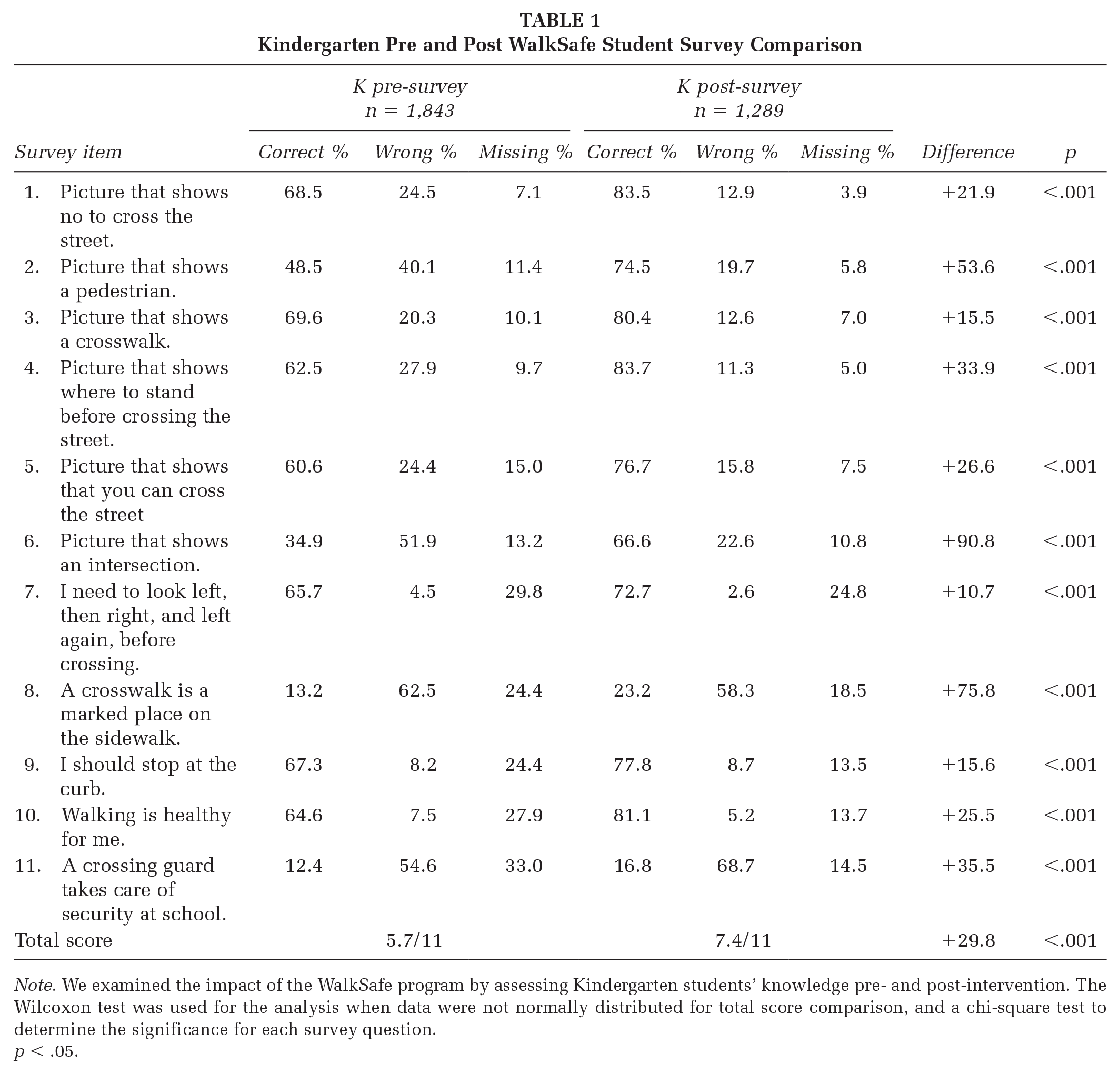
Note. We examined the impact of the WalkSafe program by assessing Kindergarten students’ knowledge pre- and post-intervention. The Wilcoxon test was used for the analysis when data were not normally distributed for total score comparison, and a chi-square test to determine the significance for each survey question.
p < .05.
Kindergarten Post and Grade 3 Post WalkSafe Survey Comparison
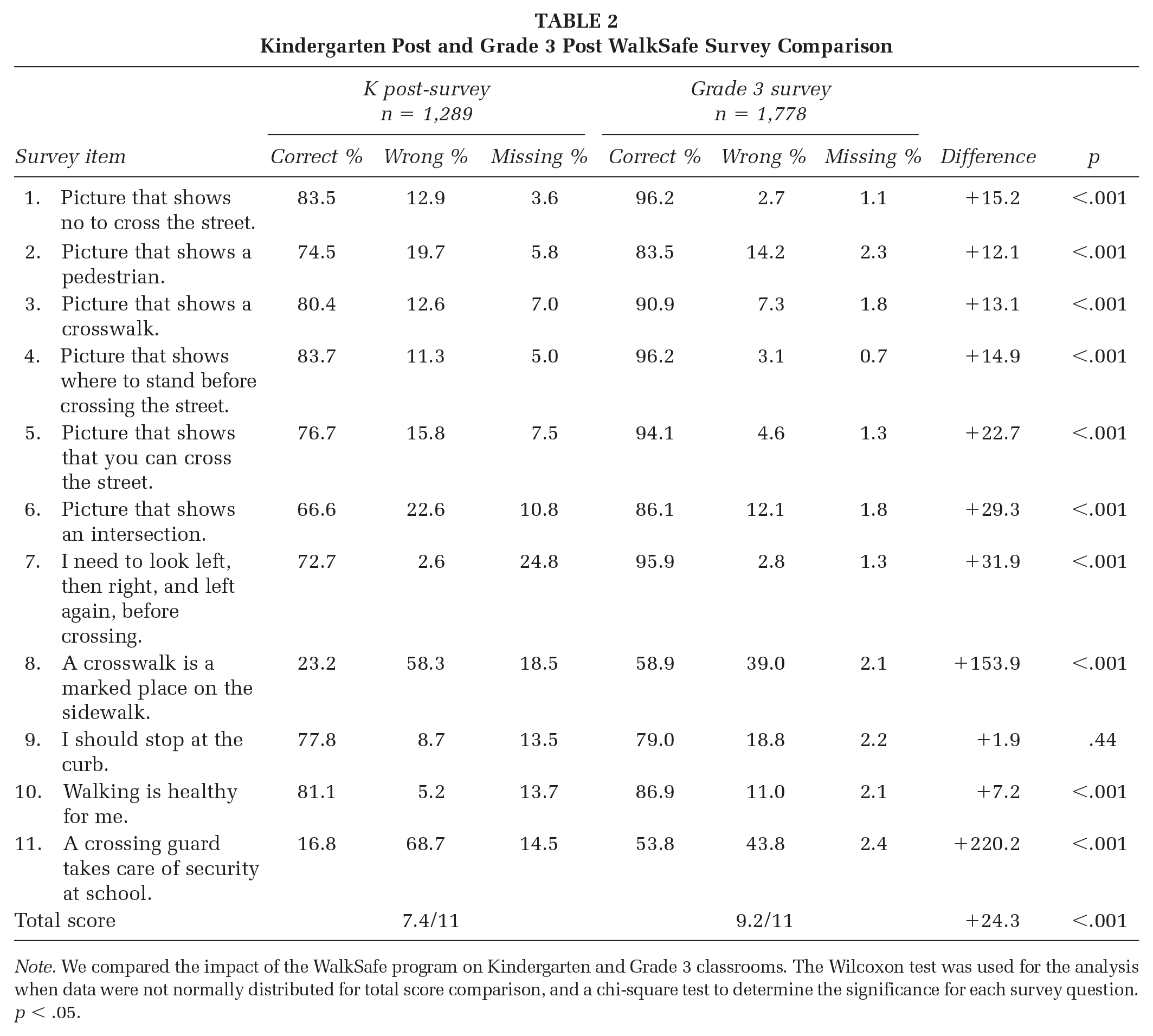
Note. We compared the impact of the WalkSafe program on Kindergarten and Grade 3 classrooms. The Wilcoxon test was used for the analysis when data were not normally distributed for total score comparison, and a chi-square test to determine the significance for each survey question.
p < .05.
Results
Table 1 provides a comparison of kindergarteners’ pre- and post-survey responses. The correct percentage improvement for each question is significant as the p-value of every question is less than .001. The average score also increased significantly from 5.7/11 in the pre to 7.4 /11 in the post with 29.8% improvement. Q8: “A crosswalk is a marked place on the sidewalk” and Q11: “A crossing guard takes care of security at school” are regarded as the most difficult questions for kindergarteners; and while their correct percentage significantly improved after the WalkSafe intervention, they were still under 30%.
Similarly, in the comparison of Kindergarten post- and Grade 3 post-survey responses shown in Table 2, the correct percentage significantly improved in every question except Q9: “I should stop at the curb.” The average score improved from 7.4/11 in the Kindergarten post-survey to 9.2/11 in Grade 3 post-survey with 24.3% increase.
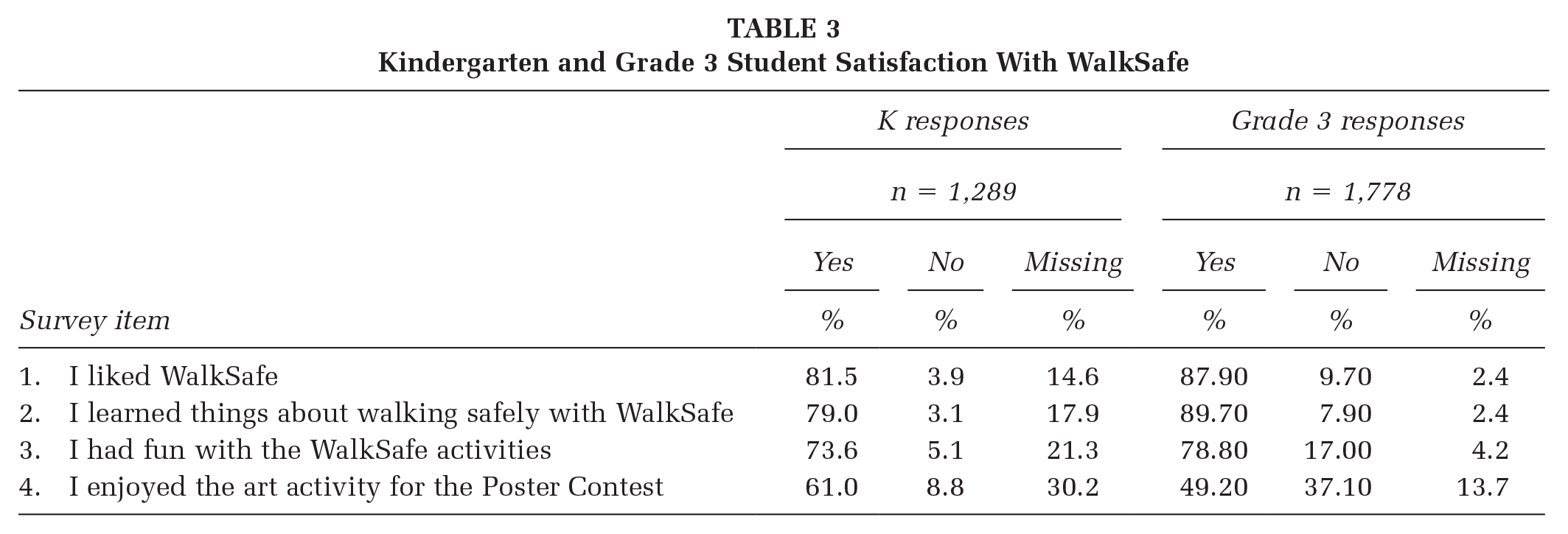
Table 3 provides results from the elementary student satisfaction section of the survey. Overall, kindergarteners (n = 1,289) and Grade 3 students (n = 1,778) reported satisfaction with their participation in the WalkSafe program. Most kindergarteners liked WalkSafe (81.5%) and thought they learned about walking safely (79%) from it. High percentages on student satisfaction were also indicated for Grade 3 students with 87.9% that enjoyed WalkSafe and 89.7% that thought they gained knowledge due to WalkSafe.
Kindergarten and Grade 3 Student Satisfaction With WalkSafe
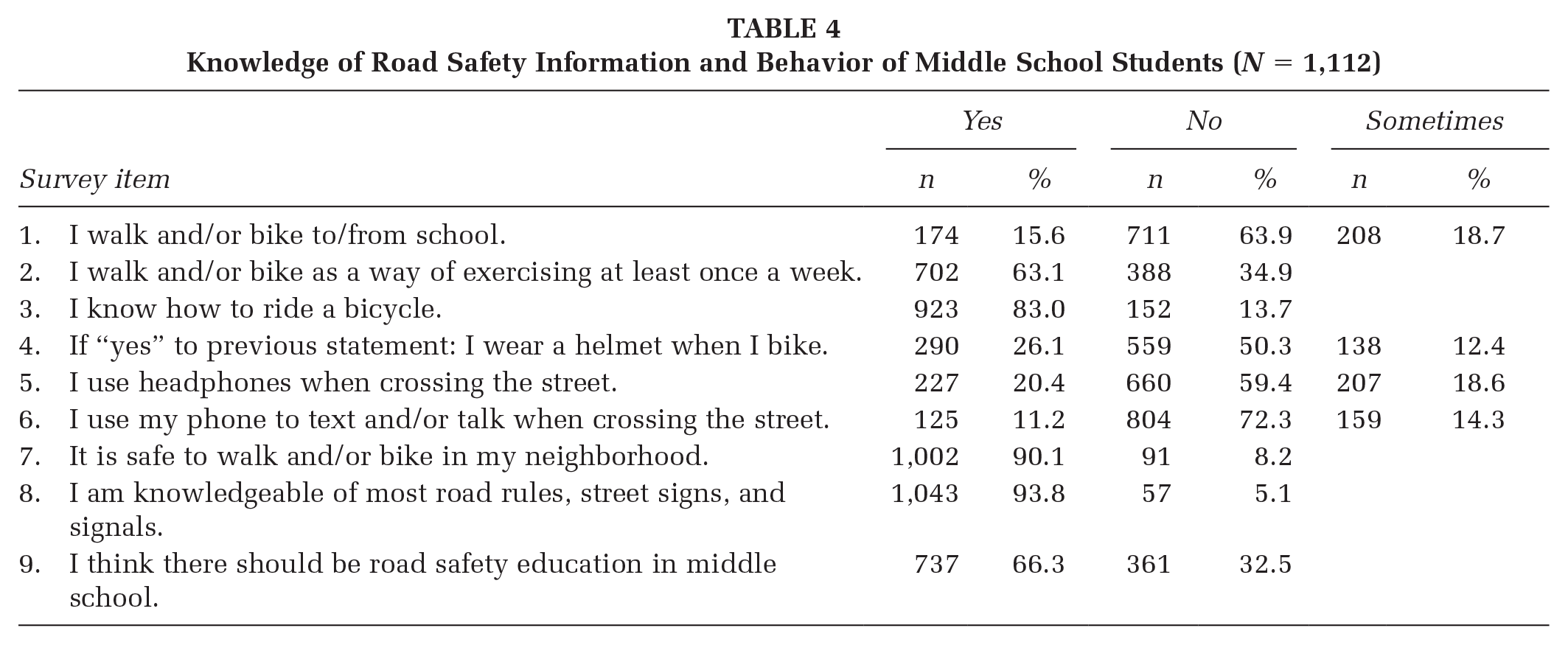
Knowledge of road safety information and behavior of participating middle schoolers (N = 1112) shows that 63.1% of students either walk or bike as a way of exercising at least once a week, but only 26.1% wear a helmet when bicycling (see Table 4). In addition, while 93.8% of surveyed students reported having knowledge of road rules, street signs, and signals, and 90.1% thought it is safe to walk or bike in their neighborhoods, there is still 20.4% of students that dangerously used headphones when crossing the street and 11.24% used their phones to text and/or talk when crossing the street.
Knowledge of Road Safety Information and Behavior of Middle School Students (N = 1,112)
In the last comparison of Grade 3 post-survey (n = 1,778) and middle school (n = 1,112) survey in Table 5, of the 11 knowledge survey items, middle schoolers maintained a high correct percentage in every question except Q8: “A crosswalk is a marked place on the sidewalk” and Q11: “A crossing guard takes care of security at school” with a slight decrease. The average score was kept at a high-level from 9.2/11 in Grade 3 to 9.4/11 in middle schoolers. The overall retention rate is optimal.
Results From the WalkSafe Student Survey in Grade 3 and Middle School (N = 2,890)
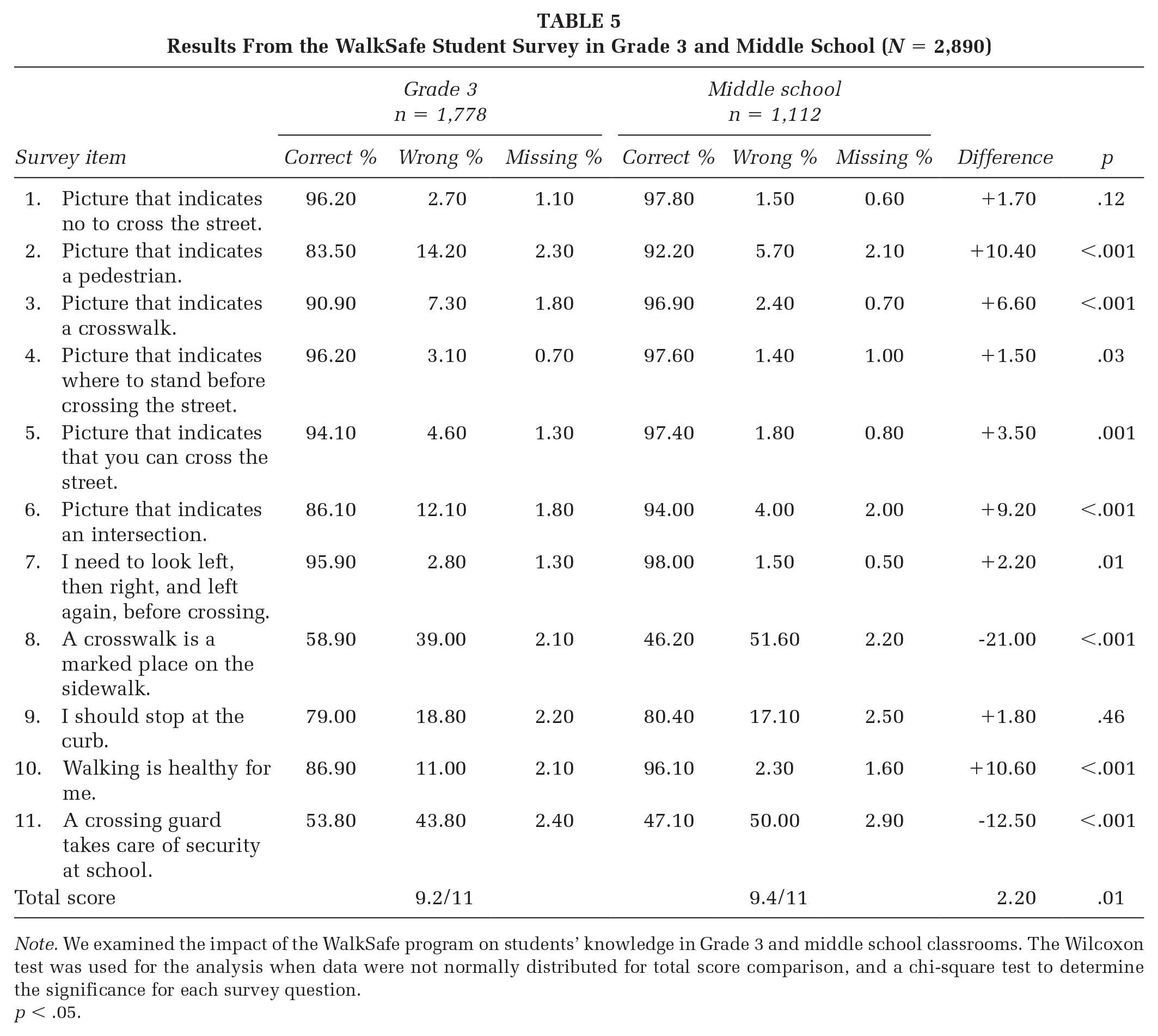
Note. We examined the impact of the WalkSafe program on students’ knowledge in Grade 3 and middle school classrooms. The Wilcoxon test was used for the analysis when data were not normally distributed for total score comparison, and a chi-square test to determine the significance for each survey question.
p < .05.
Discussion
This study provides valuable information to the sustainability and expansion of the WalkSafe program. Results of this study validate previous studies (Delouche et al., 2019; Kirley et al., 2023) on the effectiveness of WalkSafe and its positive effect on elementary students’ knowledge on pedestrian safety. Despite a few difficult safety concepts related to the role of a crossing guard and where a crosswalk mark is located on the road, this study shows an increase of pedestrian safety knowledge of elementary students as they are exposed to WalkSafe over time. This study also shows that middle schoolers are able to retain safety knowledge once they are no longer exposed to the WalkSafe program. However, participating middle schoolers (20.4%) also self-reported unsafe road practices, including the use of headphones when crossing the street and phones to text and/or talk when crossing the street (Guyon et al., 2020). The internationalization of pedestrian safety knowledge acquired through education is a critical primary prevention component in elementary and middle school.
Results of this study give pause to consider how to develop WalkSafe innovative educational strategies that reflect real-world road safety situations and require practice and repetition to reinforce learned safety knowledge that could be purposefully transferred to safety attitudes and behaviors if those are not already in place. The insertion and evaluation of purposeful interactive and innovative safety strategies, like the use of real-world simulations and virtual reality activities (Baldassa et al., 2024; McLaughlin et al., 2019; Schwebel et al., 2024) in the WalkSafe curriculum, might enhance the pathway to the development of a pedestrian primary prevention social consciousness in elementary and middle school children.
Limitations
This study identifies some limitations pertaining to the intervention and sample affecting both the results and their interpretation. With respect to the intervention, the WalkSafe curriculum was created to be fully implemented as a 3-day program; however, this study was not able to confirm that participating schools did in fact implement all 3 days. Unexpected and/or unreported changes in the intervention process may have affected the study results. Also, the sample in this study included kindergarteners and Grade 3 students, and future research on the WalkSafe program may want to include all grade levels to examine if there is a correlation between the increase of safety knowledge and years of students’ exposure to the program, particularly in Grade 5 as it is the last elementary grade in which students are exposed to the program.
This study was able to control for the pre- and post-assessments at the classroom, but not student level. Although it is reasonable to assume that, if not all, most students in selected Kindergarten and Grade 3 classrooms completed the pre- and post-surveys, there was no follow-up on students being lost, and no information can be reported on the response rate for the pre-test survey of eligible students who completed the survey. Another important limitation was that the study did not include measures to control for students’ maturation or knowledge gain about pedestrian safety from other sources of information, this included possible middle school students new to the school district or other available safety resources that students may have been exposed to prior or concurrent to the Walksafe program. In addition, a cultural consideration that may have affected the study results is that surveys were administered only in English in a school district with a large culturally and linguistically diverse student population. Some students with limited-English proficiency may have required the translation of surveys. Furthermore, a comprehensive investigation of pedestrian safety education for children encompassing safety knowledge acquisition and retention is needed to further understand other personal, social, and environmental variables, including safety attitudes and behaviors that were beyond the scope of this study.
Implications for Practice and Research
This study has both practical and research implications for educators, health practitioners, and researchers working on road safety primary prevention, particularly pedestrian safety for children and adolescents. Pedestrian safety education for children is in the eye of the beholder, and as such, future school-based research and practice should consider a multidisciplinary and participatory approach, reflecting the field of education, public health, sociology, psychology, and engineering. This approach should be inclusive of community stakeholders’ perspectives and experiences and give voice to children and adolescents in the development and implementation of innovative educational safety strategies and technology. Further international and national comprehensive meta-analyses should be conducted on effective active transportation interventions and educational models, including pedestrian safety in children. This type of study could provide insightful information on current trends and prospective study foci.
The sustainability, improvement, and expansion of the WalkSafe program are currently in motion through the development of different initiatives, including a middle school WalkSafe virtual curriculum, a family education WalkSafe program component, and a related project on an active transportation school-based program in high school. These are examples of how findings from this study and the annual WalkSafe program evaluation are being translated into transportation school-based safety practices as a path to primary prevention and health promotion.
Footnotes
Authors’ notes:
We sincerely appreciate Miami-Dade County Public Schools for its continued support and partnership over the years in the implementation of the WalkSafe program. Our appreciation also goes to the thousands of dedicated school administrators, physical education teachers, and other educators in promoting pedestrian safety for children and families in Miami-Dade County. Initial funding for the WalkSafe program was provided by the Department of Transportation Safe Routes to School Program and the Transportation Alternatives Program from the Florida Department of Transportation. We gratefully acknowledge the University of Miami KiDZ Neuroscience Center team members for their invaluable assistance with the study. Authors’ Institutional Review Board/Human Subjects granted approval for this study (ID 20221141). We, the authors, declare that there are no conflicting interests to report.
