






Abstract
Diversity, Equity, and Inclusion (DEI) efforts and facilitation have historically been focused on bias awareness, training on microaggressions, individual awareness, and affinity groups. This approach is often devoid of systems-level analysis and more profound work toward the cultural transformation of spaces, organizations, and agencies. To explore adding depth to the work of dismantling white hegemonic culture, we designed an equity committee process at the intersection of public health and social justice. The resulting tool, the Designing Equity Continuum, includes four phases (identity, formation, priorities and strategies, and implementation and evaluation) with two particles each. It was presented at four meetings of 90 staff at 50 nonprofit organizations in New York State. All participants evaluated the presentations as “very satisfied” with content. Six implications for practice are given, including varied organizational readiness, inadequate organizational structures, need for advanced capacity building, additional time needed to understand the tool, support for additional racial identity-based affinity groups, and ensuring equity committees operate separately from employee resource groups.
Keywords
Building and sustaining a commitment to organizational equity is long-term, necessary work. Diversity, Equity, and Inclusion (DEI) efforts and facilitation have historically been focused on bias awareness, training on microaggressions, individual awareness, and affinity groups (Creary et al., 2021). This approach often lacks systems-level analysis and the more profound inquiry and work required to move toward cultural transformation in organizations and agencies (Boykin et al., 2013). In addition, many DEI initiatives fail because they do not have a plan or intention to fundamentally shift power in the organization (Boykin et al., 2013).
Organizational efforts and resources spent building health equity and engaging with social determinants of health through human service programming have typically been external-facing, with little information available on efforts to examine and foster equity within these organizations (Andermann, 2016). Based on the multicultural organizational development literature, in this article we use the term “equity committee” to refer to a group of people holding the organization to values of equity and justice through thoughtful conversation and committed actions (CompassPoint Nonprofit Services, 2010; Holvino, 2008; Mayeno, 2007; Wall & Obear, 2008). Using practical tools, equity committees can support organizations with internal-facing equity framing, goal creation, and program delivery; they can also promote aligning organizational culture with the organization’s external mission (Wall & Obear, 2008). An equity committee comprises key power brokers, including staff, management, and leadership, and may also include community representatives. Equity committees hold an organization accountable to its values of equity and justice (once defined by the organization) through thoughtful conversation, data collection, and intentional action to sustain transformation inside and outside the organization. Equity committees are responsive and accountable to the needs of an organization and its community/catchment/priority individuals. The Rebellious Root Collective, a multiracial feminist facilitation and social design cooperative in New York City, founded by authors (B.B., M.F., and S.S.), worked alongside the University of Rochester LGBTQ+ Health Initiative team (S.B.R.-M. and B.A.L.) to design an equity committee tool at the intersections of public health, social justice, and organizational change to support New York State–based health and human service organizations currently providing programming focused on the health of the LGBTQ+ community.
Critical Praxis and Theoretical Framework
The Rebellious Root Collective’s work has been guided by over a decade of community organizing, youth work, social design, and nonprofit leadership. We lean heavily on our community-engaged praxis, professional, and lived experiences to shape our curriculum design, materials, and facilitation tools, and when necessary, consult the academic literature to explain our work further. As a multiracial, majority Black, femme and queer worker-owned cooperative, Rebellious Root Collective aims to build radically new futures for our communities by holding critical praxis at our center, which includes “intersectionality, scholar-activism, solidarity, attention to borders/boundaries, and radical transparent author positionality” (Hall, 2020).
As a collective, we engage in deep study of Transnational, Black, Indigenous, People of Color, Queer, Disabled, Trans, Women, and Femme scholars both inside and outside of the academy. We rely on both traditionally published literature and public scholarship to shape our understanding of the world and how we carry our mission-driven work forward. We engaged many social justice theories and critical frameworks to develop the Designing Equity Continuum but relied heavily on intersectionality to guide this work. Intersectionality, historically rooted in the experiences and narratives of Black women in the United States and coined by legal scholar Kimberle Crenshaw in 1989, is a theoretical framework, analytical strategy, and critical praxis to inform social justice work (Bowleg, 2025; Crenshaw, 1989; Eisenstein, 1978). As a critical praxis, intersectionality allows us to understand and explain the complexity of the world, people, and human experiences (Collins & Bilge, 2016). Furthermore, intersectionality highlights how power relations such as racism, sexism, heterosexism, classism, cisgenderism, and ableism differently structure the experiences and social, economic, and health outcomes of people from historically racialized, minoritized, and marginalized backgrounds (Bowleg, 2012).
While embracing critical frameworks and praxis is vital to addressing the structural inequalities in health through research and clinical practice, we have learned that they are equally, if not more, important to utilize when building the leadership, mission, and vision of health and social service organizations tasked with interrupting those very same inequalities.
Setting
The LGBTQ+ Health Initiative was funded by the New York State Department of Health AIDS Institute to increase organizational equity in terms of race, ethnicity, sexual orientation, and gender identity within 50+ New York State health and human service agencies that also received funding from New York State Department of Health AIDS Institute to provide services to the LGBTQ+ community (Levandowski, Naimool, et al., 2025; Levandowski, Rietberg-Miller, et al., 2025). A needs assessment was conducted between March 2020 and May 2021. A purposive sample of employees from all organizations were sent an email including a link to complete the survey, requesting that at least one staff member and one director/person in a decision-making position complete the needs assessment. This resulted in 38 organizations that completed 58 surveys. Over half (54%) reported interest in further antiracism (defined as the active process of identifying and eliminating racism by changing systems, organizational structures, policies and practices, and attitudes so that power is redistributed and shared equitably) training. One quarter (25%) of respondents reported interest in lesbian, gay, bisexual/transgender gender nonconforming/queer (LGB/TGNC/Q+) safe space (defined as creating policies or practices of opposing homophobia and transphobia and promoting LGB/TGNC/Q+ inclusion) training. Our basic premise is that the majority of people serving the LGBTQ+ community with healthy, human-centered services are themselves members of the LGBTQ+ community. Therefore, increasing organizational equity leads to staff being more resourced to provide better care and support to the LGBTQ+ community through their organizational roles. As illustrated in other work, prioritizing marginalized communities in intervention development builds a stronger foundation for success (Lautner et al., 2023).
Introduction to the Designing Equity Continuum Tool
The Rebellious Root Collective defines equity as the fair and just distribution of money, power, and resources that ultimately lead to fair treatment, access, opportunity, and advancement for all people. Equity as a framework, value, and practice strives to identify and eliminate barriers that have prevented the full participation of historically marginalized groups. Any path toward equity must acknowledge the root causes of disparate health outcomes in society and challenge the “status quo” of power relations, implicit bias, and societal norms that minoritize and marginalize groups. Thus, we believe that health equity can only be achieved when all people have the economic, social, and political power and resources to make decisions about their lives, families, and communities.
We offer the Designing Equity Continuum tool for organizational use, whereby the organization identifies where in the continuum their equity committee currently exists, and offers a strategy for deepening equity work. It consists of four phases: (1) Identify, (2) Formation, (3) Priorities and Strategies, and (4) Implement and Evaluate. The phases outline the stages of the equity continuum. Each phase includes two particles to ground the actions performed within the phase. Each particle is personified by a movement activist, elder, or ancestor whose body of work inspires the actions to be taken within the phase (Figure 1).

Designing Equity Continuum Illustrates the Cycle of Equity Committee Development and Movement Within Organizations
The Identify Phase asks organizations to decide what equity would look, feel, and function like in their organization; it focuses on inclusion plus team cohesion and accountability. Building on the Identify phase, the Formation mechanism supports organizations in identifying the people, money, and resources needed to sustain an equity committee. It focuses on transformative systems and community care. The third phase, Priorities and Strategies, is focused on network building and change management, i.e., when the committee chooses a focus and charts how they will get there. This mechanism says, “This is what we want, and this is how we do it,” by asking (1) how you build power, (2) with whom, and (3) how this aligns with larger goals. The fourth phase, Implement and Evaluate, asks organizations to move from the theoretical and conceptual to the material and tangible to achieve their defined priorities and strategies, by committing to sustained action toward liberation (Table 1). Practical examples of using the tool within organizational teams are available (Rebellious Root Collective, 2024).
Designing Equity Continuum Tool: Phases, Particles, and Thought Leaders to Personify Actualizing Organizational Equity
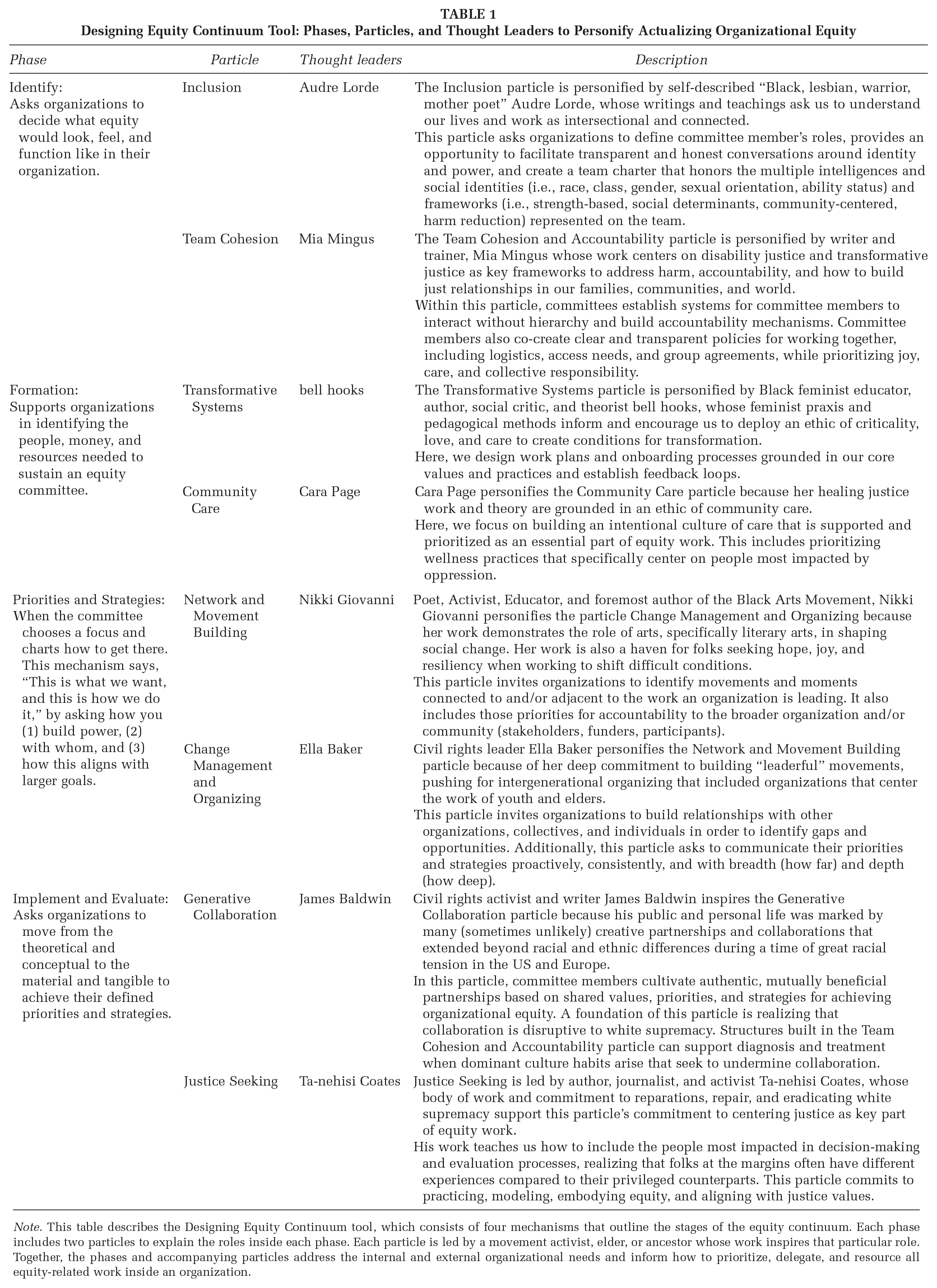
Note. This table describes the Designing Equity Continuum tool, which consists of four mechanisms that outline the stages of the equity continuum. Each phase includes two particles to explain the roles inside each phase. Each particle is led by a movement activist, elder, or ancestor whose work inspires that particular role. Together, the phases and accompanying particles address the internal and external organizational needs and inform how to prioritize, delegate, and resource all equity-related work inside an organization.
Implementation and Evaluation of the Designing Equity Continuum Tool
Over 3 years, this tool was presented at four 2-hour sessions, inviting all organizations who participated in the needs assessment. The first three sessions were evaluated by participants in a voluntary, anonymous, formal evaluation form which asked about (1) overall rating, (2) communication and presentation skills using a 5-point Likert-type scale from very satisfied to very unsatisfied, and (3) open-ended questions on feedback for session improvement and/or follow-up requested. Participants submitted only anonymous qualitative comments to a Google Jamboard in the last session. As session feedback was combined with feedback from all sessions in a day of technical assistance training, data from the fourth session is not shown. Descriptive statistics were conducted on quantitative evaluation results (Excel v.2108). Qualitative responses were inductively coded (B.A.L. and S.B.R.-M.) using deductive coding, dividing responses into categories for process/design/delivery of the tool and comments about the tool itself.
A total of 90 participants attended the sessions (n = 39, n = 6, n = 11, n = 34) in each session chronologically, respectively and 10 (18% of n = 56) completed the formal evaluation (n = 7, n = 2, n = 1 chronologically, respectively). All (100%) respondents rated the overall session, satisfaction with communication skills, and speakers’ knowledge of the topic as “very satisfied” (M = 5.0); an average of “very satisfied” was reached for pace and timing (M = 4.8). All (100%, M = 5.0) respondents reported the session “offer[ed] new insight or ideas that you can take back and apply to your job.”
Most comments highlighting critical takeaways of the session can be summarized by one respondent, who said, “Loved the way they outlined the evolving stages of committees and their work—so helpful!” Recommendations on follow-up focused solely on the tool. Several requested implementation strategies for the tool, including “how to have the hard conversation with [my] agency on approaching equity.” Specifically, participants wanted both additional time to develop action plans to start their first equity committee and examples of policies that supported equity committee creation. This includes discussions about equity committee membership and the participation of clients and community members.
Implications for Practice
Practical tools are paramount to guiding the efforts of organizations that seek to foster cultural change and promote equity. The first workshops to present the Designing Equity Continuum tool produced key lessons on its value to support the formation and maintenance of equity committees, helped identify operational prerequisites and gaps within organizations, and provided insight into the requirements for meaningful training on the tool:
Implications for Policy
Organizational policies need to delineate which DEI initiatives will be used within organizations to support organizational equity, and ensure that each initiative is funded appropriately and integrated into the organizational framework. Fully staffed committees need to include reassessment of work responsibilities, as appropriate, to ensure that staff do not need to “fit” committee work into the existing requirements/target goals; additional compensation may be considered. Policies may need to be developed within organizations to ensure that staff can be approved to join without supervisor interference.
In addition, equity committee work needs to be defined and separated from affinity and employee resource groups. Although equity committees benefit from diverse stakeholder participation, dedicated affinity spaces should be established to support specific racial and ethnic groups in processing, discussing, and addressing their unique experiences. For example, Black, Indigenous, and People of Color staff members should have access to dedicated spaces separate from general equity committee meetings. Depending on the makeup of the organization, this might require a separate space for Black-identified committee members to process concerns related to anti-Black racism. While both equity committees and employee resource groups are essential to moving an organization forward in assessing and fostering equity, they serve distinct purposes. For an equity committee to be effective, it must include members at all levels of an organization and hold decision-making power.
Conclusion
Implementing the Designing Equity Continuum tool reveals both the promise and challenges of systematically addressing organizational equity in health and human service agencies. Although the tool received overwhelmingly positive feedback from participants, the exercise uncovered critical insights about the complexity of implementing meaningful equity initiatives. The varying levels of organizational readiness, insufficient infrastructure for addressing DEI concerns, and temporal constraints in training delivery highlight the need for more comprehensive and customized approaches to organizational equity work.
The findings underscore that establishing productive equity committees requires more than just theoretical frameworks—it demands structural support, dedicated resources, and sustained commitment from all organizational levels. These lessons provide valuable guidance for organizations seeking to move beyond traditional DEI approaches toward more substantive structural change. As LGBTQ+ health care and human service organizations continue to strive for both internal and external equity, tools like the Designing Equity Continuum, when properly implemented and supported, can serve as vital catalysts for meaningful organizational transformation.
