







Abstract
Lack of access to healthful foods and food insecure environments are among the most significant issues in the United States, exacerbating health disparities especially among racially minoritized populations. Structural racism and other social determinants of health contribute to racial inequities in food and nutrition security. Many people of color in the United States do not have access to culturally relevant health care services, due to the impact of structural racism on health care access and representation in health professions. Addressing inequities in food access and nutrition security calls for systematic approaches that involve not only providing people with wholesome foods but also enabling them to embrace healthier diets. In this Career Development commentary, we share our experience as undergraduate students participating in the Delta GREENS (Growing a Resilient, Enriching, Equitable, Nourishing food System) project and our state-level policy recommendations for expanding the reach of Delta GREENS throughout Mississippi. Our collective efforts aim to instigate lasting transformations that enhance health outcomes and reduce health inequities in Mississippi. As the next generation of public health, health care, and policymaking professionals, we look forward to using our experiences and our voices to improve public health for all.
Lack of access to healthful foods and food insecure environments are among the most significant issues in the United States, exacerbating health disparities especially among racially minoritized populations. Black, Hispanic, Native American, and other minoritized racial/ethnic groups are at higher risk for cardiovascular disease and other negative health outcomes because of structural racism and discrimination (Javed et al., 2022). An example of structural racism that contributes to these inequities includes decades of redlining (Bailey et al., 2021), which limited grocery businesses and high-quality health care in black neighborhoods. Lack of economic development and inadequate infrastructure in these communities contributes to a never-ending cycle of poor health (Javed et al., 2022).
There is no doubt that nutrition influences one’s health. Poor dietary quality, defined as a lack of fresh fruits, vegetables, and whole grains, has been linked to obesity, cardiovascular disease, cancer, and other health issues (McCullough et al., 2022). Structural racism and other social determinants of health contribute to racial inequities in food and nutrition security (Volpp et al., 2023). Many people of color in the United States do not have access to culturally relevant health care services, due to the impact of structural racism on health care access (Bailey et al., 2021) and representation in health professions (Lett et al., 2019).
Addressing inequities in food access and nutrition security calls for systematic approaches that involve not only providing people with wholesome foods but also enabling them to embrace healthier diets. The Delta GREENS (Growing a Resilient, Enriching, Equitable, Nourishing food System) initiative is a collaboration between the Tufts Friedman School of Nutritional Science and the Reuben V. Anderson Institute for Social Justice and Tougaloo College. (Tufts University, 2023) Delta GREENS is designed to address inequities in food systems, access, and quality across multiple levels by partnering with local farmers, health care providers, and community organizations. In this commentary, we share our experience as undergraduate students participating in the Delta GREENS project and our state-level policy recommendations for expanding the reach of Delta GREENS throughout Mississippi.
The Mississippi Delta is renowned for its rich culture, agricultural history, and fertile soil. Yet, health inequities tied to discrimination, poverty, and racial exclusion persistently plague its Black residents. Mississippi’s extreme poverty stems from racial capitalism and the South’s slavery-based agrarian economy, the remnants of which still linger. (Tufts University, 2023)
Food Is Medicine Initiatives
Several states, including California and Massachusetts, have successfully piloted Food is Medicine (FIM) programs, providing valuable insights into effective strategies and potential challenges. Through the California Food Is Medicine Coalition (CalFIMC), California brings nutrition into health care through partnerships between health care providers and community organizations. Medically tailored meals (MTMs), nutrition counseling, and collaboration with health care providers are key components of California’s program. Food is medicine should be incorporated into standard health care procedures due to California’s success with these initiatives, which have contributed to improvements in patient health outcomes and cost reductions (CalFIMC, n.d.). Massachusetts has also set the standard for FIM programs through initiatives like the Community Servings (2025) program, which provides MTM’s and nutrition education. These initiatives have demonstrated the feasibility and impact of interventions that link health care with nutrition assistance, with the goal of improving health outcomes and reducing health care costs (Berkowitz et al., 2018). The Delta GREENS project in Mississippi draws upon lessons learned from these pioneering efforts to tailor its approach to the specific needs and contexts of communities in the Mississippi Delta region.
Our Team
Morgan D. Stanley
I am a senior at Tougaloo College, majoring in biology and minoring in public policy. I aspire to attend medical school and become a cardiothoracic surgeon, driven by personal experiences growing up in the Mississippi Delta, where cardiovascular disease is prevalent. My great-grandfather’s death from a heart attack deeply affected my family, especially my mother, who fell into depression. This experience fueled my passion for cardiology and inspired me to combat heart disease. In the Delta, limited access to fresh, affordable food and the prevalence of fast food contribute to high rates of heart disease. Many of my relatives suffer from conditions like diabetes and hypertension, and I’ve lost loved ones to heart attacks, strokes, and cancer. To address this, I’m working with the Rueben V. Anderson Institute for Social Justice to develop sustainable food economies in Bolivar, Coahoma, and Sunflower Counties. In 2024, I was a fellow in the Association of State Public Health Nutritionists Program for Public Health Practice, during which I researched cardiovascular disease risks among historically Black college students. I also collaborate with the Food Is Medicine Project, where I explore the intersection of natural and social sciences in addressing health disparities. Through these experiences, including my work with the Delta Health Food Policy Council, I am committed to improving public health and policy in my community.
Rokiyah Hobbs
Food is national security. Food is the economy. It is employment, energy, and history. Food is everything—Chef Jose Andres
This profound truth resonates deeply, especially when addressing food insecurity in the Mississippi Delta. Having worked on the Delta GREENS Food Is Medicine initiative for 3 years, I have witnessed firsthand the transformative power of this project. Growing up in the Delta, I have personally experienced how food insecurity, education gaps, and lack of access to nutritious options profoundly affect our communities. This initiative has allowed me to contribute meaningfully to solutions that address these challenges. From speaking with farmers about their lived experiences and visiting their farms to witnessing their resilience, I’ve gained invaluable insights into the intersection of food justice and sustainability. Creating community digests that educate residents about the nutritional benefits of fruits and vegetables—and how to prepare them—has been equally rewarding. These efforts not only inform but also empower individuals to make healthier choices. Researching Medicaid 1115 waivers to explore sustainable funding for nutritious foods was another key component of my work. Presenting these findings to the White House Office of Public Engagement underscored the importance of policy advocacy in addressing systemic inequities. Collaborating with my incredible Delta GREENS cohort, each member from diverse backgrounds yet unified by our shared mission, has been inspiring. We’ve connected deeply to the cause, bringing unique perspectives and strengths to a collective effort. This experience has been profoundly educational and fulfilling, reminding me that addressing food insecurity is not just a good deed but a justice-driven imperative for the well-being of our community and there is still work to be done.
Nayla McClure
As a small-town girl, working on the Delta GREENS project in partnership with Tufts University has been a transformative experience, deepening my understanding of the food insecurities faced in Mississippi. This initiative has not only allowed me to connect more profoundly with my community but also provided me the opportunity to grow as a student researcher. Through this work, I’ve gained invaluable insights into the complex interconnections between local sustainability, food insecurity, and economic growth. Witnessing the evolution of this project—from my freshman year to now—has been one of the most rewarding aspects of my collegiate journey, offering both personal fulfillment and a sense of purpose.
Wykendrick Jones
My experience with the Delta GREENS Food is Medicine program has profoundly broadened my understanding of the interconnectedness between food systems, health outcomes, and the policies that shape them. This exposure illuminated the critical role that access to nutritious food plays in fostering community well-being and equity. Inspired by this transformative experience, I have embarked on a journey to develop a Food is Medicine initiative on the campus of Tougaloo College. Through the support of the E Pluribus Unum Fund Youth Fellowship, I aim to create a program that not only provides healthier food options but also educates the campus community about the power of nutrition in preventing and managing chronic illnesses. This initiative is driven by my passion for bridging health disparities and ensuring that food justice becomes an integral part of our campus culture and beyond.
Our Policy Recommendations
To expand the reach and impact of the Delta Greens Food Is Medicine Project, we propose several policy recommendations for implementation in Mississippi First, nutritional support services including MTM’s and produce prescription programs should be included in Medicaid and Medicare services. This could include Section 1115 Medicaid demonstration waivers (see Kaiser Family Foundation, 2025) and other strategies to increase coverage of these services. Second, nutrition education and support services should be integrated into routine clinical care. This could be accomplished through partnerships with community organizations, training and continuing education for health care professionals that includes information about payment mechanisms for Food is Medicine interventions, and incorporating Food is Medicine education into curricula and continuing education opportunities. Finally, it is imperative that community-based programs that promote food security, food access, and healthy eating receive additional funding and support to provide tailored and culturally relevant services.
Implications for Practice
As participants in the Delta Greens Food Is Medicine Project, our responsibilities go beyond community involvement. We also produce and share monthly health digests and cookbooks, design informative postcards, organize community events, and advocate for policies to improve health. We produce Healthy Digests and Cookbooks, which are monthly publications that include information on the health benefits of various foods, healthy recipes, and cooking tips. We design nutritional guidance and reminders for quick, easy access in the form of postcards and distribute them at community centers, clinics, and special events. Most importantly, we advocate for policy improvements on local, state, and national levels. These efforts have included presentations to the Mississippi State Legislature’s Legislative Black Caucus and discussions at the White House Office of Public Engagement (Figure 1).
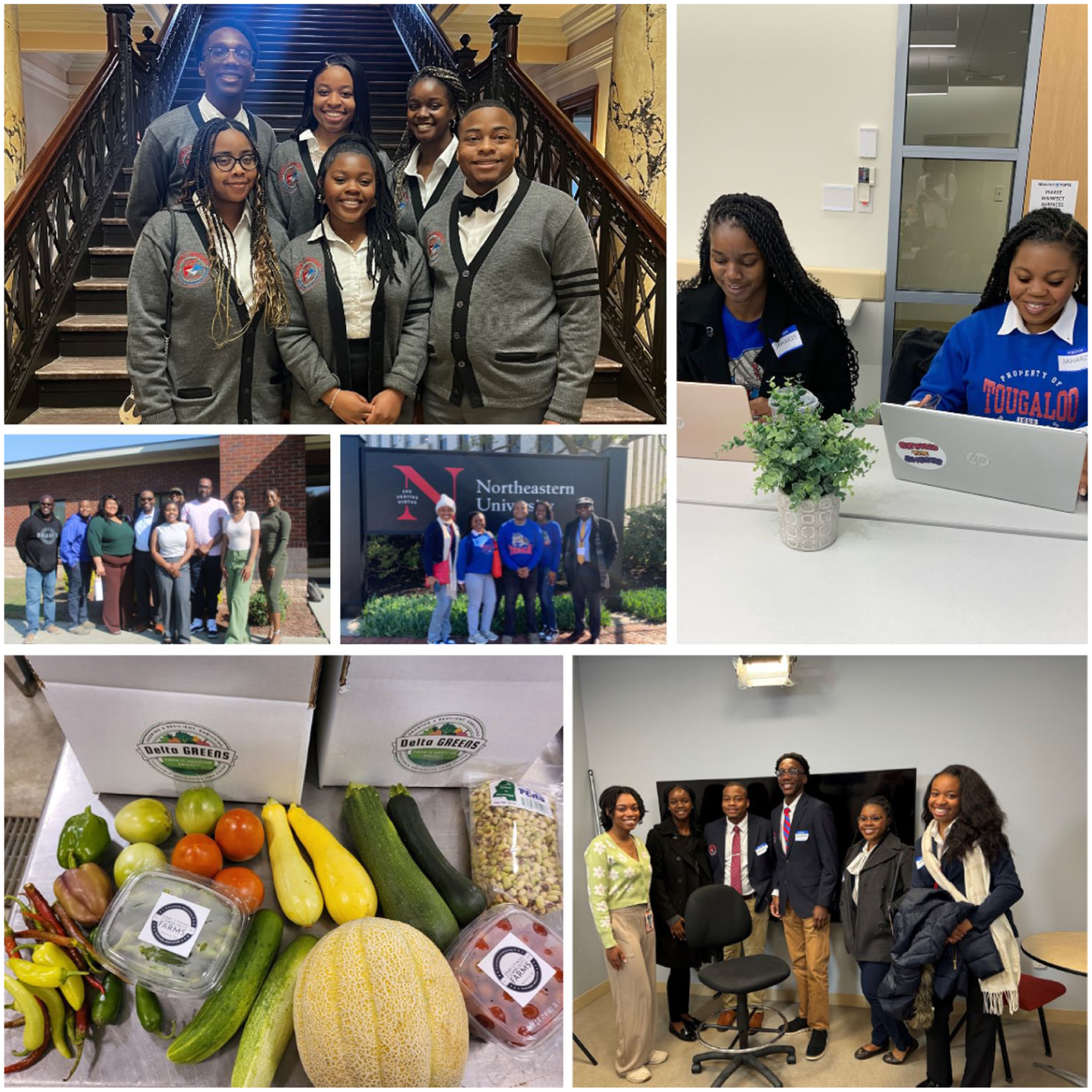
Delta Greens FIM interns advocating for health policy at the Mississippi State Capitol and serving their community with the Delta Health Food Policy Council. Also shown are the Delta Greens Produce Boxes, which were distributed to study participants and contained fresh fruits and vegetables to support nutritional health. The interns also participated in an educational visit to the Friedman School of Nutrition Science and Policy at Tufts University in Boston.
Our advocacy focuses on reducing hunger, promoting healthy eating, and encouraging physical activity. Through our efforts, we aim to instigate lasting transformations that enhance health outcomes and reduce health inequities in Mississippi. As the next generation of public health, health care, and policymaking professionals, we look forward to using our experiences and our voices to improve public health for all.
Footnotes
Authors’ Note:
We extend our sincere thanks to Atty. Julian D. Miller, Dr. Lawren Long, and Jacorius Liner of the Reuben V. Anderson Institute for Social Justice for their continued guidance and support. We also thank Dr. Christina Economos and Sharon Jimerson from Tufts University’s Friedman School of Nutrition Science and Policy for their mentorship and collaboration.
