







Abstract
In 2018, the Nicotine and Cannabis Policy Center’s (NCPC) Community Core established a partnership with two state, one national, and local nonprofit and community-based organizations (CBOs) to increase policy capacity and community involvement in tobacco and cannabis control efforts in a predominantly rural region of California. Using principles of community-engaged research, the Community Core expanded their partnership network and provided colearning and networking opportunities for local CBOs, local public health departments, community members, and researchers to enhance their policy impact. We organized four full-day in-person workshops conducted in 2018 to 2019 and 2023 to increase regional tobacco and cannabis policy expertise; discuss shared goals, resources, and strategies; develop policy messaging skills building and facilitate dialogue between different audiences; provide legislative updates and state policy engagement trainings; and discuss local successes and challenges. In 2020 to 2021, we organized and implemented six virtual webinars during the COVID-19 pandemic. In terms of communications output, we established a message board with 183 subscribers from nine counties, developed an NCPC researcher video series, and trained a cadre of college-aged youth social media interns who posted hundreds of messages. In-person interactive workshops were found to be most effective, with social media and message boards having limited engagement. Our novel approach of bringing local, state, and national CBOs together enhanced the knowledge, resources, and expertise of each organization to optimize tobacco and cannabis control in our underserved region.
Although cigarette smoking rates have declined for decades (US Department of Health and Human Services, 2014), they continue to be higher in rural regions of the United States (Roberts et al., 2016), and those in rural regions who do not smoke cigarettes are the fastest-growing demographic of cannabis users (Coughlin et al., 2019). Lack of local tobacco and cannabis control policies (e.g., multiunit housing legislation) and inequitable policy enforcement may contribute to regional differences (Matrix of Smokefree Multi-Unit Housing Policies in California, 2024). Rural settings also frequently experience limited health care resources, pro-tobacco norms, and targeted advertisements (Roberts et al., 2016). In California’s rural San Joaquin Valley (SJV), smoking rates ranged between 15.9% and 7.6% between 2018 and 2021 (UCLA Center for Health Policy Research, n.d.b), in contrast with urban regions like San Francisco, where rates ranged between 12.1% and 5.6% in 2018 and 2021 (UCLA Center for Health Policy Research, n.d.a). The rise of e-cigarette and cannabis use (Meng et al., 2022) also has potential to lead to poor health outcomes (Page et al., 2020).
In California’s urban settings, tobacco control policy initiatives have been highly successful (U.S. Laws for 100% Smokefree Multi-Unit Housing, 2023), although cannabis control initiatives are nascent. For example, in 2018, San Francisco County enacted a ban on flavored tobacco products despite a US$12 million campaign against the policy, funded primarily by R. J. Reynolds Tobacco Company (Yang & Glantz, 2018). Conversely, advocates in rural settings have encountered difficulties establishing coalitions and garnering political support for tobacco and cannabis control policies, partially because fewer resources have historically been allocated to coalitions and their ability to promote community education and policy change (Payán et al., 2022; Satterlund et al., 2011). A lack of infrastructure for coalition-building, local nonprofit, and community-based organization (CBO) policy capacity and organizational barriers have also undermined efforts (Buettner-Schmidt et al., 2019; Satterlund et al., 2011).
Prior research indicates community-engaged interventions can advance healthy changes in rural regions. Community-engaged approaches and coalitions increase community capacity to improve policy environments and regulate tobacco and cannabis products, particularly through colearning and social network expansion (Pakhale et al., 2016). As coalitions grow, they may increase policymaker awareness by elevating community concerns (Lowery et al., 2025). Such approaches provide culturally and socially appropriate resources and support (Kenny et al., 2021). However, understanding how community-engaged interventions are implemented and identifying barriers to success in rural settings is necessary.
Community coalitions comprising community leaders, CBOs, academic researchers, and others can leverage different strengths to advance policy initiatives. At the state level, a coalition led by health organizations and a nonprofit successfully advocated for a menu labeling law in California by collecting public opinion data, working with state policymakers, and collaborating with media outlets to garner support (Payán et al., 2017). At the local level, a Minnesota county health department partnered with a CBO to target menthol use in three cities (Kingsbury & Hassan, 2020). Strategies included holding educational events with community leaders, interviewing residents, collecting data, and reporting data to policymakers and the media. This partnership helped build a research-based foundation restricting sales of menthol products to adult-only stores.
In an effort to increase and leverage connections and partnerships in the SJV, the Community Core within the Nicotine and Cannabis Policy Center (NCPC) at the University of California, Merced, worked with local CBOs (Healthy House, California Health Collaborative), and the national organization, the American Heart Association (AHA), to initiate a longitudinal strategy to engage community members, enhance policy-relevant communication skills and opportunities, support local policy efforts, and create a network to develop a regional plan to eliminate tobacco use in California by 2035. Elemental to this effort were full-day workshops (n = 4 in 2018–2019 and 2023) and webinars (n = 6 in 2020–2021). Workshops fostered networking opportunities between health departments, CBOs, policymakers, and community members. We created a message board and utilized social media to regularly provide access to relevant tobacco and cannabis news, and to distribute NCPC’s resources (e.g., webinar recordings). In this case study, we use direct observations and workshop evaluations when available to describe the process of developing and implementing workshops, webinars, and social media to engage local stakeholders to develop capacity, networks, and knowledge in an underserved region. Our goal is to report successes, challenges, and lessons learned to inform those seeking to bring community members, leaders, and researchers together to help local policy initiatives succeed in rural areas.
Method
Regional Context: San Joaquin Valley (SJV), CA
The SJV is a rural region of California with a predominantly diverse, low-income population that is greatly underserved, contributing to numerous health disparities. The SJV is considered a medical desert due to the shortage of physicians and specialists, with 39 physicians per 100,000 residents when 60 to 80 physicians are recommended (Meeting the Demand for Health: Final Report of the California Future Health Workforce Commission, 2019). This shortage exacerbates existing disparities, including higher smoking rates than state coastal regions (UCLA Center for Health Policy Research, n.d.a, n.d.b). Building opportunities for CBOs to network, share resources, and support policies is important in regions like the SJV, which has limited local tobacco and cannabis policy control initiatives compared with urban regions (U.S. Laws for 100% Smokefree Multi-Unit Housing, 2023). CBOs can provide support and fill gaps in rural areas with scarce resources.
A Collaborative Empowerment and Partnered Approach
Collaborations can help increase CBOs’ capacity, but social dynamics can be challenging and complex when limited engagement and trust exist between community leaders, researchers, and other organizations (Ngui, 2020). NCPC was established when organizations in our region were disparate and siloed. Recognizing potential distrust of the scientific community, we first built community networks and trust to support future community-led and engaged research. Research activities associated with this work were reviewed and approved by the university institutional review board (IRB UCM2019-64).
The Framework for Collaborative Empowerment (Fawcett et al., 1995) served as the foundation for NCPC’s coalition and capacity-building strategies. This framework includes five components that create a feedback loop: (1) collaborative planning, (2) community action, (3) community change, (4) community capacity and outcomes, and (5) adaptation, renewal, and institutionalization, leading back to Step 1. During collaborative planning, partners identify the community’s desired goals and potential actions. Community leaders then assist residents in the planning process. Planning leads to activities that raise issue awareness and help bring about action by local leaders and residents to affect community-level change (e.g., new policies). The ideal outcome is to create change and build capacity for future initiatives by bringing diverse people together to effectively implement community-level changes.
Aligned with the Framework for Community Empowerment, the Community Core’s activities were designed to enhance: (1) experience and competence, (2) group structure and capacity, and (3) community support and resources (Fawcett et al., 1995). Policy-oriented workshops and webinars were planned and implemented in partnership with established CBOs (Healthy House, California Health Collaborative, AHA) to convene community leaders, county public health officials, policymakers, health experts, and researchers. These events included trainings on the history of state tobacco regulation, briefings on upcoming policy initiatives, mentoring in speaking with legislators, and mobilizing community volunteers for policy change.
AHA provided policy advocacy expertise and technical assistance for local CBOs, primarily including Healthy House and California Health Collaborative, which have both worked to improve the health and quality of life for SJV residents for decades. Healthy House provides a large network of interpreters who assist with health care interpretation, while California Health Collaborative offers healthcare programs for youth and seniors. AHA brought a long history of implementing coordinated advocacy campaigns to advance public policies at the national, state, local, and tribal levels. It has achieved many accomplishments in tobacco control policy and regulation in California, including playing a lead role in advocating for Proposition 56 that raised taxes on cigarettes, raising the age to purchase tobacco from 18 to 21 years, and numerous other achievements.
Case Study Development and Description
We hosted a series of in-person workshops between 2018 and 2019, and in 2023, and virtual webinars between 2020 and 2022 due to COVID-19 pandemic restrictions. Workshops and webinars aimed to: (1) establish the current state of regional tobacco and cannabis control policy and (2) build local CBO tobacco policy knowledge and expertise by allowing CBOs seasoned in tobacco policy and local leaders with less policy experience to build networks. See Table 1 for detailed descriptions of these events. We conducted direct observations of each event and recorded conversations, questions asked, and interactions in detailed fieldnotes. We also solicited participants’ feedback in both formal (short surveys) and informal (postworkshop conversation) forms. Formal evaluations were completed intermittently, and focus groups were not conducted, because we prioritized pressing education, networking, and engagement needs, and due to capacity constraints during the COVID-19 pandemic. Because we only collected formal surveys in three of four workshops and three of six webinars, findings reported stem primarily from fieldnotes.
Description of the NCPC’s Community Core Workshops and Webinars in the San Joaquin Valley (SJV), California (2018–2023): Timeline, Event Description, and Attendance
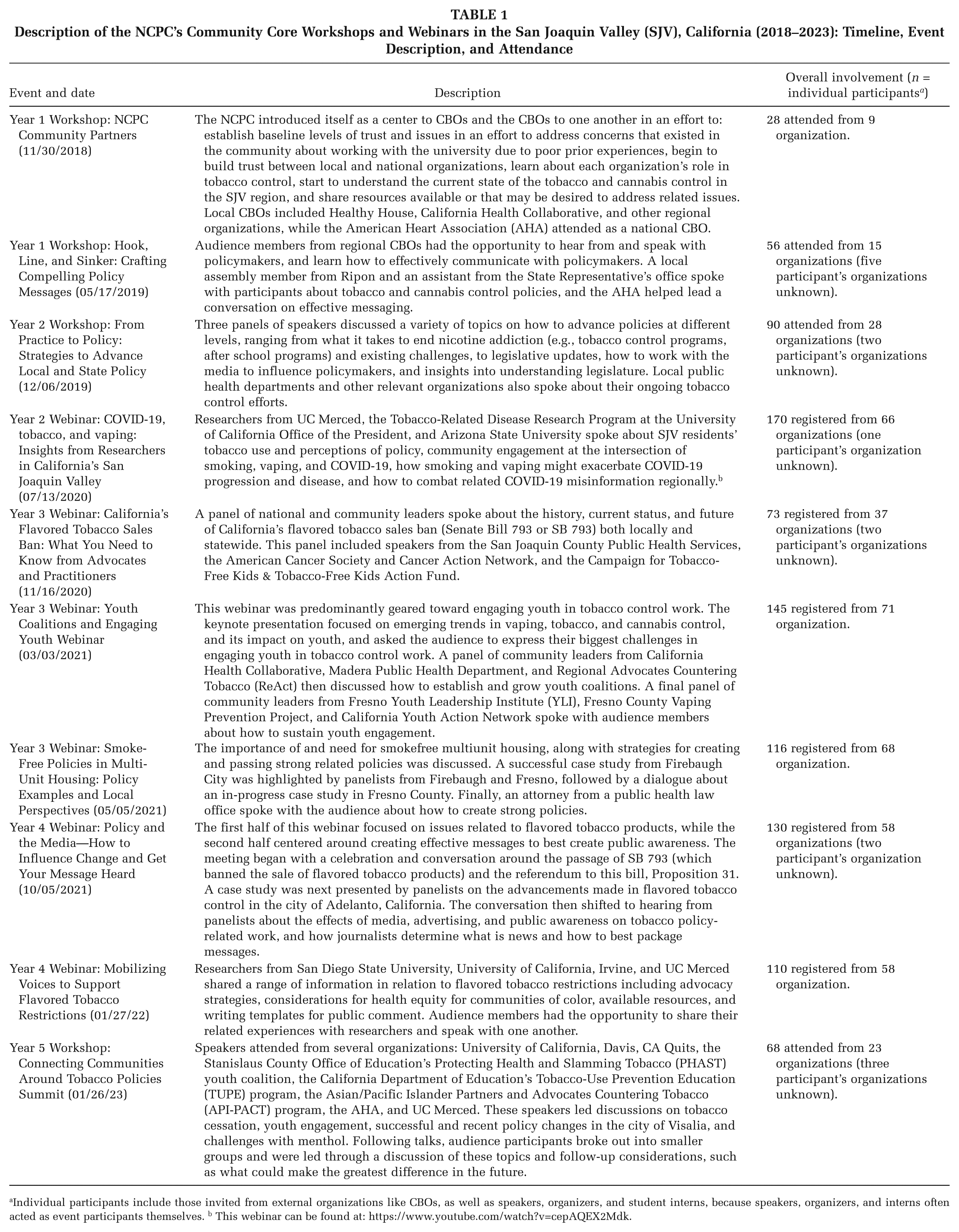
Individual participants include those invited from external organizations like CBOs, as well as speakers, organizers, and student interns, because speakers, organizers, and interns often acted as event participants themselves. b This webinar can be found at: https://www.youtube.com/watch?v=cepAQEX2Mdk.
We strategized to reach the SJV community using a message board, online video series, and social media. The message board was created through the Slack messaging program and reached 183 subscribers from nine SJV counties. Messages were created to generate further intragroup discussions (e.g., sharing relevant articles and petitions).
To publish an online video series, we created a YouTube channel and uploaded 11 videos produced between 10/09/2018 and 10/08/2021. Videos contained an NCPC overview, introductions to NCPC researchers, community members interviews, a city council presentation, webinars, and a video on the Stanford Tobacco Prevention Toolkit (Stanford Tobacco Prevention Toolkit, n.d.). Webinars were only publicly available if all speakers provided written consent. We posted up-to-date tobacco and cannabis information through the Facebook, LinkedIn, Instagram, and Twitter social media platforms. Beginning Summer 2019, NCPC’s undergraduate interns were recruited and trained to create social media posts.
Findings
In the following, we highlight activities that addressed workshop/webinar aims. Qualitative data are from anonymized postworkshop evaluations.
Participants predominantly included local individuals from CBOs, public health departments, health services, education agencies, coalitions, probation offices, and national organizations and other universities. Across workshops and webinars, participants reported positive experiences, with topics being relevant and informative. Participants found it useful to hear from and interact with those at local public health departments and CBOs, allowing opportunities to create meaningful collaborations moving forward, and underscoring the importance of having engagement between entities.
I am grateful to have network[ed] with so many health professionals. I’ve learned a lot from all of them. (Community Workshop 3) The information given was very valuable and will be something I will take back to my community and program. (Community Workshop 3)
Participants also found it beneficial to hear from policymakers and representatives, particularly on how to effectively craft messages to policymakers (e.g., including personal experiences as a “hook”). Some participants expressed concern about engaging in policy activities (particularly those who worked in government or public sector roles), while others stated that they lacked knowledge and training on policy content and policymaking processes, and were unsure how to participate or help craft effective policies.
[In future meetings, cover] suggested/sample policy language that comes from data collection. (Community Workshop 2) The crafting compelling messages workshop reminded me a lot of the I&E days that we do in tobacco control programs. (Community Workshop 2)
Keep everyone in touch that was here. Email attendees to touch base as a group! (Community Workshop 2)
In response, we created a message board and made educational materials available on NCPC’s website. This request reflected a continuous desire for additional networking and interaction time with others working in the SJV on tobacco and cannabis control. Even when ample time was provided (e.g., during an 8-hour workshop), participants still requested more interaction time, demonstrating the value of providing ongoing opportunities for connection.
Need more discussion among groups. Best part! (Community Workshop 2)
Emerging needs arose during the workshops, including interest in learning more about state and local policy advocacy, passage, and barriers.
[In future meetings, cover] how to engage local policymakers, policy 101, and best practices on tobacco policy in [the] Central Valley. Lessons learned on initiatives that were/weren’t successful in local jurisdictions. (Community Workshop 2)
Digital Outreach
Engagement levels differed for each digital outreach initiative. We found the most success using various social media platforms, posting new content frequently. Between Summer 2019 and Spring 2023, NCPC developed an undergraduate intern program geared toward translating tobacco and cannabis control information into social media content. During this time, 52 interns learned how to locate recent tobacco and cannabis-related news articles, scientific findings, laws, interventions, and programs, and report key findings on social media posts using hashtags and GIFs to help garner attention. Interns created four posts a day, uploading them to the four social media platforms on Monday through Friday between 9 a.m. and 3 p.m., resulting in approximately 60 to 90 posts per platform month per month, depending on the month’s length and holidays.
The most popular platform was LinkedIn (277 followers), followed by Facebook (255 followers), Twitter (204 followers), and Instagram (147 followers). These accounts collectively had greater engagement based on the number of followers and responses to posts (i.e., “likes” and “comments”) than our YouTube channel or Slack message board. While we developed the message board as a useful way for CBOs, community leaders, community members, and researchers to stay in touch, there was minimal use.
Our YouTube channel became active in 2018 and the 11 videos posted received an average of 60 views, with 661 total views. The least viewed video was watched seven times, and the most viewed video (the “COVID-19, Tobacco and Vaping: Insights from Researchers in California’s San Joaquin Valley” webinar) was watched 135 times. Since webinars were provided as educational resources and due to the nature of the content, we disabled the comments feature to discourage spamming.
Discussion
We brought local and national CBOs together to build networks and develop each other’s policy knowledge and expertise in areas where gaps existed. Through this partnership, we implemented a novel approach to advancing both state and local policies by providing expertise and training through workshops, webinars, and social media outreach initiatives to other local CBOs, leaders, and community members in a rural region in California. By hearing from a constellation of policy and community stakeholders, we established the current state of regional tobacco and cannabis control and contributed to raising awareness of state policy decisions. Participants acknowledged that opportunities to network were helpful for expanding their connections to other advocacy organizations. In alignment with prior literature which utilized CBO partnerships to host informational events for community members (Yasmin et al., 2022), these initiatives aided in the promotion of local policy advocacy and formulation, while increasing cohesion and visibility around tobacco and cannabis-related issues.
While not in direct causal response, local tobacco policy initiatives were successfully adopted between 2018 and 2021 while we were convening these workshops, suggesting that these events may have contributed to some extent to the co-occurring legislative momentum. Particularly in 2019 we saw major successes, including in Madera County where smoking and vaping were banned in parks and other public spaces (e.g., playgrounds; City’s Smoking Ban Kicks Butts (and Vapes) out of Its Parks, 2019), while the city of Firebaugh passed legislation prohibiting smoking in multiunit housing (City of Firebaugh, 2019). In 2021, Fresno City also passed legislation prohibiting smoking in multiunit housing (Calix, 2021). Finally, the City of Delano passed the first flavored tobacco ban in the SJV in 2019 (Goss, 2019), but this ban was later repealed (Policy Brief: California Policies Regulating the Sale of Flavored Tobacco Products, 2023), reflecting the dynamic nature of policy. We are optimistic that events like ours, which encourage networking and knowledge sharing, will help strengthen the regional support needed to pass further successful legislation.
Implications for Practice
Creating a strong foundation for collaboration and effective outreach is essential in public health practice. The workshops were designed with this purpose in mind and offered the opportunity to reflect on best practices including featuring local initiatives, alongside topical presentations. Raising awareness of these initiatives and resources helped create and strengthen regional collaborations. Due to the interest generated in the first workshop where several CBOs met and connected, we included additional CBOs, coalitions, community members, and key stakeholders in education and health care. Participants continually requested more networking and discussion time, even during day-long events. Events were held during regular business hours, allowing several participants to obtain workplace approval to receive compensation for attending. We recommend incorporating continuing education credits in the future to further benefit participants.
A major challenge we faced was determining how to continue our work during the COVID-19 pandemic. Throughout this time, we learned how valuable it is to partner with an established organization like the AHA when navigating unexpected challenges, including benefiting from their expertise when transitioning from in-person workshops to virtual webinars. Participants also benefited from the AHA’s knowledge of tobacco and cannabis statewide and national policies, which they used to help participants identify strategies to push their own policies forward and build organizational capacity.
While social media can be a useful strategy due to the elimination of physical communicative barriers (Stellefson et al., 2020), challenges remain that disproportionately impact rural communities (e.g., having Internet access). Differences in engagement between social media platforms may have been due in part to the frequency and strategies of the content posted, including hashtag use. Furthermore, the underutilization of the message board may have been due to digital fatigue during the COVID-19 pandemic. Because it was underutilized, we ultimately chose to delete it, and by doing so inadvertently lost the messages generated. We thus strongly recommend archiving all responses. Such message boards may prove to be more effective again in the future, given that others saw prepandemic success (Gofine & Clark, 2017). We recommend using it for a specific set of objectives that are decided upon by the coalition for greater utilization.
Implications for Research
Our methods for engaging with CBOs, local tobacco and cannabis control leaders, and community members can be used as a basis for ongoing public health work, for example, vaccination outreach. We found in-person workshops to be most effective for engagement, followed by virtual webinars, then social media. Considering our finding that participants continually requested more discussion time, organizations should maximize interactions among participants and speakers and minimize didactic presentations.
While frameworks such as The Framework for Collaborative Empowerment were helpful for guiding our work, our findings illustrate that collaborations are complex and implementing all aspects of the framework is not always possible in practice. Thus, before any collaborative planning begins, it is crucial to first assess the state of partnerships and relationships between organizational leaders. Another significant challenge we experienced was that poor prior relationships already existed between some local CBOs and university faculty, and as previously cautioned by Satterlund et al. (2011), CBOs also had diverging organizational cultures. As recommended by Ngui (2020), we, therefore, worked to establish a foundation of trust between organizations and researchers, including practicing open and regular communication. The time and effort the Community Core committed demonstrated the intention to invest long-term resources and build capacity locally, rather than using the community’s resources and failing to disseminate findings appropriately.
Our experience implementing capacity-building events illustrates the foundational values of engagement and building trust in establishing regional collaborations for policy change. Participants were interested in learning from others who have been successful and discussing actionable options. As recognized by Fawcett et al. (1995) and Ngui (2020), establishing networks between academic, policy, and advocacy organizations has great potential for coalition building and capacity. While this literature does not focus specifically on rural tobacco or cannabis policy, it offers transferrable insights into the need to create bridges between community members, organizations, and policymakers. Incorporating capacity-building workshops to foster community engagement in policy research strengthens local relevance and value.
Future tobacco and cannabis policy research in rural settings should be cocreated and coled with CBOs poised to work for local and regional change, where CBOs have on-the-ground insights and strategies available. Policy researchers would benefit from learning about the local, social, economic, and political issues that contextualize rural policy implementation and enforcement initiatives. Assessing how coalitions emerge or change using social network analysis methods may help to understand the role and contributions of specific organizations/individuals to the broader system (Payán et al., 2022).
Conclusion
Rural regions frequently have higher smoking rates and more difficulty advocating for tobacco and cannabis control policy initiatives. Workshops and webinars that unite community members and leaders are an effective strategy to establish and strengthen important relationships and knowledge to help local policy initiatives succeed. Our experience shows the value of bringing together national, state, and local organizations to work together to increase capacity in rural, underserved areas, offering significant potential for addressing smoking, smoking-related, and other health disparities.
Footnotes
Authors’ Note:
We would like to acknowledge and thank UC Merced Nicotine & Cannabis Policy Center interns and staff, including Alex Mellor, Gisselle Navarro, and Josefina Nelly Orozco, as well as Juliette Martinez from the American Heart Association, Evi Hernandez from California Health Collaborative, and those from Healthy House, who were all instrumental in planning and implementing NCPC workshops, events, and social media posts. We are also extremely grateful to the participants who either presented for or attended these events and provided valuable insights and feedback. This study was supported by funding from the University of California Office of the President (UCOP) Tobacco-Related Disease Research Program (28PC-0044). Its contents are solely the responsibility of the authors and do not necessarily represent the official views of the UCOP or TRDRP.
