







Abstract
Although perinatal mood and anxiety disorders (PMADs) are the most common complication of pregnancy, up to 80% of cases go undiagnosed and/or untreated. Community-based doulas provide accessible support before, during, and after birth and can play an important role in alleviating the maternal mental health crisis. However, there is little information on the perception of the role of doulas in improving perinatal mental health. This paper describes insights from a community engagement studio aimed at understanding unique perceptions of doulas on involvement to improve access to perinatal mental health support in New Mexico. Ten doula experts living in the Albuquerque-metro area took part in the studio. They emphasized that mental healthcare is important across the perinatal continuum, and a holistic framework to guide care is imperative. Experts also stressed that normalizing and changing the culture surrounding maternal mental health from fear-based to supportive is a critical step in advancing maternal mental health. Further insights included the importance of and need for doulas to receive additional training in the area of PMADs, developing formal care plans with clients, creating space for doula self-care, and establishing a listening space for co-learning between doulas and researchers as the program evolves. The insights gained through engagement with these expert doulas highlight the importance of voices and experiences of frontline community experts to advance the knowledge of health outcomes associated with doula support in this area.
Perinatal mood and anxiety disorders (PMADs) are the most common complication of pregnancy and, unfortunately, the leading cause of maternal mortality (Policy Center for Maternal Mental Health, 2025b). Up to 80% of PMAD cases go undiagnosed and/or untreated due to underidentification, stigma, and lack of access to care (Haight et al., 2024). Moreover, equitable, respectful, culturally centered, safe, and affordable care is often lacking (Haight et al., 2024).
New Mexico communities continually face health disparities. While it is geographically the fifth largest state, the population is only 2.1 million, and roughly 31% reside in rural or frontier communities (U.S. Department of Health and Human Services HRSA Maternal and Child Health, n.d.). All but 1 of 33 counties are designated healthcare professional shortage areas (HPSA find, n.d.), and 11 are maternity care deserts (March of Dimes, 2020). Notably, New Mexico received a “C” on the 2025 Maternal Mental Health Report Card (Policy Center for Maternal Mental Health, 2025a); thus, there is considerable room for improvement.
The complexities faced by individuals with PMADs, particularly those living in rural healthcare shortage areas, represent challenging healthcare needs. However, there has been little exploration of practical implementation of innovative, feasible, and sustainable interventions to expand capacity to support these individuals and their families.
Community-based doulas provide support before, during, and after birth (Ramey-Collier et al., 2023), representing a potential innovative means of increasing maternal mental health support. Doula care is associated with increased perceived social support by childbearing women and is associated with lower odds of diagnosis of postpartum anxiety or depression (Falconi et al., 2022). Despite this evidence, there is little information on the perception of the role of doulas in improving perinatal mental health. This paper describes a community engagement studio: our first step to understand unique perceptions of the doula community on doula involvement in improving access to perinatal mental health support in New Mexico.
Community Engagement Studios
Community engagement is increasingly valued as an important means to achieve positive health outcomes. The World Health Organization (2020) defines community engagement as a relationship-building process that enables interested people to work together to address community health needs to promote positive outcomes. Community engagement studios (studios) are an emerging, consultative model that focuses on obtaining lived experience expertise to inform intervention design and implementation; as such, studio participants are considered experts (Joosten et al., 2015). While recognized as a preliminary step in research design and implementation, most institutional review boards (IRBs; including the University of New Mexico) do not consider the studio research and do not require IRB approval. Audio recordings and written notes are for the purpose of preparing a written summary only and are not shared outside the facilitation team. No transcription or data analysis occurs (Joosten et al., 2015).
Studio With Doulas to Address Perinatal Mental Health
Guidance for each step of the studio including design, question development, recruitment, field notes, summaries, and dissemination was provided by community engagement experts at the University of New Mexico’s Southwest Center for Advancing Clinical and Translational Innovation. Studio experts were recruited through established relationships within the community. To maximize recruitment and participation, the studio was conducted online using videoconferencing software. Prior to the studio, experts met one-on-one with a member of the community engagement team for a short orientation about the purpose of studios, the topic at hand, troubleshooting technology, and to ask questions to be fully prepared for the discussion. During the 2-hour studio, the study’s principal investigator gave a short presentation on the project, after which a trained research specialist facilitated the discussion using the preformulated questions as a guide (Table 1).
Community Engagement Studio Discussion Guide
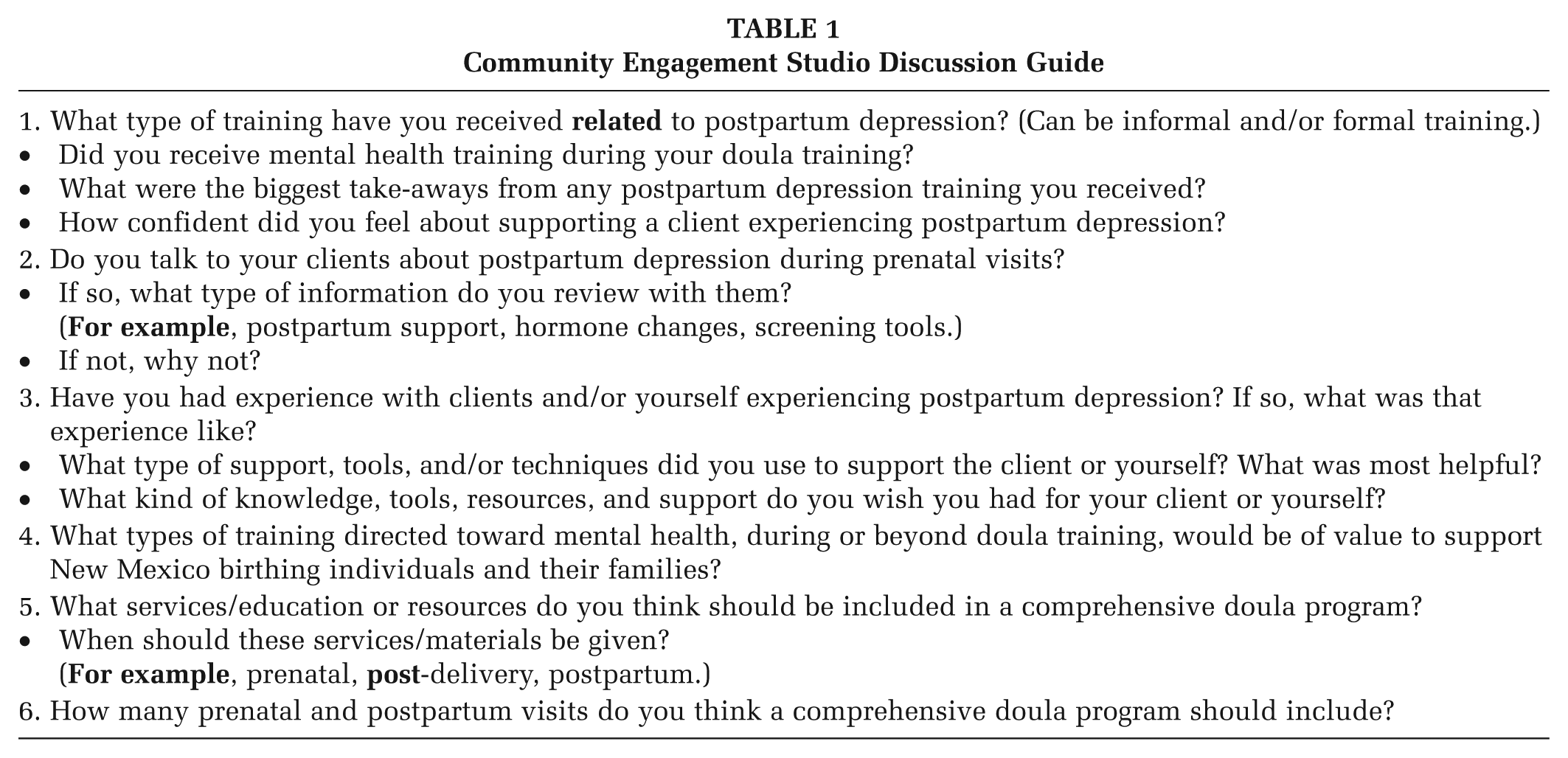
The discussion was audio-recorded for detailed note-taking purposes. Experts completed an evaluation of the studio and received $80 in compensation for their time. Field notes were compiled, a written summary of the studio was completed, and an infographic for community-facing dissemination was created (see Figure 1 for an example and Supplemental File S1 for the full infographic).
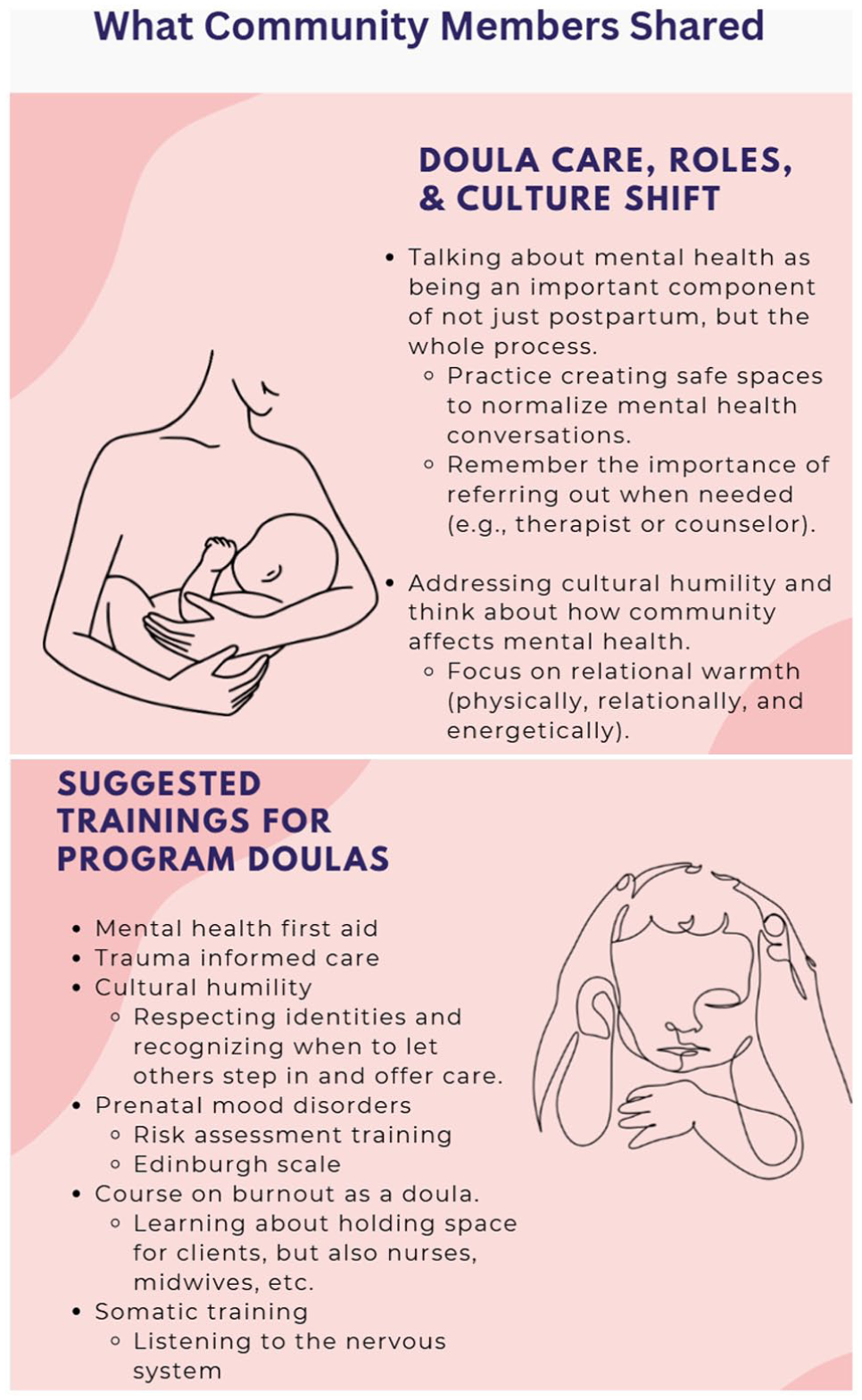
Sections of Community-Facing Dissemination: Infographic Summarizing Studio Discussion
Outcomes
Ten doulas living in the Albuquerque-metro area took part in the studio: eight provided full-spectrum care, one provided pregnancy/labor care only, and one provided postpartum care only. Key points identified in the studio included (a) framework for a comprehensive doula program; (b) doula roles and strategies to address mental health problems; (c) care plans; (d) doula self-care; (e) training; and (f) researcher considerations.
Framework for a Comprehensive Doula Program
Experts emphasized that mental healthcare is an important consideration across the perinatal period, not just postpartum, and that doulas could play an important role in improving outcomes. They discussed the Midwifery Model of Care (Rooks, 1999) as an exemplary framework for a comprehensive doula program because it is holistic, focusing on the physical, psychological, and social well-being of the birthing person throughout the perinatal period. One expert suggested that comprehensive support should be available for at least 6 months, and possibly up to 1 year postpartum.
Doula Roles and Strategies to Address Mental Health Problems
Experts stressed that normalizing and changing the culture surrounding maternal mental health from fear-based to supportive is a critical step in advancing maternal mental health. They noted that many birthing people are reluctant to disclose mental health problems to healthcare providers due to feelings of shame and fear of losing custody of their infant. Therefore, destigmatizing seeking help is important. One expert noted that routinely asking all clients about their mental health is a way of normalizing open conversations. Experts noted that important means of facilitating conversations around maternal mental health include focusing on relationship building and creating safe spaces to discuss these topics. They also discussed cultural humility as an essential characteristic of doula care, including recognizing how community support affects mental health.
Discussion also focused on not shying away from providing mental health support to people during the perinatal period because they may need help working through trauma that could affect their birth and the postpartum period. However, experts noted that doulas are not therapists, and it is important to recognize when referral is needed and to maintain an up-to-date list of community resources, including mental healthcare providers. Experts discussed that an important component of mental health support is providing education to the client, their partner, and other support people about signs of perinatal mood disorders because often the client may not realize there is a problem.
Care Plans
Experts emphasized the importance of developing a care plan with clients to include components linked to better mental health such as ensuring sleep, nutrition, self-care, and mindfulness. One doula stated this may require making arrangements with someone to watch the baby. Another stated clients should create a contact list with phone numbers of people they can call for practical, emotional, and professional support. Experts agreed that comprehensive doula care should include regular home visits and frequent “check-ins” (e.g., via text or phone call). One person recommended at least six in-person postpartum visits, of which one would be overnight shortly after the birth. Another expert recommended postpartum care should extend to at least 6 months or a year. Finally, one doula mentioned the importance of peer support in navigating the experience of mental health problems.
Doula Self-Care
Importantly, experts noted that a peer support system for doulas would be valuable given the intense nature of their work. One expert recommended monthly gatherings where doulas could discuss how this model of care is working and if they needed to make changes and allow them to share experiences and receive support. Experts also recommended implementing doula care teams to share the responsibility of support for the client and family through pregnancy, birth, and postpartum. This approach would create a support system for doulas while also allowing for continuous support for the client.
Training
While experts were supportive of implementing the proposed comprehensive doula program, the group acknowledged the need for additional formal training in the area of PMADs, including risk assessment and screening. One expert suggested using a formal tool like the Edinburgh Postnatal Depression Scale to help normalize discussing mental health with clients. Another doula discussed the importance of cultural humility and that training is important for doulas who will be caring for diverse populations. One other discussed the importance of training in trauma informed care. She commented that while trauma informed care is critical to caring for pregnant and postpartum people, it is also important to foster positive interactions with other healthcare providers because everyone has experienced some type of trauma. Finally, one expert mentioned that somatic training is an important skill to assist clients with mental healthcare because it moves beyond talk therapies and fosters an awareness of sensations in the body and using various mind-body techniques to address emotions.
Researcher Considerations
Experts also provided considerations for research with pregnant and postpartum people in New Mexico. They emphasized that postpartum care is needed for at least 6 months to a year after birth. Doulas also noted researchers must be aware of the stigma associated with mental health problems during the perinatal period. In addition, experts emphasized the importance of honoring an individual’s intersecting identities such as race and gender, as well as an understanding of systemic issues that present challenges to many people residing in New Mexico. For example, the concepts of healthy eating, transportation, and self-care may represent luxuries to certain individuals. They also stressed the importance of access to doula care for young birthing people. Finally, experts said it was critical to establish a listening space for co-learning between doulas and researchers as the comprehensive doula program evolves.
Discussion
The fact that only 26% of U.S. mothers rate their mental health as excellent represents a stark warning of the future of women’s mental health (Daw et al., 2025). Doulas are an evidence-based but underutilized means of improving maternal outcomes (Ramey-Collier et al., 2023). They spend an average of 76 hours with each client compared to other providers who only spend approximately 5.75 hours with patients (Policy Center for Maternal Mental Health, 2025b). This unprecedented connection leads to trusting therapeutic relationships between doulas and clients mitigating mistrust that many women associate with the healthcare system (Quiray et al., 2024). This often places doulas in the unique position of being one of the few people a birthing person feels safe to be honest with.
This studio provided expert insight into the potential role of doulas in improving access to perinatal mental health support in New Mexico. Although all experts resided in the urban Albuquerque-metro area, this area also includes four counties with rural communities. Key insights include that mental health is an important aspect of care across pregnancy and postpartum and that developing a holistic model of care in which doulas play an integral role is an important step in improving outcomes. Additional understandings include the importance of normalizing and destigmatizing conversations around maternal mental health, creating client care plans, doula self-care, the need for mental health training, and ensuring that young people also have access to doulas. These insights highlight the significance of employing a community-engaged approach that is grounded in the voices of frontline community experts and form the foundation of other ongoing community-engaged efforts to address maternal mental health in New Mexico.
Implications for Practice
Community engagement with individuals with lived experience is increasingly valued as an important means to achieve positive health outcomes and inform intervention design and implementation. As the maternal mental health crisis continues to worsen, there is an urgent need for novel models that address barriers to mental health support and ensure connection to care for the perinatal population. The insights gained in this studio point to community-based doulas as a future-facing solution to better serve mothers. Robust research grounded in the voices and experiences of frontline community experts is needed to advance the knowledge of health outcomes associated with doula support in this area. Such evidence will inform healthcare policy that promotes increased support, access, and coverage for this type of community-based infrastructure to support maternal mental health.
Supplemental Material
sj-pptx-1-hpp-10.1177_15248399261437139 – Supplemental material for A Community Engagement Studio to Inform the Development of Doula Care That Is Inclusive of Perinatal Mental Healthcare
Supplemental material, sj-pptx-1-hpp-10.1177_15248399261437139 for A Community Engagement Studio to Inform the Development of Doula Care That Is Inclusive of Perinatal Mental Healthcare by Sharon L. Ruyak, Julia Martinez and Heidi Rishel Brakey in Health Promotion Practice
Footnotes
Authors’ Note:
The authors would like to express their gratitude to studio experts for providing invaluable input for this paper and to guide their current and future research projects. The authors would also like to thank Alexandra Roesch for her assistance in coordinating their studio and developing the infographic. The authors declared the following potential conflicts of interest with respect to the research, authorship, and/or publication of this article: Sharon Ruyak is a board member and secretary of New Mexico Postpartum Support International. Julia Martinez and Heidi Rishel Brakey report no conflicts of interest. The authors disclosed receipt of the following financial support for the research, authorship, and/or publication of this article: This work was supported by awards from the Leah Albers Endowed Professorship in Midwifery and the National Center for Advancing Translational Sciences, National Institutes of Health (UL1TR001449, UM1TR005466).

References
Supplementary Material
Please find the following supplemental material available below.
For Open Access articles published under a Creative Commons License, all supplemental material carries the same license as the article it is associated with.
For non-Open Access articles published, all supplemental material carries a non-exclusive license, and permission requests for re-use of supplemental material or any part of supplemental material shall be sent directly to the copyright owner as specified in the copyright notice associated with the article.
