







Abstract
The community-based participatory method of Photovoice has been discussed in more than 4,700 peer-reviewed publications including a powerful special issue in Health Promotion Practice in 2022. Of the three core goals of Photovoice established by its founders Drs. Caroline Wang and Marianne Burris, one was “to reach policy makers.” A foundational method to do this is public exhibits of Photovoice research results. However, discussions of processes or impact of this Photovoice goal are under-addressed and discussed in the literature. We argue this is, in fact, the most important component of Photovoice. Particularly during times like the current socio-political environment when public health and health equity are under assault, we must put a spotlight on using Photovoice for resistance, advocacy, and publicly promoting social and policy change. This perspective piece expands on the rationale for greater emphasis on sharing Photovoice publicly and details why Photovoice exhibits matter. Two examples of Photovoice exhibits that were shared multiple times across various venues for diverse audiences are described. In addition, actionable tips to inspire readers to design or improve exhibits within their own work are discussed.
Keywords
Public dissemination of qualitative research has great potential for social change. The call to intentionally build public dissemination to share qualitative research has been growing for at least 20 years (Keen & Todres, 2007). Photovoice is a qualitative method that embeds this expectation directly into its design, calling for “reaching policy makers” as one of three core goals (Wang & Burris, 1994, 1997). Public dissemination in Photovoice typically takes the form of curated exhibits that pair participants’ photographs with narrative texts of their own words. These displays are ideally co-developed and co-presented with participants as the “artists/photographers.” They are often in community venues such as libraries or community centers or in formal policymaking settings such as meetings with local government or school boards. Increasingly, health promotion practitioners and researchers are moving exhibits into virtual realms in a variety of formats ranging from static galleries on websites to video or interactive exhibits on social media (Breny & McMorrow, 2021).
There are more than 4,700 peer-reviewed Photovoice publications across diverse disciplines. A cursory search revealed just 97 peer-reviewed publications mentioning the processes or outcomes of Photovoice exhibits. Yet, upon conceptualizing, creating, and setting forth the goals of the Photovoice method, Wang and Burris (1994) underscored the role of dissemination in relation to the key Photovoice goal of impacting policy and social change. Liebenberg (2018) reiterates and expands on the importance of dissemination as part of a critical analysis of Photovoice while also emphasizing the limited discussion of the Photovoice dissemination process across the literature. We aim to contribute to this gap with specific, illustrative examples from our experiences of exhibiting Photovoice research and accompanying lessons to influence others utilizing Photovoice to include the critical component of exhibits for social and policy change. Therefore, this perspective piece explores why public Photovoice exhibitions matter, how they are carried out, and their potential for impact.
Why Photovoice Exhibits Matter
Exhibits are a core part of photovoice research, not just an add-on at the end. Within the limited Photovoice literature offering guidance on exhibiting the Photovoice results, Catalani and Minkler (2010) and Teti and Myroniuk (2022) advanced key considerations for Photovoice exhibits. We build on these with our recommendations by describing two specific examples of community Photovoice exhibits designed to impact social and policy change. Also essential to our discussion is Mitchell et al.’s emphasis on the component of “circulation” for exhibits, which is the sharing of Photovoice results or other visual research exhibits multiple times in multiple venues for multiple audiences and potentially, in different formats such as digital approaches. They posit that circulation is critical for impact. We concur and share how we engaged in intentional circulation for both of our examples.
Four key aspects of Photovoice exhibits to consider are the ethical imperatives, knowledge translation and advocacy, empowerment and elevation of voices, and sustainability and impact (Catalani & Minkler, 2010; Teti & Myroniuk, 2022). In terms of ethical responsibility, Photovoice is conceptually grounded in principles of social justice and participatory action (Liebenberg, 2018; Wang & Burris, 1994). Prioritizing exhibits as a fundamental part of the Photovoice research process can ensure Photovoice projects are less extractive and cycle back to the community within which the research was conducted in a tangible way. For knowledge translation and advocacy, we must note that Photovoice may not always uncover new information. However, part of its power lies in offering images and stories of the lived experience of health inequities directly from those facing such inequities. There is power in the Photovoice group processes of sharing and discussing photos, but exhibits are crucial to extend this power into the public sphere, transforming participants’ photos and stories to platforms where community concerns become visible and better understood. Public exhibits of Photovoice findings must extend beyond academic circles to intentionally influence policymakers, other stakeholders with power, and the general public (Liebenberg, 2018; Mitchell et al., 2018; Wang & Burris, 1994, 1997).
A third key aspect of Photovoice exhibits is empowerment and elevation of voices. Many Photovoice projects are intentionally designed with people from marginalized groups whose voices and stories are often silenced, and images of their lives may be hidden. Public exhibits offer a platform for participants to share their perspectives on a visible stage. When participants collaborate on processes to share their photos and words, it can validate lived experiences, create or reinforce a sense of agency, and ignite sparks of hope for change. Exhibits elevate the issues of importance for Photovoice research participants and create spaces for dialogue among participants, community members, and decision-makers with power. Furthermore, the promise and potential of empowerment through participation in the Photovoice process cannot be fully realized without the exhibit component (Liebenberg, 2018; Wang & Burris, 1994).
Finally, Photovoice exhibits are the vehicle for sustainability and impact of Photovoice research. Exhibits often live beyond the project itself. They may travel, be designed in digital formats, or be archived for future advocacy. This sustains the impact of the participants’ stories and keeps issues visible. Mitchell et al. (2018) convincingly call for “circulation,” or sharing one set of photos and narratives from Photovoice research data over time in multiple settings as imperative for impact. We agree and turn to the next section to share details of two exhibits including multiple showings over many years.
Seeing Change: Two Photovoice Exhibits in Action
Based on these four key reasons why Photovoice matters, discussions of public dissemination of qualitative research including Photovoice exhibits must be elevated. This section details two case studies of Photovoice exhibits for advocacy. The first example describes an event in Michigan in 2025, that combined Photovoice results from two distinct projects with the goal of sharing women refugees’ experiences to resist the current rhetoric and policies of the federal government that are inflicting profound harm on our refugee and immigrant communities in the United States. The second example illustrates how Photovoice exhibits brought visibility to how the COVID-19 pandemic worsened existing racial inequities and led to actions to improve food security in Connecticut. Included is an overview of how both exhibits had been previously shared and circulated for greater impact.
Resilient Voices: Refugee Women in Focus
Harmful rhetoric and actions against refugees are commonplace in the United States. However, the second presidency of Donald Trump has intensified the risk, fear, and harm for the estimated three million refugees in the United States. Within this context, funding was secured from the Western Michigan University Center for the Humanities to host the Resilient Voices event in March of 2025 for the purposes of raising awareness, reducing misinformation, and promoting empathy and compassion. The Resilient Voices event was an extension of 10 years of community-based, participatory Photovoice research and included 40 photo boards of results from two different longitudinal Photovoice studies. One study followed the experiences of Congolese refugee women over time as they resettled in the United States (McMorrow & Saksena, 2025). The other was initiated by the first author as a U.S. Fulbright Scholar in Uganda. It is still in progress, but preliminary results have been presented internationally at the World Conference on Qualitative Research and nationally at the Society for Public Health Education annual conference.
Prior to 2025, the two datasets of the photos and stories had been circulated widely. To date, the exhibit sharing experiences of Congolese refugee women in the United States has been exhibited or presented in community settings 10 times over the past decade. The photos and narratives of Congolese refugee women in Uganda were exhibited twice between 2023 and 2024. Venues and audiences were diverse including a busy downtown Indianapolis market, the University of Indianapolis, a public art gallery, the U.S. mission in Kampala, Uganda, Makerere University in Uganda, and Manchester University in the United States.
In 2025, the Resilient Voices event was strategically planned to utilize the combined Photovoice study results for advocacy during March, which is Women’s History month. Components included a panel of three women who had been forcibly displaced and were living in Kalamazoo, MI, a call to action from a refugee resettlement agency who had recently lost substantial funding due to federal budget cuts and catering from a community member who had been forcibly displaced. More than 50 people attended the event and qualitative data capturing their reflections was collected from over 20% of attendees. Figure 1 illustrates the exhibit design.
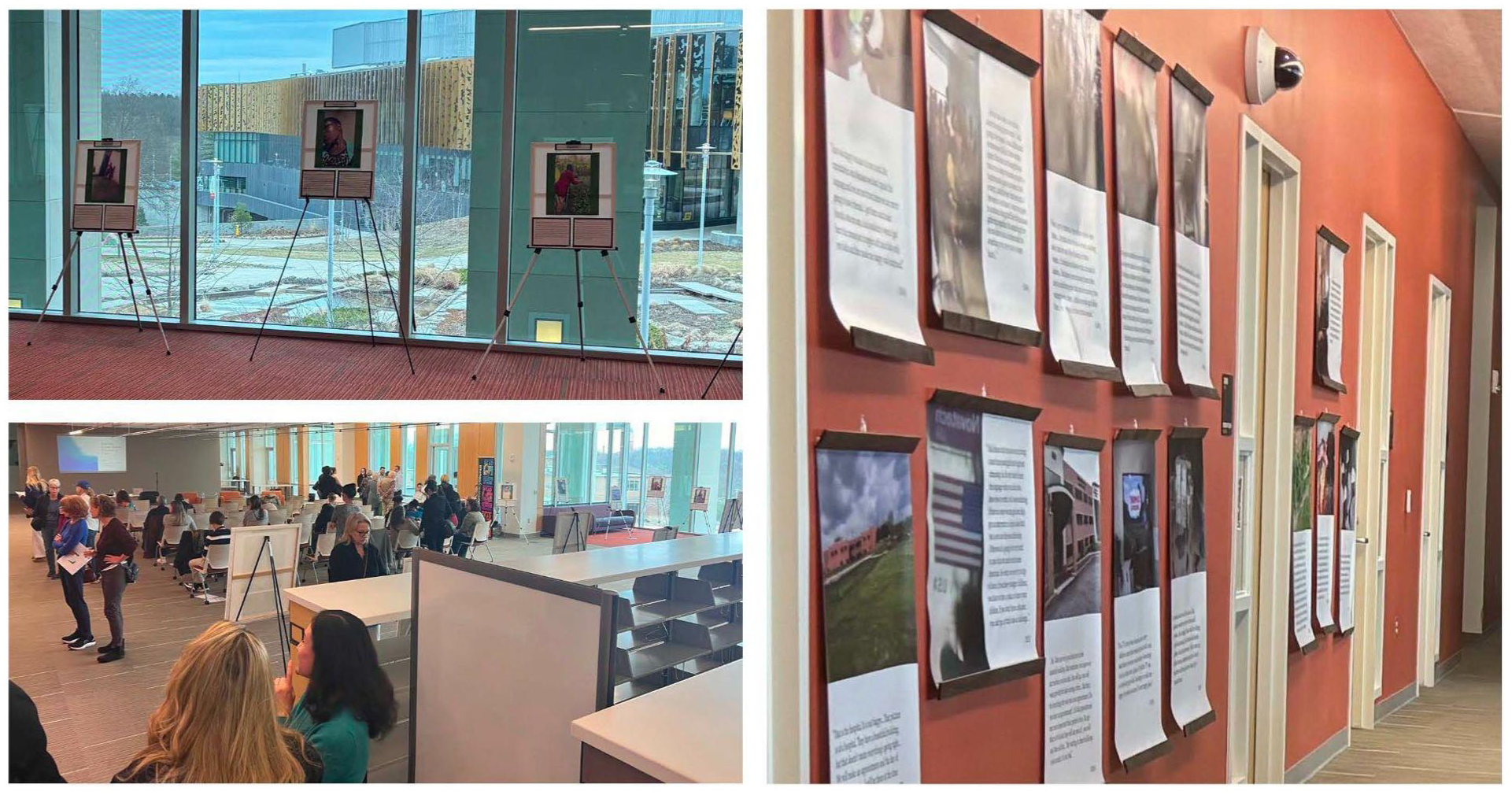
Resilient Voices Exhibit in Kalamazoo, Michigan
Exposed: How the Pandemic Deepened Racial and Ethnic Inequities
Racial and ethnic health disparities in New Haven, Connecticut, population of approximately 130,000 are well documented. It is one of the most populous cities in the state of Connecticut (Abraham et al., 2019). Located on the traditional lands of the Quinnipiac, Paugussett, and Wappinger peoples, New Haven has a diverse population with more than 60% identifying as Black, African American, and/or Latinx (Abraham et al., 2019). Racially minoritized populations and people and communities with lower incomes are burdened by health inequities in New Haven. These inequities reflect historical disinvestment, underfunding, and under resourcing and have led to disparities in social and structural determinants of health (Abraham et al., 2019). Examples include inequities in access to transportation, access to healthy food, neighborhood safety, adequate housing, access to employment, and quality of primary and secondary education (Abraham et al., 2019).
To address the disparities that were exacerbated during the COVID pandemic, the second author commenced three simultaneous Photovoice projects. Each was co-led by a Master of Public Health Student paired with a community organizer. The effects of long-standing racism, including health inequities, were amplified by the COVID-19 pandemic and the community organizers involved in this research were direct witnesses of these inequities. These Photovoice projects focused on housing and food insecurity, isolation stemming from remote learning, and changes in community structures and traditional practices within the communities. Because of the shutdown, each project was conducted fully online, which came with its own set of challenges and opportunities (Breny & McMorrow, 2022).
When designing the exhibits, we had to consider that we were just coming out of COVID shutdown. If we had not been, we would have exhibited all three projects in venues throughout New Haven to reach as many stakeholders as possible. Instead, thanks to the community organizers co-leading the projects, we chose to present the Photovoice results to two community-based organizations who focused on housing and food insecurity. These were priority issues that increased significantly during COVID-19, creating urgent challenges for many communities.
Due to COVID-19 restrictions, our initial exhibit was held outdoors, which opened opportunities to connect more directly with local organizations already working on these issues. We exhibited outdoors in partnership with a local advocacy group focused on equal and affordable housing and access to nutritious food (see Figure 2). We adapted to present the data and images from a laptop computer passed around through the crowd. Our findings sparked conversation around current legislation the group was advocating for to mandate that absentee landlords maintain their properties and to pass a “just cause conviction” bill in Connecticut. Our data–we were told–would help them in their advocacy and legislative efforts. This legislation passed the state Housing Committee but did not pass in congress. Nonetheless, this illustrates impact and a ripple effect of action initiated by the exhibit.
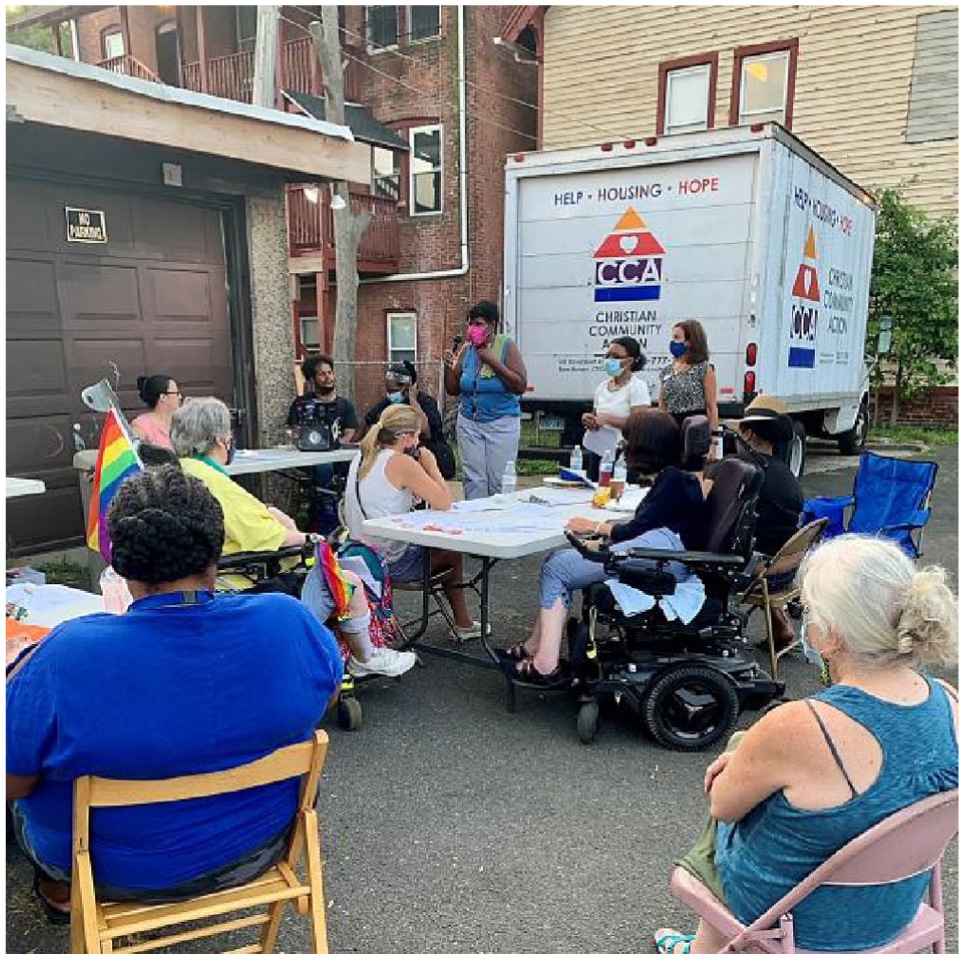
Exhibiting During COVID in New Haven, Connecticut
Our second exhibit was presented in person to an advocacy group whose sole focus was food insecurity; most of the group’s members had lived experience with these challenges. We presented the results at a regular meeting, providing essential context and contributing to community dialogue around the photos. In terms of impact, the exhibit led to an invitation to initiate training in civic engagement and advocacy skills with the food insecurity group members. Over time, these community partners grew into effective advocates, meeting with city officials and state-level policymakers to push for stronger, more equitable food security policies. This partnership demonstrated how Photovoice can evolve from storytelling to skill building and, ultimately, to sustaining community-led advocacy and policy change.
The two examples of Photovoice described in this paper have not yet been linked directly to policy change. However, one possible indicator of impact is the demonstrated circulation (Mitchell et al., 2018) over the course of several years, in multiple cities, for multiple audiences. The results of one portion of the Resilient Voices exhibit sharing experiences of refugee women in the United States have been exhibited or presented outside of academic settings at least 10 times over the past 10 years. Then, the Resilient Voices event in 2025 utilized the powerful Photovoice work of Congolese refugee women in two countries as a springboard to an event incorporating the vulnerable and powerful voices of refugee women in the local community who shared their stories with a diverse audience. Qualitative data asking attendees what action steps they might take to advocate with or for refugee community members was collected and responses indicated positive audience engagement and intention for action including, “contact representatives locally and nationally, share stories when given the opportunity, resist the current administration, gather resources for refugees, and join the Kalamazoo Immigration Solidarity Coalition.”
The exhibit in New Haven had more tangible impact. It led directly to capacity building in civic engagement and advocacy training for community-based organizations working on food and housing security, supported current advocacy work these organizations were already engaging in, and helped further connect these community activists with state legislators working on current policy. It was linked to legislation that advanced past a State Housing committee but ultimately failed at the state level. In both of our examples, the exhibits contributed unique, valuable spaces for community dialogues about important, timely, social health topics of refugee integration and racial inequities in health.
Implications for Practice
Prioritization of exhibiting is non-negotiable to meet the core Photovoice goal of “reaching policy makers.” Since the inception of Photovoice by Drs. Wang and Burris in the 1990s, there has never been a more important time to heed their call to utilize Photovoice research results in public spaces as a tool for resistance to the rapid and devastating erosion of policies that protect social and public health in the United States. Our examples illustrate implementation of Photovoice exhibits for advocacy and social change for refugee women and people experiencing racial and ethnic disparities.
All Photovoice exhibits have unique characteristics in alignment with the flexible, iterative nature of qualitative and participatory research. Indeed, the exhibits detailed in this article were conducted independently in distinct regions of the country with varying formats and design. However, there are overlapping core processes we recommend for health promotion practitioners and researchers to adopt when creating exhibits or other public facing components of Photovoice research. We recommend co-creating, collaborating, and partnership with the research participants and community members, approaching exhibit design with an advocacy mindset, centering the powerful visual images and narratives of Photovoice, implementing exhibits with strategic timing to align with current discourse on key social and public health issues, and engaging with the exhibit participants to gather feedback. We offer this checklist for consideration and adaption when working on Photovoice exhibits.
Designing Exhibits That Inform and Inspire: A Practical Checklist
✓ Co-create, collaborate, and partner with your co-researchers
✓ Find spaces to exhibit that will make the biggest impact on change (virtual vs. in person)
✓ Center the images and narratives around advocacy and change
✓ Implement the exhibits with strategic timing for great impact
✓ Align with current discourse on key social and public health issues
✓ Engage with exhibit participants to further collect data/intel
✓ If available, regroup with co-researchers after exhibits to debrief
While we have shared highlights from our experiences of two exhibits, important implications for practice also include a multitude of potential challenges when designing and implementing Photovoice exhibits. Table 1 details some common challenges and recommendations for potential solutions.
Key Challenges and Corresponding Solutions to Photovoice Exhibiting
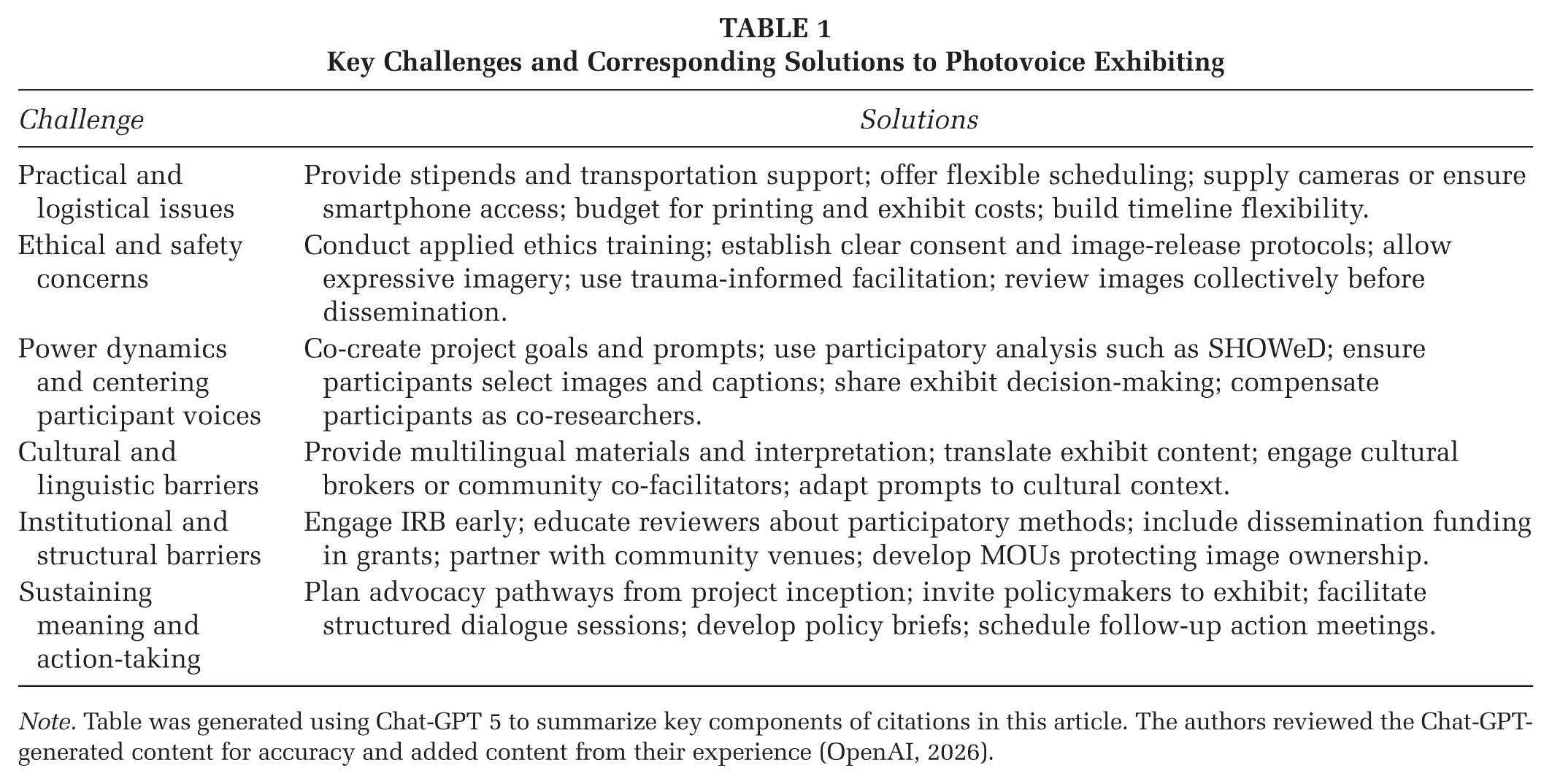
Note. Table was generated using Chat-GPT 5 to summarize key components of citations in this article. The authors reviewed the Chat-GPT-generated content for accuracy and added content from their experience (OpenAI, 2026).
Conclusion
The Photovoice method offers health promotion practitioners, researchers, and policy advocates a timeless, innovative tool to strive for the ultimate goal of impacting social and policy change. There may be benefits such as empowerment and skill-building in participatory research during the data gathering phase of Photovoice. Yet, ending a project after the data collection or academic dissemination stage falls short of maximizing all that Photovoice has to offer for social and community change. Results must be transformed into community exhibits and taken beyond academic borders into public spaces, ideally alongside the Photovoice co-researchers/participants, to raise awareness, resist harmful policies, and promote health equity and social change.
