






Abstract
As businesses continue to adapt post-COVID-19 pandemic, there is increased interest among employers in their employees’ mental health and work-life balance. However, few studies have looked at how the pandemic may have impacted employer perceptions of workplace health promotion (WHP), despite its role in addressing mental health and work-life balance. Small low-wage businesses have unique characteristics, including thin profit margins, limited financial reserves, and few employees, so the impact of the pandemic hit them particularly hard. Using a framework guided by social marketing principles, 25 small-business employers from across the United States were interviewed. Questions included what they thought was most needed in post-pandemic WHP, how the pandemic changed WHP, how comfortable they would be providing support to their employees around physical health, mental health, and work-life balance, and what avenues they would use to promote those benefits and resources. Interviews were coded and analyzed via thematic analysis. Small low-wage business employers value the importance of WHP programs and recognize how the pandemic highlighted the need to support employee mental health. These employers are interested in providing support in the domains of mental health, physical health, and work-life balance; they would use similar avenues to promote resources in these domains; and they agree that the source of these supports should be trustworthy. Small-business employers now find WHP programs incomplete if they do not support employee mental health; health promotion practitioners should collaborate with employers to identify resources suitable for small businesses and determine how best to integrate them into existing offerings.
Keywords
Background
The COVID-19 pandemic (hereafter “pandemic”) profoundly impacted many aspects of American life, with the workplace being a powerful example. This is especially true for small and medium-sized businesses, defined here as businesses with fewer than 1,000 employees (hereafter “small”). Small businesses have unique characteristics increasing their vulnerability to disruption and decreasing their ability to react swiftly, including thin profit margins, limited financial reserves, and fewer employees to support “business as usual” amid difficult circumstances (Honan et al., 2023; Peters et al., 2022).
During the pandemic, many small businesses struggled with obtaining supplies, navigating limited economic support, and managing future uncertainty (Belitski et al., 2021; Honan et al., 2023; Peters et al., 2022). Small businesses reduced employment by 40%, with immigrant, non-White, and female business owners disproportionately impacted (Bartik et al., 2020; Fairlie, 2020). The impact was felt across industries, but sectors typically characterized by lower wages and fewer resources, such as hospitality and personal services, faced significant operational and financial hardships and were disproportionately affected (Bartik et al., 2020; Fairlie, 2020). Employees in low-wage industries are more likely to be female and/or members of racial and ethnic minorities, with less access to social supports, health benefits, and paid sick leave, and higher levels of poor mental health (Center on Budget and Policy Priorities, 2022; Cubrich, 2020; Hannon et al., 2025). Because they are particularly susceptible to these negative market forces, small businesses within these lower-wage industries, and their employees, were impacted the most by the pandemic (Center on Budget and Policy Priorities, 2022; Cubrich, 2020).
While much has been written about the pandemic’s impact on employees in the workplace, little has explored how the pandemic affected employers’ attitudes and behaviors around workplace health promotion (WHP), defined here as “a coordinated and comprehensive set of health promotion and protection strategies implemented at the worksite that includes programs, policies, benefits, environmental supports, and links to the surrounding community designed to encourage the health and safety of all employees” (Centers for Disease Control and Prevention, n.d.). Research supports the efficacy of WHP in the prevention of chronic disease (Andersen, 2024; Underwood et al., 2024), and suggests a positive impact on employee productivity, morale, and workplace culture (Baicker et al., 2010; Cancelliere et al., 2011).
The limited research into the impact of the pandemic on WHP primarily focuses on employees (Hammerback et al., 2024; Wong & Greenwood, 2023), or on medium or large-sized employers, which have more flexibility and resources for WHP such as dedicated staff and budgets (Gellert et al., 2022; Underwood et al., 2024), and points to an increased emphasis on mental health and work-life balance, mirroring the growing conversation around these topics (American Psychological Association, 2022; Ezeilo & Green-McKenzie, 2024). To the best of our knowledge, no research has explored how the pandemic may have affected the views of small, low-wage businesses (SLWB) toward WHP, even though these businesses and their employees have experienced pandemic-related disruption that might be lessened through effective WHP (Belitski et al., 2021; Cubrich, 2020; Peters et al., 2022).
Purpose
The purpose of this study was to understand current attitudes and behaviors of owners and decision-makers in SLWB around WHP, including whether they currently offer it, its perceived value among both the businesses and their employees, prioritized health domains, and whether and how the pandemic affected any of these domains. Additional questions explored how WHP attitudes may differ based on support domain (physical, mental, work-life balance) and the impact this has on WHP behaviors. Our approach was guided by the HPRC Dissemination Framework (hereafter “HPRC Framework”), specifically the linkages and learning component, which utilizes principles of social marketing to understand the needs and capabilities of user organizations (such as SLWB) to facilitate adoption, implementation, and maintenance of evidence-based programming (Harris et al., 2012). The HPRC Framework facilitates collaborative learning, enabling us to capture nuanced experiences of employers at SLWB while identifying opportunities to align WHP initiatives with post-pandemic WHP priorities (Harris et al., 2012).
The focus of this research was SLWB, where employees earn lower-than-average wages, as these employees were especially vulnerable to physical and mental health declines during the pandemic (Cubrich, 2020; Peters et al., 2022). Sole proprietorships and businesses with fewer than 10 employees were excluded based on previous research indicating these micro businesses are unlikely to adopt comprehensive WHP programs, and worksites with up to 1,000 generally have fewer WHP programs in place compared to larger worksites (Hannon et al., 2012; Hannon et al., 2025). This study aims to use the HPRC Framework to inform future WHP practice, policy, and research at SLWB by updating our understanding of their post-pandemic WHP needs and barriers to implementation (Harris et al., 2012).
Methods
Setting
Interviews were conducted with individuals representing the viewpoints and experiences of U.S. employers (hereafter “employers”) nationwide, distributed roughly evenly across four census-defined geographic regions (Northeast, Midwest, South, West).
Eligibility
Employers were eligible to participate based on the following criteria:
Business employed 10 to 999 employees.
Industry was within these North American Industry Classification System (NAICS) classifications: accommodation and food services; administrative and support and waste services; health care and social assistance; retail trade; and other services excluding public administration. These industries pay disproportionately low wages compared to the average industry and employ large numbers of people (U.S. Bureau of Labor Statistics, 2024).
Most current employees spend at least some of their working hours onsite.
The worksite had a representative able to answer questions about their organization’s experience with WHP, including the organization’s status in offering such programs, what was included, and the organization’s views on WHP in general. This criterion was later modified to require that the representative could speak to the decision-making around WHP, including why and how decisions are made, as some early interviewees were unable to give detailed background into their organization’s WHP offering status.
Recruitment
All businesses were recruited by Focus Insite (FI), a nationally recognized market research firm. The research team partnered with FI on previous studies and trusted their ability to recruit a balanced, demographically representative sample. FI contacted potentially eligible businesses from their proprietary roster and determined eligibility using the screening guide supplied by the research team. FI provided daily updates so the research team could track recruitment status in real time. The two researchers (M.S. and K.H.) conducting interviews shared their calendars with FI, which then scheduled interviews between September and October 2023. A $100 incentive was provided via FI upon interview conclusion.
Measures and Procedure
The University of Washington Institutional Review Board declared this study exempt from review.
Interviewers used a semi-structured guide to conduct interviews via teleconference (Zoom Video Communications, Inc., 2023). The two interviewers had a breadth of experience facilitating interviews and focus groups neutrally and without leading respondents, and the wider research team participated in developing a bias-neutral and judgment-free interview guide. Validated questionnaires were unavailable due to this topic being exploratory and this population being understudied. Questions covered the businesses’ experience with WHP, how wellness programs may have changed since the pandemic’s onset, and what employers perceived as their employees’ greatest health needs. Participants were asked to imagine a WHP program and what type of support or resources should be offered in three domains: physical health, such as physical activity or nutrition; mental and emotional health, such as anxiety or trouble with sleep; and work-life balance, such as flexible scheduling and vacation time. As time permitted, participants were asked the following for each domain: who (e.g., supervisor, HR manager) at the worksite should deliver wellness information to employees; how (e.g., email, in-person meeting, bulletin board) the information should be delivered; and whether the business would be comfortable offering support and information for each domain.
Interviews lasted approximately 30 min and were recorded with respondents’ verbal consent. Interviews were professionally transcribed by FI. Both interviewers reviewed the transcripts and agreed they accurately reflected the interviews. See Supplemental Materials for screener and interview guide; codebook is available upon request.
Analysis
Thematic analysis corresponded with the six-phase framework by Nowell et al (2017). After reviewing transcripts, the interview guide, and the research questions (Phase 1), the team developed a coding manual (Phase 2; Crabtree & Miller, 1992). M.S. and K.H. coded transcripts using Atlas.ti 8.4.26.0 for Windows, double-coding a portion to ensure intercoder reliability (87%), and revised the coding structure as needed before coding independently (ATLAS.ti Scientific Software Development GmbH, 2023). Code reports were generated to examine patterns (Phase 3), and M.S. and K.H. reviewed and synthesized key themes (Phases 4–5), which were reviewed by the wider team (Phase 6).
Results
Participants
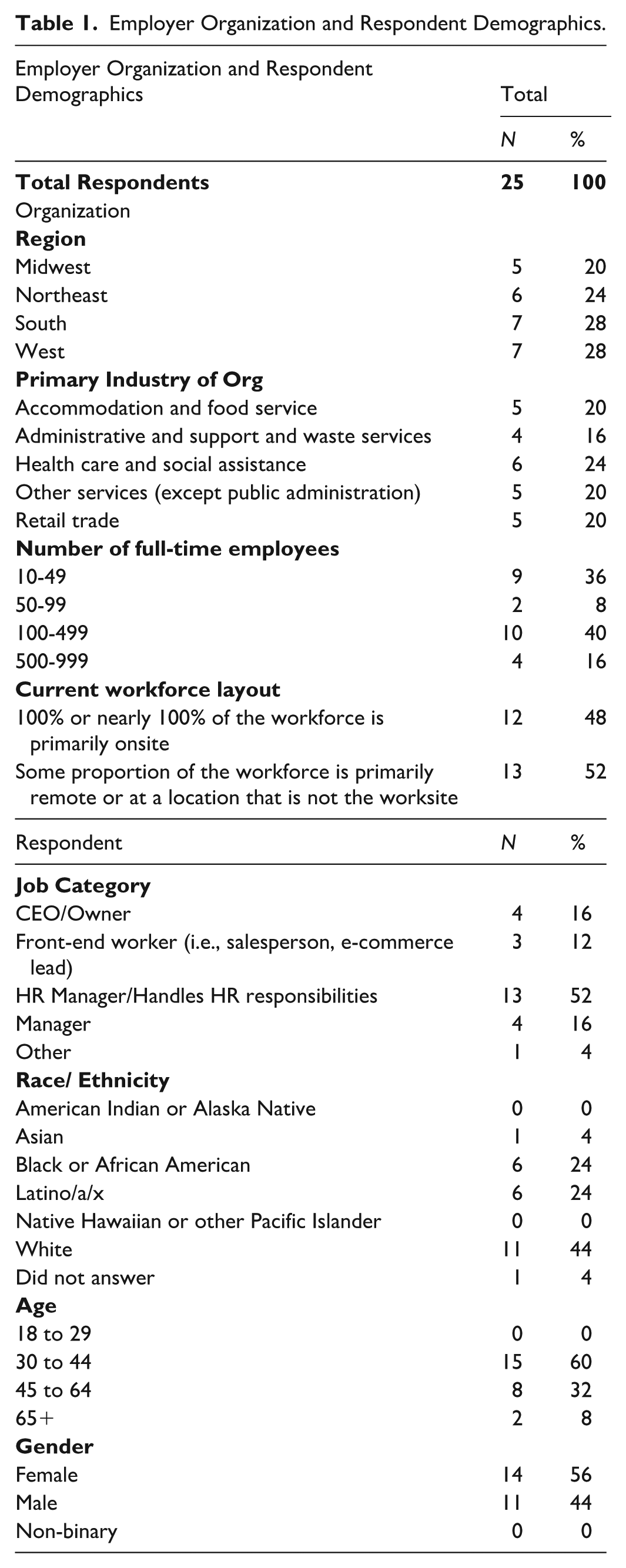
Twenty-five employers completed interviews, and a preliminary review indicated saturation was reached at that point. The characteristics of the employer organizations and individuals representing them are described in Table 1.
Employer Organization and Respondent Demographics.
What Is WHP
When asked directly, most employers said they offer WHP at their worksite. However, definitions of WHP varied considerably.
Of the employers who described a wellness program consistent with traditional definitions (i.e., prioritizing domains such as physical activity, nutrition, tobacco cessation, and other behaviors linked to chronic disease prevention), most mentioned support for physical activity as a key component, with offerings like gym discounts or yoga classes. Employers also mentioned weight-control programs, including Weight Watchers, and healthy-eating-related offerings, often tied to reimbursement from the company:
“There are some wellness programs that are available… There is reimbursement for like, if you choose to do like a gym membership or for like if you take yoga classes or for even getting massages.” (Accommodation and Food Services; 300 employees)
The domain of mental and emotional health was emphasized by a few employers when asked about their current WHP:
“. . . we’ve gotten a lot of benefits . . . [centered around] work-life balance, around mental health, around preventing burnout.” (Healthcare and Social Assistance; 300 employees)
Several described offerings attached to health insurance and linked to financial incentives or employee assistance programs (EAPs). Others responded to a question about their wellness program with a description of an EAP:
“There’s EAP, they have daily-three times a week yoga classes. They have a nutritional program . . .” (Healthcare and Social Assistance; 500 employees)
Many employers spoke about offerings not generally included in traditional wellness domains of physical activity or nutrition. For them, topics like financial health, pet health, social engagement, and volunteering constitute important components of their wellness portfolio:
“One unique thing . . . is pet insurance. And so that was raised by a bunch of people and that was covered.” (Accommodation and Food Service; 200 employees)
What Do Employers Think of WHP
Despite definition differences, employers expressed favorable attitudes toward WHP and focused on the positive aspects WHP brings to their worksite and employees, even when directly asked about barriers and challenges.
Some employers expressed their belief that WHP is a sign to employees that their employer values their health and wellbeing:
“Nobody wants to feel as though they’re working for someone and that person doesn’t care about their health . . . when a company does offer a wellness program, it ensures that OK, this person wants to not only see me thrive in my work, but live longer.” (Health Care and Social Assistance; 60 employees)
Others noted that healthy employees are more productive, benefiting both the worksite and employees:
“If you have healthy employees mentally and physically, to me, you’re going to have more production. You’re going to have more efficiency because they’re healthy and because they’re happy.” (Other Services Excluding Public Administration; 15 employees)
Employers believed employees appreciated the low- or no-cost opportunities to improve their health that wellness programs provide, such as free yoga sessions or wellness app reimbursement:
“It’s been great feedback on having that [app], in that [it’s] discounted. In the yoga too, there are a few people I’ve seen that come every time . . . I guess [that’s] good feedback.” (Health Care and Social Assistance; 500 employees)
However, some employers mentioned the importance of respecting employees who choose not to participate, and instead send the message that it is their personal decision:
“[O]ne thing we don’t want to do is put pressure on them to feel like they’re ostracized or whatnot for not participating as much. We just want them to feel welcome so that the day they are ready, hey, come on in.” (Other Services Excluding Public Administration; 20 employees)
When asked about barriers to implementing and maintaining a wellness program, most pointed to the cost of implementation and difficulties in making sure employees know about and use the program:
“I think [our wellness program] is a really good comprehensive program. It’s just, it’s not utilized. It’s not advertised. It’s not explained to people.” (Health Care and Social Assistance; 20 employees)
WHP Post-Pandemic
Employers noticed that stress, isolation, and other factors have increased the need to support employee mental health, post-pandemic.
When employers were asked about WHP changes at their worksites, and more broadly since the pandemic, the most common response focused on increasing support for employees’ mental and emotional health:
“[M]aybe they offer a lot more kind[s] of counseling because I know COVID– It’s very stressful . . . the mental health side [is] beneficial, just because you have all these thoughts all day and you’re just constantly stressing yourself . . . if you don’t have your mind right, then nothing else is going to follow.” (Accommodation and Food Services; 40 employees)
Employers spoke about the relationship between the pandemic, mental health, and isolation, and how they are approaching this with their employees. For example, one general manager from Texas noted the connection between mental health and general health:
“I think what’s changed is before . . . [WHP was] more focused on I could say hardcore conditions like diabetes, blood pressure, heart conditions, and now a big focus of that is reminding ourselves that mental health is a big part of our wellness . . . we got used to just being in our house and being anti-social . . .” (Other Services Excluding Public Administration; 100 employees)
What Employers Think Employees Want
Employers recognized that employees want both physical and mental health support, and that those tie together to impact the employee’s overall health.
When asked about their employees’ greatest health needs in the current environment, most employers focused on mental health, with a particular focus on stress, including financial stress, and social isolation:
“I do feel as though mental health needs to be explored a little bit more. Especially like I said, the economy can break anybody, COVID can break anybody . . . they need those resources . . .” (Health Care and Social Assistance; 60 employees)
Several noted that, without adequate support for mental health, asking employees to address other WHP behaviors, like physical health, was problematic:
“I think depression, mental health is huge . . . once you make some inroads on the mental health front, then you can bring in the nutrition and the physical fitness. But if there is an underlying issue there, you can address all the other stuff, but the boat is still going to be weighed down.” (Retail Trade; 350 employees)
Stemming from the impact of the pandemic, other employers noted that physical and mental health are intertwined, and a wellness program should address both:
“We’re getting lonelier, we’re getting more depressed, we’re getting fatter, we’re getting unhealthy. We need to change that. And I think workplace is a good place to start because we spend most of our day in the workplace.” (Administrative and Support and Waste Services; 200 employees)
Others highlighted the importance of their employees maintaining a healthy work-life balance to support mental health. An account executive in North Carolina mentions the importance of finding that balance:
“[I]f you’re doing everything else, but then you still don’t have a good work-life balance, you’re kind of shooting yourself in the foot . . . because you never get out of that stress of the workday.” (Accommodation and Food Services; 12 employees)
WHP Delivery
Employers consistently preferred the same communication methods for delivering WHP regardless of health domain but differed on what WHP resources should look like.
Employers were asked about the best channels for delivering WHP information for physical, mental, and work-life balance. Employers were consistent; the appropriate communication channel did not differ based on the health domain. For example, those favoring in-person meetings for physical health also saw them as ideal for mental health and work-life balance support:
“We have internal chats . . . [we] have Google Chat for everything. I send links to things. You know, I send things to their work emails, and then I’ll post it in the chat . . .” (Health Care and Social Assistance; 20 employees)
The ideal source of WHP information was also consistent over the three domains, but employers highlighted the importance of the source being seen as trustworthy by employees. Who this was differed by employer:
“Word of mouth from leadership and what I mean by leadership, not the C-suite, but your department managers and supervisors.” (Healthcare and Social Assistance; 500 employees)
One nurse practitioner in Wisconsin specified that health insurance companies should not communicate this information due to lack of trust:
“I think it needs to be probably somewhere higher up in the organization. Be it through HR or an employee assistance program, something like that. I don’t think people trust insurance companies.” (Health Care and Social Assistance; 300 employees)
Interviewees differed on what form WHP resources should take, with most stating it depended on employees’ needs; for some an app would be sufficient, while others might want community or professional resources. Specifically for mental health support, some employers mentioned wanting more information about the resources prior to distributing them to employees:
“If I’m given the correct information . . . But I have to make sure that I know thoroughly what I’m telling them and if there’s maybe a class for me to take prior, then yeah, I would totally be fine [offering supports].” (Accommodation and Food Services; 40 employees)
Discussion
While employers at SLWB defined WHP differently, with some focusing on physical health and nutrition and others taking a more holistic view of health by including topics like pet insurance, all recognized the value to both employees and businesses. Employers saw WHP as a reflection of organizational commitment to employee health and wellbeing and, post-pandemic, this commitment expanded to include mental health in addition to physical health. Employers have observed the impact of the pandemic on their employees’ mental health and recognize an opportunity to address these concerns through WHP. By improving employees’ physical and mental health, WHP initiatives are seen to potentially lead to healthier employees, less employee burnout, and increased productivity.
Pre-pandemic research indicated that both employers and their employees prioritize WHP supporting physical health, especially physical activity and nutrition (Allen et al., 2015; Hammerback et al., 2015). Since the onset of the pandemic, mental health concerns, a term which has broadened to include not only stress, depression and anxiety, but also sleep issues, substance misuse, and other areas impacting emotional health and wellbeing, have intensified (Ezeilo & Green-McKenzie, 2024; Ghouralal & Lavery, 2024; Wong & Greenwood, 2023). Addressing the growing mental health crisis is now a focus of public discussion; approximately 40% of adults report symptoms consistent with anxiety and depression (Panchal et al., 2023), and 71% of employees say their employer is concerned more about their mental health now than in the past (American Psychological Association, 2022). Research on employee burnout, job stress, and mental health has surged, with more than half of small-business employees stating that stress and work-life balance are among their top health priorities, and they would appreciate receiving mental health support from their employer (Ghouralal & Lavery, 2024; Hammerback et al., 2024; Wong & Greenwood, 2023).
Employers understand poor mental health can negatively impact a range of domains connected to quality of life, such as disturbing sleep or increasing substance use. Several emphasized the need for holistic mental health support, such as creating work environments that allow for flexibility and decreasing the potential for employee burnout, which aligns with other research showing a growing emphasis on the importance of work-life balance (American Psychological Association, 2022; Ezeilo & Green-McKenzie, 2024; Gellert et al., 2022). Our findings suggest that both the broader public’s heightened interest in multiple aspects of mental health and the desire for this type of support among SLWB employees have resonated with employers.
Despite recognizing its value, employers face significant barriers to implementing comprehensive wellness programs. Barriers include limited time, budget, and knowledge about available supports. Engaging employees can be difficult if offerings are not flexible or inclusive of disparate work schedules, responsibilities, languages, or cultures.
Study strengths include a balanced geographic and industry distribution and a focus on an understudied employer segment. Limitations include: some interviewees being unclear about their organization’s decision-making around WHP; recruitment bias that may overrepresent employers with a pre-existing interest in workplace wellness; and a small sample size hindering our ability to make comparisons across industries or sizes.
Implications for Practice
Post-pandemic, the importance of and interest in addressing mental health have increased dramatically (American Psychological Association, 2022; Hammerback et al., 2024; Panchal et al., 2023). Employers at SLWB are uniquely placed to support their employees’ well-being and now view WHP as incomplete without meaningful support for both physical and mental health. Employers recognize the need for trustworthy, inexpensive, and easily accessible resources that are relevant to their employees while also addressing mental health domains such as stress, depression, anxiety, sleep, and work-life balance.
For health promotion practitioners working with SLWB, these insights highlight the importance of offering applicable, flexible, and responsive WHP resources tailored to SLWB. WHP programs going forward should incorporate resources in various formats to fit employee needs, such as professional services or apps, while ensuring usability, and health promotion practitioners should consider the source of information and how it is delivered at the worksite. Expanding awareness of and resources around strategies to support employee mental health, for example by increasing autonomy via increased employee control over schedules or promoting a culture of support by increasing sick or leave time availability, may also be valuable (Office of the US Surgeon General, 2022). Health promotion practitioners in this space should prioritize partnership and co-design with SLWB, ensuring cultures, languages, and schedules are represented throughout development and that WHP adjustments and resources address the preventive health care gap often faced by underrepresented groups. These partnerships should expand beyond development and adaptation to include consistent feedback and evaluation, ensuring WHP offerings evolve with changing SLWB needs and priorities. Via health promotion practitioner and SLWB partnerships, WHP can continue to be a key vehicle for health promotion and can become more marketable to employers in SLWB by directly addressing their biggest priorities.
Supplemental Material
sj-docx-1-hpp-10.1177_15248399261460452 – Supplemental material for Mental Health and More: Small, Low-Wage Businesses’ Workplace Wellness Needs After the COVID-19 Pandemic
Supplemental material, sj-docx-1-hpp-10.1177_15248399261460452 for Mental Health and More: Small, Low-Wage Businesses’ Workplace Wellness Needs After the COVID-19 Pandemic by Michelle Strait, Kristen Hammerback, Jeffrey R. Harris, Marlana Kohn, Caitlin Mayotte and Peggy A. Hannon in Health Promotion Practice
Supplemental Material
sj-docx-2-hpp-10.1177_15248399261460452 – Supplemental material for Mental Health and More: Small, Low-Wage Businesses’ Workplace Wellness Needs After the COVID-19 Pandemic
Supplemental material, sj-docx-2-hpp-10.1177_15248399261460452 for Mental Health and More: Small, Low-Wage Businesses’ Workplace Wellness Needs After the COVID-19 Pandemic by Michelle Strait, Kristen Hammerback, Jeffrey R. Harris, Marlana Kohn, Caitlin Mayotte and Peggy A. Hannon in Health Promotion Practice
Supplemental Material
sj-xlsx-1-hpp-10.1177_15248399261460452 – Supplemental material for Mental Health and More: Small, Low-Wage Businesses’ Workplace Wellness Needs After the COVID-19 Pandemic
Supplemental material, sj-xlsx-1-hpp-10.1177_15248399261460452 for Mental Health and More: Small, Low-Wage Businesses’ Workplace Wellness Needs After the COVID-19 Pandemic by Michelle Strait, Kristen Hammerback, Jeffrey R. Harris, Marlana Kohn, Caitlin Mayotte and Peggy A. Hannon in Health Promotion Practice
Footnotes
Acknowledgements
The authors would like to thank Focus Insite for their assistance in recruiting interviewees.

Funding
The authors disclosed receipt of the following financial support for the research, authorship, and/or publication of this article: This project was supported by grant 5R01CA160217 from the National Cancer Institute.
Declaration of Conflicting Interests
The authors declared no potential conflicts of interest with respect to the research, authorship, and/or publication of this article.
Supplemental Material
Supplemental material for this article is available online.
References
Supplementary Material
Please find the following supplemental material available below.
For Open Access articles published under a Creative Commons License, all supplemental material carries the same license as the article it is associated with.
For non-Open Access articles published, all supplemental material carries a non-exclusive license, and permission requests for re-use of supplemental material or any part of supplemental material shall be sent directly to the copyright owner as specified in the copyright notice associated with the article.
