







Abstract
Anomia is one of the most frequent manifestations in aphasia. Model-based treatments for anomia usually focus on semantic and/or phonological levels of processing. This study reports treatment of anomia in an individual with chronic aphasia. After baseline testing, she received a training program in which semantic and phonological treatments were contrasted. The semantic treatment resulted in generalization to closely semantically related untreated items. Moreover, this beneficial effect was highly durable and maintained at the immediate posttreatment level for at least 3 months. However, the positive response to the phonological treatment was limited to treated stimuli only. This case study demonstrates that improvement in word-finding abilities may be possible in chronic anomic aphasia, even after a relatively short period of therapy. It also underlines the importance of relying on theoretical models of language processing to adapt treatments to each specific deficit.
Impairment in word retrieval or anomia is one of the most frequent manifestations in aphasia. People experiencing anomia may have some degree of difficulty in retrieving specific words during conversation. This difficulty also emerges in clinical assessments, when individuals with aphasia are engaged in naming tasks of visually presented objects or pictures. According to recent models of speech production (Butterworth, 1989; Dell, 1986; Levelt, Roelofs, & Meyer, 1999), words are retrieved and produced through the activation of specialized and interconnected components. In these models, the production of words is conceived as a staged process, in which the activation flow is initiated in a conceptual-semantic component and ends with the execution of articulation mechanisms. For picture naming, the spoken word retrieval process involves three main levels of activation: (a) the concept corresponding to the object (picture) or idea to be expressed is first activated at the conceptual-semantic level, (b) this nonverbal conceptual representation maps into a lexical-semantic representation, specifying the semantic features of the word to produce, and (c) in the third level, the lexeme (i.e., the sound form of the target word) is retrieved.
According to this cognitive theoretical model of speech production, one can describe different word retrieval impairments, each resulting from a functional deficit in one or more levels of the process. A deficit at the conceptual-semantic level (Nickels & Howard, 1994) leads to the production of semantic paraphasias but is also characterized by difficulties in any task, linguistic or otherwise, requiring access to the meaning of a word or thing. A deficit functionally localized at the lexical-semantic level (Hillis & Caramazza, 1995) leads to the production of semantic paraphasias and circumlocutions, but the difficulties are restricted to linguistic tasks necessitating conceptual-semantic activation (e.g., spoken or written picture naming). Finally, semantic errors occur for spoken naming tasks only when the deficit is functionally localized at the level at which lexemes are retrieved (Caramazza & Hillis, 1990).
The precise specification of the functional origin of naming deficits also has the advantage of guiding clinicians in the choice of treatments. For lexical retrieval deficits, these model-based treatments usually focus on semantic or phonological processing. The aim of semantic treatments is to remediate the impaired semantic processing through techniques (e.g., word-to-picture matching, semantic judgment about pictures, category sorting, etc.) devised to activate the word’s meaning. A few studies have shown positive effects of such treatments on naming abilities (for a review, see Nickels, 2002, and Nickels & Best, 1996a, 1996b) of individuals with aphasia presenting with semantic or lexical retrieval deficits.
Phonological treatments are devised to facilitate the activation of the sound form of the words by facilitation techniques such as phonemic cueing or repetition (for a review, see Nickels, 2002, and Nickels & Best, 1996a, 1996b). These treatments have also been shown to be effective not only in individuals with aphasia showing phonological retrieval impairments but also in individuals with semantic impairments (e.g., patient PA reported by Nickels & Best, 1996b).
From a clinical point of view, the generalization of treatment effects to untreated stimuli is of great importance. Because they aim at restoring information about semantic features of concepts, semantic treatments should be effective not only for the treated stimuli but also for untreated items from the same category. Conversely, the effects of phonological therapies should be item specific (i.e., generalization is not expected) since the focus is on the activation of individual representations in the phonological output lexicon. Evidence supporting these predictions is scarce and inconsistent. For example, Nickels and Best (1996b) reported generalization effects of a semantic therapy in only two of three anomic patients showing a central semantic deficit. Although she presented with a similar pattern of deficits, the third patient showed no improvement in naming. Similarly, inconsistent generalization effects were also reported by Drew and Thompson (1999) in a semantic-based treatment used with four individuals with aphasia. In general, studies designed to overtly and repeatedly strengthen activation of the semantic attributes of trained items as well as activation of the semantic attributes of semantically related untrained items appeared to lead to better generalization (Boyle, 2004; Coelho, McHugh, & Boyle, 2000; Kiran & Thompson, 2003). There have also been contradictory reports for phonological treatments. Whereas most of the studies clearly showed item-specific effects (Miceli, Amitrano, Capasso, & Caramazza, 1996; Nettleton & Lesser, 1991), a few others reported generalization effects following phonological treatments (Franklin, Clark, & Humphreys, 2002; Robson, Marshall, Pring, & Chiat, 1998). In addition to generalization, the duration of the beneficial effects of the treatment for word retrieval deficits in aphasia is also discussed in the literature.
To summarize, long-lasting effects have often been reported for semantic treatments (Marshall, Pound, White-Thomson, & Pring, 1990; Pring, White-Thomson, Pound, Marshall, & Davis, 1990). On the other hand, phonological techniques are considered to be effective in improving naming abilities for short periods of time (Howard, Patterson, Franklin, Orchard-Lisle, & Morton, 1985; Kay & Ellis, 1985). However, controversial data have been presented recently, also showing long-lasting effects for phonological therapies (Best, Hickin, Herbert, Howard, & Osborne, 2000; Miceli et al., 1996).
We report a single-case study of a patient with aphasia, GC, who showed word retrieval difficulties resulting from semantic and lexical access deficits. The investigation relied on a cognitive theoretical model of speech production and was designed to study the maintenance and generalization effects of a semantic and a phonological treatment on picture-naming performance through a single-subject crossover design.
Case Report
GC, a 55-year-old, right-handed woman, is a native unilingual speaker of French. She has a Grade 13 education (i.e., college level) and worked as a secretary-receptionist. She suffered a hemorrhagic cerebrovascular accident resulting in right homonymous hemianopia, cognitive deficits, and language impairments. A CT scan performed during the acute phase of the disease showed a lesion located primarily within the left subcortical and cortical temporal areas. Two months after her stroke, GC was admitted to a rehabilitation program in which she received occupational therapy and speech-language pathology treatments (3 to 4 therapy sessions of 1 hour/week). One year later, she returned home at the end of the rehabilitation program and lived alone without help. At that time, she still presented with an anomic aphasia as well as cognitive problems mainly characterized by a mild deficit in verbal and nonverbal episodic memory. This study took place more than 3 years after the stroke. At that time, GC did not receive any individual or group therapy. She gave informed consent to participate in the study, according to the Declaration of Helsinki (BMJ 1991; 302:1194).
Assessing the Locus of the Production Deficit
Except for tasks for which norms were available for the French Quebec population, GC’s performance was compared to the results of five female controls matched for age and level of education (mean age = 53.8 years, mean education = 12.6 years).
Spontaneous speech
Speech output was fluent, well articulated, and grammatically correct but presented many signs of word-finding difficulties: aborted sentences, latencies, and occasional semantic paraphasias.
Verbal auditory and written input
With respect to input components, GC’s abilities appeared to be largely preserved. She performed almost flawlessly in written CV syllable discrimination (same vs. different judgment task: judging if two written syllables are the same or not) (78/82, 95% correct; normal mean score = 80, SD = 1.7) and she produced only one error out of the 82 stimuli (99% correct; normal mean score = 78, SD = 1.3) for auditory CV and V syllable discrimination (judging if two spoken syllables are the same or not). Her performance in lexical decision tasks (word vs. nonword decision task) also pointed to the integrity of the patient’s phonological (116/120, 97% correct; normal mean score = 115, SD = 4.3) and orthographic (117/120, 97.5% correct; normal mean score = 116, SD = 3.9) input lexicons (judging if the written or spoken stimuli is a real word or not).
Nonverbal visual input
GC was administered several subtests of the Birmingham Object Recognition Battery (BORB; Riddoch & Humphreys, 1993). She performed typically on tests exploring low-level aspects of visual perception (tests of same–different matching of basic perceptual features: orientation, length, position, and object size), intermediate visual processes (tests of matching objects different in viewpoint), and access to stored perceptual knowledge about objects (test of object decision: judging if the presented picture corresponds or not to a real object). This suggests that although GC had some visual deficits (i.e., right homonymous hemianopia), her perceptual abilities were well preserved.
Semantic system
GC was administered a semantic battery, comprising the Pyramids and Palm Trees Test (PPTT; Howard & Patterson, 1992) and definition-to-written word matching tasks. As shown in Table 1, the patient clearly demonstrated problems with semantic processing on the picture-to-picture as well as on the written word-to-written word matching condition of the PPTT.
GC’s Performance on Semantic Assessment Tasks
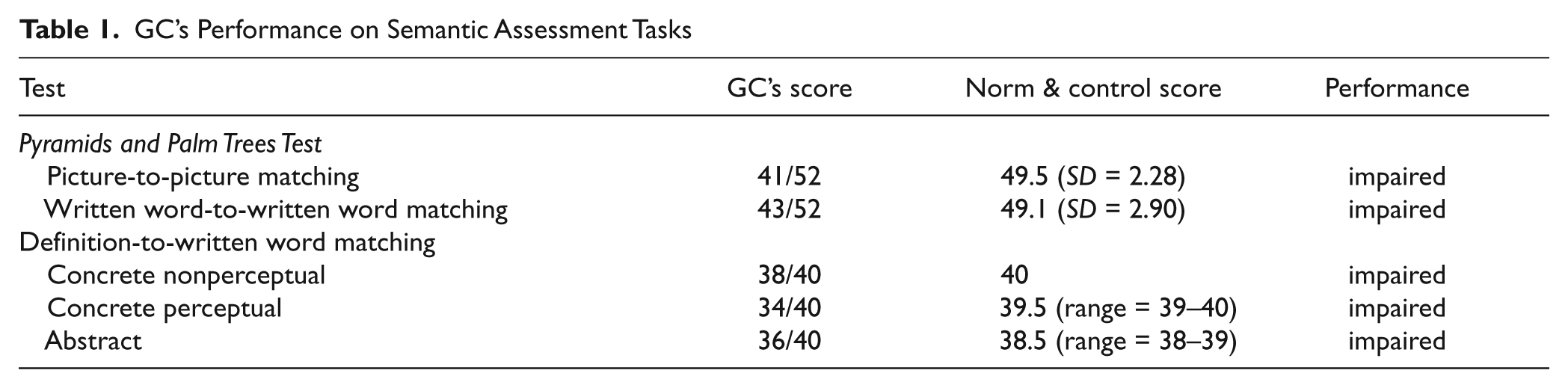
GC was also impaired in a definition-to-written word matching task. In this task, she was given a spoken definition of a word and was asked to point to one of three written words (the target word, a close semantic foil, and a distant semantic foil) printed on a card to which she thought the definition referred. Two lists of stimuli were used. The first list was composed of 40 concrete words comprising 20 animals and 20 man-made items matched for lexical frequency (Baudot, 1992). For each stimulus, the patient was presented once with a definition comprising perceptual features (e.g., a little animal with long ears and a little round tail: rabbit–rat–squirrel) and once with a definition comprising nonperceptual features (e.g., a small domestic animal that likes carrots: rabbit–rat–squirrel). The 80 definitions were presented in a pseudo-random order in two testing sessions, such that GC was only queried on a given stimulus once per session. The second list was composed of 40 abstract words (according to imageability ratings; Desrochers & Bergeron, 2000) matched for lexical frequency to the stimuli of the first list. GC was presented with a complete definition of each of these abstract words (e.g., ability to choose between several possibilities: option–interest–curiosity) and was asked to point to the appropriate written word. The complete list of abstract words was administered during the same testing session. GC was better at identifying concrete words when presented with nonperceptual definitions than with perceptual definitions (see Table 1). Overall, the results were not dependent on the semantic category (animals = 36/40; man-made objects = 36/40). GC also performed slightly below the controls for the abstract vocabulary task. These results are suggestive of a semantic deficit.
Naming
GC’s naming abilities were assessed through two tasks administered on separate occasions. In the first task, GC was asked to orally name a list of 48 line drawings of objects, selected from the Snodgrass and Vanderwart stimulus set (Snodgrass & Vanderwart, 1980) and pertaining to several living and nonliving semantic categories. The living categories set comprised 24 drawings of animals (16), fruits (4), and vegetables (4); the nonliving categories set comprised 24 drawings of vehicles (4), tools (4), musical instruments (4), and household objects (12). In the second task, GC was asked to orally name the same list of 48 stimuli in response to a verbal definition. The definition was as complete as possible, providing perceptual (physical appearance) and nonperceptual properties (functional and encyclopedic attributes) for each item as well as information about its category membership. The following variables were controlled between and within the living and the nonliving category sets: lexical frequency (Baudot, 1992), familiarity (rated by 27 normal participants on a 5-point scale), and visual complexity of the line drawings (rated by 27 normal participants on a 5-point scale).
GC demonstrated similar levels of performance in both naming tasks. As shown in Table 2, she correctly named 38 out of the 48 stimuli (79%) in picture naming (mean score for the controls = 46.6/48, 97%; SD = 1.4, range = 44–48) as well as in the naming-to-definition task (mean score for the controls = 45.75/48, 95%; SD = 2.25, range = 43–48). Her performance was better for nonliving than living categories (picture naming: nonliving = 23/24, 96%, living = 15/24, 62.5%; naming-to-definition task: nonliving = 20/24, 83%, living = 18/24, 75%) but the difference reached significance level in the picture naming task only, χ2(1) = 6.19, p < .05. GC was better at naming high-frequency words and low-visual complexity pictures than low-frequency words and high-visual complexity pictures but the differences did not reach significance. She was also better at naming high-familiarity words than low-familiarity words but the difference was significant only for picture naming: low-familiar = 11/18; high-familiar = 27/30; χ2(1) = 4.08, p < .05.
GC’s Performance on the Set of 48 Stimuli in Picture Naming and Naming-to-Definition Tasks
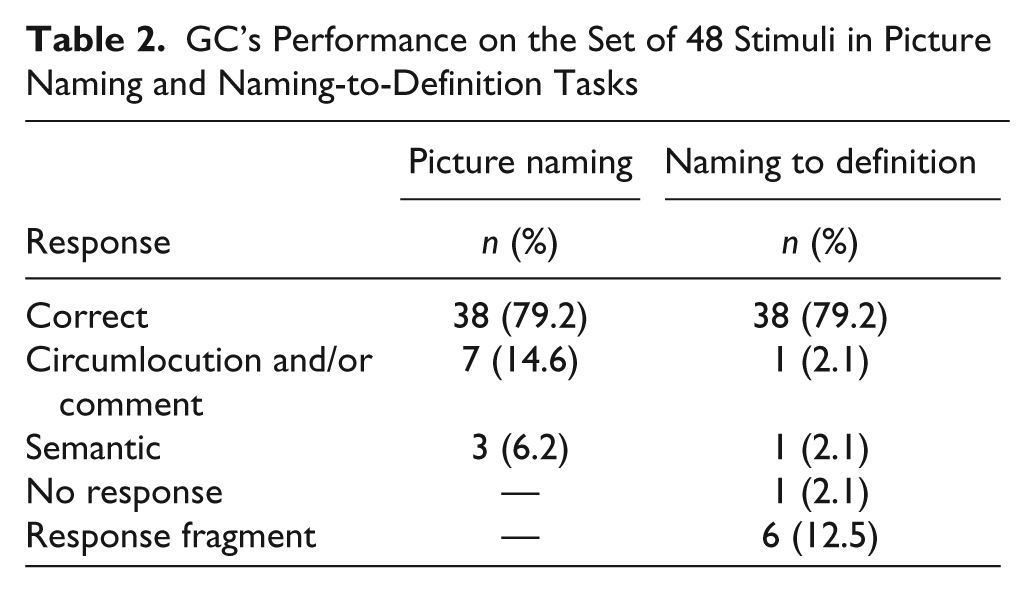
As shown in Table 2, most of the errors GC produced in the picture naming task consisted of circumlocutions (e.g., maïs [corn] → “Tu manges ça avec du beurre, c’est jaune.” [“You eat this with butter; it is yellow.”]) and/or personal comments (i.e., vague description or uninformative utterance; e.g., marteau [hammer] → “J’en ai un à la maison.” [“I have one at home.”]), followed by semantic substitutions (e.g., autruche [ostrich] → “une oie” [“a goose”]). Some of these circumlocutions were very vague or clearly corresponded to a related semantic concept (e.g., perroquet [parrot] → “Ca vole et ça attaque, c’est dangereux.” [“It flies and it attacks; it is dangerous.”]). Response fragments were predominant in the naming-to-definition tasks whereas semantic substitutions, circumlocutions and/or personal comments, and no responses were more exceptional. These results suggest that GC’s impairment in spoken naming was related to a semantic deficit combined with a deficit in accessing lexical phonological representations.
Reading aloud, repetition, spelling to dictation, and written picture naming
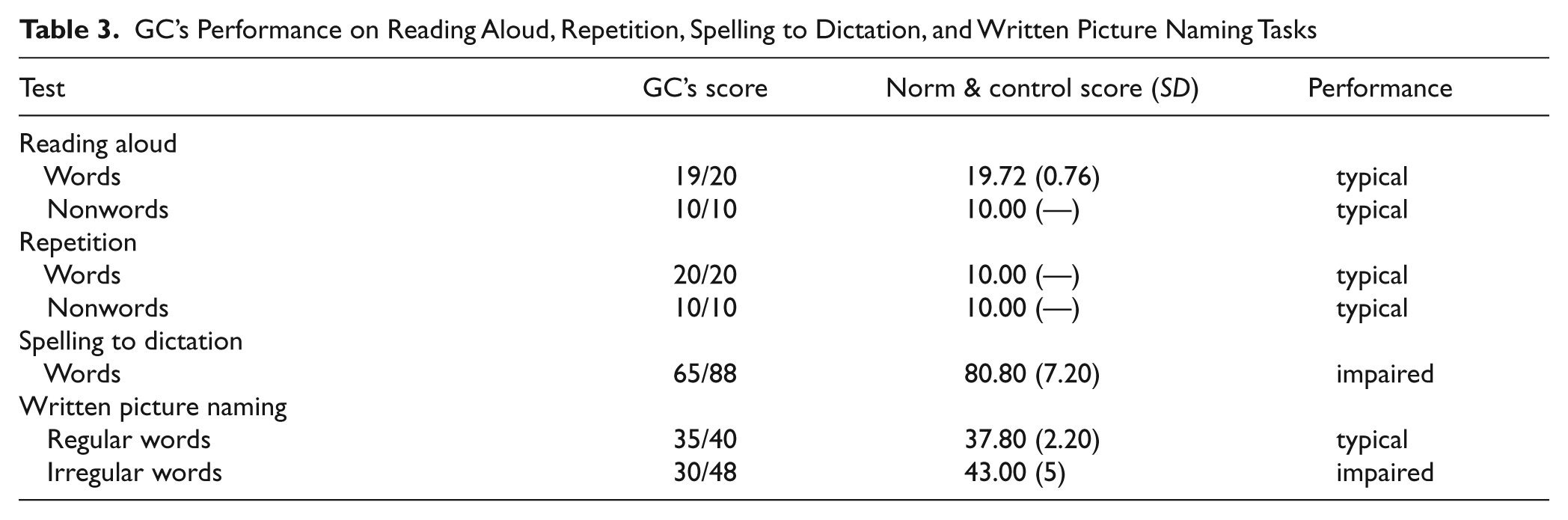
As shown in Table 3, GC performed almost flawlessly in reading aloud words controlled for lexical frequency and orthographic complexity. The only error produced consisted of a regularization of an irregular word. She also performed very well on the nonword reading task. Her ability to repeat words and nonwords was also excellent.
GC’s Performance on Reading Aloud, Repetition, Spelling to Dictation, and Written Picture Naming Tasks
She was asked to name and to write to dictation 88 word stimuli corresponding to living (44) and nonliving (44) semantic concepts. Word stimuli were categorized as regular (words that can be spelled by direct phoneme to grapheme conversion: 40 stimuli) or irregular (words that cannot be spelled by direct phoneme to grapheme conversion: 48 stimuli) following criteria established for writing to dictation by Beauvois and Derouesné (1981). The stimulus set for living and nonliving categories was matched for orthographic complexity, lexical frequency (Baudot, 1992), familiarity (rated by 27 typical participants on a 5-point scale), and letter/phoneme length.
GC presented with an impairment in spelling to dictation (see Table 3). In picture naming, her performance was better for nonliving (38/44, 86.4%) than for living (27/44, 61.4%) categories, and the difference was significant, χ2(1) = 5.89, p < .05. As shown in Table 3, GC’s performance was also largely influenced by orthographic complexity. Her performance was good on regular words whereas she presented with spelling difficulties for irregular words. The difference between regular and irregular words was significant, χ2(1) = 5.83, p < .05.
When the analysis was performed on nonliving (regular = 18/20, 90%; irregular = 20/24, 83.3%) and living (regular = 17/20, 85%; irregular = 10/24, 42%) categories separately, the difference between regular and irregular words was observed for living concepts only, χ2(1) = 6.91, p < .01. There was no effect of lexical frequency or length on the patient’s performance whereas a familiarity effect was observed in spelling to dictation (low-familiar words = 17/29, 59%; high-familiar words = 48/59, 81%), χ2(1) = 4.09, p < .05.
Except for two nonphonologically plausible errors (i.e., the sound correspondence of the error and the target are not homophonous) and one mixed error, the patient mainly produced phonologically plausible errors (20) consisting of orthographic regularizations in which the sound correspondence of the errors and the target are homophonous (e.g., “hibou” [owl] → IBOU). Written spelling of nonwords was perfectly preserved (20/20). Overall, these results clearly suggest the presence of surface agraphia, a written spelling deficit, probably linked to the semantic impairment.
Conclusions
Overall, GC presented with production deficits whereas she performed normally on tasks exploring verbal and nonverbal input processing. The semantic system was impaired, regardless of whether it was assessed through verbal or nonverbal tasks. The patient also showed a word retrieval deficit in spontaneous speech as well as in naming tasks, marked by the production of semantic paraphasias and circumlocutions. With respect to verbal transcodings, repetition and reading-aloud abilities were well preserved whereas GC showed spelling difficulties, characterized by clinical features of surface dysgraphia, a deficit directly linked to the breakdown in semantic memory (Macoir, 2009; Macoir & Bernier, 2002). For spoken output, we concluded that the functional deficit underlying GC’s anomia was localized at the conceptual-semantic system as well as in accessing representations at the lexical-semantic level.
Treatment Study
Experimental Stimuli
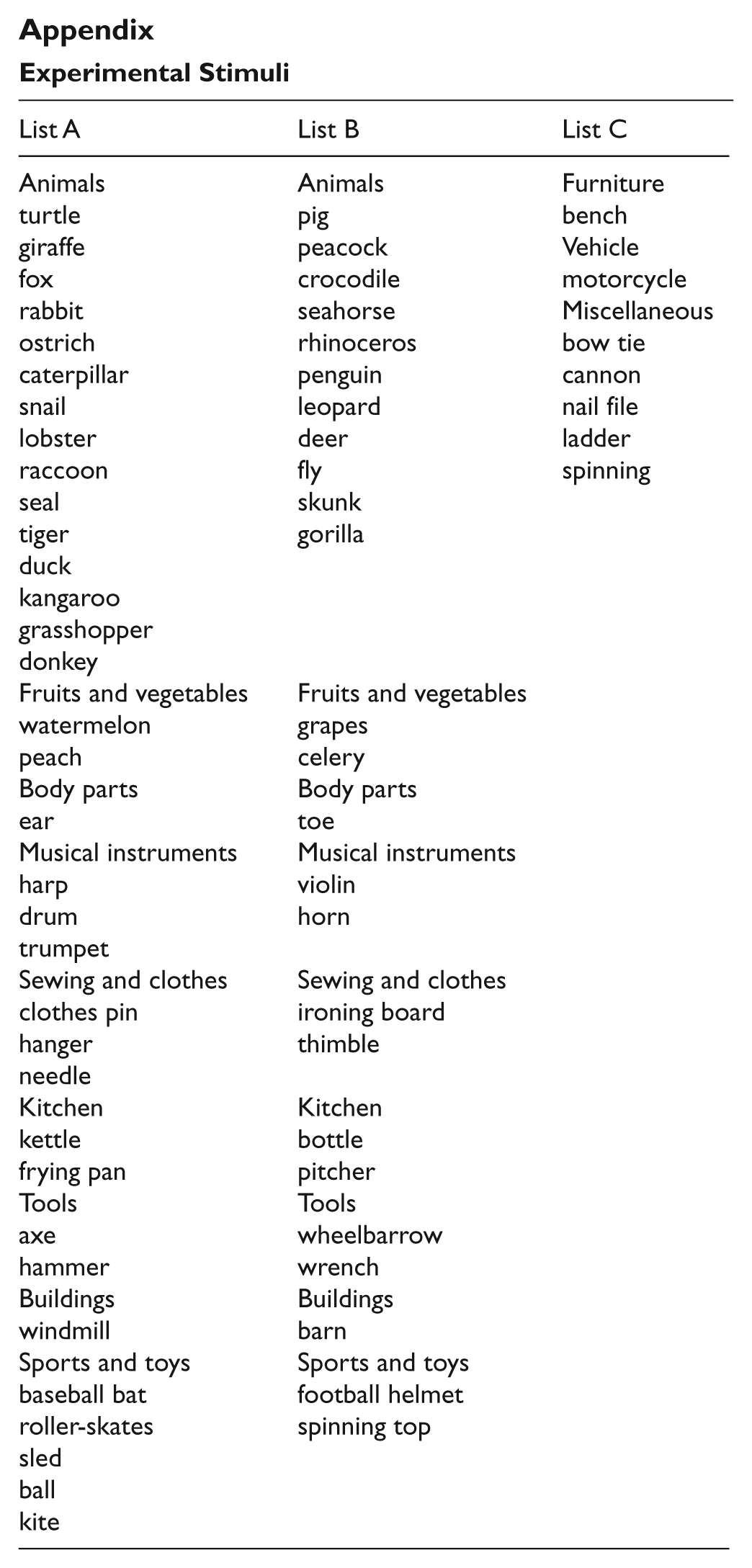
GC was asked to name 256 black-and-white line drawings (~10 cm × ~10 cm) depicting objects pertaining to different semantic categories (Snodgrass & Vanderwart, 1980) on two separate occasions. As was observed in the background testing, GC demonstrated similar levels of performance in the two administrations of the naming tasks (first administration = 71/256 errors, 28%; second administration = 80/256 errors, 31%). There was no improvement across the two testing sessions. An intermeasure reliability analysis using the Kappa statistic revealed that the patient was highly consistent (92% of concordance between first and second administrations; Kappa = 0.82, p < .000). We were then able to select the 66 items that she failed to name during the two administrations of the naming task to create three experimental sets of stimuli (see the appendix): Set A consisted of 34 stimuli (15 animals, 2 fruits and vegetables, 1 body part, 3 musical instruments, 3 objects related to sewing and clothes, 2 kitchen utensils, 2 tools, 1 building, and 5 objects related to sports and toys); Set B consisted of 25 stimuli semantically related to items in List A (11 animals, 2 fruits and vegetables, 1 body part, 2 musical instruments, 2 objects related to sewing and clothes, 2 kitchen utensils, 2 tools, 1 building, and 2 objects related to sports and toys); and Set C consisted of 7 stimuli with no semantic relationship with items in Lists A and B (1 piece of furniture, 1 vehicle, and 5 miscellaneous). Overall, the errors produced for the three stimuli lists were of the same types as observed in the background testing (circumlocutions and/or personal comments = 60%; no response = 20%; semantic paraphasia = 14%; visual error = 6%). The three sets were matched for lexical frequency (Baudot, 1992) and for visual familiarity and visual complexity (27 normal participants’ ratings).
Experimental Design
An ABACA design for multiple treatment comparison was used to evaluate the effects of a semantic and a phonological treatment as well as to explore contrasting effects of generalization between the two methods. GC performed the picture naming task three times: (a) after the semantic treatment, (b) after the phonological treatment, and (c) 3 months after completion of the overall treatment. Treatment sessions lasting approximately 1 hour were conducted once a week for 8 consecutive weeks, with 4 weeks devoted to the semantic treatment and 4 weeks to the phonological treatment.
Semantic treatment (Set A)
The semantic treatment started 7 days after administration of the baseline picture naming task. This treatment was designed to activate the semantic network of stimuli to facilitate their production in naming tasks. The hypotheses were as follows: GC’s naming impairment resulted from a deficit localized at the conceptual-semantic and lexical-semantic levels. The semantic treatment should therefore lead to a substantial improvement in the patient’s ability to name the treated stimuli (Set A). An improvement in naming ability should also be observed in regard to stimuli in List B but not List C, since only the former stimuli were closely semantically related to stimuli in List A. Each stimulus (word or picture) was treated three times in each session, once with each of the following three semantic therapy techniques:
Picture/spoken name agreement judgment task: Each picture stimulus was presented in the same session, once with the corresponding word (e.g., Is this a giraffe?), once with a close semantic foil (e.g., Is this an elephant?), and once with a distant semantic foil (e.g., Is this a squirrel?). For each trial, the patient was asked to answer yes or no if the presented word corresponded or not to the picture stimulus.
Semantic category synonymy task: Each written word stimulus was presented with three written words from the same category and the patient was asked to indicate the one that was least related in meaning (e.g., giraffe, lion, elephant, moose).
Semantic attribute questionnaire: The patient was presented with a yes/no questionnaire, probing the following semantic properties: general superordinate (e.g., Is a giraffe an animal, an object, or a plant?), same category superordinate (e.g., Is a giraffe a fish, an insect, or a mammal?), subordinate perceptual feature (e.g., Does a giraffe have a long or a short neck?), and subordinate nonperceptual feature (e.g., Is a giraffe domestic or not?).
The order of administration of the three semantic therapy techniques, as well as the order of the stimuli in each of them, was randomly assigned in the four semantic treatment sessions. Feedback was given for each response. No items in experimental lists B and C were used as distractor items in any of the three semantic therapy techniques. When an error was produced, the patient was given the correct answer, along with an explanation about the nature of the error. At the end of the fourth semantic treatment session, a naming task of the 66 pictures used in the baseline naming task was administered to the patient.
Phonological treatment (Set B)
The phonological treatment started 1 day after the end of the semantic treatment. This treatment was designed to activate the sound structure of words to facilitate their production in naming tasks. The hypotheses were as follows: The phonological treatment should lead to a substantial improvement in the patient’s ability to name the treated stimuli (Set B) but not the untreated ones. However, no effect of therapy was expected on the stimuli in Lists A and C since, according to cognitive models of lexical-semantic activation, improvement in access to lexical phonological representations should not lead to an improvement in untreated stimuli, independently of their semantic relationship (see Introduction). Each stimulus (word) was treated three times in each session, once with each of the following three phonological therapy techniques:
Repetition task: Each stimulus word was presented auditorily to GC for immediate repetition.
Reading task: Each stimulus was written in the center of individual cards in large type for reading aloud.
Written word rhyming judgment task: Each of the treated stimuli was presented along with another written word. GC was asked to determine whether they rhyme or not. Rhyming and nonrhyming pairs were controlled for spelling-to-sound correspondences (see Note 1) to avoid a decision only performed on the orthographic ending similarity: rhyming pairs with identical orthographic endings (e.g., “rhinocéros” [rhinoceros]—“albatros” [albatross]); rhyming pairs with different orthographic endings (e.g., “rhinocéros” [rhinoceros]—“carrosse” [baby carriage]); nonrhyming pairs with identical orthographic endings (e.g., “rhinocéros” [rhinoceros]—“dos” [back]); and nonrhyming pairs with different orthographic endings (e.g., “rhinocéros” [rhinoceros]—“château” [castle]).
The order of administration of the three phonological therapy techniques, as well as the order of the stimuli in each of them, was randomly assigned in the four phonological treatment sessions. Feedback was given for each response. When an error was produced, the patient was given the correct answer, along with an explanation about the nature of the error. No items in experimental Lists A and C were used in the written word rhyming judgment task. At the end of the fourth phonological treatment session, the naming task of the 66 pictures used in the baseline naming task was readministered to the patient.
Maintenance testing
Finally, the stability of the therapy effects was assessed through administration of the baseline naming task 3 months after the end of the phonological treatment.
Results
GC’s performance was analyzed by means of McNemar’s test. As shown in Table 4, GC’s performance on Set A improved significantly, χ2 = 15.2, p < .001, after the semantic treatment. As expected, an improvement in the naming performance was also observed on Set B, χ2 = 5.98, p < .05. These improvements on Sets A and B were higher than expected according to the measure of consistency between the two administrations of baseline items. As expected too, the unrelated set (Set C) remained stable between the two testing sessions. Because of the limited number of items, the difference between Set A and Set B, as well as between Set A and Set C, was not significant.
Effect of Semantic and Phonological Treatments on GC’s Picture Naming Ability at the End of Each Treatment Phase for the Three Experimental Sets
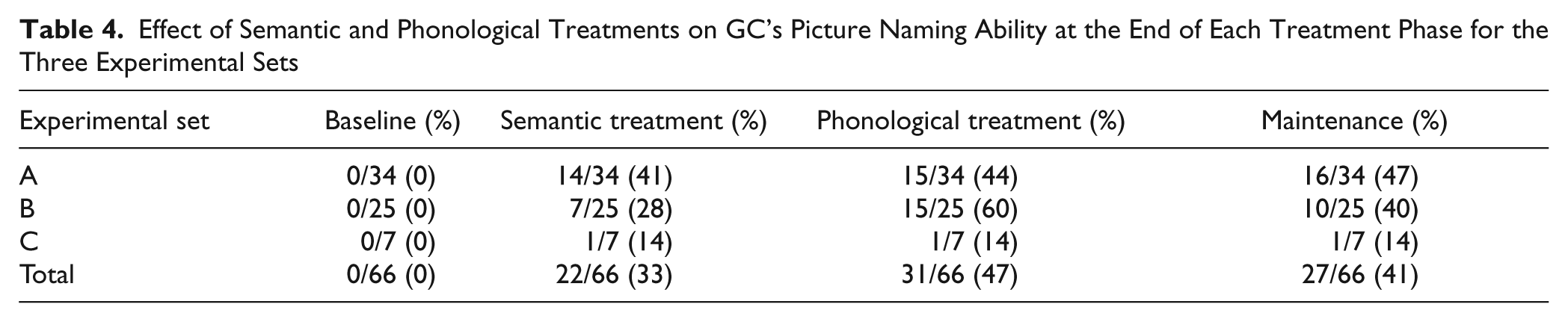
The phonological treatment also had a clear effect on GC’s naming abilities. An additional improvement of 30%, higher than expected according to the consistency measure at baseline testing, was recorded for the treated stimuli (Set B), χ2 = 3.98, p < .05. However, as shown in Table 4, the phonological treatment had no effect on untreated items, regardless of whether they were semantically related to the treated stimuli (Set A) or not (Set C). Albeit substantial, the difference between Set B and Set C did not reach significance, χ2 = 2.93, p = .08. It is interesting that the positive effect in naming abilities of List A items was maintained, at least 4 weeks after the end of the semantic treatment.
Finally, GC showed good preservation of the beneficial effect of the semantic treatment, from 15/34 (44% correct) at the end of both treatments to 16/34 (47% correct) in the maintenance testing, 3 months later. At that time, GC’s naming performance on Set B decreased to 40% compared to the number of items correctly named immediately following the last phonological treatment (60%), whereas it remained stable on the control set (Set C).
As shown in Table 5, there were also qualitative changes in the nature of GC’s errors, according to the different phases of the therapy. Most of the errors she produced in the baseline evaluation consisted of personal comments (47%), circumlocutions (18%), and semantic paraphasias (14%), whereas no responses (9%) and visual errors (7.5%) were more exceptional.
Evolution of Errors, Reported in Total Number of Errors Produced and Percentage of Specific Errors to Total Errors
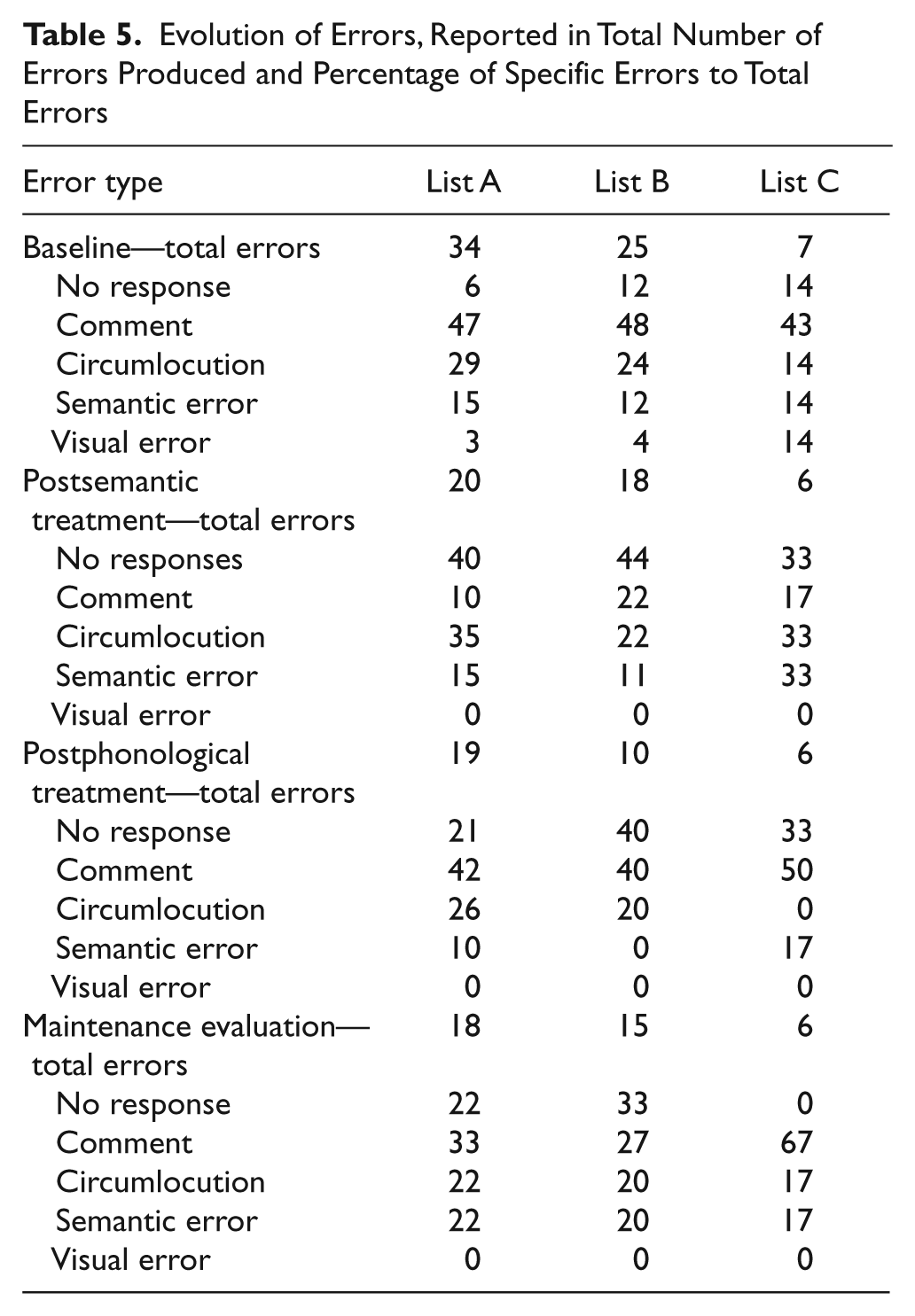
There was a significant decrease in the total percentage of personal comments after the semantic therapy (16%) as compared to the baseline (47%), χ2 = 9.93, p = .001. At the same time, the total percentage of no responses rose to 41%, as compared to 9% pretherapy, χ2 = 13.86, p < .001. There was no change in the proportion of semantic paraphasias but visual errors completely disappeared from GC’s spoken production.
Overall, except for no response errors, which remained more numerous, the proportion of the different types of errors returned to baseline, at the end of the phonological therapy (see Table 5). From a qualitative point of view, there was also no change at the maintenance testing 3 months after the end of therapy.
Discussion
We have reported the case of GC, a chronic patient with aphasia who showed word retrieval difficulties. Her performance on various tasks exploring comprehension and production was indicative of spoken production deficits functionally localized at the conceptual-semantic level as well as at the lexical-semantic level. Results in the treatment study indicate that, in GC, the semantic and the phonological treatments were both effective in improving naming abilities. The semantic treatment resulted in a clear improvement in naming the treated items. Because it required the patient to activate semantic networks, this treatment also resulted in generalization to closely semantically related untreated items. It is interesting that the beneficial effect of the semantic treatment was highly durable and maintained at the immediate posttreatment level for at least 3 months. The positive quantitative effect of the semantic therapy was also accompanied by a change in error type. The presentation of picture stimuli in one of the three semantic therapy techniques led to better visual identification and the complete disappearance of visual errors. There was no change posttherapy in the utilization of circumlocutions to compensate for word finding problems. We also observed an important decrease in the proportion of personal comments whereas no responses were paradoxically predominant at the end of the semantic therapy. It is difficult to determine the functional origin of these behaviors. Personal comments could certainly be interpreted as the exteriorization of the semantic and lexical retrieval process (“It is not a X; I have one at home; it is round . . .”). No response is a common type of error among individuals with aphasia, especially those with severe anomia. Miceli, Giustolisi, and Caramazza (1991) suggested that no response errors may be the most common type of error in an anomic patient with no demonstrable semantic deficits. These errors could also be interpreted as evidence of a preserved ability to refrain from producing an erroneous response (Mitchum, Ritgert, Sandson, & Berndt, 1990). Along with these possibilities, we suggest that no response could be suggestive of correct activation of the concept to produce whereas its phonological form remains inaccessible or insufficiently activated in the phonological output lexicon. In GC, the semantic therapy appeared to be effective in activating the semantic network of some treated and semantically related items as well as their corresponding lexical forms. For other experimental items, however, this semantic activation was insufficient to allow the retrieval of phonological forms in the output lexicon, leading to no responses.
Moreover, we have shown that the introduction of a phonological treatment immediately after the semantic treatment resulted in the subsequent improvement of GC’s naming abilities, although limited to the treated stimuli. As compared to the semantic treatment, phonological therapeutic techniques showed item-specific effects only, a result congruent with what is usually reported in the literature (Miceli et al., 1996; Nettleton & Lesser, 1991). Although 3 months posttherapy we observed a tendency to progressive fading of the phonological therapy effects, GC still showed a better naming performance on the phonologically treated stimuli than observed in the baseline evaluation. However, these stimuli were first treated through semantic techniques, and it is therefore difficult to determine if the effects after 3 months were due to one or another of the therapies or a combination of both.
This study also has some limitations. First, although we evaluated the performance of the patient on two separate occasions during the selection of the stimuli, we did not probe GC’s performance in the three experimental sets before therapy and therefore cannot completely rule out the possibility that changes following treatment reflect regression to the mean or natural performance variability. However, as shown in the background testing (picture naming and naming-to-definition) as well as in the two administrations of the picture naming task at baseline testing, the patient’s performance was highly consistent across presentations of items to name. The very limited variability in GC’s performance before the treatment supports our interpretation that the improvement observed is actually due to the effects of the treatment rather than a simple regression to the mean. Second, the three experimental sets were small in size, in particular Set C. Because of this, although the general effects of treatment are clear, the differences between treated and untreated items as well as the generalization effects were not supported by statistically significant scores. Third, one could argue that having started the phonological treatment only 1 day after the semantic treatment could have led to confounding effects. Indeed, we cannot completely rule out the fact that the generalization effects on the items of Set B continued after the semantic treatment and, thus, could have contributed to the improved performance at the phonological phase of treatment. However, the effects of the semantic treatment were highly durable, and it remains unclear whether a longer delay between the two phases of treatment would necessarily lead to better isolating their respective contributions to the improved performance of GC following the phonological treatment.
This case study demonstrates that improvement in word-finding abilities may be possible in chronic anomic aphasia. Three years poststroke, GC showed an improvement in picture naming and, moreover, this improvement occurred after a relatively short period of therapy. This study also reinforces the importance of choosing a semantic therapy that focuses on strengthening the semantic representations of target items to promote generalization to related items. Finally, with respect to the duration of the beneficial effects of the treatment for word retrieval deficits in aphasia, our study confirms the maintenance of effects after 3 months for the semantic therapy. However, further investigation is needed, in particular to clarify the relative influence of patients’ personal factors (e.g., age, type and severity of aphasia) on treatment outcomes in terms of effectiveness, generalization, duration, and transfer to functional contexts of communication.
Footnotes
Appendix
Experimental Stimuli
| List A | List B | List C |
|---|---|---|
| Animals | Animals | Furniture |
| turtle | pig | bench |
| giraffe | peacock | Vehicle |
| fox | crocodile | motorcycle |
| rabbit | seahorse | Miscellaneous |
| ostrich | rhinoceros | bow tie |
| caterpillar | penguin | cannon |
| snail | leopard | nail file |
| lobster | deer | ladder |
| raccoon | fly | spinning |
| seal | skunk | |
| tiger | gorilla | |
| duck | ||
| kangaroo | ||
| grasshopper | ||
| donkey | ||
| Fruits and vegetables | Fruits and vegetables | |
| watermelon | grapes | |
| peach | celery | |
| Body parts | Body parts | |
| ear | toe | |
| Musical instruments | Musical instruments | |
| harp | violin | |
| drum | horn | |
| trumpet | ||
| Sewing and clothes | Sewing and clothes | |
| clothes pin | ironing board | |
| hanger | thimble | |
| needle | ||
| Kitchen | Kitchen | |
| kettle | bottle | |
| frying pan | pitcher | |
| Tools | Tools | |
| axe | wheelbarrow | |
| hammer | wrench | |
| Buildings | Buildings | |
| windmill | barn | |
| Sports and toys | Sports and toys | |
| baseball bat | football helmet | |
| roller-skates | spinning top | |
| sled | ||
| ball | ||
| kite |
The authors declared no potential conflicts of interests with respect to the authorship and/or publication of this article.
The authors received no financial support for the research and/or authorship of this article.