






Abstract
The purpose of this study was to examine college students’ perceptions of individuals with autism spectrum disorder (ASD) and identify contributing factors that influence perceptions and reactions to students with ASD. Participants included 1,185 college students who responded to a survey in class or online. Trends in responses suggested that experience and exposure to ASD were positively associated with sympathy and helping reactions given a simulated scenario that included challenging behavior. Conversely, experience and exposure to ASD were associated with lower anger, perceived controllability, and punitive reactions. Multiple regression analyses indicated that punitive intentions were largely predicted by feelings of anger toward the behaviors. Feelings of sympathy significantly contributed to reactions of wanting to help the child (vs. punishing).
Social perception and peer acceptance play a major role in a child’s social, academic, and personal development (Black & Hazen, 1990; DeThorne & Watkins, 2001; Ling, Mak, & Cheng, 2010; Pijl & Frostad, 2010; Schaffer, 1996). If negative perceptions exist among peers, the child’s social exchanges, social life, and self-concept may be negatively affected. Furthermore, negative perceptions among family members, educators, and other professionals can have an impact on the child’s learning experience, educational performance, and their overall well-being (Ling et al., 2010). Social perceptions and peer acceptance are relevant to the experience and development of all children, including children with autism spectrum disorder (ASD) or social communication disorders.
Previous studies have revealed that children with differences in social communication and interaction, and behavioral challenges, have been subject to negative judgments and discrimination (Black & Hazen, 1990; DeThorne & Watkins, 2001; Hazen & Black, 1989; Ling et al., 2010; Nissenbaum, Tollefson, & Reese, 2002; Rice, Hadley, & Alexander, 1993; Swaim & Morgan, 2001). Subsequently, this may translate to an increased likelihood for individuals with ASD to experience negative judgments and discrimination.
Social Perceptions, Emotional Reactions, and Behavioral Intentions
According to the attribution theory (Weiner, 1993), a person’s perceptions of the controllability of a behavior may lead to emotional reactions and affect behavioral intentions. Perceived controllability refers to whether someone identifies a behavior as being under the individual’s control, thus exhorting responsibility on the individual for the behavior. This inferred responsibility has been noted to invoke feelings of anger and sympathy, and influence helping and punitive intentions toward individuals with ASD and other mental illnesses (Corrigan, Markowitz, Watson, Rowan, & Kubiak, 2003; Ling et al., 2010).
In Ling et al. (2010), psychologists in Hong Kong conducted a survey utilizing a hypothetical vignette to investigate whether perceived controllability and emotion affect the behavioral intention, or actions, of special educators toward individuals with ASD. The relationships between perceived controllability, anger, sympathy, helping intention (intent to help), and punitive intention (intent to punish), were defined specifically relative to the school context, based off of the Attribution Questionnaire (AQ) developed by Corrigan et al. (2003).
Perceived controllability, as noted, refers to assigning control, responsibility, intentionality, or blame over a challenging behavior. Anger refers to being angered by the child’s behavior, perceiving the child as a troublemaker, disliking the behavior, or disliking the child because of the behavior. Sympathy refers to feeling sorry or pity for the child, wanting to care for him or her, or reporting understanding for why a child behaves a certain way. Helping intention refers to wanting to seek help for the child, or the willingness to counsel the child and learn more about the child’s background or disability. Punitive intention refers to seeking out or implementing punishment for the child’s behavior, including withdrawing support or resources.
Findings from Ling et al. (2010) suggest that educators who perceived behaviors as controllable were less likely to help the child and more likely to punish them. Furthermore, feelings of anger and sympathy mediated the effect between perceived controllability and behavioral intentions. In other words, staff who were able to cope with their anger and were more sympathetic were more likely to help and less likely to punish a child with ASD.
Potential Changes in Perceptions, Knowledge, Exposure, and Education
The prior research of Ling et al. (2010) may have important implications for personnel preparation in facilitating positive responsiveness toward children with ASD. Although historically studies have shown negative perceptions of characteristics associated with individuals with ASD, along with peer rejection due to their differences in behaviors, communication, and social skills, there may have been recent changes that warrant further investigation. Potential changes in perceptions may be expected as a result of increased exposure due to educational placement trends toward inclusion, which may have led to shifts in attitudes and acceptance of differences.
In 1997, the Individuals with Disabilities Education Act (IDEA; Public Law 105-17, 1997) mandated free public education for students with disabilities in the least restricted environments (Morton & Campbell, 2008). Subsequently, students with disabilities are more likely to be placed in inclusive settings with typically developing peers. This has led to more frequent exposure and interactions between children with ASD and typically developing peers within the academic setting (Harrower & Dunlap, 2001), which may be associated with increased awareness and acceptance. Moreover, there has been an increased emphasis on public awareness campaigns in recent years.
In addition, according to Center for Disease Control and Prevention (CDC), the prevalence of ASD in children 8 years old has increased 78% during 2002 to 2008, indicating 1 in 88 children in the United States on average has ASD (Blumberg et al., 2013). Furthermore, according to parental reports, prevalence for children aged 6 to 17 to be diagnosed with ASD in 2011 to 2012 was estimated to be 2.00% or 1 in 50 (Blumberg et al., 2013).
This increase in prevalence is expected to create a shortage of personnel qualified to serve children with ASD in school settings. Given the increase in prevalence and shortage of qualified personnel coupled with the growing trend toward inclusive education, it is expected that educators and personnel in general education settings will be increasingly serving children with ASD. Moreover, personnel in childcare settings, libraries, and other public community centers will be increasingly likely to serve children with ASD. Research is needed to describe typical knowledge, experience, exposure, and perceptions of students exiting college programs that are not tailored to serve individuals with ASD. In addition, research is needed to assist in identifying desired personnel qualities as well as critical “levers” for preparing future personnel to serve children with ASD.
Knowledge and exposure are often believed to be key components in producing attitudinal change toward individuals with disabilities. Knowledge of ASD refers to one’s ability to identify traits that are and are not associated with ASD. Exposure is used to refer to a variety of activity types or experiences that may be associated with increased awareness or understanding of ASD. In educational settings, examples of exposure may vary from a brief interaction with a peer with ASD, to more prolonged engagement with classmate diagnosed with ASD.
Although increased exposure and knowledge is hypothesized to be positive factors in perceptions and behavioral intentions, research has not been clear on its relationship. Multiple studies have shown that neither the knowledge nor the amount of exposure correlated or affected altitudinal or intentional ratings toward a child with a developmental disorder, including autism (Ling et al., 2010; Swaim & Morgan, 2001; Vurdelja-Maglajlic & Jordan, 1974). However, other studies have found that educators who received education or training on disability were found to demonstrate more positive attitudes toward disability and/or inclusion (Avramidis & Norwich, 2002; Loreman & Earle, 2007; Loreman, Forlin, & Sharma, 2007; Sharma, Forlin, Loreman, & Earle, 2006; Subban & Sharma, 2006).
In a report investigating our target population, Mahoney (2007) studied college students’ attitudes toward individuals with autism and several predicting factors. One finding from this study suggests that better contact and exposure, and greater general knowledge, were predictors of dec-reased preference for social distance. In other words, knowledge and quality exposure may have a positive effect on the social interactions between individuals with ASD and college students. Edyvean (2009) also found that generally increased exposure in college students with individuals with ASD lead to increased likeability scores and an increased willingness to spend time with other individuals with ASD.
Other studies further support that exposure, specifically personal contact with persons with mental illnesses, produces the greatest consistent results in fostering positive perceptions toward those individuals (Corrigan et al., 2003). Specifically, studies indicate that familial connections with an intellectual disability (Tachibana & Watanabe, 2004) or ASD (Nevill & White, 2011), is associated with more favorable attitudes toward disability and higher openness scores, respectively.
College Students’ Perceptions
Few studies have considered college students’ perceptions of individuals with ASD. One study, Mahoney (2007), surveyed 330 college students in the United States to examine attitudes toward individuals with ASD. The investigators considered the effect of several factors on attitude including: knowledge about autism, previous contact with individuals with ASD, level of anxiety, and perceived controllability. Attitudes were assessed by asking participants to rate (a) their willingness to interact with individuals with ASD, (b) the appropriateness of mainstreaming students with ASD, and (c) the appropriateness of required accessibility in community businesses and services. In addition, the Mahoney study examined behavioral intention. Results indicated that students generally had positive attitudes associated with individuals with ASD supporting a potential change in historically highlighted negative stigma associated with ASD. The Mahoney study also found several significant predictors of attitude or perceptions including: knowledge, experience or contact with individuals with autism, level of anxiety and gender. General knowledge accounted for 4.8% of the variance in attitudes, behavioral knowledge 4.1%, and experience or contact explained 2.9% of the variance in attitudes. Anxiety accounted for 11.5% of the variance in attitudes; whereas behavioral control accounted for 3.6%. Although gender was not the primary focus of the study, it accounted for 4.8% of the variance in attitudes, with females demonstrating more positive attitudes than males.
A recently published article, Gardiner and Iarocci (2014), also explored college students’ perceptions of adults with ASD as students in the university context. The respondents of this study included 202 college students, primarily of Asian (57%) or Canadian (25%) ethnic backgrounds. The survey included questions regarding peer acceptance such as how likely they would be to hang out with the student with ASD during free time, share an apartment building, or feel comfortable being around this person. The results indicated that many college students (53%) reported only having indirect exposure to individuals with ASD previously. Respondents who reported direct contact previously (44%) reported experiences through work or a family member. In terms of perceptions, college students in the Gardiner and Iarocci study reported mostly positive perceptions particularly related to passive reactions, with 89% not feeling afraid, 60% believing the student in the scenario with ASD was likely as smart as them, and the majority (94%) feeling comfortable sharing an apartment hallway or complex and largely (81%) anticipating liking him as a person. No significant gender differences were found in peer acceptance measures. Respondents’ likelihood toward positive action or active supports was split with roughly half being willing to volunteer support and less than half indicating that they would likely hang out with college student with ASD. The contrast in respondents’ willingness to volunteer was partially explained by gender and major area of study, although only explaining 15% of the variance in responses. Female students from arts and social science programs showed greater likelihood to volunteer support than males from other majors.
Given the growing need for high-quality personnel preparation for up and rising scholars to comprise the future workforce of personnel serving children with ASD, the present study set out to explore the contribution of knowledge, education, and exposure on college students’ attitudes and reactions toward children with ASD. College students are of specific interest as most have more than likely experienced these recent changes in educational practices and witnessed the proliferation in prevalence of ASD, and subsequently have had increased exposure and knowledge of ASD. Furthermore, they hold a large stake in the expected effect on the livelihood of individuals with ASD, as the future workforce serving children with ASD in a variety of educational and community settings. Information regarding college students’ perceptions is expected to benefit pre-service and in-service personnel preparation efforts in preparing future personnel who may provide services or support to individuals with ASD in future settings.
Aims
The purpose of this study was to (a) examine and describe college students’ perceptions of characteristics associated with children with ASD and (b) examine the relationships between perceptions and behavioral intentions. Given the historical negative judgments, it might be expected that perceptions remain negative; however, considering the shifts in educational trends and generational trends toward acceptance of differences, it is equally plausible that positive perceptions pervade.
Method
To answer the above research questions, the investigators used survey methodology to allow for broad dissemination to college students at a pre-service level from a variety of backgrounds and majors. Survey methodology was also appealing in that it allowed for flexible participation options, including paper-based and online survey completion.
Recruitment
The researcher distributed information online through the social networking site Facebook, Florida State University Blackboard course email databases, and via disseminated paper copies of survey within classrooms in which instructors agreed to allow participation. After 4 months of recruitment of survey participants, preliminary data were aggregated. The investigators noted a gender imbalance with fewer male respondents. In response to the imbalance, the survey was re-opened for 10 months for additional recruitment in an effort to increase sample size and gender balance. Participation was voluntary and informed consent was confirmed through participants’ submission of a completed survey.
Individuals who completed the survey but did not click on the acknowledgment of informed consent were excluded (n = 5), along with respondents who were not students at Florida State University (n = 20). The investigators excluded submitted surveys that were substantially incomplete (n = 116; e.g., participants who began the survey but did not continue beyond the first page). Responses from graduate students were also excluded from the study. Graduate students were not intentionally invited to participate; however, 51 graduate students responded to posted invitations, largely due to their participation in classes that also included undergraduate students. Investigators decided to exclude responses from graduate students realizing that they may differ in age and experiences from the typical undergraduate on average, due to a variety of potential influences such as advanced coursework, outside employment, or prior additional bachelor’s-level education or experiences.
Participants
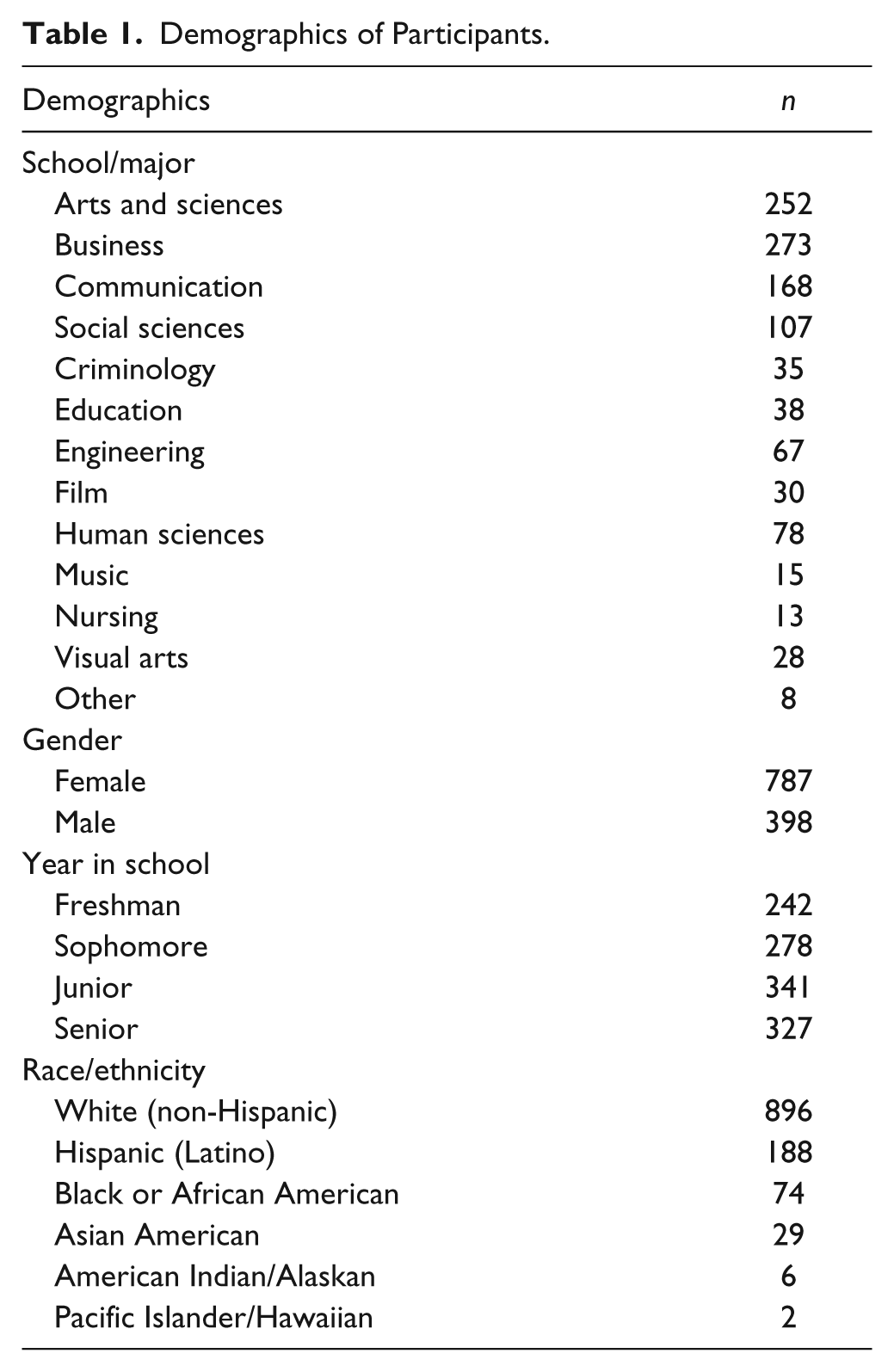
Table 1 presents demographic information about the respondents. Participants were comprised of a convenience sample of 1,204 undergraduate students attending Florida State University. On average, participants were approximately 20 years old (SD = 1.97 years), and the majority of respondents (90%) were from Florida (n = 1,040). The remaining 10% (162) were from 25 different states. In addition, 6 of the out-of-state respondents reported international origins. A large percentage of participants (74%) were from White (non-Hispanic) ethnic backgrounds although attempts were made to solicit students from diverse backgrounds. Despite attempts to solicit male respondents, there were more female participants (65%). The majority of participants (83%) reported attending public school for elementary, middle, or high school. Participants were fairly evenly distributed by number of years they had attended college. Diversity is noted regarding academic program with participants from 120 different majors in more than 12 different schools or disciplines (refer to Table 1).
Demographics of Participants.
Measures
The questionnaire consisted of items designed to measure students’ perceptions of characteristics associated with ASD and possible factors of perceptions based on previous studies. The survey included questions addressing demographics, knowledge of ASD, exposure to ASD, formal education in ASD, and perceptions of individuals with ASD.
Knowledge of ASD
A measure developed by Ling and colleagues (2010) was utilized to measure knowledge of ASD. Participants were asked to answer 19 “true” or “false” questions identifying characteristics of individuals with ASD. The characteristics of ASD and other disorders were selected from the Diagnostic and Statistical Manual of Mental Disorders (4th ed., text rev.; DSM-IV-TR; American Psychiatric Association, 2000). Although the DSM used in Ling et al. is now outdated, the identifying characteristics from the Ling et al. study were maintained, as it was determined that the characteristics were among the accepted potential attributes or red flags for ASD. In addition consistency in common attributes allowed for comparison of current findings to previous research. The questions included symptoms of ASD without co-morbidity (10 questions), Down syndrome (4 questions; e.g., was born with distinct facial features), and attention-deficit/hyperactivity disorder (ADHD; 5 questions; e.g., often does not give close attention to details or makes careless mistakes in schoolwork, or other activities). The overall percentage of correct answers was computed to derive a composite score of knowledge of ASD attributes. The knowledge-based quiz was also used to measure common characteristics associated with ASD. Characteristics identified by high percentages of participants were determined as characteristics commonly associated with ASD in college students.
Exposure to individuals with ASD
Participants were asked to answer five “yes” or “no” questions pertaining to their exposure to individuals with ASD. The researcher generated the questions. Items included exposure to a student with ASD in a school or classroom or any setting, and having a family member or friend with ASD. Answers were converted to a numeric score (i.e., yes = 1 and no = 0). A composite score was derived from the five questions by summing across the five questions. A high score (5) denoted that the participant had high exposure to ASD, whereas a low score (0) denoted low (or no) exposure.
Education of ASD
Participants were asked “Have you taken any courses addressing autism spectrum disorders (ASD)? This includes courses that addressed ASD in a single lecture.” The answer was converted to a numeric score (i.e., yes = 1 and no = 0).
Perceptions of individuals with ASD
The survey included a hypothetical vignette used in previous research depicting a child with characteristics associated with ASD (Edwardraj, Mumtaj, Prasad, Kuruvilla, & Jacob, 2010). No diagnosis was presented in the vignette and the vignette appeared prior to the ASD-focused questions, so respondents were blind to the diagnosis. The utilization of a vignette is a common research strategy when studying stigma (Link, Yang, Phelan, & Collins, 2004). Characteristics portrayed in the vignette included the presence of communication disorders, behavioral issues, self-destructive acts, challenges with social skills, and poor cognitive ability.
The measurement for the vignette developed by Ling and colleagues (2010) was included to examine perception of ASD. The questions can be found in the appendix of Ling et al. Perceptions were investigated by their behavioral intention to help or punish based on the AQ by Corrigan et al. (2003). Ling et al. reported factor analysis on the questionnaire using the principal components approach with varimax rotation showing a five-factor solution explained 53.3% of the variance. The five factors pertained to factors thought to be potentially associated with perception: perceived controllability (five items; e.g., I think the child should have control over his challenging behaviors), feelings of anger (six items; e.g., the child’s behavior makes me angry), sympathy (six items; e.g., I feel sorry for the child), helping behavioral intention (seven items; e.g., If I were the child’s teacher, I would seek help for him), and punitive behavioral intention (five items; e.g., If I were that substitute teacher, I would ask the school to punish the child). On the AQ, a Likert-type 5-point scale is utilized for these questions: (1) strongly disagree to (5) strongly agree. In the literature, internal consistency is reported for each subscale and found to be satisfactory (Cronbach’s α = .69), with the five factors reportedly showing internal consistency between .69 and .82.
In addition to the questionnaire, five additional questions were added due to the authors’ interest in social perceptions related to communication disorders in general. These questions were utilized by DeThorne and Watkins (2001) and developed by Rice et al. (1993). The questions measured the participants’ perceptions of the child’s intelligence, leadership potential, peer acceptance, and social maturity, in addition to his parent’s education and socioeconomic status (refer to Table 2). The same 5-point Likert-type scale was utilized for the additional questions.
Perceptions of an Individual With ASD Based on Reactions to Vignette.
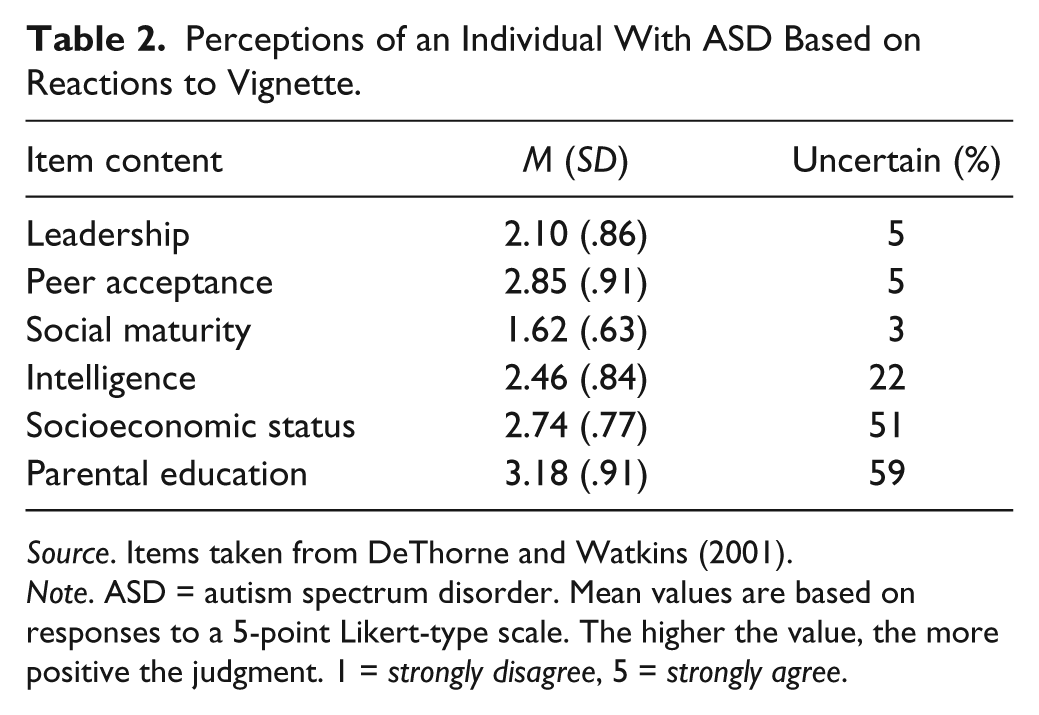
Source. Items taken from DeThorne and Watkins (2001).
Note. ASD = autism spectrum disorder. Mean values are based on responses to a 5-point Likert-type scale. The higher the value, the more positive the judgment. 1 = strongly disagree, 5 = strongly agree.
Analysis
The first research aim, to examine and describe perceptions of characteristics associated with children with ASD, was examined through the use of descriptive statistics. To accomplish the second aim, to examine the relationships between perceptions and reactions, we used bivariate correlations and hierarchical regression using IBM SPSS 20. The regression models used to accomplish the second research aim allowed for an examination of emotion and perception (e.g., anger, sympathy, perceived controllability) on the prediction of behavioral intent (punitive intentions and helping intentions). Magnitude of the association was interpreted using Cohen’s index. A correlation coefficient of anything greater than .5 was considered large, .5 to .3 was moderate, .3 to .1 was small, and anything smaller than .1 was considered unsubstantial (Cohen, 1988).
Results
Knowledge, Exposure, and Education of Individuals With ASD
To address the first research aim to describe students’ perceptions of characteristics associated with ASD, descriptive results are reported regarding knowledge, exposure, education, and perceptions. Student respondents demonstrated a large range in knowledge and exposure. The majority of participants seemed to have at least basic knowledge of ASD. On average, respondents attained 76% accuracy on a 10-item quiz over their knowledge of autism (SD = 20% accuracy). Distinctive features that most participants attributed to individuals with ASD included social skills deficits, spoken communication difficulties, oversensitivity, and repetitive behaviors. The majority of participants correctly identified characteristics associated with ASD such as inappropriate eye contact (83%), difficulty expressing oneself (86%), and difficulty understanding other people’s perspective (91%). However, participants performed near chance levels in identifying other characteristics of ASD, such as insistence for sameness (59%). In addition, some participants incorrectly attributed physical features to ASD or failed to discriminate features not associated with ASD.
Most respondents had basic exposure to an individual with ASD, with 75% of respondents reporting some type of personal experience or exposure (e.g., known someone with ASD). Most of the exposure reported came from the school (67%) with a smaller portion sharing a class with an individual with ASD (29%). Only a small group of students reported having a family member (13%) or friend (18%) with ASD. Formal education of ASD was sparse with only 19% reporting that they had taken a class or had structured training related to ASD.
Perceptions of Individuals With ASD
When participants were asked about the perceptions of the child in the vignette, although blind to a diagnosis of ASD, they made negative judgments on average regarding his leadership skills, likability among peers, social maturity, and intelligence (refer to Table 2). Among them, participants rated his social maturity and leadership skills the lowest. Only a small group (5% or less) responded with “uncertain” and did not make judgments or assumptions based on the hypothetical child’s character beyond the information presented in the vignette. More respondents chose “uncertain” in regard to the child’s intelligence (22%), and approximately half chose the “uncertain” option in regard to his parent’s socioeconomic status and educational level.
To accomplish the second research aim, correlational analyses were conducted to examine the relationship among knowledge, exposure, emotions, perceptions, and reactions. Table 3 presents the relationships between knowledge of ASD, exposure to ASD, formal education in ASD, perceived controllability, anger, sympathy, and helping behavioral intention. Exposure and knowledge of ASD were positively associated with sympathy and helping reactions, although the associations were weak in strength. Responses of low perceived controllability (i.e., the child was not intentionally misbehaving) were associated with low anger reaction and reduced likelihood of a punitive reaction. Similarly, exposure and knowledge of ASD were also associated with less anger and punitive reactions, although the relationship was small or weak.
Relationships Between Knowledge, Exposure, Perceptions, and Reactions to ASD.
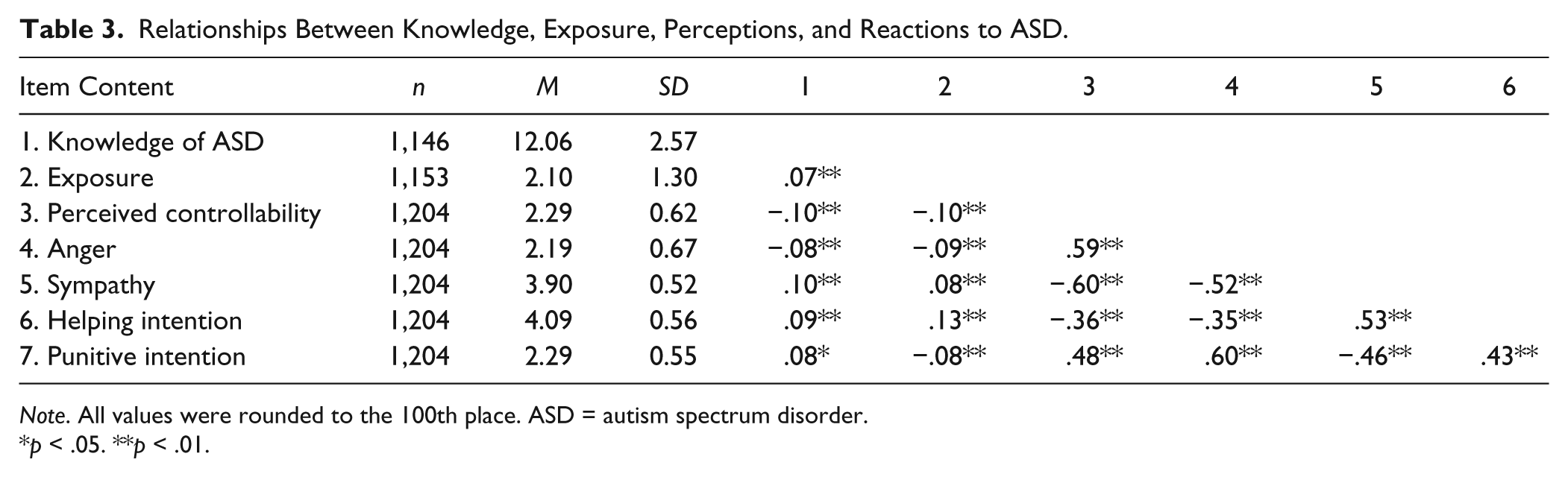
Note. All values were rounded to the 100th place. ASD = autism spectrum disorder.
p < .05. **p < .01.
Perceived Controllability
A moderately strong, positive relationship was found between anger and perceived controllability. In other words, college students who reported feelings of anger were more likely to report greater perceived controllability, or the belief that the child was intentionally misbehaving. A moderately, strong negative relationship was found between sympathy and perceived controllability. College students who reported a greater degree of sympathy were less likely to perceive that the child with ASD was in control of their behaviors or intentionally exhibiting negative behaviors.
Strong correlations were observed between emotions, perceptions, and reactions to traits associated with ASDs. In response, the relationship among anger, sympathy, perceived controllability, helping intention, and punitive intention was further explored using regression analysis. Table 4 presents regression analyses of predictor variables.
Summary of Regression Results for Behavioral Intention.
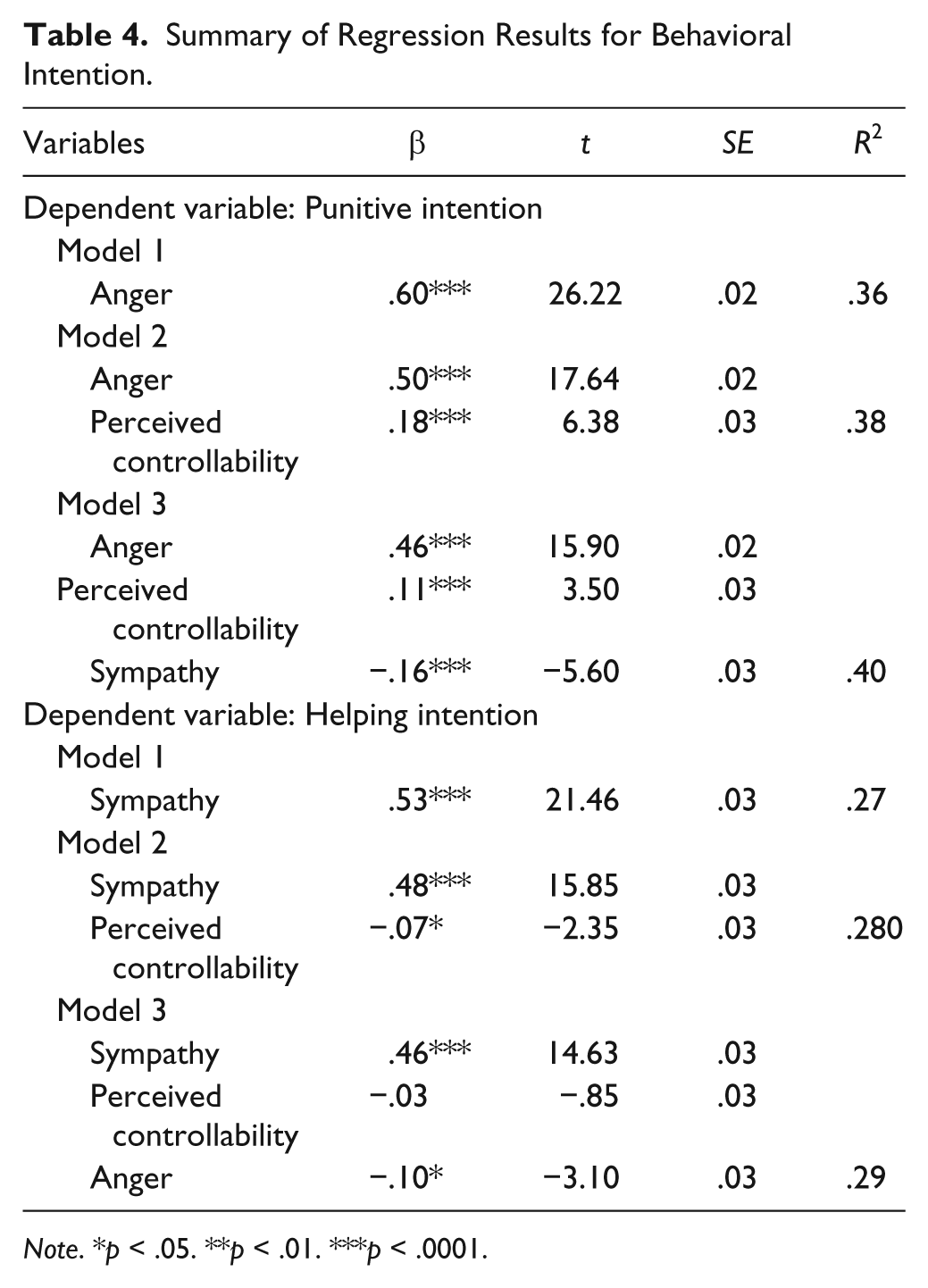
Note. *p < .05. **p < .01. ***p < .0001.
Punitive behavioral intention
Table 4 provides regression parameter estimates for each model. As anger was most highly correlated with punitive intention, anger was entered in the model first. The first model, which included only anger as a predictor, explained 36% of the variance in punitive behavioral intention, F(1, 1202) = 687.46, p < .0001. In Model 2, anger and perceived controllability were entered as predictors into the model together, predicting 38% of the variance in punitive behavioral intention F(2, 1201) = 375.46, p < .0001. In the final model anger, perceived controllability, and sympathy were entered into the model together, explaining 40% of the variance in punitive behavioral intention, F(2, 1201) = 267.05, p < .0001. Anger was moderately and positively related to punitive intention (β = 0.47, p < .0001). Participants who felt angry in response to the child’s behaviors showed greater likelihood of responding that they would punish the child. Perceived controllability had a small, positive relationship with punitive intention (β = 0.11, p < .0001). Individuals with high ratings of perceived controllability showed greater likelihood of responding that they would punish the child. There was a small, negative relationship between sympathy and punitive intention (β = −0.16, p = .0001). Participants who felt sympathetic in response to the child’s behaviors showed less likelihood of responding that they would punish the child.
Helping behavioral intention
Factors showing large correlations to helping behavioral intent were entered in regression analyses. In Model 1, sympathy was entered in the model, explaining 28% of the variance in helping intention, F(1, 1202) = 460.64, p < .0001. In Model 2, sympathy and perceived controllability were entered in the model explaining 28% of the variance in helping intention, F(2, 1201) = 233.94, p < .0001, suggesting perceived controllability did not add substantially although a significant predictor (p = .02). When anger was entered into the final model, which included sympathy, perceived controllability, and anger, the factors explained 29% of the variance in helping behavioral intention, F(3, 1200) = 160.30, p < .0001. Sympathy had a positive relationship with helping intention (β = 0.46, p < .00001). Not surprisingly, college students who reported stronger feelings of sympathy toward the child with ASD were more likely to want to help or have helping intentions. When anger was entered, perceived controllability was no longer a significant predictor. Anger had a small, negative relationship with helping intention (β = −0.01, p = .002). College students who reported stronger feelings of anger toward the child with ASD were less likely to report reactions of wanting to help, or helping intentions.
Because significant findings emerged, follow-up analyses of variance were conducted to investigate potential differences in reactions between gender groups. Although not the primary aim of the study, significant differences were found between male and female reactions and perceptions (p < .0001). Gender differences accounted for only 3% to 4% of the variance in perceptions and reactions, considered a small effect. On average, males reported more anger (M = 2.38) than females (M = 2.09), R2 = .039, p < .0001. Furthermore, males showed higher average ratings of perceived controllability (M = 2.47) than females (M = 2.2), R2 = .041, p < .0001. Conversely, the mean sympathy for females (M = 4.0) was larger than males (M = 3.8), R2 = .028; and females showed stronger helping intentions (female M = 4.2; male M = 4.0) R2 = .024, p < .0001.
Discussion
The present study expanded on past research into perceptions of characteristics associated with individuals with ASD and factors that may be related. It used a hypothetical vignette to examine personal judgments, emotional responses (anger and sympathy), perceived controllability, and behavioral intentions (helping and punitive) of college students in relation to characteristics associated with children with ASD. In addition, it investigated factors that may be related to perceptions in the relationships between all variables in addition to knowledge, exposure, and education.
Key Findings
Perceptions of ASD
The present study measured knowledge of ASD in college students and examined specific characteristics they associated with ASD. The present findings substantiate that characteristics individuals identify with ASD are indeed consistent with the key features associated with ASD based on the DSM-IV-TR. The majority of participants recognized that individuals with ASD have these characteristics: repetitive motor movements, gaze aversion, seemingly atypical behaviors, difficulties with expressive communication, and poor social skills. Furthermore, it was found that the most common characteristic associated with ASD was differences in social skills or inappropriate social interactions. Findings suggest that the majority of participants understood the important characteristics associated with diagnostic criteria.
The results of the judgment items of the survey may be indicative that a negative stigma is still associated with ASDs and their common characteristics. Participants made negative judgments regarding the hypothetical child’s leadership skills, likability among peers, social maturity, and intelligence, despite having the option to respond with “uncertain.” The average judgment ratings in the current study were within one standard deviation of those reported by DeThorne and Watkins (2001) using the same scale. Judgment measures show mixed findings in the previous literature, with several sources suggesting a negative stigma associated with individuals with communication disorders (DeThorne & Watkins, 2001; Hazen & Black, 1989; Ling et al., 2010; Nissenbaum et al., 2002; Rice et al., 1993). In contrast, however, the current findings on negative judgments were somewhat inconsistent with the Mahoney (2007) study and Gardiner and Iarocci (2014), which reported that college students had relatively positive attitudes toward individuals with autism. The contrasting findings between studies may be partially explained by the fact that Gardiner and Iarocci examined peer acceptance of college students with ASD who were high functioning and this study focused on children.
Perceptions and Reactions
The current findings offer insight into underlying emotions or reactions that possibly fuel perceptions and responses to individuals with ASD. Of particular interest in the current results was the finding that anger, sympathy, and perceived controllability were strongly associated with helping and punitive reactions. Furthermore, anger and sympathy showed strong associations with perceptions of perceived controllability. Participants with more sympathy did not perceive the behaviors as controllable and were more likely to help and less likely to punish. Inversely, participants with more anger and/or who perceived the behaviors as controllable were more likely to punish and less likely to help. This is consistent with previous findings (Ling et al., 2010). The implications of both studies suggest that emotional regulation toward challenging behavior and correct causal attribution to people with ASD may promote helping behavioral intentions toward individuals with ASD.
Although not the focus of the study, the finding that female respondents showed somewhat more sympathy and helping intentions overall was interesting. Gender had a small but significant effect on perceptions and reactions. The fact that gender differences were small is somewhat consistent with the mixed findings in the literature. Historically, some studies have reported females to be more likely to experience positive attitudes and acceptance toward disability than males (Farina, 1981; MacDonald & MacIntyre, 1999; Mahoney, 2007); however, other studies have not found significant gender differences in desired social distance in response to a vignette (Hall & Minnes, 1999; Schnittker, 2000). Gardiner and Iarocci (2014) did not find a significant gender difference in acceptance, but did find that females were more likely to volunteer support than males.
Education and Exposure
The current findings suggest that experience or exposure to individuals with ASD is associated with helpful reactions. This is consistent with a few previous studies that highlighted the role of interpersonal contact in improving attitudes and reducing negative stereotypical beliefs and/or the desire for social distance (Couture & Penn, 2003; Gardiner & Iarocci, 2014; Mahoney, 2007; Pettigrew & Tropp, 2000). The positive role of disability education substantiates previous literature (Avramidis & Norwich, 2002; Loreman & Earle, 2007; Loreman et al., 2007; Sharma, Forlin, & Loreman, 2008); however, the fact that knowledge had a small or weak association and did not substantially predict responses and emotions is not surprising. The earlier findings of Penn and Link (2002) suggest that fact sheets or informational focused training does not have a significant effect on perceptions and attitudes. Consistent with the suggestions of Penn and Link, it seems that knowledge training should be supplemented with other types of sensitivity training such as role-playing, video vignettes, or other forms of education that increase sympathy and understanding of perceived controllability to promote attitudes and perceptions associated with helpful responsiveness.
Limitations
There are a number of limitations in the present study that are important to be considered when interpreting the findings. As with most survey methodology, the results may not represent individuals who are less likely to voluntarily participate in survey research (Dillman, 2000). Research on survey methodology generally indicates that individuals from particular backgrounds (e.g., European American, middle income, with postsecondary education) are more likely to respond to survey invitations, however individuals from Hispanic and African American backgrounds are often under-represented in survey responses (Dillman, 2000). Moreover, given the methods used, a cause–effect relationship could not be inferred. As such, other factors may have contributed to the participant’s responses (e.g., how they were feeling the day they took the survey).
In addition, results of the vignette ratings should be interpreted cautiously with several considerations. The vignette was an example of a child with attributes associated with ASD, but the child’s description was not necessarily representative of the entire spectrum of characteristics of ASD, nor were attributes exclusively associated with ASD. It cannot be concluded that it was precisely ASD that respondents were reacting to, but perhaps differences from typical behavior expectations in general. It is certainly possible, and perhaps probable, that similar reactions would be obtained from a vignette focusing on attributes of other disabilities. Similarly, it cannot be presumed that the participants’ reactions to the child in the vignette are representative of perceptions of a broad age range or presented in a context other than the classroom. Participants may have reacted differently if the child was presented as older or younger. Furthermore, there may be a difference in social reality. When asked to write or state their reaction, participants may be more inclined to react in a socially acceptable way despite how they would spontaneously react in the real moment, assuming there may be a discrepancy between what participants reported they would do and what they would actually do. Similarly, participants might tend to give pro-social answers when asked; however, it is possible that respondents tend to be “nicer” hypothetically when distanced from the circumstances than when experiencing them in real-time.
Implications
Despite these limitations, this study adds to the growing body of literature measuring perceptions of characteristics associated with individuals with ASD. The findings related to judgments support the need for continued efforts to reduce potentially harmful reactions and minimize negative stigma. Perceptions of ASD and reactions to behaviors associated with ASD may be mediated by exposure and education about the characteristics of ASD. Education efforts focused on bolstering emotions associated with helpful intent (i.e., sympathy) and reducing feelings associated with punitive intent (i.e., anger) and perceptions (i.e., perceived controllability) may be expected to decrease punitive behaviors and increase helping behaviors. These findings may be beneficial in improving pre-service personnel preparation efforts to prepare the future workforce of personnel serving children with ASD. Current findings on perceived controllability may also be informative to assist personnel in preparing in-service trainings to other school staff or facilitating peer-to-peer social acceptance and support. In other words, providing in-service training to inform staff about the nature of the behaviors and lack of intent or controllability may be expected to facilitate acceptance and helpful intention.
Future research may consider evaluating which of the factors highlighted in this study could be manipulated and result in favorable outcomes for personnel preparation. For example, it would be interesting for an experimental study to examine whether programs that provide empathy training for personnel result in changes in individuals’ perceptions of ASD. Such training programs may include virtual exposure to movies in understanding and empathizing with individuals with ASD. The results of such follow-up would be useful to inform awareness campaigns regarding specific levers of awareness to target for exposure campaigns. This information may have implications toward reducing stigma and increasing sensitivity toward individuals with ASD.
In conclusion, given the adverse effects caused by negative social perception and peer rejection, additional personnel preparation and specialized training is needed to encourage increased awareness and positive responsiveness to characteristics of ASD. Continuing education efforts should consider focusing on emotions and perceived controllability, which were strong predictors of reactions and behaviors.
Footnotes
Acknowledgements
The authors express sincere gratitude to the college students who participated. Students graciously contributed their time in sharing perceptions and insights.
Declaration of Conflicting Interests
The author(s) declared no potential conflicts of interest with respect to the research, authorship, and/or publication of this article.
Funding
The author(s) received no financial support for the research, authorship, and/or publication of this article.