







Abstract
This current study explores parent perceptions of barriers to friendship development for highly verbal children with autism spectrum disorders (ASD) in mainstream academic settings. Participants were 10 parents of school-age children with ASD in mainstream classrooms. Findings from semistructured interviews and qualitative analysis pointed to five central themes regarding barriers to friendship development: propinquity, attempts at social exposure, common social problems within ASD, siblings as a protective factor, and parent networks. Results suggest parent networks among parents with mainstreamed children may help to facilitate social opportunities both in and out of school. Further investigation is needed to explore possible solutions to help parents to better support friendship development.
Keywords
Introduction
Friendship development is critical to foster social connectedness to one’s environment. Intimate friendships during childhood provide emotional support, information, and advice. Researchers have defined friendship as an emotionally intimate, reciprocal, and long-term relationship, while asserting that companionship, social engagement, and a child’s involvement with peers play a central role in early development (Laursen, Bukowski, Aunola, & Nurmi, 2007; Parker, Rubin, Price, & DeRosier, 1995). Pragmatic and social skills deficits that adversely affect friendships and social relationships are a core deficit of autism spectrum disorder (ASD). These deficits are further exacerbated in socially demanding environments such as school. As such, children with ASD may have difficulties in establishing and maintaining friendships with classmates due to social skills deficits that impede their ability to relate to others. These children often miss the loyalty, intimacy, and personal preference associated with friendships (DiSalvo & Oswald, 2002; Garfinkle & Schwartz, 2002). Despite their difficulties developing and maintaining friendships, children with ASD can have good comprehension of ideal friendship qualities and an understanding of loneliness (Bauminger, Shulman, & Agam, 2003); in fact, they report more loneliness than their neurotypical peers (Bauminger & Kasari, 2000). Findings support the argument that children with ASD want to have friends in spite of their difficulties sustaining social interactions. Evidence suggests that these social difficulties can persist well into adulthood with findings that increased quality and quantity of friendships are associated with decreased feelings of loneliness, depression, and anxiety in addition to increased feelings of life satisfaction and self-esteem among adults with ASD (Mazurek, 2014). Given the significance of friendship throughout the life span, research on the difficulties establishing and sustaining peer relationships early in life is warranted.
The Individuals with Disabilities Education Act (IDEA) establishes the rights of children with disabilities to an education in the “least restrictive environment,” essentially mandating inclusion whenever possible. Since the implementation of this law, schools have seen an increase in the number of children with ASD being assigned to general education classrooms alongside their typically developing peers. Such placements allow children with autism to receive the same educational opportunities as typical children, while the classroom environment also provides the opportunity for interaction with typical peer social models. However, as being in proximity to typical peers does not readily eradicate atypical pragmatic skills, schools are often unprepared to address the existing social skills deficits that result in children with autism having fewer friends in their classrooms. The majority of children with high-functioning autism (HFA) in inclusionary classroom settings have difficulty engaging in successful peer relationships (Kasari, Locke, Gulsrud, & Rotheram-Fuller, 2011). Constructs such as poor social reciprocity and interpersonal awareness, in addition to decreased companionship, acceptance, and social network connections, have all been implicated as barriers to friendship development for children with autism (Bauminger et al., 2008; Chamberlain, Kasari, Rotheram-Fuller, 2007; Rotheram-Fuller, Kasari, Chamberlain, & Locke, 2010). Findings suggest that children with HFA, in spite of language and cognitive strengths, continue to demonstrate social interaction failures that prevent them from being socially integrated into their classroom environment. In comparison with typical peers, children with ASD demonstrate significant differences in the quality and quantity of their friendships (Bauminger, Solomon, & Rogers, 2010). Similar to typical populations, close friendships have been shown to be negatively associated with loneliness in children with ASD, whereas positively associated with confidence that is identified as a protective factor against bullying (Bauminger, Shulman, & Agam, 2004; Hebron & Humphrey, 2014). As evidenced by their own reports of being “lonely,” children with HFA in inclusionary classroom settings are at an increased risk for social isolation in comparison with their typical peers. Understanding barriers to developing friendships for children with ASD may shed light on children’s reports of loneliness and isolation at school.
There are several known barriers to friendship development including disability barriers, homophily barriers, and propinquity barriers. Prior studies have examined the friendship development between typical students and their atypical peers. In exploring peer social networks in mainstream classrooms, research has found peer clusters in the classroom were distinguished by shared characteristics and the degree of a student’s level of centrality in the academic setting (Farmer & Farmer, 1996). One reason may be that homophily, or sameness, matters. Mainstreaming may help to expose typical peers to their peers with disabilities, but it does not necessarily serve to create genuine relationships.
Similar results are found in studies examining social relationships of children with ASD. When children with ASD report a good friend, they report poorer friendship quality compared with their typical classmates (Bauminger & Kasari, 2000; Calder, Hill, & Pellicano, 2012; Locke, Ishijima, Kasari, & London, 2010). Reasons are not completely clear why this is the case, but it may be that friendships between typically developing children and children with disabilities are heavily directed by parents encouraging the interaction, and friendships require ongoing parent support to sustain over time (Bauminger & Shulman, 2003; Turnbull, Pereira, & Blue-Banning, 1999). In attempting to develop relationships, the barrier of having a disability adversely affects the success of children with autism in forming friendships with typical peers.
The literature on homophily, or the idea of sameness, asserts that mixed ASD and typical friendships are more challenging because, more often than not, children tend to seek out friends who are similar to themselves on a number of characteristics, including gender, ethnicity, and shared interests and experiences (Clark & Ayers, 1992; Ennett & Bauman, 1996; Kupersmidt, DeRosier, & Patterson, 1995; Lee, Howes, & Chamberlain, 2007; Matheson, Olsen, & Weisner, 2007). Social networks tend to be homogeneous in respect to socioeconomic, racial, and personal characteristics. In fact, in less racially diverse school environments, minority students are more likely to seek out same-race friendship networks (Quillian & Campbell, 2003). In such cases, students are further motivated to seek out sameness in a desire to find friends who are “like them.” These homophily findings among typical school-age children suggest that children with disabilities such as ASD may have an additional barrier to establishing friendships with typically developing children because they have another layer of difference that may cause them to be less sought out by their peers.
In addition, our friendship circles tend to be localized in limited geographic spaces that are often defined by similar sociodemographic characteristics (McPherson, Smith-Lovin, & Cook, 2001). Geographic propinquity is the idea that our closest friends tend to be geographically close to us, thus increasing the likelihood of more shared experiences via increased frequency of social interaction. Evidence shows that proximity affects not only who we meet but also how often we see them. Regularity of contact contributes to friendship intimacy due to increased frequency of social interaction opportunities. Distance barriers have been explored in regard to the transition period between elementary school to middle school and middle school to high school, in addition to high school to college. Friendships can change radically during these periods because former friends may begin to move further away to attend different schools and form new social networks during the transition. Social networks of parents and children are more likely to be stronger the more local the school (Weller, 2007). Thus, families who live locally to their school may have increased opportunities for social interaction outside of school, which contributes to stronger relationships based on shared experiences across a variety of settings and contexts. However, although propinquity has been explored among typically developing children, it has not been explored as a potential barrier for children with autism and their families.
Barriers to friendship development for children with ASD have mostly been investigated as a result of poor social interaction skills inherent in the disorder (Capps, Kehres, & Sigman, 1998; Hale & Tager-Flusberg, 2005; Kerbel & Grunwell, 1998; Krasny, Williams, Provencal, & Ozonoff, 2003; Paul, Orlovski, Marcinko, & Volkmar, 2009; Shaked & Yirmiya, 2003; Tager-Flusberg, 2003). Areas less researched for children with ASD have been barriers of homophily and propinquity. Knowledge of barriers to successful peer friendships for children with ASD is an area of critical importance because of the known connection between companionship and a positive experience within the school environment. Social connections can serve as a protective factor against social isolation, bullying, and victimization (Rowley et al., 2012). A common challenge for children with ASD in inclusion settings is that they may not be educated in their neighborhood school. This issue of propinquity as a barrier to friendship development for children with autism has not been addressed in the existing research literature. The current pilot study explores propinquity as an additional barrier to friendship development for children with autism. Specifically, this study seeks to explore whether living further away from school presents an additional challenge for parents of children with ASD to help their children develop friendships with classroom peers.
Method
Participants
A total of 10 parents (nine mothers, one father) participated in the current study. Five parents had children who attended neighborhood schools, and five parents had children who attended nonneighborhood schools. All participants were parents of children with a diagnosis of ASD who were placed in general education classrooms within the Los Angeles Unified School District (LAUSD). An autism diagnosis was confirmed by both an existing school Individualized Education Plan (IEP) and the child meeting autism spectrum cutoff criteria on the Autism Diagnostic Observation Schedule–2 (ADOS-2; Lord et al., 2000), which was administered by a trained assessor. All children for the current study was administered the Module 3 of the ADOS-2, which is designed for children with verbally fluent speech. All children were in mainstream academic settings for the majority of the school day (at least 80% of the time), suggesting that they spent the majority of their day alongside typically developing peers. All children obtained an IQ of >65 determined by the Differential Ability Scales (DAS) to rule out significant cognitive impairment.
Of the 10 parent interviews conducted, 7 were completed in person and 3 via phone per parent request. One interview was conducted in Spanish per parent request. All other interviews were conducted in English. All interviews were conducted with mothers, with the exception of one father. Interviews ranged from 12 to 29 min with the average interview being 20 min. All in person interviews were conducted at a location and time selected by parents. Locations included parent homes, places of employment, and child school sites. Each interview utilized a discussion guide that contained broad, open-ended questions followed by more specific, probing questions to clarify and expand upon participant responses. Participants were asked about their perceptions of their child’s friendship development.
Regarding the parents’ children, all students were males, which is consistent with the gender disparity in autism. Students ranged from 5 to 12 years of age with the average age being 8 years. Age of initial diagnosis ranged from 1 to 9 years. The average age of diagnosis was 4 years. The children received an average of two autism-related intervention services including services such as speech-language therapy, social skills intervention, Floortime, and Applied Behavior Analysis (ABA). Although all children qualified for a diagnosis of ASD using the ADOS-2 Module 3 for verbally fluent speech, their total ADOS-2 scores ranged from 8 to 22, indicating a variety of differences in autism spectrum–related symptom severity and expression. The mean ADOS-2 Total score was 14.1.
It should be noted that the ADOS-2 assigns ratings in the domains of social affect (SA) and restricted and repetitive behavior (RRB). Ratings of 0, 1, or 2 are assigned in accordance with the prevalence of behaviors. As such, higher scores indicate greater symptom severity and presentation. Examples of SA communication behaviors include reporting of events, conversation skills, and use of gestures. Examples of SA reciprocal social interaction behaviors include unusual eye contact, directed facial expressions, and quality of rapport. Examples of RRBs include stereotyped use of words or phrases, unusual sensory interests, and excessive interest in specific topics or objects.
Most parents were 30 to 49 years of age and were high school graduates or had obtained a General Equivalency Diploma (GED). 9 out of 10 parents reported having other children at home in addition to their child with ASD. Number of children in the household ranged from one to five, including the child with ASD. Most parents reported two children at home. The sample was racially diverse and nearly equally split between racial groups (four African American, two Asian, two White, two Hispanic). Half of the parent participants stated that their child’s school of attendance was not their school of residence (see Table 1).
Participant Information.
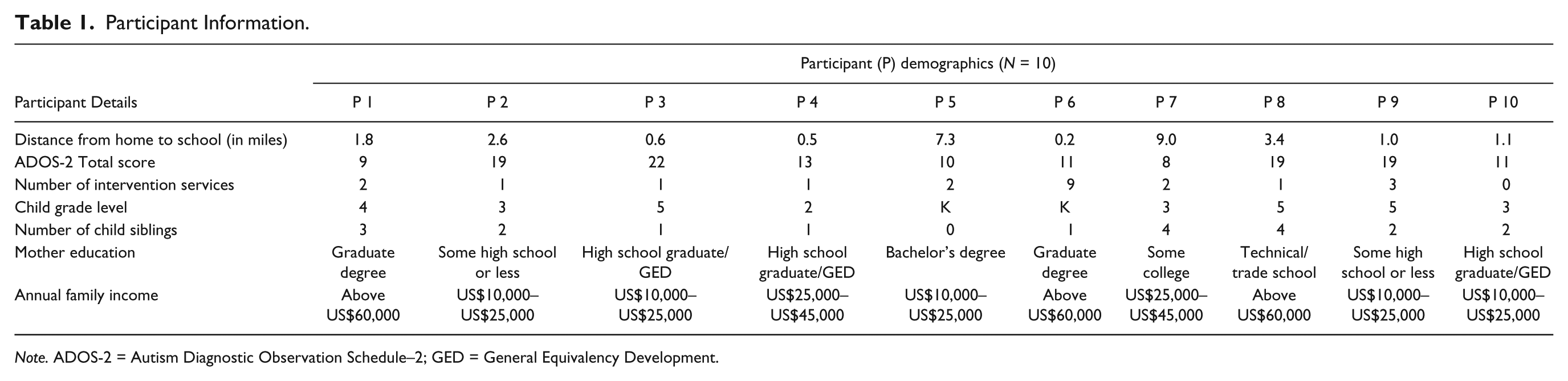
Note. ADOS-2 = Autism Diagnostic Observation Schedule–2; GED = General Equivalency Development.
Measures
Parent Perceptions Survey and coding
The Parent Perceptions Survey is a semistructured interview designed by the author for the purpose of this study. A list of interview questions is listed in the appendix. Parents completed a semistructured interview to assess perceptions and attitudes about barriers to friendship development for children with autism. The survey aimed to generate discussion about barriers to facilitating social opportunities. Interviews were intended to take place for 20 to 30 min and were audio-recorded. Following the interview, the audio recordings were transcribed. Transcripts were then edited for accuracy to live notes taken during the interview.
Reliability
All parent transcripts were analyzed and coded by two individuals, the author and one transcriber with no affiliation to the study. Both examiners read the transcripts to identify significant statements and coded the transcripts independently before comparing codes for consensus and developing themes. Interrater reliability was high (more than 90%). All disagreements on items were discussed until a consensus was reached. This approach aligns with establishing qualitative research reliability via accurate data recording, transcription, and intercoder agreement (Creswell, 2012).
Data Analysis
The use of qualitative methods provides a systematic way of gathering in-depth information. In addition, qualitative methods allow the commonalities and discrepancies in individual perspectives to emerge. The purpose of the analysis was to understand the parents’ views about the difficulties with providing social opportunities for their children with ASD. The method employed in the current study aligns with phenomenological research because it emphasizes the parents’ subjective experiences (Creswell, 2012) and seeks to understand their experiences from their unique point of view. The current study employed this method to explore the participants’ experiences within navigating the friendships for their children with autism, with the goal of better informing intervention practices. Interview questions were formed to quickly establish rapport, followed by a series of open-ended questions intended to ascertain parent experiences, opinions, feelings, and knowledge. The interview (a) began with general and open-ended questions, (b) followed by developing codes, categories, and themes post data collection to form a reverse engineered hypothesis. The first stage of analysis involved line by line coding to reveal recurring themes and ideas within the parent interviews. From the recurring themes, categories were identified and supporting quotations were extracted to support each category and reinforce the validity of the theme. Analyst triangulation was used by employing two coders to review the collected transcripts and interpret the data. Independent coders used grounded theory methodology by allowing ideas and patterns to emerge from the transcript data rather than first hypothesizing findings (Charmaz, 2006; Dey, 1999).
Results
Resulting Themes
There were 20 identified codes extracted from the parent interviews. The codes were categorized into five primary themes of barriers to friendship development: (a) propinquity, (b) attempts at social exposure, (c) social deficits in ASD, (d) siblings as a protective factor, and (e) parent networks. Participant quotes are included in the results to illuminate their perceptions and provide evidence of the resulting themes.
Propinquity
Challenges of distance were reported by all parents. Many comments related to the difficulty of maintaining connections with other families who lived further away. When asked about her son having social opportunities with peers outside of school, one parent said, “He hasn’t had really any playdates even though he talks about some friends all the time. It looks like everyone is from different areas.” Other comments related to the benefits of participating in local programs with other families who lived nearby. Parents expressed difficulty in maintaining relationships with other parents when they moved out of the neighborhood or when children changed schools. Parents expressed challenges of helping their children maintain relationships with peers they meet in different programs who live further away. Parents also remarked how much easier it was to facilitate playdates with peers who lived nearby. One mother commented facilitating play opportunities was easier because her son’s school had “a lot of local students . . . [and] he lives close by.”
Attempts at social exposure
Similar to propinquity, all parents reported actively attempting to facilitate peer interaction by keeping their children engaged in various organized social activities. Parents reported attempting both structured and unstructured activities. Examples included structured social skills groups, after-school programs, park playdates, karate class, Boy Scouts, and Jujitsu class. Parents reported choosing after-school programs to give their children additional opportunities to engage in social activities with their classmates. Parents also reported seeking out activities that were both for teaching new skills and potentially gaining friends. One mother reported, “That’s what I want him to do. To start staying after school more so he can . . . learn how to play with other kids more and try to get along with them.” In addition to providing social opportunities, some parents remarked how after-school programs also helped with providing child care solutions for working parents. Another parent reported joining weekend activities to help increase potential social opportunities such as joining a swimming class with several of their child’s classmates. A different parent reported she offers to walk kids who live in her neighborhood to school in the morning to give her son more opportunities to talk to his classmates.
Social deficits in ASD
Nearly all (9 out of 10) parents reported on challenges that were related to social interaction deficits common in children with ASD. Primary challenges as expressed by parents included initiating and maintaining friendships via conversation and play, taking on others’ perspectives, turn-taking, following social norms, selecting age-appropriate activities and play partners, and the children demonstrating a preference for social isolation. One mother commented on her son’s preference for solitary play and said, “he’s a little awkward . . . generally he likes to play by himself.” Many commented that their children engaged in age-appropriate activities such as computer, iPad, and video games but did not engage with peers. Parents described their children as introverted, awkward, and not interested in other kids. When asked about friends, more than one parent answered, “He doesn’t have any friends.”
Siblings as a protective factor
Most (9 out of 10) parents interviewed had at least one other child living in the home. Of those nine families, seven reported on the theme of siblings as a protective factor. Within this theme, age of the siblings appeared to be a contributing factor as to the nature of the relationship. Older siblings served a shielding role as an extended parent. One parent reflected, “My oldest daughter . . . she’ll take charge. She’s playing my role like a parent because my job changed so she would take care of him.” Older siblings served protective roles such as protecting against bullying at school or in the neighborhood. Siblings close in age served as play partners. One mother said, “The 11-year old, that’s my other boy, they share a room and they play together all the time. They play video games against one another, and they also go to the same school.” Parents described that siblings at the same school would play together at recess, and the sibling’s friends would also extend friendship to the child with autism who often lacked regular playmates at school. As such, typical siblings served as a gateway to increasing social interaction opportunities with other typically developing peers. In one case, the parent reported having another child with autism and comparing the two brothers. The parent expressed little concerns regarding friendship development because his son appeared happy and often talked about his classmates, despite no reported playdates or social interaction outside of school with his “friends” from his class. Friendship was less of a concern because his child was high functioning and highly verbal in comparison with his severely impacted sibling.
Parent networks
Half of all parents remarked on the importance of creating or joining networks of support for both themselves and their children to address social challenges. One mother described her conscious efforts to build a network and commented, “Like I really wanted him to have long lasting friends, so I figured if I became friends with particular moms and we were compatible and it worked out, then I figured that our kids would still be friends.” Within the theme of parent involvement, parents commented on both the presence and absence of an available network, as well as the difficulty with sustaining such networks. Parents reported about positive networks among other parents at their child’s school. One parent reported about an informal weekly group of mothers who would meet to let their children play together. Parents commented on the challenges of maintaining parent support networks with ongoing barriers such as changing work schedules, appointments for speech-language therapy and other interventions, and additional family needs. Parents commented on conscious efforts to build relationships with other parents for the sake of promoting friendships among the children. One participant said, “We had a little support group that we started with me and four or five other moms and their kids . . . We would hook up and go to the park or pizza parlor. Most of them [kids] had special needs except for one . . . It just kinda gave them a friendship circle.” Other parents talked about the absence of a salient parent network. Parents commented that their children made bonds with other children but could not sustain the friendship because the parents were unable to maintain contact with one another.
Discussion
The current study sought to better understand the difficulties parents face facilitating friendships between their children with autism and neurotypical peers. Results suggest there are significant challenges for children with ASD in developing friendships with peers.
Several parents reported their children often actively disengaged or avoided their peers such as walking away from peers rather than engaging with them in play. In addition, many parents reported their children had difficulty following social rules such as abiding by the set rules of a game or maintaining a topic of conversation, which also contributed to their difficulty maintaining high level peer engagement.
Consistent with findings providing evidence of difficulty with social interaction, most parents mentioned their children’s social challenges by referencing social skills deficits commonly found in ASD. Specific pragmatic language impairments common in ASD include difficulty establishing and maintaining eye contact, difficulty turn-taking in conversation, failure to take the listener’s perspective (i.e., theory of mind), poor speech prosody, difficulty expressing and understanding emotions, and difficulty interpreting figurative language (Kerbel & Grunwell, 1998; Krasny et al., 2003; Shaked & Yirmiya, 2003; Tager-Flusberg, 2003). More common deficits include the use of noncontingent utterances, ability to respond to questions and comments appropriately or properly extend conversations by offering relevant personal narratives, demonstration of topic management, intonation, reciprocity in conversation, and eye gaze (Capps et al., 1998; Hale & Tager-Flusberg, 2005; Paul et al., 2009). Several parents commented on these areas when describing their children. They described their children as “stubborn,” “rigid,” “self-centered,” and “weird,” while also mentioning that their children had difficulty “initiating” and “maintaining” conversation, “approaching” peers, “following the rules” in games, and “staying on the subject.” In addition, parents either explicitly or implicitly stated that the topic of socialization is an emotional topic for them because they recognized that their child did not have friends. Given that all the children were in inclusive academic settings without significant intellectual impairments and demonstrated verbally fluent speech, these statements of socialization being a sensitive issue for parents supports research that social skills is often a persisting area of deficit for children with autism. Although research shows that children with ASD do want friends (Bauminger & Kasari, 2000), some parents interpreted their children’s poor social skills as lack of interest in friendships. Other parents related that their child appeared to desire friends but lacked the social aptitude to be successful.
As a result, parents tried many strategies to help their children make friends. All parents reported trying a variety of programs to directly or indirectly address social interaction. Results were varied, but parents overall reported significant persistence despite frequent reports of less than optimal outcomes. In addition to attempts to facilitate social opportunities in organized group activities such as sports and within daily routines such as walking to school with peers, many parents also reported participating in structured programs intended to directly target socialization for children with autism such as social skills groups and recreational therapy. Several parents also reported participation in applied behavior analysis (ABA), which can assist to target behavioral issues such as rigidity and repetitiveness than can preclude appropriate social interaction. The variety of programs reported by parents, both structured and unstructured, illustrates that parents are indeed aware of their children’s deficits and are actively pursuing methods to provide opportunities for their children to socialize with their peers in an effort to improve their ability to make friends.
In addition to exploring a variety of social opportunities for their children, family structure emerged as another identified theme. 9 out of the 10 families had at least one other child living at home in addition to the child with ASD. More than 75% of those families reported on issues surrounding siblings. Several families reported that their child’s siblings served as the primary play partner. In these cases, the sibling prevented the child with autism from being chronically isolated.
Propinquity was a theme commented on by all parents. This indicates the important role that distance plays in preserving social relationships. Parents remarked about the challenges of maintaining relationships and networks after moving or changing schools. Parents who expressed challenges with propinquity mostly expressed attending a nonneighborhood school due to wanting particular autism-specific programs, smaller class sizes, or better school environments. Although such parents mentioned difficulties regarding distance barriers, they also appeared to prioritize the quality of the school and its benefits against the hassle of extended commute times.
Finally, interviews revealed that parents had much to say about social networks among parents as a means to connect their children to peers. Several parents mentioned the presence or absence of a feeling of school community and its impact on their ability to facilitate unstructured social opportunities for their children with peers outside of school. This concern may be of particular interest to parents of children with ASD in mainstream settings, who, unlike their counterparts with children in more restrictive settings, may have a more difficult time readily identifying potential allies among the parents in the child’s classroom. Prior research on parent networks in schools relates predominantly to issues of class and socioeconomics as it is associated with the relationship between schools and parents (Horvat, Weininger, & Lareau, 2003; McGhee-Hassrick & Schneider, 2009). According to prior research, parent networks were strengthened by active involvement of both children and parents in school culture. This suggests that school administration could help parents make connections by facilitating ways for families to become more integrated in the school environment. In addition, results from the current study revealed how strong parent connections appeared to serve a dual purpose of both fostering child interactions and facilitating parent support. Within the theme of building a network, parents commented on an underlying barrier to helping their children develop friendships; the parents themselves had to develop friendships with other parents. For elementary school students to develop friendships with classmates outside of school, parent facilitation is key. Without the parent connection, children were unable to remain in contact with peers and maintain friendships.
One limitation to the current study is the small sample size (N = 10), which restricts the ability to generalize findings to the larger population. In addition, specific socioeconomic data about each family were not collected. Information was also not collected about individual family support networks, which may serve as a protective factor for propinquity barriers. Despite these limitations, analyses offer interesting insights into potential intervention directions. Collective findings indicate that propinquity is a factor for parents. In comparison to parents of typical children, parents of children with ASD often find themselves having to engage in more active strategies to help their children develop social skills and friendships. Findings from this study suggest that parents of children with ASD are facing significant challenges in their efforts to meet their children’s social deficits despite ongoing persistence. Certainly, there were many noted acts of resilience and creativity on the part of parents when it came to addressing issues of friendship development for children with autism. Results support that families would benefit from opportunities for social skills training within their daily routines. As such, clinicians in natural environment settings such as schools may consider creating social skills groups when appropriate to address clients’ social skills deficits within peer groups. Such groups would allow clinicians to directly target social skills deficits while potentially fostering friendships between classmates who see each other frequently in classes or school playgrounds and cafeterias. Given parent reports, it appears that after-school services that offer extended social opportunities on site would also be welcomed solutions.
In addition, the theme of the importance of parent networks aligns with research suggesting the need to reconceptualize the manner of parent involvement and communication at school. Well-connected parent networks may serve to provide children with increased social opportunities due to increased parent relationships. This suggestion appears consistent across a diverse sample of parent participants. Although research often targets direct and indirect intervention for children with autism, there is less research directed at fostering parent and family connections in an effort to increase peer and social engagement opportunities for children with ASD. This less explored area could be an interesting direction for future research and would directly respond to challenges voiced by families of children with ASD.
Footnotes
Appendix
Parent Perceptions Survey interview questions
Background questions:
Does your child have siblings?
Do these siblings go to the same school as your child?
What do you think were the most important factors in determining where your child went to school?
What does your child enjoy doing on his free time when he is not in school?
Friendship questions:
Who does your child play with most when he is not in school?
How does your child know these playmates?
What do you think is your child’s greatest strength when it comes to making friends?
What do you think is your child’s greatest weakness when it comes to making friends?
What things to do you to help your child make friends?
What do you think are the challenges to your child making friends?
Knowledge questions:
What services are available to help your child make friends?
Who is eligible for these services?
What are the characteristics of children who participate in these services?
Distance questions:
Do you feel your child’s school is far from your home?
Do you think traffic and/or distance prevents you from participating more in after-school activities?
Is there anything else you would like to share?
Declaration of Conflicting Interests
The author(s) declared no potential conflicts of interest with respect to the research, authorship, and/or publication of this article.
Funding
The author(s) received no financial support for the research, authorship, and/or publication of this article.