







Abstract
The Focus on the Outcomes of Communication Under Six (FOCUS) is one of a few validated outcome measures related to children’s communicative participation. Additional validation of the FOCUS measure could address the paucity of validated outcomes-based measures available for assessing preschool-age children, particularly for those who are multilingual. The data collected for this study, with a representative sample of Jamaican Creole-English speaking children, extend the applicability of the FOCUS to a broader range of preschoolers and expand psychometric evidence for the FOCUS to a multilingual and understudied context.
Keywords
In response to challenges regarding child outcomes and outcomes-based assessments, the World Health Organization (WHO, 2007) has called for increased research to support the evaluation of outcomes for all children, including those who are multilingual. In this effort, the WHO (2007) has offered the biopsychosocial framework known as the International Classification of Functioning, Disability and Health–Children and Youth version (ICF-CY).
This holistic and person-centered framework provides researchers and clinicians with a common language and integrated approach for considering children’s communication abilities across linguistic contexts (Bornman & Louw, 2021). The ICF-CY also offers a framework to guide researchers’ and clinicians’ understanding of how an impairment, as well as personal and environmental factors, may affect children’s communication (Cunningham et al., 2017; Westby & Washington, 2017; WHO, 2007). Several international speech-language pathology professional organizations, including the American Speech-Language-Hearing Association (ASHA), have adopted the ICF-CY as their conceptual framework for informing recommendations surrounding assessment, intervention, and outcome measurement (ASHA, 2016; Bornman & Louw, 2021; Westby & Washington, 2017). Moreover, proponents of the ICF-CY framework have specifically highlighted the need for speech-language pathologists (SLPs) to shift away from impairment-based assessment and treatment to support children by targeting functional communication and facilitating their inclusion in everyday contexts (Cunningham et al., 2017; Threats, 2003; Washington et al., 2012).
The ability to use communication to interact socially with others and to participate in real-life situations (e.g., ask for help, tell others about your interests, understand what others are saying, express emotions) is known as communicative participation (Eadie et al., 2006; Singer et al., 2020; WHO, 2007; Yorkston et al., 2014). As communication specialists, SLPs are tasked with evaluating and treating children with a range of speech and language abilities, with the ultimate goal of effectively supporting their communicative participation across a variety of contexts (ASHA, 2017). Despite the importance of communicative participation in the lives of children, there is a paucity of validated outcome measures (Cunningham et al., 2017), which has resulted in SLPs’ overreliance on the more accessible and familiar impairment and activity-based measures, ultimately limiting the development of functional treatment goals and meaningful intervention outcomes. This challenge is further intensified when working with clients from multilingual backgrounds for whom there are even fewer validated measures available (Wright Karem et al., 2019). This contributes to the variety of reasons that multilingual children are at an increased risk for being misdiagnosed with a developmental language disorder (DLD; Boerma et al., 2016; Fichman et al., 2017; Wright Karem et al., 2019), making the paucity of available validated assessments a complex and problematic issue. In concert with this challenge are findings from previous studies that have identified a crucial relationship between the accurate determination of multilingual children’s language abilities and their current and future academic achievement, as well as their participation in society (Wright Karem et al., 2019). Given the increased risk for multilingual children to be misdiagnosed with a DLD, as well as the critical relationship between the accurate determination of their language abilities and academic and social outcomes, there is a well-motivated need to address the dearth of assessments available for this population.
One outcome measure with the potential to capture meaningful changes in children’s communicative participation, and to support the identification of functional limitations for the differential diagnosis of DLD, is the Focus on the Outcomes of Communication Under Six (FOCUS; Thomas-Stonell et al., 2010). The FOCUS has strong psychometric merits and is specifically aligned with the ICF-CY framework, with 90% of items relating to Activity and Participation (Thomas-Stonell et al., 2010, 2013). The FOCUS was developed with primarily monolingual English-speaking preschoolers with communication disorders (Thomas-Stonell et al., 2010). However, the extensive research on its development and validation, as well as its emphasis on Participation and parental perspectives, make the FOCUS a strong culturally responsive measurement tool (Bornman & Louw, 2021; Thomas-Stonell et al., 2009; Westby & Washington, 2017). These distinctions have also prompted several researchers to translate the FOCUS (e.g., Afrikaans, Bornman & Louw, 2021; German, Neumann et al., 2017), in response to the need to adapt established measures that consider personal and environmental factors for culturally and linguistically diverse contexts that will meet the needs of unique populations. While studies investigating the translation of the FOCUS have demonstrated its applicability as a measurement tool appropriate for diverse contexts, the research has primarily focused on monolingual speakers of other majority languages (Cunningham et al., 2020).
In addition, the FOCUS Profile scores, which describe specific skills contributing to overall communicative participation, have not been frequently reported or have been used for purposes for which they were not developed. For example, Profile scores have been used to measure skill discrepancy rather than observing where changes in communicative participation occurred (cf. Cunningham et al., 2020). With the FOCUS being only one of a few validated outcomes-based measures available for use with preschoolers, further construct validation in multilingual contexts with a representative group of preschoolers offers a promising extension for the applicability and psychometric evidence of the FOCUS measure.
As it pertains to children who are multilingual, the International Expert Panel on Multilingual Children’s Speech (IEPMCS) has supported researchers and clinicians by defining multilingualism as an overarching term that refers to one’s ability to understand or produce two or more languages (McLeod et al., 2017). This definition serves to conceptualize multilingualism as a comprehensive term that includes various typologies of bilingualism (see Wright Karem & Washington, 2021 for further examples), which allows researchers to investigate unique features of bilingualism while concurrently contributing to the collective evidence base of multilingual research.
Using the definition of multilingualism outlined by the IEPMCS, the present study was conducted with Jamaican preschoolers who were simultaneous bilingual speakers of Jamaican Creole (JC; an understudied minority language) and English (languages with shared linguistic foundations; Craig, 1971; Devonish & Harry, 2008) who primarily resided in Jamaica where simultaneous bilingual development is common (Washington et al., 2019; Wright Karem & Washington, 2021). In addition, Jamaicans also represent a large and growing populace of speakers in Canada and the United Kingdom and represent the third largest Carribean-born immigrant group in the United States (Hinrichs, 2011; U.S. Census Bureau, 2017). By studying JC-English speaking bilinguals, we offer novel findings related to multilingual children’s communication development beyond the most commonly studied linguistic paradigms (e.g., Spanish-English). As languages interact differently depending on their typological properties, this approach could offer additional insight about speech and language abilities and communicative participation within other minority languages or language pairings (e.g., Catalan and Spanish, which share extensive cognates). The present study also addresses a knowledge gap related to participation-based measures in underserved and understudied multilingual populations that will inform both research and practice. More specifically, by investigating communicative participation (i.e., children’s involvement in their life situations; WHO, 2007) in this population, we extend the validity evidence of the FOCUS to a multilingual context in which the evidence base is limited. We also provide new validity evidence by describing how FOCUS scores relate to measures of functional language (participation) and activities-based metrics (impairments) in JC-English speaking preschoolers. This study addressed two research questions.
Method
Ethical approval was obtained from the Institutional Review Board at the University of Cincinnati. Additional support and permissions were obtained from the Early Childhood Commission, Government of Jamaica, and participating early learning centers (n = 5). Licensure to practice speech therapy in Jamaica was obtained to support data collection in Jamaica. Parents’ written consent and children’s verbal assent were obtained.
Participants
A representative sample of children with a range of speech and language abilities from Kingston, Jamaica (n = 229, 96.2%) and New York City, United States (n = 9, 3.8%) were included. The dataset of children comprised those JC-English simultaneous bilinguals who were typically developing, as well as children whose parents and teacher or bilingual JC-English speaking SLP reported developmental speech and language concerns, indicating a possible DLD. This two-sourced approach (cf. Restrepo, 1998) also referred to as converging evidence (Castilla-Earls et al., 2020) offered a consensus of concerns as described in previous works (León et al., 2021; Wright Karem & Washington, 2021) to inform children’s developmental status, providing a representative sample of preschoolers reflective of the broader population (cf. Law et al., 1998).
Data were collected as part of a larger investigation for the multiyear Jamaican Creole Language Project (cf. Washington et al., 2017, 2019, 2021). Although different assessments were implemented based on the annual needs of the investigation, an invariant research protocol was applied to ensure consistency in the methods and techniques used. The data needed to inform the present cross-sectional exploratory study were collected between 2014 and 2019 and included 273 individual children. Due to corrupt/missing components, complete data were available for 254 of these children. Children met the following inclusion criteria: (a) used JC and English at home and at preschool as indicated by parents and teachers, (b) passed a standard binaural hearing screening at 25 dB for 1, 2, and 4 kHz, (c) no parent-reported history of neurological or pervasive developmental disorders, (d) met age-based criterion on the Diagnostic Evaluation of Articulation and Phonology (DEAP) Oral-Motor subtest (Dodd et al., 2006), and (e) achieved a standard score of ≥72 on the Primary Test of Nonverbal Intelligence (Ehrler & McGhee, 2008). Data for 16 children were excluded for failing to meet the set inclusion criteria. After all exclusions, a final cohort of 238 children (age range = 3 years and 0 month to 6 years and 2 months, M = 4.85, SD = 0.69) were included as study participants (n = 103 males, 43.3%; n = 135 females, 56.7%). To ensure that all data needed to address the research questions were available, an additional criterion was that children had complete FOCUS and CELF-P2 Descriptive Pragmatics Profile data.
Measures
The FOCUS. As a parent-report measure of communicative participation, the FOCUS is both valid and reliable and can be used as a measure of the functional use of language in a variety of social contexts (Thomas-Stonell et al., 2010, 2013). The original FOCUS included 50 items (Thomas-Stonell et al., 2010), but more recently, a streamlined 34-item version has been published (i.e., FOCUS-34; Oddson et al., 2019). The FOCUS provides a Total score, which can be used to measure clinically meaningful changes in communicative participation during speech-language intervention (Oddson et al., 2019; Thomas-Stonell et al., 2010) and has been validated based on children’s current level of functioning within a pre-post design (Washington, Oddson, et al., 2013; Washington, Thomas-Stonell, et al., 2013). The FOCUS also provides Profile scores that allow clinicians to informally observe changes in communicative participation that align with either a child’s capacity (ICF-CY components of Body Functions or Activities), or performance (ICF-CY Participation component; WHO, 2007). The FOCUS Profile capacity scores are calculated using items related to speech (original FOCUS only), expressive language, pragmatics, and receptive language/attention and relate to how a child uses their communication skills with supports and within clinical contexts (Oddson et al., 2019; Thomas-Stonell et al., 2010). The FOCUS Profile performance scores are calculated using items related to intelligibility, expressive language, social/play, independence, and coping/emotions, and relate to how children use their skills independently in everyday contexts (Oddson et al., 2019; Thomas-Stonell et al., 2010).
The CELF-P2 Descriptive Pragmatics Profile (i.e., Pragmatics Profile). The Pragmatics Profile was selected for this study to investigate the construct validity of the FOCUS as it evaluates a similar construct in relation to how children use communication to interact socially (i.e., pragmatics or social communication; Wiig et al., 2005). The Pragmatics Profile is a criterion-referenced checklist that applies a 4-point Likert-type scale to inform a Total criterion score. This measure provides age-specific cutoffs to obtain information about children’s general pragmatic development and pragmatic deficits that may influence their communicative participation (Wiig et al., 2005, 2006). Questions on the Pragmatics Profile are categorized into three subdomains: Nonverbal Communication Skills, Conversational Routines and Skills, and Asking for, Giving, and Responding to Information. Information from the Pragmatics Profile can be used to ascertain how children are using their verbal and nonverbal pragmatic skills in context (i.e., across environments), but individual items can be impairment-focused (i.e., similar to a FOCUS capacity item) or performance-focused (i.e., similar to a FOCUS performance item).
Mean Length of Utterance (MLU). MLU is a common activity-based language development measure used to characterize grammar acquisition and utterance length/complexity in young children (Baron et al., 2018; Brown, 1973; Rice et al., 2010; Washington et al., 2019). MLU has traditionally been calculated in morphemes (i.e., MLUm) to document children’s grammatical complexity and growth (Brown, 1973; Rice et al., 2010), as well as to identify language impairments (Gutierrez-Clellen et al., 2012; Rice et al., 2010). However, when considering MLU as a metric for assessing multilingual children, researchers have identified MLU in words (i.e., MLUw; Gutierrez-Clellen et al., 2012) as a more responsive and accurate calculation. The MLUw calculation responds to differences across languages regarding morphological “rules, rate, and order” (Baron et al., 2018, p. 975) and addresses natural features of multilingualism, such as crosslinguistic influence (Baron et al., 2018; Kapantzoglou et al., 2021; Paradis et al., 2021). Because MLUw is unaffected by cross-linguistic influence and is more responsive to differences in morphemes (Baron et al., 2018), it is increasingly recommended for use with multilingual children (Gutierrez-Clellen et al., 2012). Given the paucity of valid and reliable outcomes-based measurement tools available for assessing young children (Cunningham et al., 2017), particularly multilingual children (Wright Karem et al., 2019), the decision was made to explore the construct validity of the FOCUS by examining its relationship to both MLUw and MLUm. By doing so, we also develop a deeper understanding regarding impairment-focused measures and their association with communicative participation using established metrics to better inform clinical decision-making and future research.
Cultural and Linguistic Considerations
Key sociolinguistic factors within the Jamaican context influenced the selection of assessment measures and how responses were documented in this study. Within the Jamaican context, English is the language of instruction, business, and education (lingua franca of the classroom) that is used formally (Craig, 1971; Devonish & Carpenter, 2007). Contrastively, JC is considered the language of the people, which is used in informal contexts and has often been described as being reflective of a linguistic continuum (Craig, 1971; Devonish & Carpenter, 2007; Irvine-Sobers, 2018; Washington et al., 2019, 2021). These sociolinguistic dynamics are also present in the cultural expectations for reading and writing. Stated differently, English has a strong oral and written foundation within the Jamaican context, whereas JC has historically been an oral language with a recently standardized orthography that is not taught in schools (Jamaican Language Unit, 2009; Washington et al., 2019).
Due to the sociolinguistic considerations, completion of the FOCUS in English only was determined to be a culturally responsive approach for describing communicative participation (i.e., communication in real-life situations) as reported by parents within the Jamaican context. This approach follows models within the literature where parent interviews were conducted in English only to consider how bilingual children (e.g., French–English speaking children) used their full repertoire of language abilities, rather than one of their spoken languages (Paradis, 2016; Paradis et al., 2010; Paradis et al., 2021). With the FOCUS being a parent-report measure with items developed based on data from extensive parent interviews and feedback (Thomas-Stonell et al., 2009, 2010, 2013), this approach was deemed appropriate for the current study and is in line with the strategy implemented by Paradis et al. (2010).
Procedures
During the scheduled interviews, parents of JC-English-speaking children in the current study completed the FOCUS in English only but considered how their children dynamically used communication across both of their spoken languages. Important to note is that code-mixing (i.e., use of features of both languages in a single production) is ubiquitous in the Jamaican context (Wright Karem et al., 2021), in-keeping with observations of language use in other multilingual children (Castilla-Earls et al., 2016; Kapantzoglou et al., 2021; Paradis et al., 2021), offering ecological validity in support of our chosen approach. Based on availability at the time of data collection, the FOCUS or FOCUS-34 was used. Using the conversion tool described in the FOCUS-34 manual, original FOCUS Total scores were converted to FOCUS-34 Total scores to create a parsimonious dataset for analysis.
The Pragmatics Profile is a supplementary criterion-referenced checklist included with the CELF-P2. Using the aforementioned details and 4-point Likert-type scale, the profile can be completed by parents, teachers, and/or clinicians who are familiar to the child (Wiig et al., 2005, 2006). For the purposes of the present study, a research team member, who was either an ASHA certified SLP or a trained and supervised student clinician, completed the Pragmatics Profile for each participant. Although an English only Pragmatics Profile protocol form was used, research team members reviewed responses from parent and teacher interviews and observed each child over several days across a variety of contexts (e.g., playing with peers at recess, talking with peers at lunch, performing in a school production, answering questions in class, working on assignments, completing whole group instruction, behavior in the testing environment, interactions with parents at an after-school function). From the complete Pragmatics Profiles, 93.7% of participants (n = 223) met and 6.3% of participants (n = 15) did not meet the age-based criterion for passing the assessment.
This immersive and participatory method of inquiry facilitated research team members in completing the Pragmatics Profile based on observations of each child in a variety of naturally occurring cultural and linguistic contexts. To illustrate, research team members were able to observe and interact with children across multiple linguistic contexts where children would primarily communicate in either JC, English, or dynamically use both languages (i.e., cross-linguistic influence; Kapantzoglou et al., 2021; Paradis et al., 2021), and could supplement observations with feedback from parents and teachers. By implementing this approach, the Pragmatics Profile questions were answered based on a broad range of children’s social interactions, rather than their ability to socially interact in only one of their languages with research team members who, for the most part, were not members of Jamaican culture.
Regarding MLU, we applied the considerations from Baron et al. (2018) concerning the language-specific acquisition of morphemes, necessitating the elicitation of language samples in JC and in English. As part of the Jamaican Creole Language Project (Washington et al., 2017, 2019), 15-min play-based language samples were collected using language-specific stimuli in counterbalanced sessions facilitated by language-specific elicitors who were unfamiliar to the child (see Washington et al., 2019 for more details). The spontaneous language samples elicited from each child were video- and audio-recorded and later transcribed according to the transcription process described by Washington et al. (2019). MLUw and MLUm were then calculated in each language in line with previous works (cf. Washington et al., 2019, 2021). In the present study, JC and English language samples were collected and transcribed for 92 of the 238 participants (age range = 4 years and 1 month to 6 years and 1 month, M = 4.92, SD = .62; n = 47 males, 51.1%; n = 45 females, 48.9%) and calculated for MLUw and MLUm (i.e., a total of 184 transcribed language samples, 92 in JC and 92 in English). Important to note is that language sample data were not collected in each year of the Jamaican Creole Language Project. For those whose data were available, not all were complete in both spoken languages, which explains the smaller number of children for whom this type of data were available for analysis.
Data Analysis
Data were analyzed using the IBM SPSS Version 27. Measures of central tendency and variance were completed, and data fit the assumptions for normalcy, skewness, and kurtosis. Multiple Pearson correlations were conducted to compare FOCUS, CELF-P2 Pragmatics Profile, and MLU scores. Important to note is that based on the research question being addressed, different sample sizes were applied. For RQ1, the entire available sample was included (n = 238) and a pairwise extraction was statistically applied to offset unmatched data. For RQ2, a subset of the sample for which MLUw and MLUm data were available in both languages was included (n = 92). A Bonferroni correction was applied a priori to address the issue of multiplicity when conducting multiple correlations. As a result, an adjusted alpha of p < .006 was used to account for comparisons between FOCUS Total and Profile scores being compared with eight different variables. Cohen (1988) was used to classify correlation magnitudes as minimal (0.1<|r|<.3), moderate (0.3<|r|<.5), and strong (|r|>.5).
Results
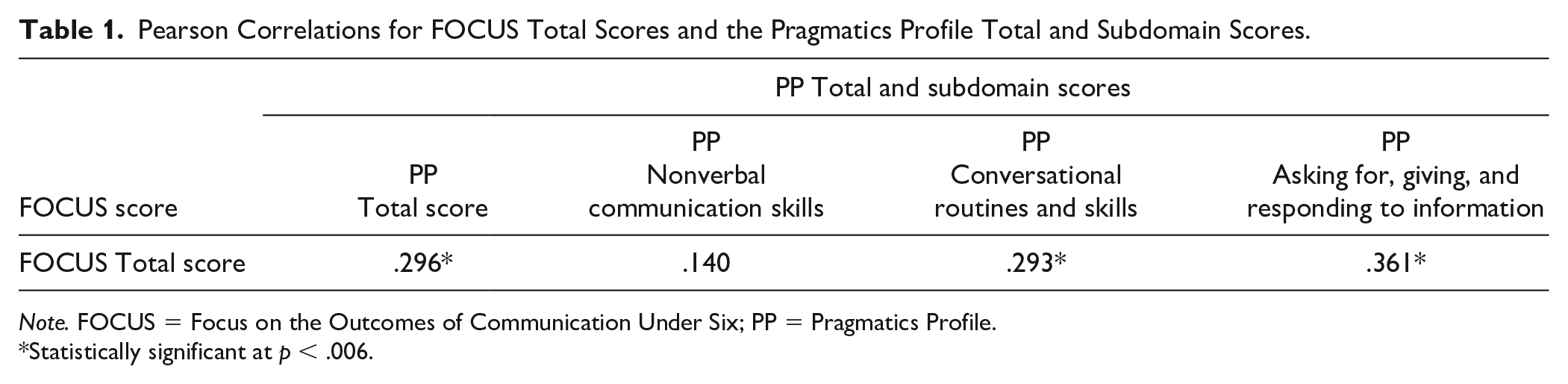
The FOCUS Total score was minimally correlated to the Pragmatics Profile Total score of the CELF-P2 (r = .296, p < .006; see Table 1) and was minimally-moderately associated with the Pragmatics Profile subdomain scores Conversational Routines and Skills and Asking for, Giving, and Responding to Information (r = .293–.361, p < .006; see Table 1), demonstrating some evidence of convergent validity (i.e., the degree to which related constructs are actually related). The FOCUS Total score, which considered capacity and performance items, was not significantly correlated with the Pragmatics Profile subdomain score Nonverbal Communication Skills that considered capacity or impairment-focused items only (r = .140, p = .049; see Table 1), demonstrating some evidence of divergent validity (i.e., the degree to which unrelated constructs are actually unrelated).
Pearson Correlations for FOCUS Total Scores and the Pragmatics Profile Total and Subdomain Scores.
Note. FOCUS = Focus on the Outcomes of Communication Under Six; PP = Pragmatics Profile.
Statistically significant at p < .006.
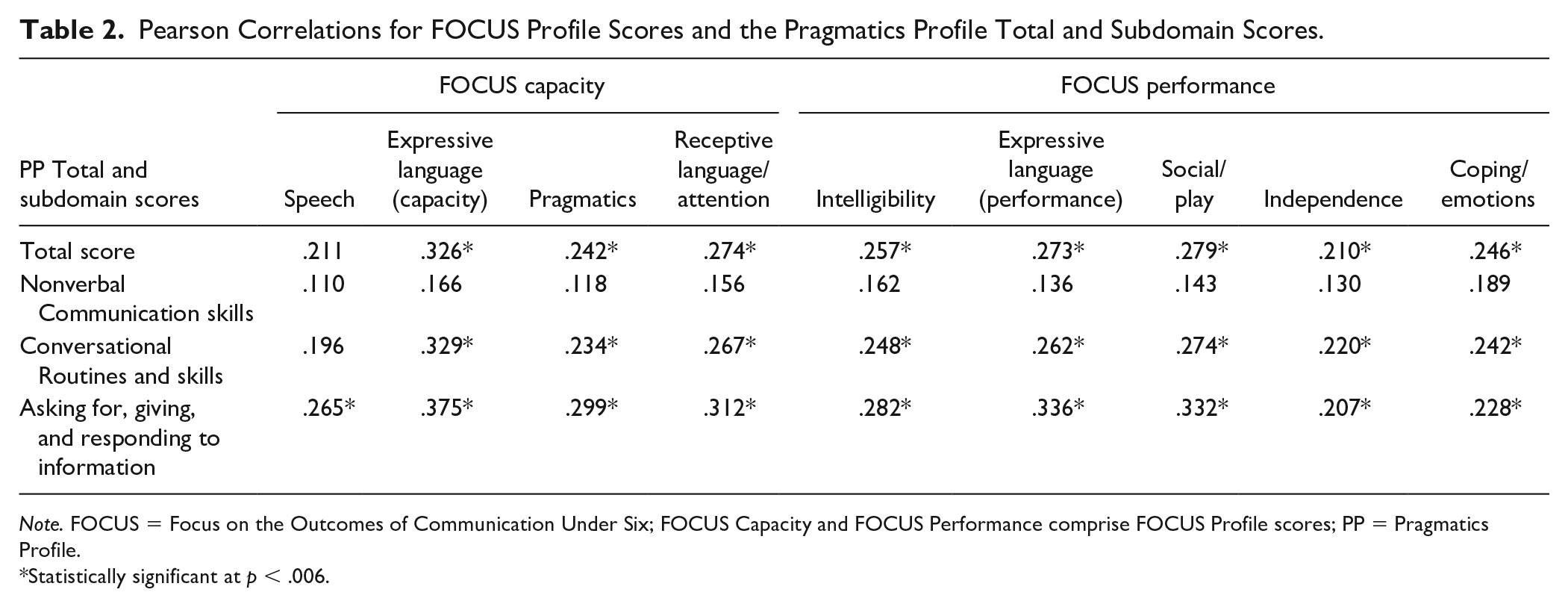
The FOCUS Profile scores, with exception of the capacity item speech, were significantly correlated with the Pragmatics Profile Total score and the Pragmatics Profile subdomain score Conversational Routines and Skills (r = .210–.329, p < .006; see Table 2), demonstrating minimal-to-moderate evidence of convergent validity. In a similar fashion, significant minimal-to-moderate associations were observed between all FOCUS Profile scores and the Pragmatics Profile subdomain Asking for, Giving, and Responding to Information (r = .207–.375, p < .006; see Table 2), demonstrating additional evidence of convergent validity.
Pearson Correlations for FOCUS Profile Scores and the Pragmatics Profile Total and Subdomain Scores.
Note. FOCUS = Focus on the Outcomes of Communication Under Six; FOCUS Capacity and FOCUS Performance comprise FOCUS Profile scores; PP = Pragmatics Profile.
Statistically significant at p < .006.
Conversely, there were no significant associations between any of the FOCUS Profile scores, which generally consider capacity and performance items, and the Pragmatics Profile subdomain Nonverbal Communication Skills that only considers capacity or impairment-focused items (r = .110–.188, p ≥ .006; see Table 2). In addition, no significant relationship was observed between the FOCUS Profile capacity item speech and the Pragmatics Profile Total score (r = .211, p = .009; see Table 2) or subdomain score Conversational Routines and Skills (r = .196, p = .015; see Table 2), demonstrating additional evidence of divergent validity.
Clear evidence of divergent validity was found between FOCUS Total and Profile scores and MLUw and MLUm in JC and in English. No significant associations were observed between the FOCUS Total scores and MLUw in JC (r = −.017, p = .884) or in English (r = .023, p = .843). Similarly, no significant associations were observed between FOCUS Total scores and MLUm in JC (r = −.008, p = .944) or in English (r = .020, p = .866). Moreover, no significant relationships were found between any of the FOCUS Profile scores and MLUw or MLUm in JC or in English (r= −.007–.268, p = .040–.954).
Discussion
The aim of this exploratory validation study was to expand the psychometric evidence available for the FOCUS to a diverse multilingual context using a representative sample of preschoolers. By using an understudied language pairing (JC and English) as a model system, the preliminary construct evidence found in the present study may have greater applicability to the broader population and could be used as an example for investigating other understudied diverse linguistic populations (e.g., Creole languages and their lexifier language such as Haitian Creole and French). In concert with the emerging construct validity evidence, this is one of the first studies to attempt to validate the FOCUS Profile scores (cf. Cunningham et al., 2020). In the present case, in relation to preschoolers’ functional language use and expressive language skills as such, these findings fulfill calls to investigate the validity evidence for the use of the FOCUS Profile scores and also contribute to what is known about the relationship between children’s communicative participation and their speech and language abilities. Noteworthy, however, is the caveat that this research focused on scores at a single point in time and as such did not consider the change in Profile scores or the relationship between change in Profile scores and change on other assessments. Future research investigating change in Profile scores would serve to broaden the validity evidence of the FOCUS for this population, as change scores are considered the primary, and a valid and reliable feature of the FOCUS and FOCUS-34.
FOCUS and Pragmatics Profile Scores
The minimal but statistically significant relationship between communicative participation (i.e., FOCUS Total score) and the Pragmatics Profile Total score was reasonably expected. This is due to the agreed-upon observation that as overall measures the FOCUS and the Pragmatics Profile consider a child’s functioning in context and are measuring different, but related constructs (Oddson et al., 2019; Thomas-Stonell et al., 2010; Wiig et al., 2005). It is possible though that these minimal correlations were related to factors within the study design, such as the majority of participants residing in Jamaica, indicating that replicated studies should closely consider how these related constructs are emphasized within different cultural contexts. Within the present study, the related constructs are most evident in the Pragmatics Profile subdomain scores Conversational Routines and Skills and Asking for, Giving, and Responding to Information where there is minimal-to-moderate evidence of convergent validity with FOCUS Total scores.
The absence of a relationship, however, between the FOCUS Total score and the Pragmatics Profile subdomain Nonverbal Communication Skills highlights a principal difference between the measures and identifies an area of divergent validity. This theme is further reflected within the FOCUS Profile scores with no observed associations between any of the FOCUS Profile scores and the Nonverbal Communication Skills subdomain of the Pragmatics Profile. Although the FOCUS Total and Profile scores may initially appear to be related to the Nonverbal Communication Skills subdomain, the absence of any relationship may speak to the important nature of verbal communication within the Jamaican context (i.e., JC being a primarily oral language used in social or informal context; Craig, 1971; Devonish & Carpenter, 2007; Washington et al., 2021).
It is possible then, that Jamaican children who demonstrate fewer nonverbal communication skills may not necessarily be more restricted in their communicative participation as long as they are engaging in other verbal pragmatic functions. We also interpret these novel findings to mean that in the Jamaican context, the FOCUS Total score may be an effective indicator of communicative participation as it pertains to children’s conversational skills and their ability to ask, give, and respond to information, but there may be limitations as it relates to a child’s nonverbal communication skills. Future research investigating the development and relevance of nonverbal communication skills within the Jamaican context, as well as the nonverbal items from the FOCUS in other culturally diverse contexts, is warranted. This type of research could lend valuable insights to better understand an important cultural difference and help mitigate the misidentification of DLD in JC-English speakers as well as children from culturally and linguistically diverse backgrounds.
The only Pragmatics Profile subdomain that demonstrated minimal-to-moderate evidence of convergent validity with all FOCUS Profile scores (i.e., capacity and performance) was Asking for, Giving, and Responding to Information. This indicates that multiple capacity and performance skills are involved in being able to ask for, give, and respond to information.
However, these critical capacity and performance skills may vary as other areas of pragmatic functioning are considered. In the current study, no significant correlation existed between the FOCUS capacity score speech, and the Pragmatic Profile Total score or the Conversational Routines and Skills and Nonverbal Communication Skills subdomains. This lack of significant correlation not only demonstrates evidence of divergent validity but also emphasizes the difference between a child’s speech capacity (i.e., speech-production skills) and their intelligibility performance (i.e., how well they are understood by others).
A possible explanation for this finding is that speech capacity is understandably unrelated to nonverbal communication, whereas difficulties with speech performance (i.e., intelligibility) could disrupt conversational routines (McLeod, 2020; McLeod et al., 2012; McLeod & McCormack, 2007). Stated differently, difficulties experienced with intelligibility could impede conversational routines such as reciprocity and turn-taking by way of conversational partners requesting clarification and speakers needing to provide repetition or use other communicative repair strategies that are otherwise unrelated to the conversation (McCormack et al., 2010).
Using this conceptualization, it is then reasonable to infer that within the Jamaican context, intelligibility may have a greater impact on a child’s overall pragmatic functioning and their ability to participate in conversational routines than does their speech-production accuracy. As a final observation, we also underscore the need for future research to consider the predictive nature of the moderate relationships identified within the current study. Although these are moderate correlation coefficients, the applied analysis procedures in the present study offered a stringent criterion for detecting significance. The parametric testing, which provides more statistical control for detecting a significant effect when one truly exists, along with the a priori Bonferroni correction, indicates that the present findings were not likely to have occurred by chance. Future research exploring the predictive nature of the moderate relationships between the FOCUS and Pragmatics Profile measures could provide additional insights to support the development of culturally responsive interventions and prioritizing treatment goals.
FOCUS and MLU
The distinct evidence of divergent validity between the FOCUS Total and Profile scores and MLUw and MLUm in JC and in English suggests that there is a subtle yet important difference between activity-focused assessments and participation-focused assessments (Westby & Washington, 2017; Wright Karem et al., 2019). Although calculations of MLUw and MLUm in JC and in English provided a conservative and culturally responsive approach for determining the grammatical complexity and linguistic productions of JC-English speaking bilingual children, these metrics are activity-focused and do not provide details about how children are using their language abilities to interact with others in social contexts (Westby, 2007). As such, the lack of significant relationships between the FOCUS and MLUw/m suggests that MLUw/m may partially represent a child’s functional language and serve as an indicator of a language impairment; but demonstrates that measures of word quantity or grammatical complexity do not reflect how children socially interact and participate across environments (Kapantzoglou et al., 2017; Washington et al., 2019; Westby, 2007).
Limitations and Future Directions
One limitation of this study relates to the representation of Jamaican children included and their location of service. Most children were from Jamaica (96.2%), with a few also being from other places where Jamaicans reside (3.8% from the United States). Children were also simultaneous speakers of JC and English but completed their English language samples in the school environment with elicitors who spoke a different dialect of English (i.e., Standard Jamaican English vs. Standard American English). The sampling condition (i.e., location of the school environment) coupled with the elicitors using a different dialect of English may have indirectly influenced children to use more formal English patterns. However, the nature and duration of the play-based assessment provided opportunity for elicitors to build rapport with each child to address this limitation. That said, future research that considers between group differences for MLUw/m in JC and in English could provide clarity regarding what, if any, impact a different dialect of English may have and whether those differences are confounded by location.
A second limitation relates to our use of the Bonferroni correction to address multiplicity. This method was necessary for supporting the cautious interpretation of findings statistically to validate FOCUS Total and Profile scores. It is possible that our approach may have been too conservative and could have resulted in lack of significance reported for certain correlations (e.g., Type II errors). However, this method was deemed necessary to reduce the increased likelihood of a Type I error when conducting multiple correlations.
We also consider the nature of using two assessments in English only due to the absence of translated and validated versions of the FOCUS and Pragmatics Profile as another potential limitation. Although this approach was considered culturally responsive for the purposes of the current study and is also in keeping with research with other bilinguals (Paradis et al., 2010), it may be less responsive for children who primarily or exclusively use JC or who represent a different bilingual typology than was represented in this study (e.g., sequential bilinguals).
Finally, we also recognize the absence of associations between communicative participation and nonverbal communication skills described in the study, which may be due to the Pragmatics Profile being standardized on monolingual children in the United States. As such, the Pragmatics Profile may not include questions about nonverbal communication skills that are emphasized or valued within the Jamaican context. We also consider the possibility that the Pragmatics Profile may have had a disproportionate number of items related to activity-based nonverbal skills (e.g., child appropriately smiles, frowns, demonstrates looks of surprise) that were differentially characterized by the FOCUS, which emphasized nonverbal performance abilities (e.g., my child can communicate effectively with adults who know my child well).
Conclusions and Clinical Implications
Findings from the present study provide emerging evidence of construct validity for the FOCUS in the Jamaican context as it relates to children’s functional language use and expressive communication skills. By extension, this study has also fulfilled calls for additional research in two primary areas. First, this investigation addresses the need for additional research and development to expand outcomes-based measures (Cunningham et al., 2017; WHO, 2007) that are validated using multilingual children (Wright Karem et al., 2019). Second, this study provides preliminary validity evidence for the use of the FOCUS Profile scores (cf. Cunningham et al., 2020); offering a broader understanding about the relationship between speech and language abilities and communicative participation and further extending the psychometric evidence of the FOCUS measure. The identified associations between communicative participation and pragmatic skills may contribute to our understanding about the relevance of different pragmatic abilities across various multilingual/cultural populations. Similarly, the absence of relationships between speech capacity and pragmatic abilities, further emphasizes the importance of prioritizing speech performance/intelligibility to support children’s participation.
We also provide a broader source of information that supports the interpretation of established activity-based metrics (i.e., MLUw/m) and how they may relate to children’s communicative participation. Of further significance is the recognition that the lack of relationships between communicative participation and MLUw/m does not negate the importance of this metric for identifying grammatical complexity or language impairments in children. It does, however, indicate that using MLUw/m to identify grammatical complexity or language impairments in children may be a more valuable use of this metric than using it as a means for determining how well a child is able to participate and socialize across environments.
In summary, the results of this study ultimately expand the psychometric evidence for the FOCUS measure to an understudied multilingual context. In addition, these findings also provide a more in-depth understanding about the relationship between communicative participation and speech and language abilities for JC-English speaking children. Moreover, these results extend the utility of the FOCUS to a broader range of preschoolers and address the paucity of available outcomes-based assessments, which will support future clinical and research endeavors.
Footnotes
Declaration of Conflicting Interests
The author(s) declared no potential conflicts of interest with respect to the research, authorship, and/or publication of this article.
Funding
The author(s) disclosed receipt of the following financial support for the research, authorship, and/or publication of this article: The first author of this study is the recipient of an NIH diversity supplement award (3R21DC018170-02S1) that funded this research investigation, which was granted under the second author’s NIH R21 parent award (PI Washington, R21DC018170). The second author has contributed to the validation of the FOCUS but has no relevant financial contributions. The third author is a scientist at CanChild Centre for Childhood Disability Research that sells the FOCUS.
