







Abstract
Effective services for students who are deaf or hard of hearing depend on uniquely skilled professionals who coordinate their support. University programs have developed interdisciplinary models, training different types of professionals together to equip them for work settings that are increasingly inclusive and collaborative. These training programs address standards-based knowledge and skills from various disciplines, but may not be as deliberate in addressing the professional dispositions that are foundational to collaborative practice. Particularly when belief systems intersect topics of language use and identity, dispositions can be challenging to teach and are often applied differently across professions. This article provides a narrative description of an interdisciplinary training program that equips teachers of the deaf and speech-language pathologists. Using a “self-reflective cycle” representative of participatory-action research, it considers both missteps and successes within a continuous improvement process, and the integration of interdisciplinary dispositions as a foundational component of training. A framework of “What to Teach,” Why to Teach It,” and “How to Teach It” is provided that can be embedded or adapted for similar interdisciplinary training programs. The identified dispositions are informed by research-based best practices and center on inclusivity.
Students who are deaf or hard of hearing (deaf/hh) participate in special school programs to address unique, language-driven learning needs with the teacher of the deaf/hh (TDHH) and the speech-language pathologist (SLP) providing primary supports. A recent literature review that considered interprofessional education for TDHHs and SLPs identified evidence-based methods to train these preservice professionals to engage in collaborative practices including shared instructional experiences, specific coaching for collaboration skills, and explicit instruction and practice in “perspective-taking” (Secora & Shahan, 2023, p. 513). Training interdisciplinary perspective-taking in the form of inclusive dispositions is the focus of this article. Professional dispositions are the values, beliefs, and motivations that underlie practices and are embedded within the standards of our professions. For example, the American Speech-Language-Hearing Association (ASHA) requires program graduates to “recognize needs, values, preferred communication mode, and cultural/linguistic background,” and “ensure interprofessional, team-based, collaborative practice” (American Speech-Language-Hearing Association [ASHA], 2020). Similarly graduates from programs in deaf education are expected to “advocate for . . . programming . . . to provide equal communication access” and “demonstrate collaborative behaviors” (Council on Education of the Deaf, 2018).
Teams made up of professionals from different disciplines bring together corresponding skill sets to support the complex language and learning needs of students who are deaf/hh, and the task is difficult. In a study that included in-depth interviews with team members in deaf education settings, researchers found that the compounding combination of linguistic, academic, and cultural needs was a primary challenge across professions in effectively meeting student needs (Becker & Bowen, 2018). Each student’s language is shaped by variations in levels of hearing (threshold range mild-profound), use of hearing technology, use of communication modality (sign and/or speech), presence of additional disabilities (physical, sensory, intellectual), and experiences with early intervention. Other contributing factors include home language, access to health care, and educational services (Tomblin et al., 2015). It may seem that practices of TDHHs and SLPs overlap in addressing language and learning needs for this population, but there is a history of divisiveness, with much of it centered on the modality of language (sign vs. speech) which can present a barrier to collaboration. A dichotomy of communication philosophies is often mirrored in training programs, with programs that train TDHHs more typically allied with sign language and SLP programs focused predominantly on spoken language. The Joint Committee of the American Speech-Language Hearing Association and the Council of Educators of the Deaf (ASHA, 2004) asserts that SLPs and [TDHHs] are uniquely qualified to provide services to children who are deaf or hard of hearing in the development of communicative competence and have specific as well as overlapping roles in this area . . . (which require them to) combine their expertise. (ASHA, 2004)
This article describes the initiation of an interdisciplinary training program focused on building collaborative practices, the process of addressing program interdisciplinary training challenges using a Self-Reflection Cycle, and the resulting Framework of Inclusive Dispositions. The author uses the perspective of faculty members, with consideration of students’ experiences.
Need for a Framework of Inclusive Dispositions
When implementing interdisciplinary supports, we may not recognize that each team member enters the collaboration with a set of dispositions connected to a professional identity, along with their contribution of skills, and potentially colliding belief systems. Genuine interdisciplinary collaboration ultimately requires shared values and priorities, dispositions, which should be explicitly integrated into professional preparation. While the intrinsic qualities targeted may be less concrete than the development of knowledge and skills that characterize professional training, dispositions have been identified as foundational elements of training for school professionals (Association for Advancement of Quality Educator Preparation [AAQEP], 2023; Council for Exceptional Children [CEC], 2015; Council for the Accreditation of Educator Preparation [CAEP], 2020). It is also critical to consider how to teach dispositions. For example, Bullough notes that empathy would be desired professional disposition, but is difficult to define, while teaching the practice of “listening to learn” may achieve a similar outcome (Bullough, 2019). A framework of interdisciplinary dispositions is proposed that provides a complementary set of shared values and commitments, internally held and externally demonstrated, which are well matched to collaborating teams of SLPs and TDHHs.
Context: An Interdisciplinary Training Model
An interdisciplinary graduate program was designed to train TDHHs alongside SLPs to address statewide service needs in school programs for the deaf. Students who opt into the interdisciplinary track are enrolled in shared coursework in addition to their regular training programs. Faculty from the deaf education program deliver courses on language support strategies, family-centered early intervention, literacy, and classroom assessments. Faculty from the SLP program teach courses on cultural and linguistic diversity, as well as counseling in a cross-cultural society. Both groups also complete practicum experiences in deaf education settings. Upon the successful completion of the program, the SLPs have 12 additional credit hours and meet requirements for specialty graduate certificate: Speech-Language Pathologist for Deaf/HH, with the practice emphasis specifically the school-based population. The deaf education graduates are able to test for and complete state credentialing in English as a second language (ESL) in addition to becoming certified in deaf education.
The university’s program in deaf education has a long-held comprehensive communication philosophy, recognizing that graduates may serve students across a continuum of communication approaches (i.e., oral, sign, and Total Communication). The preparation program integrates both spoken and sign language throughout coursework and practicum experiences with an emphasis on differentiating language to meet student needs, and it was important that SLP training reflected a complementary approach. The standards of practice for both disciplines have been addressed with complementary knowledge and skills integrated into the syllabi for the interdisciplinary graduate students. Considerations have included learning objectives, practice-based assignments, summative assessments, and field experiences. In addition to courses that are shared, there is also parallel coursework, for example, the SLP students take an aural habilitation course that emphasizes intervention, and the TDHH students take a course on supports for listening and speech that pertains to a classroom setting. Students often enter these courses with some inherent biases related to communication approaches. Identifying teaching materials was a challenge, with one or the other modality (sign or speech) diminished in value in the presentation of the other’s “optimal outcomes.” Program faculty have been intentional about curating course readings, developing more balanced materials as open educational resources (OERs), and using case studies that reflect the cultural and linguistic diversity of the population. Faculty have also learned through the reflection cycle process that they need to be more intentional about explicitly framing professional dispositions at the onset.
Method: A Self-Reflection Cycle
As the interdisciplinary program was planned and implemented, faculty entered a deliberate self-reflection cycle consistent with a participatory-action research (PAR). Wimpenny (2010) describes the aims of PAR as “increasing participant awareness of external forces affecting decisions . . . including the self-confidence and capacity to develop decisions that enable a new level of awareness and competence” (p. 90), a definition consistent with our interdisciplinary program aims. Participatory-action research has been shown to be an effective approach to study elements of higher education, both the pedagogical elements and the professional development of faculty (P. Gibbs et al., 2017). An often-used and well-matched model for investigation and improvement of practice is the Self-Reflection Cycle (G. Gibbs, 1988, p. 49), which can be particularly useful in studying the experiences of groups who encounter difficulties. The Self-Reflection Cycle has six components: Describe what happened; Identify feelings about the experience; Evaluate what was good and bad about the experience; Analyze “why” to extract from meaning from the experience; Summarize learning; and Plan action to implement change and improvement. Throughout the interdisciplinary program’s development and implementation, there has been a consistent pattern of planning for interdisciplinary training, executing shared training and dialoguing with students and among faculty about observed changes, reflecting on the processes, and making adjustments. While the nature of faculty and student experiences are largely subjective, our program’s target of developing collaborative, interdisciplinary professionals was clear. The use of a Self-Reflective cycle helped drive us toward the outcome of developing a framework of inclusive dispositions, as illustrated in Table 1.
Self-Reflection Cycle Components.
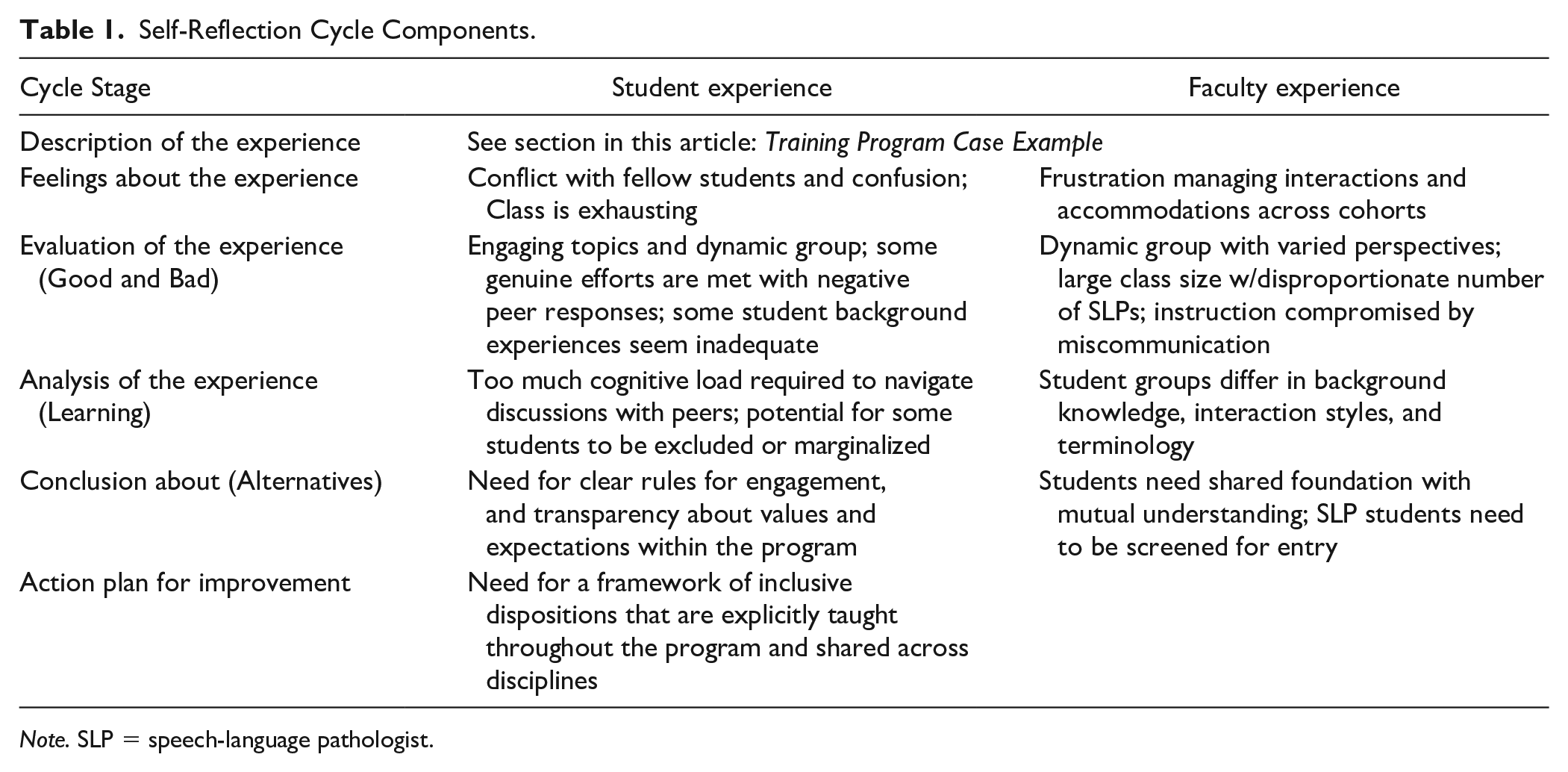
Note. SLP = speech-language pathologist.
A Training Program Case Example: Addressing Challenges Encountered in Interdisciplinary Training
There is a learning curve in building an interdisciplinary training model. The following example illustrates missteps and challenges in a shared course within this interdisciplinary program and also functions as the “Description of Experience” which is the first step in the Self-Reflection Cycle.
The online course “Strategies for Supporting Language” had synchronous weekly sessions and was delivered within the deaf education program. Speech-language pathologist students pursuing a specialty certificate in deaf/hh were added to the course based on stated interest, though were not screened for background knowledge or sign language skills. The result was a larger class and a disproportionate number of SLP students, which changed the course dynamic. The deaf education cohort included a number of students who were deaf/hh themselves, and who reflected the heterogeneity of the deaf/hh population including some who used cochlear implants and spoke, some who used only American Sign Language (ASL), some who used a combination of speech and sign systems, a couple who came from culturally Deaf backgrounds, and another who was not deaf until adulthood. Students from the two disciplines entered the course with different types of preparation. The SLPs with a clinical focus were tuned in to evaluating and effectively treating language disorders. The TDHHs were more aware of language challenges for students who are deaf/hh, and they were working to identify strategies to promote access and build proficiency. On a cursory level, they had complementary objectives. Still, their expectations and engagement styles were inherently different, which resulted in conflict and confusion.
The instructor worked to manage interactions during class meetings via Zoom, eventually adding a teaching assistant to coordinate accessible communication elements such as chat boxes, captions, and sign language interpreting. The SLP students were not accustomed to the deliberate pace required when accessibility is a primary consideration. For example, initially when the on-camera interpreter was providing voice interpreting for deaf students, the SLP students unintentionally spoke over deaf students, adding to a disconnect between cohorts. The shared course was also the final class of the week with students winding down from practicum, classes, and family responsibilities. From a cognitive load standpoint, they were exhausted even before they entered the taxing Thursday night dynamic.
Course elements designed for constructive learning included online discussion boards that were less than clear and, on occasion, felt inflammatory. Both groups had a knowledge base. Still, there was a gap between knowledge and application. Speech-language pathologist comments on the class board focused on the “disordered language” of deaf people. One statement, “ASL has no grammar,” bred frustration and resentment, especially given that culturally deaf individuals who used ASL were participating in the graduate-level coursework. There was also confusion about terms. For example, the term “auditory impairment” is often used on Individualized Education Program (IEP) documents within the state’s public school programs. Speech-language pathologist students with system knowledge did not intuitively grasp why that term was not favored in the deaf education program. The deaf education program had made a shift from “hearing loss” to “hearing difference.” This too was not explained to the SLP students, which added confusion. Finally, the topics and strategies covered in the course did not always make sense to the SLPs because they lacked knowledge about the population (e.g., how auditory supports could be leveraged for students who use sign language). There were also differing expectations for course assessments. The SLP students had more hands-on learning in practicum settings, with coursework more grounded in principles and theory; the deaf education courses tended to be project-based and appeared to the SLP students to be ambiguous work rather than structured assessments that required the identification of “right answers.”
This example illustrates the mismatch that can occur across student groups with dissimilarities in background knowledge, experiences, and even program culture. The two cohorts of students, both focused on language supports, held different views of success and opinions on the professional’s role. Most critically, central perceptions of identity were not proactively addressed in our training, leaving members of both groups feeling vulnerable and misjudged. There was an acknowledgment that the faculty had not prepared the SLP students for participation in the deaf education courses, placing them at a particular disadvantage. Programmatic changes were made which included managing the number of SLP students who entered courses in the deaf education track to balance the class dynamic, adding an entry requirement of sign language skills, contributing to the SLP students’ background knowledge, and filtering in those who had more direct experiences with the population of students who are deaf/hh. Course sequences were adjusted, making the aural habilitation course an SLP prerequisite for the course in language strategies. A more formal orientation takes place as the SLP and TDHH students enter the interdisciplinary program which includes candid discussions about terminology, accessible communication, and collaboration. These elements are reflected in the literature by others who note that interdisciplinary collaboration beyond a surface level requires both a shared vocabulary and a shared vision, both requiring an investment of time and effort by all parties (Scanlon et al., 2019).
A Framework of Inclusive Dispositions: Our What, Why, and How of Training
A critical component of this interdisciplinary training program has been the addition of a shared framework of inclusive dispositions, now included in syllabi, embedded in discussions, and referred to as students are coached on best practices. Well-articulated dispositions serve as guideposts as students build knowledge and skills, particularly when they must make difficult decisions that professionals in deaf education often encounter. By selecting and stating dispositions explicitly, we expect to further inform evidence-based practice, and in turn shape decision-making, collaboration, and the delivery of services. The identified dispositions center on inclusiveness and reflect evidence-based practice as they were derived from current research, professional expertise, and community values. Graduate students have been led into difficult discussions about perspectives on disability, views of helping, decision ownership, identity, and efficacy of services. In considering how to coach dispositions, the culture of our programs was re-examined, including how we were (or were not) modeling true collaboration. In “Cultivating a Collaborative Culture,” Zimmerman et al. (2019) provide helpful guidance on building collaborative teams, describing three critical components: a sense of safety in team learning grounded in mutual trust; an opportunity for constructive conflict that integrates diverse perspectives; and learning directed toward compassionate action. These tenets, also compatible with the PAR guidelines (Wimpenny, 2010), helped guide identification of three core dispositions, each with several corresponding inclusive dispositions and examples of how they may be coached within coursework. The framework is provided in a summarizing table (see Table 2) which lists each disposition selected, why it was selected, and how it may be taught and assessed. A narrative is provided with disposition descriptions, rationale, and teaching examples. This is not a prescriptive model with designated actions and outcomes. Rather this is an example of using a continuous improvement model to plan thoughtfully, teach and observe, reflect on consequences, and implement targeted changes.
Inclusive Interdisciplinary Dispositions.
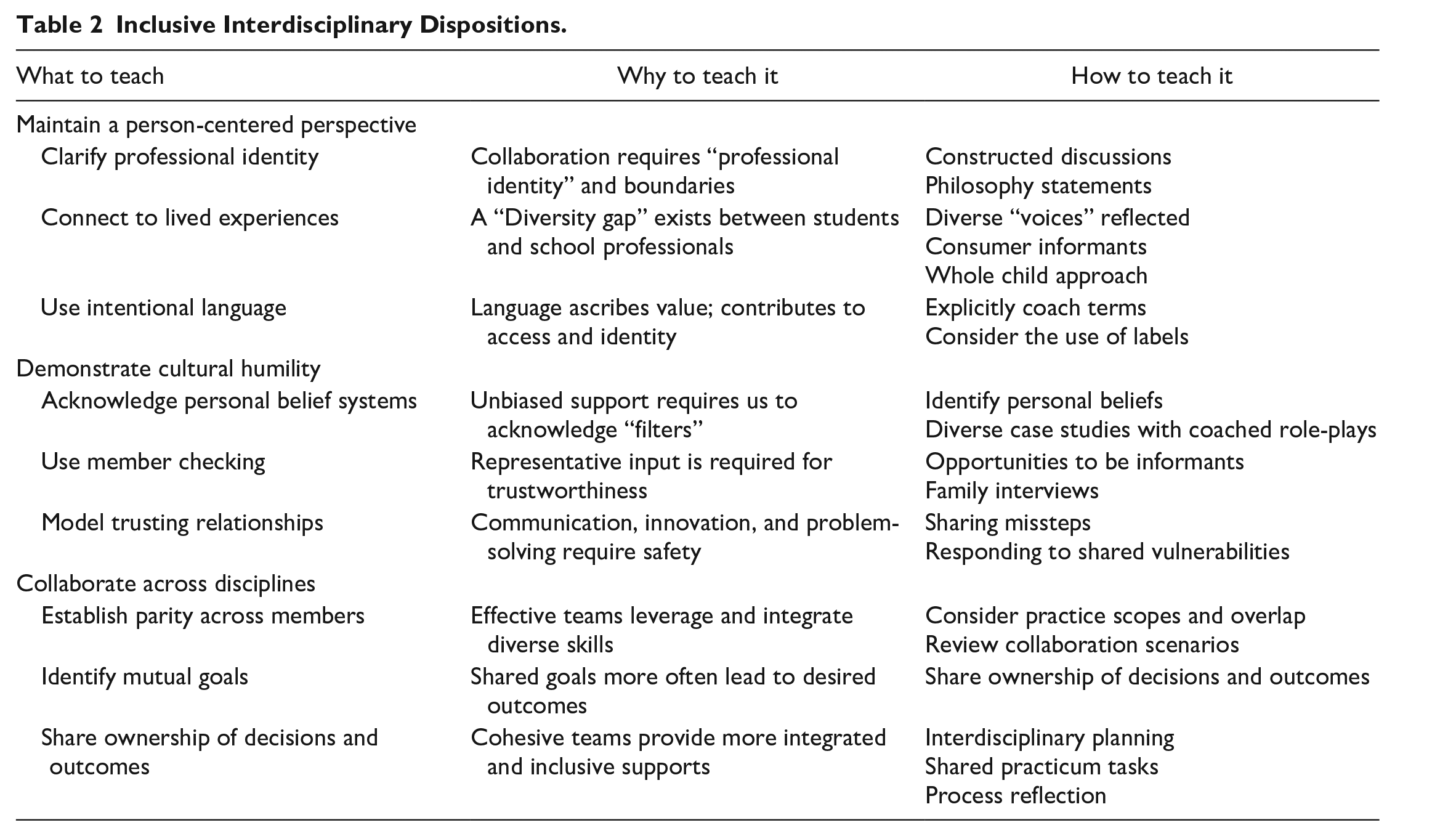
Core Disposition 1: Maintain a Person-Centered Perspective
Careers of TDHHs and SLPs focus on providing access and opportunities to students who are challenged in their language, and in many cases, marginalized. There may be an inherent desire to be a “helper,” a perspective that has the potential to set up a deficit-focused dynamic. Amid assessments, interventions, accommodations, and modifications, practitioners can focus on the deficits or service needs rather than the individual as a person. The inclusion of diverse students as individuals necessitates an awareness of one’s own identity, the experiences of others, and ways we communicate.
WHAT: Clarify Professional Identity
Why
Effective collaboration requires individuals to work toward a common goal which necessitates the navigation of personalities, boundaries of practice, and particularly professional identity (Griffin, 2015; Stull & Blue, 2016). Beyond a belief system, professional identity is shaped by one’s training and experiences, and at the early stages practitioners are working to develop a clear sense of roles and skills, and how they fit into the larger system. A clear sense of one’s “professional identity” adds value to individual team members, as well as practitioners’ confidence in advocating and contributing professional opinions (Turner & Knight, 2015).
How
Refining professional identity can be facilitated within discussions that invite students to share perspectives that intersect with content. A discussion board early in the coursework asks students to “Introduce us to your ears.” Students reveal frustrations with hearing aids, pride in their piercings, notes about favorite sounds, curiosities about hearing tests, and other personal details. The exercise allows the deaf/hh students to share the information they choose and gives hearing students a peek into their lived experiences which has been a catalyst for building trusting relationships.
Just as many teachers in training are required to develop a philosophy of teaching, students in this interdisciplinary program must draft communication philosophies related to deafness as they begin the program. They are coached to use current terminology, reflect unbiased professional perspectives, consider diverse backgrounds, and represent cultural humility. The created documents are edited throughout the coursework as a sense of role and dispositions evolve. The philosophy statements provide evidence of professional growth and are a point of reference at program completion.
WHAT: Connect to Lived Experiences
Why
There has been a cultural shift and heightened awareness of diverse perspectives within society, and schools are expanding efforts to represent the varied backgrounds of our population via teaching materials, curriculum, instructional practices, recruitment of diverse teachers, and media (Nishina et al., 2019). Similarly, there have been initiatives to integrate adults who are deaf/hh into program roles such as teachers who are native users of ASL, early interventionists who draw from lived experiences to coach families, and role models for students (Higgins & Lieberman, 2016). While deaf professionals (including those that are culturally Deaf) have been prominent in state schools for the deaf, they are increasingly present stakeholders in public schools and service systems. Much of this trend has been driven by awareness of the “diversity gap,” including the fact that professionals who serve students who are deaf/hh have been predominantly White, female, and hearing (Luckner & Ayantoye, 2013), and do not reflect most of the students they serve.
How
For this interdisciplinary program, students are exposed to professionals and community members who are deaf/hh, and deaf perspectives are integrated to complement clinical content with an additional viewpoint. These include the following:
A deaf historian who explores the evolution of pediatric audiology in schools for the deaf, as well as the intersections of her own identity (Virdi, 2020);
A deaf audiologist blogger who shares her love for ASL, tips for using an array of assistive technology, and challenges of navigating the Deaf and hearing worlds (Childress, 2015);
A deaf scholar and advocate who influences perspectives and policies in early hearing detection and intervention (EHDI) systems on a national level (Joint Committee on Infant Hearing of the American Academy of Pediatrics [JCIH], 2013).
Inviting the “consumers” of school programs can also provide a powerful message of identity and accountability. For example, hosting guests who students can actively engage with has set the tone of an aural habilitation course. Visitors, such as teens and young adults, have relevant experiences and can share candidly about schools and systems. Exposing students to individuals who use a variety of communication approaches and accommodations builds a practical awareness of the targets they are working toward. In addition, having individuals share successes and struggles, from being a member of the high school sports team to being bullied in the cafeteria, builds on a whole child perspective as dispositions are shaped, bringing the “big picture” more clearly into focus.
WHAT: Use Intentional Language
Why
Coursework related to deafness includes content focused on hearing abilities, the delivery of which can tend to be filtered through a “hearing” perspective.
How
There is an acknowledgment that the professional terms we choose can ascribe value and contribute to identity, consequently as SLP and TDHH students consider topics of audiology and speech, they are coached explicitly on terminology. For example, the term “hearing impaired,” which is increasingly considered derogatory, has been replaced by the preferred term “deaf or hard of hearing.” Cultural identity is commonly referred to as “Deaf” with a capital “D”; while “deaf” with a lowercase “d” often references hearing status. The term “deaf plus” refers to individuals who are deaf/hh and also have an identified disability. This replaces the older term, “multiply disabled.” “Deaf Pride” is a sense of positive identity that, like other features of identity, may evolve over time. Regarding sign language, students are presented with visual communication as a valid choice rather than a “Plan B,” with language proficiency and accessibility being emphasized over language modality. Students receive a clear message about the value of deaf/hh individuals and are reminded to consider the social milieu of those with lived experiences as they engage in thoughtful dialogue.
Core Disposition 2: Demonstrate Cultural Humility
The school environment is a conglomeration of relationships. Professionals are expected to operate with cultural competence, which is defined as the ability to interact with people from different cultures or belief systems in a way that is understanding and appreciative (DeAngelis, 2015). There is also a practical inability to be “competent” across all cultures, including with students and families whose experiences with deafness (as well as disability) add complexity to caseloads. Cultural humility takes the response further through self-reflection and shared learning that builds trusting relationships and is particularly important for value-laden discussions about language and identity. It can be argued that cultural humility is an ethical obligation, as well as a best practice (Rogers-Sirin & Sirin, 2009).
WHAT: Acknowledge Personal Belief Systems
Why
The TDHHs and SLPs are expected to support students across a continuum of language modalities, proficiencies, and preferences. Team members are tasked with sharing critical information regarding language and learning with parents and other professionals, and must be able to fairly and accurately present information in a way that facilitates informed decision-making (Porter et al., 2018). Each professional is entitled to a personal belief system shaped by personal and practical experiences, as well as training (Seaver, 2004). Team members may hold strong views about the benefits of sign language or cochlear implants, a particular therapy approach, or instructional method and may express them within appropriate professional boundaries. Conversations become biased when other approaches are maligned or when information is shared to manipulate someone’s choice. Acknowledgment of one’s belief system is the first step in the effort to provide unbiased support.
How
As a part of the interdisciplinary training, students are asked to identify personal beliefs that they use to filter information related to language and learning. Concepts of informed decision-making are emphasized, including presenting choices along a continuum, recognizing that choices may change, and understanding that families vary in priorities and capacities. Case studies are used during student role-plays, describing the potential benefits of different decision paths and providing varied examples of positive outcomes. For example, students considered an elementary-age student who was deaf with a progressive loss of hearing (and whose family spoke only Spanish). Team members discussed potential supports in Spanish, English, and sign language, as well as the options of placement in English students of other languages (ESOL) class or a deaf education class, and also practiced supporting the parent through decisions related to the IEP process. Differentiating concepts of bias and personal belief systems has provided a guidepost for providing feedback on sensitive topics within discussions and assignments, and has helped students identify when they cross the threshold of bias.
WHAT: Use Member Checking
Why
“Member checking” is used to establish the trustworthiness of findings by having participants provide feedback on interpretation and conclusions in research (Lincoln & Guba, 1985). Similarly, when training programs frame practices to support cultural competence, it is appropriate to validate the guidance provided to students by including input from representative members, such as families, teachers and administrators, and community members who are deaf/hh. The delivery of coursework online has made member-checking even more critical as students within a single cohort may be working across different populations. Within the interdisciplinary program described, graduate students include a teacher who is deaf working on an island in Maine, an early interventionist who is hard of hearing providing itinerant services in rural Kansas, a speech-language pathology assistant working in a predominantly Spanish-speaking school on the Mexican border, and an SLP student completing a practicum in a suburban Texas hospital.
How
Providing students with opportunities to be informants about their communities broadens the perspective of cultural diversity for the cohort. For a course on family-centered practices, students were asked to interview a family about decision-making processes. For another course on assessment, students were required to complete a language evaluation for a child who is deaf/hh. For courses in audiology and aural habilitation, students were asked to create a coaching tool for a teacher in their program to support a specific child. Through each activity, students applied practices within the cultures of their communities and gleaned insight from multiple perspectives. They are “member-checking” new knowledge and skills, and integrating their findings with those reported by their peers.
WHAT: Model Trusting Relationships
Why
In coaching cultural humility, the instructor must facilitate an environment of both vulnerability and care. Shared problem-solving and honest communication in cross-cultural contexts require a sense of personal safety. Trust is a critical building block, intimately connected to integrity and respect (Zimmerman et al., 2019). The social exchanges and bonds that occur between faculty and students cultivate engagement during the course and also provide the model for engagement with colleagues, students, and families.
How
The uncomfortable practice of sharing instances of personal missteps can be formative. We can note when wrong assumptions were made based on stereotypes, asking open questions about perceptions of class members from varied backgrounds (and genuinely desiring their insight), and responding without judgment to the student reflections. For example, in a classroom exchange, an instructor shared the story of a Jewish Orthodox family whose toddler son, with a profound hearing loss, was being served through early intervention. Adjustments were made to accommodate the family’s cultural values. The family was seen at a center rather than at home, touch and interactions were carefully navigated, and interpreters were provided consistently. After much deliberation, the family decided to pursue a cochlear implant. A detail that had not been clearly communicated was that a portion of the child’s hair would be shaved for the surgery, hair that traditionally would not be cut until age 3. The surgeon could have accommodated the request if he had been informed in advance. The older extended family was offended in a way that was difficult to repair. This illustration emphasizes the importance of engaging a cultural interpreter rather than only considering linguistic access. Even with good intentions, there is potential for consequential misunderstandings.
Sharing cases like the one described above has been a catalyst for students to describe how their cultural backgrounds intersect with services and systems. In a subsequent classroom discussion, a student who is Hispanic shared her perspective of being a cultural mediator for her own family growing up, and recently with clients at an English-speaking practicum site. The class conversations shifted to how to respond to families with concerns about pursuing care when they feel vulnerable based on immigration status. In addition to addressing topics of cultural competence, shared exchanges like this allowed class members to grapple with complex issues on an equal platform rather than elevating the role of either the instructor or the majority culture.
Core Disposition 3: Collaborate Across Disciplines
Students enrolled in deaf education receive services from a team of professionals. Working effectively requires collaboration between different disciplines on behalf of students. This can be challenging because team members must prioritize the students’ needs above what is preferable or comfortable. Friend and Cook (2020) identify prerequisite conditions for effective collaboration including agreement on shared goals and resources, ensuring that members have equal contributions and decision-making power, and co-owning problem-solving and outcomes. These efforts require time and communication commitments in school settings and within training programs.
WHAT: Establish Parity Across Members
Why
The TDHH’s distinctive skill set can lead to a sense of “ownership” of this subset of students. Comparatively the training of the SLP is broad, with the scope of communication skills encompassing cognition, literacy, social functioning, expressive language, and speech production. Other members of the deaf education team include educational audiologists to manage assistive technology and provide input on auditory access, and sign language interpreters who facilitate access for students using sign language, and the paraprofessional (classroom assistant) who provides significant support as a partner in service delivery. While every team needs to be coordinated, there can be an inclination to set up a hierarchy based on role that undermines team effectiveness and the value of its individual members. The educational interpreter is an example of a member who is often under-utilized. This professional facilitates academic and social communication for the signing student and is often able to glean information about the student’s ability to adapt to the instructional rigor and rate of the inclusion setting, their basic comprehension, their use of self-advocacy skills, and their engagement with peers. A skilled educational interpreter is equipped to work with educators to facilitate inclusion, work with the SLP to provide support for assessing language and communication, and work with the team on communication development (Seal, 2000). Similarly, the paraprofessional may have insight into the effectiveness of implemented behavior strategies, the educational audiologist may have an idea for assistive technology for the student who does not use hearing aids, or even the bus driver may be the first to know about changes in a student’s home life and share information informally with the teacher.
How
Recognizing the knowledge base and skills of team members helps to build a strengths-based identity for a collaborative team. Students review the scopes of practice of various professionals, identifying the differences and overlap in roles. An online discussion board assignment asked students to identify situations where it might be difficult to meet the conditions of collaboration, as well as how they might partner with a colleague to share ownership. Considering potential challenges in a specific and proactive way gives the disposition that we are targeting practical relevance. One student shared, I think it is difficult to share responsibility for solving a problem with the SLP on my team because we serve students in such a different way. If there is a difficulty with a student (like forgetting his hearing aid or not understanding question forms) she “problem-solves” in a small setting. The short interaction focuses on communication. As a teacher, I have to prioritize many more challenges across children AND deliver instruction. One approach could be to ask her to join our class regularly to provide support (such as during English language arts). We could see strategies and supports that each other use with the same students.
WHAT: Identify Mutual Goals
Why
Elements that contribute to effective goal setting and achieving desired outcomes include setting goals as a team that are difficult but attainable, and having those goals accepted by others (Lunenberg & Samaras, 2011). Sharing a purpose and working together brings a sense of fulfillment to work and leverages the benefits of effective interdisciplinary teams for students.
How
Within U.S. school programs, IEP goals are developed to ensure that students who receive special education services have access to the curriculum, and for the most part, this considers access to academic areas. For students who are deaf/hh, there is an additional and unique set of skills organized into the Expanded Core Curriculum for Students who are Deaf or Hard of Hearing (ECC-DHH; Iowa Department of Education, 2019). The ECC-DHH document has been widely adopted by many state education agencies and includes nine target areas such as audiology, communication, self-determination, and advocacy. Due to its functional focus and application to IEP goals, the ECC-DHH is used within the interdisciplinary training program to practice collaborative goal setting. For example, both the SLP and TDHH may address vocabulary development, communication repair strategies, and the use of assistive technologies. Developing goals together builds discussions of “why” as team members prioritize and share knowledge across disciplines. To illustrate, the SLP may want to target auditory memory for a hard-of-hearing student, building the ability to recall auditory items (such as a list or sentence) in a specific order. Initially, this may seem more arbitrary and less of a priority to the TDHH, until the SLP explains how skills in auditory memory are prerequisites for the development of syntax and contribute to proficiency in writing. A shared plan results from meaningful discussions related to developing functional goals, determining measurable objectives, and identifying needed supports.
WHAT: Share Ownership of Decisions and Outcomes
Why
When team members value each other’s contributions, they share ownership, perform better, and act in cohesion (Schaap & de Bruijn, 2018). There can be a tendency to consider “your” students and “my” students rather than “our” students. For instance, while the TDHH and regular educator may agree that the student who is deaf/hh is lost during large group instruction, the regular educator may perceive the issue as the student’s lack of readiness for the level of content, and the TDHH may identify inaccessible instruction. Information gathering should also be a shared responsibility. This may include assessment data, classroom observations, or a review of accommodations. Engaging other team members in the discussion (including the student as developmentally appropriate) can contribute to the deliberate process of identifying primary issues and planning supports such as pre-teaching, adding visual aids and comprehension checks, or changing the students’ seating. The teaching team would share in the implementation and agree on how progress would be monitored, potentially by the student’s level of participation, performance on a test, or ability to summarize daily lessons.
How
Bronstein (2003) provides a conceptual model to guide interdisciplinary practice that has been widely applied, with components including interdependence, collective ownership of goals, and reflection on the process. Students in the interdisciplinary program had opportunities to develop these skills as they generated therapy plans and lesson plans during their respective coursework. They completed the assignments in small teams, requiring them to own goals collectively and depend on each other to complete tasks. They were also required to match their plans to a specific student on their caseload or from a video case, and reflect on how their plan aligned with the needs of the student. Peer reviews allow students to evaluate the performance of their partners and the products of other teams.
At the practicum level, students engaged with professionals from disciplines including audiology, occupational therapy, counseling, and adaptive physical education. Some goals were developed jointly, with services coordinated across settings, followed by debriefing. Students also had opportunities to “coach” peers and professionals by sharing information about accommodations and modifications specific to the population, such as working with a music therapist to identify strategies to engage both the child with mild hearing loss and the one with profound hearing loss in the same session, or learning from a physical therapy student in an interprofessional education setting about positioning a child who is deaf with cerebral palsy in a modified chair to improve participation in language activities. In these processes, students were mutually invested in the success of one another while expanding their skill sets.
Conclusion: Build on Imperfect Models
While focusing on dispositions may appear provider-centric, the inclusive dispositions are targeting provider readiness to deliver the collaborative services that clients/students/families depend on. Our aim was to summarize the process and product of a self-reflective cycle that focused on inclusive interdisciplinary dispositions, highlighting a framework developed for training in speech-language pathology and deaf education. When programs tout “best practices” or “inclusive dispositions,” there is a discomfort in recognizing that each member of the teaching and learning team continues to grow in their own professional development. This includes faculty members. Training graduate students who are deaf/hh, as well as those with other diverse learners, helps keep the program accountable to the values they espouse. The reciprocal inclusion of TDHH students into SLP courses on counseling and multicultural practices has also enriched both programs. Deliberate attention to building shared dispositions has been a critical component of growing interdisciplinary professionals who are equipped to provide inclusive services for students who are deaf/hh. Still, there are missteps, including the use of an insensitive term, an assumption made based on a stereotype, or a professional boundary crossed unintentionally. These occasions do not invalidate the inclusive dispositions framework. Instead, they provide an opportunity to model the strategies that graduates will need to use to respond and repair relationships, as they will often need to do within the schools in which they work.
The inclusive dispositions framework is the starting point for this particular model of interdisciplinary training, connecting knowledge and skills to the diverse deaf/hh students that program graduates will serve. As each practice-based competency is addressed, there is an effort to align it with a disposition, and we continue to examine other dispositions to fold into our framework. We seek to attribute worth to the student and ownership to a collaborative team, explicitly and implicitly, throughout the training program. Our objective has been transformative learning, a shift in both “habits of mind” and “points of view” based on new experiences and the self-reflective cycle (Mezirow, 1991, p. xi). This will shape the convictions, thinking, and behaviors of practitioners and faculty members to promote inclusive interdisciplinary practices in every educational setting.
Footnotes
Declaration of Conflicting Interests
The author(s) declared no potential conflicts of interest with respect to the research, authorship, and/or publication of this article.
Funding
The Project EPIC interdisciplinary training program described is funded by a grant from the U.S. Department of Education, Office of Special Education & Rehabilitative Services, Office of Special Education Programs: Personnel Development to Improve Services and Results for Children with Disabilities: Interdisciplinary Preparation in Special Education, Early Intervention and Related Services for Personnel Serving Children with Disabilities who have High-Intensity Needs.
