







Abstract
The purposes of this tutorial are twofold – first, to present data documenting elementary-aged children’s production of complex syntax in language samples collected using the SUGAR (Sampling Utterances and Grammatical Analysis Revised) method of language sample analysis, and second, to offer step-by-step instructions detailing how to analyze a SUGAR language sample for complex syntax. The tutorial begins with a review of coordinate and subordinate clauses, supported by data documenting elementary-aged children’s production of those structures. Next, a case study is presented to demonstrate how to use the SUGAR method to analyze a sample for coordinate and subordinate clauses. Sub-analysis of a SUGAR language sample can be used to assist SLPs with intervention planning. Specifically, SLPs can use sub-analysis when identifying appropriate intervention targets, tracking progress in therapy, and facilitating conversations with teachers and others regarding curriculum-relevance.
Keywords
Introduction
Language sample analysis (LSA) is one clinically useful and versatile tool that researchers have advocated when planning treatment and monitoring progress (Costanza-Smith, 2010; Overton & Wren, 2014; Owens et al., 2018; Price et al., 2010). LSA can be particularly useful when analyzing language samples for the use of complex syntax. School-based speech-language pathologists (SLPs) need to consider children’s use of complex syntax because many state standards for elementary students require students to use complex syntax (National Governors Association Center for Best Practices & Council of Chief State School Officers, 2021), and because children with language impairments produce fewer complex utterances than their peers with typical language development (Guo et al., 2021; Scott & Windsor, 2000). The purposes of this tutorial are twofold – first, to present data documenting elementary-aged children’s production of complex syntax in language samples collected using the SUGAR (Sampling Utterances and Grammatical Analysis Revised) method of LSA, and second, to offer step-by-step instructions detailing how to analyze a SUGAR language sample for complex syntax.
The term “complex syntax” refers to compound sentences (two independent/main clauses joined with a coordinating conjunction), complex sentences (an independent/main clause, with at least one subordinate/dependent clause), and compound-complex sentences (two independent/main clauses joined with a coordinating conjunction and at least one of the independent clauses also includes a subordinate/dependent clause). This tutorial will only address compound and complex sentences. We will use the terms “main clause” to refer to independent/main clauses and “subordinate clause” to refer to subordinate/dependent clauses.
Coordinate Clauses
A compound sentence includes two or more main clauses that are connected by a coordinating conjunction (for, and, nor, but, or, yet, and so). Each independent clause can stand alone and is not dependent on the other to express a complete thought. For example, I was hungry, and I went to the grocery store.
During the preschool years, most sentence development includes learning to comprehend and produce simple one-clause sentences in declarative, interrogative, and imperative forms (Campbell & Tomasello, 2001; Rowland et al., 2005; Rowland & Theakston, 2009; Salomo et al., 2013; Santelmann et al., 2002). Children also begin to produce coordinate clauses during preschool, with the most frequently used conjunction being and (Scott, 1987).
Elementary-aged children (aged 5–10 years) frequently produce coordinate clauses (Owens et al., 2024; Pavelko et al., 2025). Owens and colleagues (2024) examined children’s (aged 5;0–10;11) use of coordinate and subordinate clauses in 50-utterance language samples. Of the 10,000 utterances examined, nearly 10% (N = 880) included a coordinate clause only. The most frequently occurring coordinating conjunction was and, which accounted for nearly 70% of the conjoined utterances. In a follow-up study (Pavelko et al., 2025), the same authors reported that children’s use of the coordinating conjunctions but and so significantly increased from age 5;0 to age 10;11. Table 1 shows the percentage of compound sentences that included the coordinating conjunctions “and,” “but,” and “so.” Across all ages, the most frequently used coordinating conjunction was “and” (ranging from 63% to 75% of compound sentences), followed by “but” (ranging from 18% to 23% of compound sentences), and then “so” (ranging from 7% to 14% of compound sentences). Taken together, these results suggest that, as children develop throughout the elementary years, they continue to produce “and” with the greatest frequency and use both “but” and “so” with increasing frequency.
Percentage Occurrence of “And,” “But,” and “So,” Disaggregated by Age.
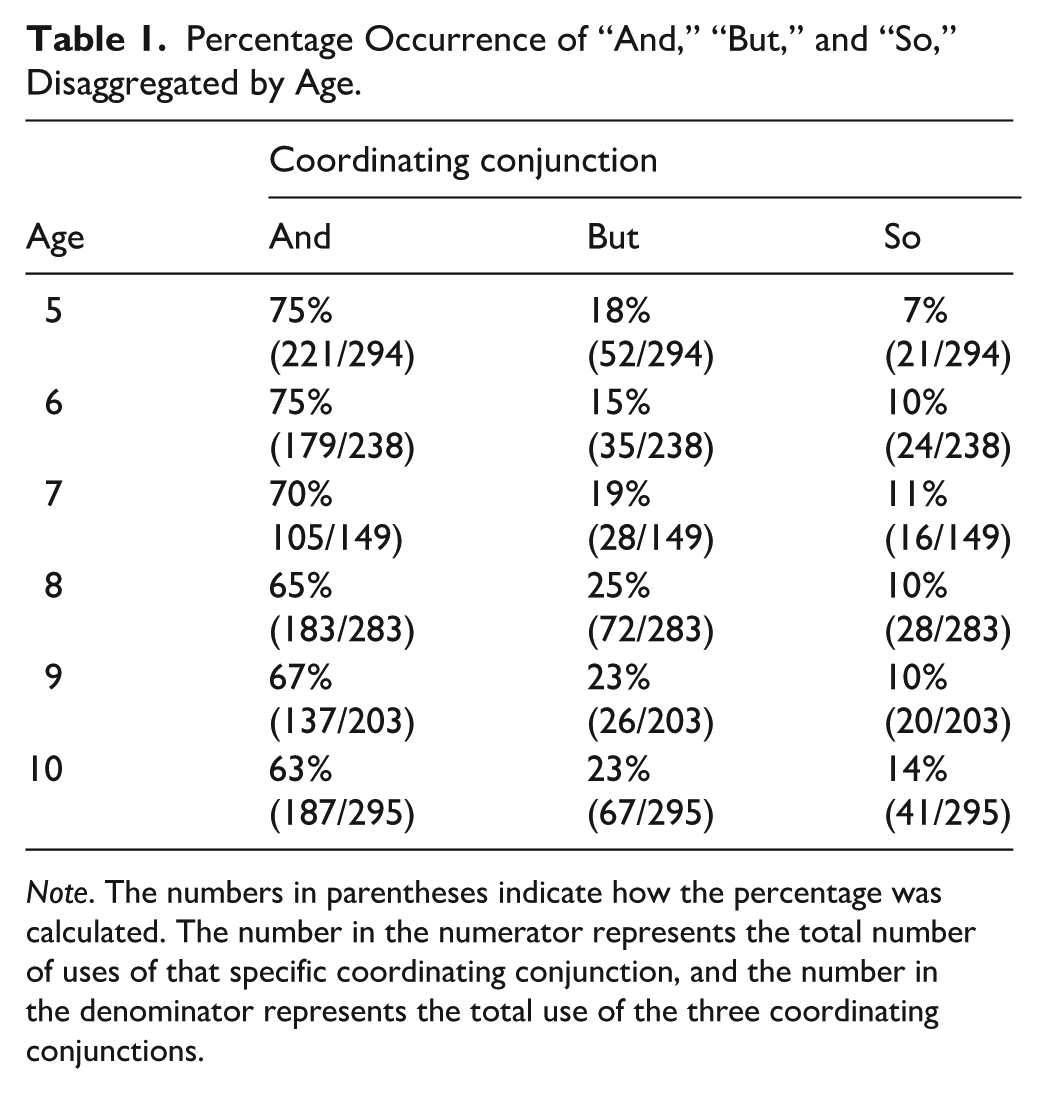
Note. The numbers in parentheses indicate how the percentage was calculated. The number in the numerator represents the total number of uses of that specific coordinating conjunction, and the number in the denominator represents the total use of the three coordinating conjunctions.
Subordinate Clauses
A complex sentence includes a main clause and at least one subordinate clause. Subordinate clauses have a subject and a verb; however, a subordinate clause cannot function as a main clause. Subordinate clauses can be introduced by a subordinating conjunction (words such as if, because, before, when, and where) or a relative pronoun (words such as which, whose, and that). For example: I got wet because it was raining.
The clause I got wet forms the main clause, and the other clause, because it was raining, is the subordinate clause. It cannot grammatically be used independent of the other clause.
There are two types of subordinate clauses: (a) nonfinite clauses (i.e., infinitive, participial, and gerund clauses) which include a nonfinite verb (i.e., a verb not marked for person, tense, or number); and (b) finite clauses (i.e., nominal, relative, and adverbial clauses), which include a finite verb (i.e., a verb marked for person, tense, and number). This tutorial will focus on finite clauses (i.e., nominal, relative, and adverbial clauses).
Nominal Clauses
Nominal subordinate clauses fill a noun function and appear in the subject or object position. For example, a nominal subordinate clause in the subject position: Whoever colors in all the horseshoe wins.
In this example, the nominal clause “whoever colors in all the horseshoe” functions as the subject of the main verb “wins.” Nominal subordinate clauses can also function as an object, for example: I know what you did.
In this sentence, there are two clauses (I know and what you did). The nominal subordinate clause (what you did) is the object of the sentence and completes the thought “I know [what you did].”
Relative Clauses
Relative subordinate clauses modify a noun or pronoun in a main clause and are typically introduced with relative pronouns such as that, who, and which. The relative pronoun “that” is often optional and may be omitted. When “that” is omitted, it is indicated as [that], as in the following examples: I saw the car [that] we drove yesterday. I saw the car that we drove yesterday.
In these examples, the relative clause “[that] we drove yesterday” modifies the noun “the car.”
Adverbial Clauses
Adverbial subordinate clauses can occur before or after the main clause and answer questions about where, when, why, and how. They begin with a subordinating conjunction such as because, if, and when. For example: We went to school because it was Monday.
In this sentence, there are two clauses (We went to school and because it was Monday). The adverbial subordinate clause (because it was Monday) answers the question why.
Elementary-aged children (aged 5–10 years) frequently use subordinate clauses (Owens et al., 2024; Pavelko et al., 2025). Specifically, Owens et al. (2024) reported that children’s use of subordinate clauses ranged from 3.15 to 12.15 utterances of a 50-utternace sample, and children’s utterances that included only a subordinate clause or both a coordinate and a subordinate clause significantly increased with age. Although these results provide evidence that elementary-aged children are increasingly using subordinate clauses, they do not offer the fine-grained detail needed to plan intervention.
Specifically, there are at least 50 different subordinating conjunctions in English, and SLPs would benefit from guidance in the specific subordinating conjunctions that students use. Therefore, we re-analyzed the Owens et al (2024) data set. Participants included 199 children (female = 103; male = 96) who demonstrated age-appropriate language skills and spoke General American English. Children ranged in age from 5;0 to 10;11 including 5-year-olds (n = 54), 6-year-olds (n = 32), 7-year-olds (n = 23), 8-year-olds (n = 37), 9-year-olds (n = 25), and 10-year-olds (n = 28). All children completed a SUGAR language sample. Additional demographic information and coding details are available from Pavelko and Owens (2017) and Owens and Pavelko (2020). Figure 1 includes the subordinating conjunctions that were used in more than 10% of utterances, disaggregated by age. As noted earlier, that can be optionally omitted and is indicated as [that].
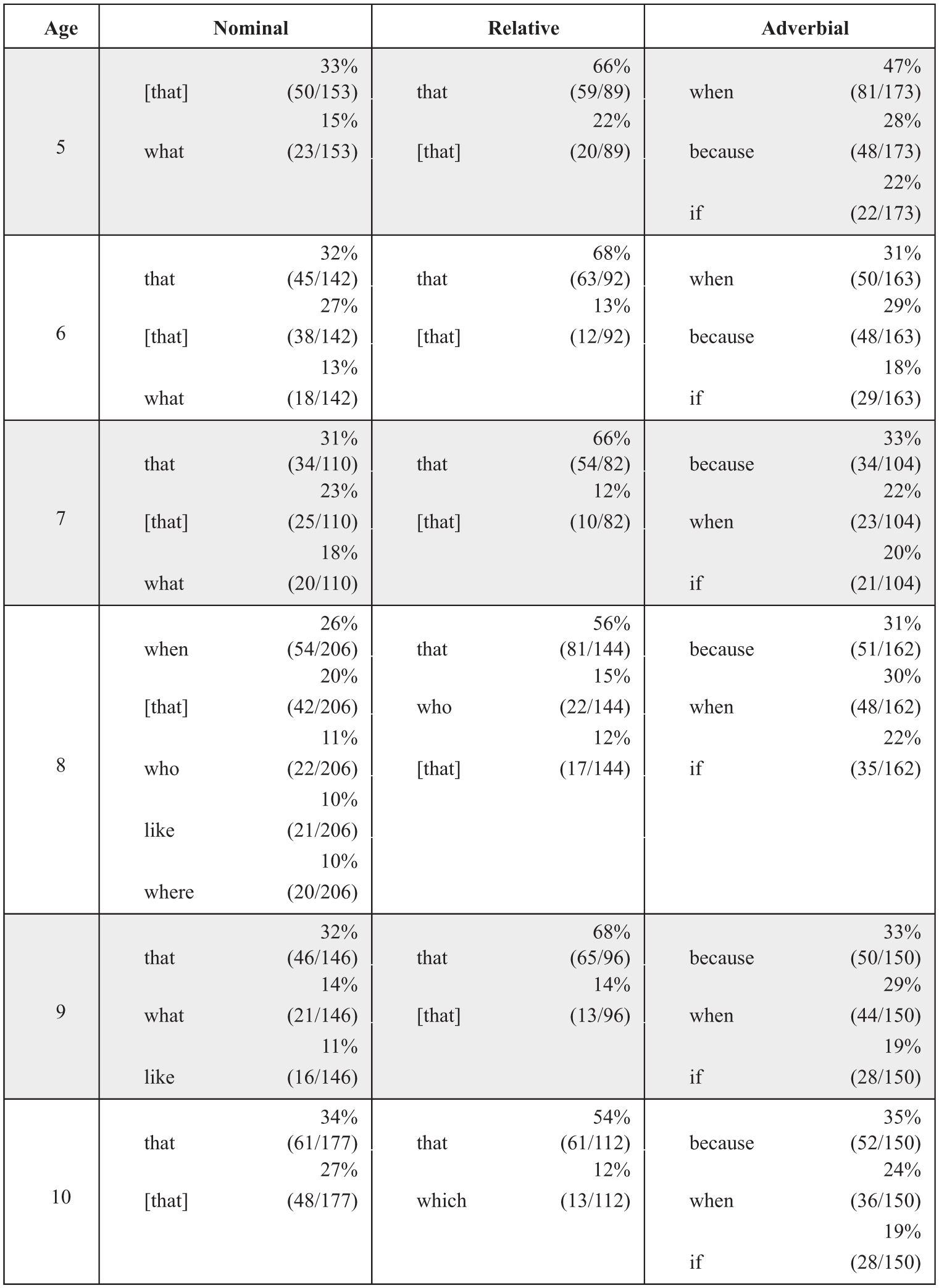
Percent Occurrence of Nominal, Relative, and Adverbial Clauses, Disaggregated by Age.
Case Study
SUGAR consists of an initial quantitative analysis to determine if a child might have a language disorder. The values determined from the sample are total number of words (TNW), mean length of utterance via the SUGAR method (MLUSUGAR or MLUS), words per sentence (WPS), and clauses per sentence (CPS). The specific methodology can be found in Pavelko and Owens (2017, 2023), Owens and Pavelko (2020), and on the SUGAR website (sugarlanguage.org). Although quantitative analysis is a quick, easy method, it provides little direction for intervention. For example, MLUS does not indicate which morphemes a child may have difficulty using. Similarly, CPS does not indicate which subordinate clauses a child does/does not use and might be appropriate for a clinician to address in intervention. In the following sections, we will offer step-by-step directions to analyze a SUGAR language sample for complex syntax, which we refer to as “sub-analysis.”
We will provide a case study to explain the SUGAR sub-analysis process. The child in this case study (who we will call “Brenda”) is a female in fourth grade (age 9;4). Brenda has already been identified as a child with a language impairment. In collecting and analyzing the progress-monitoring data to determine appropriate goals for the upcoming school year, the SLP completed a SUGAR language sample and obtained the following metrics: TNW = 292, MLUS = 6.88; WPS = 6.04, CPS = 1.15. The CPS metric (1.15) is more than one standard deviation below the mean, when compared to children of the same age (see Owens & Pavelko, 2020). Fourth-grade curricular standards will require Brenda to use a complex syntax. For example, one of the fourth-grade Common Core ELA standards (CCSS.ELA-Literacy.L.4.1.a) states, “use relative pronouns (who, whose, whom, which, that) and relative adverbs (where, when, why).” Therefore, the SLP decides to examine Brenda’s language sample for the creation of compound and complex sentences so that she can write curriculum-relevant goals targeting a complex language structure.
SUGAR Sub-Analysis
The SUGAR sub-analysis examines a child’s generation of phrase elements, morphemes, and coordination and subordination within multiclausal sentences. The Supplemental Material includes the analysis of Brenda’s language sample. Additional forms can be found on the SUGAR website (www.sugarlanguage.org). Each sub-analysis form has two sheets. The first sheet examines phrase elements and morphemes. Owens et al. (2018) discuss how to complete the first sheet.
The second sheet is used to document coordination and subordination within multiclausal sentences, the coordinating conjunction, and the subordinating conjunction and/or pronoun based on the normative data presented in Owens et al. (2024) and Pavelko et al. (2025). Therefore, the forms only include the three coordinating conjunctions “and,” “but,” and “so” and the subordinating conjunction and relative pronouns that were used with more than 10% occurrence for each age.
To complete the second sheet, the SLP will need the WPS transcript from the quantitative analysis (see Pavelko & Owens, 2023 for additional details). The WPS transcript includes only those utterances that are also identified as sentences. The next step is to copy those sentences into the second workbook page of the appropriate sub-analysis form (see Supplemental Material).
Once the sentences have been copied into the workbook page, each sentence is coded for coordination and/or subordination by placing the number of occurrences in the corresponding box. For example, the sentence “you can hurt skeletons and other stuff but they can’t hurt you” is coded as “1” in the coordination column and “1” in the column for the coordinating conjunction “but” (see Supplemental Material; highlighted in yellow).
Coding subordinate clauses is similar. For example, the sentence “You can just hit it to hit the other person if they’re all out” is coded as “1” in the subordination column and “1” in the adverbial subordinate clause column “if” (see Supplemental Material; highlighted in yellow). The last column, “Notes,” can be used to indicate any coordinate or subordinate clauses that are not coded otherwise in the form.
After coding all sentences, the sheet will automatically total each column. It is important to note that these categories and the values given for each are not prescriptive. It is possible that a 50-utterance sample may yield only a handful of sentences, resulting in a small sample.
Goal Writing
Once the sub-analysis has been completed, the SLP can examine the data to determine intervention goals that target a complex syntax. Although the corpus of sentences is small, Brenda produced fewer multiclausal sentences in both the Coordination and Subordination categories than would be expected for a child of her age. Information needed to develop intervention goals can be obtained from the analysis. For example, Brenda is able to produce clausal coordination with both “and” and “but.” With respect to complex sentences, Brenda produces both nominal and adverbial subordinate clauses, but does not produce any relative clauses. Thus, the use of the coordinating conjunction “so” and relative subordinate clauses may be appropriate intervention goals for Brenda. Because the standards require the use of relative pronouns “who, whose, whom, which, that,” the SLP decides to write a goal for relative subordinate clauses introduced with the relative pronouns who, whose, whom, which, that. Figure 1 indicates that the most frequently used relative pronouns to introduce a subordinate relative clause are “that” and “[that]”; therefore, the SLP decides to first target production of subordinate relative clauses introduced by “that” and “[that]” as described in the Complex Sentence Intervention (Balthazar & Scott, 2017).
Conclusion
A SUGAR sub-analysis can help SLPs identify appropriate intervention targets, track progress in therapy, and facilitate conversations with teachers and others regarding curriculum-relevance. Specific to Brenda, results of the sub-analysis indicated that she was not using relative clauses. Because the curricular standards require Brenda to use relative pronouns, the SLP could discuss with the classroom teacher how a goal to produce subordinate relative clauses will require Brenda to use relative pronouns. Thus, the language goal is consistent with the fourth-grade standards and will help Brenda to be successful in the general education classroom.
At the time of this publication, SUGAR has not been developed for use with children who speak languages other than English or nonmainstream dialects of English. Therefore, it would not be appropriate to assess a child who does not speak mainstream English and compare those results to the SUGAR data. An SLP could, however, conduct a SUGAR sub-analysis to track progress in therapy.
Supplemental Material
sj-docx-1-cdq-10.1177_15257401261438791 – Supplemental material for A Sweet Surprise: Using SUGAR Language Analysis to Develop Intervention Goals
Supplemental material, sj-docx-1-cdq-10.1177_15257401261438791 for A Sweet Surprise: Using SUGAR Language Analysis to Develop Intervention Goals by Robert E. Owens and Stacey L. Pavelko in Communication Disorders Quarterly
Footnotes

Funding
The authors received no financial support for the research, authorship, and/or publication of this article.
Declaration of Conflicting Interests
The authors declared no potential conflicts of interest with respect to the research, authorship, and/or publication of this article.
References
Supplementary Material
Please find the following supplemental material available below.
For Open Access articles published under a Creative Commons License, all supplemental material carries the same license as the article it is associated with.
For non-Open Access articles published, all supplemental material carries a non-exclusive license, and permission requests for re-use of supplemental material or any part of supplemental material shall be sent directly to the copyright owner as specified in the copyright notice associated with the article.
