







Abstract
Expected yield rates are essential to a survey’s data collection plan, as they inform requisite sample sizes to meet the survey’s objectives. Given an overall expected yield rate for a self-administered mail survey, this short take describes a simple method for using the Census Planning Database to assign differential yield rates to lower-level geographies within the study area.
Background
In combination with other inputs such as target completes, precision goals, and budgetary constraints, the expected yield rate in a self-administered mail survey is used to determine the initial sample size. The yield rate is defined as the number of completes ultimately obtained divided by the initial sample size. It is a single quantity simultaneously accounting for undeliverable mailings, household ineligibility (if applicable), and unit nonresponse. Given the expected yield rate and target number of completes, one simply multiplies the target number of completes by the inverse of the yield rate to arrive at the starting sample size needed.
Repeated mail surveys have the luxury of using historical yield rates for planning purposes. Establishing expected yield rates for a new mail survey effort generally requires locating a comparable survey to serve as a reference, and this is naturally an imperfect endeavor since factors such as topic, sponsor, incentive amount, and other subtle features of the data collection protocol can have an impact (Dillman et al. 2014; Groves and Peytcheva 2008). Another complexity is that the expected yield rates may not only be needed overall, but also for specific geographies within the broader study area. For example, the 2020 Healthy Chicago Survey (HCS) aimed for 4,500 completes citywide, but also targeted 35 completes within each of 77 mutually exclusive community areas (i.e., sampling strata). Provided an overall expected yield rate for a mail survey, this short take describes a simple method for merging information from the publicly available tract-level Census Planning Database (PDB) to ascribe differential yield rates to particular geographies that may help inform respective over- or under-sampling needs.
As described in Akers and Alnwick (2001), the first iteration of the PDB was as a resource for the 2000 Decennial Census—in particular, for identifying areas where enumerators might experience barriers or where special procedures need be applied. It consisted of a range of housing, demographic, and socioeconomic variables from the 1990 Decennial Census. Its latest version (accessible via https://www.census.gov/topics/research/guidance/planning-databases.html) contains hundreds of variables that can be used for a myriad of purposes. Some of these variables are derived from the most recent Decennial Census, and others from the American Community Survey (ACS) five-year data file. Pertinent to this short take is the ACS self-response rate variable capturing the rate at which eligible housing units responded during the first phase of ACS data collection, one that involves a sequential series of mail contacts to complete the ACS by web, paper, or telephone questionnaire assistance. Note that the self-response rate excludes from the numerator responses obtained during the subsequent phases of outbound telephone and in-person data collection modes.
Procedure
Step 1: Determine the Census Tract for Each Address on the Sampling Frame
A census tract is a subdivision of a U.S. county (or equivalent) covering a contiguous area which, in most cases, has a population between 1,200 and 8,000 people. They are largely stable over time. Tracts are assigned four- to six-digit codes by Census Bureau personnel. As an example, the White House at 1600 Pennsylvania Ave., NW in Washington, DC, is situated within tract code 9800. The first step is to assign these codes to each address on the mail survey’s sampling frame. The Census Bureau offers an online tool to look up the tract code of an address at https://geocoding.geo.census.gov/geocoder/geographies/address?form. A batch submission option is available, so this need not be done one address at a time.
Step 2: Merge the ACS Self-response Rate From the Tract-level PDB Onto the Sampling Frame
The two key fields needed from the tract-level PBD are GIDTR and the ACS five-year self-response rate for the tract, labeled SELF_RESPONSE_RATE_ACS_15_19 in the most recent version of the file. The first five digits of GIDTR are reserved for state/county FIPS codes; the final six digits are reserved for census tract. Define the ACS five-year self-response rate for address i as ACS_RR i , the value for the tract within which it resides, and define the average value across all addresses in the sampling frame as ACS_RR.
Step 3: Assign a Yield Probability to Each Address on the Sampling Frame
Given the overall expected yield rate for the survey, EYR, define the probability address i results in a survey complete as P i = EYR*(ACS_RR i /ACS_RR). In this way, probabilities are inflated for addresses in tracts where the ACS self-response rate exceeds ACS_RR, the average probability of all addresses in the sampling frame, and vice versa.
Step 4: Calculate Differential Expected Yield Rates
For any geography within the study area, the expected yield rate is found by summing the associated P i values from the sampling frame and dividing by the number of addresses. The initial sample size required is then determined by multiplying the target number of completes in the geography by the inverse of this expected yield rate.
Application
We have found this technique to produce promising results in recent self-administered mail surveys. For example, it was used in planning for the 2020 HCS, which had newly transitioned from an interviewer-administered random-digit dialing telephone survey to a self-administered format. Specifically, the 2020 HCS was the first in the series to offer web and paper data collection modes to an address-based sample (Harter et al. 2016) of households stratified into community areas, geographies defined by aggregations of census block groups. Note that, since census block groups are nested within census tracts, the same value of P i was used for all addresses within a census block group.
Figure 1 is a scatterplot of the PDB-derived expected yield rates (2019 vintage) versus the yield rates ultimately observed for the 77 community areas of interest. The plot is overlaid with a 45-degree reference line and a simple linear regression line. While there is some evidence that observed yield rates tend to surpass expectations in lower yield areas and fall short of expectations in higher yield areas, we were encouraged to find the correlation between the two rates to be ρ = 0.74. Note that the 14,799 sampled addresses for the HCS survey were released at two separate points in time during the summer and fall of 2020. Yield rates observed in the first release supplanted the PBD-derived yield rates when planning for the second release. Interestingly, the correlation between rates observed during the first and second releases was lower (ρ = 0.52), but this could be attributable to more noise in the second releases’ rates. The number of sampled addresses in the first release was roughly four times the number in the second release. Plans for the 2021 HCS are to maintain two releases, but with an equal number of sampled addresses in each. Of particular interest will be to determine which yield rates track closer with those to be observed in the 2021 HCS, the 2020 HCS rates or the latest version of PBD-derived rates. Comparison of expected yield rates and observed yield rates for the 77 community areas targeted by the 2020 Healthy Chicago Survey.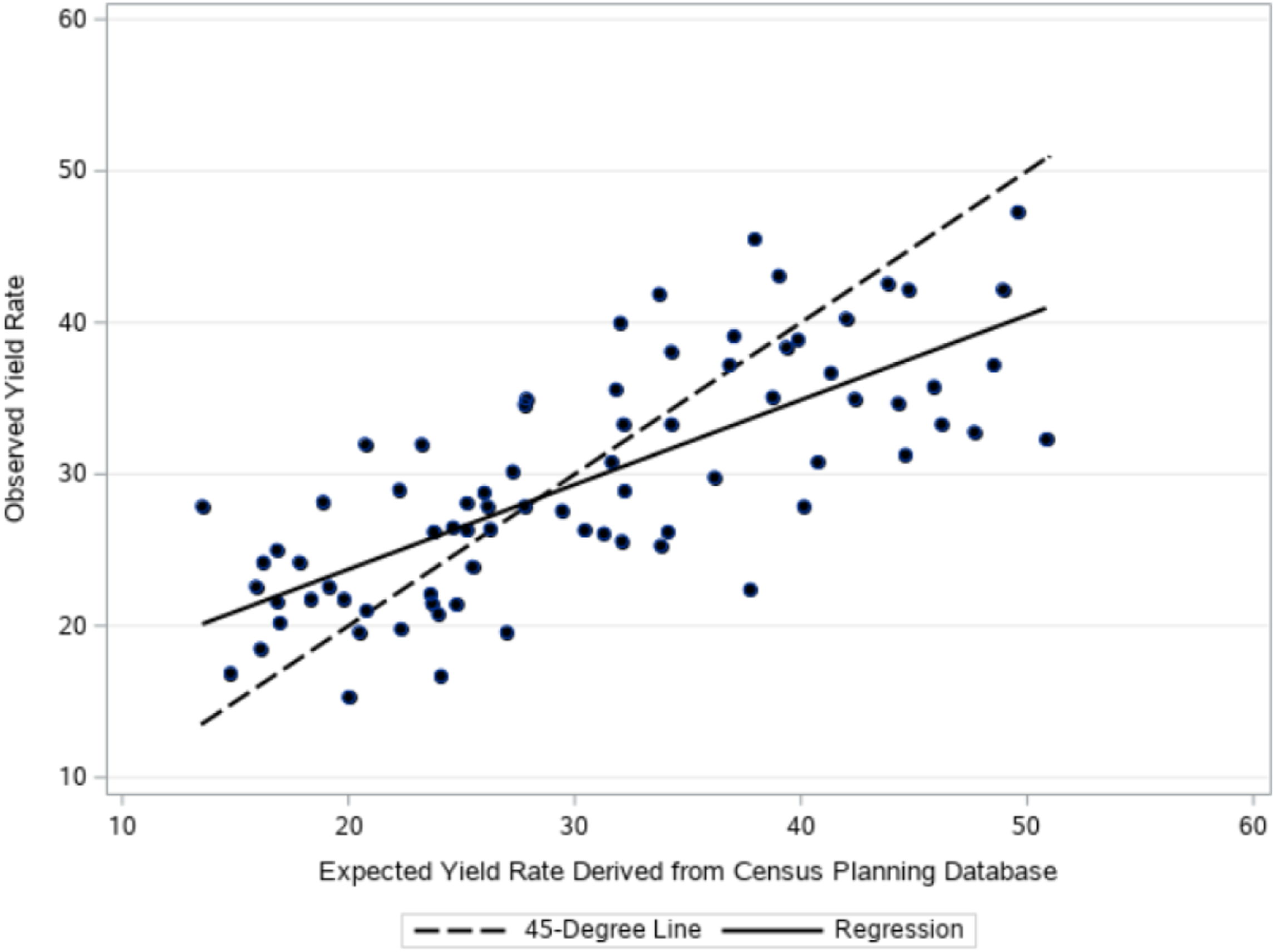
Lessons Learned and Limitations
One lesson learned in applying this technique is that the differential expected yield rates calculated may lead to requisite sample sizes that conflict with other constraints, such as the overall sample size accommodated by the survey’s budget or the tolerable precision loss attributable to variable selection probabilities (Kish 1992). This can lead to a breakdown in how the total sample size for the survey is allocated. Potential workarounds include truncating the distribution of expected yield rates, modifying the value input for EYR, or modifying the overall target number of completes. Indeed, some truncation of expected yield rates across community areas was required in the 2020 HCS application, but this did not substantively impact our ability to meet CA-specific target completes or the magnitude of the correlation coefficient with observed yield rates.
Two limitations to the approach are worth noting. The first is that it can only be used for locatable addresses. The Census Bureau’s tract code lookup tool will not work for addresses identified by PO boxes or rural routes, for example. A second limitation is that, until more research is conducted to prove otherwise, we recommend using the approach only for surveys conducted in a self-administered mode via mail contact. A study by Zhu and colleagues (2018) evaluating the predictive ability of PDB-derived performance measures analogous to ours did not produce promising results. Their technique was applied retrospectively for two in-person surveys, however, and used a different metric, the Low Response Score (Erdman and Bates 2017) derived from the 2010 Decennial Census. Similarly, Murphy et al. (2017) conducted an experiment during the 2015 Residential Energy Consumption Survey, finding the correlation of the Low Response Score was in the direction expected for a portion of sample assigned to complete the survey by mail, but not for the complementary portion designated for in-person data collection. Even within the confines of a mail contact, self-administered mode, additional research evaluating our approach would be insightful, particularly for other survey topics (e.g., political attitudes and general market research), surveys covering different or larger areas of the United States, or surveys sponsored by other, non-government entities (e.g., academic, commercial, or nonprofit institutions).
Footnotes
Acknowledgments
The Chicago Department of Public Health sponsors the Healthy Chicago Survey discussed in this short take. The views expressed here are those of the authors and do not necessarily represent the views of the Chicago Department of Public Health.
Declaration of Conflicting Interests
The author(s) declared no potential conflicts of interest with respect to the research, authorship, and/or publication of this article.
Funding
The author(s) received no financial support for the research, authorship, and/or publication of this article.