







Abstract
This article presents a novel application of the Future Workshop (FW) method in evaluating a university-based collaborative project. FW engages participants in critically examining a problem, envisioning an ideal solution, and developing actionable recommendations. We implemented FW to assess the Science Hub (SH) initiative, which fosters tripartite collaboration among academics, students, and external partners. Conducted over two sessions, FW involved 14 project team members in identifying barriers to cooperation, envisioning ideal stakeholder roles, and prioritizing feasible improvements to SH’s operational framework.
Introduction
The Future Workshop (FW) method is grounded in group work principles including voluntariness, creativity, self-direction and openness to results. It frequently fosters the generation of novel ideas and innovative solutions, serving as a source of motivation for participants within a given social group (Brzeziński et al. 2024; Troxler and Kuhnt 2007; Vidal 2006). FW is often used within the participatory research paradigm. It was developed in the second half of the 20th century by a journalist Robert Jungk, who specialized in science and futurology (Vidal 2006). The method initially gained prominence in German-speaking countries (notably Austria) as well as in Sweden and Denmark (Jezierska 2015). Its early applications were rooted in civic engagement and activism, aiming to raise awareness of issues affecting marginalized groups in society as a result of various policy decisions (Vidal 2006). Today, FW is used to develop shared visions for the future of organizations, institutions, geographical areas (e.g., municipalities, towns, villages), and other stakeholder groups.
A number of studies document FW’s versatility in facilitating dialog, decision-making, and institutional development, yet methodological issues remain largely unaddressed. FW has been applied across various fields, including urban planning, education, social services, and workplace collaboration. In urban development, it has been used to support community-building (Vidal 2006) and participatory planning (Löwis and Neumann 2009). In education, it has facilitated stakeholder dialog (Åkerblom 2005), fostered creativity (Nikičić 2023), and contributed to teaching climate change adaptation (Schrot et al. 2021). FW has also been used to support vulnerable groups, assisting children in divorce cases (Alminde and Warming 2020), improving elderly care (Åhnby and Henning 2009), and enhancing disability support (Rensinghoff 2009). Additionally, FW has been used to improving workplace collaboration, enhancing ergonomics (Skoglind-Öhman and Shahnavaz 2004) and fostering cross-sector discussions on urban heating (Andersen et al. 2022).
Description of the FW Phases
The FW method comprises four sequential phases: preparatory, critical, utopian and implementation. In the preparatory phase, decisions are made regarding organizational and substantive matters, including topic selection, meeting scenario, and information dissemination as well as recruitment of participants and facilitators. During the critical phase, participants define the problems related to the topic under discussion, focusing on challenges, shortcomings, and negative aspects. The utopian phase involves developing an idealized vision of the issue, unconstrained by existing limitations, barriers, or practical considerations. In the implementation phase, the feasibility of the proposals generated in the utopian phase is assessed, and the ideas are refined into actionable recommendations with specific deadlines and assigned responsibilities.
Application of the FW in the Evaluation of the Science Hub (SH) Project
The SH project (2022–24) aimed to establish a framework for collaboration between the university and external stakeholders while strengthening existing partnerships (Dzimińska and Krzewińska 2025). The project facilitated joint problem-solving initiatives involving students, academics, and external partners, and addressed priority issues identified by the external organizations. Over its duration, a total of 41 tripartite collaboration projects were carried out, engaging 61 students, 40 academic supervisors, and 38 external partners. All SH activities were subject to comprehensive evaluation, employing both quantitative and qualitative methods. These included focus group interviews with the implementers of the collaboration projects to facilitate reflection on SH's functioning and its further development as well as a set of questionnaires assessing both the process and outcomes of the cooperations.
The FW’s primary objective was to assess SH’s progress and development. During the FW, two key aspects were analyzed and discussed: (1) collaboration, and (2) the SH operational framework, including tools and strategies for integrating SH into the university’s structure. The FW involved 14 members of the SH project team, rather than a random selection of stakeholders. This decision reflected the project’s pilot status and specific nature, which required participants to provide informed insights into the project implementation process. The FW was conducted in two sessions: The critique phase was in June 2023, and the utopian and implementation phases were in December 2023. Each session lasted approximately four and a half hours. The six-month interval between the workshop meetings allowed participants to gain additional practical experience with tripartite cooperation projects and to identify areas for improvement.
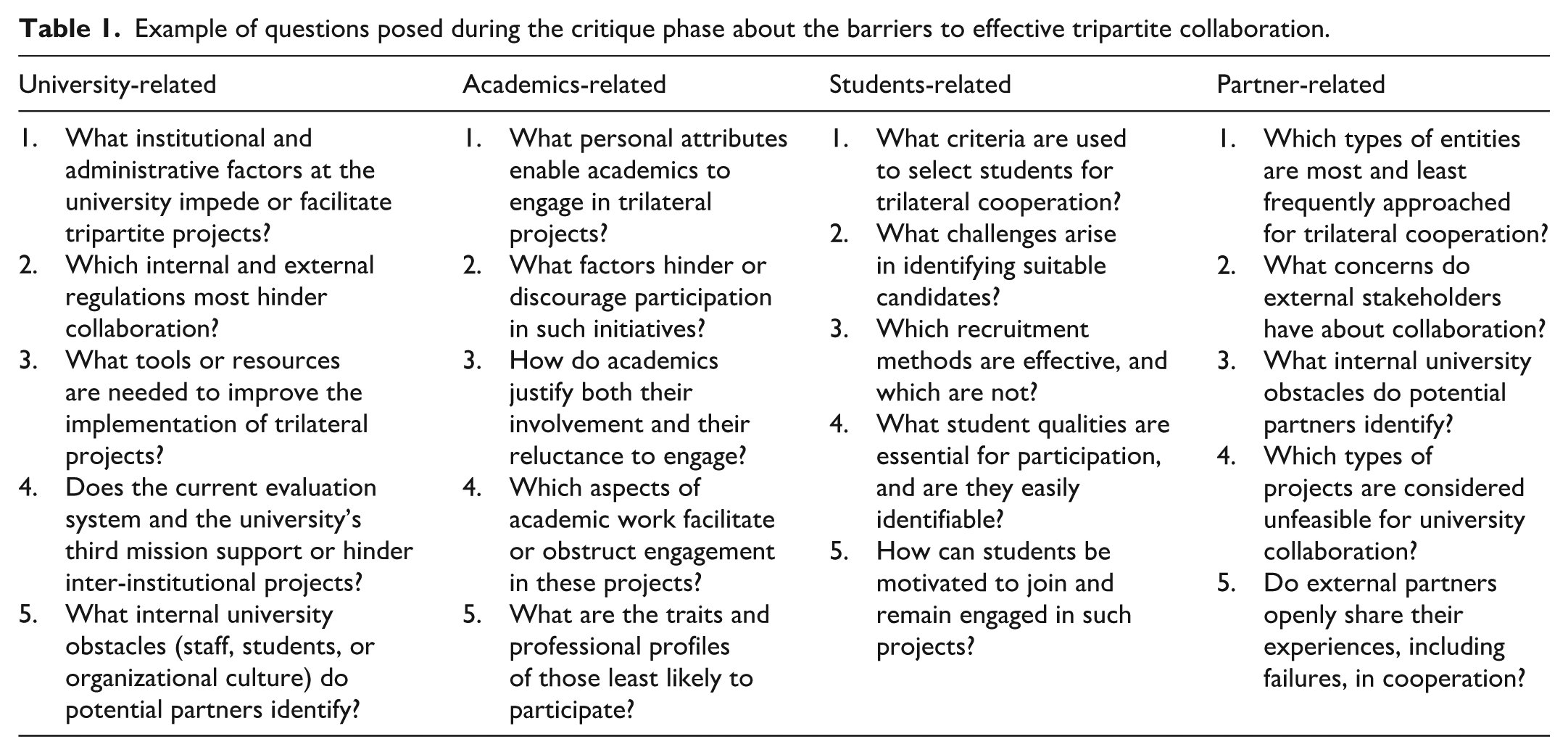
During the critique phase, participants identified barriers to effective tripartite collaboration related to the university, academics, students, and partners. A comprehensive overview of the university environment in which trilateral cooperation projects had been carried out to date was obtained by recording the participants’ opinions on a flipchart. Example questions posed to stimulate discussion are presented in Table 1.
Example of questions posed during the critique phase about the barriers to effective tripartite collaboration.
In the utopian phase, participants envisioned optimal solutions for tripartite collaboration, challenging their own assumptions by defining the ideal academic, student, and external partner for SH activities. In this section, the work was divided into three subgroups, with participants focusing on lists of ideal characteristics for project partners: academics, students, external partners. After developing their respective lists, each subgroup presented its results to the entire group for discussion. The instructions included:
Imagine an ideal scenario in which all stakeholders actively engage in tripartite collaboration. Define the key traits that make this cooperation successful.
Identify actions the university and SH should take to foster and sustain this ideal collaboration.
Conceptualize how SH should operate to maximize engagement and ensure long-term success.
Explore strategies to maintain continuous commitment and enthusiasm from students, staff, and external partners.
In the implementation phase, participants refined the developed ideas into realistic recommendations for enhancing SH’s operational framework. After compiling a list of proposals, participants selected the five to seven most significant recommendations using a simple preferential voting system. Each participant was allowed to allocate a maximum of five points, which could be assigned to a single recommendation or distributed to several options. After all votes were tallied, the recommendations with the highest point totals were selected. The following instructions helped guide the participants through the process:
Develop practical recommendations to address issues identified in the critique phase and make utopian concepts feasible.
Propose specific solutions for the university (including SH), staff, students, and external partners.
Vote by allocating points to the most promising recommendations to determine the top five to seven for implementation.
FW as an Evaluation Method—Strengths and Limitations
The present study posits that the FW method is a valuable qualitative evaluation tool that aligns with contemporary research practices (see Linfield and Posavac 2018; Patton 2008). As demonstrated by numerous reports and scientific studies on the practical application of FW, this method is highly flexible—it can be used for a wide range of topics and in work with groups that are diverse in terms of sociodemographic characteristics and experience. FW has proven effective in both small teams of approximately 15 individuals and in large workshops with up to 200 participants.
This study confirms that FW serves as an inclusive medium that facilitates participation in discussions by all interested parties. During the workshops, participants actively used a range of techniques, including facilitation tools (such as flipcharts and sticky notes), graphic representations (e.g., drawings, models, diagrams, charts), and various forms of voting to assess the submitted proposals. Participants’ initial critical opinions were documented in the critical phase without interruption, then revisited in subsequent phases, where structured facilitation techniques, such as clustering similar points, encouraging reflection on differing perspectives, and ensuring balanced participation, supported the collaborative refinement of these views, first into idealized visions and then into more constructive and actionable recommendations.
The FW method is particularly effective in the analysis of complex problems that cannot be adequately explored through simple questionnaire-based approaches. It enables generation of relevant and innovative insights that can form the basis for comprehensive and in-depth evaluation reports. Implementation of FW fosters an environment conducive to constructive criticism and the development of innovative solutions. This process provides a secure environment for the articulation of opinions, free from the threat of exclusion or marginalization. The absence of evaluative judgment on participants’ contributions encourages openness and the uninhibited exchange of perspectives. FWs facilitate multifaceted reflection, in-depth debate, and the formulation of well-founded, substantive conclusions.
The FW method used in the evaluation process has also certain limitations. The efficacy of this approach is contingent on the active involvement of individuals who demonstrate a willingness to engage in discussions concerning their assigned tasks. This engagement is pivotal in generating in-depth, well-considered, and valuable data, which is essential for a comprehensive evaluation of the project. A paucity of such involvement, a reluctance to speak up, or a tendency to be reticent in expressing opinions in a group context are significant factors that limit the effectiveness of this method. The involvement of a suitably trained facilitator who can effectively moderate the group’s work, ensuring that the discussion remains substantive and does not deviate excessively from the designated topic, is also of paramount importance.
FW also requires adequate time planning so that each phase can be completed in full. Participants should be aware that the process involves multiple meetings, each of which may extend over several hours. A crucial element in facilitating such discussions is the maintenance of an optimal dynamic, often necessitating the deployment of supplementary techniques to enhance the debate. Consequently, the facilitator must possess a high level of proficiency in the application of these techniques. It is also imperative to emphasize that the material gathered during FW is of a qualitative nature, and its preparation and analysis require a substantial investment of time and research effort. Nonetheless, FW proves valuable when assessed against the established OECD’s evaluation criteria (OECD 2021): relevance, coherence, effectiveness, efficiency, and impact. In the SH project, FW confirmed the necessity of collaboration among academics, students, and external partners (relevance), demonstrated alignment with the university’s strategic direction and its third mission (coherence), and generated valuable insights for improving SH’s operational framework (effectiveness). The insights shared during the FW also informed structured improvements that streamlined tripartite projects (efficiency) and helped identify impact areas, including effects on the individuals and organizations involved.
This case study examines the use of FW, demonstrating its capacity to enrich project evaluation and implementation. To maximize its impact, a follow-up phase should be planned to monitor the implementation of recommendations and assess long-term effects. While limitations exist, FW meets recognized evaluation research standards and should be further explored as a qualitative evaluation tool.
Footnotes
Acknowledgements
The authors are sincerely grateful to the SH project team members participating in the FW, including SH ambassadors, the project management team, and the facilitator, whose valuable contributions, insights, and engagement benefited this study.

Funding
The authors disclosed receipt of the following financial support for the research, authorship, and/or publication of this article: Ministry of Education and Science, Poland (Science for Society Program, Grant No: NdS/543803/2021/2022)
Declaration of Conflicting Interests
The authors declared no potential conflicts of interest with respect to the research, authorship, and/or publication of this article.