






Abstract
We conducted a two-wave personal network study in a rural Romanian community. We interviewed 68 participants twice using different name generators. The first wave used a fixed-choice generator (25 alters) focused on emotional closeness. The second wave, six months later, used a non-fixed generator based on frequent interaction. This change responded to feedback that the fixed-choice format was burdensome. The study illustrates how adapting design to respondent feedback affects data collection. It also compares alter profiles across generators and examines patterns of tie re-elicitation across waves. Alters re-elicited across waves were typically kin, co-residents, and emotionally close. Although the non-fixed generator captured weaker and more diverse ties, re-elicitation was shaped mainly by tie strength, underscoring how relational attributes shape consistency in reported ties across generators. Because name generator type and wave are confounded, observed differences should be interpreted cautiously and cannot be attributed solely to social network change.
Introduction
Name generators are the primary tool for collecting personal network data (Bernard et al. 1990). Because personal networks may include over 1,700 known individuals (Killworth et al. 1990), generators constrain elicitation through criteria such as content, relational role, or numeric limits to reduce respondent burden and improve data accuracy (McCarty et al. 2007; Marsden 1987).
Name generators typically follow two formats. Fixed-choice generators prompt respondents to list a set number of alters, often prioritizing close ties (Campbell and Lee 1991; Maya-Jariego 2018). Free-choice generators rely on interaction criteria without nomination caps (Bidart and Charbonneau 2011). The choice between formats influences both the structural and compositional characteristics of elicited networks (Perry et al. 2018). However, most evidence on name generators derives from cross-sectional comparisons across distinct samples, leaving limited understanding of how observed network data vary when the same individuals respond to different generators over time.
Switching between fixed-choice and free-choice name generators is expected to affect multiple stages of the survey response process, including comprehension, retrieval, judgment, and response (Tourangeau et al. 2000). Differences in task demands may also influence respondents’ motivation and effort under conditions of burden (Krosnick 1991). Fixed-choice generators can reduce open-ended recall demands but increase burden when respondents must meet a preset quota, often requiring additional probing and increasing fatigue (Brewer 2000; Marsden 2003). By contrast, free-choice generators place greater demands on retrieval and salience, tending to elicit weaker or more peripheral ties while increasing susceptibility to recall error and contextual influences. Recent reviews show that fixed-choice and free-choice formats engage different cognitive and motivational processes, with consequences for feasibility and the types of ties elicited (Marsden and Hollstein 2023; González et al. 2024). Adapting generator design in response to respondent feedback may improve cooperation and reduce task effort (González-Casado et al. 2026), but it also affects recall and response processes in ways that introduce trade-offs, complicating whether repeated nominations reflect social continuity or differences in how ties are elicited.
To address this gap, we conducted a panel study in a rural Romanian community, applying two distinct name generators to the same participants at two time points. In Wave 1, a fixed-choice generator asked respondents to list 25 alters, prioritizing emotionally close contacts. In Wave 2, a free-choice, interaction-based generator prompted them to name daily and weekly interaction partners. This design compares alter profiles elicited under different generators and assesses the composition and consistency of reported networks. Specifically, we examine (1) differences in alter composition and relational attributes across generators; (2) patterns of tie re-elicitation across waves rather than substantive network stability or turnover; and (3) the sociodemographic and relational characteristics associated with alters re-elicited across generators versus those elicited under only one generator.
Our findings contribute to understanding how elicitation strategies shape networks that are observed and reported in longitudinal, resource-constrained, and culturally specific contexts. Because name generator type and wave are confounded, observed differences cannot be attributed solely to social network change but instead highlight the interpretive limits of panel personal network data.
Methods
Study setting and sampling
We conducted this study in Lerești, a rural commune located approximately 160 km northwest of Bucharest, Romania. At the time of data collection, Lerești had 3,808 adults. We administered face-to-face structured interviews in September 2023 and March 2024. The data collection was part of the 4P-CAN project (HORIZON-MISS-2022-CANCER-01), a translational research initiative focused on cancer prevention and health equity.
We selected the cohort using link-tracing sampling (Hâncean et al. 2021), where each participant was invited to nominate and recruit approximately five others. Six initial seeds were purposively selected to maximize variation in sex, age, income, education, and employment status. The number of seeds and referrals reflected a pragmatic balance between network reach, interviewer capacity, and field implementation. Limiting the number of referrals per seed helped avoid excessive clustering around highly connected individuals. The objective was not to achieve full network saturation but to assemble a diverse set of respondents under manageable fieldwork conditions.
Link-tracing was employed primarily to increase initial participation and retention in a longitudinal panel, rather than to identify socially embedded individuals per se. In a rural field setting, referrals through existing social ties facilitated trust, access, and re-contact across waves. While this approach may favor respondents who are more socially connected, our analysis focuses on egocentric networks elicited independently of recruitment ties. Accordingly, the findings should be interpreted as descriptive of the sampled panel rather than as estimates of population-level network structure.
We interviewed 83 adults in Wave 1 and successfully re-interviewed 68 in Wave 2. Attrition was not systematic on age, sex, or education (see Hâncean et al. 2026, for the supplementary material; SM). Participants did not receive financial incentives but were offered access to a free medical hotline and invited to community-based cancer prevention events. Full cohort characteristics are presented in SM, Table 2S.
All research procedures complied with the Declaration of Helsinki and the European General Data Protection Regulation (GDPR). The study protocol was approved by the Ethics Committee of the Center for Innovation in Medicine (EC-INOMED Decision No. D001/09-06-2023 and No. D001/19-01-2024). Written informed consent was obtained from all participants. We anonymized personal identifying information and securely stored data on encrypted drives accessible only to authorized personnel.
Data collection
Seven trained interviewers conducted face-to-face interviews in Romanian using Network Canvas software (Version 6.5.3) (Birkett et al. 2021). Demographic attributes (age, sex, education) and relational indicators (kinship, co-residence, emotional closeness, interaction frequency) were recorded for alters. These relational variables are not mutually exclusive; an alter can be both kin and emotionally close.
In Wave 1, we used a fixed-choice name generator that asked participants to list 25 individuals aged 18+ with whom they regularly interact, giving priority to people they feel emotionally close to. We fixed the generator at 25 alters, as prior research shows this threshold preserves key network properties while minimizing fatigue (McCarty et al. 2007). In Wave 2, we used a free-choice interaction-based name generator that asked participants to nominate individuals they met daily or weekly across domains such as household, work, and community events.
Emotional closeness and meeting frequency were assessed only in Wave 1, consistent with the affective framing of the fixed-choice generator. We excluded these variables from Wave 2 to minimize burden. In contrast to kinship and co-residence, which are measured consistently across waves, evidence regarding emotional closeness is necessarily weaker due to its measurement only in Wave 1 and, thus, should be interpreted as indicative rather than definitive.
Furthermore, single name-generator questions cannot reliably distinguish substantive network change from generator-driven reporting differences. Because we did not include explicit follow-up questions asking whether alters were newly formed or had ceased to be part of respondents’ networks, alters elicited in only one wave may reflect recall and question-format effects rather than actual tie change.
The modification of the generator between waves was informed by field-level feedback rather than by a pre-planned experimental design. During Wave 1, interviewers reported repeated instances of respondent fatigue and difficulty completing the fixed-choice requirement, particularly in longer interviews. This feedback was collected through informal interviewer debriefs and ongoing communication with the research team. While fixed generators of this length are commonly used in other settings, respondent burden is known to vary by incentive structure and population context. In this study, interviews were unpaid and conducted in a rural setting, which may have lowered tolerance for extended name-elicitation tasks compared to incentivized studies in other populations. Based on these observations, we adopted a context-based, non-fixed generator in Wave 2 to reduce respondent burden and improve feasibility. Changing the question may have affected how comfortable and engaged respondents felt, so differences between waves may reflect interview conditions rather than real network changes. The generator change did not affect sample inclusion criteria, which limits but does not eliminate the risk of self-selection bias. Because interviewer variance was negligible in all models (see SM), changes in interviewer effects are unlikely to explain observed differences.
Measurements
To compare alter lists across waves, we computed a set of ego-level metrics based on alter nominations. Using unique identifiers, we matched alters across waves and classified them as re-elicited across waves, elicited in Wave 1 only, or elicited in Wave 2 only.
To identify alters re-elicited across waves, contacts named in Wave 1 and Wave 2 were matched using a manual disambiguation procedure. Matching was based primarily on alter names, supplemented by sociodemographic information collected during interviews, including relationship type (e.g., kin, neighbor), co-residence status, and interaction context. In cases where names alone were insufficient to establish identity, the research team reviewed available information to ensure consistent matching across waves.
For each ego, we computed several key metrics. Total re-elicitation activity: proportion of alters named in only one wave relative to the union of alters across waves. Higher values indicate greater divergence in alter reports across generators. Net difference in alter count across generators: the numeric difference in the number of alters elicited in Wave 2 versus Wave 1, reflecting directional differences in the volume of reported ties across generators. Jaccard index: the ratio of shared alters to the total number of unique alters across both waves. Elicitation balance ratio: the ratio of alters named in Wave 2 only to those named in Wave 1 only, indicating asymmetry in tie elicitation across generators. Alters elicited in Wave 2 only: proportion of Wave 2 alters that were not listed in Wave 1. Alters elicited in Wave 1 only: fraction of Wave 1 alters that did not reappear in Wave 2.
Although Wave 1 employed a fixed-choice name generator instructing participants to enumerate 25 alters, 13 of the 68 panel respondents did not reach this target. We kept these cases in the analysis to avoid unnecessary data loss and to preserve analytically valuable variation in reporting behavior. We interpret this pattern as indicative of task fatigue and cognitive burden associated with numerical enforcement and repeated probing in fixed-choice elicitation. This pattern was consistent with the respondent burden observed during Wave 1 data collection, as described above.
Model Structure and Random Effects
Analytically, we adopt a tie-level perspective, treating ego–alter ties as the unit of analysis and modeling ties as nested within respondents. This approach is appropriate for the study’s primary aim of examining how different name-generator designs shape which relationships are elicited and consistently reported. Rather than assessing ego-level perceptions of overall network stability, we focus on the reporting status of individual ties and the attributes associated with their re-elicitation across generators.
To examine predictors of alter re-elicitation, we estimated three mixed-effects logistic regression models with binary outcomes (using complete-case analysis). The pooled model combined data from both waves and contrasted re-elicited alters with those elicited in only one wave. Wave-specific models estimated re-elicitation separately for Wave 1 (re-elicited vs. elicited in Wave 1 only) and Wave 2 (re-elicited vs. elicited in Wave 2 only).
All models included random intercepts for ego identity (n = 68) to account for within-ego clustering. We initially included interviewer identity as an additional random effect, but its variance component was negligible, indicating minimal interviewer-related clustering. For parsimony, the final models retained random intercepts for ego only. Fixed effects included alter and ego demographics (age: completed years; sex: male and female; education: lower or elementary, high school, and faculty), wave (where applicable), and tie-level attributes (family tie, co-residence, emotional closeness, and meeting frequency, where available). Full model diagnostics and replication materials are provided in the SM. All analyses were conducted in RStudio (version 2024.12.1+563).
The mixed-effects models estimate pooled associations that combine within-ego and between-ego variation. To address this potential conflation, we conducted supplementary analyses using two complementary approaches. First, conditional logistic regression models stratify by ego identity, thereby controlling for all stable ego-level characteristics (both observed and unobserved) and isolating within-ego variation. This approach shows which ties are preferentially re-elicited within the same respondent’s network, independent of stable ego traits such as sociability or reporting consistency. Second, hybrid (Mundlak) models explicitly decompose each predictor into within-ego and between-ego components, distinguishing tie-level effects from differences between respondents. Together, these approaches clarify whether kinship, co-residence, and tie strength are associated with re-elicitation independent of ego-level composition. These supplementary analyses are reported in full in the SM (Section 6.5).
Results
Descriptive Statistics
The fixed-choice generator (Wave 1) produced networks with a higher proportion of kin (44.0%) and emotionally close alters (30.6%). It also yielded a majority of alters seen daily or weekly (54.9%). In contrast, the interaction-based generator (Wave 2) captured a more diverse set of ties, including a lower proportion of kin (25.9%) but a higher proportion of co-resident alters (10.7%).
Descriptive statistics for ego-level alter nominations are provided in SM, Table 1S. On average, egos nominated 24 alters in Wave 1 (SD = 2.62), 17 in Wave 2 (SD = 6.38), and 32 unique alters across both waves (SD = 5.58). The average in Wave 1 was below 25 because the analysis included respondents who did not reach the nomination cap. Reporting variability was substantially higher in Wave 2 (Coefficient of Variation, CV = 60.65%) than in Wave 1 (CV = 10.88%), suggesting that changing the generator influenced reporting behavior.
The distributions of ego-level re-elicitation and overlap measures (SM, Figure 1S) reveal substantial variation across respondents. The mean Jaccard index was 0.28 (SD = 0.14), indicating limited overlap across generators. Egos reported fewer alters under the free-choice generator (Net difference M = −6.66, SD = 6.60). Total re-elicitation activity averaged 0.72 (SD = 0.14), indicating that
The proportion of alters elicited in Wave 2 only was 0.46 (SD = 0.20), while alters elicited in Wave 1 only accounted for 0.62 (SD = 0.17). This asymmetry suggests that the change in name generator affected which alters were elicited. Because wave and generator are confounded, these patterns should be interpreted as reflecting differences in elicited networks rather than substantive network change.
Descriptive Profile, Alters Based Re-elicitation Status
Table 1 provides a descriptive overview of alters and ego-alter ties, disaggregated by elicitation status across waves. Alters across these three groups were of similar age, with means ranging narrowly from 53.1 to 54.5 years and standard deviations around 16 years. Sex composition was consistent, with female representation ranging from 53.7% to 56.3% across categories. Educational distributions were comparable across groups, with medium-level education (high school) being the most prevalent (52.8%–58.7%). High education (faculty) was evenly distributed, comprising approximately 37.0%–41.0% of alters.
Demographic and relational profile of alters and ego-alter ties by elicitation status across waves.
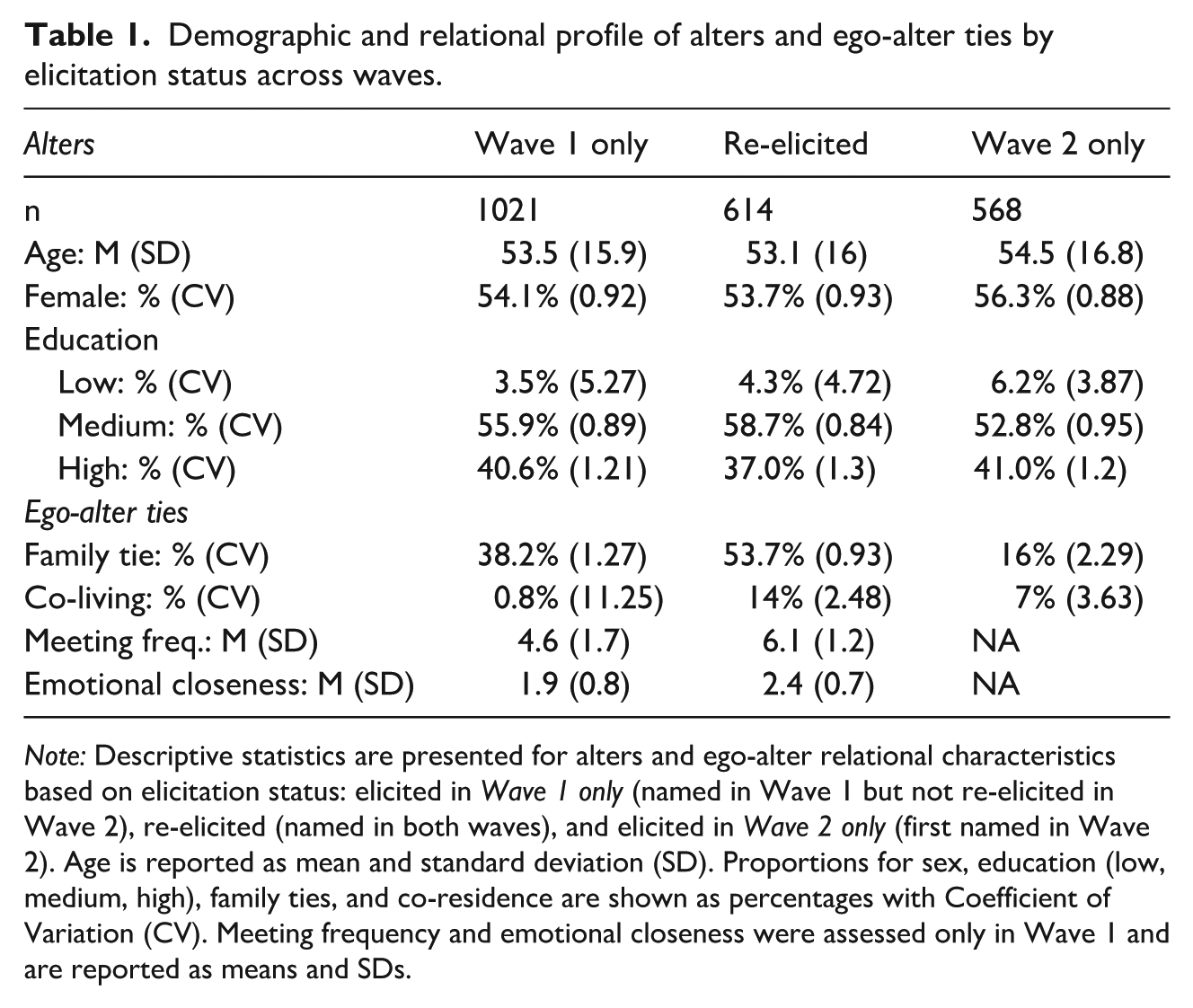
Note: Descriptive statistics are presented for alters and ego-alter relational characteristics based on elicitation status: elicited in Wave 1 only (named in Wave 1 but not re-elicited in Wave 2), re-elicited (named in both waves), and elicited in Wave 2 only (first named in Wave 2). Age is reported as mean and standard deviation (SD). Proportions for sex, education (low, medium, high), family ties, and co-residence are shown as percentages with Coefficient of Variation (CV). Meeting frequency and emotional closeness were assessed only in Wave 1 and are reported as means and SDs.
Ego-alter tie characteristics demonstrated greater differentiation by elicitation status. Kinship ties were most prevalent among re-elicited alters (53.7%) and less common among those elicited in Wave 1 only (38.2%) or Wave 2 only (16.0%). Co-residence followed a similar pattern, occurring most frequently among re-elicited alters (14.0%) while remaining infrequent among alters elicited in Wave 1 only (0.8%) or Wave 2 only (7.0%). Measures of interaction intensity (meeting frequency and emotional closeness) were available only for Wave 1, yet revealed meaningful contrasts. Re-elicited alters were seen most frequently (M = 6.1, SD = 1.2) and rated as more emotionally close (M = 2.4, SD = 0.7) than alters elicited in Wave 1 only (M = 4.6, SD = 1.7 for meeting; M = 1.9, SD = 0.8 for closeness).
These results suggest that alters re-elicited across both generators were more likely to be kin, co-residents, and relationally closer, characteristics associated with greater salience and ease of recall. Conversely, alters elicited under only one generator were more peripheral relationally, underscoring that relational embeddedness shapes which ties are consistently reported across different elicitation strategies. Because wave and generator type are confounded, these patterns should be interpreted as reflecting reporting consistency rather than substantive tie persistence. Further analyses indicate that alters named earlier in the interview tended to be emotionally closer to the ego, particularly when the alter was a family member (see SM). This pattern suggests that closeness, especially kinship-based, influences elicitation order, with egos prioritizing socially salient ties when responding to name generators.
Predicting re-elicited Alters
We estimated three mixed-effects logistic regression models to examine predictors of alter re-elicitation across the two waves (Table 2). The pooled model (n = 2,738; AIC = 3352.5; re-elicited vs. elicited in one wave only) included random intercepts for ego identity to account for clustering within networks. The model examined the effects of alter-level and ego-level covariates on the likelihood of re-elicitation.
Mixed-effects logistic regression models predicting alter re-elicitation (1 = re-elicited; 0 = elicited in one wave only).
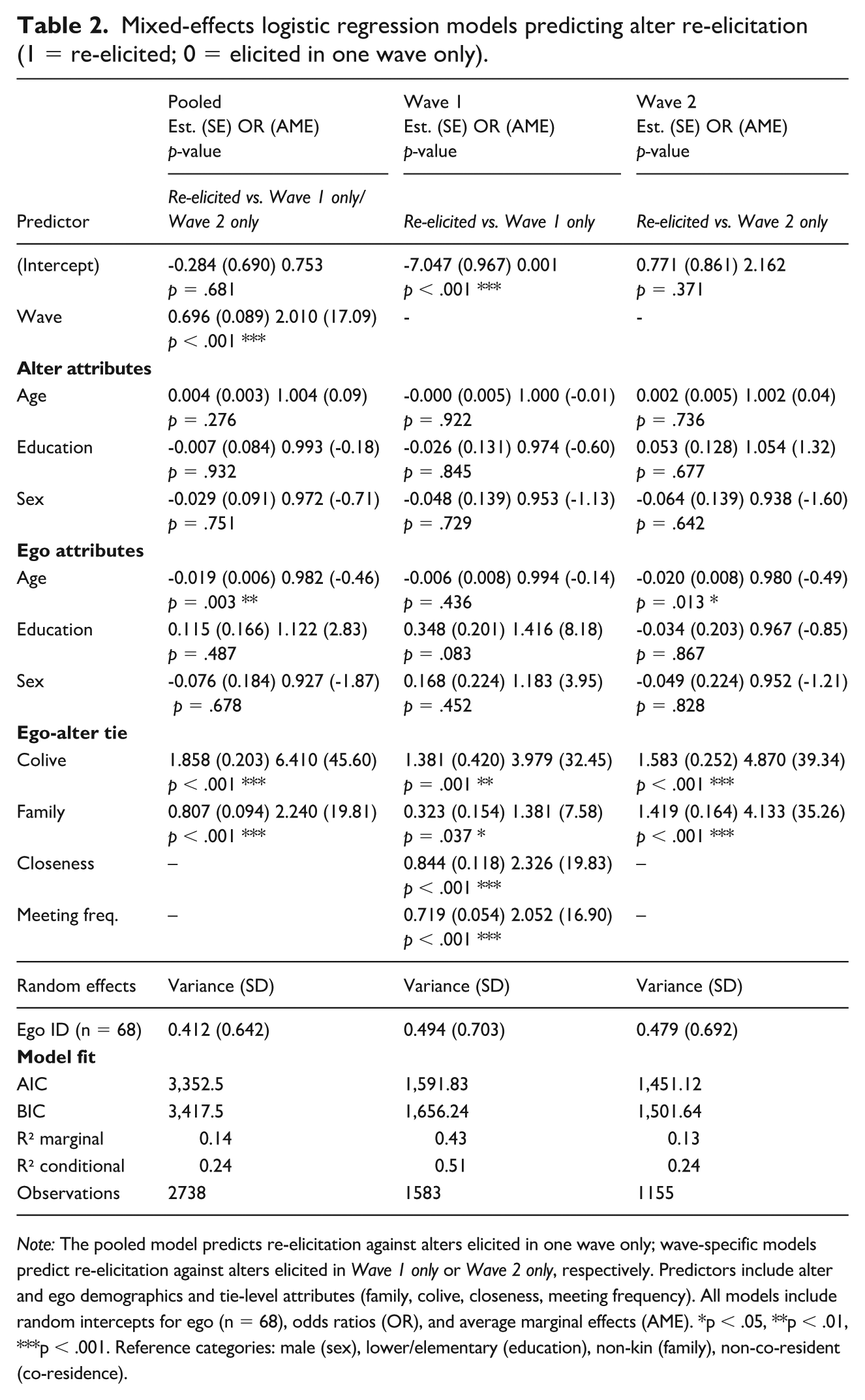
Note: The pooled model predicts re-elicitation against alters elicited in one wave only; wave-specific models predict re-elicitation against alters elicited in Wave 1 only or Wave 2 only, respectively. Predictors include alter and ego demographics and tie-level attributes (family, colive, closeness, meeting frequency). All models include random intercepts for ego (n = 68), odds ratios (OR), and average marginal effects (AME). *p < .05, **p < .01, ***p < .001. Reference categories: male (sex), lower/elementary (education), non-kin (family), non-co-resident (co-residence).
Family ties (OR = 2.24, p < .001) and co-residence (OR = 6.41, p < .001) emerged as strong predictors of re-elicitation. Older egos were significantly less likely to re-elicit alters (p = .003). This pattern may reflect age-related differences in recall effort or cognitive load during name elicitation, rather than substantive network contraction. However, this effect is attenuated in supplementary analyses and should be interpreted with caution. No significant associations were observed for alter age, sex, education, or ego-level education and sex.
The Wave 1 model (n = 1,583; AIC = 1591.8; re-elicited vs. elicited in Wave 1 only) extended the specification with tie-level variables available only at baseline. In addition to family and co-residence effects, meeting frequency (OR ≈ 2.05, p < .001) and emotional closeness (OR ≈ 2.33, p < .001) were both positively associated with re-elicitation, reinforcing the salience of relational strength in reporting consistency across generators.
The Wave 2 model (n = 1,155; AIC = 1451.1; re-elicited vs. elicited in Wave 2 only) reaffirmed the predictive power of family ties (OR ≈ 4.13, p < .001) and co-residence (OR ≈ 4.87, p < .001). Ego age again exhibited a negative association with re-elicitation (p = .013). Further analyses (see SM) show that older egos re-elicit family ties at similar rates as younger egos, but are less likely to re-elicit non-family alters.
Supplementary within-ego analyses using conditional logistic regression confirm that the effects of kinship and co-residence remain significant when controlling for all stable ego-level characteristics (see SM, Section 6.5). Effect sizes are attenuated relative to the mixed-effects estimates, particularly for co-residence (OR ≈ 2.38 vs. 6.41), indicating that a portion of the pooled associations reflects between-ego compositional differences.
Further, because wave and name-generator type coincide, coefficients should be interpreted as indicating which types of ties are more likely to be reported under both elicitation strategies, rather than as evidence of tie persistence. Within this interpretive frame, kinship and co-residence are strongly associated with consistent reporting across generators; these results identify ties that are easier to recall and resistant to measurement variation, not necessarily socially stable ones.
Discussion
We used a two-wave egocentric panel in a rural Romanian community to examine how different name generators shape tie elicitation. We interviewed 68 respondents with a fixed-choice, emotionally focused generator in Wave 1 and a free-choice, interaction-based generator in Wave 2. Alter list overlap was limited, with most ties reported under only one generator. Family and co-resident ties were the most likely to appear under both formats. Rather than indicating that rural networks are inherently stable over time (Bignami-Van Assche 2005), this pattern more plausibly reflects the salience of these ties, i.e., they are easier to recall and resistant to measurement variation across elicitation strategies. From this perspective, the differences observed across generators largely reflect reporting consistency rather than substantive change in personal networks. Supplementary within-ego analyses confirm these findings: kinship and co-residence effects remain significant when controlling for all stable ego-level characteristics, though effect sizes are attenuated, particularly for co-residence (63% reduction). When tie strength is directly modeled, it emerges as the dominant predictor, suggesting that kinship and co-residence partly serve as proxies for relational closeness.
Several limitations should be acknowledged. Emotional closeness and meeting frequency were measured only in Wave 1, constraining direct comparisons of tie strength across waves. Although alters are elicited independently of recruitment, link-tracing shapes which egos enter the study and may indirectly influence the frequency of kinship and co-residential ties observed. Most critically, wave and name-generator types are perfectly confounded, so regression coefficients indicate which ties are consistently reported across generators rather than providing direct evidence of tie persistence. The negative association between ego age and re-elicitation should also be interpreted with caution; this may reflect age-related differences in recall effort rather than substantive network contraction.
Despite these constraints, the consistent re-elicitation of kinship and co-residential ties highlights the role of relational embeddedness in the elicitation process. This aligns with prior work showing that salient ties are more likely to be reported repeatedly and are less affected by recall bias than weaker relationships (Ureña-Carrion et al. 2020). Comparing generator formats within a single cohort provides a rare opportunity to examine how different questions elicit different networks, rather than to infer substantive network change. We echo prior calls (Bidart and Charbonneau 2011) for integrated generator strategies and suggest that attention to tie attributes is important for improving reporting consistency across formats. Our study also highlights design trade-offs central to field-based personal network research. The shift from a fixed-choice to a context-based generator (made in response to participant feedback) illustrates how reducing respondent burden can improve feasibility in this rural, unpaid setting while limiting strict comparability across waves. This adaptive approach identified a set of recall-robust ties (kin and co-residents) that remain visible across elicitation strategies.
The rural setting likely shapes observed patterns. High residential stability and dense kinship structures may increase the salience and recall consistency of family ties, while limiting the diversity of weak ties compared to more urban or mobile contexts. As a result, overlap across generators may be higher here than in settings with greater population mobility. The findings should be interpreted as analytical rather than statistically transferable. The prominence of kin ties observed here is consistent with prior research on rural social organization (Koster, 2018) and may extend to other stable rural contexts. However, personal network composition is shaped by local institutional and cultural conditions.
Supplemental Material
sj-docx-1-fmx-10.1177_1525822X261446429 – Supplemental material for Comparing Name Generator Designs in Panel Personal Network Data: Implications for Alter Re-Elicitation in a Rural Field Setting
Supplemental material, sj-docx-1-fmx-10.1177_1525822X261446429 for Comparing Name Generator Designs in Panel Personal Network Data: Implications for Alter Re-Elicitation in a Rural Field Setting by Marian-Gabriel Hâncean, Jürgen Lerner and Christopher McCarty in Field Methods
Footnotes
Acknowledgements
We express our gratitude to Marius Geantă and the 4P-CAN project team for their contribution to this study.
Ethical Considerations
All research procedures complied with the Declaration of Helsinki and the European General Data Protection Regulation (GDPR). The study protocol was approved by the Ethics Committee of the Center for Innovation in Medicine (EC-INOMED Decision No. D001/09-06-2023 and No. D001/19-01-2024). Written informed consent, for participation and publication, was obtained from all participants. We anonymized personal identifying information and securely stored data on encrypted drives accessible only to authorized personnel.
Author Contributions
M-GH: conceptualization, data curation, software, formal analysis, investigation, methodology, visualization, writing – original draft. JL: software, formal analysis, methodology, writing – original draft. CM: conceptualization, formal analysis, methodology, writing – original draft.
Funding
The authors disclosed receipt of the following financial support for the research, authorship, and/or publication of this article: M.-G.H. was supported by the 4P-CAN project, HORIZON-MISS-2022-CANCER-01, project ID 101104432, programme HORIZON; J.L. was supported by Deutsche Forschungsgemeinschaft (DFG 555455503). The funders had no role in study design, data collection, analysis, interpretation, writing, or publication decisions.
Declaration of Conflicting Interests
The authors declared no potential conflicts of interest with respect to the research, authorship, and/or publication of this article.
Data Availability Statement
The dataset analyzed in the current study and the R code (as Supplementary Material) are made openly available in the Zenodo data repository as Hâncean, M.-G., Lerner, J., & McCarty, C. (2026). Replication data for: Comparing name generator designs in rural panel studies. [Dataset]. Zenodo.  .
.
Supplemental material
Supplemental material for this article is available online.
References
Supplementary Material
Please find the following supplemental material available below.
For Open Access articles published under a Creative Commons License, all supplemental material carries the same license as the article it is associated with.
For non-Open Access articles published, all supplemental material carries a non-exclusive license, and permission requests for re-use of supplemental material or any part of supplemental material shall be sent directly to the copyright owner as specified in the copyright notice associated with the article.
