






Abstract
Keywords
Introduction
Patients with symptomatic infrainguinal peripheral artery disease (PAD) are being treated increasingly using minimally invasive percutaneous revascularization techniques.1–3 Chronic total occlusions (CTOs) are defined as completely occluded arterial segments of ≥3 months’ duration. Femoropopliteal and infrapopliteal (together grouped as infrainguinal) artery CTOs are present in up to 50% of patients with claudication or critical limb ischemia.4,5 Crossing of infrainguinal CTOs can be technically challenging, primarily due to long lesion length, calcification, difficulty in penetrating the proximal cap, and subintimal passage of crossing devices. Given these challenges, a crossing device must be firm to penetrate the proximal cap, highly maneuverable to allow directional guidance, and flexible, with a low profile to avoid large dissections or perforation.6–8
Successful crossing of infrainguinal CTOs involves selection of an optimal initial crossing strategy, which can be broadly divided into 2 groups: use of a guidewire supported by a microcatheter (wire-catheter strategy) or use of a specialized CTO crossing device. However, there are to date no comparative clinical studies to guide decision making between these crossing strategies. Instead, contemporary clinical practice is based largely on operator experience or single-arm studies performed primarily for regulatory approval of CTO crossing devices. We sought to compare the success rates and clinical outcomes of infrainguinal CTO interventions based on the initial selection of a wire-catheter combination vs specialized CTO crossing devices in a contemporary multicenter peripheral intervention registry.
Methods
Study Design
The Excellence in Peripheral Artery Disease (XLPAD) is an ongoing multicenter registry of peripheral interventions registered on the National Institutes of Health website (ClinicalTrials.gov; identifier NCT01904851). Data are collected retrospectively and/or prospectively depending on per-site institutional review board approval. Most of the data collection are retrospective (71%); however, the distinguishing feature of the registry includes a high level of data audit and verification performed by the study staff (95% of the procedure records and 98% of angiograms that were made available for core laboratory analysis have been verified).
The institutional review board of all participating sites approved the present study and, in certain cases, waived the need for obtaining informed consent to use the data. For the analysis, data were collected on 438 consecutive infrainguinal CTO interventions in 438 patients (mean age 63.2 years; 402 men) performed by 13 endovascular operators from 9 participating centers between August 2006 and May 2014. Patient risk factors, comorbidity, laboratory data, TransAtlantic Inter-Society Consensus (TASC II) lesion types, and medications were collected from the patient electronic medical records and diagnosis codes; procedure information was obtained from abstraction of procedure notes and review of angiograms. Study data were collected and managed using the REDCap (Research Electronic Data Capture) online data capture software, 9 and angiograms were analyzed at the XLPAD study core laboratory. 8
Definitions
Chronic total occlusion length was defined by angiographic distance between the proximal and distal caps, and lesion length additionally included any angiographic ≥70% diameter stenosis compared to the reference vessel segment (Figure 1). A single CTO was defined by angiographic 100% occlusion or sequential occlusions separated by ≤2 cm in the superficial femoral artery (SFA) and popliteal arteries or a single occlusion separated by ≤1 cm in below-the-knee (BTK) arteries. Vascular calcification visible on angiographic views prior to contrast injection was classified as mild (isolated foci of calcification), moderate (contiguous segments of calcification on one or alternating sides of the vessel), or severe (contiguous calcification on both sides of the vessel).7–10

Angiographic depiction of a superficial femoral artery chronic total occlusion (CTO) with labels identifying the important aspects of the lesion.
Strategies and Devices
Selection of a crossing strategy, guidewires, support catheters, anticoagulation regimens, and antiplatelet therapy were at the discretion of the operator. A wide array of 0.014- to 0.035-inch guidewires was used, though the registry did not collect the specific brands used. A variety of 4-F to 6-F support catheters were used and recorded in the registry, among which were the CXI (Cook Medical, Bloomington, IN, USA), Trailblazer (Covidien/Medtronic, Mansfield, MA, USA), QuickCross (Spectranetics, Colorado Springs, CO, USA), NaviCross (Terumo, Somerset, NJ, USA), and GlideCath (Terumo). The specialized CTO crossing devices that were used and recorded in the registry were the Frontrunner XP (Cordis Corp., Bridgewater, NJ, USA), Crosser (Bard, Inc., Tempe, AZ, USA), TruePath (Boston Scientific, Natick, MA, USA), and Viance (Covidien/Medtronic). Re-entry devices included the Outback LTD (Cordis Corp.), Pioneer (Volcano Corp., San Diego, CA, USA), and Enteer (Covidien/Medtronic). Technical descriptions of these approved devices have previously been published.7,8,11
Endpoints and Definitions
Outcome measures included crossing success, procedure success, complications, and major adverse events (MAEs). Crossing success was defined as placement of a guidewire in the distal true lumen, past the distal CTO cap, confirmed by either angiography or intravascular ultrasound (IVUS). Crossing success could be primary (achieved with the initial CTO crossing strategy, Figure 2A), secondary (failed initial strategy and subsequent success with an alternate device, Figure 2B), or provisional (subintimal passage of the initial crossing device necessitating the use of a specialized re-entry device, Figure 2C).

Illustrations depicting (A) primary, (B) secondary, and (C) provisional crossing success.
Procedure success was defined as successful revascularization of the CTO with ≤30% angiographic residual diameter stenosis. Periprocedural complications included flow-limiting dissections, arterial perforations, access site hematomas ≥5 cm in diameter, retroperitoneal hematomas, distal embolizations, major bleed requiring blood transfusion, or emergency surgery. MAE included all-cause mortality, nonfatal myocardial infarction, ischemic stroke, and unplanned endovascular or surgical revascularization/amputation of the target limb.
Statistical Analysis
Continuous variables are expressed as mean ± standard deviation and were compared using the Student t test. Categorical data are expressed as counts (percentage) and were compared using Pearson chi-square or Fisher exact tests as appropriate. All statistical tests were 2-tailed, and p<0.05 was considered the threshold for significance. Statistical analysis was performed using JMP software (version 11.0; SAS Institute, Cary, NC, USA).
Results
The primary wire-catheter technique was used in 295 (67.4%) and a specialized CTO crossing device in 143 (32.6%) patients (p<0.001). The baseline patient and lesion characteristics (Table 1) were similar in the study groups. The CTO angiographic characteristics were also similar, with wire-catheter and CTO device approaches utilized initially in SFA CTOs (82.8% vs 79.7%, p=0.432), de novo lesions (81.7% vs 86.7%, p=0.219), long lesions (134.2±72.8 vs 136.9±71.2 mm, p=0.730), and TASC II types C (21.7% vs 19.6%, p=0.800) and D (14.2% vs 18.2%, p=0.247) lesions, respectively.
Baseline Patient and Lesion Characteristics.
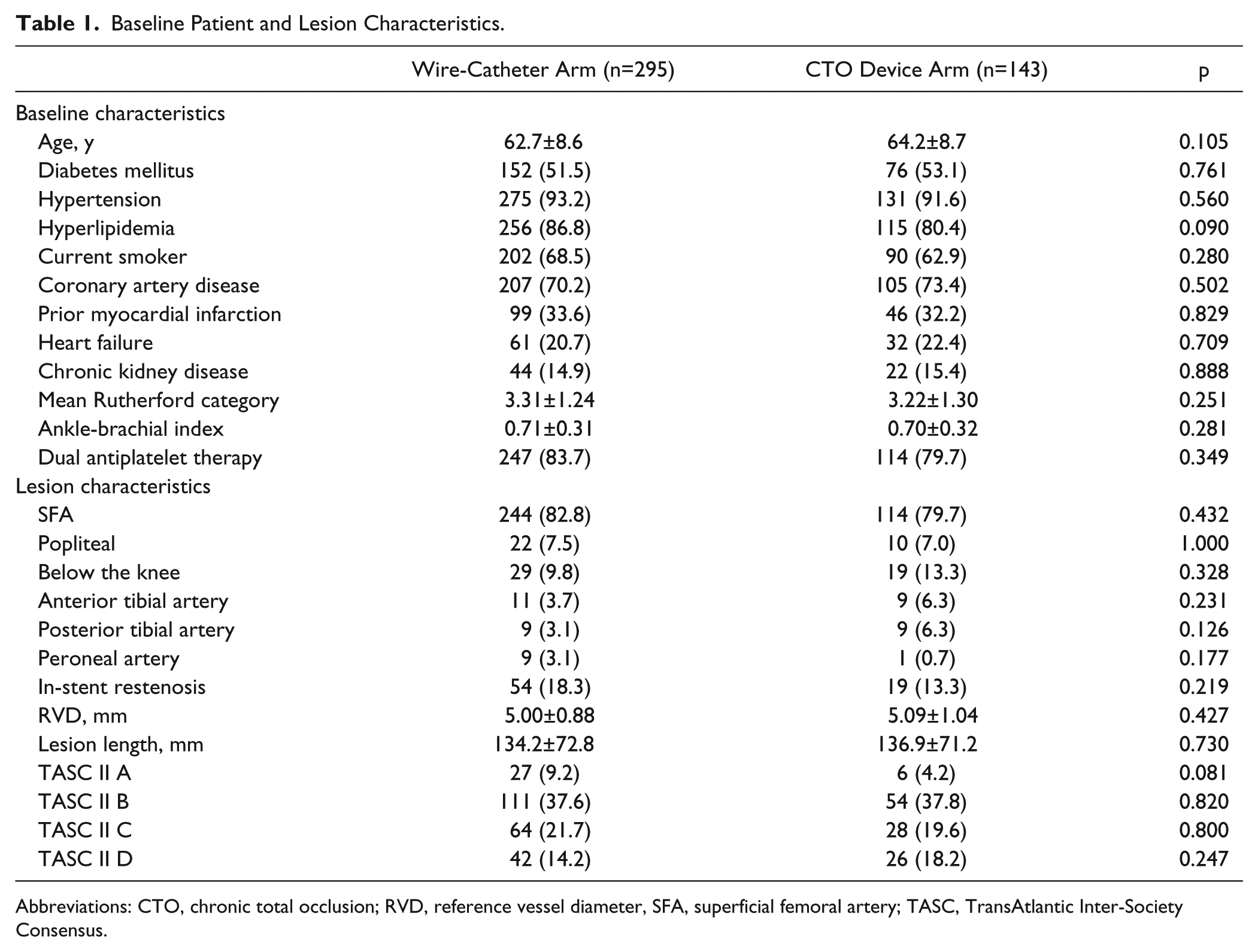
Abbreviations: CTO, chronic total occlusion; RVD, reference vessel diameter, SFA, superficial femoral artery; TASC, TransAtlantic Inter-Society Consensus.
Although a high proportion of lesions received stents (71.2%), stent use was significantly higher in the CTO device arm (77.6% vs 64.7%, p=0.006). Drug-coated stent use was 5.9% overall: 6.1% in the wire-catheter and 4.9% in the CTO device arms, respectively (p=1.0). Devices used, based on an initial crossing strategy, are shown in Figure 3. The primary wire-catheter arm used significantly more secondary CTO devices (28.1% vs 17.5%) and/or provisional re-entry devices (26.7% vs 4.9%) compared with the primary CTO device arm (both p<0.001).

A description of the primary, secondary, and provisional devices used corresponding to the initial crossing strategy. CTO, chronic total occlusion.
Crossing Success Rates
Overall crossing and procedure success rates are shown in Figure 4. Primary crossing success was significantly higher in the primary CTO device arm (72.1% vs 51.9%, p<0.001); however, overall procedure success was equally high in both arms (90.9% vs 93.6%, p=0.332). Secondary crossing success and provisional crossing success were both not significantly different between the wire-catheter and CTO device arms: 67.5% vs 71.4% (p=1.000) and 84.2% vs 87.5% (p=0.768), respectively. Primary crossing success was higher for the CTO device arm in both femoropopliteal (72.6% vs 52.6%, p<0.001) and BTK lesions (68.4% vs 44.8%, p<0.001). Retrograde crossing of CTO via a pedal approach was performed in 25 (5.7%) cases. IVUS was used in 43 (9.8%) procedures to confirm distal true lumen access, and the rest were confirmed with angiography.

A comparison of primary, secondary, provisional, and procedure success rates by the initial crossing strategy. CTO, chronic total occlusion.
Subset analysis allowed for comparison of specific CTO devices used as primary crossing strategies: the Viance was most frequently used (76, 53.1%), followed by the Frontrunner XP (44, 30.8%), TruePath (15, 10.5%), and Crosser (8, 5.6%). The primary crossing success rate of the two most frequently used devices, the Viance and Frontrunner XP, were 73.7% and 72.7%, respectively. The Frontrunner XP was used solely in SFA CTOs compared with 64.5% SFA lesions attempted with the Viance (p<0.001). Compared with the Frontrunner XP, the Viance was used in shorter (126.2±70.8 vs 150.3±71.1 mm, p=0.092) and less complex (19.7% vs 13.7% TASC IIA, p=0.082) lesions, with similar usage rates in TASC II type C (18.4% vs 18.2%, p=1.000) and D (15.8% vs 18.2%, p=0.801) lesions. Further subgroup analysis compared primary crossing success rates for femoropopliteal vs BTK CTOs and found no significant differences using either a wire-catheter (52.6% vs 44.8%, p=0.441) or CTO device (72.6% vs 68.4%, p=0.785) as the initial crossing strategy. Procedure failures, however, were higher for BTK CTOs compared to femoropopliteal lesions for both the wire-catheter (17.2% vs 3.3%, p=0.007) and CTO device (17.4% vs 4.8%, p=0.051) initial crossing attempts.
Outcomes
Procedure characteristics and periprocedural complications are shown in Table 2. Fluoroscopy time (43.3±55.8 vs 36.8±54.6 min, p=0.007), contrast volume (195.5±103.4 vs 167.7±98.8 mL, p=0.007), and procedure duration (148.0±23.6 vs 130.6±21.5 min, p=0.025) were all significantly higher in the CTO device arm. There were no significant differences in the incidences of flow-limiting dissections (1.0% vs 0%, p=0.554), access site hematomas (1.4% vs 0%, p=0.309), retroperitoneal hematomas (1.0% vs 0.7%, p=1.000), distal embolization (1.4% vs 2.8%, p=0.447), arterial perforation (1.4% vs 0%, p=0.554), or need for emergency surgery (0% vs 0.7%, p=1.000).
Procedure Characteristics and Periprocedural Complications.

Abbreviations: ACT, activated clotting time; CTO, chronic total occlusion.
Thirty-day and 12-month MAE (Figure 5) were not significantly different in regards to all-cause mortality, vessel thrombosis, unplanned major amputation, and surgical or endovascular revascularization at both time points, except for a significantly higher surgical revascularization rate in the primary wire-catheter arm (8.8% vs 2.8%, p=0.025) at 12 months. Patients experienced significant improvements in both ankle-brachial indices and Rutherford category at 12 months across both crossing strategies (Figure 6).

The 30-day and 12-month major adverse event rates compared for the initial crossing strategies. CTO, chronic total occlusion; MAE, major adverse events.

The 12-month change in Rutherford category and ankle-brachial index compared between the initial crossing strategies. CTO, chronic total occlusion.
Discussion
While ~8% to 18% of coronary lesions treated are chronically occluded, nearly 50% of peripheral lesions constitute a CTO. 2 The implication is that while a select group of operators may need or choose to specialize in coronary CTO revascularization, the ability to treat a CTO is nearly obligatory for a peripheral endovascular specialist. More than 50% of procedures recorded in the XLPAD registry were performed for a CTO indication and, combined with the fact that CTO recanalization is associated with higher procedure failures and complications, the need for studies to optimize crossing strategies and outcomes becomes paramount. 12
To the best of our knowledge, no one has until now compared guidewire and microcatheter vs dedicated CTO devices for crossing infrainguinal peripheral artery CTOs. The main results of our study show that operators more often selected an initial wire-catheter strategy, although primary crossing success was significantly higher with an initial CTO device approach. Use of either an additional CTO crossing device or a re-entry catheter was significantly lower with a primary CTO device crossing strategy. Long-term outcomes were similar with either approach.
The higher primary crossing success with CTO devices may suggest improved penetration and the ability to maintain an intraluminal course, as well as enhanced navigation through dense fibrocalcific occlusive lesions with CTO crossing devices. Although the primary wire-catheter strategy was associated with lower primary crossing success, overall procedure success rates were high and not statistically different due to significantly greater utilization of secondary crossing and provisional re-entry devices following an initial wire-catheter failure. Interestingly, primary crossing success rates with CTO crossing devices were similar if they were used initially or secondarily following a failed wire-catheter attempt. This observation may suggest that operators could select an initial wire-catheter strategy and if faced with failure could still achieve high crossing success with a secondary CTO crossing device and/or a provisional re-entry catheter. Moreover, this observation may also have important health economic implications, given the large difference in cost of guidewires, guide catheters, and specialized CTO crossing devices. Other factors that also need to be considered when estimating the overall procedure cost include the higher use of additional CTO crossing and re-entry devices in the primary wire-catheter arm, balanced against greater use of stents, longer procedure durations, and higher contrast use in the CTO device arm.
The current report is limited by the lack of overall procedure cost and cost-effectiveness analyses; however, it underscores the need for dedicated prospective randomized studies comparing peripheral artery CTO crossing strategies. The observed longer procedure durations and increased volume of contrast use during primary CTO device crossing could be attributed to a relatively limited familiarity of the operators with some of the more recently approved CTO devices compared with traditional guidewires and catheters. Regardless, complication and 30-day MAE rates were low and similar with the use of either crossing strategy.
The significantly higher 12-month surgical revascularization rate in the wire-catheter arm could be related to the difference in final treatment, not crossing strategies, as indicated by less frequent use of stents in this arm. Alternatively, increased stenting in the CTO device arm could provide limited anastomosis targets for bypass grafts, resulting in fewer surgical revascularizations.
Although there have yet to be studies comparing crossing success rates of infrainguinal peripheral artery CTO crossing strategies, various observational studies and randomized controlled trials have reported crossing success rates using wire-catheters as part of their analysis (Table 3). For studies not exclusively treating CTO lesions, primary wire-catheter crossing success rates ranged from 87% to 98%.13–18 For studies exclusively treating CTO lesions, primary wire-catheter crossing success rates were observed to be much lower, ranging from 5% to 66%.19–22 The major reasons for failure to cross were inability to penetrate the proximal cap, navigate side branches or bridging collaterals, and re-enter the distal true lumen.
Success Rates With the Wire-Catheter Crossing Strategy.

Abbreviations: BMS, bare metal stent; BNS, bare nitinol stent; BTK, below the knee; CTO, chronic total occlusions; FP, femoropopliteal; GW, guidewire; PTA, percutaneous transluminal angioplasty; RCT, randomized controlled trial; SFA, superficial femoral artery; TASC, TransAtlantic Inter-Society Consensus.
Weighted average.
Occlusion length.
Crossing success rates from several device approval and observational studies using specialized CTO crossing devices are reported in Table 4. The Crosser CTO device, which wields a high-frequency vibrating distal tip, was used in 3 observational studies,23–25 only one of which was as a primary crossing strategy. 25 Primary crossing success was 77%, with secondary crossing success ranging from 75% to 84%. Two studies have reported outcomes using the Frontrunner XP, a blunt microdissection device with a “jaw-like” distal tip, in femoropopliteal CTO, with secondary success rates ranging from 65% to 95%.20,22 The Wildcat (Avinger Inc, Redwood City, CA, USA) catheter, with manually rotating wedges on the distal tip, was studied as part of the CONNECT trial, and exhibited an 89% secondary technical success rate. 19 The Ocelot (Avinger Inc.) device, which uses optical coherence tomography in aiding intraluminal CTO crossing, exhibited a 72% primary crossing success rate. 26 Two observational studies used the TruePath device, which on activation rotates a diamond-coated distal tip at 13,000 rpm; they achieved secondary crossing success rates between 77% and 80%.7,27 The Viance, which is a low-profile device using a blunt tip to navigate microchannels, demonstrated 50% to 88% secondary technical success rates.8,11 Finally, the SafeCross device (Intraluminal Therapeutics, Carlsbad, CA, USA), which uses a radiofrequency-generated pulsating distal tip, reported a 94% secondary technical success rate. 28 It is important to indicate that most studies report use of a CTO crossing device on failure of a wire-catheter approach (secondary crossing success). Furthermore, the observational setting of the trials introduces significant operator bias, especially considering their regulatory approval premise.
Single-Arm Crossing Device Studies.

Abbreviations: FP, femoropopliteal; GW, guidewire; n/a, not available; SFA, superficial femoral artery; TASC, TransAtlantic Inter-Society Consensus.
Limitations
Our study has several important limitations. The observational registry setting of the study allowed operator selection of the initial crossing strategy, guidewires, catheters, and CTO devices. Also, CTO crossing time was not recorded, and switching to an alternate strategy was solely at the operator’s discretion. Although lesion length, lesion location, and TASC II distribution were matched in our study, operator bias could have certainly influenced the selection of particular devices in specific situations, which could only be controlled in the setting of a prospective randomized trial. Further analysis is needed to elucidate patient and lesion characteristics predictive of successful CTO crossing. Additionally, some CTO devices were used in a small proportion of cases and not all devices available for clinical use were utilized in the study, limiting the generalizability of the results across all CTO devices. Success rates with specific guidewires and guide catheters were also not reported in the study. Furthermore, temporal bias could be introduced, as there have been many recent technical developments in crossing infrainguinal CTO. Last, although all operators routinely perform infrainguinal endovascular revascularization as part of their daily practice, a measure of operator experience is not included in this analysis. However, many of these limitations also reflect the challenges in conducting any peripheral artery CTO intervention study and may need to be considered during the design and implementation of future studies in this area.
Conclusion
Overall, this study provides an insight into CTO crossing strategies selected by operators in a multicenter registry setting for tackling infrainguinal peripheral artery CTO. Most operators opted for a primary wire-catheter crossing strategy, though a primary CTO crossing device strategy had higher primary technical success.
Footnotes
Acknowledgements
We would like to acknowledge the XLPAD study investigators, Conrad Wolfe for illustrations, and the RedCap database software utilized in the XLPAD registry (Academic Information Systems National Institutes of Health grant UL1-RR024982).
Declaration of Conflicting Interests
The author(s) declared the following potential conflicts of interest with respect to the research, authorship, and/or publication of this article: Subhash Banerjee: research grants from Boston Scientific, The Medicines Company; consultant/speaker honoraria from Gilead, St Jude, Cordis, Boehinger Ingerheim, Sanofi, Medtronic; ownership of Mdcare Global (spouse); intellectual property: HygeiaTel. Nicolas W. Shammas: research grants from Boston Scientific, Possis, Edwards, The Medicines Co, ev3, Schering-Plough, Fox-Hollow, Spectranetics, Atrium, Gilead, Medtronic, Genesis Foundation, CSI, Bayer; educational grants/philanthropist support: Abbott Vascular, AGA Medical, Astellas Pharmaceuticals, AstraZeneca, Boehringer-Ingelheim, Boston Scientific, Cordis Vascular, Daiichi Sankyo, ev3, Gilead Sciences, IDEV Technologies, Lilly USA, Pfizer, BMS, The Medicines Company, Medtronic Cardiovascular, Spectranetics, St. Jude Medical, Takeda Pharmaceuticals, Terumo Medical, and Zoll Lifevest; consultant to CSI, The Medicines Company, Covidien/ev3, NAMSA; promotional programs: Boehringer-Ingelheim, Forest Pharmaceuticals, Lilly/Daichii, Astra Zeneca, Pfizer/BMS, Gilead. Emmanouil S. Brilakis: consulting honoraria/speaker fees from Sanofi, Janssen, St. Jude Medical, Terumo, Somahlution, Elsevier, Asahi, Abbott Vascular, and Boston Scientific; research grant from Guerbet; spouse is an employee of Medtronic.
Funding
The author(s) received no financial support for the research, authorship, and/or publication of this article.