





Abstract
Keywords
Introduction
According to the 1999–2000 National Health and Nutrition Examination Survey, the prevalence of lower extremity peripheral artery disease in the United States is as high as 4.3% among adults older than 40 years and 14.5% among those older than 70 years. 1 Superficial femoral artery (SFA) stenosis or occlusion is the most common cause of symptomatic peripheral artery disease. 2 The progression from intermittent claudication to critical limb ischemia (CLI) occurs in 5% to 10% in 5 years and leads to amputation in 1% to 3.3%. 3
To date, many different treatment modalities, such as surgical above-knee bypass (AKB), percutaneous transluminal angioplasty (PTA), and endovascular intervention can be used in the treatment of SFA occlusive diseases. 3 Although AKB using autogenous vein is still considered the “gold standard” for complex SFA lesions, 4 endovascular therapy provides a viable alternative approach due to its minimally invasive nature and technical advances, particularly for patients without available saphenous vein grafts. 3 Several multicenter controlled trials have proven the efficacy of endovascular intervention in the treatment of long SFA lesions,5–7 but the low patency rate, in-stent restenosis, and stent fracture must be addressed before endovascular intervention can be recommended as the first-line therapy.8,9
The Viabahn (formerly Hemobahn) endoprosthesis (W.L. Gore & Associates, Flagstaff, AZ, USA) is a flexible, self-expanding device consisting of an expanded polytetrafluoroethylene (ePTFE) lining with an external nitinol frame extending along its entire length; it was introduced in the United States in 2002 and received Food and Drug Administration approval for SFA indications in 2005. Prospective multicenter randomized controlled trials (RCTs) have confirmed the safety and effectiveness of Viabahn for long-segment complex SFA lesions during short-term follow-up.10,11
The aim of this study was to systematically review the current body of evidence for the Viabahn stent-graft in the treatment of SFA occlusive diseases and quantify related patient outcomes [target vessel patency, target lesion revascularization (TLR), and ankle-brachial index (ABI) improvement] using random-effects meta-analysis models.
Methods
Data Sources and Search Results
A systematic review and meta-analysis was performed in accordance with the standards set forth in the PRISMA (Preferred Reporting Items for Systematic Review and Meta-Analyses) statement.12,13 The following databases were searched from inception until 16 June 2014 (data of final search): PubMed (67 articles retrieved), Embase (74), Web of Science (72), SciFinder (85), Cochrane Central Register of Controlled Trials (9), and BIOSIS Previews (5). There were no restrictions on language, publication year, or type of publication. The search strategy was amended for each database (Supplemental Table 1; Supplementary Material is available at http://jet.sagepub.com/content/by/supplemental-data). After title and abstract screening, non-English articles were excluded. A manual search was also performed of all the references from the included studies for potential interesting publications.
Study Selection
Articles eligible for the analysis included controlled studies comparing target vessel patency, ABI change, and TLR in patients treated with the Viabahn device vs other interventions, as well as noncontrolled studies comparing ABI in a single group of patients before and after Viabahn therapy. Inclusion criteria were (1) symptomatic lesions confined to the SFA and not involving the iliac or popliteal artery, (2) >20 participants or limbs, and (3) at least 6-month follow-up. Reviews, editorial/opinions, conference abstracts, case reports, animal studies, new techniques, non-English articles, and other stent research were excluded. After full articles were retrieved, the largest sample size study was selected if there was overlap in patients within the same study.
Data Extraction
Two investigators (L.Z. and J.Z.) independently extracted data using a standard form; disagreements were resolved by consensus. Data were extracted pertaining to characteristics of included studies and subjects, therapeutic effect, length and diameter of the devices, and anticoagulation plan after the procedure; the data were pooled for the main analysis according to the intention-to-treat principle for RCTs.
Outcome Measurement
The outcomes were measured anatomically, hemodynamically, and clinically. The anatomical effects of treatment were reflected in the primary and secondary patency rates of the target vessel at 1, 2, and 3 years. The hemodynamic impact of treatment was based on changes in the ABI at 1, 6, 12, and 24 months, while the clinical outcome was measured with the TLR at 1 and 2 years.
Methodological Quality
To assess the quality of the included studies, the Cochrane Collaboration Risk of Bias Tool was used for the 4 RCTs (Supplemental Table 2) and the Newcastle-Ottawa scale for the 9 observational studies (Supplemental Table 3). A follow-up rate <70% at 1 year was the threshold for high risk of bias in the observational studies.
Data Synthesis and Statistical Analysis
For controlled studies, the risk ratios (RRs) of primary patency, secondary patency, and TLR were pooled across studies and analyzed using random-effects meta-analysis models with inverse variance weighting when comparing Viabahn with other interventions. The events in the patency analyses were defined as the freedom from patency in each study. Subgroup analysis of primary patency stratified by different lesion lengths was performed using the same models. Linear correlation analysis was used to explore the potential relationship between 1-year primary patency and average lesion length; the outcome was reported as the Pearson product-moment correlation coefficient (r).
The differences in ABI change with Viabahn vs other interventions was also pooled across studies and analyzed using the same meta-analysis models. For uncontrolled studies, the differences of ABI change at discharge and at 1, 6, 12, and 24 months after Viabahn therapy were pooled and analyzed using a generic inverse variance weighting model.
The degree of heterogeneity was estimated using the I2 statistic based on values between 0% and 100%; typically values of 25% suggest low heterogeneity, 50% moderate, and 75% large heterogeneity.
All analyses were performed using the Cochrane Collaboration Review Manager (version 5.20; Cochrane Collaboration, Copenhagen, Denmark). The values were expressed as numbers, percentages, and mean ± standard deviations (SD). The RRs are reported with the 95% confidence interval (CI). The threshold of statistical significance was p<0.05.
Results
Study Selection and Characteristics
The literature search identified 135 potentially relevant studies as shown in the flow diagram (Figure 1). Of these, 46 full-text articles were assessed for eligibility, with 19 meeting the inclusion criteria. Three RCTs and two observational studies14–18 were excluded because of patient overlap, leaving 14 studies encompassing 1198 patients treated between September 1996 and March 2011. There were 4 RCTs (n=572),10,11,19,20 a retrospective controlled study (n=52), 21 and 9 observational studies (n=574).22–30 In the controlled studies, the comparators included bare metal stents,10,19 PTA, 11 and AKB.20,21 The design and characteristics of the included studies are summarized in Table 1.

Study flow diagram according to the Preferred Reporting Items for Systematic Reviews and Meta-Analyses (PRISMA) guidelines.
Characteristics of Included Studies.
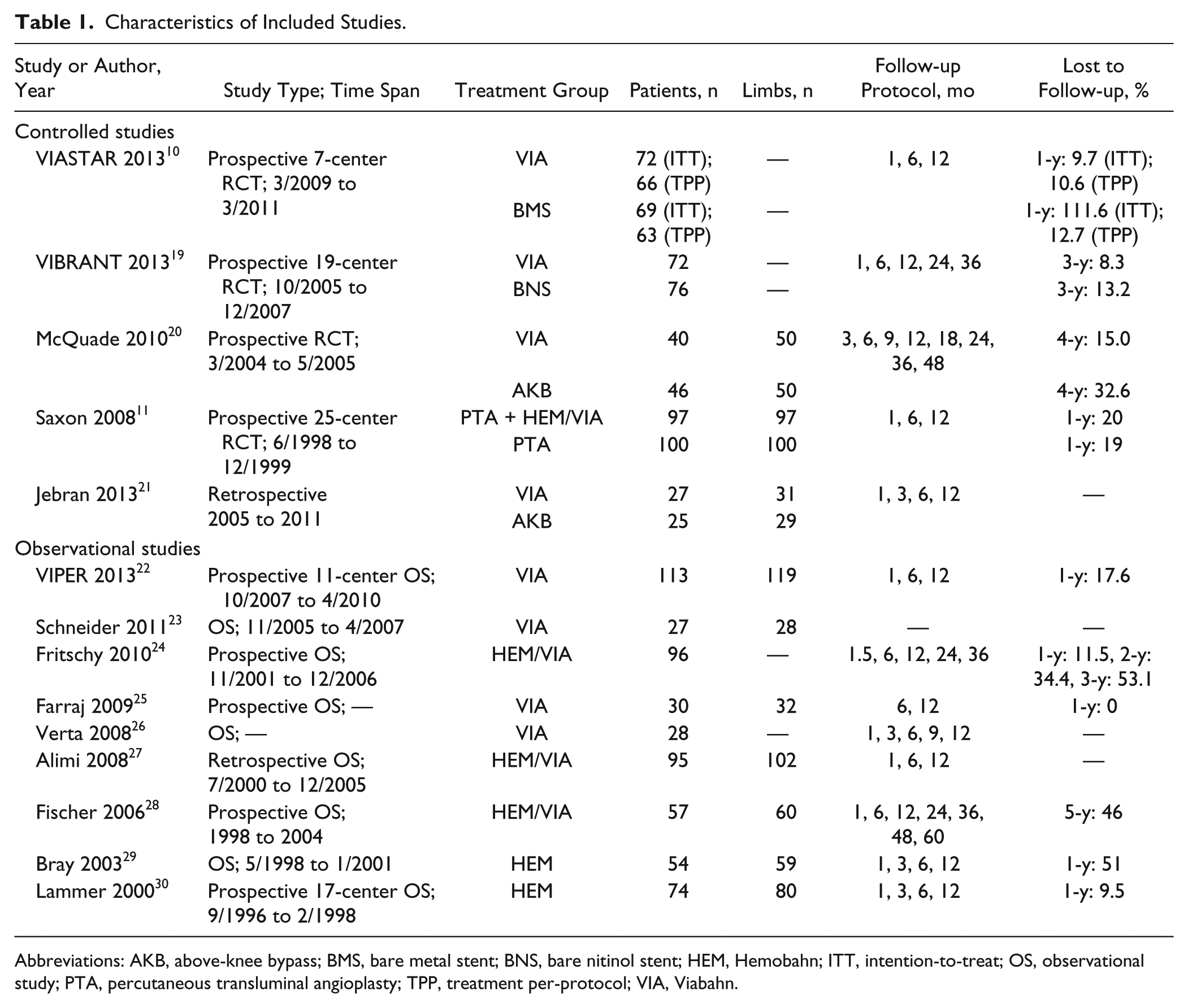
Abbreviations: AKB, above-knee bypass; BMS, bare metal stent; BNS, bare nitinol stent; HEM, Hemobahn; ITT, intention-to-treat; OS, observational study; PTA, percutaneous transluminal angioplasty; TPP, treatment per-protocol; VIA, Viabahn.
The patient characteristics and treatment outcomes are summarized in Tables 2 and 3. The average age was 67.6 years and 70.5% of patients were men. Other risk factors were hypertension (75.9%), coronary artery disease (39.5%), dyslipidemia (61.3%), diabetes mellitus (35.1%), smoking (67.6%), renal insufficiency (10.2%), and chronic obstructive pulmonary disease (13.2%). The mean lesion length was 14.7 cm. The incidences of stenosis and occlusion were 57.6% and 42.4%, respectively. The proportions of runoff vessels (0, 1, 2, and 3) were 2.1%, 21.6%, 38.1% and 38.1%, respectively.
Baseline Characteristics of Included Study Subjects.

Abbreviations: ABI, ankle-brachial idex; AKB, above-knee bypass; BMS, bare metal stent; BNS, bare nitinol stent; CAD, coronary artery disease; CLI, critical limb ischemia; COPD, chronic obstructive pulmonary disease; DLD, dyslipidemia; DM, diabetes mellitus; HEM, Hemobahn; HTN, hypertension; IC, intermittent claudication; ITT, intention-to-treat; OS, observational study; PTA, percutaneous transluminal angioplasty; RI, renal insufficiency; SMK, smoker; TASC, Trans-Atlantic Inter-Society Consensus; TPP, treatment per-protocol; Tx, treatment; VIA, Viabahn.
Standard error of the mean.
Treatment Effect After Procedure.

Abbreviations: AKB, above-knee bypass; Asp, aspirin; BMS, bare metal stent; BNS, bare nitinol stent; Clop, clopidogrel; HEM, Hemobahn; ITT, intention-to-treat; PTA, percutaneous transluminal angioplasty; TLR; target lesion revascularization; TPP, treatment per-protocol; Tx, treatment; VIA, Viabahn.
Effectiveness of Viabahn
In controlled studies, the RRs of primary patency at 1, 2, and 3 years were 0.63 (95% CI 0.49 to 0.82, p<0.001), 1.35 (95% CI 0.89 to 2.03, p=0.16) and 1.02 (95% CI 0.82 to 1.25, p=0.89), respectively, for Viabahn vs other interventions. There was low heterogeneity (I2=0% at each time point) among these studies (Figure 2A).

(A) Forest plot of primary patency at 1, 2, and 3 years in controlled studies demonstrates better primary patency at 1 year for the Viabahn covered stent. (B) Forest plot of ankle-brachial index (ABI) change at 1, 6, 12, and 24 months in controlled studies; only at 6 months was the change greater for Viabahn vs other strategies. (C) The forest plot of target lesion revascularization at 1 and 2 years in controlled studies shows no difference between Viabahn and other treatments. (D) The forest plot of secondary patency at 1, 2, and 3 years in controlled studies shows no advantage for Viabahn. (E) Forest plot of ABI change at discharge and at 1, 6, 12, and 24 months in uncontrolled studies indicates greater change for the Viabahn vs other interventions. (F) In the subgroup analysis of primary patency in lesions ≤10 cm and >15 cm long at 1, 2, and 3 years in controlled studies, the forest plot demonstrates the superiority of the Viabahn covered stent in lesions ≤10 cm long at 1 year. CI, confidence interval(s); IV, inverse variance; SD, standard deviation.
The mean differences in ABI change at 1, 6, 12, and 24 months were 0.01 (95% CI −0.04 to 0.05, p=0.84), 0.05 (95% CI 0.01 to 0.09, p=0.01), 0.05 (95% CI −0.01 to 0.12, p=0.12), and −0.02 (95% CI −0.12 to 0.08, p=0.70), respectively. There was a large degree of heterogeneity (I2=98% at 1 and 24 months, 96% at 6 months, and 99% at 12 months; Figure 2B).
The RRs of TLR at 1 and 2 years were 0.95 (95% CI 0.52 to 1.75, p=0.87) and 1.13 (95% CI 0.76 to 1.68, p=0.56), respectively. The degree of heterogeneity was moderate (I2=46% at 1 year and 0% at 2 years; Figure 2C).
The RRs of secondary patency at 1, 2, and 3 years were 0.69 (95% CI 0.25 to 1.91, p=0.48), 1.09 (95% CI 0.60 to 1.98, p=0.77), and 1.31 (95% CI 0.76 to 2.27, p=0.33), respectively. There was a moderate amount of heterogeneity (I2=58% at 1 year and 0% at 2 and 3 years; Figure 2D).
The stent fracture rate was described in only one RCT. 19 The advantage of Viabahn was obvious compared with bare metal stents. The RRs at 1, 2, and 3 years were 0.07 (95% CI 0.01 to 0.47, p=0.007), 0.01 (95% CI 0.02 to 0.38, p<0.001), and 0.05 (95% CI 0.01 to 0.37, p=0.003), respectively. Additionally, the stent fracture rate was analyzed in different stented lengths at the same time periods. In ≤15-cm stented lengths, the RRs were 3.30 (95% CI 0.15 to 72.08, p=0.45), 7.50 (95% CI 0.41 to 136.52, p=0.17), and 1.29 (95% CI 0.10 to 17.14, p=0.85), respectively. The RRs of stent fracture in >15-cm stented lengths were 0.03 (95% CI 0 to 0.51, p=0.01), 0.02 (95% CI 0 to 0.34, p=0.006), and 0.03 (95% CI 0 to 0.41, p=0.01), respectively.
In uncontrolled studies, the mean differences in ABI change at discharge and at 1, 6, 12, and 24 months were 0.39 (95% CI 0.34 to 0.44), 0.37 (95% CI 0.36 to 0.38), 0.33 (95% CI 0.27 to 0.39), 0.31 (95% CI 0.27 to 0.35), and 0.25 (95% CI 0.15 to 0.35), respectively (p<0.001 for all). There was a large degree of heterogeneity (I2=97% at discharge, 75% at 1 month, and 99% at 6, 12, and 24 months; Figure 2E).
Subgroup Analysis of Primary Patency in Different Lesion Lengths
Subgroup analyses of primary patency in ≤10 and >15 cm lesion lengths were performed. The RR of 1-year primary patency of lesions ≤10 cm long was 0.58 (95% CI 0.41 to 0.84, p=0.003). On the other hand, the RRs of primary patency of lesions >15 cm long at 1, 2, and 3 years were 0.69 (95% CI 0.47 to 1.01, p=0.06), 1.35 (95% CI 0.89 to 2.03, p=0.16), and 1.02 (95% CI 0.82 to 1.25, p=0.89), respectively. There was a modest amount of heterogeneity (I2=0% at 1, 2, and 3 years; Figure 2F). The funnel plot for each meta-analysis showed a low likelihood of publication bias (Supplemental Figure 1).
Summary of 1-Year Primary Patency
The 1-year primary patency rates of the Viabahn stent-graft and other devices in different lesion lengths are summarized in Figure 3. The other devices included directional atherectomy, 31 bare metal stent,10,32,33 drug-eluting stent,34,35 and drug-coated balloon.36,37 Linear correlation examining the potential correlation between 1-year primary patency and average lesion length found that there might be a positive correlation between 1-year primary patency and average lesion length using Viabahn devices (r=0.159), while there might be a negative correlation for other devices (r= −0.868). The results were verified by weighted linear regression (b′=0.754 and −2.199, respectively).

Comparison of 1-year primary patency between Viabahn and other devices according to the average lesion length.
Discussion
The treatment paradigms for symptomatic SFA lesions have changed from open to endovascular therapy over the past 2 decades, with 80% open surgery in the first decade and 61% endovascular interventions in the second decade. 38 Influenced by the complex compression, torsion, flexion, contraction, and extension forces of the lower extremity, postintervention complications such as in-stent restenosis and stent fracture have undermined the superiority of endovascular treatment.
The Viabahn endoprosthesis is widely used for improving blood flow in symptomatic SFA lesions. To our knowledge, no one has performed a meta-analysis of the published literature pertaining to SFA lesions treated using the Viabahn stent-graft. Our results demonstrate that the primary patency rate associated with the Viabahn device was significantly higher than other interventions at 1-year follow-up. Although no advantages were observed at 2 and 3 years in our study, the VIASTAR trial reported a significantly improved 2-year primary patency rate for Viabahn compared with bare metal stent. 39 ABI improvement was apparent only at 6 months with Viabahn vs other interventions, implying the potential efficacy of the Viabahn stent-graft. There was no superiority of TLR or secondary patency after Viabahn implantation.
In-stent restenosis or reocclusion is the main drawback of endovascular treatment of SFA occlusive disease, reducing patency, especially for long lesions. Many risk factors could contribute to restenosis/reocclusion, such as neointimal hyperplasia, runoff, diabetes mellitus, blood viscosity, lesion length, tobacco smoking, and dyslipidemia. One-third of the included patients had diabetes, which is an important determinant of in-stent restenosis, and previous studies have confirmed the relationship between diabetes and blood viscosity.40,41 Meanwhile, two thirds of the patients had smoking history and dyslipidemia. The mean lesion length was nearly 15 cm, relatively long, which makes the situation worse. Our subgroup analysis of primary patency in different lesion lengths confirmed that superiority of Viabahn treatment was more obvious in lesions ≤10 cm long at 1 year. Moreover, the latest prospective, multicenter RCT demonstrated that the treatment of femoropopliteal in-stent restenosis with a Viabahn endoprosthesis achieved significantly better results than standard balloon angioplasty at 1 year. 42
Stent fracture is another risk factor for restenosis, and its incidence increases with stented length in bare metal stents. 43 Late clinical failure caused by stent fracture has raised considerable concern. 44 Given its design, the flexible Viabahn endoprosthesis had particularly low fracture rates in our analysis and was superior to bare metal stents. Moreover, the advantage of a low stent fracture rate is more obvious in stented lengths >15 cm, which is different from a previous study 43 and beyond our expectations. Maybe it is an incomparable and unique advantage of the endoprosthesis.
As a covered stent, the Viabahn has not only the advantage of no ingrowth of neointimal hyperplasia but also the disadvantage of graft thrombosis. The improvements in Viabahn are notable since its approval in 2005. Laser technology made possible the new contoured edge at the proximal end in 2009, and the endoprosthesis with a heparin bioactive surface became available in 2011. The effect of immobilized heparin on the inner surface of the ePTFE graft was confirmed in the Scandinavian Propaten trial, which demonstrated that the heparin-bonded ePTFE-covered stent yielded clinical and patency benefits comparable with standard bypass grafts. 45
The comparison of the 1-year primary patency in different lesion lengths between Viabahn and other devices suggested that the patency rate of Viabahn was significantly higher than other devices for long lesions, which was in accordance with the recent prospective, single-arm, multicenter study. 46 The study confirmed that the 25-cm Viabahn endoprosthesis was safe and efficacious in the treatment of complex femoropopliteal lesions. As mentioned previously, the advantage of no tissue ingrowth would reasonably account for the results.
Limitations
This systematic review and meta-analysis has some limitations that should be taken into consideration. First, the analysis was composed of only 1198 patients, which was a relatively small sample for a meta-analysis. However, it should be noted that the number of included studies, 5 controlled studies and 9 observational studies, was more important than the volume of patients.
Second, the outcomes of controlled studies were not reported in the same time frame, which resulted in relatively small studies included in the subgroup analysis. Third, many outcome measurements, such as primary patency, TLR, secondary patency, were drawn from the controlled studies only and may therefore suffer from insufficient data. Fourth, the included studies were conducted from 1996 to 2011, a relatively long time span during which the Viabahn had been updated several times, so the device itself may not be consistent.
Conclusion
The current published body of literature suggests that Viabahn has satisfactory effects of primary patency and ABI change at short-term follow-up. The limited data also suggest that Viabahn will be a favorable and effective option for improving ABI in the treatment of SFA lesions. Because of its flexibility and stented design, the device is superior to bare metal stents in terms of stent fracture. Nonetheless, prospective multicenter RCTs with long-term follow-up are needed to confirm the sustained efficacy of the Viabahn endoprosthesis.
Footnotes
Acknowledgements
We want to thank Jun Xia, Systematic Review Solutions Ltd, Nottingham, UK, and Sai Zhao, Systematic Review Solutions Ltd, Yantai, China, for guidance on methodology.
Authors’ Note
Lei Zhang and Junmin Bao contributed equally to this work and have shared first authorship.
Declaration of Conflicting Interests
The author(s) declared no potential conflicts of interest with respect to the research, authorship, and/or publication of this article.
Funding
The author(s) disclosed receipt of the following financial support for the research, authorship, and/or publication of this article: The study was supported by grants from the National Natural Science Foundation of China (81330034, 81273522) and the Clinical Technology Key Project of China (2010gxjs063).
References
Supplementary Material
Please find the following supplemental material available below.
For Open Access articles published under a Creative Commons License, all supplemental material carries the same license as the article it is associated with.
For non-Open Access articles published, all supplemental material carries a non-exclusive license, and permission requests for re-use of supplemental material or any part of supplemental material shall be sent directly to the copyright owner as specified in the copyright notice associated with the article.
