






Abstract
Keywords
Introduction
The incidence of lower limb critical limb ischemia (CLI) is increasing, driven by an aging population and rising prevalence of both obesity and type 2 diabetes.1–3 Patients who suffer from CLI exert a heavy burden on most health care systems, with lower limb amputation costing the United States 4.3 billion dollars annually. 4 The German annual reimbursement for the treatment of peripheral artery disease was 2.6 billion Euros in 2009, which increased 21% over the 2 years prior. 3 Perhaps more difficult to quantify is the flow-on effect that lower limb amputation has on the physical and psychological health of patients and their caregivers, as well as the deeper societal impact that is associated with loss of productivity and increased secondary morbidity.5–7
Corresponding to these escalating CLI trends there has been a rapid evolution of minimally invasive treatment options. The forces driving this have been the development of endovascular techniques and technologies, which have made possible the treatment of those elderly and medically fragile patients previously considered unacceptably high risk for open surgical treatment. These percutaneous procedures have facilitated shorter recovery times and reduced hospital resource utilization, making them attractive to administrators and patients alike. 8 As a result, the United States has observed a 4-fold increase in the number of endovascular lower limb procedures between 1998 and 2007. 9
This study examined the emerging treatment patterns for CLI patients presenting to our center over an 8-year period to quantify the shift from open to endovascular revascularization procedures and identify the effect on lengths of stay, resource utilization, and, perhaps most importantly, rates of limb salvage, our primary clinical goal. Simultaneous retirements leading to a change in senior vascular surgical staff in 2008 resulted in a paradigm shift toward the unit approaching CLI with a primary “endovascular-first” strategy after that time, facilitating an era-based analysis of those same endpoints before and after that shift.
Methods
Study Design
A retrospective clinical study approved by the local human research and ethics committee was conducted of patients presenting to a tertiary hospital over an 8-year period with chronic ischemia of the lower limb resulting in rest pain or tissue loss (Rutherford categories 4–6). Those whose ischemia resulted from a non-atherosclerotic process, such as aneurysm, vasculitis, or entrapment were ineligible, as were patients with primary acute limb ischemia in the absence of previous chronic CLI.
The admissions database was interrogated to capture all patients admitted between 2004 and 2012 with at least one International Classification of Disease 10 (ICD) code for lower limb ischemia (I70.20–I70.92). To ensure completeness of the sample, an independent search was undertaken through our operating theatre database to identify those patients who underwent a lower limb revascularization procedure, debridement, or amputation using the Commonwealth Medical Benefits Scheme codes, 32739–32757 (femoral artery bypass), 32712–32718, 33518–33521 (iliac bypass or endarterectomy), 35300–35309 (percutaneous lower limb intervention), 35100–35103, 44338–44376 (lower limb debridement, minor or major amputation) over the same period. Each individual operation report was then reviewed to ensure accuracy and retrieve procedural details, which were input to a combined database that was completed with demographic data from individual hospital medical records.
In the first of this 2-phase study, a treatment analysis was performed over the entire study period, allocating patient limbs to one of 3 groups [endovascular revascularization (ER), open surgical revascularization (OR), or no revascularization (NR)] based on their initial therapeutic procedure. In the second study phase, patient data were analyzed based on an era-allocation whereby the timing of admission (before or after June 2008) determined the “early” or “late” group status. In each substudy, the groups were compared for patient demographics, comorbidities, procedure types, and primary/secondary clinical outcomes during that hospital admission. Finally, the complete list of major amputations and repeat vascular admissions was cross-referenced against the patient database to capture every repeat hospital encounter where a patient limb was confirmed as either intact or amputated.
At the completion of the study in December 2014, follow-up was conducted for all 279 patients by clinic review, phone call, and/or retrieving archived medical records at our institution. Regional hospital records were cross-referenced to ensure capture of all amputations and deaths that occurred outside of our institution.
Patient Cohort
Of the 1266 admissions for lower limb ischemia over the 8-year period, 104 were excluded due to incomplete data and 615 owing to Rutherford scores ≤3, which left 344 limbs in 279 patients (mean age 74.0±11.4 years; 179 men) admitted for ischemic symptoms on 547 occasions for the analysis. Their demographic data are presented in Table 1. Of those 344 limbs, 168 (48.8%) underwent ER, 75 (22.0%) OR, and 101 (29.3%) had no revascularization (NR group). A total of 121 patients were treated in the early (2004–2008) period vs 223 in the late (2008–2012) era. There was a significant difference in Rutherford category between the three groups of limbs (Table 2), with ER (137/168, 81.5%) and NR (94/101, 93%) having more advanced disease (Rutherford 5/6) compared with those in the OR group [57/75 (76%), p=0.006].
Patient Characteristics by Primary Treatment Strategy.
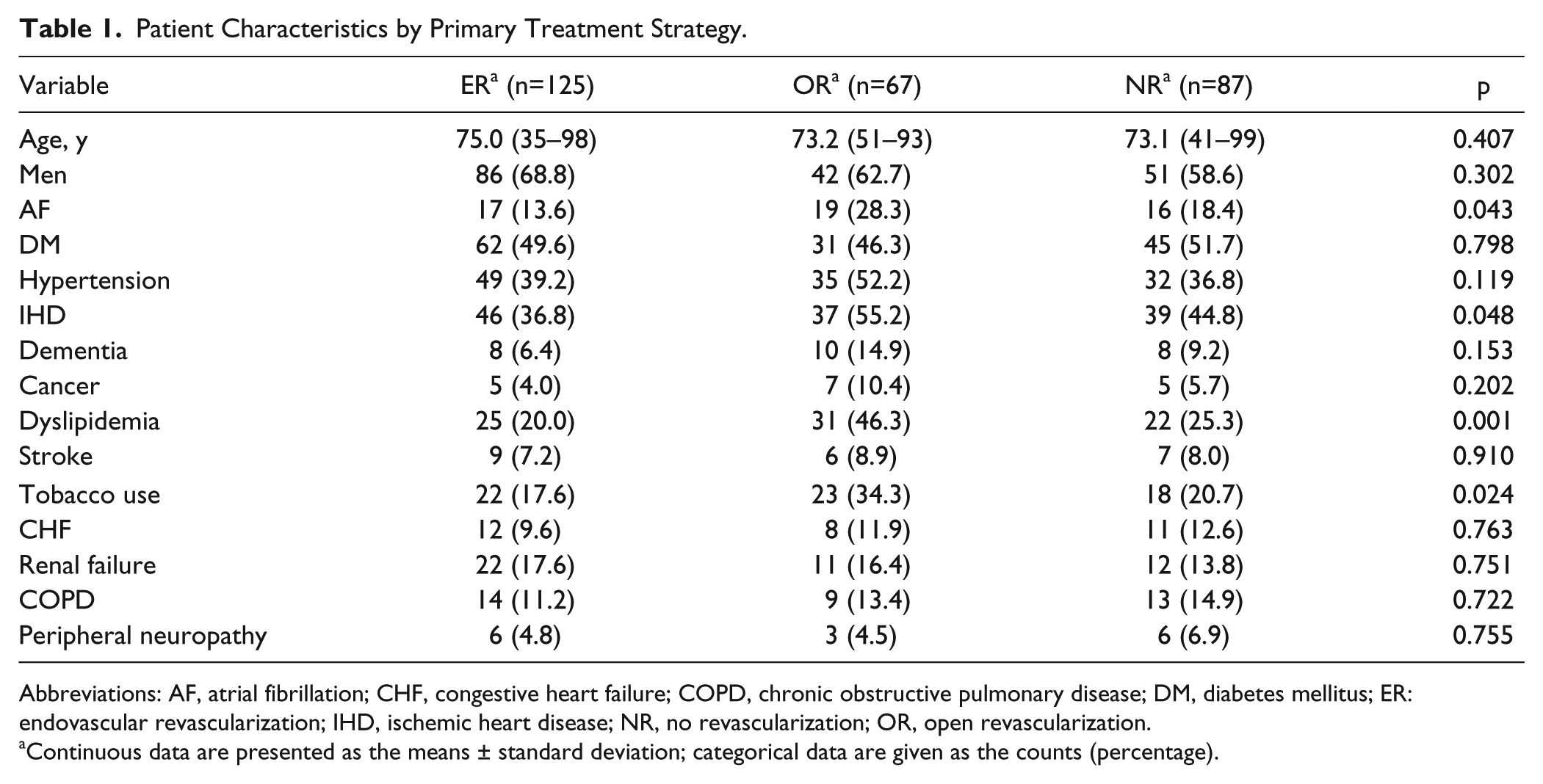
Abbreviations: AF, atrial fibrillation; CHF, congestive heart failure; COPD, chronic obstructive pulmonary disease; DM, diabetes mellitus; ER: endovascular revascularization; IHD, ischemic heart disease; NR, no revascularization; OR, open revascularization.
Continuous data are presented as the means ± standard deviation; categorical data are given as the counts (percentage).
Admission and Operation Details and Amputation Rates per Limb According to Primary Treatment Strategy.

Abbreviations: ER: endovascular revascularization; NA, not applicable; NR, no revascularization; OR, open revascularization.
Continuous data are presented as the means ± standard deviation; categorical data are given as the counts (percentage).
ER/NR vs OR.
Critical Limb Ischemia Management
Patients who presented with CLI were investigated with duplex ultrasound, ankle-brachial pressure measurements, computed tomographic angiography, and/or digital subtraction angiography; rarely were patients studied with magnetic resonance angiography.
All procedures were performed by 1 of 4 attending vascular surgeons in an operating theatre equipped with a mobile C-arm (Vision RFD Hybrid, Ziehm, Germany) and vascular software package. Open surgical procedures included endarterectomy and arterial bypass at various levels, with a preference for autologous conduit over prosthetic. Endovascular procedures varied depending on the level of revascularization. Conventional balloon angioplasty, with bailout stenting and primary stent therapies, were employed at the discretion of the treating surgeon, based on the lesion and patient characteristics. Common femoral access was used for most endovascular procedures, with adjunctive distal retrograde access used to ensure a high degree of technical success. Drug-coated balloons and covered or drug-eluting stents were used as primary therapy in a small number of procedures; atherectomy was not used. Perioperative administration of at least one antiplatelet agent was routine, with discretionary use of a second agent or therapeutic anticoagulation.
Outcome Measures and Definitions
The primary outcome was freedom from major amputation, defined as any amputation above the ankle. Secondary outcomes were minor amputation (distal to the ankle), length of hospital and intensive care unit (ICU) stays, and number of repeat admissions for further vascular care.
Statistical Analysis
The quantitative data are presented as mean ± standard deviation or with the 95% confidence interval (CI), while qualitative data are presented as number (percentage). Time-dependent data were presented as median and 95% CI. Quantitative data were analyzed using the independent Student t test for 2 groups or 1-way analysis of variance and a post hoc test (least significant difference method or Bonferroni correction) for ≥3 groups. The Pearson chi-square or Mann-Whitney U test was used to compare categorical data.
A general linear model multivariate analysis was performed to determine any associations of selected clinical parameters with limb salvage and patient survival measured for ER, OR, and NR groups, as well as the different era groups. A multivariate Cox proportional hazards model with forward likelihood filter was used to identify independent factors for limb salvage, amputation-free survival, and patient survival. The significant factors were then analyzed individually by log-rank testing to clarify relationships of subgroups. Results are presented as the hazard ratio (HR) and 95% CI.
Survival analyses using the Kaplan-Meier method were conducted for limb salvage, patient survival, and freedom from amputation with those patients/limbs lost to follow-up censored at the last confirmed date of vitality. Estimates were compared with the log-rank test.
All tests were 2 sided; p<0.05 was considered the threshold of significance. Statistical analysis was performed using IBM SPSS software (version 22; IBM Corporation, Somers, NY, USA).
Results
Primary Treatment Strategy Analysis
Ninety-three patients died during the study period, and 142 patients were alive as of the last follow-up date (December 2014). Mean follow-up time was 35.1±31.9 months for all limbs [39 (11%) limbs lost to follow-up]; by treatment group, per limb follow-up was 36.8±33.0 months for ER, 44.0±42.3 months for OR, and 36.8±23.6 months for the NR groups.
Overall, there were 59 major amputations. The number of major amputations was fewer in the ER group (13/168, 7.7%) compared with both the OR [15/75 (20.0%), p<0.001] and NR [31/101 (30.7%), p<0.0001] groups, resulting in a freedom from major amputation rate of 92.3% for the ER group and 80% for the OR group (Table 2). The relative risk reduction in major amputation for patients in the ER group was 62% vs 75% for the OR and NR groups.
The mean operating time for the ER group was 157.9 minutes compared to 316.8 minutes for the OR and 73.4 minutes for the NR (p<0.0001) groups (Table 2). The number of admissions per limb was higher for the OR (1.9) group than the ER (1.5) or NR (1.5) groups (p=0.007; Table 2). Length of hospital stay (Table 3) was significantly shorter in the ER groups compared to the OR and NR groups (15.2 vs 31.6 vs 25.9 days, respectively, p<0.001). The mean hours in ICU (Table 3) in the ER group was lower than both OR and NR (2.3 vs 23.7 vs 7.2, respectively, p=0.033).
Secondary Outcomes by Primary Treatment Strategy.

Abbreviations: ER: endovascular revascularization; ICU, intensive care unit; LOS, length of stay; NR, no revascularization; OR, open revascularization.
Mean (95% confidence interval).
ER vs OR; p=0.018 for ER vs NR.
Counts/sample (percentage).
p=0.029 for ER vs OR.
There were 127 treated limbs in patients who died by the end of the study censored at the date of their death. Kaplan-Meier analysis calculating limb survival demonstrated a significant advantage to the ER group compared to both OR and NR out to 8 years (p<0.001; Figure 1A). For the patient and amputation-free survival analyses, 46 patients were lost to follow-up and censored at the last known date alive. Although there was no demonstrable difference in amputation-free survival between the ER and OR groups, both were greater than NR (p<0.01; Figure 1B). Finally, there were no differences in patient survival observed among the groups (Figure 1C).

Kaplan-Meier estimates of limb, amputation-free, and patient survival between the 3 treatment groups (A-C) and 2 eras (D-F). The standard error was <10% for all groups in all graphs.
Era-Based Analysis
The patients allocated to the early (n=121) or late (n=223) presentation groups were of similar age (mean 73.4 and 74.4 years, respectively) and gender distribution (Table 4) and had similar proportions of rest pain (Rutherford 4) and tissue loss (Rutherford 5/6; Table 5). Freedom from major amputation (Table 5) was observed in 90/121 (74.4%) limbs in the early group vs 195/223 (87.4%) in the late group, representing a 51% relative risk reduction (p<0.01). Mean length of stay was shorter in the late group (21.0 days) vs 31.3 days in the early group (p=0.003). ICU stay, although infrequent, was shorter in the late group (mean 3.4 hours) compared with 16.8 hours in the early group (p=0.02). In terms of limb survival, the late group had a significant advantage compared to the early group out to 8 years (p<0.001; Figure 1D). Amputation-free and patient survival did not differ between the 2 eras (Figure 1E and F).
Multivariate Analysis by Early (2004–2008) or Late (2008–2012) Era and Treatment Group.
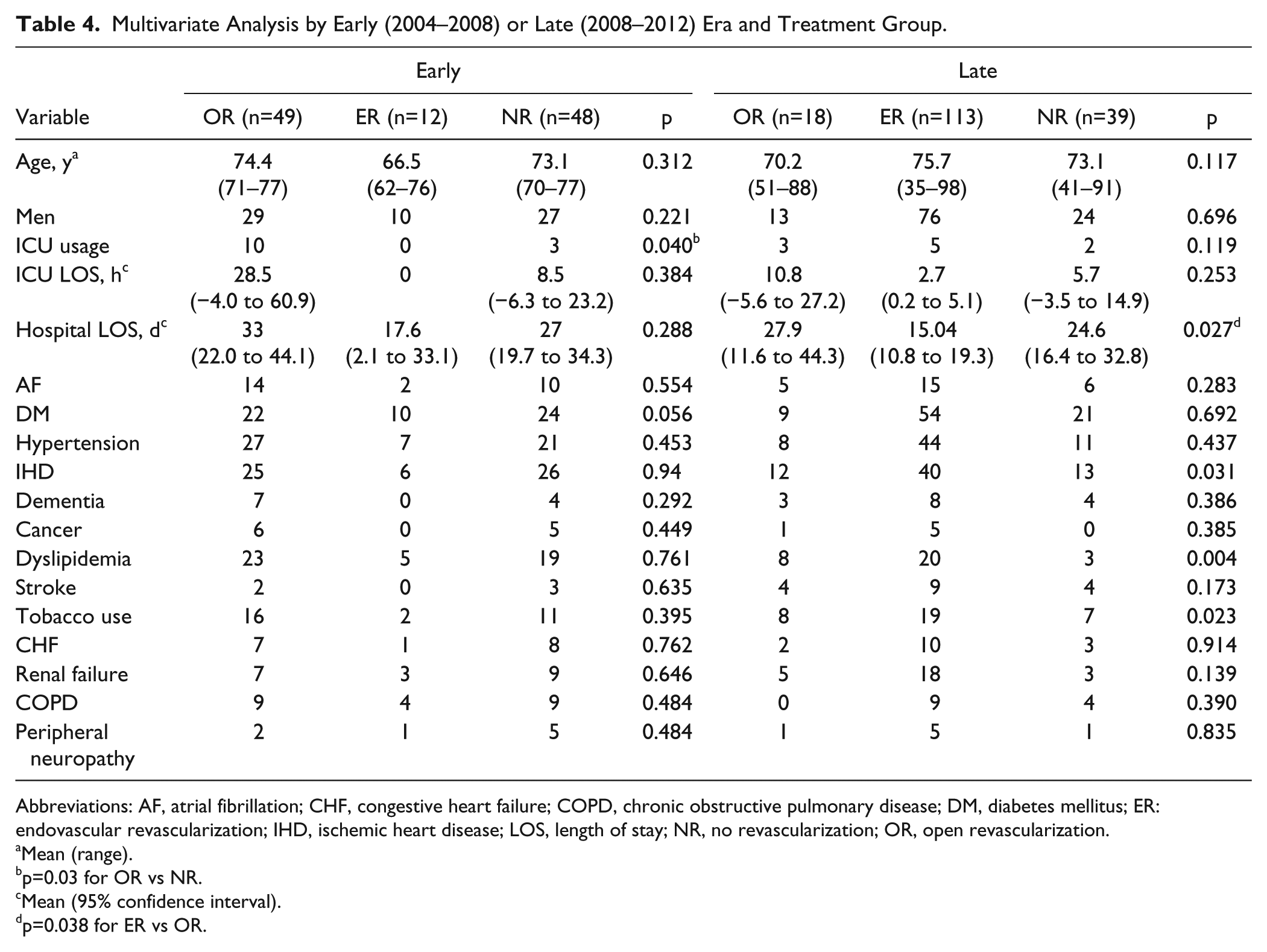
Abbreviations: AF, atrial fibrillation; CHF, congestive heart failure; COPD, chronic obstructive pulmonary disease; DM, diabetes mellitus; ER: endovascular revascularization; IHD, ischemic heart disease; LOS, length of stay; NR, no revascularization; OR, open revascularization.
Mean (range).
p=0.03 for OR vs NR.
Mean (95% confidence interval).
p=0.038 for ER vs OR.
Limb Outcomes for Patients With Critical Limb Ischemia According to Early (2004–2008) or Late (2008–2012) Era.
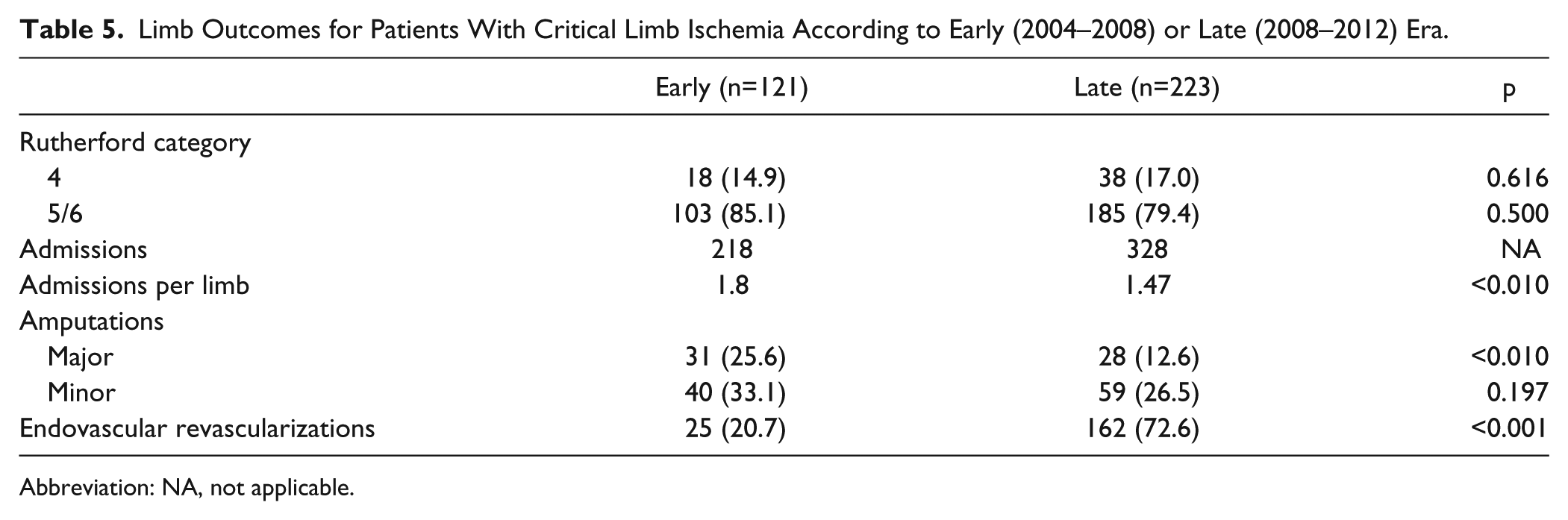
Abbreviation: NA, not applicable.
Independent Predictors of Limb Salvage, Patient Survival, and Freedom From Amputation
Independent predictors (Tables 6 and 7) of limb loss were renal disease (HR 1.9, p=0.046), Rutherford categories 5/6 (HR 6.9, p=0.008), tobacco use (HR 2.3, p=0.006), and dementia (HR 2.2, p=0.047). Independent predictors of death were dyslipidemia (HR 2.0, p=0.001), renal disease (HR 2.2, p=0.001), and heart failure (HR 1.9, p=0.006). Independent predictors of amputation-free survival were renal disease (HR 2.0, p=0.001), heart failure (HR 1.7, p=0.013), dyslipidemia (HR 1.7, p=0.011), atrial fibrillation (HR 1.6, p=0.019), and Rutherford categories 5/6 (HR 2.4, p=0.002).
Bivariate Association of Demographics, Comorbidities, Rutherford Classification, and Procedure Type With Outcomes of the 279 Patient Cohort.
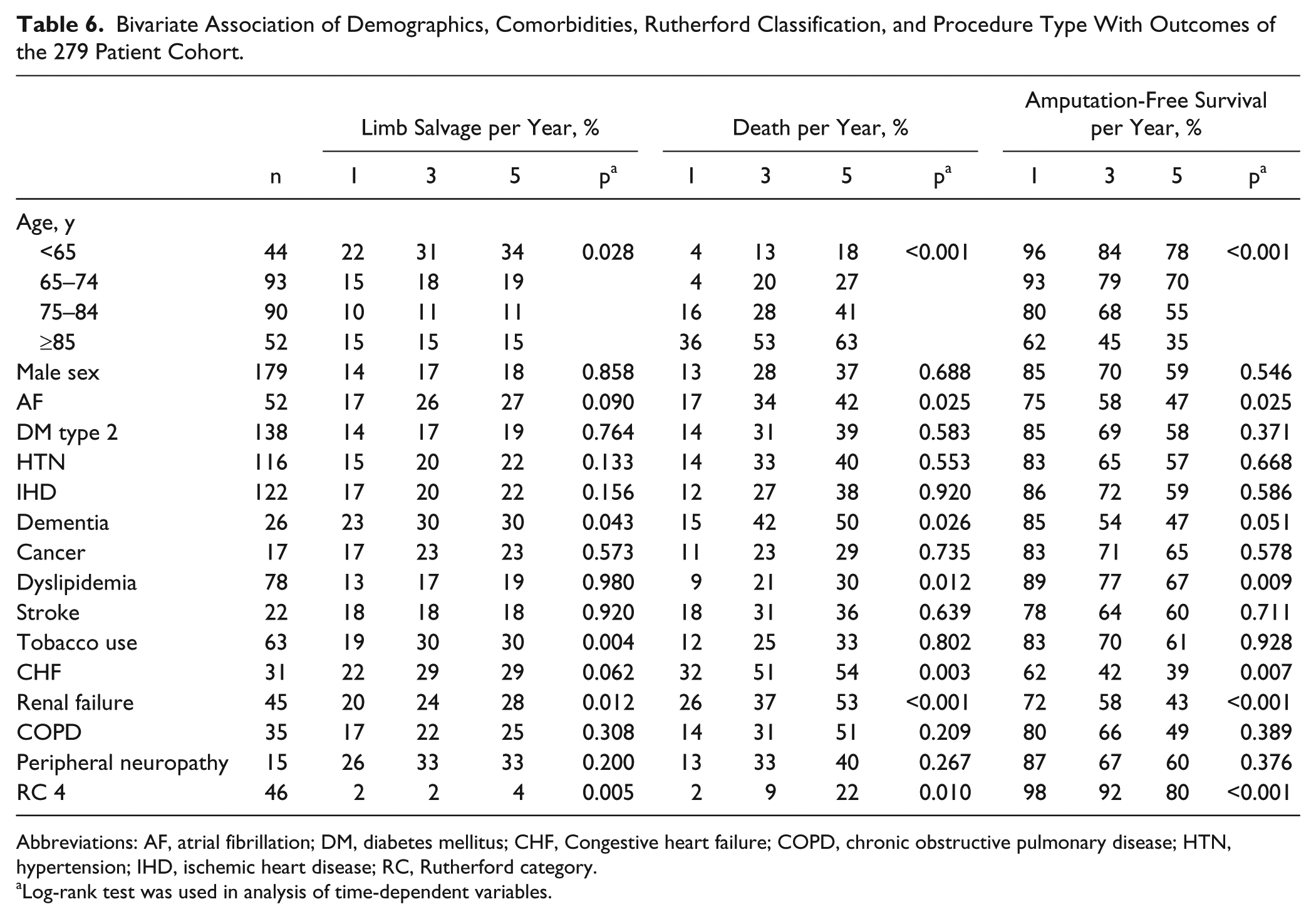
Abbreviations: AF, atrial fibrillation; DM, diabetes mellitus; CHF, Congestive heart failure; COPD, chronic obstructive pulmonary disease; HTN, hypertension; IHD, ischemic heart disease; RC, Rutherford category.
Log-rank test was used in analysis of time-dependent variables.
Independent Predictors.
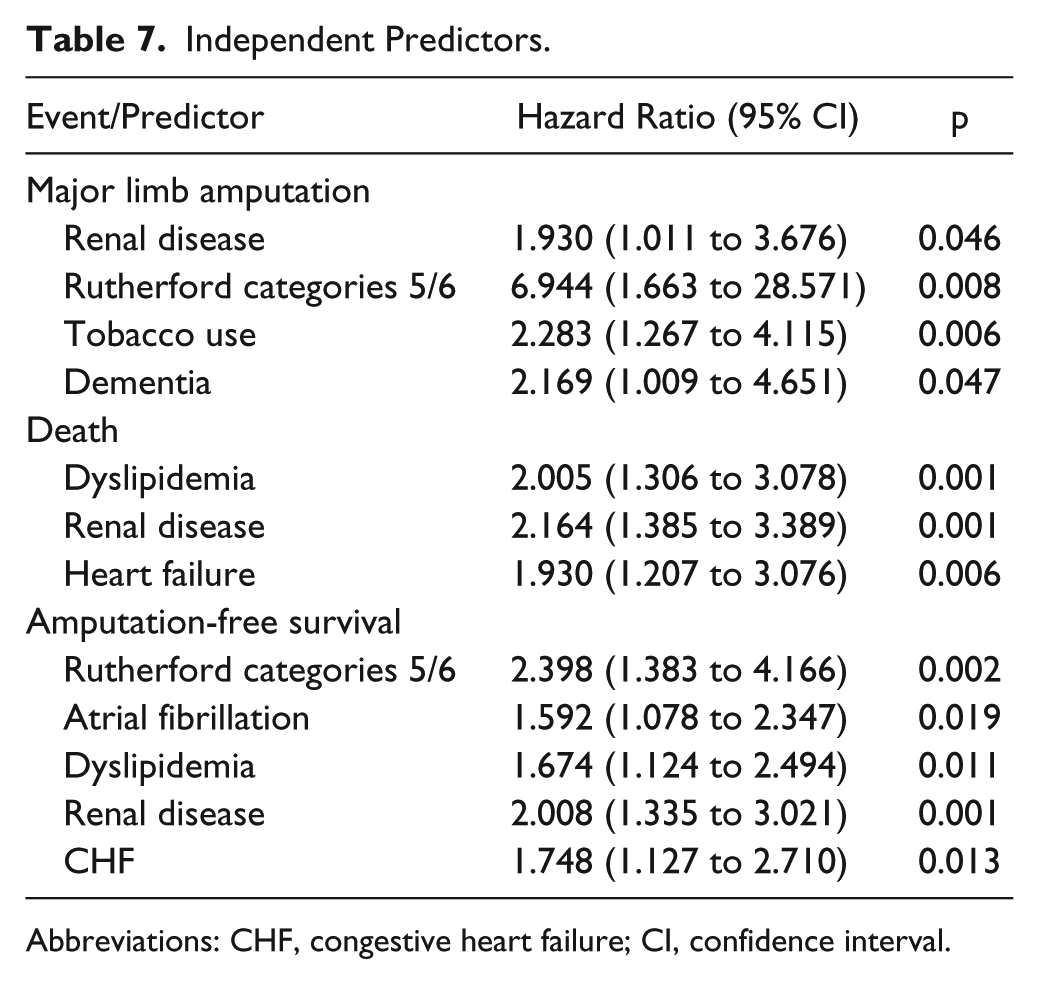
Abbreviations: CHF, congestive heart failure; CI, confidence interval.
Discussion
This study characterized the contemporary CLI treatment paradigm shift at a single tertiary referral center. While the patient demographics have remained similar over time, the shift toward an endovascular first strategy was associated with a decreased rate of major amputation, length of hospital stay, and ICU utilization. The change toward a primary endovascular approach also resulted in the treatment of a larger number of patients compared with the immediate past era. Despite previous studies demonstrating excellent limb salvage with ER compared with OR,10,11 no other study to our knowledge has reported superior limb salvage with an endovascular-first strategy.
The change in staff at our center in 2008 brought with it a simultaneous and immediate change in methodology, from a unit that favored a primary open surgical approach to one that preferred a less invasive strategy under most circumstances. Although there has been a gradual shift in this direction in many regions throughout the world, the change in key personnel presented a unique opportunity to evaluate and compare 2 real-world strategies in a single patient population either side of a midpoint in the observation period.
The primary focus of this study was intentionally placed on limb salvage in order to determine whether these different strategies would influence this crucial outcome in a group of patients with threatened limbs. The differences were striking. During the baseline era prior to 2008 when open surgery predominated, our limb salvage rates were comparable to other published centers.12,13 Subsequently, there was a 3.5-fold increase in the proportion of limbs treated with a primary endovascular strategy in the latter period (from 20.7% to 72.6%). Accompanying this change, major lower limb amputations were reduced by 51%, length of stay shortened by 10 days, and time in the ICU was reduced 80%, with a statistically significant decrease in the number of admissions per limb. The number of patients who were older and had dementia and past stroke increased, likely reflecting the broader patient selection based on lower perioperative risk, known to occur with the application of less invasive techniques.
The overall primary strategy analysis revealed marked differences in outcome over the entire study period. Patients who were treated with an endovascular-first approach had a significantly improved chance of maintaining their limb during their hospital admission compared with the other 2 groups. However, there was an observed cost to this approach, with a larger number of admissions during the latter period. Presumably, this was due to the broader application of these less invasive treatments, resulting in a larger number of presentations being admitted for care. Of particular interest was the finding that there was a significant difference in the number of minor amputations and a reduction in the number of repeat admissions for vascular care in the late group, in contradistinction to what one might expect with the adoption of an approach that has been criticized for its inferior durability. 13 Together these results attest to the importance of technical revascularization success followed by a moderate period of patency combined with local wound care in achieving limb salvage, with long-term durability a secondary consideration.14–16
Over the past 2 decades, a number of authors have published their own single-center experiences as endovascular therapy has developed into a reasonable alternative to open surgery for the treatment of CLI. Each of these is a historical snapshot in time documenting the proportional creep toward percutaneous procedures and improving technical success rates as endovascular skills blossomed. In 2003, Molloy et al 17 published their experience treating CLI patients with simple balloon angioplasty, achieving a 79% technical success rate and 88% 12-month limb salvage. In 2005, Hynes et al 10 reported their experience over the 15 preceding years to demonstrate an 85.6% cumulative limb salvage rate at 3 years for patients undergoing subintimal angioplasty, significantly improved from their previous open surgery era. In the same year, Faglia et al 18 published their results of 993 diabetic CLI patients between 1999 and 2003. Using advanced multilevel endovascular techniques, they were able to achieve an enviable limb salvage rate of 98.3%, perhaps demonstrating for the first time the notion that superior limb salvage may be attainable with an aggressive endovascular approach.
Most recently, Garg et al 11 compared a selective endovascular to open bypass–first strategy, which was chosen based on characteristics in 307 patients between 2007 and 2010. They found limb salvage equivalency between the 2 approaches despite the endovascular group having more advanced disease. 11 Our study goes further by demonstrating that a shift toward an unselected endovascular-first approach for the majority of CLI patients can result in superior limb salvage rates compared with open surgery. This is another step forward along the path of endovascular evolution, one that we predict will see percutaneous revascularization methods as the first line for all CLI patients, with open surgery reserved for endovascular failure.
A speculative discussion as to why the endovascular approach was more successful than open surgery in our hands is beyond the scope of this study. However, there is little doubt that modern day endovascular techniques facilitate direct, inline revascularization to the foot without the need for extensive surgical dissection and lymphatic disruption. The minimally invasive nature of these procedures also simplifies reintervention when required and broadens its application to more patients. It may be that all of these factors play a role.
Limitations
As with all retrospective studies, ours was limited by its reliance on hospital coding and departmental databases for data capture; without prospective data, it is not possible to attain the entire dataset. As only presentations to our own hospital were recorded, patients under our care who subsequently presented elsewhere will certainly have been overlooked; however, considerable efforts were made to capture them, and it is likely that the bias was similar across each of the groups.
Between 2004 and 2008, indications for treatment evolved such that the 2 era groups are likely to represent a different patient population. Attempts were made through multivariate analysis to minimize that bias and make adjustments accordingly. Throughout the study period, there has been rapid evolution in techniques and technologies; certainly, our unit has observed a trend toward higher technical success rates and increased lengths of patency over the last few years, which although not specifically quantified in this study will likely lead to even better outcomes in the future. It is our obligation to evaluate these evolving techniques to ensure that our direction remains aligned to our patients’ best interests. Further research might take the form of a prospective single-center registry or a multicenter randomized trial from institutions with an approach similar to our own for the treatment of CLI.
Conclusion
Over an 8-year period, an increasing number of endovascular procedures were performed within our center, partly due to a shift away from open revascularization and also to the increased applicability of minimally invasive techniques to patients who would otherwise have had no revascularization undertaken at all. Not only did the major amputation rates fall dramatically as a result of this change, but this improvement occurred despite attracting a higher proportion of patients with the most advanced stages of CLI. This study supports the global trend toward an endovascular-first approach to the treatment of CLI and suggests that in well-trained hands it may be superior to open surgery in achieving limb salvage.
Footnotes
Acknowledgements
The authors wish to thank Ms Carmelina Gudinho, Data Manager, Randwick Campus Operating Suites, Prince of Wales Hospital, for assistance with the operating theatre database interrogation and Ms Maria Salazar, Clinical Coding Manager, Prince of Wales Hospital, for providing that same assistance with the medical records database.
Declaration of Conflicting Interests
The author(s) declared no potential conflicts of interest with respect to the research, authorship, and/or publication of this article.
Funding
The author(s) received no financial support for the research, authorship, and/or publication of this article.