






Abstract
Keywords
Introduction
Mathias et al 1 first reported catheter intervention for subclavian artery disease in 1980. Subsequently, endovascular therapy (EVT) has been shown to be effective for treating stenotic and occlusive lesions2–6 and is widely used as the first-line treatment in many hospitals. In addition, endovascular techniques, such as intravascular ultrasound (IVUS), primary stenting, and distal protection, have been advancing. As an alternative treatment, EVT should be examined for safety and efficacy. Some studies have already shown that primary EVT for subclavian artery disease was safe and durable in the midterm7–9; however, these were small samples or a single-center experience. Here, a large-scale, multicenter retrospective study was performed to evaluate the safety and efficacy of EVT in patients with subclavian artery disease.
Methods
Subjects
The study analyzed the outcomes from a multicenter retrospective registry (SubClavian Artery disease treated with endovascuLar therapy; muLticenter retrOsPective registry: SCALLOP) of 718 consecutive patients with upper extremity artery disease who underwent EVT between January 2003 and December 2012 at 37 Japanese cardiovascular centers. The study is registered with the University Hospital Medical Information Network–Clinical Trials Registry (UMIN000012370). All patients had given informed consent for the procedure, and the follow-up protocol was approved by the institutional review boards of all participating centers. Baseline demographic and follow-up data were collected from hospital charts or by contacting patients, family members, or referring physicians.
Of the 718 patients enrolled in the registry, 162 patients were excluded because of acute onset ischemia (n=48), restenotic lesions (n=44), lesions not involving the subclavian artery (n=40; 6 axillary, 10 brachial, 24 below-the-elbow), collagen disease or aortitis (n=9), a history of surgical or endovascular revascularization for the target arm (n=8), inadequate data (n=8), brachiocephalic artery disease (n=3), and other reasons (n=4). Therefore, 553 patients (mean 70±7 years, range 41–91; 405 men) who underwent primary EVT for de novo subclavian artery disease (560 arms) were included in the analysis. The characteristics of the patients are shown in Table 1. Diabetes, dialysis, coronary artery disease (CAD), and peripheral artery disease (PAD) were present in 238 (43%), 70 (13%), 290 (52%), and 251 (45%) of the patients, respectively. Aspirin was prescribed in almost all (525, 95%) as a base drug; nearly half of patients (294, 53%) received statin therapy.
Characteristics of the 553 Study Patients. a

Abbreviations: ACEi, angiotensin-converting enzyme inhibitors; ARB, angiotensin receptor blockers; CABG; coronary artery bypass grafting; PAD peripheral artery disease.
Continuous data are presented as the means ± standard deviations; categorical data are given as the counts (percentage).
The treated lesion was on the left side in 86% (482/560) of cases (Table 2). The most common indications for treatment were arm claudication (234, 42%). Eleven patients underwent EVT prior to coronary artery bypass to secure inflow to the intended left internal mammary artery (LIMA) grafts. The mean lesion length and reference vessel diameter were 26±9 and 7.7±1.0 mm, respectively. Chronic total occlusion (CTO) was present in 171 (31%) lesions; half of all lesions were calcified (283, 51%).
Lesion and Procedure Characteristics. a

Abbreviations: IVUS, intravascular ultrasound; VA, vertebral artery.
Continuous data are presented as the means ± standard deviation; categorical data are given as the counts (percentage).
Calcified lesion defined as obvious densities noted within the apparent vascular wall in the angiogram.
Procedures and Follow-up
All patients received dual antiplatelet therapy (aspirin 100 mg/d + clopidogrel 75 mg/d or ticlopidine 100 mg twice a day) before the procedure. After insertion of a 6- or 7-F guiding sheath using a femoral (90-cm) or radial/brachial (45- or 55-cm) approach, a 5000-unit intra-arterial bolus of heparin was injected, with additional heparin given intravenously during the procedure to maintain the activated clotting time at >200 seconds. An attempt was made to insert a 0.035-, 0.018-, or 0.014-inch guidewire into the lesion, using a bidirectional approach if the guidewire was less likely to pass through the obstruction. After the guidewire passed through the lesion, self-expanding and balloon-expandable stents (the latter preferred) were placed in the lesion after predilation under distal embolic protection if indicated before the procedure; aspiration was performed if necessary. The operator at each facility selected the types and diameters of the stent based on the angiograms. After the procedure, all patients were prescribed lifelong aspirin (100–200 mg/d); clopidogrel (75 mg/d) or ticlopidine (100 mg twice a day) was continued for at least 1 month. Treated vessels were monitored within 1, 6, and 12 months and at least every 12 months thereafter in concert with clinical examinations. Repeated revascularization was performed based on clinical symptoms and findings on duplex sonography or computed tomography (CT).
Definitions
Primary patency was defined as a treated vessel that remained patent without restenosis and repeat revascularization. Assisted primary patency was defined as a patent target vessel that underwent repeat revascularization to improve patency. Secondary patency was defined as an occluded target vessel that was reopened by repeat revascularization. Restenosis was defined as a peak systolic velocity ratio >2.0 on duplex ultrasound, >50% stenosis on angiography or CT, or a 20-mmHg decrease in resting brachial blood pressure in the target upper limb compared with the blood pressure on the normal opposite side.
Transient ischemic attack (TIA) was defined as a sudden onset of a focal neurologic symptom or sign lasting <24 hours. Stroke was defined as a cerebral or cerebellar event that persisted for at least 24 hours. Myocardial infarction (MI) was judged using the Third Universal Definition of MI. 10 Cerebrovascular disease (CVD) was defined as a diagnosis of TIA or ischemic stroke.
Procedure success was defined as angiographic residual stenosis <50% after treatment. Clinical success was defined as procedure success without perioperative complications (ie, in-hospital death, MI, TIA, stroke, vessel rupture, aortic dissection, transfusion, urgent surgery, access-site complication, or other reasons for a prolonged hospital stay).
Outcome Measures
For the perioperative period, reported outcomes included procedure success, clinical success, perioperative complications, and 30-day mortality. Outcomes in follow-up included primary patency, assisted primary patency, secondary patency, overall survival, freedom from major adverse cardiovascular events (MACE: all-cause death, MI, and stroke), and freedom from major adverse events (MAE: MACE plus any reintervention for the target arm).
Statistical Analysis
Continuous data are presented as the means ± standard deviations; categorical data are given as the counts (percentage). Continuous variables were examined using an unpaired t test; categorical variables were compared using a chi-square test. Patency and even-free survival were estimated using the Kaplan-Meier method; estimates are presented as the rates ± standard error. Curves were compared using the log-rank test.
Clinically prespecified predictors with p<0.05 in univariate models were entered into a multivariate Cox regression model. Data are presented as the hazard ratio (HR) and 95% confidence interval (CI). The threshold of statistical significance was p<0.05. All statistical analyses were performed with the Statview software package (version 5; SAS Institute, Inc, Cary, NC, USA)
Results
Perioperative Outcomes
The EVT procedure was successful in 97% of lesions (542/560); the 18 (3%) failures were because a CTO could not be crossed. Medical management and repeat EVT were performed in 13 and 5 of these patients, respectively; 4 of the 5 repeat EVT procedures were successful. The one unsuccessfully retreated patient had a third attempt that also failed, and the patient was medically managed. Nearly all lesions (535, 96%) were stented.
The procedure success rate was significantly lower in CTOs (91% vs 100%, p<0.001), likely owing to longer lesion length (31.1±11.9 vs 23.8±10.2 mm, p<0.001) and more frequent moderate or severe calcification (59% vs 46%, p=0.005). The bidirectional approach (77% vs 38%, p<0.001), IVUS use (47% vs 25%, p<0.001), and aspiration (31% vs 22%, p=0.02) were more frequently performed in CTOs. Self-expanding stents were selected more commonly in CTOs (44% vs 28%, p<0.001), and the postdilation balloon diameter was smaller (6.6±1.1 vs 7.0±1.3 mm, p=0.03). Procedure time was longer (99.0±55.9 vs 58.1±33.9 minutes, p<0.001).
The overall clinical success rate was 88% (495/560), and the clinical success rates in stenotic and CTO lesions were 92% (358/389) and 80% (137/171), respectively, with a significantly lower rate in CTO lesions (p<0.001). The 30-day mortality was 0.7% (4/560). The causes of death were ischemic colitis (day 8), aspiration pneumonia (day 10), cerebellar hemorrhage (day 25), and cardiac arrest due to hyperkalemia (day 29).
Complications
The perioperative complication rate was 9.2% (52/564) (Table 3), with access-site complications being the most common [4.5% (25/560): 12 pseudoaneurysms, 16 hematomas prolonging hospitalization, and an arteriovenous fistula]. The incidence of access-site complications was not related to the brachial or radial access. There was no in-hospital death, but one patient developed MI postoperatively. A neurologic event occurred in 1.8% of procedures (12/560: 2 TIAs, 10 strokes); most demonstrated symptoms intraoperatively or immediately postoperatively, but one developed symptoms on 8 day after EVT. The prevalence of TIA was significantly higher in the CTO group (0% vs 1.2%, p=0.03). There was no significant difference in the incidence of complications between patients with CTO and non-CTO lesions (11.6% vs 8.2%, p=0.19).
Perioperative Complications for the Entire Cohort and Stratified by Lesion Type. a

Abbreviations: CTO, chronic total occlusion; MI, myocardial infarction; TIA, transient ischemic attack.
Data are presented as the counts (percentage).
With respect to the 10 strokes, 5 were ipsilateral cerebellar infarctions. Both procedure time (114±49 vs 70±46 minutes, p=0.03) and the need for blood transfusion (10% vs 1%, p=0.01) were significantly greater in stroke victims compared with those without stroke in univariate analysis. These patients also had higher rates of prior cerebrovascular disease (40% vs 18%, p=0.07), intraoperative aspiration (50% vs 25%, p=0.07), age ≥80 years (30% vs 12%, p=0.1), and larger balloon size for pre- (5.1±1.4 vs 4.1±0.5 mm, p=0.1) and postdilation (8.0±2.0 vs 6.9±1.2 mm, p=0.1). There was no definite relationship between onset of stroke and lesion location, presence of CTO, approach site, reference vessel diameter, or crossover stent for the vertebral artery.
Outcomes in Follow-up
The mean follow-up period was 39±24 months (range 1–129). Patency was evaluated in 546 lesions, including 542 lesions treated successfully in initial EVT and 4 lesions that underwent successful repeat EVT. Primary patency estimates were 90.6%±1.3%, 83.4%±1.8%, and 80.5%±2.2% at 1, 3, and 5 years, respectively (Figure 1). There was no significant difference in primary patency between stenotic and CTO lesions (p=0.53 by log rank test; Figure 2). Assisted primary patency estimates were 95.1%±1.0%, 91.7%±1.3%, and 89.7%±1.6% and secondary patency estimates were 99.2%±0.4%, 98.2%±0.6%, and 97.7%±0.8% at 1, 3, and 5 years, respectively. Stent thrombosis developed in 1 (0.2%) patient.

Primary, assisted primary, and secondary patency estimates after successful procedures. The standard errors did not exceed 10% at 5 years.
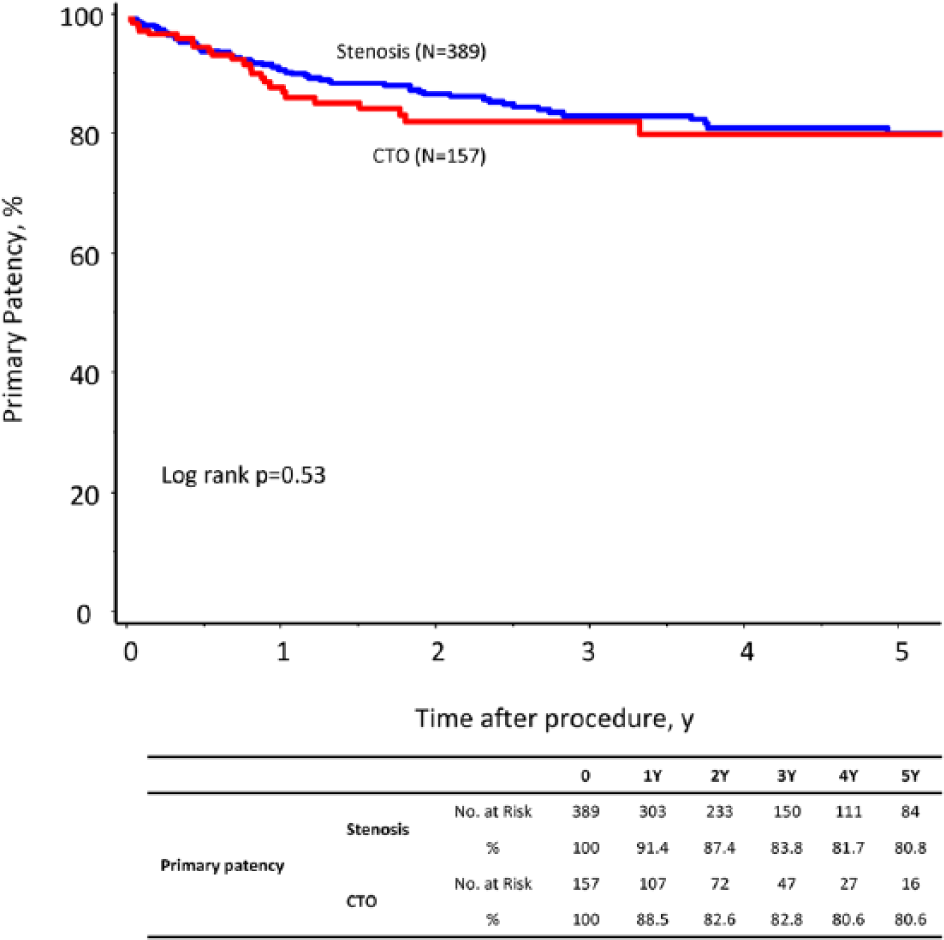
Primary patency estimates in totally occlusive and stenotic lesions. The standard errors did not exceed 10% at 5 years.
There was no difference in primary patency based on the type of stent. Balloon-expandable stents were more frequently placed for stenosis (44% vs 28%, p<0.001) and proximal lesions (88% vs 69%, p<0.001), while self-expanding stents were selected for longer lesions (32.7±12.4 vs 22.8±9.0 mm, p<0.001), calcified lesions (58% vs 47%, p=0.01), and vertebral and/or internal mammary artery involvement (29% vs 9%, p<0.001). Both types of stents were implanted in 12 long curved lesions.
In multivariate analysis, critical hand ischemia (HR 4.6, 95% CI 2.06 to 10.2, p<0.001), CVD (HR 1.9, 95% CI 1.14 to 3.06, p=0.01), current smoking (HR 1.8, 95% 1.14 to 2.79, p=0.01), and lesion length (in 1-cm increments; HR 1.02, 95% CI 1.00 to 1.04, p=0.03) were negative independent predictors of primary patency (Table 4), while IVUS use (HR 0.6, 95% CI 0.30 to 0.96, p=0.04) was a positive predictor of primary patency.
Univariate and Multivariate Analysis of Primary Patency After a Successful Procedure. a

Abbreviation: IVUS, intravascular ultrasound.
Data are presented as the hazard ratio, 95% confidence interval, p value.
Event-free survival curves are shown in Figure 3. Freedom from MACE (all-cause death, MI and stroke) estimates were 91.7%±1.2%, 82.0%±1.9%, and 71.8%±2.6%, and freedom from MAE (MACE plus any reintervention for the target arm) were 87.4%±1.5%, 76.2%±2.1%, and 64.8%±2.7% at 1, 3, and 5 years, respectively. The respective overall survival rates were 94.6%±1.0%, 86.8%±1.7%, and 79.0%±2.4%. There were 86 deaths during follow-up, including cardiac death (35%, 30/86), vascular death (16%, 14/86; total cardiovascular death 51%), non-cardiovascular death (41%, 35/86), and unknown causes (8%, 7/86). In multivariate analysis, CAD (HR 2.3, 95% CI 1.4 to 3.8, p=0.001), body mass index <18 kg/m2 (HR 2.0, 95% CI 1.0 to 4.0, p=0.04), hemodialysis (HR 4.9, 95% CI 3.1 to 7.6, p<0.001), and heart failure (HR 2.2, 95% CI 1.34 to 3.5, p=0.001) were significantly associated with all-cause mortality.

Event-free survival curves after endovascular treatment. MACE, major adverse cardiovascular events (including all-cause death, myocardial infarction, and stroke); MAE, major adverse events (surgical conversion or reintervention in addition to MACE). The standard errors did not exceed 10% at 5 years.
Discussion
Most of the patients in the SCALLOP registry had symptomatic subclavian artery disease, but 5% of the lesions were asymptomatic. These were treated to maintain an access route for hemodialysis and prior to coronary artery bypass with intended LIMA grafts. A consensus on aggressive revascularization in patients with asymptomatic subclavian artery disease has not been reached. While the disease may evolve to severe stenosis in terms of hemodynamic indexes, disease progression is usually too slow for symptoms to develop. Schillinger et al 11 found that most asymptomatic subclavian artery disease patients remained symptom-free over a median 42-month follow-up. In a study of 64 patients, Ackermann et al 12 showed that progression of stenotic lesions occurred in 17% of cases in 2-year follow-up and that symptoms developed in only 4 of 55 patients in 4-year follow-up. Since revascularization is not indicated in most asymptomatic subclavian artery disease patients, an interview and assessment of hemodynamics should be performed to determine the most appropriate treatment.
Procedure success in this study was high and comparable to the 93% to 100% rates in previous studies.4,13 Procedure failure occurred only in CTOs lesions, which were longer and more calcified, requiring the use of a bidirectional approach, IVUS, and aspiration more frequently. The use of a bidirectional approach was extremely high because crossing devices are still not available in Japan. Regarding the vertebral and internal mammary arteries, the location of the bifurcations, flow patterns (antegrade or reversed), and pre- and postprocedure stenosis at the artery orifice were not associated with serious complication, likely because the operators actively used IVUS, self-expanding stents, and postdilation with smaller balloons to prevent a serious complication (rupture or stroke). This careful technique may explain why there was no significant difference in serious complications between CTOs and stenoses. If covered stents had been available, it might have been a good option, particularly in occlusion, to avoid rupture and protrusion after stenting. Perioperative and long-term outcomes were similar between occlusions and stenoses.
The type of stent did not appear to affect patency. Based on this large population, it seems that balloon-expandable stents were suitable for short proximal stenotic lesions and self-expanding stents was preferable for longer and calcified lesions with involvement of the vertebral or internal mammary artery.
Previous studies have shown cumulative primary patency rates of 73% to 88% and secondary patency rates of 90% to 95% at 24 to 66 months.4,13–16 In the current study, the primary and secondary patency rates were similar to previous studies, indicating acceptable durability of EVT for subclavian disease. Female gender (p=0.02) and vertebral artery stenosis (p<0.01) have previously been found to be independent predictors of primary patency, 14 but in the current study, these variables were not related with primary patency. Severity of ischemia (critical hand ischemia), CVD, current smoking, and lesion length did emerge as independent negative predictors of primary patency. On the other hand, IVUS use was a positive factor in primary patency, which was particularly interesting because the accurate blood vessel diameters measured with IVUS optimizes selection of the stent diameter, which might contribute to improved primary patency.
Though the incidence of complications was 9%, the severity was generally mild; only 3% were serious complications (death, MI, stroke, rupture, aortic dissection). When there is vertebral artery involvement with subclavian artery disease, there are some concerns about procedure-related stroke. However, in this study, no significant determinant of early or late stroke was found despite detailed analysis of various possible factors, such as the presence of a protection device, flow pattern (antegrade or reversed), balloon inflation time, direct stenting, the crossover stenting of the vertebral artery, lesion morphology, and pre- and postprocedure stenosis. However, the number of strokes was too small to evaluate related factors in detail. Therefore, further investigation is required to verify these findings.
The 5-year mortality estimate was 21%, which is similar to that of CAD patients undergoing coronary intervention (14% to 20%)17,18 and of PAD patients undergoing EVT (23% to 24%).19,20 Half of deaths were from cardiovascular causes. Since CAD and heart failure were independent predictors of mortality, it is important to consider subclavian artery disease in the context of systemic arteriosclerosis, with careful diagnosis and management of cardiac diseases.
Limitations
First, the study was a retrospective analysis, despite the use of a large-scale multicenter database, and there was considerable bias in many of the data assignments. Therefore, a prospective study is needed to examine the findings. Second, while strokes and serious complications occurred, the events were few. Thus, accumulation of more cases of procedure-related complications seems to be required for analysis. Third, the diagnosis of subclavian artery disease and the determination of symptomatic or asymptomatic status varied by medical facility. Also, with regard to etiology, inflammatory diseases and collagen diseases were not completely ruled out and thus might have been included. Therefore, a prospective study is required based on a definitive diagnosis and treatment plan to examine aggressive revascularization and the efficacy of EVT for asymptomatic subclavian artery disease. Despite these limitations, this large-scale multicenter study of subclavian artery disease has important clinical implications for future studies of EVT for subclavian artery disease.
Conclusion
Although initial success and long-term durability of primary EVT for subclavian artery disease were very high, neurologic events (0.9% ipsilateral posterior stroke) did occur and may have been associated with longer procedure time and the need for blood transfusion. However, the efficacy of distal protection or aspiration for subclavian artery disease to avoid stroke was unclear. Regarding patency, critical hand ischemia, a history of CVD, current smoking, and lesion length were negative factors, while IVUS was a positive predictor.
Footnotes
Acknowledgements
We acknowledge the expertise of Dr Osamu Iida and Dr Kiyonori Nanto (Kansai Rosai Hospital), Dr Kenichiro Yuba (Tokushima Red Cross Hospital), Kan Zen (Omihachiman Comunity Medical Center), Dr Yoshinori Tsubakimoto (Kyoto Second Red Cross Hospital), Dr Takuya Haraguchi (Chidoribashi Hospital), Dr Tadashi Fukunaga (Hyogo Medical Collage), Dr Keisuke Hirano and Dr Hideyuki Takimura (Yokohama City Eastern Hospital), Dr Norihiko Shinozaki (Tokai University Hospital), Dr Takashi Miura (Shinshu University Hospital), Dr Takahide Suzuki (Engaru Kosei General Hospital), Dr Jyunichi Tazaki (Kyoto University Hospital), Dr Shinya Sasaki (Saka General Hospital), Dr Makoto Utsunomiya (Tokyo Rosai Hospital), Dr Taketsugu Tsuchiya (Kanazawa Medical University Hospital), Dr Yuki Imoto (Fukuoka Wajiro Hospital), Dr Tatsuki Doijiri (Yamato Seiwa Hospital), Dr Jun Tanabe (Shizuoka Medical Center), Dr Go Miyazawa (Hikone Municipal Hospital), Dr Nobuhiro Suematsu (Fukuoka Red Cross Hospital), Dr Hideyuki Aihara (Tsukuba Medical Center Hospital), Dr Shinichi Okino (Funabashi Municipal Medical Center), Dr Hiroshi Asano (Tosei General Hospital), Dr Atsushi Tosaka (Kawakita General Hospital), Dr Hiroki Takahashi (Yamagata University Hospital), Dr Terutoshi Yamaoka (Matsuyama Red Cross Hospital), Dr Tai Kojima (Gifu Prefectural General Medical Center), Dr Soichirou Enomoto (Tenri Hospital), Dr Yasuhiro Kaetsu (Tottori University Hospital), and the medical staff and clinical research coordinators in all the participating centers.
Declaration of Conflicting Interests
The author(s) declared no potential conflicts of interest with respect to the research, authorship, and/or publication of this article.
Funding
The author(s) received no financial support for the research, authorship, and/or publication of this article.