






Abstract
Keywords
Introduction
With the continuing shift toward value-based healthcare, enhanced recovery after surgery (ERAS) pathways have been adopted with increasing frequency. These ERAS or fast-track surgery protocols aim to facilitate faster postoperative recovery while reducing healthcare costs. Fast-track surgery programs have been adopted in many specialties, including colorectal, gynecologic, orthopedic, genitourinary, and vascular surgery. 1 While the specific elements comprising these programs vary, the common premise is utilization of a multimodal strategy to reduce the physiological stress response to surgery, which in turn may encourage earlier mobilization and faster hospital discharge with fewer complications.
Endovascular aneurysm repair (EVAR) reduces perioperative morbidity and mortality rates compared to open surgery. 2 Still, opportunity remains to further improve perioperative EVAR outcomes. Traditional EVAR involves bilateral femoral cutdown for vascular access, general anesthesia, intensive care unit (ICU) stay, and a hospital stay of 2 to 3 days.3,4 Furthermore, EVAR costs often exceed reimbursements, resulting in negative hospital margins. 5 Development of a fast-track EVAR protocol that avoids ICU admission and allows next-day discharge without compromising patient safety may reduce the cost of patient care and potentially improve patient satisfaction.
Few studies have evaluated the feasibility of fast-track EVAR.6–9 Since vascular access and anesthesia type influence perioperative EVAR outcomes, development of standardized protocols that incorporate these elements may improve outcomes in well-selected patients. As stent-grafts evolve toward lower profile delivery systems, percutaneous endovascular aneurysm repair (PEVAR) is becoming a feasible atraumatic option for vascular access in most patients. PEVAR is associated with shorter procedure times, lower complication rates, and similar technical success rates compared with surgical cutdown. 10 Avoidance of general anesthesia is feasible in most patients 11 and is associated with lower ICU admission rates and shorter hospitalization.12,13 Therefore, it is plausible that an EVAR protocol that integrates multiple fast-track elements may act synergistically to accelerate patient recovery, reduce perioperative morbidity, and control healthcare costs compared with standard EVAR. The purpose of this study was to report perioperative outcomes in well-selected patients treated using a standardized fast-track EVAR protocol.
Methods
Study Design
The Least Invasive Fast-track EVAR (LIFE) postmarket registry ( ClinicalTrials.gov identifier NCT02224794) is a prospective, multicenter, single-arm trial conducted at 31 centers in the United States (Supplemental Table 1). The study received institutional board approval at each center, and patients provided written informed consent before participation.
The elements of the fast-track EVAR protocol were bilateral percutaneous access with a 14-F stent-graft, no general anesthesia or ICU stay, and next-day hospital discharge. Surgical suite type, local anesthesia protocols, and patient monitoring were implemented at the discretion of each institution. Patients were eligible for the study if they had abdominal aortic aneurysms (AAAs) anatomically suitable for elective EVAR and were deemed by the treating physician appropriate for a fast-track EVAR protocol. The main inclusion and exclusion criteria of the study are reported in Supplemental Table 2. Pretreatment assessments included medical history, laboratory tests, and contrast-enhanced computed tomography. All patients enrolled in the LIFE registry were followed through 1 month since the primary benefits of a fast-track EVAR program were anticipated to be realized in the perioperative period.
Stent-Graft Procedure
PEVAR was performed with a 6-F suture-mediated closure device (Perclose ProGlide; Abbott Vascular, Santa Clara, CA, USA) and a 14-F stent-graft (Ovation Prime Abdominal Stent Graft System; Endologix, Inc, Irvine, CA, USA). Two closure devices were routinely employed on each side using a large hole closure technique. The aortic body was delivered through a flexible hydrophilic-coated delivery catheter that facilitates bilateral percutaneous access. The aortic body consists of a low permeability polytetrafluoroethylene (PTFE) graft and a suprarenal nitinol stent with integral anchors to achieve active fixation to the aortic wall. The aortic body contains a network of inflatable channels and sealing rings that are filled during deployment with a low viscosity, radiopaque fill polymer that cures in situ to create a conformable seal to the aortic neck. The iliac limbs, comprised of highly flexible nitinol stents encapsulated in low-permeability PTFE, are packaged in a 13/14-F outer diameter delivery system.
Patient Enrollment
Between October 2014 and May 2016, 376 consecutive patients were screened for eligibility and 250 patients (mean age 73±8 years; 208 men) were enrolled in the study (Figure 1). Of the 126 (34%) patients excluded from participation, primary reasons were anatomical unsuitability for the Ovation stent-graft (n=38); unsuitability for Perclose closure, mainly due to small diameter (<5-mm) access vessels (n=20); small (<5-cm) AAA diameter (n=17); planned adjunctive procedures (n=15); next-day discharge not feasible (n=12); and poor candidate for open surgery (n=12).

Patient flow diagram listing the most common reasons for study exclusion. Multiple reasons in some patients account for the disparity between reasons for fast-track noncompletion and patients who failed to complete the fast-track protocol.
Baseline patient characteristics and aortoiliac morphology are presented in Table 1. Comorbidities included tobacco history (197, 79%), hypertension (190, 76%), hyperlipidemia (188, 75%), coronary artery disease (109, 44%), and chronic obstructive pulmonary disease (COPD; 72, 29%). Proximal neck anatomy was generally straightforward, with mean neck angle of 24°, neck length of 24 mm (≤15 mm in 27% of patients), moderate or severe calcification in 10%, and moderate or severe thrombus in 20%. Data from 129 of the 250 patients enrolled in this study have been published. 14
Baseline Patient Characteristics and Aortoiliac Morphology. a
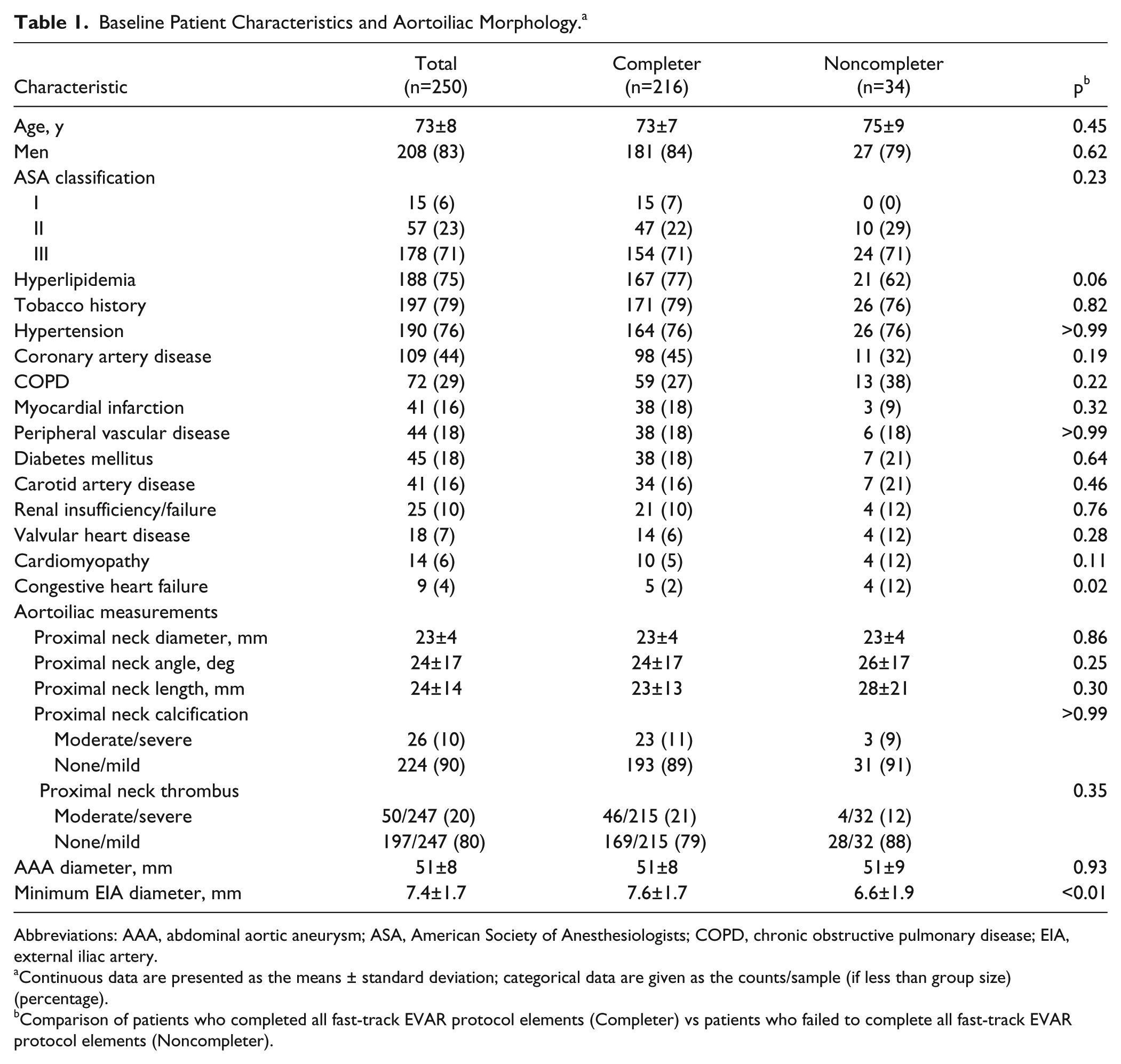
Abbreviations: AAA, abdominal aortic aneurysm; ASA, American Society of Anesthesiologists; COPD, chronic obstructive pulmonary disease; EIA, external iliac artery.
Continuous data are presented as the means ± standard deviation; categorical data are given as the counts/sample (if less than group size) (percentage).
Comparison of patients who completed all fast-track EVAR protocol elements (Completer) vs patients who failed to complete all fast-track EVAR protocol elements (Noncompleter).
Endpoints and Definitions
The primary endpoint of the study was a major adverse event (MAE) through 30-day follow-up. An MAE was defined as death, myocardial infarction, stroke, renal failure, respiratory failure, paralysis, bowel ischemia, or operative blood loss ≥1000 mL. Additional outcomes of the LIFE registry included ability to successfully complete all elements of the fast-track EVAR protocol, procedure outcomes, convalescence and recovery indices, postoperative groin pain, and device-related complications. Adverse events were adjudicated by a Clinical Events Committee. Postoperative groin pain was measured with the Wong-Baker FACES Pain Rating Scale, ranging from 0 (none) to 10 (worst imaginable). 15 The target performance goal for the MAE endpoint was 10.4%, which was derived by taking the 1-sided 90% Wilson upper confidence limit of the 30-day MAE rate from the Ovation investigational device exemption (IDE) study (5.4%) 16 and adding a 5% margin. That is, primary endpoint success in the current study required the upper confidence limit for 30-day MAE incidence to be <10.4%. A sample size of 250 patients provided at least 80% power to detect a statistical difference provided attrition did not exceed 10% and the 30-day MAE rate did not exceed 6%.
Statistical Analysis
Continuous data were reported using mean ± standard deviation or median (interquartile range) depending on normality assumptions. Categorical data were reported with counts (percentages). The fast-track EVAR protocol completers were compared with the noncompleters using the Fisher exact test for categorical outcomes and the independent samples t test or Wilcoxon-Mann-Whitney test depending on normality assumptions. Univariate logistic regression was performed to determine the association of baseline patient characteristics with the odds of fast-track EVAR protocol completion. Independent variables were selected a priori based on an assumption of plausible association with fast-track EVAR completion. Variables that reached p<0.2 in the univariate model were considered for inclusion in a multivariate model. The multivariate model used a forward-backward stepwise elimination variable selection process that optimized the Akaike information criterion by assessing model fit penalized for the number of estimated parameters. 17 Results are reported as the odds ratio (OR) and 95% confidence interval (CI). Statistical analyses were performed using SAS (version 9.4; SAS Institute, Inc, Cary, NC, USA) and R (version 3.3.2; R Foundation for Statistical Computing, Vienna, Austria; http://www.r-project.org ).
Results
Vascular access, stent-graft delivery, and stent-graft deployment were successful in all patients. A total of 216 (86%) patients completed all elements of the fast-track EVAR protocol. Completion of individual elements was 98% for general anesthesia avoidance, 97% for bilateral percutaneous access, 96% for ICU avoidance, and 92% for next-day discharge. Of the 8 PEVAR failures, 2 occurred at initial access, 6 were converted at the end of the procedure, and none occurred after procedure completion. In the 20 patients with ≥2-day hospitalization, causative factors included urinary retention (n=4), patient request (n=3), femoral endarterectomy (n=2), COPD exacerbation (n=2), operative blood loss or worsening anemia (n=2), postoperative nausea (n=2), unspecified reason (n=2), acute bronchitis (n=1), monitoring for hemostasis (n=1), and pacemaker implant (n=1). Eleven patients were admitted to the ICU owing to hospital routine after EVAR (n=3), lack of ward beds (n=1), assisted manual compression after PEVAR failure (n=1), femoral endarterectomy (n=1), COPD exacerbation (n=1), pacemaker implant (n=1), groin hematoma with morphine analgesia (n=1), conversion to cutdown (n=1), and hypotension (n=1).
Perioperative outcomes among all patients were favorable, with a mean procedure time of 88 minutes, median blood loss of 50 mL, early oral nutrition (median 6 hours), early mobilization (median 8 hours), and short hospitalization (median 26 hours).
Patients who completed all fast-track EVAR elements did not differ from noncompleters except for less frequent congestive heart failure (CHF; 2% vs 12%, p=0.02) and larger external iliac artery diameters (7.6 vs 6.6 mm, p<0.01). Fast-track EVAR completers had shorter procedure time (84 vs 110 minutes, p<0.001), less blood loss (50 vs 75 mL, p=0.04), faster return to oral nutrition (6 vs 15 hours, p<0.001) and ambulation (8 vs 15 hours, p<0.01), and shorter hospital stay (25 vs 47 hours, p<0.001; Table 2). Blood transfusion of 300–350 mL was required in 2 (0.8%) patients. Most patients (84%) reported no or minimal postoperative groin pain (Wong-Baker pain score of 0 or 2). Fast-track protocol completers reported less groin pain vs those failing at least 1 element of the protocol (88% vs 65% reporting no or minimal pain, p=0.01). Need for opioid analgesia was less frequent in fast-track EVAR completers (25% vs 44%, p=0.04).
Perioperative Data. a

Abbreviations: EVAR, endovascular aneurysm repair; ICU, intensive care unit; IR, interventional radiology; PEVAR, percutaneous endovascular aneurysm repair.
Continuous data are presented as the means ± standard deviation or median (interquartile range); categorical data are given as the counts (percentage).
Comparison of patients who completed all fast-track EVAR protocol elements (Completer) vs patients who failed to complete all fast-track EVAR protocol elements (Noncompleter).
In univariate logistic regression, larger access vessel diameter (OR 1.4 per 1-mm increase, p<0.01) and freedom from CHF (OR 5.6, p=0.01) were associated with higher odds of completing all fast-track EVAR elements (Table 3). The relationship of access vessel diameter to fast-track EVAR completion rate is shown in Figure 2. In multivariable analysis, larger access vessel diameter (OR 1.5 per 1-mm increase, p<0.01) and freedom from CHF (OR 9.5, p<0.01) remained associated with higher odds of completing all fast-track EVAR components. Patients with access vessel diameter ≥6 mm and without CHF had a 93% (171/184) completion rate, while patients with access vessel diameter <6 mm or CHF had a 68% (40/59) completion rate.
Odds of Fast-Track EVAR Protocol Completion by Univariate Logistic Regression. a

Abbreviations: ASA, American Society of Anesthesiologists; CI, confidence interval; EIA, external iliac artery.
Odds ratio >1 when p<0.05 implies that the characteristic increases the odds of completing all fast-track EVAR protocol elements.

Association of minimum access vessel diameter and percentage of fast-track endovascular aortic repair (EVAR) protocol completers.
With 241 (96%) of the 250 patients returning for the 30-day follow-up, the MAE incidence was 0.4% (90% CI 0.1% to 1.8%), significantly less than the performance goal (p<0.001). The single MAE was in a fast-track completer who died from acute respiratory failure. No AAA rupture, conversion to surgery, or AAA-related secondary procedure was reported. There were no type III endoleaks and 1 (0.4%) type I endoleak. Iliac limb occlusion was identified in 2 (0.8%) patients, both fast-track EVAR completers. Secondary procedures were not performed for the type I endoleak or the iliac limb occlusions through the 1-month follow-up interval. The 30-day hospital readmission rate was 1.6% overall, with comparable rates between fast-track protocol completers and noncompleters (1.4% vs 2.9%, p=0.44). Reasons for readmission were renal insufficiency requiring hospitalization, ischemic cardiomyopathy with acute respiratory failure, diverticulosis and splenic infarct, and chronic obstructive pulmonary disease and worsening anemia.
Discussion
Results of this study show that patients deemed suitable for a fast-track EVAR protocol using a 14-F stent-graft achieve excellent perioperative outcomes, regardless of whether all fast-track elements were completed successfully. Completion of all fast-track EVAR protocol elements was achieved in 86% of patients and led to a reduction in healthcare resources relative to noncompleters, including shorter procedure time, ICU avoidance, and faster hospital discharge. From the patients’ perspective, fast-track completers recovered from the procedure faster, had less postoperative groin pain, and required opioid anesthesia less frequently.
Small-caliber access vessels and CHF were independently associated with lower fast-track EVAR completion rates. When assessing each fast-track element individually, small access vessels were associated with higher PEVAR failure and extended hospitalization. Patients with CHF had greater risk for ICU admission and extended hospitalization. Still, outcomes in patients who failed to complete the fast-track EVAR protocol were favorable overall. Within this subset of patients, there were no technical failures and outcomes were similar to perioperative outcomes from other EVAR studies. In the Ovation IDE trial, 161 patients underwent EVAR with the 14-F Ovation stent-graft. 16 General anesthesia and femoral cutdown were employed in most cases. While patient characteristics were comparable between studies (Supplemental Table 3), outcomes in patients who failed to complete all fast-track EVAR protocol elements remained at least comparable to those in the Ovation IDE trial (Supplemental Table 4), which reported some of the most favorable 30-day outcomes of any EVAR clinical trial.
A major practical consideration with any fast-track surgical pathway relates to organizational requirements in delivering healthcare. A patient undergoing EVAR will typically present to a preoperative unit, operating room, postoperative recovery unit, and ward during hospitalization, where each unit is comprised of different personnel and patient care protocols. Incorporation of fast-track EVAR into routine clinical practice requires coordination of multidisciplinary teams to ensure fast-track elements are delivered by different departments along the continuum of patient care. Still, compliance to ERAS programs is a known challenge. 18 For example, in the current study, 3 of 11 ICU admissions were due to hospital policy following EVAR even in the absence of complications. Education of hospital staff to the benefits of fast-track EVAR may help to overcome potential barriers to implementation and resistance to change in how the perioperative care pathway is defined. Implementation of a fast-track surgery program is beyond the scope of this study but has been described in detail elsewhere.19–21
A fast-track surgical pathway is not appropriate for all patients undergoing EVAR. Ideal patients would have anatomy suitable for PEVAR, including femoral arteries free from heavy calcification or extreme tortuosity, and no major comorbidities that would be anticipated to require intensive care support or prolong hospitalization. However, a fast-track EVAR protocol could potentially be customized based on patient characteristics. For example, if a patient required general anesthesia and presented with significant comorbidities that would likely necessitate ICU stay and prolonged hospitalization, benefit may still be derived from PEVAR alone.22–29
Furthermore, the choice of stent-graft within a fast-track EVAR program is a potentially important consideration since lower profile stent-grafts facilitate safer PEVAR. Bilateral PEVAR was achieved in 97% of patients in this study. Although PEVAR is not an absolute requirement for implementation of a fast-track EVAR program, it is likely the single element that offers the greatest benefit by reducing groin complication risk and enabling faster recovery. This is supported by previous studies of the Ovation stent-graft that reported excellent perioperative outcomes with predominant or exclusive use of percutaneous access, with or without local anesthesia.30–33 As fast-track EVAR evolves, development of evidence-based surgical decision-making algorithms would allow flexibility in patient management decisions.
There is recent emphasis on cost containment reforms given the continuing rise in healthcare expenditures. In a bundled payment environment, shorter procedures, lower complication rates, and faster discharges translate into lower costs and better margins for hospitals. The median hospital stay of 26 hours in the current study is notably shorter than the 2- to 3-day stays reported with traditional EVAR.3,4 Unplanned readmissions must also be considered in EVAR cost analyses. While hospitals do not currently incur financial penalties for higher-than-expected readmission rates following EVAR, 34 unplanned hospital readmissions result in higher costs to patients and healthcare payers. Implementation of a fast-track EVAR protocol as described in this study may offset the total cost of EVAR given the 1.6% 30-day hospital readmission rate compared to rates of 8% to 13% reported with traditional EVAR.35,36 Although a formal cost analysis was beyond the scope of this article, the combination of short procedure times, avoidance of ICU stay in most patients, next-day discharge in most patients, and low hospital readmission rates likely results in lower EVAR costs, even after considering the added cost of suture-mediated closure devices.
Limitations
This study had several limitations worth further discussion. First, there was no control group undergoing traditional EVAR. When comparing outcomes of the current study to that of the Ovation IDE trial, with comparable devices, overlapping participating sites, and similar patient characteristics, it can be reasonably inferred that bilateral PEVAR and general anesthesia avoidance allowed for faster postoperative recovery. Second, these study outcomes are not necessarily generalizable to all EVAR stent-grafts. This study used a 14-F stent-graft, which is the lowest profile available in the United States. To the extent that EVAR stent-grafts evolve toward smaller profile delivery systems, adoption of fast-track EVAR protocols that include percutaneous access may become more feasible. Third, patients were highly selected and enrolled at experienced centers. This study demonstrates the feasibility of a fast-track EVAR protocol under highly controlled conditions. Further study is required to determine the combination of periprocedural elements that delivers the ideal balance between improved patient outcomes and reduced healthcare costs under real-world conditions. Finally, although the benefits of a fast-track EVAR program are anticipated to be realized almost entirely within the perioperative period, the durability of outcomes beyond 1-month follow-up could not be evaluated in the current study.
Conclusion
A fast-track EVAR protocol was feasible in most well-selected patients and resulted in efficient perioperative resource utilization with excellent safety and effectiveness.
Footnotes
Authors’ Note
Preliminary study data were presented in abstract or poster form at the following meetings: VIVA 2016 (September 11–14, 2016; Las Vegas, NV, USA); VEITH 2016 (November 15–19, 2016; New York, NY, USA); LINC 2017 (January 24–27, 2017; Leipzig, Germany); and Charing Cross 2017 (April 25–28. 2017; London, England).
Declaration of Conflicting Interests
The author(s) declared the following potential conflicts of interest with respect to the research, authorship, and/or publication of this article: Zvonimir Krajcer, Venkatesh Ramaiah, Esteban Henao, D. Chris Metzger, Wayne Nelson, Mohammed Moursi, Hiranya Rajasinghe, Raed Al-Dallow, and Larry Miller are consultants for Endologix, Inc.
Funding
The author(s) disclosed receipt of the following financial support for the research, authorship, and/or publication of this article: This work was sponsored by Endologix, Inc.

References
Supplementary Material
Please find the following supplemental material available below.
For Open Access articles published under a Creative Commons License, all supplemental material carries the same license as the article it is associated with.
For non-Open Access articles published, all supplemental material carries a non-exclusive license, and permission requests for re-use of supplemental material or any part of supplemental material shall be sent directly to the copyright owner as specified in the copyright notice associated with the article.
