






Abstract
Keywords
Introduction
The continuous development of endovascular therapy over the past decades led to a paradigm shift in the treatment of femoropopliteal atherosclerotic disease, and the endovascular approach has replaced surgery as the first-line treatment strategy. Common femoral artery (CFA) disease, however, is a notable exception because surgical endarterectomy is still considered the gold standard. Although several publications demonstrated the durability of open repair,1-6 the relatively high rate of perioperative morbidity remains a drawback of surgical revascularization.
On the contrary, angioplasty and stent therapy offer a minimally invasive alternative to surgery. Primary stent deployment in the CFA has been associated in some series with improved long-term clinical and radiological outcomes compared with angioplasty alone.7-9 Still, there are valid concerns regarding the potential loss of a valuable vascular access site, the interference with future surgical options, and the risk of compromising flow in the deep femoral artery.
In this context, the use of drug-coated balloon (DCB) angioplasty or combined directional atherectomy with antirestenotic therapy (DAART) may provide a more effective endovascular solution in the treatment of CFA atherosclerosis. Both modalities showed favorable outcomes in the treatment of superficial femoral (SFA) and popliteal artery disease,10-15 and DAART reduced dramatically the need for permanent metallic implants. However, the exclusion of CFA lesions from all randomized controlled trials that evaluated the performance of “leave nothing behind” strategies has produced a relevant gap in the available evidence. The aim of this study was to evaluate and compare the outcomes of DCB angioplasty and DAART for CFA atherosclerotic disease.
Methods
Study Design and Patient Population
A single-center, retrospective study was undertaken of 47 consecutive patients (mean age 71 years; 26 men) treated using either DCB angioplasty alone (n=26) or DAART (n=21) for symptomatic CFA disease (de novo or postsurgical restenosis) between October 2011 and July 2016. Patients treated using atherectomy alone (n=1), primary stent therapy (n=2), or cutting balloon angioplasty (n=2) were excluded from this analysis. Additional exclusion criteria were the presence of in-stent restenosis (ISR) or stenosis of a bypass anastomosis, vascular access site complication, acute limb ischemia, active neoplastic disease, or clotting disorders. Iliac vessel disease was not considered an exclusion criterion as long as the CFA disease was isolated and not part of a continuous iliofemoral lesion.
All patients underwent a thorough clinical examination at baseline. Patient demographics and comorbidities as well as imaging and clinical data were prospectively collected and retrospectively analyzed. Table 1 summarizes the baseline characteristics of the study cohorts. In both groups the majority of patients (14 DCB and 15 DAART) presented with lifestyle-limiting claudication (Rutherford categories 2/3). Most lesions were restenotic (14 DCB and 12 DAART); only 4 lesions were chronic total occlusions (all in the DAART group). Mean lesion length (39±14 mm DCB vs 34±16 mm DAART), vessel calcification (17 DCB and 11 DAART), and severity of calcium burden were comparable between the groups.
Baseline Characteristics and Comorbidities. a
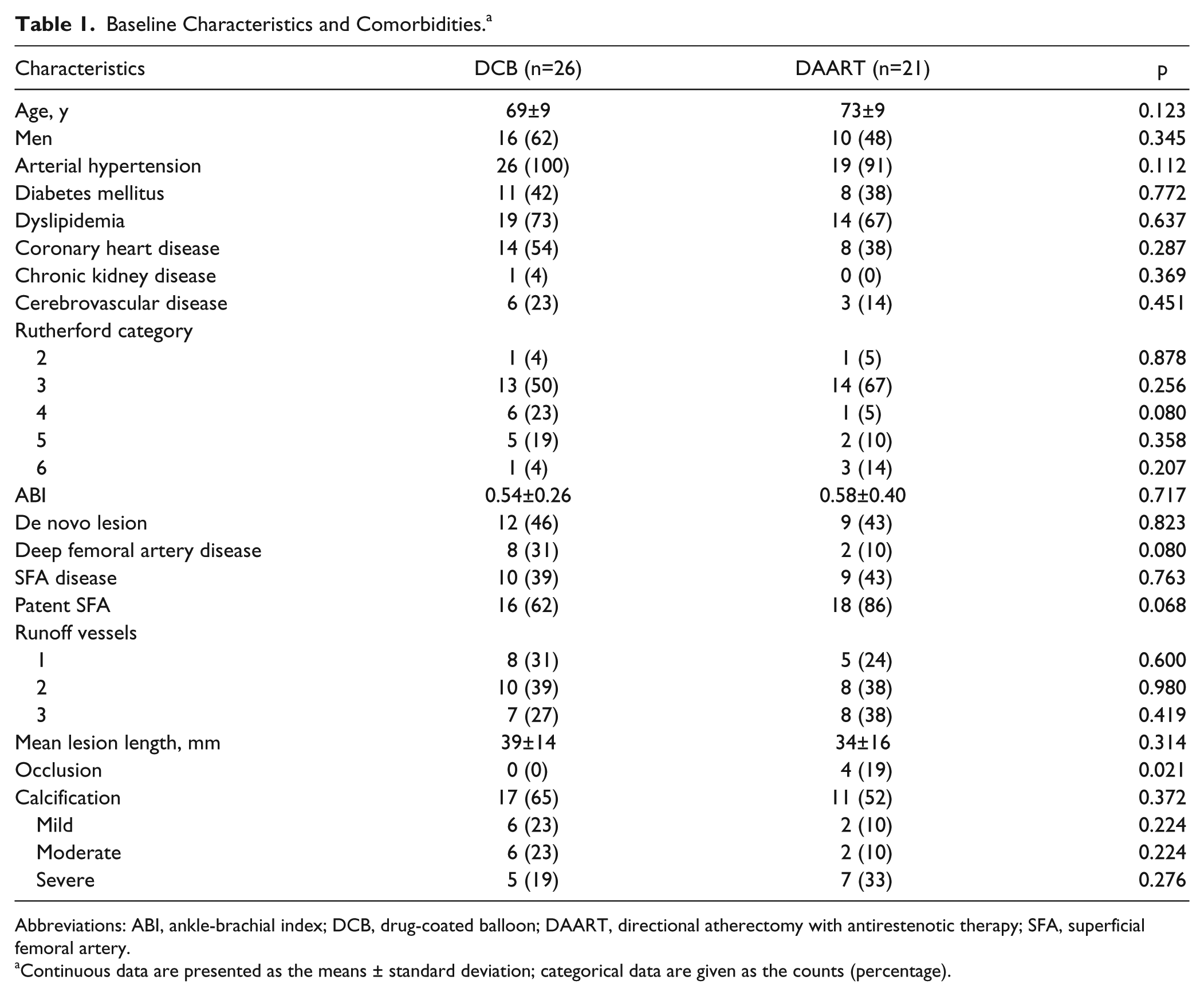
Abbreviations: ABI, ankle-brachial index; DCB, drug-coated balloon; DAART, directional atherectomy with antirestenotic therapy; SFA, superficial femoral artery.
Continuous data are presented as the means ± standard deviation; categorical data are given as the counts (percentage).
Intention-to-Treat Protocol
DAART
The aim of DA was to reduce the plaque burden of the target lesion at least 50%, while the procedure goal was to achieve a <30% residual stenosis by visual estimation. The choice of paclitaxel-coated balloon [In.Pact (Medtronic, Santa Rosa, CA, USA) or Passeo Lux (Biotronik, Berlin, Germany)] and debulking device [TurboHawk or HawkOne (Medtronic); Pantheris (Avinger, Redwood City, CA, USA)] was left to the discretion of the treating interventionist.
The contralateral CFA was the preferred primary access site; additional access sites were employed only when an up and over revascularization was not feasible. A percutaneous upper extremity access was not used owing to the need for 7-F or 8-F sheaths. A distal protection device (SpiderFX; Medtronic) was positioned in the SFA if it was patent; otherwise, the deep femoral artery was selected. The distal protection device was sized slightly larger than the vessel diameter. Plain angioplasty with low-profile catheters was applied prior to debulking only when the atherectomy device could not be advanced through the lesion.
Adjunctive DCB therapy was applied in all cases. The DCB was inflated with complete lesion coverage for 180 seconds. Conventional balloon angioplasty was not routinely performed before DCB. Flow-limiting dissections were treated using prolonged dilation; bailout stenting was applied only in cases of persistent major dissections or recoil.
DCB Angioplasty
The contralateral groin was also the preferred access site for DCB angioplasty; no distal protection device was used in this group. Vessel preparation with balloon dilation was performed prior to DCB angioplasty in all cases using a standard uncoated balloon inflated to a diameter 1 mm less than the selected DCB catheter. Adjunctive DCB therapy was then applied from healthy-to-healthy vessel; the paclitaxel-coated balloon selection was at the discretion of the treating interventionist. In the event of deep femoral artery disease requiring treatment, DCB angioplasty of the distal CFA/proximal SFA and of the deep femoral artery was performed using a kissing balloon technique. The inflation time was 180 seconds. Flow-limiting dissection or residual stenosis >50% was treated with repeated prolonged (>2 minutes) balloon inflation with an uncoated balloon. Provisional (bailout) stenting with a self-expanding nitinol bare stent was used to treat major flow-limiting dissections or recoils.
Dual antiplatelet therapy with acetylsalicylic acid (ASA; 100 mg/d) and clopidogrel (75 mg/d) was prescribed for 8 weeks, followed by ASA or clopidogrel monotherapy. Patients previously taking warfarin were maintained on the anticoagulant with an additional single antiplatelet agent for 8 weeks after the procedure and warfarin monotherapy thereafter.
Follow-up examinations in all patients were scheduled at 6 and 12 months after the initial procedure and annually thereafter or in case of clinical worsening. The patency of the treated vessels was assessed by duplex ultrasound at each follow-up. Angiography was performed in cases of clinical worsening.
Endpoints and Definitions
The main outcome measure was primary patency, defined as freedom from significant restenosis or occlusion without any reintervention. Secondary outcomes were technical success, secondary patency, and freedom from clinical-driven target related revascularization (TLR). Technical success was defined as residual stenosis <30% after DAART or DCB angioplasty in the absence of arterial perforation of the treated segment. Bailout stenting was considered loss of primary patency and associated with technical failure. Secondary patency was defined as restored flow in the treated segment after occlusion or restenosis. Any surgical revascularization of the CFA was considered loss of primary and secondary patency. In the event that the CFA was used as a proximal or distal anastomotic site, the patency of the treated vessels was not further analyzed. Significant restenosis was indicated by a >2.0 peak systolic velocity ratio on the ultrasound scan.
The degree of calcification was graded on the basis of the arterial wall calcium deposits observed during fluoroscopy. Mild calcification referred to the angiographic identification of calcifications <1 cm long on one side of the lumen, whereas moderate calcification was the presence of calcifications <1 cm along both sides of lumen. Severe calcification was defined by the radiopacities >1 cm along both sides of the arterial wall. 16
Statistical Analysis
Continuous variables are presented as the mean ± standard deviation or median (interquartile range, IQR), while categorical data are given as the count (percentage). Continuous numeric variables were compared by Student t test for independent variables or Mann-Whitney test according to their distribution (D’Agostino-Pearson test). The chi-test was applied to categorical data. Cumulative primary and secondary patency rates, as well as freedom from TLR and amputation-free survival, were estimated using the Kaplan-Meier method; between group differences were compared using the log-rank test. Estimates are given with the 95% confidence interval (CI). The threshold of statistical significance was p<0.05. Analyses were performed using MedCalc statistical software (version 12.4.0.0; MedCalc Software, Ostend, Belgium).
Results
The InPact Admiral/Pacific DCB catheter was used predominantly in both groups; only 1 patient (DCB only group) was treated with a Passeo Lux. In the DAART group, the TurboHawk atherectomy catheter was used in 15 patients, the Hawk-One atherectomy device in 5, and the optical coherence tomography–assisted Pantheris atherectomy catheter in 1 patient. The mean nominal CFA diameter was 6.2±1.2 mm, and the mean stenosis diameter was 1.4±1 mm. The mean luminal gain following atherectomy was 62%±25%, while the overall luminal gain following DAART amounted to 73%±21%. Concomitant iliac interventions were more frequently performed in DCB only patients (p=0.01) and DAART patients had more adjunctive femoropopliteal procedures performed (p=0.07). The need to treat concomitant deep femoral artery and proximal SFA lesions did not differ significantly between the 2 groups.
Early Outcomes
Technical success was achieved in 23 (88%) of the 26 patients in the DCB group vs 20 (95%) of the 21 DAART patients (p=0.41). The mean contrast volume was 147±48 mL for DCB vs 165±45 mL for DAART (p=0.20); mean fluoroscopy times were 18.3±7.0 minutes for DCB vs 23.2±11.5 minutes for DAART (p=0.08). Bailout stenting (1 DCB vs 1 DAART, p=0.87), vessel perforation (1 DCB vs 0 DAART, p=0.36), access site complications (4 DCB vs 3 DAART, p=0.91), and distal embolization (0 DCB vs 1 DAART, p=0.26) were comparable. In contrast, more non-flow-limiting dissections were observed following DCB angioplasty alone (8 vs 1 for DAART, p=0.02); no flow-limiting dissections were seen in either group. The single distal embolism in the DAART group was aspirated. The access site complications included 2 false aneurysms requiring surgical treatment following DCB angioplasty and 5 hematomas (2 DCB and 3 DAART).
Follow-up
The median follow-up intervals were 16 months (IQR 11, 24) and 17 months (IQR 9, 34) in the DCB and DAART groups, respectively. The 12-month primary patency (Figure 1A) was higher in the DAART group (88%, 95% CI 73% to 100%) vs 68% (95% CI 48% to 88%) for DCB; however, this difference did not reach statistical significance (p=0.40). The 12-month freedom from TLR estimate (Figure 1B) was 75% (95% CI 56% to 92%) for DCB vs 89% (95% CI 75% to 100%) for DAART (p=0.98), while DAART had better 12-month secondary patency (100%) vs 81% (95% CI 63% to 98%) for DCB (p=0.03). No aneurysmal degeneration of the treated vessels was observed during follow-up.

(A) Primary patency and (B) freedom from target lesion revascularization at 12 months for drug-coated balloon (DCB) angioplasty vs directional atherectomy with antirestenotic therapy (DAART). The standard error exceeded 10% at 16 months in both groups.
In follow-up, 1 DCB patient succumbed to acute coronary syndrome and 5 DAART patients died (3 of unknown causes and 2 of multiple organ dysfunction syndromes). None of the deaths was considered procedure-related. Three patients underwent major amputation of the index limb (2 DCB and 1 DAART) due to uncontrolled skin infections; amputation-free survival did not differ between the groups: 88% (95% CI 74% to 100%) for DCB vs 80% (95% CI 62% to 98%) for DAART (p=0.66). Figure 2 presents the clinical status of the treated patients at baseline and 12 months.

Rutherford categories for both groups at (A) baseline and (B) follow-up.
Among the reinterventions performed, 3 DCB patients underwent surgical endarterectomy, 1 had a repeat DCB angioplasty, 1 was treated with DAART, and the last patient was treated using cutting balloon angioplasty and DCB angioplasty. Of the 4 reinterventions in the DAART group, 2 were repeat DAART, 1 had a Supera stent implanted to treat a calcified reocclusion, and the last patient had DCB angioplasty alone.
Discussion
Despite the evolution of endovascular techniques, the role of endovascular therapy in the treatment of CFA disease remains controversial. Endovascular techniques, and especially stent therapy, are not favored by many physicians owing to the high mechanical stress exerted on the artery, the potential loss of femoral access for future percutaneous procedures, and the risk of jailing the deep femoral artery. Although DCB angioplasty and DAART could offer alternative approaches to the established treatment options, data concerning the outcomes of “leave nothing behind” strategies for CFA lesions are scarce. In this cohort, 12-month primary patency was higher following DAART, but not significantly significant. Both modalities minimized the need for permanent implants and showed promising 12-month secondary patency.
Similar to our results, the DEFINITIVE AR trial had a trend to higher 12-month primary patency following DAART compared to DCB angioplasty alone for SFA and popliteal artery disease (82.4% vs 71.8%, respectively). However, this difference did not reach statistical significance either. 12 A possible explanation in both studies is that the surveillance period was not long enough to identify a statistically significant difference between DAART and DCB only treatment. Moreover, in a single-center study, DAART was associated with higher primary patency than DCB angioplasty alone for isolated popliteal artery atherosclerosis. 15
Concerning CFA lesions, a recently published single-arm study reported promising results after DAART but without a control group. 17 In particular, Cioppa et al 17 observed a 90% duplex-documented primary patency, while the clinically-driven TLR rate at 12 months was 6.7%. Bailout stenting was necessary in 10% of the treated patients; however, compared to our cohort this was not considered loss of patency. Furthermore, the authors included only severely calcified lesions. Although a direct comparison of the aforementioned studies is confounded by the different selection criteria, it seems that vessel preparation with DA might provide an additional benefit to DCB angioplasty. Plaque modification might lead to better paclitaxel penetration into the arterial wall and improved drug uptake, a theoretical concept that has been examined in animal models using orbital atherectomy. 18 Debulking could be particularly meaningful in the treatment of CFA disease, given the high rates of osteoid metaplasia observed in CFA atherosclerotic plaques and the poorer outcomes of DCBs in severely calcified vessels.19,20 Of note, the DEFINITIVE AR trial suggested trends to higher patency rates following DAART in the treatment of calcified lesions. 12
Furthermore, the risk for dissections with the consequent increased need for adjunctive stent therapy may limit the performance of DCB angioplasty. 15 In our study cohort, DCB angioplasty produced more dissections, but these were not flow-limiting, and the bailout stent rate did not differ between the groups. The long-term effect of such dissections needs to be defined.
On the other hand, concerns are raised about the ability to sufficiently size the atherectomy catheter, as most de- bulking devices are designed to treat vessels with diameters up to 7 mm. In this study, DA prior to DCB angioplasty achieved a better patency rate; however, the difference was not statistically significant. Although this is likely related to the small sample size and the short follow-up period, the efficacy of DAART in the treatment of larger vessels has to be proved in larger trials.
Additionally, aneurysmal degeneration of the treated vessels may compromise the performance of DAART. 15 The higher antiproliferative drug uptake can theoretically increase the risk of aneurysm formation. Paclitaxel probably inhibits the healing of minor arterial wall injuries, which occur during plaque debulking and cannot be visualized by control angiography. This could be of importance in the treatment of smaller diameter vessels such as the popliteal artery. In our cohort, however, no degeneration of the treated vessels was observed, most probably because the larger diameter of the CFA may reduce the risk of deep arterial wall injury.
Angioplasty, atherectomy, and primary bare stent or stent-graft therapy have also been described in the treatment of CFA disease.7,9,21-25 Atherectomy as a standalone therapy can improve the acute outcomes and reduce the need for adjunctive stent deployment.7,21,25 However, up to now data concerning the long-term benefit of CFA atherectomy over plain balloon angioplasty are limited. 25
With regard to stent therapy, various series reported improved clinical and radiological outcomes compared to plain dilation for CFA lesions.7-9 Nonetheless, the relatively high rates of ISR limit the performance of primary stent therapy. 26 Both self-expanding and balloon-expandable stents have been used either as primary therapy or as bailout following balloon angioplasty. The high mechanical stress during flexion of the hip joint increases the risk for stent fractures and the consequent ISR. 27 Although stent deployment could preclude an important access site for percutaneous procedures, there are reports of uncomplicated arterial access through CFA stents. 22 Despite the aforementioned limitations, stent therapy using new-generation devices with increased flexibility and radial force might be a treatment option in highly selected patients and in severely calcified lesions.
Surgical endarterectomy is still considered the treatment of choice for CFA atherosclerosis. A number of studies reported the durability of open repair with primary patency rates up to 96% at 7 years.1-4 On the other hand, although surgical repair is considered by many physicians a safe and technically straightforward procedure, it is associated with a significant rate of local complications and perioperative morbidity.5,6 Nguyen et al 6 reported a 15% combined rate of overall mortality and major complications; 10% of patients were returned to the operating room. Interestingly, a significant number of adverse events occurred after hospital discharge. Obesity, diabetes, and chronic steroid use have been identified as risk factors for postoperative morbidity.5,6
The role of endovascular treatment in the management of these high-risk patients remains unclear. Although the use of bioabsorbable stents in CFA treatment was found to be inferior to surgery in terms of patency, 28 it significantly reduced the incidence of local complications. Interestingly, in the Endovascular Versus Open Repair of the Common Femoral Artery (TECCO) trial, 29 endovascular therapy was found to achieve 2-year clinical and hemodynamic outcomes comparable with surgery. The ongoing Percutaneous Intervention versus Surgery in the Treatment of Common Femoral Artery Lesions trial (PESTO-AFC; www.clinicaltrials.org NCT02517827), which will compare the performance of DAART to open repair, will inform this debate and provide further evidence concerning the efficacy of a “leave nothing behind” strategy for treatment of CFA disease.
Limitations
The retrospective nature of the study, the lack of randomization despite the comparable baseline characteristics of both groups, and the short 1-year observation period were major limitations of the current analysis. Additionally, during the study period, DCB catheters were available in diameters up to 7 mm, so undersizing of the selected devices could not be avoided in some cases. However, the launch of larger diameter DCB catheters (8–12 mm) might improve the outcomes of paclitaxel-coated balloon angioplasty and DAART.
Since endarterectomy was considered the treatment of choice during the study period, endovascular procedures were performed in highly-selected patients. Initially, endovascular procedures for CFA disease were indicated in patients who were considered poor candidates for surgery or in patients with postsurgical restenosis. However, following the paradigm shift in the treatment of femoropopliteal disease and the promising results of drug elution, our treatment protocol was expanded to include patients with excessive iliofemoral or femoropopliteal disease including the CFA.
Finally, the use of atherectomy and DCB catheters and a distal protection device increases the procedure cost considerably and could limit the application of DAART for the treatment of femoropopliteal disease in general.
Conclusion
In this nonrandomized, single-center study, vessel preparation with DA prior to DCB angioplasty was associated with a higher estimated 12-month patency, although the difference did not reach statistical significance. Nonetheless, both modalities were associated with promising 12-month outcomes. Up to now endovascular procedures for CFA disease are indicated in highly selected patients, and the application of “leave nothing behind” strategies in consecutive unselected patients remains undetermined. Because of the limited number of patients in this study, it was difficult to detect more than a trend; however, this analysis could serve as a basis for future randomized control trials. Ongoing prospective multicenter trials have to confirm the theoretical advantages of vessel preparation and address any areas of uncertainty regarding this treatment option.
Footnotes
Declaration of Conflicting Interests
The author(s) declared the following potential conflicts of interest with respect to the research, authorship, and/or publication of this article: Konstantinos Stavroulakis received honoraria from Medtronic. Arne Schwindt is a member of the advisory board of Avinger Inc. Theodosios Bisdas is a consultant for Medtronic.
Funding
The author(s) received no financial support for the research, authorship, and/or publication of this article.
