






Abstract
Keywords
Introduction
Endovascular treatment of external iliac artery (EIA) disease comes with low mortality and morbidity 1 but higher restenosis and reintervention rates than bypass surgery, which has excellent long-term patency but is associated with increased complications and death. 2 The TransAtlantic Inter-Society Consensus (TASC II) guidelines recommend endovascular treatment for noncomplex lesions (TASC II A and B) and open surgical repair for advanced lesions (TASC II C and D), such as EIA occlusions extending into the common femoral artery (CFA). 3 More recent literature advocates an endovascular-first approach, even in advanced lesions. 4 However, results after endovascular revascularization in patients with advanced EIA lesions are disappointing, especially when the CFA is involved. 5 In these patients, remote iliac artery endarterectomy (RIAE) may be a less invasive hybrid alternative to bypass surgery. 6 In a selected group of patients, this technique may combine the benefits of endovascular and open surgical therapies. However, since its introduction 20 years ago, only a handful of articles have been published reporting results of this technique.6–13 This study evaluated the long-term results of RIAE in 2 vascular referral centers and reviewed the existing literature.
Methods
Study Design and Patient Population
A retrospective analysis was conducted to identify all patients with EIA occlusion extending at least partially into the CFA who underwent RIAE for symptoms of Rutherford category 2–6 ischemia at 2 vascular centers between January 2004 and August 2015. Alternative options during this time frame were open surgical bypass or CFA endarterectomy combined with endovascular EIA revascularization; however, in our institutions, CFA occlusion was considered a relative contraindication to complete endovascular treatment. In the case of combined CFA and EIA lesions without complete occlusion of the EIA, CFA endarterectomy and endovascular treatment of the EIA were preferred.
Patients were identified by operation codes from the electronic patient record system, followed by examination of the operative reports to retrieve technical success, duration of surgery, blood loss, planned and unplanned additional procedures, and complications. Baseline characteristics, perioperative details, and follow-up data were collected and entered into an online data management system (Castor EDC; CIWIT B.V., Amsterdam, the Netherlands). Medical ethics research committee approval was obtained for analysis, and the report was written in accord with the Strengthening the Reporting of Observational Studies in Epidemiology (STROBE) 14 guidelines.
The database search identified 109 patients (mean age 64.2±10.7 years; 72 men) in whom 113 RIAEs were attempted (1 simultaneous and 3 staged bilateral procedures). The indication for surgery was intermittent claudication in 59 (52.2%) procedures, rest pain in 33 (29.2%), and tissue loss in 21 (18.6%). Patient characteristics and risk factors as defined by Rutherford et al 15 are summarized in Table 1. The majority of limbs (82, 72.6%) had TASC II D lesions (31 TASC II C). Calcification was scored as none in 29 (25.7%), mild (1%–25% circumference) in 26 (23.0%), moderate (25%–50%) in 22 (19.5%), and severe (>50%) in 36 (31.9%).
Baseline Characteristics of the 109 Patients in the Study. a

Abbreviations: CIA, common iliac artery; EIA, external iliac artery.
Continuous data are presented as the means ± standard deviation; categorical data are given as the counts (percentage).
Glomerular filtration rate <60 mg/mL/1.73 m2.
In 97/113 limbs; ankle-brachial index was not performed or was not reliable in 16 patients due to incompressible arteries.
Technique
All patients were prescribed a statin and aspirin unless they were already taking another antiplatelet or anticoagulant drug. Patients with intermittent claudication were initially treated conservatively by supervised exercise therapy, smoking cessation, and best medical treatment. Patients whose symptoms did not improve after 3 to 6 months were scheduled for RIAE.
In the early years of the series, procedures were performed in the general operating room with a C-arm; in 2011 this changed to a hybrid angio suite at both centers. Patients were administered ceftriaxone (2 g) or cefazolin (1 g) prophylactically 60 minutes before the operation. Procedures were performed under regional or general anesthesia, and all patients received heparin (5000 units) systemically. RIAE was conducted through a vertical groin incision, exposing and controlling the CFA, superficial femoral artery (SFA), and deep femoral artery (DFA). After the SFA and DFA were clamped, a vertical arteriotomy was made in the CFA, and a spatula was used to separate the intimal core from the adventitia. It is necessary to have at least 2 to 3 cm of intimal core separated to be able to keep tension on the intimal core when performing the remote endarterectomy. After distal transection of the intimal core, a Vollmar ring stripper was advanced retrograde up to the origin of the hypogastric artery, or in some cases, even into the common iliac artery (CIA) when no resistance was felt at the origin of the hypogastric arteries. The Vollmar ring stripper was changed for a MollRing Cutter (LeMaitre Vascular, Inc, Burlington, MA, USA), and the intimal core was cut at the desired position and removed using slight traction with the rings of the MollRing Cutter semiclosed. The intimal core was removed, and angiography was performed. CIA occlusion was treated with recanalization and balloon-expandable stent placement. In the case of residual stenosis or dissection of the proximal transection zone, balloon angioplasty with or without stent placement was performed. The endarterectomized segment itself was not routinely stented. Stent size was determined by the diameter of the proximal, non-endarterectomized segment of the artery to avoid oversizing; stents ranged in diameter from 6 to 9 mm. In the EIA, a self-expanding stent was preferred. Usually this was delivered from the contralateral side, but when this approach was not feasible, a retrograde puncture of the Dacron patch closing the SFA arteriotomy was used.
CFA endarterectomy with Dacron patch angioplasty was performed in all cases. In case of DFA origin stenosis, profundaplasty was performed routinely. Simple symptomatic aortoiliac lesions on the contralateral side were generally treated endovascularly within the same procedure, while more extensive contralateral aortoiliac lesions required a second procedure.
Follow-up
Surveillance was not standardized. Patients were seen at the outpatient clinic 6 to 8 weeks postoperatively and were eventually discharged from follow-up after symptom improvement. Additional imaging studies were performed if symptoms recurred. All patients who had been discharged for 1 year or more were invited for clinical assessment, treadmill test, and duplex ultrasonography. Twenty of 26 invited patients responded.
Outcome Measures and Definitions
Primary outcomes were primary, assisted primary, and secondary patency during follow-up. Secondary outcomes were technical success, hemodynamic success, ABI improvement, clinical success, 30-day mortality, complication rate, freedom from major amputation [in patients with critical limb ischemia (CLI)], restenosis rate, and reintervention rate during follow-up.
Technical success was defined as revascularization of the occluded EIA using RIAE with good inflow, at least DFA outflow, and no additional open procedures. The use of additional endovascular procedures was not considered a technical failure. Primary patency was defined as uninterrupted patency without any reinterventions. Assisted primary patency referred to the use of any reintervention to maintain patency. Secondary patency was defined as patency after reintervention for occlusion. Restenosis was indicated by a peak systolic velocity ratio >2.5 on duplex ultrasonography or >50% stenosis on an imaging study. Hemodynamic success was based on ABI improvement of ≥0.10 postoperatively. Clinical success referred to improvement of at least 1 Rutherford category and improvement to at least Rutherford category 3 for patients with CLI. 15 Major amputation was defined as amputation above the level of the ankle.
Systematic Review
A comprehensive search was performed based on the Preferred Reporting Items for Systematic Reviews and Meta-Analyses (PRISMA) statement 16 to identify all full-text English-language articles published after 1990 reporting the results of RIAE. PubMed and EMBASE were searched on September 15, 2016, using the following search terms as index terms or free-text words: “remote” and “endarterectomy” or “thromboendarterectomy,” and “iliac” and various search terms describing the lower extremity. This systematic review was registered in the Prospero international prospective database of systematic reviews ( http://www.crd.york.ac.uk/PROSPERO registration number CRD42015026963).
Two authors (J.B. and S.B.) independently performed a title and abstract search, followed by a full-text search of articles that were deemed relevant. References and bibliographies of included articles were searched for additional references. Data were then collected independently using a standardized data form. The methodological quality of the studies was assessed using the MINORS (Methodological Index for Nonrandomized Studies) classification system. 17 Studies were considered of high quality when they scored at least 9 points (16 possible). Disagreements were resolved by discussion, and the final decision was made by a third author (B.F.).
Statistical Analysis
Continuous data were compared using the Student t test, while categorical data were compared using the chi-square test. Kaplan-Meier survival analysis was employed where feasible; estimates are presented with the 95% confidence interval (CI). A 2-sided p<0.05 was considered statistically significant. Statistical analysis was performed with SPSS software (version 23.0; IBM Corporation, Armonk, NY, USA).
Results
Technical success was achieved in 95 (84.1%) of the 113 procedures. Advancing the ring stripper was not possible in 18 RIAEs because of heavy calcifications in 10, a rupture of the EIA adventitial layer in 7, and a dissection progressing into the distal aorta in 1 patient. In all but 1 of the 7 EIA rupture patients there was still an occluded proximal EIA segment, so there was no active bleeding. The failed RIAEs were successfully converted to an open surgical bypass in 12, semiclosed endarterectomy in 2, and balloon angioplasty in 2 patients. No revascularization was performed in the remaining 2 patients because no other options were available due to advanced comorbidity and contralateral CFA occlusions, resulting in major amputation in 1 patient. All other patients with technical failure recovered without mortality or major amputation. A small blush was seen on the completion angiogram in 2 patients and treated successfully with a covered stent. Despite the intraoperative complication, these procedures were considered technically successful. Average operation time (incision to closure) for successful procedures was 160±70 minutes, and the average blood loss was 279±239 mL.
The CIA was involved in 59 patients. In 16, RIAE was extended into the CIA, and another 20 occlusions and 23 stenoses were treated with angioplasty and stenting except for 2 cases in which only balloon angioplasty was performed. Including the aforementioned patients, additional stent placement proximal of the RIAE was performed in 69 (72.6%) of 95 patients [mean stented length 40 mm (range 30–52; 35 limbs) in the EIA, 46 mm (range 30–60; 38 limbs) in the CIA-EIA, and 64 mm (range 38–88; 11 limbs) in the CIA]. In these cases, the distal edge of the stent was deployed to cover the proximal transection edge of the RIAE.
Occlusion of preoperatively patent hypogastric arteries was seen on completion angiography in 7 (10.4%) of 67 patients. In all, a bare stent was placed covering the origin of the hypogastric artery. None of these patients complained of buttock claudication or sexual dysfunction. One preoperatively occluded hypogastric artery was patent after RIAE.
RIAE alone was considered insufficient in the 45 CLI patients, so 11 concomitant revascularizations were performed in the femoropopliteal area: 5 femorodistal bypasses, 3 remote SFA endarterectomies, and 3 SFA angioplasties. After RIAE, all patients had a patent DFA and 35 of 45 patients also had a patent SFA or bypass.
Postoperative complications were observed in 13 (13.7%) of the 95 successfully treated limbs. Four wound hematomas and 4 superficial wound infections were treated conservatively. Two wound infections with septic bleeding from the CFA patch were re-explored with successful resolution. A case of pneumonia and a urinary tract infection (UTI) were treated with antibiotics. There was 1 myocardial infarction (MI) and no perioperative deaths.
Preoperative and postoperative ABI measurements were available in 72 patients; hemodynamic success was obtained in 66 (91.7%) patients. The ABI measurements in 5 patients were unchanged, and the ABI in 1 patient deteriorated by 0.2 because of a complete occlusion after 3 months. Average improvement of ABI was 0.45±0.21 (p<0.001). In the 84 patients with postoperative clinical success assessment, 80 (95.2%) showed clinical improvement. Of the other 4 patients, 2 had tissue loss that eventually led to major amputation; the other 2 were claudicants who had no improvement in symptoms.
Follow-up
Radiological follow-up was available over a mean of 28 months in 84 (88.4%) of the 95 patients with a successful procedure. Five patients had no follow-up and another 6 did not have any postoperative radiological assessment. At 5 years, primary patency of successful RIAEs was 78.2% (95% CI 64.0% to 92.3%), assisted primary patency was 83.4% (95% CI 69.4% to 97.4%), and secondary patency was 86.7% (95% CI 74.1% to 99.2%; Figure 1). An EIA restenosis occurred in 17 patients during follow-up; 10 were not treated because 7 were asymptomatic, 2 had only mild claudication, and 1 patient had a below-the-knee amputation. Of the 7 patients who underwent a reintervention, 5 were treated endovascularly, 1 was treated with aortofemoral bypass, and 1 underwent femorofemoral crossover bypass. The estimated restenosis rate was 33.0% at 5 years, and the estimated reintervention rate was 14.7% (Figure 2).

Kaplan-Meier graph of primary (dotted line), assisted primary (semi-dotted line), and secondary patency (continuous line).

Kaplan-Meier graph of reintervention (dotted line) and restenosis (continuous line).
The difference in primary patency, or any of the other outcomes, between patients who did and did not undergo stent placement was not significant (p=0.493 for primary patency by log-rank test). Also, no difference was shown between patients who had RIAE continued into the CIA, between patients who had endovascular treatment of the CIA and patients who had patent CIAs, or between patients who were current smokers at the time of RIAE and those who were not. Unfortunately, data on smoking behavior at the time of diagnosis of restenosis was not obtainable.
Freedom from major amputation in 45 successfully treated CLI patients was 94.7% at 1 year, which was sustained over 5 years of follow-up. There were no major amputations in the intermittent claudication group.
Systematic Review
Six studies7–11,13 (Table 2; Figure 3) were eligible for inclusion, encompassing 419 limbs treated in 407 patients; adding to this the current series produced 532 limbs for analysis. All studies were nonrandomized and retrospective except one. 10 Five studies were scored as low methodological quality, and only the study by Smeets et al 10 was scored as high methodological quality (Table 3). The latter was the only study to have a standardized follow-up protocol.
Characteristics of the Articles in the Systematic Review.

Abbreviations: CAD, coronary artery disease; CLI, critical limb ischemia; COPD, chronic obstructive pulmonary disease; HTN, hypertension; NR, not reported; P, prospective; R, retrospective; SMK, smoking.
Data are presented as the means or median (range).

Flowchart of inclusion of articles.
Methodological Index for Nonrandomized Studies (MINORS) Scores of Included Articles.
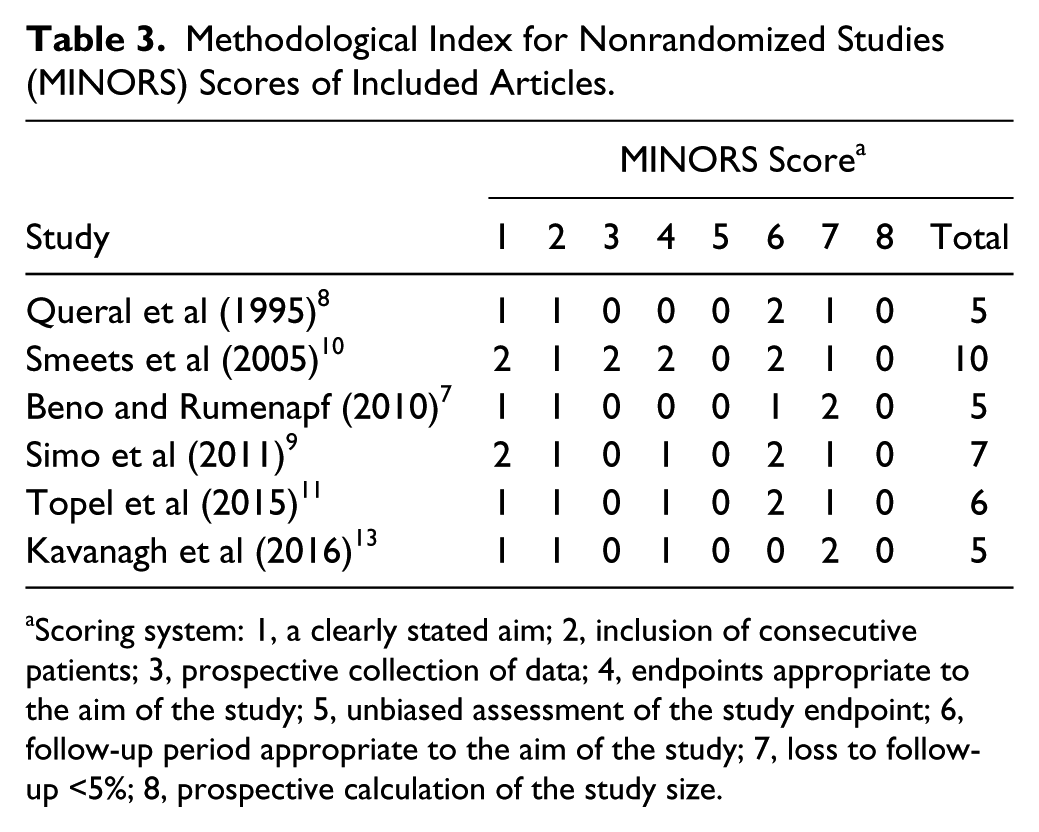
Scoring system: 1, a clearly stated aim; 2, inclusion of consecutive patients; 3, prospective collection of data; 4, endpoints appropriate to the aim of the study; 5, unbiased assessment of the study endpoint; 6, follow-up period appropriate to the aim of the study; 7, loss to follow-up <5%; 8, prospective calculation of the study size.
Several different techniques for RIAE were used. Queral et al 8 employed an angioplasty balloon before advancing the ring stripper to create the dissection plane. Kavanagh et al 13 used a balloon inside the ring stripper to dissect the intimal core rather than the MollRing Cutter. All but Smeets et al 10 passed the lesion with a guidewire before advancing the ring stripper. Simo et al 5 applied direct stenting in the proximal transection zone; the other studies described a selective stenting strategy, using a stent only for residual stenosis or flow-limiting dissection. The stenting rate in these studies varied widely, ranging from 11.1% to 72.6%.
The definition of patency varied among the studies. Queral et al 8 defined patency as the absence of restenosis or reocclusion on duplex imaging. Simo et al 9 stated that “Clinical success and patency were determined using the Rutherford classification,” implying that only full thrombosis would be considered loss of patency. Smeets et al 10 defined patency as absence of occlusion or >70% restenosis. Kavanagh et al 13 and Topel et al 11 did not provide a definition. Patency rates ranged from 75% to 100% at 1 year and from 63.9% to 83% at 5 years. Beno and Rumenapf 7 reported only a 6-month primary patency rate of 100%. Kavanagh et al 13 reported 1- and 2-year patency rates of 100% and 78%, respectively. Pooled primary patency was 85.8% at 1 year, 77.6% at 3 years, and 73.3% at 5 years (Table 4). Three studies9,10,13 reported assisted primary patency and secondary patency. Pooled assisted primary patency rates were 90.8% at 1 year, 86.6% at 3 years, and 81.7% at 5 years. Pooled secondary patency rates were 92.7% at 1 year, 89.9% at 3 years, and 84.7% at 5 years.
Outcomes from the Studies in the Systematic Review.
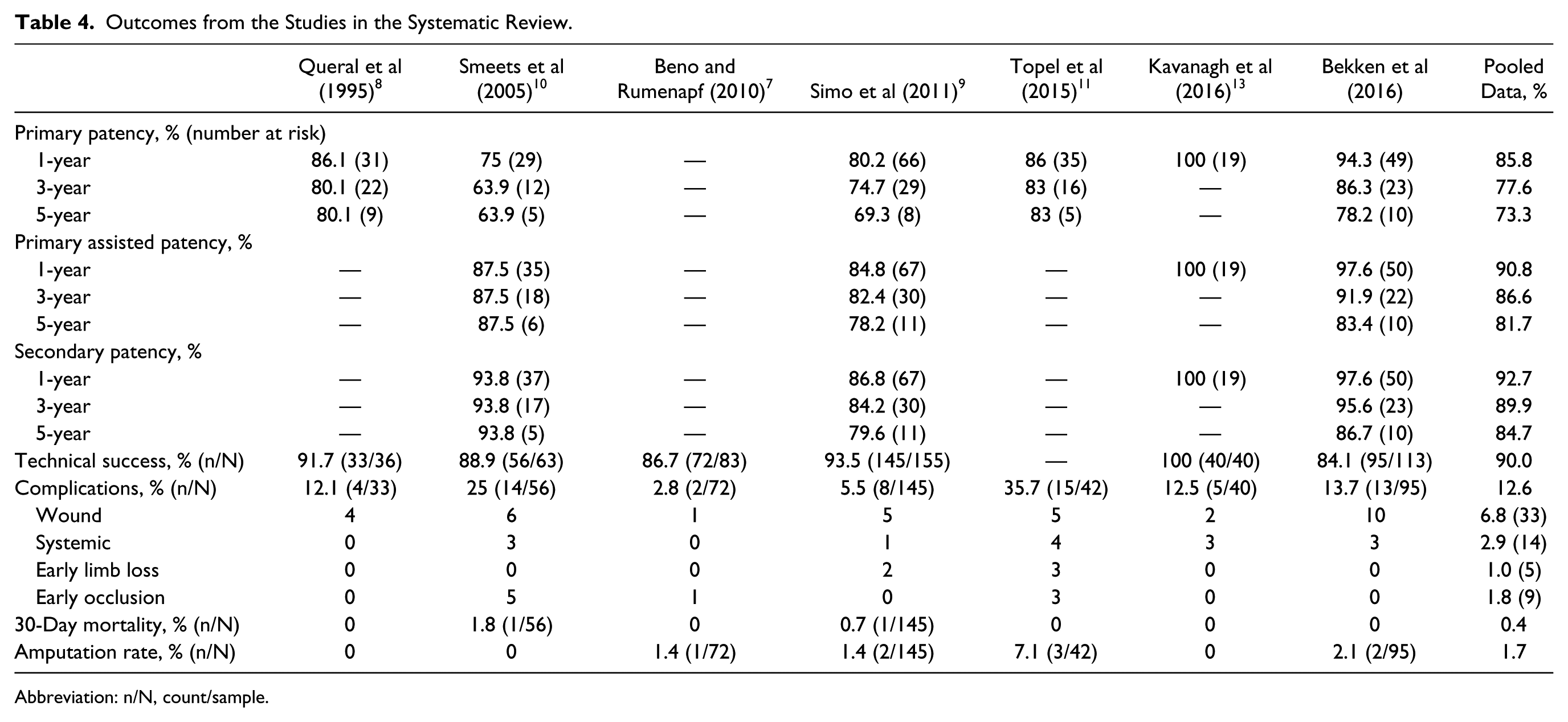
Abbreviation: n/N, count/sample.
All studies except one 11 reported technical success (pooled rate 90.0%). Of 49 technical failures reported, 27 were due to inability to advance the guidewire or ring stripper. An adventitial rupture occurred in 13. Intraoperative conversion to surgical bypass or semiclosed endarterectomy was successful in 47 of 49 failures.
The pooled complication rate was 12.6% for all studies. Complications were classified as wound (hematoma, infection, and bleeding), systemic (pneumonia, UTI, transfusion, and MI), early limb loss, and early occlusion (Table 4). One of the 5 MIs was fatal. Early limb loss was defined in all publications as unexpected major amputation within 30 days. Early occlusions were treated with thrombectomy or conversion to iliofemoral bypass. The pooled 30-day mortality was 0.4%. Based on all studies, the pooled amputation rate was 1.7%.
None of the studies reported restenosis or reintervention rates. Only 2 studies reported hypogastric artery patency. Simo et al 9 saw no alteration of iliac artery patency at completion angiography, while Kavanagh et al 13 reported that hypogastric artery occlusion increased from 35% to 55%; however, no pelvic or buttock ischemia was reported.
Only 3 studies7,9,13 reported clinical success. Beno and Rumenapf 7 observed clinical success (from clinical examination and duplex imaging) in 71 (98.6%) of 72 patients. Kavanagh et al 13 stated that all patients but one had subjective symptom improvement. Simo et al 9 defined clinical improvement as increase in the ABI >0.10 and at least a single Rutherford category improvement. The clinical success rate was 76.6%. A further 18.6% of patients had improvement in ABI >0.10 but no improvement in the Rutherford classification. Only 3.4% of patients had no change in ABI. Clinical deterioration occurred in 2 (1.3%) patients with unexpected major amputation. Data on this outcome could not be pooled because of the heterogeneity in the definition.
Discussion
RIAE is a technically challenging procedure, as reflected by its substantial technical failure rate, and is considered to have a learning curve of at least 8 to 10 procedures. 8 The 2 main reasons for failure are inability to advance the ring stripper and adventitial perforation. To be able to advance the ring stripper it is necessary to have at least 2 to 3 cm of intimal core that can be grasped, either with a clamp or by hand, to keep it under tension when advancing the ring stripper. Calcified plaque irregularities may cause challenges in advancing the ring stripper. However, with slight oversizing of the ring stripper, it is generally possible to advance it right up to the origin of the hypogastric artery or even into the CIA. Excessive oversizing should be avoided to minimize the risk of adventitial rupture, which is especially high in calcified, irregular lesions. Furthermore, force should be avoided when resistance is felt during advancement. Rather, one should try advancing from different angulations or rotating the ring stripper while always keeping tension on the intimal core. When passage of the ring stripper is still not possible, the operator should consider endovascular recanalization and stenting of the residual occluded segment.
Adventitial rupture can occur at 2 junctures in the RIAE procedure: during dissection of the intimal core, which is more common, or following removal of the core. In the first case, no hemorrhage will occur, as there is no antegrade flow in the EIA. In the second case, there will be antegrade arterial flow, so prompt control is required by either placing a covered stent or by clamping the CIA through a retroperitoneal approach.
During the period of our case series, guidewire passage of the lesion was not routinely performed. However, this adaption of the technique may have some advantages. First, the guidewire might facilitate the passage of the ring stripper and thereby reduce the risk of perforation. In the event that a perforation occurs nonetheless, the guidewire can be used to place a covered stent, obviating the need to perform more invasive bailout procedures such as iliofemoral bypass. So, the safety profile of the procedure could be improved by the use of a guidewire. Conversion of an intended RIAE to a more invasive surgical procedure has no adverse clinical effect on long-term outcomes. 10
The 84% technical success rate in our series was lower compared with other reports (Table 4). One explanation is that both centers already had considerable experience with RIAE at the start of the inclusion period, so perhaps the indications were broadened to include more challenging lesions, as illustrated by the preponderance of TASC II D lesions. Moreover, half the patients had intermediate or severe calcification of the EIA occlusion. Finally, no guidewire was used in our series before the ring stripper was advanced, as was done by other authors.7 –9,11,13
One possible risk of the procedure is hypogastric artery occlusion, which occurred in 10% of our patients who had patent hypogastric arteries preoperatively. Two other studies9,13 reported 0% and 20% hypogastric artery occlusion rates. Both in our own series and in the literature, no buttock claudication or sexual dysfunction has been reported. Because of the retrospective nature of these studies, this complication may be underreported.
One of the advantages of RIAE is its low morbidity and mortality (0.4% 30-day pooled rate), especially compared with bypass surgery, with its reported major complication rate ranging to 30% and mortality of ~3%. 18 Most complications after RIAE were minor, predominantly local wound problems that could be treated successfully with conservative measures. Compared with aortofemoral bypass surgery, RIAE is obviously a less invasive technique, relieving patients of the need for an abdominal or retroperitoneal incision and aortic clamping. These benefits allow treatment of patients with severe cardiopulmonary disease who would otherwise not be appropriate for surgical revascularization. For patients who have patent CIAs, as was the case in about half of our patients, iliofemoral bypass is a less invasive alternative to aortofemoral bypass, obviating the need for midline incision and aortic clamping. Still, an additional retroperitoneal incision is warranted, leading to greater surgical trauma. Two recent case series reported mortality up to 1.9% and a major complication rate up to 12.5%.19,20
In a large review of open vs endovascular repair for aortoiliac occlusive disease, 5-year patency estimates were 82.7% for primary and 91.0% for secondary patency. 18 Carsten et al 19 reported 5-year secondary patency for iliofemoral bypasses of 93.3%. 19 Compared with these results, patency rates after RIAE were markedly lower. However, almost half of the restenoses after RIAE were asymptomatic, perhaps because these patients had extensive occlusions preoperatively with well-developed collaterals, which are preserved after RIAE. Moreover, because of comorbidities, the walking distance may be insufficient to develop symptoms.
Several cohort series have shown decreased patency rates after endovascular treatment of the EIA compared with endovascular treatment of the CIA.21–23 A recent randomized controlled trial comparing bare metal and covered stents for both CIA and EIA disease showed 5-year patency rates of 73.9% for covered stents and 62.9% for bare stents. 24
Compared with RIAE, endovascular treatment has less favorable patency rates, especially in combined EIA and CFA lesions. Endovascular treatment of concomitant EIA and CFA obstructions results in 2-year assisted primary patency rates of only 45%.5,25,26 Although complication rates after endovascular treatment are well below 10% in most series, 2 most surgeons would perform CFA endarterectomy rather than angioplasty alone in patients with disease extending into the CFA. 27 In these patients who already have an indication for a groin incision, the benefit of a lower complication rate of EIA endovascular treatment disappears. A series of 171 patients undergoing combined CFA endarterectomy and iliac stenting reported a complication rate of 22%, with a 5-year primary patency of 60%. 28 Therefore, patients with EIA disease progressing into the CFA seem excellent candidates for treatment with RIAE, combining improved patency rates with acceptable morbidity.
The use of stents after RIAE varies greatly among the available studies, in which a selective stenting strategy was most commonly used. Our relatively high stenting rate may be explained by the high number of patients with concomitant CIA disease. The RIAE was continued into the CIA in some of these patients, but most underwent additional recanalization and stent placement in the CIA to avoid rupture of the origin of the hypogastric artery during RIAE. Simo et al 9 advised that a primary stenting strategy may lead to less restenosis and longer patency because, in their experience, most restenoses occurred at the proximal transection zone. In our series, there was no difference in patency rates or other outcomes between stented and non-stented patients. Also, the series in this review with higher stenting rates do not seem to report better results. Further research is therefore required to determine the optimal stenting strategy in RIAE.
Limitations
Several limitations to the study have to be addressed. Because of the retrospective nature of the study, selection bias cannot be ruled out, although this was minimized by our scrupulous search of operation codes and operative reports. Also only patients with total EIA occlusions were treated with RIAE in our centers, while other studies also included patients with stenosis. This may lead to further selection bias, although it is unclear how this affects outcomes.
There was a considerable loss to follow-up, as 11.6% of our patients had no radiological follow-up at all. This may also have led to some attrition bias as patients who were free from symptoms may have been less inclined to continue follow-up; however, mean follow-up for the rest of the group was well over 2 years.
Unfortunately, because of the retrospective nature of the study and the fact that some patients were treated over a decade ago, it was not always possible to retrieve all desired data from the patient files. For example, ankle-brachial indexes and toe pressures were unavailable in 16 patients, and smoking habit in follow-up was not routinely recorded, so the influence of persistent smoking on patency rates could not be determined.
Conclusion
For EIA occlusions extending into the CFA, RIAE appears to be a valuable hybrid treatment option. It combines acceptable morbidity and low mortality with good long-term patency. It has some advantages over an open surgical iliofemoral bypass or complete endovascular revascularization and could be the best treatment option in selected cases.
Footnotes
Declaration of Conflicting Interests
The author(s) declared no potential conflicts of interest with respect to the research, authorship, and/or publication of this article.
Funding
The author(s) received no financial support for the research, authorship, and/or publication of this article.
