






Abstract
Purpose:
To directly compare the clinical outcomes of aortobifemoral bypass surgery (ABF) and endovascular treatment (EVT) for chronic total occlusion (CTO) of the infrarenal abdominal aorta (IAA).
Materials and Methods:
In this retrospective, multicenter study, we used an international database of 436 patients who underwent revascularization for CTO of the IAA between 2007 and 2017 at 30 Asian cardiovascular centers. After excluding 52 patients who underwent axillobifemoral bypass surgery, 384 patients (139 ABFs and 245 EVTs) were included in the analysis. Propensity score-matched analysis was performed to compare clinical results in the periprocedural period and the long-term.
Results:
Propensity score matching extracted 88 pairs. Procedure time (ABF; 288 [240–345] minutes vs EVT; 159 [100–205] minutes, p<0.001) and length of hospital stay (17 [12–23] days vs 5 [4–13] days, p<0.001) were significantly shorter in the EVT group than in the ABF group, while the proportions of procedural success (98.9% versus 96.6%, p=0.620), complications (9.1% versus 12.3%, p=0.550), and mortality (2.3% versus 3.8%, p=1.000) were not different between the groups. At 1 months, ABI significantly increased more in the ABF group for both in a limb with the lower (0.56 versus 0.50, p=0.018) and the higher (0.49 versus 0.34, p=0.001) baseline ABI, while the change of the Rutherford category was not significantly different between the groups (p=0.590). At 5 years, compared with the EVT group, the ABF group had significantly better primary patency (89.4±4.3% versus 74.8±4.3%, p=0.035) and survival rates (86.9±4.5% versus 66.2±7.5%, p=0.007). However, there was no significant difference between the groups for secondary patency (100.0%±0.0% versus 93.5%±3.9%, p=0.160) and freedom from target lesion revascularization (TLR) (89.3±4.3% vs 77.3±7.3%, p=0.096).
Conclusion:
Even with recent advancements in EVT, primary patency was still significantly better for ABF in CTO of the IAA. However, there was no difference between the groups in terms of secondary patency and freedom from TLR at 5 years. Furthermore, there was no difference in procedural success, complications, mortality, and improvement in the Rutherford classification during the periprocedural period, with significantly shorter procedure time and hospital stay in the EVT group.
Keywords
Introduction
Recent advancements in endovascular technology and techniques have led to the expansion of indications for endovascular treatment (EVT) of complex aorto-iliac lesions, categorized as TransAtlantic Inter-Society Consensus (TASC) II C and D lesions, with satisfactory results comparable to those of surgical bypass.1–4 This momentum is further accelerated by the evidence that previous EVT treatment does not affect the outcomes of patients undergoing secondary open surgery. 5 However, the recommended management of chronic total occlusion (CTO) of the infrarenal abdominal aorta (IAA), sometimes called Leriche syndrome, is still surgical bypass, due to excellent long-term patency.6,7 This is recommended in the most recent guideline, if the patient is able to tolerate surgical bypass. 8
There have been sporadic reports focusing on EVT for CTO of the IAA, most with a limited number of patients,9–13 and to the best of our knowledge, only one study directly compared EVT with surgical bypass.
14
However, this study combined cases of aortobifemoral bypass (ABF) with cases of axillobifemoral bypass for the surgical treatment of CTO of the IAA.
14
Since ABF is significantly superior in terms of patency and is the preferred first-line treatment,14–16 the results of EVT should be compared with the results of ABF. Therefore, we conducted a retrospective study to compare clinical outcomes between ABF and EVT for CTO of the IAA in real-world clinical practice using an international, multicenter registry; the
Materials and Methods
Patients and Study Design
This was an international, multicenter, retrospective study using a registry of 436 patients undergoing revascularization for CTO of the IAA between 2007 and 2017 at 30 cardiovascular centers in Asia (CHAOS registry). All patients had symptomatic peripheral arterial disease (PAD), including chronic limb threatening ischemia (CLTI) (Rutherford categories 2–6). Revascularization for acute limb ischemia was not included in the registry, and after excluding 52 patients undergoing axillobifemoral bypass surgery, the remaining 384 patients (139 ABFs and 245 EVTs) were included in the analysis. The study was performed in accordance with the Declaration of Helsinki, and the study protocol was reviewed and approved first by the institutional review board (IRB) of the principal investigator’s hospital (reference number: #30-70), and then at each hospital registering the study participants. Since this study was a retrospective review of medical charts, the IRB waived the need for patient informed consent, and the opt-out method was utilized.
Patient Management and Data Collection
All interventions were performed by a board-certified physician at each hospital. The decision to perform ABF or EVT was at the discretion of each hospital. All ABFs were performed under general anesthesia, and a prosthetic graft was used to bypass the occlusion, from the proximal IAA to the distal arteries. Most EVTs were performed under local anesthetic, and selection of the puncture site, usage of intravascular ultrasound (IVUS), guidewires, balloons, and stents were at the operator’s discretion. Generally, retrograde approach from the common femoral artery (CFA) was the initial approach. When the guidewire failed to cross the lesion, antegrade approach from the upper limb was performed as a bidirectional approach. As for the stent size selection, when IVUS was not used, measurement from preoperative computed tomographic (CT) scan was used. Since covered stents were not approved in all countries at the time of the study, bare metal stents were most commonly used in the study population. All hospitals had similar postintervention surveillance protocols, which included perioperative antiplatelet therapy and periodic evaluation using ankle brachial index (ABI), duplex ultrasound, or CT scan. Data gathered from the patient charts included demographics, comorbidities, medications, lesion characteristics, and clinical outcomes (intraoperative, perioperative, and long-term).
Definitions
Severe calcification was defined as a calcification length of more than 50% of the lesion length with circumferential calcification at any point in the lesion on the CT scan. Technical success was defined as successful use of a device or technique to establish vessel patency with residual stenosis <30% or reduction of the pressure gradient across the lesion to <10 mm Hg for both limbs at the end of the procedure. Procedural complications included any complication requiring additional treatment or prolongation of the hospital stay. Procedural mortality included any deaths occurring within 30 days of the procedure. Postoperative ABI value and improvement in the Rutherford classification were also assessed within 30 days of the procedure. Loss of primary patency was defined as a peak systolic velocity ratio >3.0, measured by duplex ultrasound, or more than 50% stenosis on CT scan or angiography. Clinically-driven target lesion revascularization (TLR) was defined as a secondary procedure performed for symptomatic restenosis. Loss of secondary patency was defined as the point when reintervention was aborted.
Outcome Measures
Primary patency was the primary endpoint. Secondary endpoints included procedure time, procedural success, procedural complications, procedural mortality, length of hospital stay, improvement in Rutherford classification, freedom from TLR, secondary patency, and survival. Assessments of angiography, CT scan, and duplex ultrasound results were reported on site, without validation by a core laboratory.
Statistical Analyses
Data on baseline characteristics are presented as mean±standard deviation (SD) or median (interquartile range) for continuous variables and as frequency (percentage) for categorical variables, unless otherwise mentioned. Statistical significance was set at p<0.05. The differences in baseline characteristics between groups were crudely tested using Welch’s t test for continuous variables, Fisher exact test for dichotomous variables, and the Mann-Whitney U test for ordinal categorical variables.
When clinical outcomes were compared between the bypass and EVT groups, propensity score matching was performed to minimize intergroup differences in baseline characteristics. The propensity score was calculated using a logistic regression model. The following explanatory variables were included in the model: sex, age, cardiovascular risk factors, renal function, smoking, antiplatelet therapy, ABI, CLTI, CTO length, lesion length, arterial calcification, and femoropopliteal lesions. Matching was performed on the logit of the propensity score within the caliper of 0.2 SD of the logit of the propensity score. Each pair matched one participant from the EVT group to one in the bypass group. After matching, intergroup differences were analyzed with stratification by the pairs. Procedure time was compared using the Wilcoxon signed-rank test, and procedural success, complication, and death were tested using the McNemar test. The change of ABI at 1 month after revascularization was compared using the linear mixed model in which the group (ABF vs EVT) and baseline values were entered as the fixed model and the interpair variability was treated as the random effects. The change of the Rutherford category at 1 month after revascularization was compared using the cumulative link mixed model in which the group (ABF vs EVT) and baseline values were entered as the fixed model and the interpair variability was treated as the random effects. The time-to-event risk was analyzed using the Kaplan-Meier method and the log-rank test with stratification. The interaction effect of clinical features on the association of EVT vs ABF with restenosis risk was analyzed using the Cox proportional hazards regression model stratified by the matched pairs. All statistical analyses were performed using R version 3.6.0 (R Development Core Team, Vienna, Austria).
Results
During the study period, 139 ABFs and 245 EVTs were performed for CTO of the IAA in 30 cardiovascular centers in Asia. The trends in ABF/EVT performed during the study period is shown in Figure 1, with an increase in EVT over the years, from 28% in 2007–2009 to more than 68% in 2016–2017.
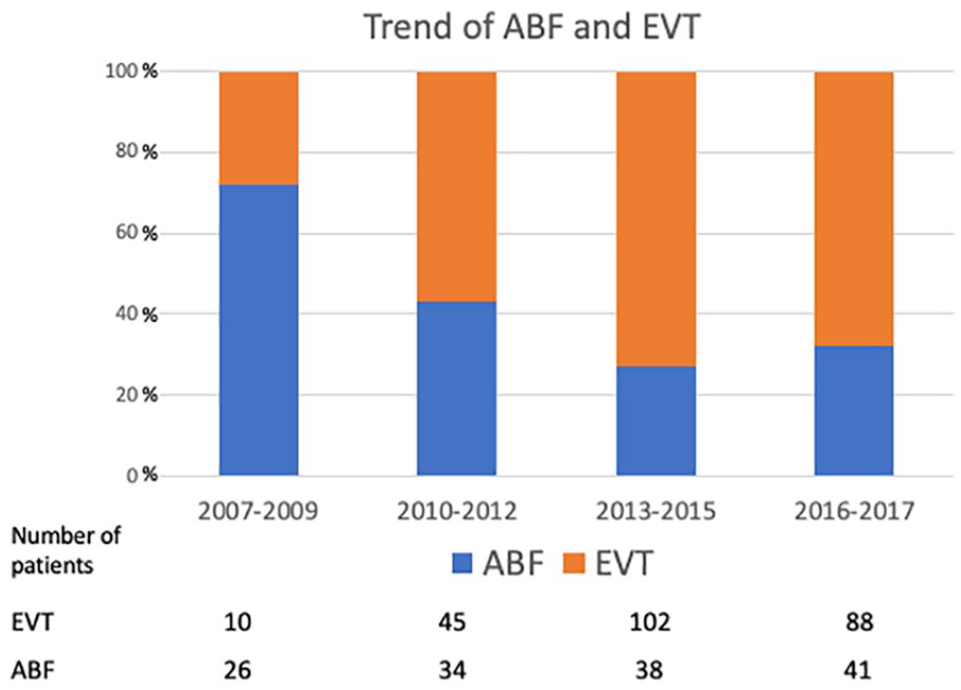
Trends in ABF/EVT over time. The EVT proportion increased from 28% to 68% during the study period. ABF, aortobifemoral bypass, EVT, endovascular treatment.
Patient Characteristics
The baseline characteristics of the patients are shown in Table 1, with significant differences between the groups. Overall, the EVT group was significantly older (ABF: 62±10 vs EVT: 66±12, p<0.001); and morbid, with a significantly higher incidence of hypertension (60.4% vs 74.7%, p=0.005) and diabetes mellitus (34.5% vs 47.8%, p=0.016) and a higher trend in the incidence of coronary artery disease (27.3% vs 35.9%, p=0.110), chronic kidney disease (30.9% vs 40.4%, p=0.082), and CLTI (30.2% vs 39.6%, p=0.084). In contrast, the ABF group had significantly more complex lesions with longer CTO length (14.2±6.3 cm vs 10.1±7.1 cm, p<0.001) and the occlusion began at a higher level (juxtarenal aorta: 53.2% vs 26.5%, p<0.001). There was no difference between the groups for calcification (22.8% vs 24.4%, p=0.850) and prevalence of femoropopliteal lesions (35.4% vs 41.2%, p=0.330).
Baseline Characteristics of Study Population Before and After Matching.

Abbreviations: ABF, aortobifemoral bypass; ABI, ankle brachial index; CFA, common femoral artery; CIA, common iliac artery; CTO, chronic total occlusion; EIA, external iliac artery; EVT, endovascular treatment.
Data were missing on ABI in 30 patients, CTO and lesion length in 8 patients, severe calcification in 28 patients, and femoropopliteal lesion in 12 patients. There was no significant difference in the proportion of cases with missing data between the matched groups (all p>0.05)
Continuous data are shown as mean±standard deviation or median (interquartile range).
Severe calcification was defined as a calcification length of more than 50% lesion length with circumferential calcification at any point in the lesion.
Procedure Details
The procedure details and results for ABF and EVT are summarized in Tables 2 and 3. In the ABF group, polyester grafts were used more frequently than expanded polytetrafluoroethylene (ePTFE) grafts, and the most frequent site for distal anastomosis was the common femoral artery for both limbs. In the EVT group, 211 cases (86.1%) were performed under local anesthesia and the technical success was achieved in 237 patients (96.7%). The upper extremity approach was used in 150 patients (61.2%), most frequently from the brachial artery (92.0%), with a 6Fr sheath (30.7%). For the lower extremity approach, a combination of the CFA (right, 86.9%; left, 86.1%) with a 6Fr sheath (right, 77.2%; left, 75.6%) was the dominant choice. The main guidewire used for the passage of the CTO was a 0.035 in. guidewire (52.2%), followed by a 0.018-in. guidewire (25.7%), and a 0.014-in. guidewire (22.0%). Intravascular ultrasound (IVUS) and distal protection devices were used in 81 (33.1%) and 3 patients (1.2%), respectively. Stents were used in most patients (98.8%). As for the type of stent used, balloon expandable stents and covered stents were used in 83 patients (33.9%) and 42 patients (17.1%), respectively. The most frequent stent configuration was kissing iliac stents in 151 patients (61.6%), followed by 67 aortic stent with bilateral iliac stents (27.3%), and spot stenting was performed in 34 patients (13.9%).
Aortobifemoral Bypass Surgery Details.

Abbreviations: CFA, common femoral artery; DFA, deep femoral artery; ePTFE, expanded polytetrafluoroethylene; EVT, endovascular treatment.
Continuous data are shown as the mean (standard deviation).
Endovascular Treatment Details.

Abbreviations: CFA, common femoral artery, CIA, common iliac artery, EIA, external iliac artery, FP, femoropopliteal, IVUS, intravascular ultrasound, SFA, superficial femoral artery
Incidence of sheath size and hemostasis was calculated for 150 cases that had an upper extremity approach.
The incidence of sheath size and hemostasis was calculated for 215 patients who underwent the right lower extremity approach.
The incidence of sheath size and hemostasis was calculated for 213 patients who underwent a left lower extremity approach.
Patients using at least one balloon expandable stent or covered stent irrelevant of self-expandable stent usage.
Postoperative Findings
During the mean follow-up period of 30.0±34.0 months, loss of primary patency was observed in 39 cases. The propensity score matching extracted 88 pairs, without significant intergroup differences in baseline characteristics (Table 1). As for the perioperative outcomes after propensity matching, procedure time (ABF; 288 [240–345] minutes vs EVT; 159 [100–205] minutes, p<0.001) and length of hospital stay, 17 (12–23) days versus 5 (4–13) days, p<0.001, were significantly shorter in the EVT group than in the ABF group, while the proportion of procedural success (98.9% vs 96.6%, p=0.620), complications (9.1% vs 12.3%, p=0.550), and mortality (2.3% vs 3.8%, p=1.000) was not different between the groups. At 1 month after revascularization, the increase of ABI was significantly higher in the ABF group for both in a limb with the lower baseline ABI value (0.56 [0.38–0.70] vs 0.50 [0.32–0.59], p=0.018), and in a limb with the higher baseline ABI value (0.49 [0.28–0.63] vs 0.34 [0.18–0.51], p=0.001), while the change of the Rutherford category was not significantly different (−3 [−3 to −1] vs −3 [−3 to −2], p=0.590) (Table 4).
Perioperative Outcomes After Propensity Matching.

Abbreviations: ABF, aortobifemoral bypass; ABI, ankle brachial index; EVT, endovascular treatment
In the matched population, data were missing on procedure time in 14 patients, procedural complications in 3 patients, and ABI in 30 patients. There was no significant difference in the proportion of cases with missing data between the matched groups (all p>0.05).
Continuous data shown as mean±standard deviation or median (interquartile range).
Procedural complications included 2 complications leading to death (1 coronary artery disease, 1 cerebrovascular disease), 1 bleeding, 1 thromboembolism, 1 pulmonary edema, 2 acute renal failures, and 1 cellulitis in the ABF group and 3 complications leading to death (2 sepsis, 1 heart failure), 4 puncture site-related complications, 3 thromboembolisms, and 1 vessel rupture in the EVT group.
Figure 2 demonstrates the long-term clinical outcomes between the matched groups. At 5 years, the ABF group had a significantly higher rate of primary patency (89.4±4.3% vs 74.8±4.3%, p=0.035) and survival rate (86.9±4.5% vs 66.2±7.5%, p=0.007) than the EVT group. The rate of freedom from TLR (89.3±4.3 % vs 77.3±7.3%, p=0.096) and secondary patency (100.0±0.0% vs 93.5±3.9%, p=0.160) were lower in the EVT group, but the difference did not reach statistical significance. No clinical features had a significant interaction effect on the association of EVT vs ABF with restenosis risk (Figure 3).

Primary patency (A), freedom from TLR (B), secondary patency (C), and survival rate (D) in the matched population. Dotted lines indicate 95% confidence intervals. EVT, endovascular treatment; SE, standard error; TLR, target lesion revascularization.

The interaction effect of baseline characteristics on the association of the revascularization strategy with restenosis risk. Error bars indicate 95% confidence intervals. ABI, ankle brachial index; CLTI, chronic limb threatening ischemia; CTO, chronic total occlusion; EVT, endovascular treatment.
Discussion
In this study, we directly compared the results of ABF and EVT for the CTO of the IAA utilizing propensity score matching in a real-world clinical setting using data from the CHAOS registry, the main findings of which were as follows: 1. In the long-term, ABF was still associated with significantly superior primary patency and survival compared with EVT; however, there was no significant difference between the groups for secondary patency and clinically-driven TLR. 2. For perioperative outcomes, ABF was associated with a significantly longer procedure time and hospital length of stay with no difference in procedural success, complications, or mortality, or improvement in Rutherford classification.
ABF is still the gold standard for treatment of CTO of the IAA due to excellent long-term results6–8 and the ability to treat visceral arteries in cases of juxtarenal aortic occlusion. 6 However, because ABF requires laparotomy and cross-clamping of the aorta, the procedure is invasive, leading to longer procedure times and hospital stays, and the most recent guidelines only recommend ABF for patients fit for open surgery. 8 Indeed, patient background was significantly different between the ABF and EVT groups in our study and was associated with significantly longer procedure times and hospital stays, even after propensity matching. Furthermore, since most ABFs have bilateral distal anastomosis at the CFA, a future endovascular approach from the CFA will be difficult. These factors have elevated expectations for EVT to treat CTO of IAA at higher and higher levels.
EVT for CTO of the IAA has been complicated by the anatomical characteristics of the CTO lesion. The CTO of the IAA is usually long, extending into the iliac arteries; it makes crossing of the guidewire technically demanding, and if the guidewire crosses the subintimal space, the chances of perforation, which can easily be fatal, will rise. Furthermore, if the lesion extends into the iliac arteries, the guidewire passage needs to be repeated.
However, technical innovations, such as the bidirectional approach and the controlled antegrade retrograde subintimal tracking (CART) or reverse CART technique 17 have enabled a high technical success rate of ~95% in recent reports.9,11 Our result for technical success in the EVT group was 96.7%, which is consistent with previous reports; even after propensity matching, there was no significant difference between the ABF and EVT groups for procedural success.
The other factor that complicates EVT for the CTO of the IAA is the rich thrombus burden observed in the aorta, which is much larger than the superficial femoral artery (SFA). Even after successful crossing of the CTO, thromboembolism may easily occur during stent placement. To avoid complications such as thromboembolism and perforation, use of a covered stent,18,19 and even the use of stent grafts dedicated to aneurysm treatment have been promoted. 20 However, since covered stents were not approved in all countries during the study period, only 42 patients (17.1%) had covered stents in our study, and there was no difference between the EVT and ABF groups for procedural complications and mortality, which should have been fewer for the less invasive EVT group.3,4 There have been reports of use of only bare metal stents for treatment of CTO of the IAA with good results11–13; however, we cannot deny the possibility that if more covered stents were used in our study, procedural complications and mortality may have been lower in the EVT group.
The same is true for IVUS use. Since IVUS can tell us where the guidewire has passed, such as the subintimal lumen or true lumen, the nature of the plaque, and the exact size of the vessel, some reports support the use of IVUS to reduce complications during EVT for the CTO of the IAA.11,13 The use of IVUS during EVT has been supported in other lesions as well;21–23 however, IVUS is expensive and usually not approved in most Asian countries. In our study, only 81 patients (33.1%) underwent IVUS during the procedure. If IVUS was used more, we may have had better technical success and fewer complications in the EVT group.
In terms of long-term clinical results, the ABF group had significantly better primary patency than the EVT group, even after propensity score matching (89.4±4.3% vs 74.8±4.3%, p=0.035). These results are in line with those of previous reports,6,7,9,11 and considering the ease of secondary intervention for restenosis after EVT and the achieved 5 year secondary patency of 93.5±3.9%, our results are acceptable to support the use of EVT for the treatment of CTO of the IAA. Furthermore, interaction analysis revealed that there was no clinical feature that had significant effect on the restenosis risk. This suggests that there is no subset of patients suitable to certain revascularization strategy, and EVT may be attempted as an initial treatment for the treatment of CTO of the IAA for all patients. 5 To further improve primary patency in the EVT group, usage of covered stent will probably be needed, since EVT for the CTO of the IAA usually requires long bare metal stent placement, and the failure mode will most likely be in-stent restenosis, which can be avoided, except for the stent edge, using a covered stent. 4
On the other hand, there was a significant difference between the groups for survival at 5 years, even after propensity matching, with the ABF group having an advantage over the EVT group. This was unexpected, since there is usually an early advantage in terms of mortality for the EVT group that gradually diminishes and ends up with no differences between the groups in the long-term.2–4 One possible reason is that our database did not include information on factors such as chronic heart failure, malnutrition, and frailty score, which are known to affect survival, 24 and this may have precluded us from discovering the selection bias that was present at the initial treatment, and thus could not be adjusted, even with propensity score matching.
Limitations
There are several limitations that must be noted. First, this was a retrospective study that used an international, multicenter registry. Through international collaboration with 30 hospitals from 7 Asian countries, we were able to recruit the largest number of patients to directly compare ABF and EVT for the treatment of CTO of the IAA in a real-world clinical setting. However, during the process, we noticed many differences between the countries, including patient care and follow-up, which precluded us from proposing a procedural standardization using results from our study. As previously mentioned in the manuscript, the biggest factor that may have affected the result was the use of covered stents, which was not approved in all countries at the time of the study, resulting in only 17.1% of patients using covered stents. Furthermore, there has been a report claiming that a certain bare metal stent brand affects the outcome, 11 but we do not have the details of bare metal stents used in the study. To adjust for the differences observed between the groups, we used propensity score matching for the analysis; however, from the results of the survival analysis, we strongly believe in the existence of selection bias at the time of the procedure. To clarify the questions raised in this study, future studies should focus on the use of covered stents for the EVT group and incorporate factors that assess the frail state of the patient into the database.
Conclusion
Even with recent advancements in aorto-iliac endovascular intervention, primary patency was still significantly better for ABF than for EVT for CTO of the IAA at 5 years. However, there was no difference between the groups in terms of secondary patency and freedom from TLR at 5 years. Furthermore, there was no difference in technical success, improvement in Rutherford classification, complications, and mortality during the periprocedural period, with significantly shorter procedure time and hospital stay in the EVT group.
Footnotes
Acknowledgements
This article was supported in part by the Asian Chapter of The International Society of Endovascular Specialists (ISEVS), Endovascular Asia ( ), a nonprofit physician education and research meeting.
The authors thank Benjamin Chua, MBBS, MHSc, FRCSEd, The Vascular & Interventional Centre, Singapore, Hsuan-Li Huang, MD, Division of Cardiology, Department of Internal Medicine, Taipei Tzu Chi Hospital, Buddhist Tzu Chi Medical Foundation, Taipei, Taiwan, Venkatesh Bollineny, MS, DrNB, Department of Vascular and Endovascular Surgery, Narayana Hrudayalaya Hospital and Mazumdar Shaw Multispeciality Hospital, Justin Kwan, MD, Department of Vascular and Interventional Radiology, Tan Tock Seng Hospital, Singapore, Kevin Chung-Ho-Hsu, MD, Division of Cardiology, Department of Internal Medicine, China Medical University Hospital, Taichung, Taiwan, Jin Hyun Joh, MD, PhD, Department of Surgery, KyungHee University School of Medicine, Seoul, Korea, Furuyama Tadashi, MD, PhD, Department of Surgery and Science, Graduate School of Medical Sciences, Kyushu University, Morisaki Koichi, MD, PhD, Department of Surgery and Science, Graduate School of Medical Sciences, Kyushu University, Susumu Watada, MD, PhD, Department of Surgery, Kawasaki Municipal Hospital, Kanagawa, Japan, Masahiko Fujihara, MD, Department of Cardiology, Kishiwada Tokushukai Hospital, Osaka, Japan, Hitoshi Anzai, MD, PhD, Department of Cardiology, SUBARU health insurance Ota memorial hospital, Gunma, Japan, Amane Kozuki, MD, PhD, Division of Cardiology, Osaka Saiseikai Nakatsu Hospital, Osaka, Japan, Ryoichi Kyuragi, MD, PhD, Department of Vascular Surgery, Kyushu Medical Center, Fukuoka, Japan, Yoshinori Tsubakimoto, MD, PhD, Department of Cardiology, Japanese Red Cross Society Kyoto Daini Hospital, Kyoto, Japan, Daiki Uchida, MD, PhD, Department of Vascular Surgery, Asahikawa Medical University, Hokkaido, Japan, Atsushi Funatsu, MD, Cardiovascular Center, Kyoto Katsura Hospital, Kyoto, Japan, Masami Shingaki, MD, Department of Cardiovascular Surgery, Hakodate Municipal Hospital, Hokkaido, Japan, Fuminari Kasashima, MD, PhD, Department of Cardiovascular Surgery, National Hospital Organization, Kanazawa Medical Center, Ishikawa, Japan
This manuscript has not been published elsewhere in part or in entirety and is not under consideration by another journal
Declaration of Conflicting Interests
The author(s) declared the following potential conflicts of interest with respect to the research, authorship, and/or publication of this article: Naoki Fujimura receives consulting fees from Cook Medical, Endologix, Medtronic, and W.L. Gore. Terutoshi Yamaoka receives a consulting fee from the Japan Lifeline. Osami Kawarada receives a research grant and consulting fee from Terumo and remuneration for lectures from Medicon, Otsuka, and Kowa. All other authors declare no conflicts of interest.
Funding
The author(s) received no financial support for the research, authorship, and/or publication of this article.