






Abstract
Introduction:
The presence of severe arterial calcification is associated with less favorable outcomes in terms of procedural and clinical success as well as higher rates of major adverse limb events. Recent studies incorporating rotational atherectomy for effective preparation of severely calcified lesions demonstrate beneficial procedural outcomes by obtaining maximal luminal gain and improved long-term outcomes.
Methods:
This prospective single-center, observational study includes patients with severely calcified femoropopliteal lesions with chronic limb ischemia Rutherford 1–5 between January 2017 and July 2019, who underwent atherectomy using the Jetstream Atherectomy system, followed by drug-coated balloon angioplasty. Lesion calcification was categorized by the Peripheral Arterial Calcium Scoring System (PACSS), whereas lesion complexity was classified by the Transatlantic Inter-Society Consensus (TASC). Safety and efficacy aspects in terms of vessel injury, thromboembolism, and clinical success were systematically analyzed up to 12 months of follow-up (FU).
Results:
In 162 consecutive patients, 210 non-stented and 22 stented lesions were treated. Twelve (7.4%) patients received bail-out stenting. Mean lesion length was 24.2±4.8 cm; 51% were chronic total occlusions (mean occlusion length 18.2±5.1 cm). TASC C lesions were present in 38 patients (23.5%) and TASC D lesions in 124 patients (76.5%). The mean PACCS score was 3.3±0.9. Device success was achieved in 88%; procedural success was noted in 99% of the lesions. Embolic protection device was used in 11.7%. Perforation or dissection occurred in none of the cases. Asymptomatic peripheral embolization was noted in 10 patients (6.2%). Clinical FU at 12 months was available in 157 of 162 patients (96.9%). At 12 month FU, (1) mean Rutherford classification at baseline of 3.7±0.6 significantly dropped to 1.0±0.9 (p<0.05), (2) baseline mean anke-brachial index (ABI) of 0.4±0.1 significantly increased to 0.8±0.2 (p<0.05), (3) 92.6% were free from target lesion revascularization (TLR), (4) 95.1% were free from target vessel revascularization (TVR), and (5) binary restenosis measured by duplex occurred in 22 patients (13.6%). Multivariate analyses showed lesion length as predictive of stent placement (p=0.02), whereas both lesion length (p=0.006) and PACCS score (p=0.02) are predictive of clinical success.
Conclusion:
Rotational atherectomy in combination with drug-coated balloon (DCB) can be safely performed in long, calcified (non-) occlusive lesions with a relatively low rate of bail-out stenting and favorable clinical mid-term results.
Clinical Impact:
In this prospective, single arm study we demonstrated that combination treatment using rotational atherectomy and DCB is safe and effective in complex and calcified TASC C/D femoropopliteal lesions in patients with claudication or CLTI in a real-world clinical setting. Despite mean lesion length of >20cm and a relatively high rate of chronic total occlusions, the rate of bail-out stenting was surprisingly low (7.4%), whereas the rates of freedom from TLR and TVR were surprisingly high. Thus, our study may encourage vascular specialists to choose an endovascular -first approach even in such complex and calcified femoropopliteal lesions and occlusions in daily clinical practice.
Keywords
Introduction
The prevalence of peripheral artery disease (PAD) is continuously rising due to prolonged life expectancy and increasing number of patients with diabetes mellitus and chronic kidney disease. 1
Standard endovascular revascularization techniques are effective tools to treat patients with symptomatic PAD.2–4 However, such basic treatment options may be compromised by severe calcification, due to (1) difficult intraluminal recanalization, (2) inadequate balloon expansion, (3) malapposition of the stent to the vessel wall, (4) acute recoil, or (5) significant flow-limiting dissections, all contributing factors for a less favorable clinical outcome.5–9
Recent drug-coated balloon (DCB) trials have shown superior long-term target lesion revascularization (TLR) and patency rates in femoropopliteal (FP) lesions when compared with balloon angioplasty (POBA) alone.10–17
In this context, endovascular plaque-modifying techniques have been developed and refined, permitting removal of calcified and fibrotic tissue, prior to adjunct treatment with DCB. 18
Recent studies with the rotational Jetstream atherectomy (JA) system (Boston Scientific Corporation) demonstrated a high procedural and clinical success rate; however, data on complex, calcified (non)-occlusive Trans-Atlantic Inter-Society Consensus Document (TASC) C/D lesions are rather limited.19–24
We therefore sought to prospectively investigate the combined treatment modality of Jetstream™ (Boston Scientific Corporation) atherectomy and DCB in these challenging lesion characteristics in elderly and comorbid patients where stent implantation followed by prolonged dual antiplatelet therapy may be problematic.
Materials and Methods
Study Design
A single-center, observational/prospective study with an “all-comer” design was conducted to assess clinical and peri- and post-procedural data in patients treated with the rotational JA device combined with DCB (43.8% InPact Pacific, Medtronic, Inc, Dublin, Ireland and 56.2% Lutonix 0.035, BARD, New Hope, Minnesota) treatment. Out of 535 patients, referred to our department between January 2017 and July 2019 for endovascular treatment of PAD, we prospectively enrolled and analyzed 162 consecutive patients, who underwent endovascular atherectomy using the JA system.
The inclusion criteria consisted of (1) TASC C/D lesions; (2) moderate to heavily calcified lesions; (3) lesions within no-stent zones, such as the common femoral artery (CFA) and the popliteal artery (PA); (4) FP lesions exhibiting de novo or restenotic lesions (>70%); (5) total lesion length of at least ≥15 cm; and (6) one vessel outflow below the knee (BTK) had to be present.
These inclusion criteria also allowed recruitment of elderly and comorbid patients, who may have been poor candidates for open surgery.
The study was performed in accordance with the ethical principles by the Helsinki Declaration. Approval was obtained from our local ethics committee (S-665/2020) of the University of Heidelberg and patients provided written informed consent.
Endovascular Procedures
All procedures were performed by experienced vascular interventionalists. Antegrade or crossover techniques were applied depending on the anatomical location of the lesion. Lesions starting at the level of common femoral artery (CFA) or superficial femoral artery (SFA) origin and extending to the proximal one third of the SFA were treated in crossover technique while the rest of the lesions were treated using an antegrade approach.
The JA was used as first modality of treatment; no other debulking devices and scoring/cutting balloons were allowed. The JA catheter XC 2.4/3.4 (93.2%) and XC 2.1/3.0 (6.8%) were used. After successful crossing of the lesion and placement of a 0.014″ Spartacore guide wire (Abbott), angiography during device activation was used to document the target vessel region and the position of the JA system before and during treatment. The device had to be advanced very slowly. Post-treatment angiography of the entire target vessel and run-off after removal of the JA system and after adjunctive treatment was performed.
Pre-dilatation angioplasty with small-diameter balloon (max. Ø 2.0 mm) prior to atherectomy was required in only 13 cases. This was performed to allow passage of the JA device so as not to have a confounding therapeutic angioplasty effect on the target lesion.
Embolic protection device (Spider FXTM; Covidien, Mansfield) was only used in heavily calcified lesions at the discretion of the investigator.
All patients were treated with DCB following JA. Adjunctive stenting with self-expanding nitinol stents was deemed necessary in cases of (1) significant residual narrowing (>30%) or (2) significant dissection (type D or higher).
All patients were treated with clopidogrel (oral 600 mg loading dose followed by 75 mg daily) and aspirin (500 mg loading dose followed by 100 mg daily) for 3 months.
Analysis of Angiographic Data
Patients with infrainguinal arterial lesions meeting the inclusion criteria were enrolled. Baseline angiography of the entire target vessel and run-off was performed prior to placement and activation of the JA system.
Lesion length and baseline, post-JA, and post-final adjunctive treatment lesion severity (percent stenosis and minimal luminal diameter [MLD]) were measured.
Multiple target lesions regardless of their location (above the knee and involving the popliteal segments P1–3) were considered. A lesion was defined as single if the distance between stenoses was no longer than 3 cm in the SFA and PA. If multiple diseased outflow vessels were present, the treatment of any outflow vessel non-target lesion was left to the discretion of the operator. 25 Because multiple target lesions were allowed per treated limb, each target lesion was classified separately.
The degree of lesion calcification was categorized by the Proposed Peripheral Arterial Calcium Scoring System (PACSS): grade 0=no visible calcium; grades 1 and 2=unilateral calcification <5 or ≥5 cm, respectively; and grades 3 and 4=bilateral calcification <5 or ≥5 cm, respectively.6,8,26
All angiograms were evaluated for lesion complexity according to the TASC classification, 27 lesion localization, and calcification.
All data collected were reviewed and verified by an independent monitor.
Study Endpoints
The primary endpoints of the study were to assess clinically-driven TLR at 12 months of follow-up (FU).20,21 Clinically-driven target vessel revascularization (TVR) was also censored at 30 days and 12 months following the index procedure for completion of the data. The second primary endpoint included binary restenosis rates, defined as a peak systolic velocity ratio (PSVR) of ≥2.5, which were systematically analyzed by duplex ultrasound at 30 days and 12 months following index procedure.
Secondary endpoints included (1) Technical (Device) success, defined as residual stenosis <50% after atherectomy prior to adjunctive treatment19,21; (2) Procedural success, defined as residual stenosis <30% after atherectomy and adjunctive treatment19,21; and (3) Clinical success, defined as achievement of at least one grade improvement in the Rutherford (RF) category at 30 days and 12 months of FU. 28
Major adverse events (MAE) were defined by major amputation, death, and myocardial infarction measured at 30 days and 12 months post index event.
Unplanned major amputation of the treated limb at 30 days and 12 months was defined as surgical removal of a limb or a part of a limb above the ankle that was unanticipated prior to the index procedure.
Vessel perforation, dissection, or angiographic distal embolization that requires a separate mechanical or pharmacological (except vasodilator) intervention or hospitalization were all recorded. 21
In addition, major bleeding defined as per Thrombolysis in Myocardial Infarction (TIMI) definition (signs of hemorrhage associated with a drop in hemoglobin of ≥5 g/dL intracranial bleed or fatal bleed) and access vascular complications (arterio-venous fistula or pseudoaneurysm) were analyzed at 30 days and 12 months of FU.
Statistical Analysis
Analysis was performed using commercially available software MedCalc 18.5 (MedCalc software, Mariakerke, Belgium). Continuous variables were expressed as mean±standard deviation and categorical variables as proportions. The Mann-Whitney test was used to compare ordinal variables and Fisher test to compare nominal variables. The analysis of variance (ANOVA) test was used for comparing 3 or more normally distributed groups with the Scheffé test for post hoc analysis. In addition, multivariable logistic regression analysis was used to test the association between demographic and angiographic variables, with (1) the need for stent placement and (2) TLR during FU. Furthermore, freedom from TLR was estimated by the Kaplan-Meier method. Differences were considered statistically significant at p<0.05.
Results
Demographic and Baseline Clinical Characteristics
Clinical characteristics of 162 all-comer patients who underwent JA are illustrated in Table 1.
Demographic Baseline Characteristics.

Abbreviations: CAD, coronary artery disease.
Mean age was 72.6±4.5 years, 95 patients (59%) were male, and 99 patients (63%) had diabetes.
Clinical Presentation and Lesion Characteristics
Sixty-six patients (41%) had intermittent claudication (RF category 2 or 3), 82 patients (51%) had ischemic rest pain (RF category 4), and 14 patients (10%) exhibited ischemic ulcerations (RF category 5). Mean RF category was 3.7±0.6 (Table 1).
Lesion characteristics are illustrated in Table 2. In a total of 232 lesions, 210 non-stented lesions and 22 stented lesions were treated. Combined SFA lesions involving CFA and/or PA were treated in 26.5%. Mean lesion length was 24.2±4.8 cm; 51% were chronic total occlusions, with a mean occlusion length of 18.2±5.1 cm.
Lesion Localization and Characteristics of Patients With Claudication and Critical Limb Threatening Ischemia (CLI).

Abbreviations: CFA, common femoral artery; PA, popliteal artery; PACCS, Peripheral Arterial Calcium Scoring System; SFA, superficial femoral artery; TASC, Transatlantic Inter-Society Consensus.
Mentioned as proportions in case of involvement of the popliteal artery.
TASC C lesions were present in 38 patients (23.5%), TASC D lesions were present in 124 patients (76.5%), and most lesions exhibited at least moderate or severe calcification with a mean calcium score of 3.3±0.9 (Table 2).
Procedural aspects and characteristics including procedure times are shown in Table 3.
Procedural Aspects and Characteristics With Sole Rotational Atherectomy and Combined Treatment (Atherectomy Plus Adjunctive Therapy) Including Complication Rates.

Abbreviation: DCB, drug-coated balloon.
Technical and Procedural Success and Adjunctive Treatment
Technical success was achieved in 88%; procedural success was noted in 99% of the lesions (Figure 1). Perforation or dissection occurred in none of the cases (Table 3).
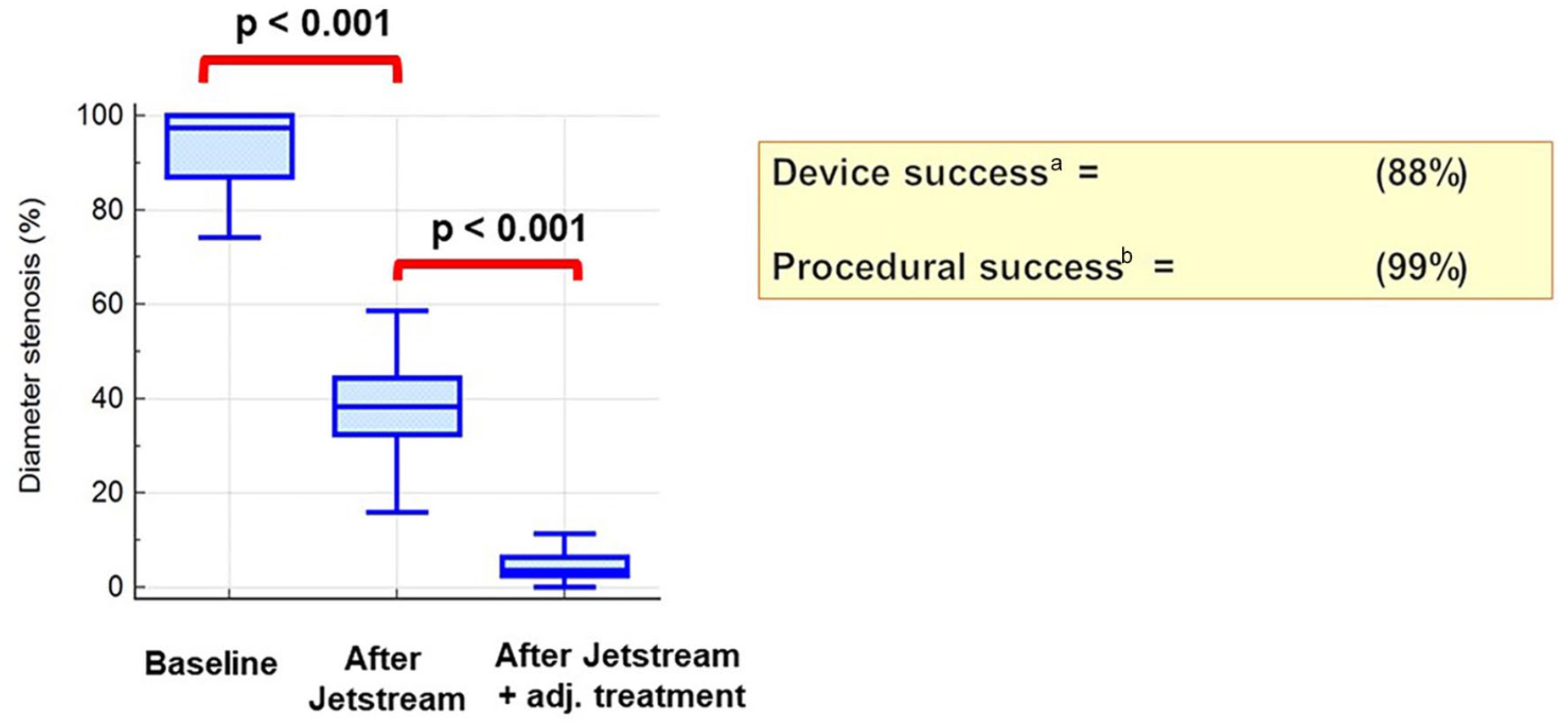
Technical and procedural success rates.
Distal embolization was noted in 10 of our patients (6.2%) (Table 3). In all of these cases, only minor, asymptomatic embolization occurred without vessel occlusion and was successfully treated by simple catheter aspiration. Of note, 5 of the 10 cases of distal embolization occurred despite the use of embolic protection.
Major bleeding defined as per TIMI did not occur in any of our patients during 12 months of FU; however, 3 of 162 patients (0.0185%) developed vascular access complications in the form of pseudoaneurysms, all of which could be successfully treated by thrombin injection (Table 4).
Safety and Efficacy Endpoints After 30 Days and 12 Months of Follow-up.

Abbreviations: MAE, major adverse events; TLR, target lesion revascularization; TVR, target vessel revascularization.
Adjunctive treatment was performed using DCB in all patients and only 12 patients (7.4%) with infrainguinal lesions required bail-out stent implantation (Table 3). The mean number of DCB used was 2.6±0.5 per patient, whereas the mean number of stents was 1.6±0.5 per patient (in those who received stenting).
Clinical Outcomes
Clinical FU was available in 162 of 162 patients (100%) after 30 days following treatment and in 157 of 162 patients (96.9%) during mean of 389.8±24.9 days of FU.
92.6% of patients were free from TLR and 95.1% of patients were free from TVR at 12 months of FU (Figure 2A and B).

Kaplan-Meier curves demonstrating freedom of target lesion revascularization (TLR) and target vessel revascularization (TVR) for all patients during follow-up.
Baseline mean anke-brachial index (ABI) was 0.4±0.1 and increased to 0.9±0.2 at 30 days after treatment and to 0.8±0.2 at 12 months FU (Figure 3).

Development of anke-brachial index (ABI) measurements 30 days and 12 months of follow-up versus baseline.
Of 162 patients, 149 (92%) experienced an improvement of ≥2 Rutherford categories at 12 months of FU (mean reduction from baseline RF category of 3.7±0.6 to 1.0±0.9). An overview of our patients by RF category at baseline versus FU is provided in Figure 4.

Clinical improvement measured by reduction of Rutherford Category at 12 months of follow-up.
Binary restenosis measured by duplex ultrasound with a PSVR of ≥2.5 at 12 months following index procedure occurred in 22 patients (13.6%) (Table 4).
Six patients (3.7%) underwent planned minor amputation surgery within 2 months after index procedure.
In 5 patients (3.1%), death occurred during FU (4 attributed to myocardial infarction, 1 to refractory heart failure); however, none was related to the index procedure.
Multivariate analyses demonstrated that lesion length is predictive of stent placement (p=0.02), whereas both lesion length (p=0.006) and PACCS score (p=0.02) are predictive of clinical success (Table 5).
Multivariate Analyses.

Abbreviations: CI, confidence interval; PACSS, Peripheral Arterial Calcium Scoring System.
Discussion
In this prospective, single-arm, single-center study, we focused on the effects of the combined treatment modality of JA and DCB in complex, calcified (non-)occlusive TASC C/D lesions in patients with claudication or critical limb threatening ischemia (CLTI) in a real-world setting. Despite the mean lesion length of 24.2±4.8 cm and a relatively high rate of chronic total occlusions next to a mean PACCS score of 3.3±0.9, the rates of freedom from TLR and TVR were higher than one might expect.
This may be due to lesion debulking prior to DCB treatment, thus removing a potential biological barrier represented by calcium for drug transfer as proposed by Fanelli et al. 6 Similarly, Tepe et al 14 demonstrated that severe calcium (bilateral) is associated with significant late lumen loss in a retrospective analysis of 91 patients treated with DCB. Thus, it is hypothesized that a debulking strategy, leading to a reduction of atherosclerotic burden, before applying balloon pressure and drug, may contribute to improved long-term patency.
Furthermore, atherectomy of the FP artery has been shown to improve vessel compliance allowing adjunctive PTA to occur at low pressure and with less dissections and bail-out stenting. 18 Preclinical studies have also shown that atherectomy improves paclitaxel concentration and diffusion into arteries with moderate to severe calcification. Compared with controls, orbital atherectomy system (OAS)-treated FP segments exhibited 45% less plaque calcification and 2 log orders higher paclitaxel bulk absorption rate constants. Fluorescent paclitaxel penetrated deeper in OAS-treated FP segments compared with controls, due to a 70% increase in diffusivity (p<0.001). 29 This seems to translate into higher patency and freedom from TLR in small clinical studies.30,31
However, previous data analyzed in the prospective, multi-center DEFINITIVE LE trial, a landmark study for the effectiveness and versatility of directional atherectomy (DA), demonstrated a 12 month primary patency rate of only 78% for SFA lesions, although the mean lesion length was rather short and less than one third of the FP lesion length treated in our current study. One explanation for this finding could be the lack of DCB use and adjunctive therapy following DA treatment being performed in only 35.3% of the patients. 25
In contrast, the pilot Definitive AR study has shown a higher clinical success in the combined treatment arm of atherectomy with DCB compared with DCB alone in FP artery lesions. In addition, more flow-limiting dissections were seen in the DCB only arm (19% vs 2%). 31
Recent studies with the rotational JA device (Boston Scientific Corporation) demonstrated a high procedural and clinical success rate.19–24,32,33 However, long-term data on combined JA and DCB treatment of FP arteries are scarce.
Shammas et al 20 underlined the concept of vessel preparation with atherectomy prior to adjunctive DCB treatment by demonstrating superior freedom from TLR rates in the combined treatment arm compared with JA and PTA up to 16 months of FU, thus indicating a better drug transfer and permeability into the vessel wall due to atherectomy.
Recent data from the J-Supreme and J-Supreme II trials, on the other hand, demonstrated similar technical and procedural success rates with nearly identical acute reductions in lesion stenosis following atherectomy. However, there were substantial differences in sustained patency at 12 months between the 2 treatment arms, JA+PTA and JA+DCB, supporting the anti-restenotic effect of DCB. The beneficial effects of debulking due to rotational atherectomy could be confirmed by intravascular ultrasound (IVUS)-guided analyses of the minimum lumen area gained using this treatment approach. 34
It is noteworthy that despite these challenging long lesion characteristics in this registry, a high rate of procedural and clinical success was achieved with the JA system. Freedom from TLR of 92.6%, freedom from TVR of 95.1%, and binary stenosis of 13.6% measured by duplex by 12 months in this cohort exceed previously published results for endovascular atherectomy24,28 most likely owing to a debulking strategy combined with DCB. Furthermore, we were able to demonstrate a sustained clinical improvement defined as significant reduction of RF categories (more than 2 categories in 92% by 12 months FU) and a significant longstanding improvement of the ABI measurements in our patients.
However, despite the excellent procedural and clinical outcomes with this hybrid approach, using rotational atherectomy combined with the anti-restenotic effects of DCB in this registry, the main contributor to maintaining patency needs further clarification considering the heterogeneity of lesion characteristics analyzed and the single-arm design of our trial.
Our study corroborated the promising results of combination therapy (JA and adjunctive DCB treatment) of complex TASC C/D lesions, which is currently an area of active research (NCT 02850107, NCT02363894, NCT02686541, NCT01763476).
Comparisons between previously published data and the current study results are limited due to different designs and patient populations. These results presented here contribute additional support for the safety and efficacy of rotational atherectomy to treat FP lesions in combination with drug-coated technology.
Although distal embolization has been described in up to 22% of atherectomy cases, 35 only 10 patients at our site experienced minor distal embolization, which could be easily resolved by catheter aspiration in all cases and despite a low rate of embolic protection application in our study.
It is also remarkable that the need for stent placement was only in 7.4%. This effect is multifactorial but may be explained by adjunctive therapy first with PTA alone followed by DCB treatment in all cases, which is in line with previous studies using atherectomy. 36 Perforation or dissection was not observed in any cases.
Multivariate analyses of our data showed that lesion length is predictive of stent placement (p=0.02), and both lesion length (p=0.006) and PACCS score (p=0.02) are predictive of clinical success, which have been already acknowledged previously.32,37
Limitations
There are several limitations to our single-center registry. The main limitation of this study is the relatively small sample size for the prespecified endpoint of binary restenosis and TLR rate at 12 months, and there is a lack of a control group due to the single-arm study design. Furthermore, stent use was at the discretion of the investigator and therefore was not randomly assigned. Given the potential for bias inherent in the choice to use adjunctive stenting (since stent use may be more likely in more serious cases), a comparison of results between stented and non-stented patients should be done cautiously.
Thus, this study could be considered hypothesis generating, which needs further confirmation in a setting of randomized controlled trials with an adequate number of patients.
Conclusion
In this Jetstream Long Lesion (LL) registry, high device and procedural success rates were seen in a variety of lesions including a high prevalence of chronic total occlusions (CTO) and moderate to severe calcium. The combination of JA and DCB markedly improved anticipated freedom from TLR and clinical improvement parameters up to 12 months.
The specific device contributing mechanisms of why this JA+DCB approach seems to have a superior outcome compared to historic data in the literature cannot be categorically defined. It is likely that JA plays an important role in debulking lesions and enhancing anti-proliferative drug penetration and diffusion into the vessel wall, thus improving long-term patency rates.
Footnotes
Declaration of Conflicting Interests
The author(s) declared no potential conflicts of interest with respect to the research, authorship, and/or publication of this article.
Funding
The author(s) received no financial support for the research, authorship, and/or publication of this article.