






Abstract
Purpose:
To evaluate the closure success rate’s outcomes with suture-mediated vascular closure device Perclose ProGlide in patients undergoing aortic or iliac artery endovascular repair using large delivery systems (>21F).
Materials and Methods:
We screened all the patient records in aortic databases at 2 centers who had undergone vascular interventions via ProGlide for percutaneous femoral access >21F between 2016 and 2020. Patients were divided into 2 groups according to the delivery system size: large (L) (22F–23F) and extra-large (XL) (24F–26F). Demographics, anatomical details, and outcome of percutaneous access were evaluated.
Results:
Included were 239 patients: 121 in the L group and 118 the XL group. Intraprocedural conversion to open surgery because of bleeding was necessary in 2% L and 6% XL patients (p=0.253). Severe femoral artery calcification was the sole risk factor for converting to open surgery (odds ratio=23.44, 95% confidence interval=1.49–368.17, p=0.025). In all, 2% of L and 3% of XL (p=0.631) did require late percutaneous intervention due to stenosis (all treated with balloon angioplasty). Overall, 3% developed pseudoaneurysm treated conservatively in all except one patient requiring surgical repair. Hematoma and groin infection were observed in 9% and 1%, respectively; none required surgical therapy.
Conclusion:
A femoral arterial defect after accessing the artery via a large bore sheath (22F–26F) can be closed successfully with ProGlide in more than 90% of patients. Severe femoral artery calcification is a risk factor for conversion to open surgery caused by bleeding.
Clinical Impact
This study adds evidence on efficacy of accessing the artery via a large bore sheath (22-26F) secured by ProGlide. In more than 200 patients conversion to open surgery was necessary in only 4%. Severe femoral artery calcification was the sole risk factor for converting to open surgery. Our findings encourage physicians to choose the percutaneous access even in patients requiring the use of large bore sheath.
Introduction
Endovascular aortic repair typically involves delivery systems with 14F–22 F profiles. Although there is a tendency to reduce the size of delivery systems on modern endovascular platforms, 1 large thoracic stent-grafts and stent-grafts with branches or fenestrations frequently require delivery sheaths with an outer diameter between 22F and 26F. The most frequently used access site is the common femoral artery. Recently, surgical cut-down and preparation of the femoral artery have been largely replaced by percutaneous access.2,3 The Perclose ProGlide (Abbott Vascular, Temecula, CA, USA) is a suture-mediated vascular closure device enabling percutaneous access to the femoral artery. According to the instructions for use, it is recommended for sheaths up to 21F. Our purpose was to evaluate the closure success rate with ProGlide in patients undergoing aortic or iliac artery endovascular repair using “large” (L) (22F–23F) and “extra-large” (XL) bore sheaths (24F–26F).
Materials and Methods
Study Population
Institutional review committees at both institutions approved this study, and the need for informed consent was waived (No. EK 21-1070 and No. EK KB-130/2021). Aortic databases at both institutions were searched for all patients who had undergone aortic or iliac artery endovascular treatment between 2016 and 2020 via ProGlide for percutaneous femoral access with delivery sheaths >21F. The data we collected were patient demographics, baseline characteristics including medication with anticoagulants and thrombocyte aggregation inhibitors, computed tomography angiography (CTA) measurements of the femoral and iliac arteries on the access site, and outcome of percutaneous access including the success rate, need for open surgical exploration, development of hematoma, infection, pseudoaneurysms, and new stenosis at the level of femoral puncture. An experienced radiologist analyzed all the CTAs. Patients were divided into 2 groups according to the delivery system size: L (22F–23 F) and XL (24F–26F) groups.
Inclusion and Exclusion Criteria for Percutaneous Access
The ProGlide has been in regular use since 2014 at both institutions. In 2016, all patients undergoing any aortic or iliac intervention were considered for percutaneous access regardless of the introducing sheath’s size. The exclusion criteria for percutaneous access were (1) previous surgical bypass graft in the groin with no native femoral artery available for puncturing, (2) circumferential calcifications, (3) calcification of the entire anterior wall of both femoral arteries, and (4) femoral or iliac diameter at least 2 mm smaller than the delivery device’s outer diameter.
Image Analysis
Diameters of the iliac and femoral arteries and their calcification were analyzed according to CTA. A slice thickness of 3 mm or less was accepted. Analysis was performed using Impax EE (Agfa HealthCare N.V., Morstel, Belgium) in Freiburg and Osirix MD (Pixmeo SARL, Geneva, Switzerland) in Wroclaw. All the measurements were taken in multiplanar reconstruction (MPR) always in the plane perpendicular to the manually corrected local centerline. Arterial diameters were calculated as the mean of maximum and minimum diameters. Calcification in the femoral or iliac arteries was defined as none if there was no calcification observed and trace, moderate, and severe if calcified segments involved less than 25%, 25%–50%, and more than 50% of arterial circumference, respectively. The calcification’s location (anterior, posterior, or lateral) was not analyzed. The sheath-to-artery ratio was calculated as a ratio between the sheath’s outer diameter (mm) and artery’s minimal inner diameter (mm).
Percutaneous Access Technique
Percutaneous access was achieved as previously described. 4 Shortly, the common femoral artery was punctured under ultrasound guidance in all patients. An 8F introducer was used to predilate the puncture site. Two ProGlides were advanced over a 180-cm standard guidewire SupraCore (Abbott Vascular, CA, USA) and applied at 2 and 10 o’clock position, or both at 12 o’clock position gently pushing one ProGlide to medial and another one to lateral site during deployment (Supplemental Video 1). After the endovascular procedure, the rail limb of both ProGlide devices was pulled according to the instructions for use, while the guidewire was left in place in case a third device at 12 o’clock was needed to control bleeding. If the third ProGlide device failed to stop the bleeding, we carried out conversion to surgical cut-down and repair.
Once hemostasis was achieved, the guidewire was removed and heparin was antagonized with protamine sulfate in patients with short procedural time (less than 30 minutes). Local hemostatics such as Hematrix Active-Patch (Lamed, Oberhaching, Germany) and 24-hour compression were applied in case of minor bleeding. In case of bleeding, a large bore sheath was introduced over the guidewire to control the bleeding and facilitate the artery’s surgical exposition and repair. We assessed the result of percutaneous access immediately after the intervention by clinically examining the pulse in the groin. In case of any signs of leg malperfusion, a duplex scan was done. The final evaluation of any potential complications at the access site, such as stenosis or pseudoaneurysm, was done by relying on the CTAs done in all patients before discharge.
Statistical Analysis and Definitions
Continuous data are reported as median (first quartile, third quartile), and categorical variables are reported as counts and percentages. The 2-sided t test or the Mann-Whitney U test was used for comparisons of continuous variables. Categorical variables were compared using the χ2 test. In case of small group sizes (n<5), Fisher exact test was used. Multivariate logistic analysis was performed to identify risk factors for composite endpoint of ProGlide failure, including intraoperative converting to open surgery, postoperative open conversion, and postoperative interventional correction. Included were factors associated with poor vessel quality, that is, calcification, history of cut-down, or intervention at the access site. We also included anatomical parameters such as minimal vessel diameter and the introducing sheath’s diameter. All statistical calculations were performed using SigmaPlot 12 (Systat Software, San Jose, CA, USA).
Adipositas was defined as body mass index higher than 30 kg/m2. Coronary artery disease was defined as reduction in internal diameter of any coronary artery of at least 50%. Arterial hypertension was defined as persistent elevation in the arterial pressure requiring at least 1 antihypertensive medication daily. Late intervention or late open conversion was defined as that performed during the postoperative course and before discharge.
Results
Clinical Characteristics
Patients’ clinical characteristics are illustrated in Table 1. Included were 239 patients: 121 in the L group and 118 in the XL group. Most patients were men (71%), and the median age was 70 (64–77) years. Male patients were more frequent in the L group (75 vs 67%, p=0.033), and L group patients were taller (1.8 [1.7–1.8] vs 1.7 [1.7–1.8] m, p<0.001). Adipositas was observed in 21% patients, and 2% suffered from adipositas per magna. Overall, 82% suffered arterial hypertension and 36% coronary heart disease; 39% were smokers. There were 4% patients on dialysis.
Patients’ Characteristics

Values are n (%) or median (first quartile, third quartile).
Abbreviations: BMI, body mass index; COPD, chronic pulmonary obstructive disease.
BMI >30 kg/m2.
BMI >40 kg/m2.
Anatomy of Access Side and Procedural Details
The right and left common femoral arteries were used in 62% and 38% of patients, respectively. (Table 2). The femoral artery had been previously accessed via cut-down or percutaneous puncture in 5% and 23% of patients, respectively. The calcification pattern did not differ between L and XL groups. The median minimal common femoral artery diameter was 7.3 (7–7.9) mm. The sheath to iliac and femoral artery ratios were both higher in the XL group (1 [0.9–1] vs 0.8 [0.8–0.9]; 1.1 [1.1–1.2] vs 1 [0.9–1.1], both p<0.001).
Preprocedural Medication, Blood Tests, and Access Anatomy.

Values are n (%) or median (fist quartile, third quartile).
Abbreviations: INR, international normalized ratio; PLT, platelet count; PTT, partial thromboplastin time; Hb, hemoglobin.
At the puncture site.
Most patients underwent thoracic endovascular aortic repair (TEVAR) (59%), followed by implantation of an iliac branched device (19%), fenestrated or branched thoracoabdominal stent-grafts (18%), and EVAR (3%) (Table 3). Of the 37 fenestrated or branched thoracoabdominal stent-grafts, 36 were implanted in the XL group. The procedural time was longer in the XL group (122 [56–88] vs 88 [57–140] minutes, p=0.034). In 14%, the third ProGlide device was used to achieve hemostasis. Local hemostatics were also used in 10% of patients (all in the XL group), and 9% of patients underwent 24 hours of compression in the groin. After the intervention, 77% patients were given aspirin and 27% clopidogrel (Table 3).
Procedural Details.

Values are n (%) or median (fist quartile, third quartile).
Abbreviations: TEVAR, thoracic endovascular aortic repair; BEVAR, branched endovascular thoracoabdominal aortic repair; FEVAR, fenestrated endovascular thoracoabdominal aortic repair; EVAR, endovascular abdominal aortic repair.
Hematrix Active-Patch.
Outcome
After excluding intraoperative conversions to open surgery and postoperative interventions for stenosis, our overall successful closure rate of the puncture site was 96% and 90% in the L and XL groups, respectively (p=0.055; Figure 1). Intraoperative conversion to open surgery caused by bleeding was necessary in 2% of L and 6% of XL patients (p=0.253; Table 4). Severe femoral artery calcification was the sole risk factor for composite endpoint of ProGlide failure, including intraoperative converting to open surgery, postoperative open conversion, and postoperative interventional correction (odds ratio=3.35, 95% confidence interval=1.49–18.29, p=0.035; Table 5). Two percent of L and 3% of XL (p=0.631) patients did require postoperative interventional correction due to stenosis (all via balloon angioplasty), yielding a total rate of 3% for postoperative interventional corrections. All postoperative interventions took place before discharge. Overall, 3% developed a pseudoaneurysm detected on the first postoperative CTA; they were treated conservatively in all except one patient treated in an open fashion. Hematoma and a groin infection were observed in 9% and 1%, respectively, yet none of them required surgical therapy.
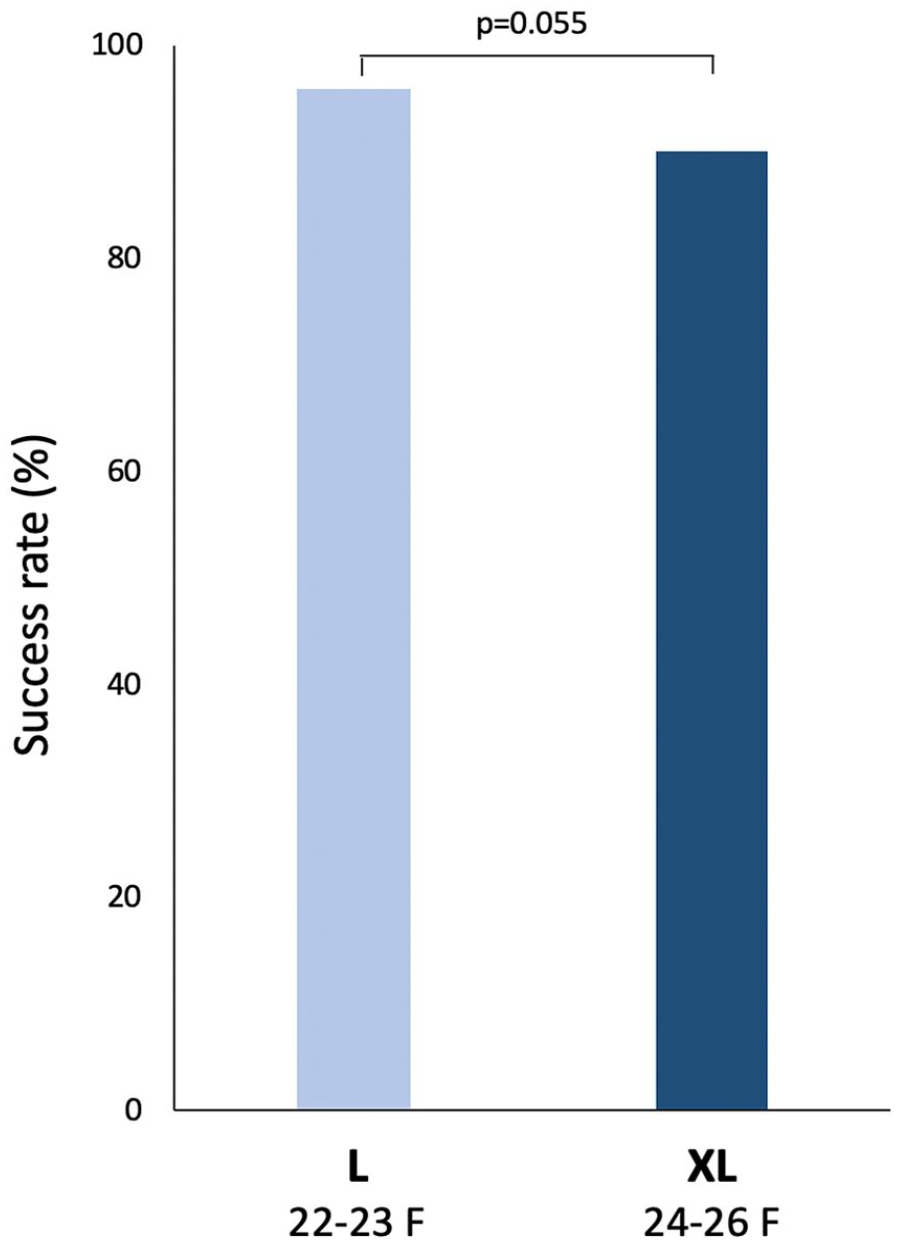
Success rate of puncture site closure with ProGlide. Successful closure was defined as closure of the access site without need for perioperative conversion to open surgery due to bleeding or postoperative interventions due to stenosis.
Outcome.

Values are n (%).
Multivariate Logistic Regression Analysis of Risk Factors for Composite Endpoint, Including Intraoperative Conversion Due to Bleeding, Postoperative Open Conversion, and Postoperative Interventional Correction.

Abbreviations: OR, odds ratio; CI, confidence interval.
Discussion
Our main observations were as follows:
After accessing the artery via a large bore sheath (22F–26F), a femoral arterial defect can be closed successfully with the ProGlide in a vast majority of patients.
Femoral artery closure with ProGlide after using a large bore sheath is associated with a 4% risk of converting to open surgical repair and with the risk of postoperative interventional or surgical correction in 3%.
Severe femoral artery calcification is a risk factor for ProGlide failure.
Although low-profile aortic endovascular systems are already available, large stent-grafts and stent-grafts with branches or fenestrations still require large introducer sheaths. Several studies reported good results after using suture-mediated vascular closure devices such as Prostar XL5–7 or ProGlide.8–10 However, there is little evidence on the feasibility and safety of percutaneous access via a large bore sheath using the ProGlide. According to the instructions for use provided by the company, the ProGlide enables the closure of access not exceeding 21F. Melloni et al 11 reported on ProGlide outcomes in 191 patients with a sheath larger than 21F. Their overall closure success rate was 91% with a 9% rate of converting to the femoral artery’s surgical exposure. Our results with 6% conversion to open surgery correspond well with their data.
After removing the introducing sheath, the rail limbs of both ProGlides are pulled while the guidewire is left in place in case a third device becomes necessary. In our series, 11% of L and 17% of XL patients required a third device. In a series reported by Melloni et al, 11 a third device was needed in 15% of patients. In another series entailing 418 femoral access sites with devices between 12F and 24F, the third ProGlide was applied in 12% and led to impressive percutaneous-access success in 99% of patients. 12 Those authors identified arterial calcification as a risk factor for requiring an additional ProGlide device. A larger sheath size and femoral artery diameter were not associated with needing a third ProGlide in their study using both small and large delivery sheaths. In our experience, the third device enables effective closure of the puncture site in many patients. However, we could not match the 99% success rate using the third device as Lin et al 12 managed to do, probably because our study included only those patients whose femoral artery was accessed via bore sheaths >21F.
Several risk factors for failure of closure devices have been reported. Some studies reported that greater access-vessel depth is a risk factor for higher complication and technique failure rates. 12 This factor was not associated with ProGlide failure and the need for conversion in other reports. 11 Some working groups reported that larger sheath size leads to more frequent conversions,13,14 while others reported sheath sizes up to 24F where sheath size was not a risk factor for ProGlide failure. 12 The authors of most reports agree that femoral artery calcification makes percutaneous access more difficult, and that it raises the failure rate.12–14 Similar observation has been done using Prostar XL vascular closure device with only week correlation of sheath size with early conversion to open access. 15 In this study, operator experience and anterior wall calcification were predictors of primary failure. Finally, in our study, we did not observe higher risk of conversion to open access in patients with a history of cut-down in the groin or intervention via the ipsilateral femoral artery. Similar findings reported Çelik et al 16 in a study with 17 and 56 patients with and without previous intervention via the same femoral artery, respectively.
In our study, we divided patients into 2 groups according to the delivery device’s size. In 118 patients whose delivery devices were between 24F and 26F (XL group), the success rate was still very high, and only 6% patients suffered bleeding, necessitating intraoperative conversion. The rates of local complications such as hematoma, pseudoaneurysm, or local infections were all in single digits, and all were managed conservatively. The sole risk factor for conversion to open surgery due to bleeding was severe femoral calcification defined as a calcification occupying more than 50% of arterial circumference. Our results show that the ProGlide can be safely used to close the puncture site after endovascular aortic repair with “extra-large” bore sheaths. Percutaneous access should be avoided, however, in patients with severe femoral calcification. Puncturing the femoral artery under ultrasound guidance enables surgeons to identify and avoid the calcified arterial wall portion. We advise against percutaneous access in case of extensive anterior wall calcification. However, the similar extensive calcification of the posterior arterial wall is less problematic, and these patients can benefit from percutaneous access to the femoral artery. Ultrasound guidance is essential to achieve the generally high success rate of ProGlide by accessing the artery via a large bore sheath. Finally, having bilateral femoral access, the ProGlide performance can be checked by angiography via the contralateral side to detect any potential early complications such as stenosis, occlusion, or bleeding.
This study has several limitations. First, it is a retrospective study with a selection bias because not all comers underwent percutaneous access. Small femoral arteries and severe calcification were reasons for open access, and this decision was made individually by the treating surgeon. Second, the method of both ProGlide applications (parallel or crossed) was not indicated in surgical reports and cannot be evaluated. Third, this is a 2-center report, and local hemostatics were used only in selected patients at 1 of the 2 centers.
Conclusion
Percutaneous access to the femoral artery via large bore sheaths (>21F) is feasible and safe, yielding a 96% success rate in selected patients. The use of “extra-large” bore sheaths (24F–26F) does not raise the risk of conversion to open surgery when compared with “large” ones (22F–23F).
Footnotes
Declaration of Conflicting Interests
The author(s) declared the following potential conflicts of interest with respect to the research, authorship, and/or publication of this article: Martin Czerny is a consultant to Terumo Aortic, Medtronic, Endospan, and NEOS; received speaking honoraria from Bentley and Cryolife; and is a shareholder of TEVAR Ltd and Ascense Medical. Bartosz Rylski is a consultant to Terumo Aortic and shareholder of Ascense Medical.
Funding
The author(s) received no financial support for the research, authorship, and/or publication of this article.

Supplemental Material
Supplemental material for this article is available online.
References
Supplementary Material
Please find the following supplemental material available below.
For Open Access articles published under a Creative Commons License, all supplemental material carries the same license as the article it is associated with.
For non-Open Access articles published, all supplemental material carries a non-exclusive license, and permission requests for re-use of supplemental material or any part of supplemental material shall be sent directly to the copyright owner as specified in the copyright notice associated with the article.
