






Abstract
Background and Objectives:
Endovascular aneurism repair (EVAR) is a minimally invasive alternative to open surgery for the treatment of abdominal aortic aneurysm. Iodine contrast medium (ICM) is considered the gold standard, at the high price of related nephrotoxicity and allergic reactions. Carbon dioxide (CO2) has been suggested as an alternative non-nephrotoxic contrast media agent. We aimed to evaluate the safety and the renal impact of the administration of CO2, compared with ICM in EVAR procedures.
Design, Setting, Participants, and Measurements:
We retrospectively reviewed data of patients who underwent EVAR at the Vascular Surgery Department of the Sant’Orsola Hospital in Bologna. Estimated glomerular filtration rate (eGFR) was evaluated before intervention, immediately after and at 12 months.
Results:
In total, 22 patients received CO2 and low-dose ICM (CO2 Group) and 22 received standard ICM (Control Group), matched for clinical characteristics and renal function at the time of procedure. Pre and post-operative renal function values (eGFR) were compared between the two groups: in the immediate post-operative the group treated with CO2 and low-dose ICM globally showed a slight improvement in renal function (mean eGFR +5.10%±3.2), meanwhile the group treated with standard dose of ICM presented a significant worsening of renal function compared with pre-procedure values (mean eGFR −9.65%±4). Incidence of post-contrast acute kidney injury (PC-AKI) was 9% in the CO2 group vs 27% in the Control group. At 12 months, the renal impairment was significantly greater in the ICM group than in the CO2 group (mean eGFR decrease −19.2%±11.1 and −7.40%±3.5, respectively).
Conclusions:
Administration of either CO2 alone or along with low-dose ICM showed to be safer than full-dose ICM alone, lowering the incidence of PC-AKI in patients undergoing EVAR. Unexpectedly, our study revealed also a significant worsening of renal function in patients treated with standard dose of ICM in 1-year follow-up, introducing the concept that acute renal damage caused by ICM could elicit a chronic injury process that affect long-term renal outcomes.
Clinical Impact
Evaluating the safety and the renal impact of the administration of CO2, compared to Iodinate Contrast Medium, in EVAR procedures represents a first step in order to further tayloring medical procedures on patients characteristics. Our findings can guide the clinicians and surgeons in the procedures choice, not considering only the immediate effect of ICM on renal function but also the potential long-term effects.
Keywords
Introduction
Endovascular aneurism repair (EVAR) is a minimally invasive alternative to major open surgery for the repair of abdominal aortic aneurysm (AAA). 1 Randomized controlled trials (RCTs) have shown good or even better results with endovascular procedures when compared with open surgery over both the short and medium term. 2 However, such endovascular procedures are traditionally associated with a significant risk for developing acute kidney injury related to the use of iodine contrast media, 3 particularly in patients affected by chronic kidney disease (CKD). 4 Nowadays, iodine contrast medium (ICM) is considered the gold standard in endovascular procedure but at the high price of hypersensitivity reactions and nephrotoxicity related to its use. 5
Post-contrast acute kidney injury (PC-AKI), a term coined in 2017 by the Contrast Media Safety Committee (CMSC) of the European Society of Urogenital Radiology (ESUR), replaced the older term contrast-induced nephropathy (CIN). 4 PC-AKI is defined by KDIGO as an impairment of renal function (raise of the serum creatinine > 0.3 mg/dL within 48 hours or >50% within 7 days) after the intravascular administration of ICM; 6 it has a reported incidence that ranges from 2% to 19%, 4 that raises to 36.4% in patients with estimated glomerular filtration rate (eGFR)<30 mL/min/1.73 m2. 7
The pathophysiologic basis of PC-AKI is still not completely understood. Both direct and indirect damage mechanisms have been hypothesized, involving direct tubular toxicity and ischemic damage. 8 Moreover, intra-arterial ICM administration, as necessary in EVAR, is at higher risk of PC-AKI rather than the intravenous administration.
Carbon dioxide (CO2) has been suggested as an alternative, non-nephrotoxic, contrast agent in patients with formal contraindications to ICM (advanced chronic kidney disease or iodine-related hypersensitivity); 1 its use for diagnostic purpose was first described by Hawkins in 1982. 9 More recently, CO2 has been introduced in EVAR procedures and other endovascular interventions showing procedural efficacy equivalent to ICM and being safe and effective in the prevention of PC-AKI, 10 – 12 especially in patients with renal impairment. 13 CO2 has been demonstrated to be safe and effective also in combination with intraprocedural 3D preoperative computed tomography angiography overlining onto 2D live fluoroscopic images (fusion imaging [FI]), thus reducing the amount of procedural ICM during fenestrated endografting (FEVAR). 14
The real impact of PC-AKI, although supported by the majority of the literature, has been confuted by some authors, 15 who invite to revaluate the role of the ICM as the principle responsible for nephropathy.
These controversies leave open the debate on both the effect of ICM administration on short and long-term kidney function. In this study, we aimed to evaluate peri-operative and 1 year renal outcomes between the administration of CO2 alone or combined with low dose of ICM compared with the administration of standard dose ICM in patient who underwent EVAR procedure.
Materials and Methods
This is a retrospective observational study that includes patients who underwent EVAR from August 2016 to October 2019 at the Vascular Surgery Department of the Sant’Orsola Hospital in Bologna. The population has been divided into two groups: patients who received CO2 alone or CO2 in addition to low-dose ICM (<100 cc), formerly “CO2 Group,” and patients who received full dose of ICM (>200 cc), formerly “Control Group.”
For each patient, the database included data related to name, surname, date of birth, date of EVAR procedure, gender, age at the time of the procedure, and medical history; in particular data on the presence/absence of obesity, dyslipidemia, diabetes mellitus (DM), chronic obstructive pulmonary disease (COPD), smoking, hypertension (HPT), and coronary artery disease (CAD).
Data related to the intervention itself were also reported in addition to any complications that have occurred. Moreover, dosage of ICM received by each patient, expressed in centiliters (cc), was reported as well as both pre and post-operative serum creatinine along with the eGFR values calculated accordingly to the CKD-EPI formula. Chronic kidney disease (CKD) stage was assessed, according to the KDIGO guidelines, 16 evaluating eGFR values at the time of the procedure for each patient.
The populations of the study were extracted from the aforementioned database following the below reported inclusion and exclusion criteria.
Inclusion criteria:
Available data on serum creatinine and eGFR level before intervention, after intervention, and at 1 year follow-up;
Having received CO2 alone or CO2 combined with less than 100 cc of ICM during the whole EVAR procedure;
No renal function modifying event had occurred between procedure and the date of long-term follow-up.
Exclusion criteria:
Unreachable and follow-up data not obtainable;
Risk factor data not complete or totally unavailable;
Incomplete data about serum Creatinine and eGFR in pre and post intervention and at 12 month follow-up;
Follow-up data obtained was outside the defined time interval;
Patients who had repeated surgery or had undergone interventions using ICM during the time interval considered.
The “Control Group” was then extracted from the same database, with the following criteria:
Demographic, clinical characteristics, and baseline CKD stage matched to the CO2 Group, in order to have non-statistically significant differences (p values>0.05) for the variables reported in Table 1;
Anatomical and procedural characteristics matched to the CO2 Group, in order to have non-statistically significant differences (p values>0.05) for the variables reported in Table 2;
Receiving a dose of iodinated contrast medium of at least 200cc and not CO2 for imaging during EVAR procedure;
No renal function modifying event had occurred between surgery and the date of follow-up obtained.
Data were obtained either by consulting the hospital health archive or by direct telephone interview with the patient. During the telephone interviews, a specific questionnaire was administered to ensure that between the day of EVAR and the follow-up at 12 months, there were no intercurrent events capable of interfering with renal function (hospitalization for any cause including surgery, ICM administration for any cause, introduction of angiotensin-converting enzyme/angiotensin receptor blockers, heart failure events, AKI events for any cause).
Demographic and Clinical Characteristics of Populations.

aDemographic characteristcs and comorbidities of the study groups.
Abbreviations: CAD, coronary artery disease; CO2, carbon dioxide; COPD, chronic obstructive pulmonary disease; DM, diabetes mellitus; HPT, blood hypertension; ICM, iodine contrast medium; IQR, interquartile range.
Anatomical and Procedural Characteristics of Populations.

Abbreviation: EIA, external iliac artery; EVAR, endovascular aneurism repair; IBD, internal branched device; IIA, internal iliac artery.
The statistical analysis of the data obtained was carried out with the use of the software IBM SPSS and are extensively reported in Supplementary Materials.
Results
The total number of patients in the database was 322. Of these, 250 received full dose of iodinated contrast medium, while 72 patients underwent procedure with the use of CO2 alone or with low dose of ICM (<100 cc).
After the process of population selection according to the above reported criteria, 22 patients were enrolled in the CO2 group and the same number was extracted for the Control group. Complete selection process is depicted in Figure 1.
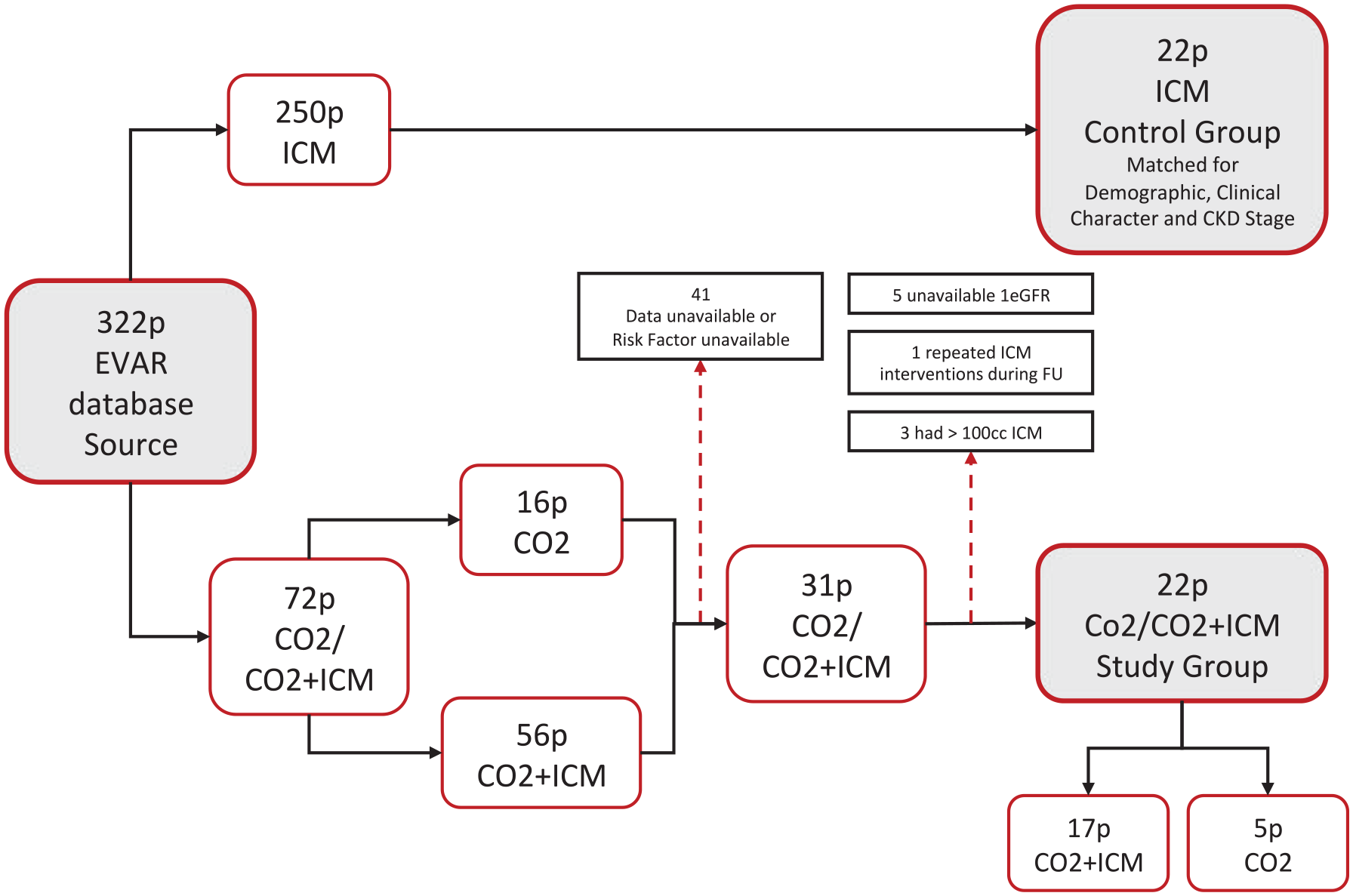
Study population selection process. CKD, chronic kidney disease; CO2, carbon dioxide; eGFR, estimated glomerular filtration rate; EVAR, endovascular aneurism repair; FU, follow-up; ICM, iodine contrast medium.
To stratify renal function, we assigned to each patient a value from 1 to 6 based on the stage of chronic kidney disease (I=1; II=2; IIIa=3; IIIb=4; IV=5; V=6). Thus, to calculate the average CKD class of each population, which was exactly the same in the two groups. The mean quantity of ICM used in both group has also been reported; 5 patients in the Study Group did not received ICM during the procedure but CO2 only (Table 3).
Renal Function at Baseline and Mean ICM used in Study and Control Group.

Abbreviations: CKD, chronic kidney disease; CO2, carbon dioxide; eGFR, estimated glomerular filtration rate; ICM, iodine contrast medium.
Differences between the two populations in terms of serum creatinine, mean eGFR, and CKD stage before EVAR were not significant. The two populations were successfully homogenized in terms of clinical and demographic characteristics and baseline renal function.
Moreover, a multivariate analysis was performed to exclude the presence, within both populations, of a risk factor that creates a significant dependence on the outcome of the renal function trend, regardless of the contrast medium utilized.
eGFR Values
The analysis of the two populations was based on the observation of the trend of renal function (expressed in terms of eGFR, mL/min/1.73 m2) at 3 time points, respectively t0, t1, and t2. t0 corresponds to the pre-operative time, t1 to the early post-operative time (48–72 hours), and t2 to the follow-up at 12 months after EVAR.
The first analysis performed concerns the trend of the average eGFR value of each population. Figure 2 and Table 4 show both the trend of the mean values (solid line) and the trend of the results from the time before the procedure up to the follow-up at 12 months (dotted line).
Mean Values of eGFR and CKD Stage for Both Populations at 12 Months Follow-up.

Abbreviation: CKD, chronic kidney disease; CO2, carbon dioxide; eGFR, estimated glomerular filtration rate.

Comparison of mean values (solid lines) and global trend (dotted lines) of eGFR from the time before the procedure to the 12 months follow-up. CO2, carbon dioxide; eGFR, estimated glomerular filtration rate; FU, follow-up; ICM, iodine contrast medium.
The trend of decline in the glomerular filtration rate (GFR) in the two populations is significantly different: the curve for the CO2 Group has a lower slope than the curve of the Control Group. From a baseline where eGFR mean value for the two groups were non-statistically significant different (p=0.58), the observed value at t2 (eGFR t2) presents statistically significant differences (p<0.05).
For each patient of the two groups, changes in eGFR value between the pre and post-operative time and over the first-year after EVAR are graphically represented in Figure 3, respectively as t1−t0 and t2−t0. Considering t1−t0, the variation of eGFR values is positive in most of the patients within the CO2 Group (18/22), while it is negative in most patients Control Group (14/22). Incidence of PC-AKI was thus significantly lower in the CO2 group (9%) compared with the Control group (27%) (p<0.05). One year after the procedure (t2−t0), patients with worsening of eGFR were 10/22 in the CO2 Group and 16/22 in the Control Group.

Single patient’s changes in eGFR value between the pre- and the post-operative time (A) and at 12 months follow-up (B), respectively, indicated as t1−t0 and t2−t0. CO2, carbon dioxide; eGFR, estimated glomerular filtration rate; ICM, iodine contrast medium.
CKD Class Switch
Globally, there was a greater worsening in the Control Group than in the CO2 Group. In detail, both groups had the same mean CKD class before the procedure, thus justifying the same risk of kidney impairment at baseline. The CO2 Group remained within the same mean CKD Class at t1 and at t2. Conversely, in the Control Group the renal function progressive worsening lead to pass from mean CKD Class II to IIIa at t2. The change in the average value of each CKD Class has a statistically significant value (p<0.05), confirming the better trend of the patients in the CO2 Group, as reported in Figure 4A.
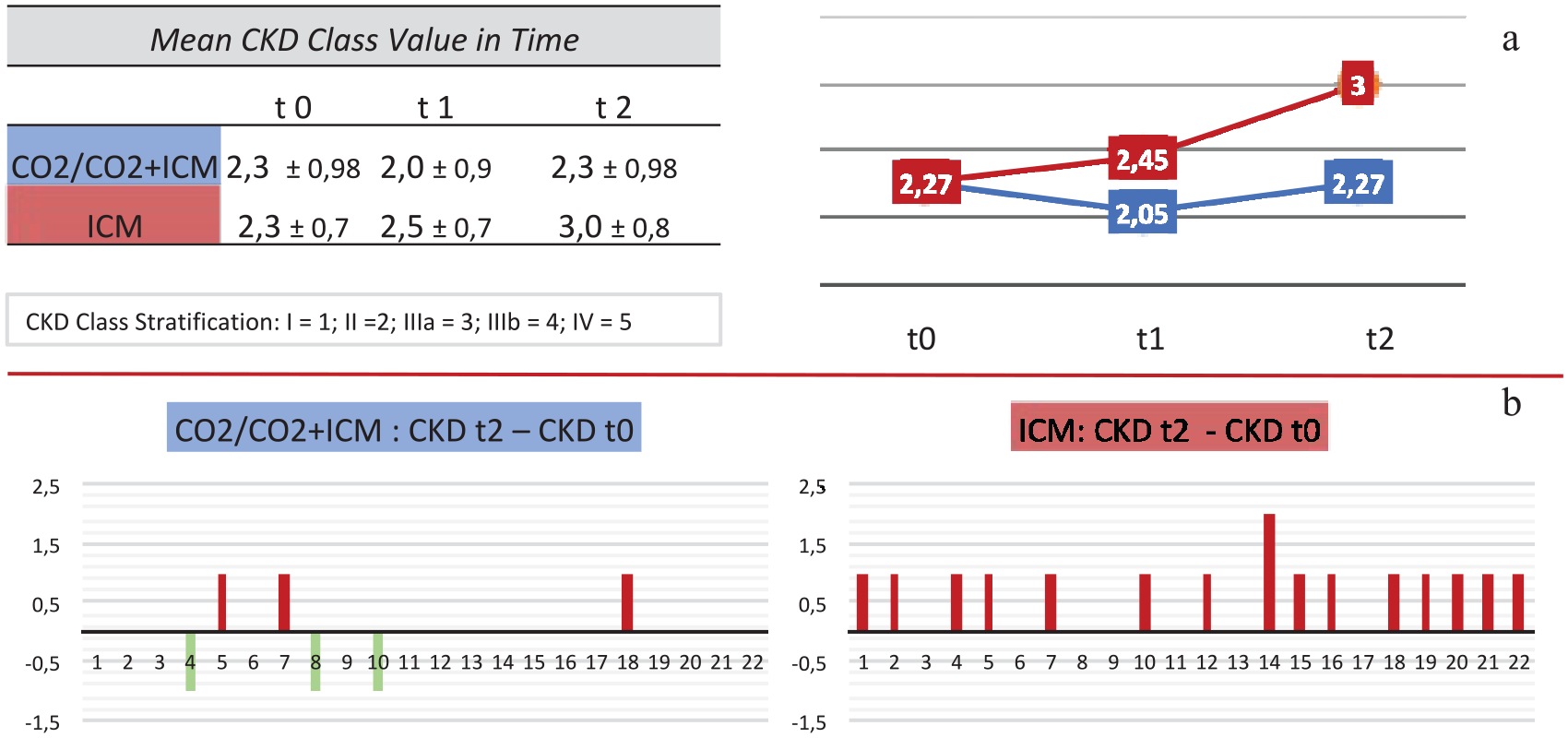
(A) Mean CKD stage values. (B) Single patient’s CKD stage. CKD, chronic kidney disease; CO2, carbon dioxide; ICM, iodine contrast medium.
Carrying out an analysis on the single patient regarding the stage of CKD it emerged that in the CO2 Group, 3 patients had a worsening of CKD stage and 3 patients had an improvement passing from one stage to the less severe one, meanwhile other 16 patients stayed in the same stage.
In the Control Group, 14 patients worsened their CKD stage, moving from one class to the next one, 1 patient worsened CKD of 2 stages, and no patients showed improvement (Figure 4B).
The population CKD stage change analysis data, by treatment group, are shown in Table 5. In the CO2 Group, the percentage of occupancy of the CKD class remains the same, mainly thanks to maintaining the same class both at the post-treatment period and at the follow-up time. In particular, 6 patients changed their class, 3 getting worse and 3 improving their renal function, thus balancing each other. In the Control Group, the percentage of employment moves toward higher classes between the two moments taken into consideration. In particular, no patient maintains class I, 7 patients in class II pass to class IIIa, 4 patients who were in class IIIa worsened to class IIIb, the only patient who was already in class IIIb got worse, passing to class IV; note also the presence of a passage of two classes of a patient who passed from class I to class IIIa.
Population CKD Stage Change Analysis Data.

Abbreviations: CKD, chronic kidney disease; CO2, carbon dioxide.
Discussion
In this study, we analyzed the renal impact of administration of carbon dioxide alone or with low-dose iodinated contrast medium compared with the administration of standard iodinated contrast medium in angiographic procedures for the endovascular repair of abdominal aortic aneurysm (EVAR) both in peri-operative period and at 1 year of follow-up.
Peri-Operative Findings
The short-term impact was analyzed by observing the trend of renal function parameters within the 48–72 hours post-procedure, when PC-AKI is defined to occur. 5
Our study confirms the expected result that the group treated with standard dose ICM experienced a significant worsening of renal function compared with the CO2 Group, thus revealing a significantly lower incidence of PC-AKI. Majority of the studies reported in literature are consistent with our findings. Criado et al, in a retrospective study, compared 114 patients who underwent CO2-EVAR versus 22 patients treated with ICM-EVAR procedure. They found that patient with reduced glomerular filtration rate before undergoing ICM-EVAR had higher reduction (12.7%) in eGFR after procedure compared with CO2-EVAR group (p=0.004). 10 In 2018, Mascoli et al analyzed the effectiveness of CO2, reporting good results in terms of safety, high sensitivity, and specificity for high-flow and low-flow endoleaks detection during EVAR procedures. 11 Moreover a unique and complementary role of CO2 angiography has been reported in clarifying the position of the target vessel in misalignment during FEVAR. 17
Nevertheless, other authors raised some concerns regarding the direct connection between ICM administration and kidney injury. Wilhelm-Leen et al compared pluri-comorbid adult patients admitted to the United States in 2009, evaluating the onset of AKI in both patients undergoing and not undergoing ICM. The risk of AKI was also stratified for different disease. The authors found that the risk of acute kidney impairment in patients receiving was nearly identical to those not receiving radiocontrast (5.5% vs 5.6%, respectively), assuming that the risk of CIN may be lower than suspected; nevertheless, they also admitted that the relationship “between radiocontrast administration and AKI is highly confounded, unpredictable and sometimes bidirectional.” 18 Newhouse et al analyzed serum creatinine trend on five consecutive days of patients not receiving ICM during the previous 10 days, revealing that creatinine level increases in patients who do not receive contrast material as often as it does in patients who receive ICM. 15
Regardless the difficulties to find the direct link between iodinated contrast media and kidney injury, and to define the precise dimension of the phenomenon, PC-AKI is an existing clinical entity that affects several patients every day. 19 Ghumman et al in 2017 conducted a meta-analysis to compare the incidence of AKI, with CO2 versus ICM finding that CO2 was associated with a lower incidence of PC-AKI (4.3% vs 11.1%; odds ratio [OR] 0.465, 95% confidence interval [CI]: 0.218–0.992; p=0.048). 20 However, also in the studies with CO2 as primary contrast media agent, the average incidence of AKI is still 6.2%, supporting the hypothesis that other factors may contribute to renal impairment following peripheral angiography.
Nevertheless, the cohorts of the mentioned studies involve a very large number of patients from extremely heterogeneous settings (i.e. intravenous ICM administration), making the results not completely comparable to our findings.
One Year Follow-up Findings
Compared the current literature, the peculiarity of our study is the focus on the late impact on renal function, recovering data on eGFR up to 12 months after EVAR procedure. Despite also other authors investigated long-term consequences of PC-AKI, to our knowledge this is the first study specifically focused on renal function. Solomon RJ et al, in a post hoc analysis on the patients from the CARE study, found a positive association between PC-AKI and long-term adverse events. 21
We found that the group treated with standard dose of ICM, 12 months after EVAR, experienced a statistically significant greater worsening of renal function (mean eGFR −19.2%±11.1) compared with the group treated with CO2 and low-dose ICM or CO2 alone (mean eGFR −7.4%±3.5).
These findings allow to hypothesize that the damage from PC-AKI caused by intra-arterial administration of ICM is not only an acute event, as historically considered.
The pathogenesis of PC-AKI is very complex and not completely understood. Iodinated contrast agents induce intense and prolonged vasoconstriction at the cortico-medullary junction leading to an extended reduction in renal blood flow and subsequent release of reactive oxygen species (ROS) at reperfusion; moreover, high-osmolar dyes directly impair the auto-regulatory capacity of the kidney through a loss of nitric oxide production. These effects, associated with direct tubular toxicity of contrast media, carry to overt acute tubular necrosis. 22 This acute injury could trigger a process that continues overtime leading to chronic kidney damage, as described for others AKI models.
The use of CO2 allows a reduction in the quantity of ICM administered in EVAR procedure up to its total zeroing, completely replacing the traditional nephrotoxic contrast medium, leading not only to a significant reduction of PC-AKI incidence, but also guaranteeing better long-term renal outcomes, independently from baseline renal function.
Moreover, the safety of CO2 allows to perform the procedure in patients who otherwise would be excluded or addressed to other surgical techniques, such as those with advanced CKD stages or previous severe hypersensitivity reaction to ICM.
Limitations
Our study present significant limitations: first of all the retrospective design of the study and limited number of patients; secondary the extremely specific setting of contrast medium application such the EVAR procedure, that requires intra-arterial administration of high-dose ICM, which cannot be generalized to all radiological investigations that require the use of ICM. Perspective randomized trials with higher number of patients are required to confirm these results.
Conclusion
Our study confirmed that the use of CO2 as a contrast medium, alone or combined with a low dose of ICM, is safer in terms of renal function compared with the standard dose of ICM in patients undergoing EVAR.
Patients in the CO2 Group had a significantly lower incidence of PC-AKI and higher eGFR values in the immediate post-procedure controls. Unexpectedly, also in a long-term course the renal function is better in patients undergoing CO2-assisted EVAR opening to the new concept that the damage caused by intra-arterial ICM administration is not only acute but could also elicit a chronic injury process that affects long-term renal outcomes.
Moreover, we can affirm that the use of CO2 use as contrast media is useful not only in advanced CKD stages, but also in lower risk ones, in preventing PC-AKI and long-term worsening of renal function.
Supplemental Material
sj-docx-1-jet-10.1177_15266028231162258 – Supplemental material for Renal Benefits of CO2 as a Contrast Media for EVAR Procedures: New Perspectives on 1 Year Outcomes
Supplemental material, sj-docx-1-jet-10.1177_15266028231162258 for Renal Benefits of CO2 as a Contrast Media for EVAR Procedures: New Perspectives on 1 Year Outcomes by Marco Busutti, Alice Sensoni, Andrea Vacirca, Chiara Abenavoli, Chiara Donadei, Anna Laura Croci Chiocchini, Matteo Righini, Giorgia Comai, Alessia Pini, Gianluca Faggioli, Enrico Gallitto, Gaetano La Manna and Mauro Gargiulo in Journal of Endovascular Therapy
Footnotes
Declaration of Conflicting Interests
The author(s) declared no potential conflicts of interest with respect to the research, authorship, and/or publication of this article.
Funding
The author(s) disclosed receipt of the following financial support for the research, authorship, and/or publication of this article: This article was supported by research fundings from the Italian Health Ministery “Ministero della Salute” (Ricerca Corrente).

Supplemental Material
Supplemental material for this article is available online.
References
Supplementary Material
Please find the following supplemental material available below.
For Open Access articles published under a Creative Commons License, all supplemental material carries the same license as the article it is associated with.
For non-Open Access articles published, all supplemental material carries a non-exclusive license, and permission requests for re-use of supplemental material or any part of supplemental material shall be sent directly to the copyright owner as specified in the copyright notice associated with the article.
