






Abstract
Purpose:
We present the results of unconventional endovascular treatment of a voluminous (65 mm) saccular visceral aortic aneurysm in a 78-year-old woman. Patient was deemed unfit for open surgery due to comorbidities. Fenestrated or branched endografting was also excluded due to the small diameter of the aorta, the severe stenosis at the origin of celiac trunk, and the anomalous origin of superior mesenteric artery arising infrarenally.
Case Report:
After a preliminary selective angiography of the superior mesenteric artery showing valid anastomotic network with celiac trunk branches, an aortic self-expandable bare stent (Jotec E-XL) was deployed in the visceral aorta. Aneurysm sac embolization (Penumbra detachable Ruby Coils) in a coil-jailing technique was performed. Finally, an aortic cuff endograft (Gore) was deployed immediately above the origin of the left renal artery to cover the wide neck of the saccular aneurysm and improve sac exclusion. Hospital stay was uneventful, computed tomography (CT) at 12-month demonstrated aneurysm shrinkage to 62 mm without images of endoleak. Literature review showed how this technique has successfully been applied to manage similar cases of postsurgical and posttraumatic saccular aortic aneurysms in high-risk patients; however, long-term results are still unknown.
Conclusion:
Coil-jail technique for the treatment of saccular aortic aneurysms can be considered an alternative when open surgery or conventional endovascular treatment is not feasible. Technical success and mid-term outcomes are promising but strict follow-up is recommended.
Clinical Impact
This study aims to share the unconventional endovascular treatment of a visceral aortic aneurysm in a patient unfit both for open and traditional endovascular surgery. To the best of our knowledge this is one of the first cases published in Literature, for this reason, a step-by-step video has been created to describe the procedure. Literature review was then performed to analyze midterm results of this technique. Despite being a treatment that is not recommended for conventional cases, the knowledge of endovascular devices and techniques may help to manage or simplify complex aortic diseases.
Introduction
Saccular aneurysm involving the visceral portion of aorta is an uncommon condition and its repair can be very challenging. Open surgery, through a left thoraco-phrenic-laparotomic approach, has been considered for long time the gold standard, despite high level of invasiveness, high peri- and post-procedural morbidity rates and long hospitalization. 1 Endovascular approach, through fenestrated or branched endografts (F/B TEVAR), is nowadays a reliable and less invasive alternative to open surgery in favorable anatomy and allows to also treat patients unfit for open surgery.2,3 Hybrid repair, through visceral debranching and TEVAR, or physician modified endografts have been proposed as alternatives in selected cases with unfavorable anatomy. 4 We describe the case of a female patient with a 65 mm saccular aneurysm deemed unfit for open surgery and for conventional endovascular repair that was treated with the stent-assisted coil embolization technique.
Case Report
A 78-year-old woman was referred to our hospital for the incidental detection of an asymptomatic saccular aortic aneurysm at the level of visceral vessels. The examination was performed to stage a recently diagnosed right lung adenocarcinoma with indication for lobectomy. Medical history revealed smoking habit, chronic obstructive pulmonary disease (COPD) and hypertension.
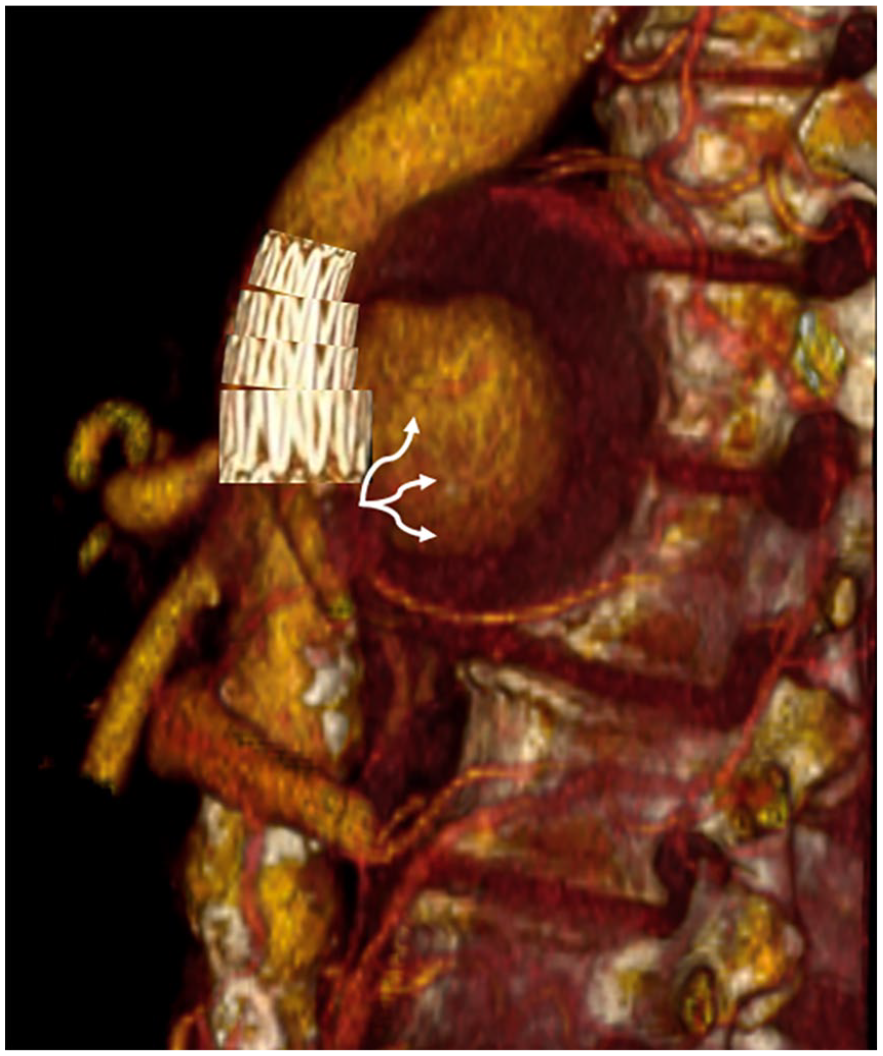
Computed tomography angiography (CTA) (Figure 1), showed a saccular aortic aneurysm, with a maximum diameter of 65 mm x 43 mm measured in a plane perpendicular to aortic centerline. The proximal extent was located above the celiac trunk, and the distal one just above left renal artery. The superior mesenteric artery presented an anomalous origin below renal arteries, and celiac trunk was stenotic at its origin. After multidisciplinary discussion, aneurysm repair was considered the priority followed by thoracic surgery for cancer. The patient was deemed unfit for open surgery with lefr thoraco-phreno-laparotomy due to COPD, and the need of a right thoracotomy in a short time-frame for the pulmonary disease. F/B TEVAR approach was excluded considering the small vessel diameter of visceral aorta (15 mm) and the proximity of the origin of the visceral branches with the anomalous distal take-off of the superior mesenteric artery. It was planned to exclude the saccular aneurysm with a stent-assisted coil jail technique and intentional occlusion of celiac trunk (Figure 2). After extensive discussion of risks and benefits of treatment, the patient refused open surgery and consented to undergo total endovascular exclusion and embolization of the aneurysm sac. Written consent was also obtained to collect anonymized data and images for scientific purposes.

Preoperative computed tomography (CT) multi planar reconstruction (A) and 3D (B) reconstructions of the saccular aneurysm.

Coil jailing technique of the saccular aneurysm: (A) Step 1: self-expandable aortic stent-graft. (B) Step 2: coil embolization of saccular aneurysm. (C) Step 3: aortic extention endograft to partially cover the wide aneurysm neck.
Procedure
The procedure was performed in a hybrid operating theater (Video 1) equipped with Allura Xper FD20 Angio System (Philips Healthcare, Best, the Netherlands) under local anesthesia. Bilateral ultrasound-guided percutaneous femoral accesses were obtained (12F left and 16F right) and pre-closed with 2 Proglide (Abbott Vascular, Redwood City, CA, USA) in each side. A selective angiography of superior mesenteric artery confirmed valid anastomotic network between the vessel and celiac trunk branches before its occlusion. A 5F selective catheter (Bern, Cordis, Miami, FL, USA) was positioned into the saccular aneurysm, and jailed in with a 24 mm x 100 mm E-XL self-expandable aortic stent (Jotec GmbH, Hechingen, Germany) that was deployed into the aorta to fully cover the wide neck of the saccular aneurysm. The aneurysm sac was then embolized with 10 Ruby Coils (Penumbra Inc., Alameda, CA, USA) to occlude the aneurysm sac (total coil length: 560 cm). A selective cannulation of the left renal artery was performed as bailout in case of its unintentional coverage, and a 26 mm x 45 mm Gore Excluder aortic extender (W.L. Gore & Associates, Flagstaff, AZ, USA) was deployed to guarantee partial coverage of the aneurysm neck. The Gore device was chosen to exploit the bottom to tip deployment mechanism. The use of both aortic bare metal stent and aortic cuff had the purpose of creating a proper distal landing zone and to avoid the cuff migration into the aneurysm sac (with a consequent type Ib endoleak that can be corrected only by open surgical conversion) (Figure 3). Completion angiography showed complete exclusion of the aneurysm, patency of renal arteries and superior mesenteric artery and reperfusion of celiac trunk from collateral branches (Figure 4). Procedure time was 80 minutes, and contrast volume was 120cc. Postoperative stay was uneventful and the pre-discharge CTA confirmed the success of the procedure (Figure 5). Thoracic surgery was successfully performed after 30 days, with right inferior lobectomy of a stage I adenocarcinoma. At 1-year, follow-up CTA demonstrated complete exclusion of the saccular aneurysm that decreased 3 mm in diameter.
Risk of aortic cuff migration into aneurysm sac and type Ib endoleak in case of thoracic endovascular repair alone, due to the absence of a proper distal sealing zone.
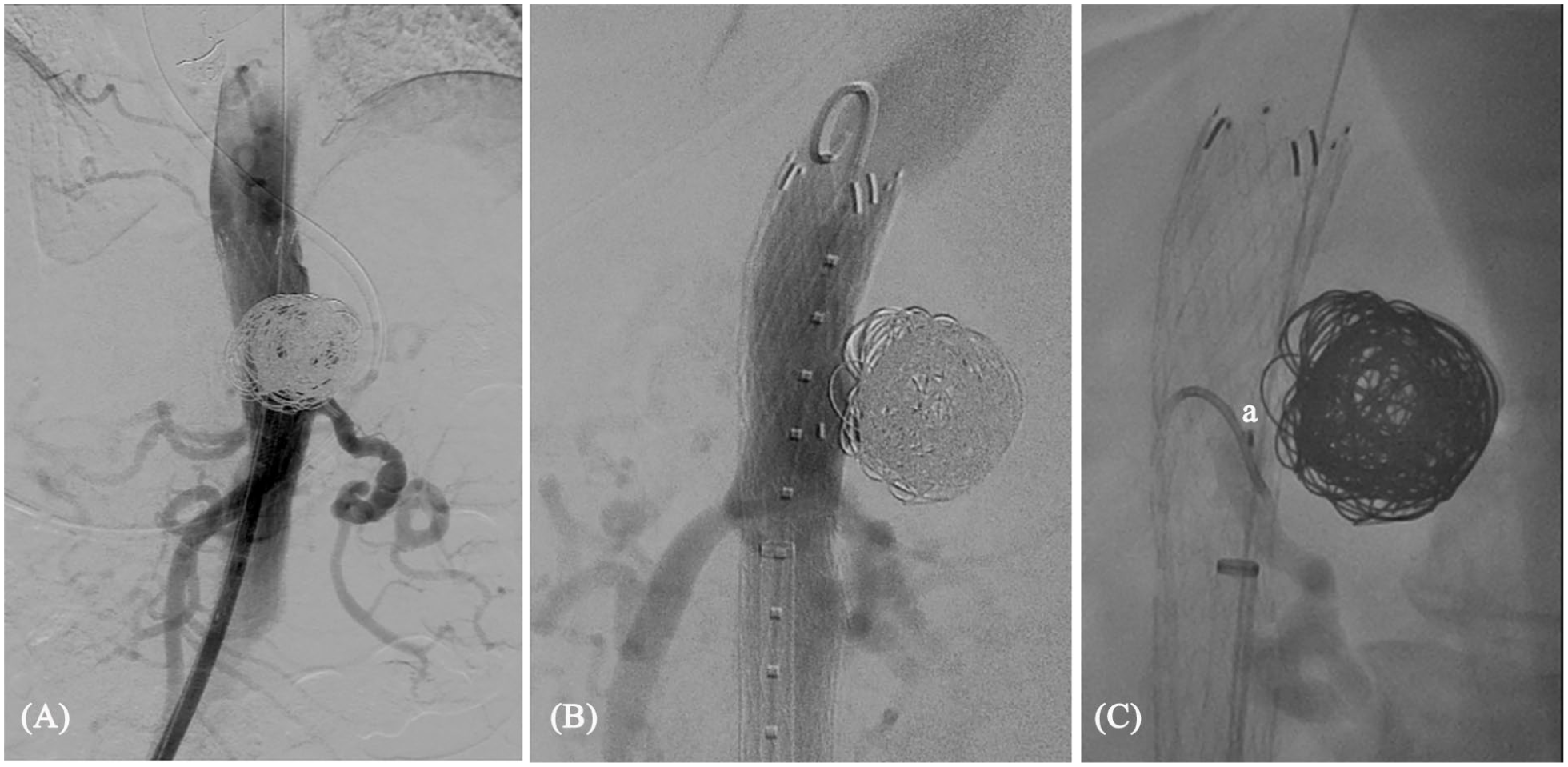
(A) Antero-posterior and (B) lateral completion angiography showing complete exclusion of saccular aneurysm and patency of renal arteries and superior mesenteric artery.

One-year computed tomography angiography (CTA) 3D reconstruction showing patency of superior mesenteric artery and renal arteries and exclusion of saccular aneurysm.
Discussion
Open surgery is still considered the gold-standard for the treatment of thoracoabdominal aneurysms in young and fit patients in high-volume centers.5 –7 F/B TEVAR can be considered a valuable alternative in fragile patients or those who already underwent previous aortic surgery, with similar early and late mortality rates and increased reintervention rate. 8 Despite the improvement in device materials and profiles, traditional F/B TEVAR can hardly be used in non-fusiform aneurysms and narrow aortic lumens like in the case we presented here or in case of aortic dissections. 9 Alternatively, hybrid procedures of visceral debranching and TEVAR have been described to combine a less invasive surgery with endovascular deployment of a thoracic stent graft, often with reported suboptimal results that render this procedure infrequent in most vascular units. 10 Our patient was considered a poor candidate both for open repair and hybrid procedure, due to the severe pulmonary comorbidity and the need for a quick recovery to face up to the subsequent intervention of right lung lobectomy for cancer.
Stent-assisted coil embolization is an established procedure to treat narrow-neck aneurysms of cerebral or visceral arteries.11,12 In our case, a self-expandable aortic stent was used for several reasons: to segment the wide neck of the saccular aneurysm into small meshes to prevent coil migration; to create a proper distal landing zone for the deployment of aortic cuff and to maintain patency of renal and superior mesenteric artery branches. Detachable coils have been preferred in this case to increase accuracy of deployment and to further reduce the risk of coil migration. Finally, a Gore Excluder aortic cuff was used to improve coverage of the aneurysm neck and favor complete sac exclusion for its peculiar way of flaring. Cases that describe endovascular coil embolization of aortic aneurysms published in the Literature are summarized in Table 1.13 –21 Nine patients have been treated with this technique, mean age was 58 years (range: 36–74 years). Two patients were treated in urgent setting. Most of them were post-surgical and post-traumatic aortic aneurysms. Technical success was achieved in all cases and complete sac exclusion was reported in 6 cases (67%) at mean follow-up of 13 months (range: 3–25 months). No long term data are currently available in literature and reported good results may be affected by positive publication bias. A strict follow-up is mandatory especially when endografts are used off-label or outside instruction for use. A follow-up protocol was tailored for this specific case with CTA at 1, 6, and 12 months and yearly thereafter plus Duplex ultrasound every 6 months.
The Table Summarize Case Reports of Coil Embolization for the Treatment of Aortic Aneurysms/Pseudoaneurysms.

n/a=not assessed.
Conclusion
Stent-assisted coil embolization of complex visceral aortic aneurysm is feasible and may represent a valuable treatment option according to this single experience. Of course, it should be reserved to very selected cases, especially if open surgery or complex fenestrated/branched stent grafts are contraindicated due to unfavorable anatomy.
Footnotes
Authors’ Note
There has been no duplicate publication or submission of any part of the work. All authors have read and approved the manuscript. There is no financial arrangement or other relationship that could be construed as a conflict of interest. The case report has been partially presented by the corresponding Author at Italian Expert Meeting (IEM), virtual roundtable, 24 May 2021, Bologna, Italy.
Declaration of Conflicting Interests
The author(s) declared the following potential conflicts of interest with respect to the research, authorship, and/or publication of this article: FV is declaring Istitutional and personal consultancy fees from Cook, Gore, Medtronic.
Funding
The author(s) received no financial support for the research, authorship, and/or publication of this article.

Supplemental Material
Supplemental material for this article is available online.
References
Supplementary Material
Please find the following supplemental material available below.
For Open Access articles published under a Creative Commons License, all supplemental material carries the same license as the article it is associated with.
For non-Open Access articles published, all supplemental material carries a non-exclusive license, and permission requests for re-use of supplemental material or any part of supplemental material shall be sent directly to the copyright owner as specified in the copyright notice associated with the article.
