







Abstract
Nurses are the largest group of health-care professionals, yet they are not uniformly educated regarding transplantation and organ donation. The future of transplantation hinges on education of this group. Before meaningful studies can be conducted, an instrument to measure attitudes and commitment to organ transplantation is needed. The purpose of this study was to examine content and construct validity as well as establish internal reliability of an investigator-developed online instrument to measure nurses’ attitudes and commitment to organ transplantation by registered nurses. The online instrument was administered to registered nurses enrolled in transplantation electives at the University of Alabama in Huntsville and Vanderbilt University. Exploratory factor analysis revealed 4 components with eigenvalues over 1.0. The components were as follows: (1) desire to work in transplantation, (2) confidence in transplantation advocacy, (3) organ donation advocacy, and (4) procurement. Internal consistency of the revised instrument was established (α = .94). The Transplant-Registered Nurse (TXP-RN) instrument is a new instrument with excellent reliability and validity that can be used to measure attitudes and knowledge of American nurses about organ donation and transplantation. This important step is necessary before educational interventions can be accurately assessed.
Introduction
Rates of organ transplantation have more than quadrupled in the last 2 decades, 1 yet nurses lack uniform education regarding organ donation and transplantation. Many nurses in practice today were formally educated in a time when transplantation was less prevalent and not included in typical nursing curricula. As the largest group of health-care professionals, nurses are in a pivotal position to advocate for organ donation as providers of care at the bedside of potential donors and their families and as trusted health-care workers in their own communities.
Existing evidence suggests that nurses’ attitudes and knowledge about donation and transplantation are essential factors in organ donation rates 2 and that educational sessions can increase awareness of organ donation. 3 Little is known about the most effective methods of educating nurses in regard to transplantation issues and whether education impacts nurses’ attitudes, confidence, and advocacy related to organ donation and transplantation. There is a need to provide education about transplantation and its associated issues and test its effectiveness using valid and reliable instruments. Unfortunately, a review of the literature revealed no instruments that could be used to measure the effectiveness of education on nurses’ commitment and confidence in organ donation and transplantation. The purpose of this article is to describe the background development of a new instrument designed to test the efficacy of transplantation education and to report on its validity and reliability.
Review of Literature
Nurses are the largest group of health-care professionals, 4 but little is known about their knowledge of organ donation and transplantation. A need for increased knowledge and training on issues of organ donation and transplantation in order to increase rates of donation has been documented in previous research. 5,6 Studies involving nurses have been small scale, 7 confined to 1 or 2 settings, 3,6 confined to the intensive care setting, 7 –9 or were specific to a different cultural environment. 10,11 The close proximity of nurses to potential donors, families, and transplant patients make them critical links in the transplant process. 6 There is a gap in the nursing literature regarding the experience of nurses with organ donation, and there is a significant need for transplantation education for intensive care unit nurses and in other areas of hospital settings where nurses provide patient care. 2
Other researchers have noted the lack of training in organ donation and transplantation among the curriculum content and methods of instruction for both nursing and medical students. 12 The lack of curricular content about issues of organ donation and transplantation may affect the comfort level which a nurse has in caring for a patient who is a potential organ donor. Being unfamiliar with the definition of brain death, donor criteria, suitable tissues for donation, and how to care for multi-organ donor patients has been documented in surveys of intensive care nurses. 9 Lack of familiarity with organ donation and transplantation has further been shown to increase the role stress of the nurse at the bedside, spurring behaviors that can lead to family perceptions of a lack of emotional support during the stressful period surrounding the decision of deceased organ donation. 13
In addition to the paucity of literature on transplant education, there are few instruments that can be used to assess the attitudes of nurses regarding organ donation registration, deceased organ donation, and organ procurement. Existing instruments have been limited to intensive care unit nurses, 7,9 college students, 14 and to eastern cultural environments with vastly different social and legal contexts. 7,15,16
This is not the case in medicine as medical students have been assessed in regard to knowledge and attitudes for organ transplantation. 12 Physician education has been shown to affect donation rates, 17 and coursework during medical school is significantly associated with increased knowledge regarding donation and transplantation. 12 Research can no longer be limited to physicians and exclude the largest group of health-care professionals that may create a positive impact on rates of transplantation. Further study into nurses’ attitudes and transplant advocacy is needed to sustain organ donation and the future of transplantation, a life-saving treatment for patients with kidney, heart, liver, pancreas, or lung failure.
Methods
The researchers examined data from a previous pilot study on the effect of an educational intervention on nurses’ attitudes, confidence, and advocacy for organ donation and transplantation. 18 Because no instrument was available to evaluate attitudes and commitment to organ donation and transplantation, the principal investigator (PI) developed a new instrument, using methods described by Mishel. 19 The researchers examined content and construct validity and internal reliability in 2 different phases. In phase 1, initial item writing was the major focus. Exploratory factor analysis and scale reliability were also assessed. In phase 2, additional items were developed and final assessment using factor analysis and reliability analysis were conducted.
Results
Phase 1: Initial Instrument Development
Content validity
Phase 1 consisted primarily of item writing. Having worked in transplant specialty for 10 years, the PI used her clinical background and expertise in transplantation management to write items for the instrument, the TXP-RN. Additional items for the instrument were developed from a review of literature. Other experts in the field of organ donation and transplantation were asked to evaluate items on the TXP-RN instrument for their relevance to clinical practice and content validity. Each item was to be given a rating between 1 and 4, with 1 being not relevant and 4 being very relevant. Only items with a mean rating greater than or equal to 3 were retained on the instrument. Any item with a mean score greater than or equal to were removed or revised. Revised items were evaluated by the same panel of experts. The revised TXP-RN contained 16 items at the end of the revision process.
Construct validity
After completion of a 5-week educational intervention (described in Hoy et al), an exploratory factor analysis using maximum likelihood method for extraction and varimax rotation was undertaken to evaluate construct validity of the instrument. All items with eigenvalues greater than 1.0 and factor loadings of 0.30 or higher were retained; 3 components were extracted. Component 1 contained 6 items related to Desire to Work in Transplantation; component 2 contained 8 items about Organ Donation Advocacy; and component 3 had 6 items about Confidence in Transplantation Advocacy that met the factor loading criteria.
Reliability
Item-to-scale correlations and Cronbach coefficient α were calculated to determine the instrument’s internal consistency reliability. Items with an item-to-total correlation coefficient less than 0.3 were considered for deletion. Three subscales were found to have acceptable reliability coefficients. Desire to Work in Transplantation had a Cronbach α of .93. Organ Donation Advocacy and Confidence in Transplant Advocacy had Cronbach α coefficients of .87 and .82, respectively. The overall scale reliability was 0.94.
Phase 2: Instrument Refinement and Psychometric Evaluation
Refinement
Although the scale had satisfactory reliability coefficients, initial pilot testing suggested that additional items related to organ procurement would refine and strengthen the tool. Therefore, 6 additional items related to organ procurement were written by the PI to measure this construct. Additional items in the area of organ procurement resulted in a 22-item TXP-RN. Content validity was undertaken through review of the instrument by transplant professionals at Vanderbilt Medical Center and doctorally prepared nurse educators at the University of Alabama in Huntsville College of Nursing (UAH CON) Scholars’ Forum.
Construct validity
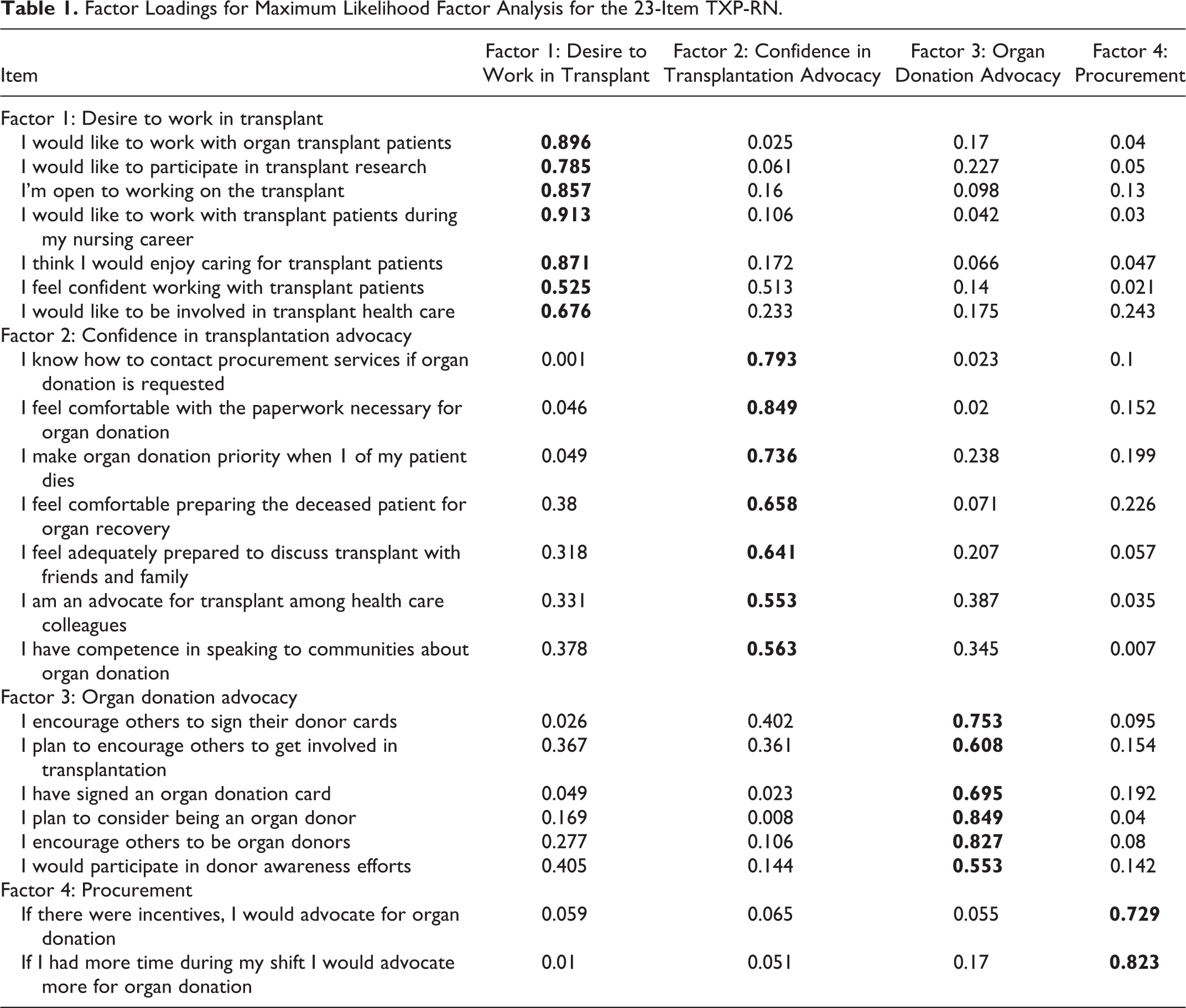
Factor analysis was used to test for construct validity on the revised TXP-RN using exploratory factor analysis with maximum likelihood method for extraction and varimax rotation. Four components had eigenvalues over 1.0 and were extracted from the data: 3 original components were extracted and 1 additional component was found. The components were as follows: (1) desire to work in transplantation, (2) confidence in transplantation advocacy, (3) organ donation advocacy, and (4) procurement. Table 1 summarizes the factor analysis results using maximum likelihood method for extraction and varimax rotation for the 4 factors. Questions that correlated the highest on a factor were retained in that particular factor. These questions now make up the 4 subscales in the TXP-RN.
Factor Loadings for Maximum Likelihood Factor Analysis for the 23-Item TXP-RN.
Reliability
A follow-up reliability test of the revised TXP-RN showed excellent internal consistency (α = .94). Subscale reliability was good, except for subscale 4. Desire to Work in Transplantation had a Cronbach α of .925. Organ Donation Advocacy and Confidence in Transplant Advocacy had Cronbach α coefficients of .870 and .818, respectively. The Cronbach α for Procurement was .649, most likely because the subscale contained only 3 items.
Replication
The pilot study with the revised TXP-RN was replicated at UAH CON and Vanderbilt School of Nursing. Thirty-two registered nurses enrolled in a transplantation elective at UAH and 7 at Vanderbilt (n = 39) took both pre- and posttests and participated in a transplantation elective course. The added items related to procurement evolved as a separate factor. The researchers found that the mean scores on the pre- and posttest TXP-RN administered in phase 2 all increased. The scores were tested using paired t tests (pre- and post-TXP-RN) and were statistically significant: (1) desire to work in transplantation (t = 1.937, df = 81, P = .05), (2) confidence in transplantation advocacy (t = 1.744, df = 81, P = .08), (3) organ donation advocacy (t = 2.831, df = 81, P = .006), and (4) procurement (t = 1.653, df = 81, P = .102) with excellent overall internal consistency (α = .94).
Discussion
The TXP-RN was found to be a valid and reliable measurement instrument of attitudes, commitment, and advocacy for organ donation and transplantation. The instrument (with its 4 subscales) provides a way for researchers to compare organ donation attitudes and commitment across time (pre- and posttest) and across different populations of registered nurses. As previously stated, nurses are the largest group of health-care professionals but little is known about the best way to provide them with transplantation and organ donation education. The development of a valid, reliable instrument is the first step toward filling this gap in the literature.
Application to Practice
Use of the TXP-RN survey has well-defined applications for health-care professionals with an interest in organ donation and transplantation, along with broader implications for those who are interested in the capabilities of focused online learning opportunities to affect eventual social change. Though attitudes toward organ donation and transplantation have been reported as favorable by previous researchers, the importance of providing information that will dispel myths and misconceptions about organ donation and transplantation has been identified as an important factor in new and ongoing campaigns. 20,21
Immediate further use of the TXP-RN instrument involves the PI and coinvestigators, who are working with the UAH Information Technology and Systems Center in promoting a web-based mobile application for the transplant community, which was initially targeted to advanced practice nurses involved in the subspecialty. Because the app and website house a continuing education module for bedside nurses designed to increase knowledge and improve attitudes related to issues of organ donation and transplantation. The TXP-RN can be used to evaluate changes in attitudes in different nurse populations; widespread use of the TXP-RN instrument will continue to strengthen its validity and reliability.
The TXP-RN instrument adds a new scale with acceptable reliability and validity to measure attitudes and knowledge of American nurses on organ donation and transplantation. Its use in addressing the knowledge deficits of bedside nurses supports the need for further education and interventions to increase both registration and deceased organ donation in the United States. Data on knowledge levels and attitudes can also assist health-care organizations in designing specific educational interventions to address staff needs related to transplantation. Efforts to increase the knowledge levels and improve the attitudes of health-care professionals on issues of organ donation registration and procurement is the initial step in increasing numbers of organs available for donation, shrinking wait-lists, and enhance the quantity and quality of life for individuals after transplantation.
Footnotes
Declaration of Conflicting Interests
The author(s) declared no potential conflicts of interest with respect to the research, authorship, and/or publication of this article.
Funding
The author(s) received no financial support for the research and/or authorship of this article.