







Abstract

Introduction
Vascular complications remain a common cause of renal allograft failure. The integrity of the renal artery intima is paramount to superior outcomes post kidney transplantation. We report the use of back-table angioscopy to diagnose and determine the extent of intimal injury in a deceased donor kidney allograft. An appropriate surgical repair was fashioned to accomplish a successful transplant.
Case
The recipient was a 63-year-old African American male patient with end-stage renal disease. The allograft was a right kidney from an ABO compatible, 38-year-old male donor with a 35% kidney donor profile index who died of anoxia. There was a single artery on an aortic cuff and a single renal vein with the inferior vena cava.
Back-table preparation of the allograft revealed an intramural hemorrhage of the renal artery that extended from the middle of the renal artery to the hilum, very close to the bifurcation (Figure 1). In order to evaluate the depth and integrity of the hematoma, we performed an ex vivo angioscopy using a 12F rigid Storz ureteroscope. Cold heparinized saline was used for irrigation. The hematoma was found to extend deep to the intima with a possibility of an intimal tear (Figure 2). The segment of the renal artery involved with the hematoma was excised. The proximal remaining segment was used as a graft to extend the artery.

Hematoma within the wall of the renal artery.
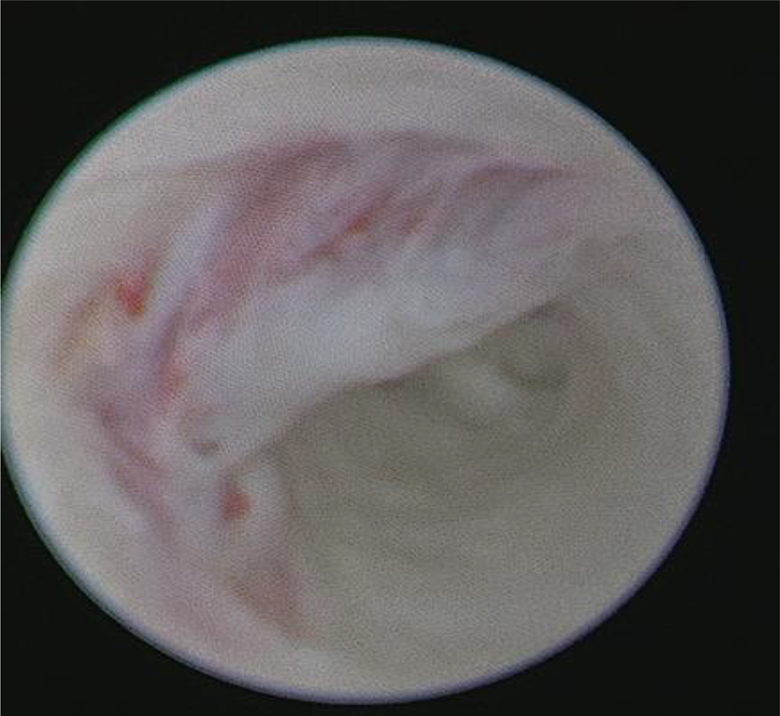
Angioscopic view demonstrating involvement of intima in the renal artery.
The allograft was placed in the left lower quadrant and vascular anastomosis was performed to the external iliac artery and vein. The allograft reperfused well with no evidence of arterial dissection or aneurysmal dilatation. The patient had immediate graft function and continues to have excellent graft function on 6-month follow-up visit.
Discussion
Vascular injury in renal allografts adversely affects transplant outcomes with increased incidence of thrombosis, stenosis, or aneurysms of the graft vasculature. The fear of such complications has led to several discarded allografts with reported vascular injury. Determining the extent of intimal injury in these grafts can facilitate a vascular reconstruction and ensure a successful transplant. This can help reduce underutilization of these scarce donor organs.
The usefulness of angioscopy was first reported by L’Hermite et al who revealed 6.6% to 12% reduction in the incidence of stenosis compared to transplantation without prior angioscopy. 1 Burgos et al in their study reported vascular pathology (subintimal hematomas, intimal tears, atheromatous plaques) in 40% of the high-risk grafts where angioscopy was used to assess. 2
This once described technique of back-table angioscopy is underused or unreported in the past 2 decades. In our case, angioscopy helped to determine the need for vascular reconstruction which, if not performed, may have resulted in either thrombosis or stenosis of the renal artery. We believe that renal allograft angioscopy can be useful in selected cases, providing safe procedure to improve transplant outcomes and particularly reduce inadvertent wastage of organs.
Footnotes
Declaration of Conflicting Interests
The author(s) declared no potential conflicts of interest with respect to the research, authorship, and/or publication of this article.
Funding
The author(s) received no financial support for the research, authorship, and/or publication of this article.