






Abstract
Introduction:
Tests exist for ApoL1 genetic variants to determine whether a potential donor’s kidneys are at increased risk of kidney failure. Variants of the ApoL1 gene associated with increased risk are primarily found in people with West African ancestry. Given uncertainty about clinical implications of ApoL1 test results for living kidney donors and recipients and the lack of uniform guidelines for ApoL1 testing, transplant centers across the United States vary in ApoL1 testing practices.
Research Questions:
(1) What approach do transplant centers take to determine whether prospective donors are of West African ancestry? (2)How do transplant centers engage potential donors during the ApoL1 testing process? (3) What do transplant centers identify as concerns and barriers to ApoL1 testing? and (4) What actions do transplant centers take when a potential donor has 2 ApoL1 risk variants?
Design:
We explored the current practices of transplant centers by surveying nephrologists and transplant surgeons at transplant centers evaluating the majority of black living donors in the United States.
Results:
About half of these transplant centers offered ApoL1 testing. Of those who offered ApoL1 testing, only half involved the donor in decision-making about donation when the donor has 2 risk variants.
Discussion:
Unaddressed differences in the priorities of transplant centers and black living donors may stigmatize black donors and undermine trust in the health-care and organ donation systems. Variation in transplant center testing practices points to the critical need for further research and community engagement to inform the development of guidelines for ApoL1 testing.
Introduction
Variants of the ApoL1 gene increase the risk of kidney disease and are primarily found in people with West African ancestry. 1,2 However, most individuals with 2 ApoL1 risk variants do not progress to chronic kidney disease or end-stage renal disease (ESRD), making the effects of ApoL1 variants on recipient outcomes uncertain and complex. 3 Recent retrospective analyses suggest that kidneys transplanted from donors with 2 ApoL1 risk variants are at increased risk of graft failure compared to kidneys transplanted from donors with 1 or no ApoL1 risk variants. 4,5 However, some evidence indicates that the increased risk of graft failure requires a second risk factor which may be either environmental or genetic, although recent evidence increasingly supports the notion that it is likely to be environmental. 6,7
While population-level screening for ApoL1 is not currently recommended, the association between an increased risk of kidney disease among individuals with 2 ApoL1 risk variants is particularly concerning the setting of living donor nephrectomy 8,9 and magnified by anecdotal reports of the development of ESRD among donors. 10,11 Recent cohort study data from black donors and recipients have underscored these risks. 3,12 In the absence of prospective data to guide practice, some transplant centers have begun to test for ApoL1 genetic variants as part of the evaluation of black living donor candidates. 13,14 However, this approach has the potential to be applied unevenly or for screening to be recommended inappropriately for some individuals. 15 Clinicians at transplant centers may depend on visual cues or race as indicated in the medical record to determine who should be offered ApoL1 testing. 16,17 This approach is problematic because ApoL1 does not affect all black people in the United States; individuals with East African ancestry have considerably lower odds of having ApoL1 risk variants. 18 Those who are of East African ancestry but who identify as black may be unnecessarily tested for ApoL1. Conversely, individuals with West African ancestry who are from the Caribbean islands but who do not identify as black may not be offered ApoL1 genetic testing despite being at increased risk of having 2 ApoL1 risk variants. 19,20 Taken together, both self-identified and clinician-identified race are unreliable substitutions for assessing genetic ancestry to identify which candidates are likely to benefit from ApoL1 testing. 21 This leads to our first research question (RQ):
RQ 1: What approach do transplant centers take to determine whether prospective donors are of West African ancestry?
Because of the complex social implications of ApoL1 testing (eg, family members of prospective donors learning about confidential testing results, potential for undue anxiety or stigmatization of prospective donors) and the uncertainty that exists about the risk related to ApoL1 variants, transplant centers across the United States are likely to have varied policies on and approaches to ApoL1 testing. This complexity and uncertainty may also lead transplant centers to be inconsistent in whether or not they engage the issue of ApoL1 testing in the first place. In fact, no unified set of guidelines about ApoL1 testing exists. Editorials from thought leaders have arrived at varied conclusions, and a recent consensus conference was only able to articulate broad suggestions. 14,22,23 Lack of transplant center consistency in ApoL1 testing and the way decisions about kidney donation are made subsequent to testing could exacerbate transplantation outcomes and health disparities among black donors. 14 In fact, research shows that black donors share these concerns but also favor routine ApoL1 testing. 24,25 Very little is known about the current clinical practices of transplant centers as they relate to ApoL1 testing. This leads to our next set of RQs:
RQ 2: How do transplant centers engage potential donors during the ApoL1 testing process?
RQ 3: What do transplant centers identify as concerns and barriers to ApoL1 testing?
In addition to inconsistencies in ApoL1 testing, there may also be inconsistencies with who is given ApoL1 testing results and how those results are used. A prior study of a diverse sample of 383 transplant surgeons and nephrologists across the United States examined individual attitudes, intentions, and practices of ApoL1 testing and found that physicians are supportive of ApoL1 testing for black living donors despite limited actual use of ApoL1 testing. 26 However, a gap in understanding ApoL1 testing practices of transplant centers remains, especially those centers that perform the majority of black living donor kidney transplants.
There are ethical and clinical considerations that need to be addressed with ApoL1 testing practices, especially with respect to the impact on prospective donors, families of donors, and recipients. Furthermore, there may be discrepancies between the priorities of transplant centers and prospective donors. For example, the desire for a living donor with 2 ApoL1 variants to donate a kidney to a loved one may be at odds with a transplant center’s goal to protect donor health or to identify a kidney that poses lower risk to the recipient. That is not to say this tension negates the use of ApoL1 testing. Rather, if approached thoughtfully and with all stakeholder concerns in mind, testing for ApoL1 could encourage shared and informed decision-making. It is unclear how transplant centers return results, such as whether genetic counselors are involved, and to what extent transplant centers engage in shared decision-making about ApoL1 testing given the current uncertainty about how this information should inform subsequent clinical decision-making. This leads to our final RQ:
RQ 4: What actions do transplant centers take when a potential donor has 2 ApoL1 risk variants?
Methods
To answer the above RQs, an online survey exploring ApoL1 testing practices was disseminated via email to nephrologists and transplant surgeons at 63 transplant centers in the United States that currently have had at least 10 black living donors per year according to 2015 United Network for Organ Sharing data. Transplant centers meeting this criterion perform approximately 79% of all black living kidney donor transplants in the United States. The survey consisted of multiple-choice questions asking about transplant center demographics, race identification practices, transplant center-wide standards for ApoL1 testing practices, and barriers to ApoL1 testing.
Authors S.M. and D.S., both members of the ApoL1 Long-term Kidney Transplantation Outcomes (APOLLO) network, created a list that contained the name, e-mail address, and phone number of 1 individual at each of the targeted transplant centers. Individualized survey links were emailed to each contact using Qualtrics online survey system, which is password and firewall protected and meets Health Insurance Portability and Accountability Act (HIPAA) data security requirements. If, after 1 week, potential participants did not respond to the survey, S.M. and D.S. sent up to 4 follow-up e-mails or made telephone calls reminding participants about completing the survey. If the initial recipient thought he or she was not the appropriate individual to take the survey, he or she provided the name and email of a contact deemed more appropriate. Individualized survey links were then sent to these individuals.
After clicking on the survey link, participants were presented with information about the study. Informed consent was obtained from all individuals, and those who wished to participate were instructed to click on the next button to advance to the survey. The survey was expected to take about 8 minutes to complete. Participants were not paid for completing the survey but were entered into a lottery to win one of the three US$25 Starbucks gift cards. Statistical analysis was conducted in IBM SPSS Statistics version 25 (IBM Corp, Armonk, New York). We generated descriptive statistics and frequencies. This study was approved by the institutional review board (protocol ID # 201808050).
Results
Data were collected in September 2018. A total of 33 of the 63 contacts responded, resulting in a 52% response rate. About 91% of respondents were transplant nephrologists and 9% of participants were transplant surgeons.
Table 1 presents the frequencies of race determination and ApoL1 testing practices of transplant centers. Transplant centers rely heavily on prospective donor self-report of race to determine if these donors are of West African ancestry. Despite this practice, the vast majority (75.9%) of transplant centers think that their current approach for identifying race misses potential prospective donors who are of West African ancestry who do not identify as black. Particularly notable is that over one-third of the respondents used a method other than asking the prospective donor directly suggesting perhaps a certain reluctance on the part of clinicians to ask prospective donors about their race. Of the 33 transplant centers, 48.5% offer ApoL1 genetic testing to prospective black living donors, and 51.5% do not currently offer ApoL1 testing. Specifically, 33.3% of transplant centers have no current plans to offer ApoL1 testing, and 18.2% are considering offering ApoL1 gene testing in the future.
Transplant Center Race Determination and ApoL1 Testing Practices.a
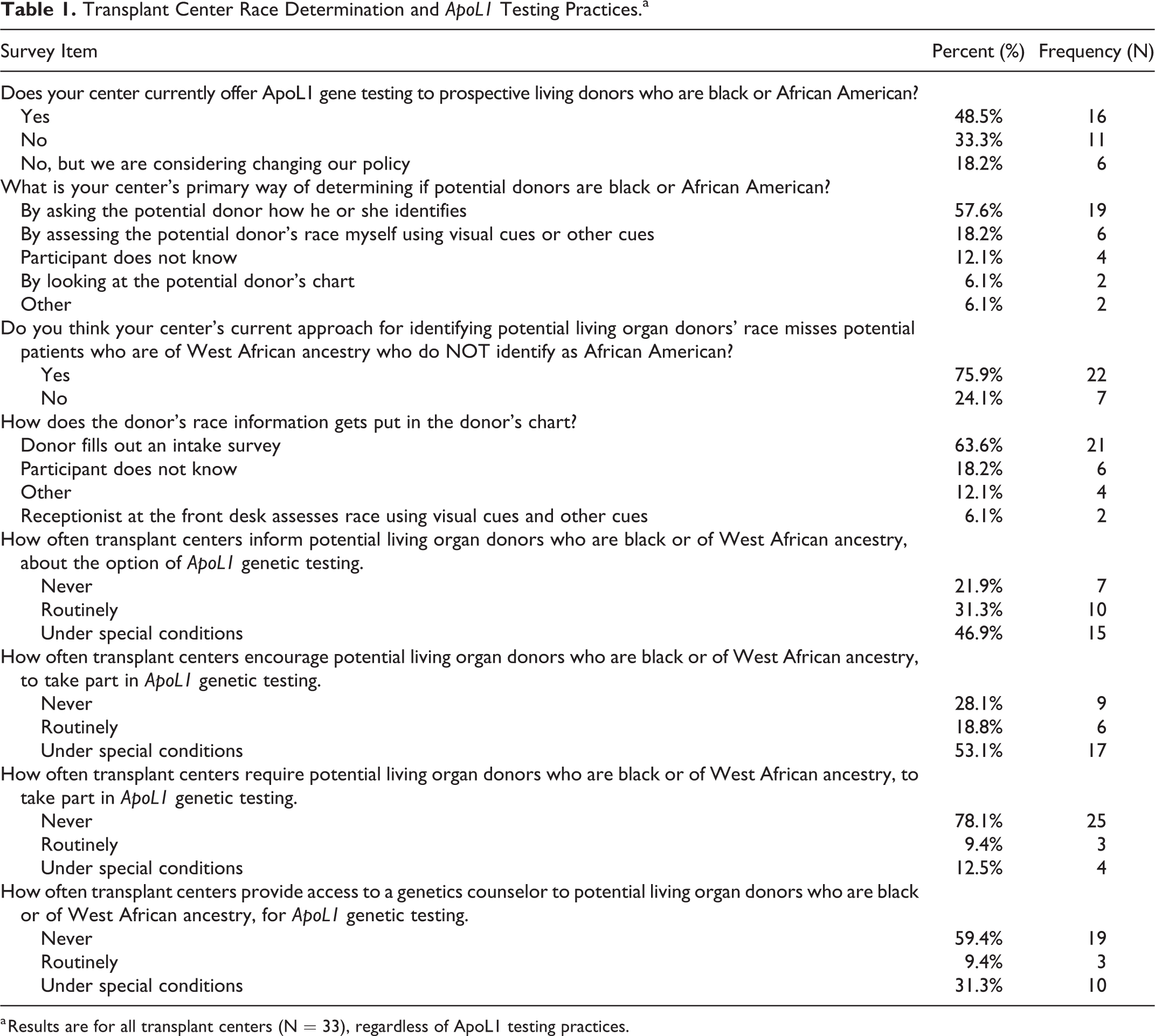
a Results are for all transplant centers (N = 33), regardless of ApoL1 testing practices.
Table 2 presents the frequencies of barriers and concerns that transplant centers have with offering ApoL1 testing. The primary reason for not offering ApoL1 testing (70.6%) is that there is inadequate information about the implications of donating for living donors who have 2 ApoL1 risk variants. Another, although less common, reason (23.5%) is that offering ApoL1 testing may reduce access to living donor kidney transplantation. Tertiary reasons include inadequate of information about implications for recipients (17.7%), testing not being covered by insurance (17.7%), low risk to recipients (17.7%), and concern about stigmatizing minorities (17.7%).
Transplant Center Concerns and Barriers to ApoL1 Testing.a

a Results are only for transplant centers that do not offer ApoL1 testing (N = 17). For this set of questions, participants were instructed to check all response options that applied.
Many transplant centers that do not currently offer ApoL1 testing would consider changing their practice if data become available that show an increased likelihood that living donors with 2 risk variants would develop kidney disease (58.8%) or if transplant centers were able to determine which individuals with 2 risk variants would be likely to develop kidney disease (47.1%).
While 3 quarters of all respondents who do not currently offer ApoL1 testing were concerned about the limited information currently available or that the risk was small enough to be overlooked, nearly a quarter of respondents expressed concern about the adverse impact that this would have on access to living transplantation for a population that already experiences a significant disparity in access to living donor transplantation. Nearly 1 in 6 expressed concerns about the cost of testing and 1 in 3 suggested that they would start to test if the test was covered by insurance companies despite the fact that the evaluation of donors is covered by Medicare as part of the costs related to organ acquisition, thereby neutralizing concerns related to cost. Furthermore, ApoL1 testing is relatively inexpensive, costing around US$350 to US$400 per test. 27
Currently, nearly a quarter of transplant centers included in this study do not inform prospective donors about the option of testing for ApoL1, and nearly a third of transplant centers do not encourage testing. Only 9.4% of transplant centers require testing. Most transplant centers inform (46.9%) or encourage (53.1%) ApoL1 testing only under special conditions rather than on a routine basis. The majority of transplant centers never provide prospective donors with access to a genetic counselor (59.4%) when engaging issues of ApoL1 testing or only do so under special conditions (31.3%).
Table 3 presents the frequencies for the actions transplant centers take when a prospective donor has 2 ApoL1 risk variants. Personnel at half (50%) of the transplant centers that offer ApoL1 testing discuss the risk with the donor and make a joint decision about donation. However, 43.8% of transplant centers offering ApoL1 testing make the decision to exclude the individual as a donor without involving the potential donor in decision-making. While 37.5% of transplant centers do not encourage donors with 2 ApoL1 variants to share their results, an equal proportion of transplant centers encourage donors to share results with their family members (37.5%). In 18.8% of transplant centers, donors were encouraged to share results with the intended recipient and more often with their primary care doctor (50%).
Transplant Center Actions When Prospective Donor Has 2 ApoL1 Risk Variants.a

a Results are only for transplant centers that currently offer ApoL1 testing (N = 16). For this set of questions, participants were instructed to check all response options that applied.
Conclusions
A high degree of variability in ApoL1 testing practices was found across transplant centers in the United States, potentially reflecting the continued clinical uncertainty of the role that ApoL1 testing has in a majority of potential at-risk donors. The approach that most transplant centers take consists of donor candidate self-reports of race, which is an unreliable means of determining ancestry. This has the potential to miss donor candidates who would benefit from screening as well as unnecessarily test those who are unlikely to carry 2 risk variants.
Transplant center ApoL1 testing practices appear to be limited in the extent to which they engage with and take into account the perspectives and priorities of relevant stakeholders, such as donors and their families. There are likely differences in the priorities of transplant centers, black living donors, and black recipients when considering ApoL1 testing and related clinical practices. While respondents aspire to the goal of shared decision-making, only a small minority of centers have trained genetic counselors available to help transplant teams share this information and its implications with prospective donors. Nearly, a quarter of transplant centers in this study who do not offer ApoL1 testing considered the adverse impact of ApoL1 testing on access to kidneys from living donors, and 17.7% of transplant centers identified concerns about stigmas associated with genetic testing for a variant that was strongly associated with black race. Prospective donor concerns about stigma and the misuse of results from genetic testing may increase mistrust in the health-care and organ donation systems. This will only be made worse if prospective donors discover inconsistencies between centers on whether and how the test is used and the implications that arise from the test results. 28 This points to the importance of involving and informing prospective donors at all stages of the ApoL1 testing process including the current uncertainty associated with the interpretation of the test results as well as the fact that this is not a clinically actionable mutation at this time.
As genetic testing becomes more commonplace and more transplant centers increasingly conduct ApoL1 testing of prospective living donors, it will be imperative to involve the donors and their recipients in a shared decision-making process. This is a notable area for development and change in the actions taken by transplant centers, considering 43.8% of transplant centers make the decision about suitability for donation without consulting donors with 2 ApoL1 variants. Not including donors in decision-making may perpetuate the concept of medical paternalism, may result in unintended emotional harm to these potential donors and negatively affect the psychosocial well-being of potential donors. 29,30 This unintended emotional harm may be particularly salient when potential donors are hoping to donate to a close first-degree relative. Transplant center concerns are reasonable: donors with first-degree relatives with ESRD are more likely to have 2 risk variants and potentially share the risk of exposure to a yet to be identified second risk factor. If a transplant center uses ApoL1 test results to unilaterally exclude a person from serving as a living donor, then perhaps this should be disclosed in an informed consent discussion prior to genetic testing. In general, patients have the rights to be informed not only of the rationale for a genetic test (or any medical procedure), but also the risks and alternatives.
Our study has many strengths. It is a national assessment of transplant center practices and attitudes regarding ApoL1 testing that was targeted to the centers with the most clinical experience working with this donor population. It identified a key limitation in the practice of identifying suitable candidates for screening on the part of transplant centers. While a prior survey examined diverse factors that influence individual physicians’ perspectives on ApoL1 testing in donor evaluation, 26 our study focused on the practices and policies of transplant centers, specifically, those that do the majority of living donations involving black donors. Policies on genetic testing are likely to be instituted at a center-wide level, regardless of individual physician perspectives. Understanding transplant center practices are integral to exploring and addressing issues related to ApoL1 testing. Our response rate of 52% was a robust one and exceeds that of prior surveys conducted in this domain. 24
Our study has limitations. It is possible that the centers that did not complete the survey have different ApoL1 testing practices than the participating centers. As new data, including from the APOLLO Network, becomes available, it is possible that ApoL1 testing practices may change and attitudes could shift rapidly, rendering our results less relevant to future practice. However, regardless of future ApoL1 testing policy or practice, our observation regarding how physicians determine prospective donor race, and by extension, appropriateness for testing, remains an important one.
The variability in transplant center ApoL1 testing practices and transplant decisions based on the results of ApoL1 testing necessitates further research on best practices in ApoL1 testing. These best practices should help centers identify who is to be tested, how and to whom to disseminate the results, as well how to use the results of this test in a manner that is fair and equitable for both donor and recipient.
Footnotes
Acknowledgments
The authors thank all participants who completed the survey.
Declaration of Conflicting Interests
The author(s) declared the following potential conflicts of interest with respect to the research, authorship, and/or publication of this article: A.I. is affiliated with Wake Forest Health Sciences, which holds a patent for an ApoL1 genetic test. She has no financial interest in the patent. The remaining authors have no other relevant conflicts of interest to disclose as described by Progress in Transplantation.
Funding
The author(s) disclosed receipt of the following financial support for the research, authorship, and/or publication of this article: The effort of TJM was supported in part by the Mid-America Transplant Foundation.
