







Abstract
Introduction
Organ shortage is a global issue. A disaster like an earthquake not only increases the number of people in need of organs but also negatively affects the treatment processes of patients who have already undergone transplants.
Aim
The aim of this study is to examine the impact of the earthquake that occurred on February 6, 2023, in Türkiye on organ donation and transplantation.
Methods
The study was conducted using open-access statistical data of 2022-2023 years available on the official website of the Tissue, Organ Transplantation, and Dialysis Services of the Ministry of Health in Türkiye.
Results
It was found that the earthquake did not affect the number of organ transplants, organ donations, brain death diagnoses, and family consent in Türkiye, but in the provinces affected by the earthquake, it decreased the number of organ donations, brain death diagnoses, and living donors and increased the number of family consent.
Conclusion
Healthcare professionals in disaster-affected regions should receive specialized training to maintain critical organ donation protocols, supported by decentralized coordination systems that ensure the continuity of these processes even when central networks are disrupted.
Introduction/Background
Attitudes toward organ donation are affected by social and cultural factors, policies implemented, religious beliefs, level of knowledge, and family consent.1-3 It is thought that natural disasters may also have an effect. The effect of a social response to a natural disaster on organ donation can be explained by the social representation theory. Within the scope of this theory, 4 organ donation is more than an individual's attitude or decision; it is affected by the individual's “values, ideas, and practices” 5 (p8) and the meaning attributed to social issues by a society or a group. This has been seen in natural disasters affecting entire communities6-8 such as the dramatic and unprecedented increase in blood donations in response to the 2009 Victorian bushfires in Australia. 8 Theoretically, the context of destruction, injury, and death caused by bushfires made the belief that blood donation could help others particularly salient and overshadowed the negative emotions and thoughts associated with donation. 7
Earthquakes are one of the world's greatest natural disasters that remain in the memory of societies and still threaten them. Türkiye is a country located within the most active fault zones on the Earth due to its geological features and topographic structure and is always exposed to the danger and risk of major earthquakes. 9 Earthquakes measuring 7.8 and 7.5 on the Richter scale, Kahramanmaraş-centered earthquakes that occurred February 6, 2023, were the biggest disasters Türkiye has experienced since 1939. As stated in the statement made by the Ministry of Internal Affairs on April 24, 2023, the number of people who lost their lives in the earthquakes was 50 783. The number of injured was reported as 107 204. 10 According to the United Nations development experts report, 1.5 million people were left homeless. 11 A 3-month-long state of emergency was declared in 12 provinces affected by the earthquakes, and the World Health Organization (WHO) declared a level 3 emergency for Türkiye. 12
These earthquakes affected people physically, psychologically, socially, politically, and economically.13,14 It has been stated that these impacts were experienced more in special groups who have end-stage renal failure and have undergone organ transplantation and increased mortality.15,16
A disaster such as an earthquake with unexpected and multidimensional impacts both increases the need for organs and negatively affects the treatment and follow-up processes of patients undergoing transplantation. It has been stated that the number of patients with acute renal failure increases in an earthquake. 16 Also, problems in accessing immunosuppressive drugs used by organ transplant patients 15 and in the follow-up and monitoring of transplant patients 17 emerge. There was no study in the literature about the impact of the earthquake on the number of organ donations and organ transplants performed.
Specific Aim
This study was conducted to examine the effect of the major earthquake disaster in Türkiye on the number of organ donations and organ transplants performed. Organ donation activity assessments included brain death, family consent, the number of people willing to donate organs and the number of living donors. Organ transplantation activities assessment included the number of kidney, liver, heart, and lung transplantation performed.
Design/Methods
Design
A descriptive and cross-sectional research design was used to retrospectively evaluate open-access statistical data for the years 2022 and 2023 available on the official website of the Tissue, Organ Transplantation, and Dialysis Services Department of the General Directorate of Health Services of the Ministry of Health in Türkiye. Ethics committee approval was obtained to conduct the study (8836-GOA, 2024/15-07). The study met the criteria of the ethical use of research data and waiver of written informed consent was granted by the ethics committee decision number (8836-GOA) and date (May 15, 2024).
Population
The population of the study included people who registered in the Tissue, Organ Transplantation, and Dialysis Services Department of the General Directorate of Health Services of the Ministry of Health in Türkiye.
Setting
A total of 12 provinces were affected by the 2023 earthquake in Türkiye: Adana, Adiyaman, Diyarbakir, Elaziğ, Gaziantep, Hatay, Kahramanmaraş, Kilis, Malatya, Mardin, Osmaniye, and Şanliurfa. There were 10 kidney transplant centers (2 in Adana, 2 in Diyarbakir, 3 in Gaziantep, 1 in Malatya, and 1 in Kahramanmaraş) and 8 liver transplant centers (1 in Adana, 1 in Diyarbakir, 1 in Elaziğ, 3 in Gaziantep, and 1 in Malatya).
Sampling
The sample of this study consists of all organ donors and recipients registered in the Organ Transplantation and Dialysis Services Department of the General Directorate of Health Services of the Ministry of Health in Türkiye. The study sample was divided into 2 groups: donors and recipients. The donor group includes; individuals who voluntarily donated organs in 2022 and 2023 or families who provided consent for organ donation after brain death. The recipient group included patients who were on the waiting list for organ transplantation, had received a transplant (from living or cadaveric donors), or were diagnosed with brain death. Inclusion criteria for the study required individuals to be registered in the Tissue, Organ Transplantation and Dialysis Services Department system, either as organ recipients, donors, or family members who gave consent for organ donation.
Data Collection
A descriptive characteristics form was used to collect data developed by researchers. It consists of questions about the number of organ donation cards, brain death, family consent, and living donor transplants in 2022 and 2023 both for Türkiye general and for the 12 provinces affected by the earthquake. The total population of Türkiye and the provinces affected by the earthquake were obtained from the Turkish Statistical Institute (TURKSTAT), a publicly accessible website.18,19 All data were entered into the data collection form manually as the data could not be downloaded from the websites.
Organ Donation and Transplantation Procedure
All procedures related to organ transplantation in Türkiye are carried out in accordance with Law 2238 on Organ and Tissue Removal, Storage, Grafting, and Transplantation (Official Gazette Date: 09.12.2022; Official Gazette Number: 32038). Every individual aged 18 years and over in the country can donate their organs voluntarily. Even if individuals donate their organs while they are alive, family approval is required for their organs to be taken after brain death. Organ transplantation from a living donor can be the recipient's spouse, who the recipient has been married to for at least two years, and blood and in-law relatives up to the fourth degree (including the fourth degree). In cases where the disease requiring organ transplantation is diagnosed after marriage, spouses are not required to have been married for at least two years. 20
Organ donation, waiting list, and organ transplantation data in Türkiye are obtained by the Ministry of Health through transplantation, dialysis, and monitoring systems. The organ and tissue transplantation coordination system in Türkiye operating under the General Directorate of Health Services of the Ministry of Transplantation and Dialysis Services has grouped all donor source centers, organ transplant centers, dialysis centers, and intensive care units into the Turkish Organ and Tissue Donation Information System (OTDIS). Currently, all national organ transplantation sharing and distribution services are provided through this system. The Population Information System (PIS), the Social Security Institution (SSI), the Dialysis Information Management System (DIMS), the Intensive Care Monitoring System (ICMS), and the Organ and Tissue Donation Information System (OTDIS) have also been integrated into this system. 21 In this system, data about waiting lists according to organs and transplants performed are provided annually for Türkiye total only. The data about people with organ donation cards can be accessed both for Türkiye total and by province. In addition, the same data can be viewed both annually and monthly. The number of brain deaths, family consent, and living donor transplants are provided only annually for the country total and by province.
Data Analysis
Data were evaluated by calculating frequencies, percentages, incidences per million people (PMP), and increase and decrease rates. Per million people data were calculated by the researchers using the formula,


Results
Organ Donation Activity
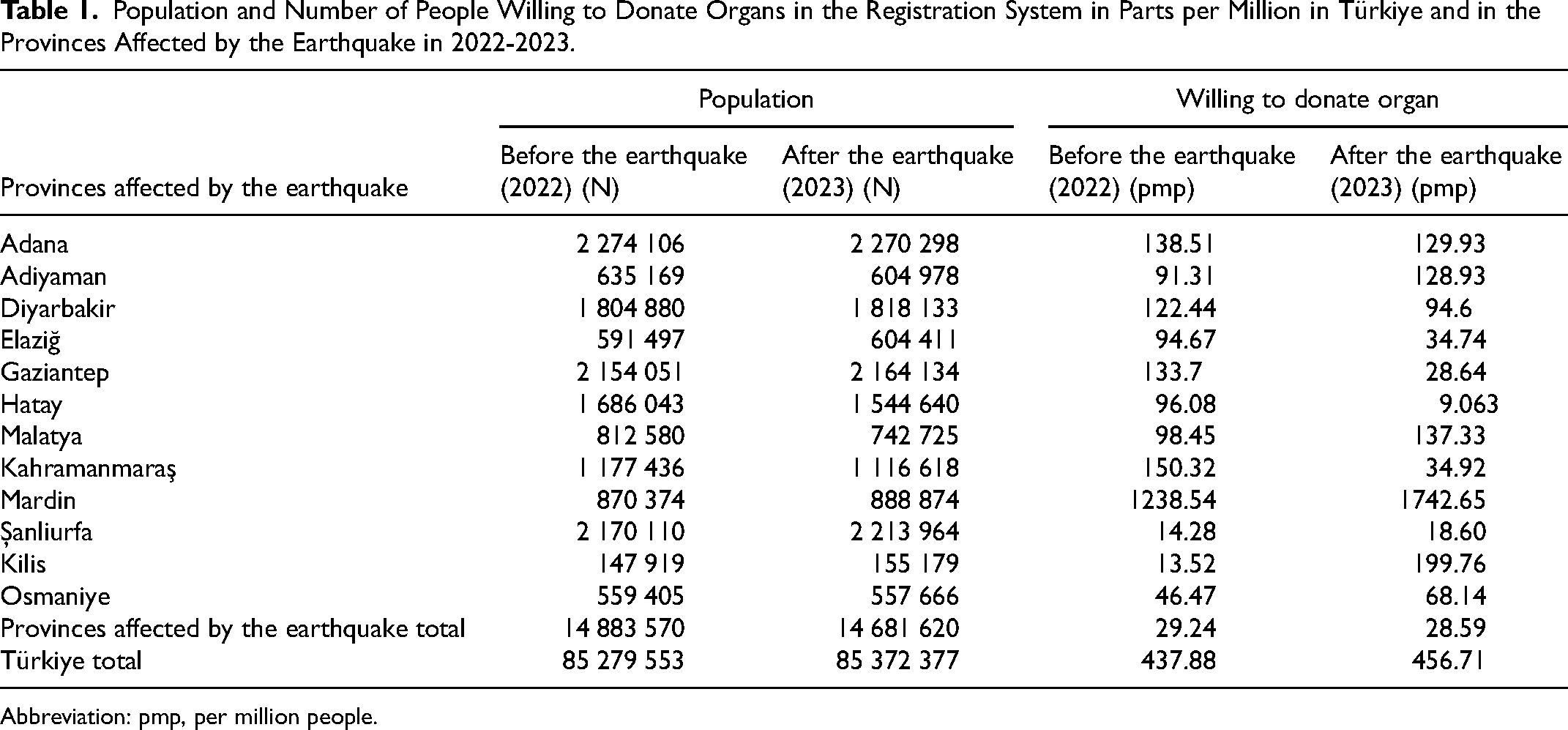
The population in Türkiye general and in the provinces affected by the earthquake in 2022-2023 earthquake and throughout Türkiye show differences between provinces. Before the earthquake, the total number and incidence of voluntary organ donations (having an organ donation card) were PMP 437.88 in Türkiye total and PMP 29.24 in the provinces affected by the earthquake. After the earthquake, voluntary organ donations were PMP 456.71 in Türkiye total and PMP 28.59 in the provinces affected by the earthquake. While the voluntary organ donation rates in the provinces affected by the earthquake decreased by 2.27%, they increased by 4.12% in Türkiye general. The province with the highest increase in the number of voluntary organ donations was Mardin, while the province with the highest decrease was Hatay (
Population and Number of People Willing to Donate Organs in the Registration System in Parts per Million in Türkiye and in the Provinces Affected by the Earthquake in 2022-2023.
Abbreviation: pmp, per million people.
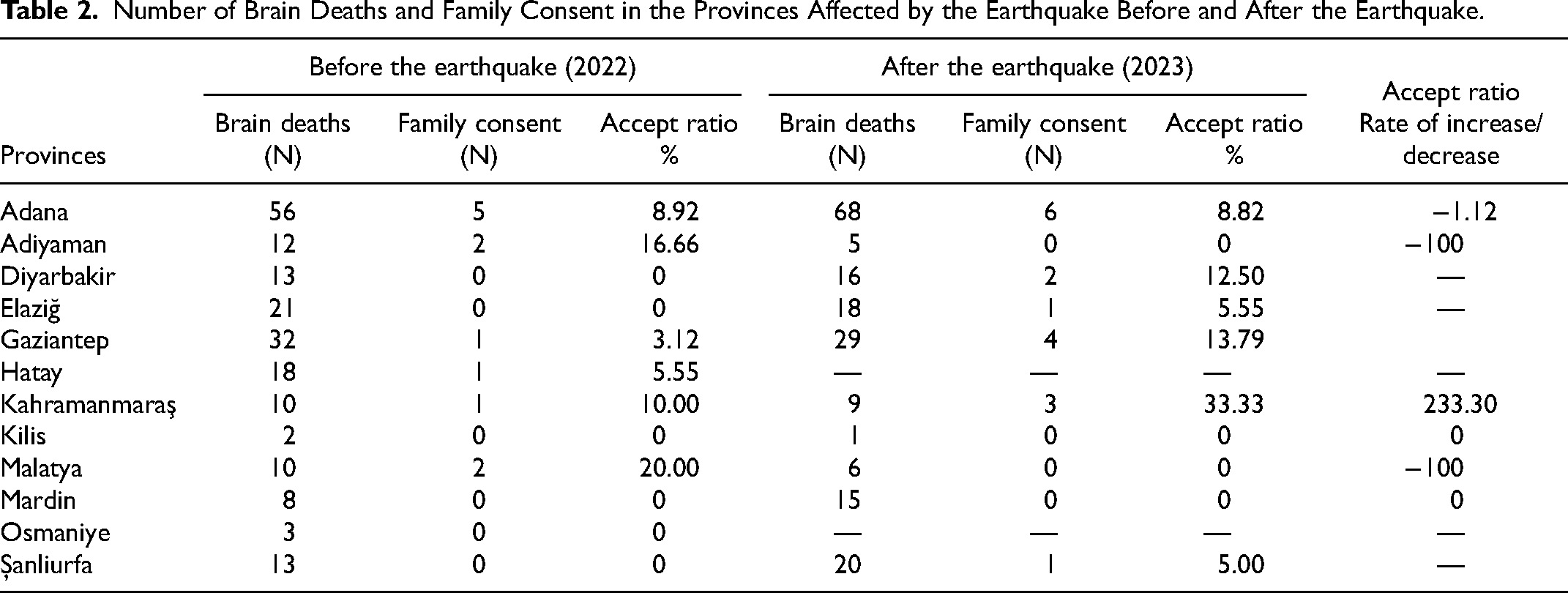
The number of brain death diagnoses and family consent before and after the earthquake according to the provinces affected by the earthquake is given in
Number of Brain Deaths and Family Consent in the Provinces Affected by the Earthquake Before and After the Earthquake.
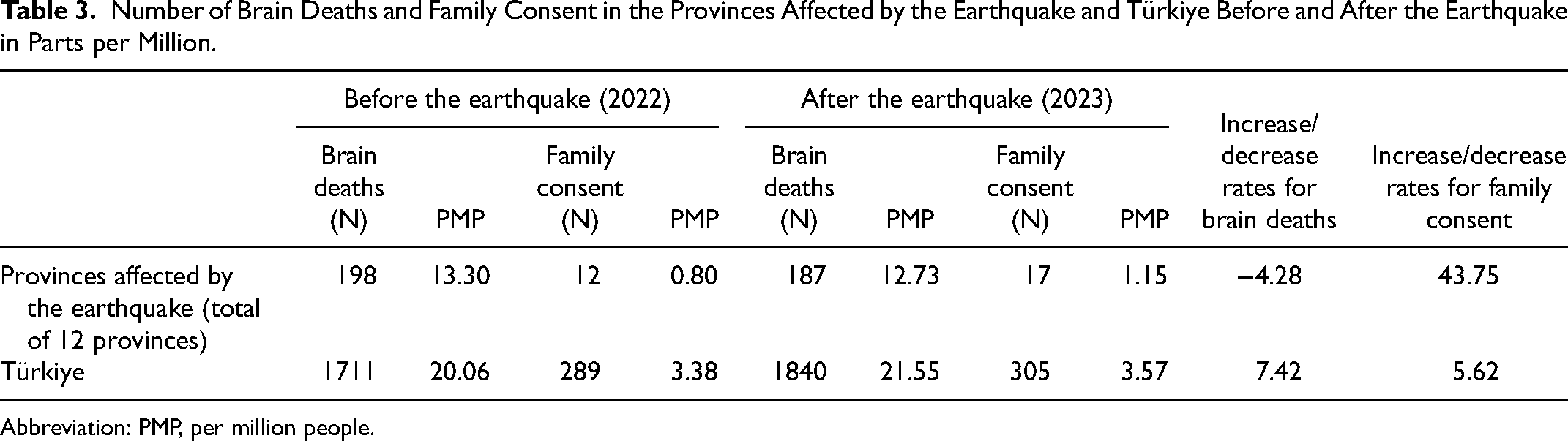
The incidence and increase/decrease rates of the total number of brain death diagnoses and family consent in Türkiye total and in the provinces affected by the earthquake before and after the earthquake are given in
Number of Brain Deaths and Family Consent in the Provinces Affected by the Earthquake and Türkiye Before and After the Earthquake in Parts per Million.
Abbreviation: PMP, per million people.
Organ Transplant Activity
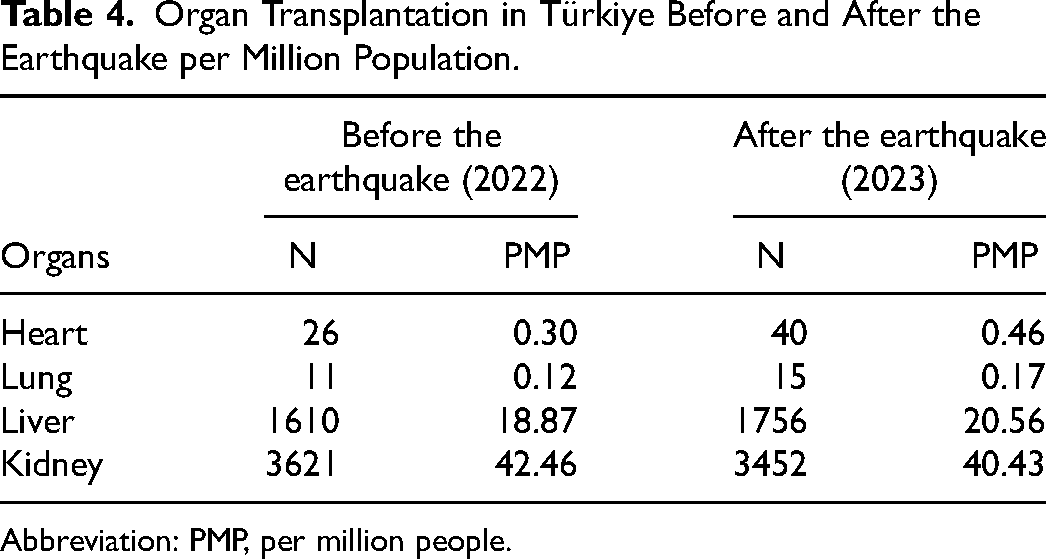
The PMP incidence of heart, lung, liver, and kidney transplants performed in Türkiye before and after the earthquake are given in
Organ Transplantation in Türkiye Before and After the Earthquake per Million Population.
Abbreviation: PMP, per million people.
When the distribution of living donor kidney and liver transplants as PMP in Turkey and in the provinces affected by the earthquake before and after the earthquake was examined, living donor kidney transplants decreased by 7.16% in Türkiye and by 21.43% in the provinces affected by the earthquake. The incidence of living donor liver transplants increased by 7.60% in Türkiye and by 6.64% in the provinces affected by the earthquake.
Discussion
One of the most important factors affecting the organ transplantation process is organ donation. The results of the evaluation indicated there was a 4.12% increase in the organ donation rate in 2023 compared to 2022 in Türkiye, while there was a 2.27% decrease in the earthquake zone. The report published by the Global Observatory on Donation and Transplantation (GOTD) showed that the organ requirement in 2022 worldwide increased by approximately 9.1% compared to 2021. 22 In the Newsletter Transplant report published in 2023, the per million population waiting list rate was 85.6 in Türkiye, while the transplant rate was 61.5 PMP. 23 This data showed that although the number of people in need of organs increases every year, the transplants performed were not enough to meet this need. The increase in organ transplants from deceased donors and meeting the existing organ requirement in Türkiye is inadequate. A 2.27% decrease instead of an increase in the earthquake region was quite noteworthy when the increased organ failure and need for organ transplantation due to the earthquake was considered. This may be due to the high number of deaths in the earthquake region and the migration of survivors to other regions.
According to the Istanbul Declaration, transplantation from a cadaver donor is recommended from medical, social, and ethical perspectives. 24 In Türkiye, even if people donate their organs voluntarily while they are alive, family approval is required after brain death. 20 In this study, brain death diagnosis was found to increase by 7.42% and family consent by 5.62% after the earthquake compared to the pre-earthquake period in Türkiye. In the earthquake region, although brain death diagnosis decreased by 4.28%, a 43.75% increase was observed in family consent. While it was seen that there was a very significant decrease in brain death diagnoses in some provinces and even none at all, there was an increase in family approval in provinces where brain death diagnoses were made. Some studies indicated that the main determinants in brain death diagnosis were the knowledge level and education of health professionals25,26 and it was emphasized that many factors, such as the attitude of healthcare professionals, the care they provided for the patient during his/her hospital stay, the family's satisfaction with care, trust in the healthcare professionals, and level of knowledge about the diagnosis of brain death and organ donation, affected family consent.26,27 In this context, the results of this research showed that the effects of variables previously defined in the literature on the diagnosis of brain death and family consent in Türkiye continued and that the earthquake did not affect this. There was no study in the literature about the effect of the earthquake on the number of brain death diagnoses and family consent. In this study, the decrease in brain death diagnoses in earthquake-stricken regions may have been because intensive care units accepted primarily earthquake victims in the first months of the earthquake. In addition, brain death diagnosis requires educated health professionals and intensive care services with enough quality. Due to the earthquake, qualified health professionals in the earthquake region may have migrated to different regions and the intensive care services of some hospitals may have been disrupted affecting brain death diagnosis. Organ donation, conceptualized within the scope of social representations theory, 4 is more than an individual's attitude or decision. Representations, defined as values, ideas, and practices, 5 are systems through which a society or a group comes to understand social issues. The representation may have aspects that become more or less salient depending on the context in which it occurs. It is thought that this increase, which occurs after natural disasters such as earthquakes and forest fires, is because the context of destruction, injury, and death caused by the natural disaster makes the idea and belief that donation can help others more apparent and overshadows the negative feelings and thoughts associated with donation. 7
There was no change in the total number of transplants performed in Türkiye before (5268) and after the earthquake (5263). There are 144 organ transplant centers in Türkiye, including 15 hearts, 2 lungs, 75 kidneys, and 52 livers. Eighteen of these organ transplant centers, including 10 kidneys and 8 livers, were located in the regions affected by the earthquake. It is thought that the reason why the number of organ transplants was not affected by the earthquake was that the number of organ transplant centers in the earthquake region was not high enough to affect Türkiye total and that even if they were negatively affected functionally in the acute period after the earthquake, other centers were not affected by this process.
Compared to the pre-earthquake, kidney transplants from living donors decreased both in Türkiye and in the earthquake region and liver transplants increased in Türkiye general and decreased in the earthquake region. The rate of living donor transplants in Türkiye is quite high, with kidney transplants ranking first in the world 28 and liver transplants ranking third. 29 The decrease in living donor transplants in the provinces affected by the earthquake may have been due to the migration of the majority of people to other provinces after the earthquake. Living donor transplants are a more planned surgery than deceased donor transplants and affect both the recipient and the donor. In addition, in living donor transplants, both the living donor and the recipient must live near the transplant center for a while for post-transplant monitoring. There may have been a decrease in the living donor transplant rate because patients did not want to live in the earthquake zone or could not find safe residential areas to live in.
Limitations
This study has several limitations. Since the number of organ transplants performed was given only for Türkiye general, the number of transplants in the regions affected by the earthquake was unknown. There was no data on brain death diagnosis and family consent in some provinces (Hatay and Osmaniye) in the year when the earthquake occurred and the increase and decrease rates were unknown since PMP could not be calculated. Finally, gender was not provided in the databases used and therefore the effects among gender were not able to be studied.
Conclusion
This study indicated that the earthquake did not affect the number of organ transplants, organ donations, brain death diagnoses, and family consent in Türkiye, but it decreased the number of organ donations, brain death diagnoses, and living donors and increased the number of family consent in the provinces affected by the earthquake in total. There was no study on the effects of natural disasters such as earthquakes on organ transplants and organ donations. Strategies should be developed and implemented to sustain and support organ donation, especially brain death diagnosis in earthquake disasters. There is a need to examine the effect of the earthquake on organ transplant services.
Footnotes
Acknowledgments
We would like to express our sincere gratitude to Prof. Dr Reyhan Uçku for her invaluable contributions to the data analysis in this study.
Funding
The authors received no financial support for the research, authorship, and/or publication of this article.
Declaration of Conflicting Interests
The authors declared no potential conflicts of interest with the research, authorship, and/or publication of this article.
Data Availability Statement
The data that support the findings of this study are available from the corresponding author upon reasonable request.
