







Abstract
How do the rewards for a victory influence the soccer teams' offensiveness? The authors argue that a “home bias” induces the home team to play excessively offensively, in the sense that the home team does not maximize the tangible returns from a match. When the rewards for a victory are increased, the opportunity costs of playing excessively offensively rise, so that the home team chooses a more defensive playing style. Therefore, an increase in the rewards for a victory leads to the counterintuitive result of a more defensive soccer match if the home bias is sufficiently strong and if the levels of offensiveness of the teams are strategic substitutes. The authors test their theoretical hypotheses with data on the German soccer premier league. If the home bias is proxied for by the number of spectators relative to the stadium capacity, the authors find support for the theoretical predictions. The results have implications for the design of soccer competitions.
Introduction
A more offensive strategy in soccer is typically regarded to be a more attractive strategy. Still, it seems that many soccer teams attach more importance to the efficiency and less importance to the attractiveness of their playing style.
The discrepancy between the efficiency and attractiveness of a playing style can be illustrated by, for example, the Dutch and the German soccer national teams. During the European Cup in 2008, the Dutch team was considered as playing rather attractively with an average of 2.5 goals per match. However, the Dutch team apparently did not play effectively since it dropped out of the tournament already in Round 16. The German team, in contrast, was considered to play unattractively with an average of 1.67 goals per match. Still, the German team is the current European vice champion. During the World Cup in 2010, in contrast, the Dutch team intentionally adopted a less risky, but more efficient playing style, scored only 1.71 goals per match on average, but is the current world vice champion. 1 The German team, in contrast, adopted a more playful style during the World Cup in2010, scored on average 2.3 goals per match—but is ranked behind the Netherlands. 2
Thus, the crucial question is: how to induce teams to play more attractively? The most obvious tool is the reward scheme. In the mid-1990s, the reward scheme in the group stages of the World Cup and the European Cup and in many national leagues was made more convex. Before the World Cup in 1994, for example, a victory has been awarded 2 points, a draw 1 point, and a loss 0 points. Since 1994, a victory is awarded 3 points, while a draw still leads to 1 point and a loss still to 0 points. How does the increased convexity of the reward scheme influence a team’s playing style?
First, we provide a game theoretic analysis. Since no generally accepted “production function” for soccer exists, we make our arguments with a minimum of assumptions on functional forms. We show the following. If both the home and the guest team only consider efficiency of their playing style, that is, both teams only aim at maximizing the expected number of points they earn from the match, a more convex reward scheme increases the offensiveness of both teams. Since “offensiveness” might be highly correlated with “effort,” especially in the context of soccer, this result is not unique to our article, but has been derived in the existing literature about contests and reward schemes (e.g., Chan et al., 2009; Nalebuff & Stiglitz, 1983).
However, anecdotal evidence tells us that especially the home team partly has other objectives. Commentators of soccer matches often refer to the “twelfth man” if they describe how the presence of home fans influences the behavior of the home team. Thus, the presence of home supporters typically induces the home team to play more offensively, that is, the home team does not only aim at winning but also at performing an attractive match to please its supporters. Moreover, there are well-known examples for matches, in which a supposedly weaker team managed to beat a supposedly stronger term, probably due to the support by the audience. Therefore, we also add a “home bias” to the home team’s utility function in order to capture the influence of home supporters on the home team’s strategy. 3 We operationalize the home bias by an additional “offensiveness term” in the home team’s objective function since the home supporters consider a match to be more attractive if the home team plays more offensively (Czarnitzki & Stadtmann, 2002). Furthermore, we weight this additional term in the home team’s objective function by a measure of capacity utilization of the home stadium. Thus, we assume that more spectators relative to the capacity of the stadium imply a stronger home bias.
The home bias accordingly induces the home team to attach more importance to the attractiveness, but less importance to the efficiency of its playing style. Thus, the home team chooses an “excessively” high level of offensiveness, in the sense that it does not maximize the expected number of points from a match anymore. If the reward scheme now becomes more convex, the “punishment” for the deviation from the most efficient playing style increases. If the home bias is sufficiently strong, the home team’s offensiveness decreases with the more convex reward scheme. Furthermore, if the teams' offensiveness choices are strategic complements, that is, the guest team’s optimum offensiveness is negatively influenced by the decrease in the home team’s offensiveness, even both teams may play less offensively in the new equilibrium with the more convex reward scheme.
Therefore, including a home bias may lead to a paradox result in the sense that increasing the points for a victory decreases both teams' levels of offensiveness and the total number of goals during a match.
Second, we test our main theoretical hypothesis with data on the German premier federal league between 1982 and 2008. In 1995, the German premier federal league switched from the two-point rule to the three-point rule (TPR). We analyze how this switch influenced the number of goals of the home team and the guest team, the winning probabilities of either team, and the probability for a draw. In order to capture a home bias, we consider as independent variables both a three-point dummy and an interaction between this dummy and the number of spectators in the stadium, relative to the stadium’s capacity. Our results show that the three-point dummy influences the number of goals and the winning probability of the home team significantly negatively, while the influence on the guest team’s number of goals and winning probability is positive, though not significantly. More importantly, the interaction term has a significantly negative influence on the number of home goals.
Thus, our empirical results clearly point to the existence of a home bias and support our theoretical analysis for the case of strategic substitutability between the home team’s and the guest team’s offensiveness.
The contribution of our article is threefold. First, our article is the first one, which provides a game theoretic, though general, analysis of how the reward scheme influences the soccer teams' offensiveness under the presence of a home bias. Second, we bring our theoretical model directly to the data. Our empirical results have obvious implications for the organization of soccer matches. If the home team also attaches some importance to the attractiveness of a match, increasing the rewards for a victory may induce teams to switch to a more efficient—and, therefore, less attractive—playing style. Our empirical results might also explain why previous empirical studies, which do not consider a home bias, led to ambiguous conclusions on how the reward scheme influences the teams' offensiveness. Third, our article combines two different subfields of research on strategies and incentives in soccer. On one hand, Carmichael and Thomas (2005) and Monks and Husch (2009) analyze the existence of a home-field effect. However, these studies do not analyze how it affects the influence of rewards on the teams' strategies. On the other hand, Baslevent and Tunali (2001) and Moschini (2010) analyze rewards and the teams' strategies, but they do not consider a home bias.
Previous theoretical research on strategies in soccer is, to the best of the authors' knowledge, rather scarce. Palomino, Rigotti, and Rustichini (2002), for example, demonstrate that a team, which is down by one goal, should be more likely to score a goal than a team that is ahead. However, Palomino et al. (2002) do not analyze how the reward scheme influences the teams' strategies. Brocas and Carrillo (2004) show in a game theoretic approach that the teams' offensiveness will not change between the first and the second half of a match if the two-point rule applies and if the match is tied between both halves. However, if the rewards for a victory increase to 3 points and if the match is tied between both halves, teams should play less offensively at the beginning and more offensively at the end of the match. The main innovation of Brocas and Carrillo (2004) is to allow the teams to change their strategies over time. Moschini (2010) provides a numerical simulation of Brocas and Carrillo (2004) and shows that in a setting in which teams can change their strategies between both halves of a match, we should have an increase in the expected number of goals per match and a decrease in the probability that a match ends with a draw. The main difference between the papers by Palomino et al. (2002), Brocas and Carrillo (2004), and Moschini (2010) on one hand and our article on the other is that the former do not allow for different objective functions of teams. Guedes and Machado (2002) address this issue by allowing for teams differing in their “qualities.” They show that only teams with a higher quality should score more goals if the rewards for a victory are increased.
Empirical research on rewards and strategies in soccer has started with Baslevent and Tunali (2001), who show for the Turkish premier league that the switch from the two-point rule to the TPR has increased the number of goals per match and it has decreased the number of matches that end with a draw. In contrast to this, Palomino et al. (2002) show with data on the English, Italian, and the Spanish premier league that the incentive to win is independent of the number of points a team earns from a win. Dewenter (2003) gets a similar result as he shows for the Portuguese premier league that the number of goals per match has decreased due to the switch from the two-point rule to the TPR. Guedes and Machado (2002) refine previous empirical studies as they show for the Portuguese premier league that only the best teams score more goals under the TPR. Dilger and Geyer (2009) take data from the German premier league and show, first, that the leading team has become more defensive due to the switch to the TPR and, second, that the number of matches that end with a draw has decreased. Finally, Moschini (2010) uses data for 30 years from 35 countries. He shows that the switch from the two-point rule to the TPR has increased the expected number of goals per match and has decreased the fraction of matches which end with a draw.
While the existing empirical literature consistently shows a decrease in the number of matches that end with a draw, the results are rather mixed if we consider the expected number of goals per match. We argue that this ambiguity in previous empirical studies might be due to neglecting a home bias for the home team.
The structure of the article is as follows. In The Model section, we present our theoretical model and the comparative static results. Empirical Evidence section test our theoretical hypotheses with data on the German premier league. Conclusion section concludes the article.
The Model
Our model considers two players, the home team H and the guest team G. The strategic interaction between both teams is formulated as a one-stage simultaneous moves game in one matchday of a league contest.
We explicitly distinguish between both teams by choosing different objective functions for the home team and the guest team. We assume that the guest team only aims at maximizing the expected number of points it earns from a match. For the home team, in contrast, the objective function consists of two components. The first component is again the expected number of points it earns from a match. The second component should reflect the home bias and we operationalize it by an “offensiveness term,” which is weighted by the number of spectators in the home stadium, relative to the stadium’s capacity. Thus, we assume that a match is more attractive for the home supporters if the home team plays more offensively.
Except for the additional “offensiveness term,” we assume that both teams are completely symmetric. We make this assumption in order to consider that in our data each team is equally often a home team and a guest team, that is, the average home team is identical with the average guest team.
Finally, we make our points with as few assumptions on functional forms as possible. This sometimes comes at the cost of ambiguous results but allows for more general conclusions and analytical solutions.
Number of Goals and the Teams' Offensiveness
We follow the previous literature in the field by assuming that the team’s choice variable is not the level of effort but the amount of resources, which are allocated to defensive and offensive forces (e.g., Moschini, 2010; Palomino et al., 2002). The idea behind this assumption is that in professional sports we should assume that players always exert maximum possible effort. Only the number of defenders, midfielders, and strikers and their position on the field is what the coach decides upon.
In the following,
Furthermore, since
We make the following assumptions on how Assumptions—expected number of goals:
Winning Probabilities
In the following,
Notice that
Therefore, we simplify notation and write the winning probabilities directly as functions of First, assumptions (i)–(v) imply
If team

If team i’s level of offensiveness is large, an increase in Second, assumptions (i) and (iii) imply
Expected Number of Points From a Match
The expected number of points team Assumptions—expected number of points: (vi) (vii)
Assumptions (vi) and (vii) imply that the second partial derivative


Equilibrium and Comparative Statics
Both teams choose their levels of offensiveness






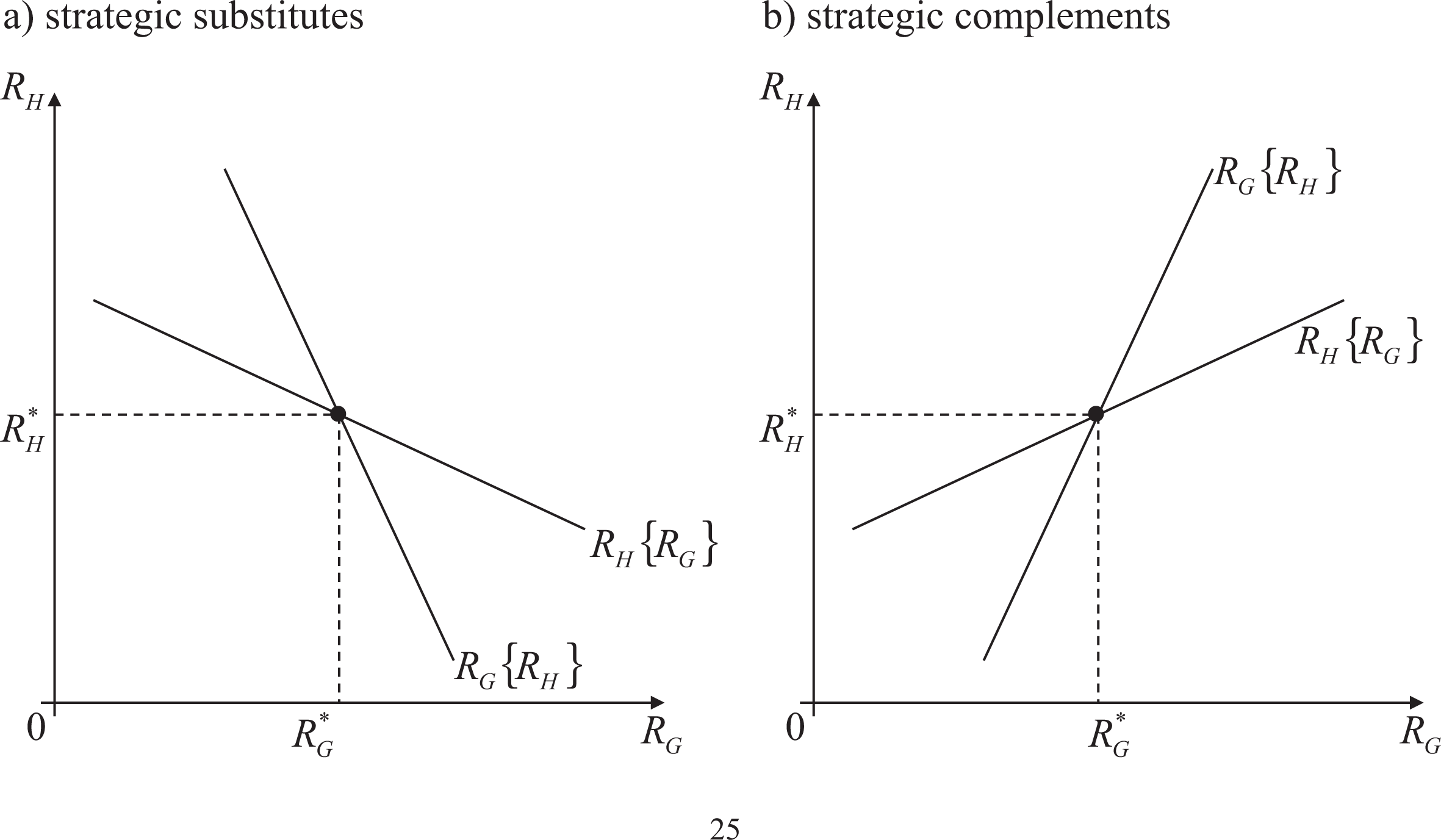
Reaction curves. (a) Strategic substitutes and (b) Strategic complements.
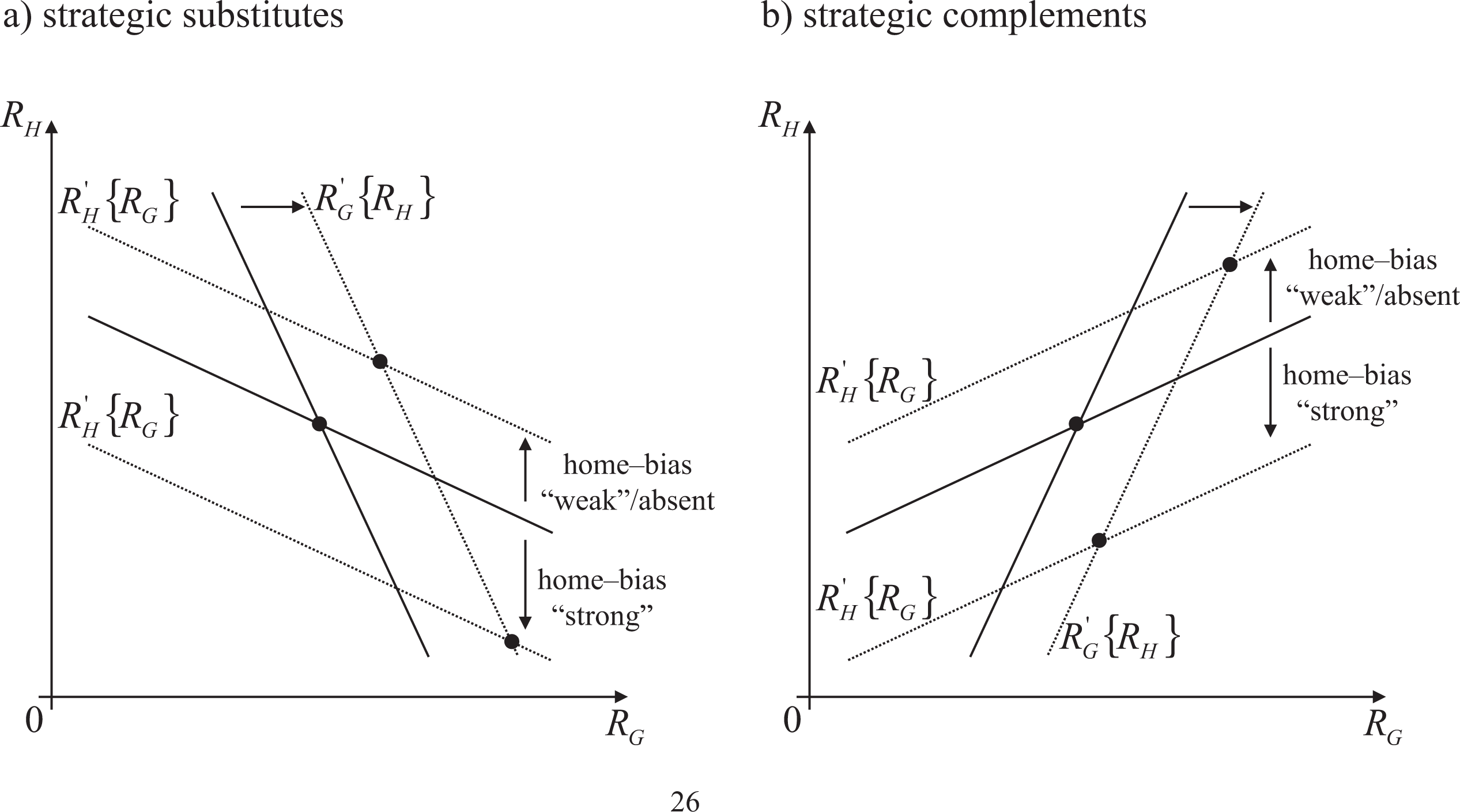
Shift of reaction curves-increase in a. (a) strategic substitutes and (b) strategic complements.
The shift of either reaction curve due to an increase in a can be derived in a straightforward way. Totally differentiating Equations 5 and 6, while holding the opponent’s level of offensiveness constant, leads to the following:


The numerator on the right-hand side of Equation 10 is negative as well. This follows from the respective necessary first order condition. Since
However, the numerator on the right-hand side of Equation 9 can be positive or negative. This follows from Equation 5. Depending on the strength of the home bias, that is, depending on the magnitude of
Lemma
The second partial derivative
Otherwise, the second partial derivative
This lemma implies that the home team’s reaction curve in Figure 1 shifts upward with the increase in
These comparative static results are illustrated by Figure 1. The extent of the shift of the
Our comparative static results lead to the following hypothesis:
Hypothesis
If the home bias is weak or absent ( the home team plays more offensively; the guest team plays more offensively; the home team scores more goals; the guest team scores more goals; the number of matches which end with a draw decreases. the home team plays less offensively; the guest team plays more offensively; the home team scores less goals; the guest team scores more goals; the number of matches which end with a draw may increase or decrease. the home team plays less offensively; the guest team plays less offensively; the home team scores less goals; the guest team scores less goals; the number of matches which end with a draw increases.
If the home bias is sufficiently strong (
If the home bias is sufficiently strong (
In our empirical analysis, we will estimate the influence of the switch to the TPR on the following variables: (a) number of the home team’s goals during a match, (b) number of the guest team’s goals during a match, (c) total number of goals during a match, (d) probability for the home team winning, (e) probability for the guest team winning, and (f) probability for a draw.
Furthermore, we test for a home bias. The home bias has an unambiguous effect on the outcomes for the home team, while the outcomes for the guest team also depend on whether
To understand the intuition for the negative relationship between
Empirical Evidence
To test the hypothesis from our theoretical model, we analyze data on the German “Fussball—Bundesliga” (soccer premier league) where the TPR has been implemented in the season 1995-1996. Since information on variables such as fixtures, match results, and attendances numbers is publicly available at no cost, sufficient observations from both systems (two-point rule vs. three-point rule) exist.
However, investigating the teams' offensiveness is no trivial task. Even though line-ups of home and guest teams are well known—also to the econometrician—much more information such as the teams' strategies is needed to apply a direct test of offensiveness levels. For this reason, a more indirect test of our theoretical model is provided by analyzing the outcomes of a match measured by the number of goals the home and the guest teams scored.
The theoretical model suggests that an increase of the rewards for a victory from
Since the probability to win depends positively on the number of goals, the introduction of the TPR should also lead to a change of the winning probabilities. Given that a significant home bias exists, we expect to observe a decrease in the number of home wins and an increase (a decrease) in the number of guest wins if both teams' levels of offensiveness are strategic substitutes (complements).
Finally, given that a significant home bias exists and that the levels of offensiveness are strategic complements, we should also observe an increase in the number of draws.
We therefore also analyze the winning probabilities for both teams and the probability for a draw as a robustness check.
Data
The variables used in our study are extracted from the online databases of the German Soccer Association (Deutscher Fussballbund, DFB, www.dfb.de). The DFB provides various data on German soccer leagues to some extent from the beginning of the German soccer premier league in
Our dependent variables are the total number of goals scored in a match (goals), the number of goals scored by the home team (hgoals), and the number of goals scored by the guest team (ggoals), respectively. In addition to the scorings, we use dummy variables indicating a win (win), a win of the home team (hwin), and the guest team (gwin) (see Table 1).
Variable Descriptions.
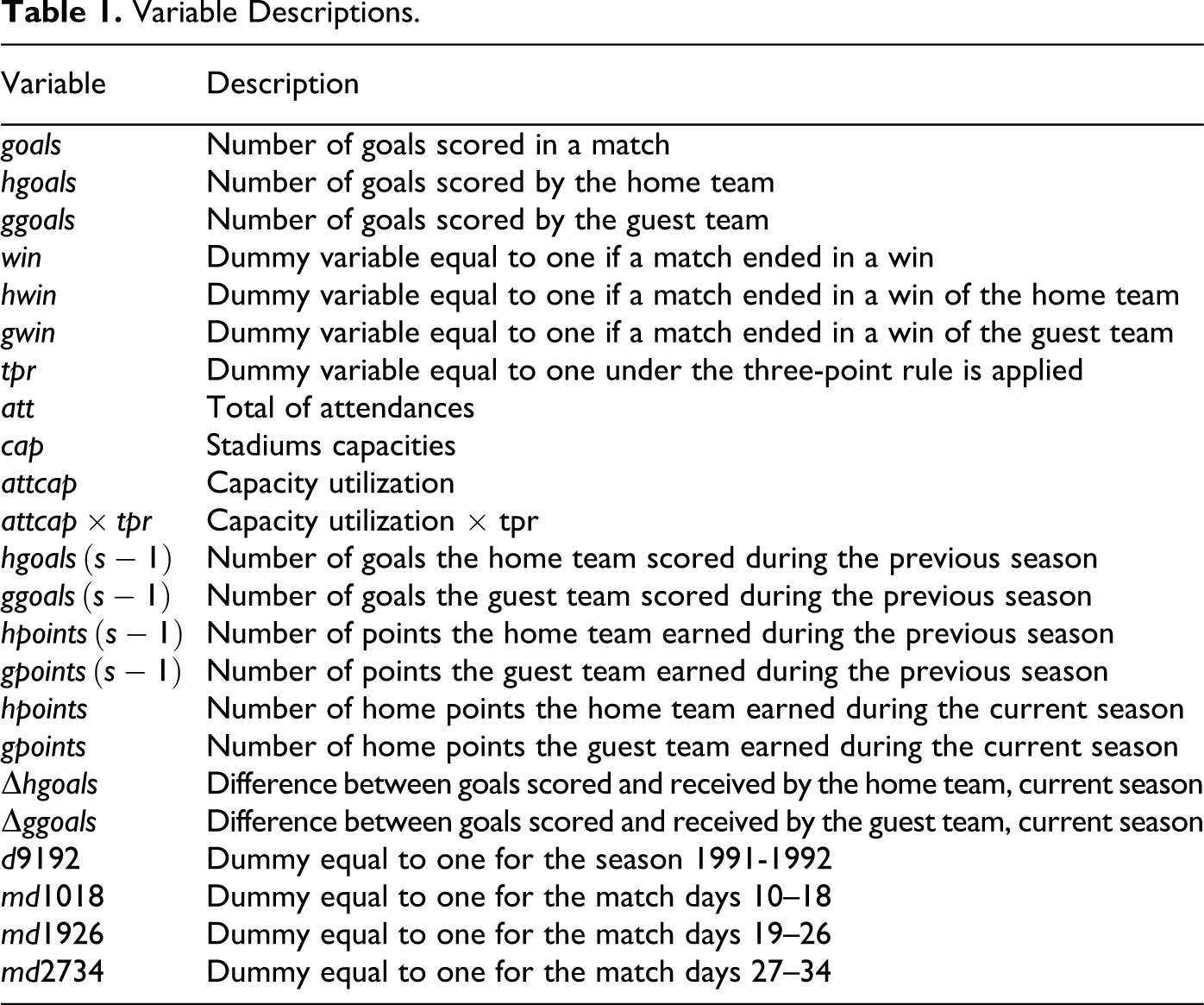
Our most important explanatory variable is a dummy variable tpr which is equal to 1 whenever the three-point system was used (i.e., from 1995 to 2008 in our sample). This dummy is introduced in order to measure the impact of the TPR on the left-hand side variables. In addition, we use the logarithm of the total of attendances (
In order to measure the impact of a potential home bias, we use the degree of capacity utilization (
We furthermore use various variables measuring the relative and absolute team strengths such as the number of goals a home team scored during the current and previous season (see Table 1 for a description), a dummy variable equal to one for the season 1991-1992 (
Results
Descriptive analysis
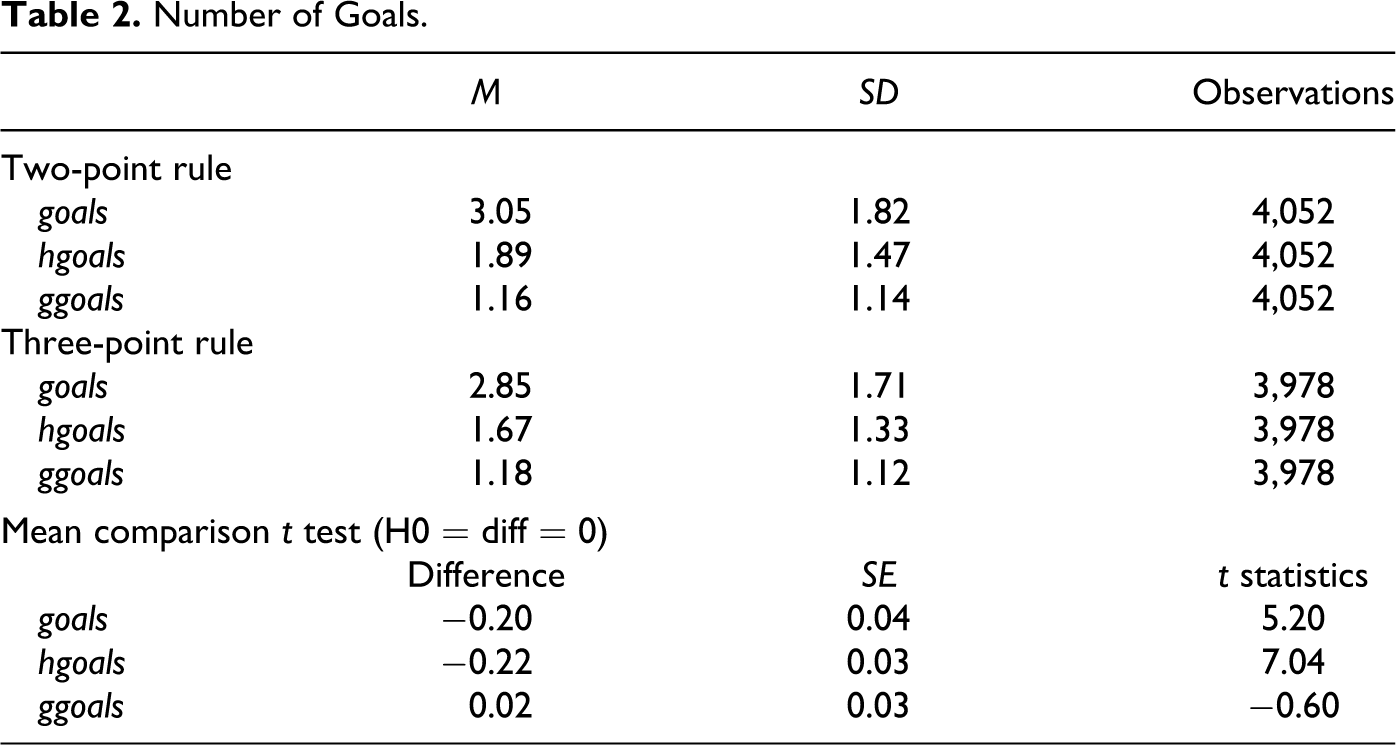
As a first rough test, we use simple descriptive statistics as well as t tests in order to compare the means of our left-hand side variables under both the two-point and the three-point rule. Interestingly, both the total number of goals and the goals scored by home and guest teams were reduced since 1995. Using t statistics supports the results suggesting a statistically significant change in scorings. However, the goals scored by the guest teams seem not to be reduced significantly (see Table 2).
Number of Goals.
Slightly different results can be observed considering the variables
Number of Wins.
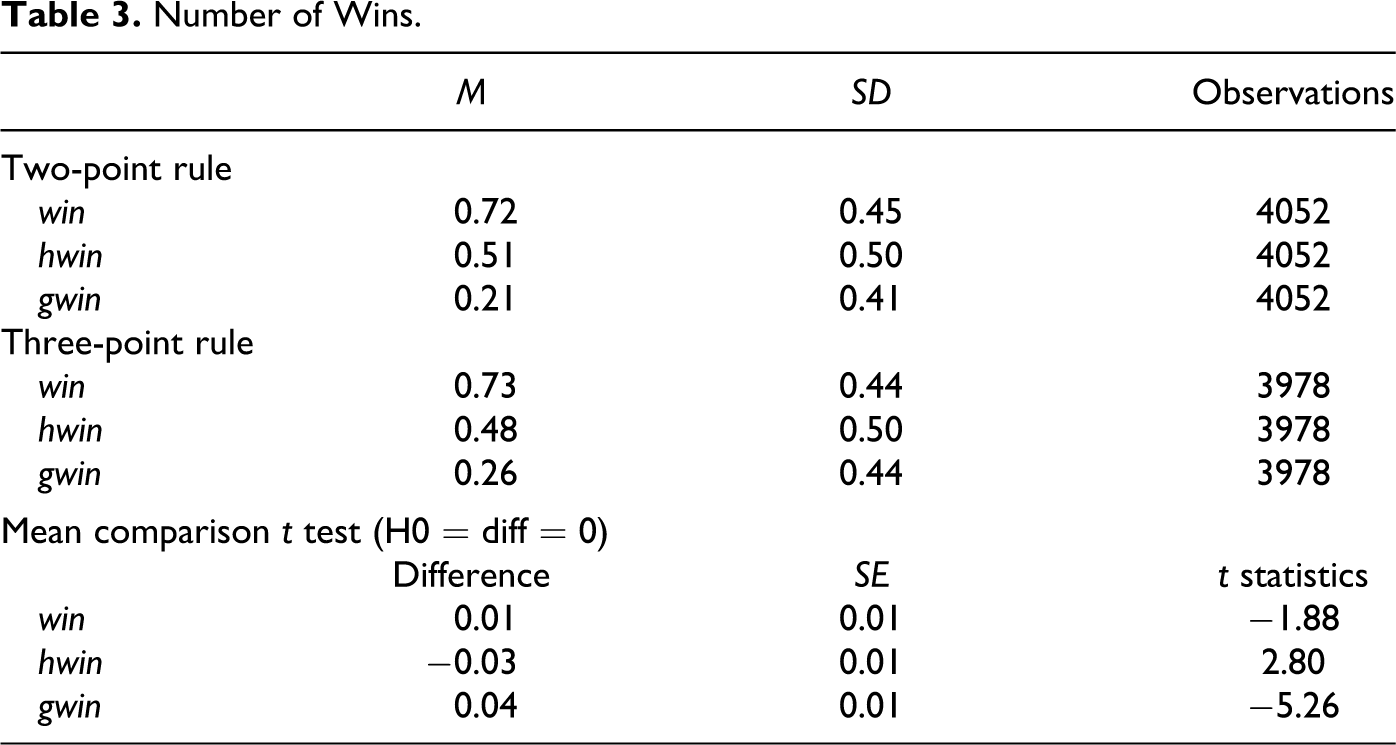
However a simple comparison of the average number of goals and wins can only be a rough measure. For this reason, we extend our analysis using panel data techniques in order to identify the impact of tpr.
Regressions results
Next, scorings as well as dummies indicating a win are regressed on the various explanatory variables described above using panel data techniques. To account for recurring pairings, we apply conditional (fixed effects) negative binomial as well as conditional (fixed effects) logit regressions to analyze the impact of tpr as well as the impact of
Analysis of the scores
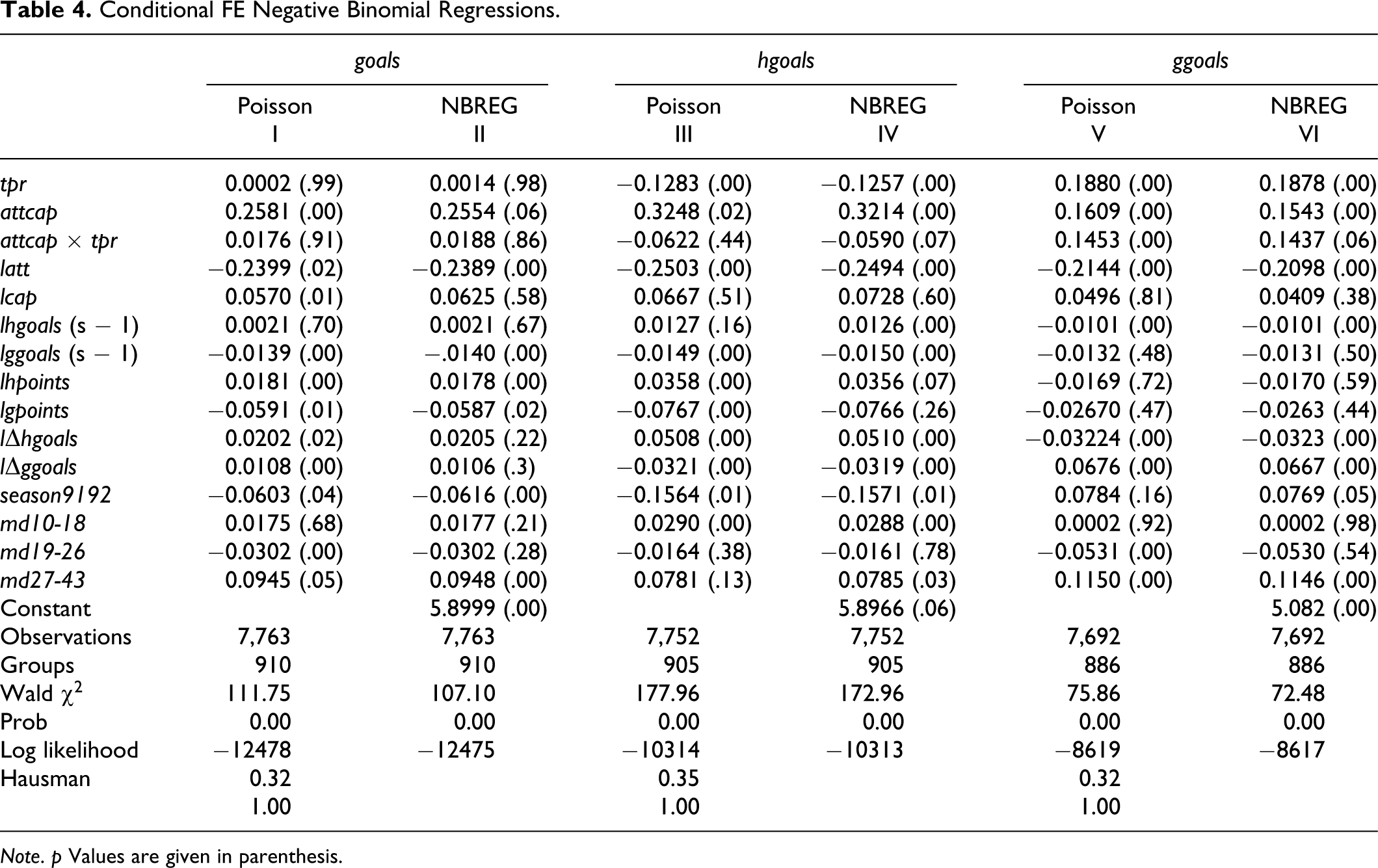
As descriptive statistics provides evidence that there is overdispersion in the raw data, a negative binomial model would be an adequate choice for the analysis of the scores. However, while negative binomial models require that the variance assumption is met for being consistent and efficient, the Poisson model is consistent even in case of overdispersion, but yields too small standard errors (see Wooldridge, 2001). For this reason, we first have applied Poisson fixed effects models with robust standard errors and then used a negative binomial fixed effects regressor to the same regression equations. Finally, we applied a standard Hausman test to test whether the negative binomial models are both consistent and efficient.
Table 4 presents the results from Poisson as well as from negative binomial fixed effects regressions of
Conditional FE Negative Binomial Regressions.
Note. p Values are given in parenthesis.
Again, while guest teams score more goals under the three-point system, a reduction in the number of goals scored by the home teams can be observed in both NBREG and Poisson models. However, in contrast to the results from descriptive statistics, the total number of goals seems to be unaffected by the introduction of the TPR. However, the number of home goals has been reduced in favor of an increase in away goals.
Both variable reflecting the strength of a possible home bias (attcap and
Turning to total attendances and capacity, our regressions yield unexpected results. First,
Further results are more or less intuitive. The number of goals scored by the home team in the previous season increases the total number of home goals and decreases the number of away goals, although this effect is not always statistically significant. The number of goals scored by the guest team in the previous season is only significant in the regressions with
One should keep in mind that both points earned by a team and the goals scored are correlated and, thus, some statistically insignificant coefficients are not very surprising. We also used different functional forms for the variables, but this did not change the results substantially. 8
Finally, the season 1991-1992 is characterized by a reduction of goals scored by home teams. 9
Summing up, the change of the reward system has led to a reduction in the number of goals scored by home teams and to an increase in goals scored by guest teams. Guest teams therefore seem to increase their offensiveness due to the switch to the TPR. This outcome is consistent with our theoretical model, in case that the home bias is sufficiently strong and that the teams' levels of offensiveness are strategic substitutes. Furthermore, it seems that the reduction of home goals is compensated by the increase of guest goals since the total number of goals did not change with the introduction of the TPR.
Robustness checks
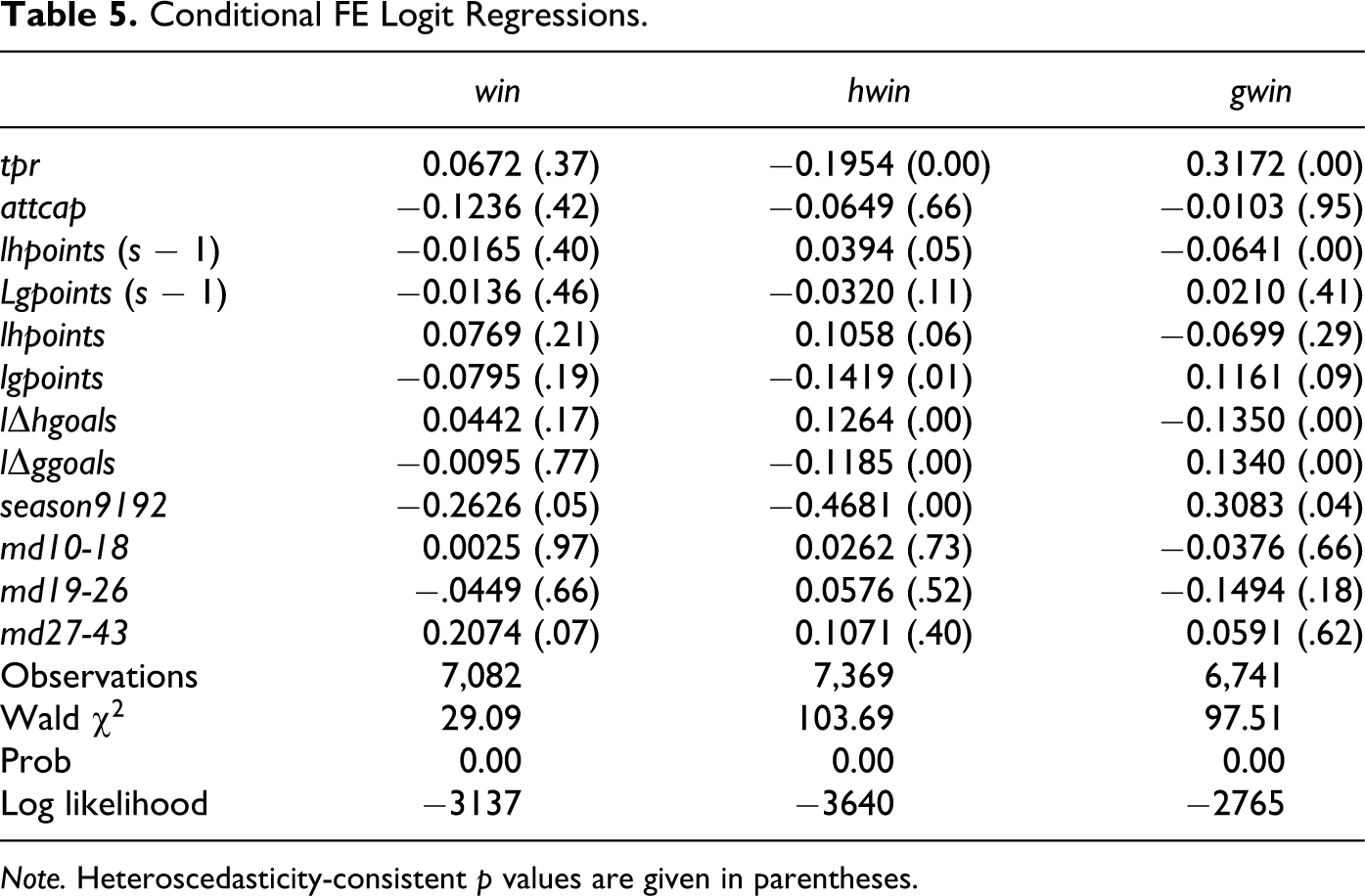
Turning to the conditional logit regressions of the probability for a victory leads to similar results. Again, the fixtures are used as groups in order to compare the outcomes under both rules. We changed the specification and used
As can be seen from Table 5, the TPR seems to have a negative impact on home wins (
Conditional FE Logit Regressions.
Note. Heteroscedasticity-consistent p values are given in parentheses.
Furthermore, attcap has no statistically significant impact on either the number of home or the number of guest goals. While the probability of winning a match has been changed due to the change of the reward system, an impact of the home bias is not detectable with the introduction of the TPR. However, we should emphasize that the variables, which we use to analyze the probability of a win, can only be very crude. Especially the latter results from the conditional logit analysis should not be stressed too much.
To summarize, also the robustness check provides support for our theoretical model. Overall, we found that the adoption of the TPR has not led to a higher total number of goals or a higher total number of wins, but to a reduction of the asymmetry in offensiveness between home and guest teams. We take this result as support for our model since with a strong home bias, a decrease (an increase) of a home (guest) team’s offensiveness can be observed.
Conclusion
How do the rewards for a victory influence a soccer team’s offensiveness? In this article, we build a simple theoretical model to analyze how a soccer team’s offensiveness reacts to the tangible returns from a match. We explicitly consider that a home bias might influence the home team’s offensiveness choice. Furthermore, we empirically analyze the impact of the so-called three-point rule on the total number of goals during a match and the number of home and guest goals, respectively. We also analyze the impact of the TPR on the probability for a victory for the home and the guest teams.
Our empirical results support the outcomes of our theoretical model. We find that the introduction of the TPR leads to a reduction in both the number of home goals and the number of victories for home teams. At the same time, the number of guest goals as well as the number of guest teams' victories has increased. Interestingly, the total number of goals as well as the total number of victories has not been affected significantly. Put differently, it seems that the increase of the rewards for a victory induces the home team to play less offensively due to the existence of a home bias. The guest team, in contrast, reacts to the introduction of the TPR by choosing a more offensive strategy.
Our results imply that the strategic interaction between soccer teams is sufficiently complex, so that a more convex reward scheme does not necessarily induce teams to play more offensively. Just to the contrary, reducing the number of points for a victory would give teams an incentive to attach more importance to the attractiveness of their playing style.
Footnotes
Acknowledgment
The authors would like to thank Erwin Amann, Benoît Crutzen, Bernd Hayo, Kornelius Kraft, Otto Swank, and seminar participants at various places for helpful comments. The authors would also like to thank Thomas Jaschinski and Veit Boeckers for research assistance. All shortcomings are our responsibility.
Declaration of Conflicting Interests
The authors declared no potential conflicts of interest with respect to the research, authorship, and/or publication of this article.
Funding
The authors received no financial support for the research, authorship, and/or publication of this article.