







Abstract
National sentiment can have major implications for individual consumption and investment choices but has been researched little by economists. This article studies how national sentiment in the form of a perception or loyalty bias of bettors may affect pricing patterns on national wagering markets for European football. The authors show theoretically that both biases can be profitably exploited by domestic bookmakers through price adjustment. Analyzing empirically a unique data set of betting odds from online bookmakers in Europe, the authors find evidence of systematic biases in the pricing of own national teams, deviations that can be explained by the aforementioned two biases.
Introduction
Consumer preferences for home country products, “buy domestic” campaigns, the issuing and success of war bonds, or the home equity puzzle in international financial markets suggest that national sentiment may be of importance for individual consumption and investment choices. Little empirical research, however, has been done to substantiate such conjectures. 1 This article contributes to this insufficiently researched area in economics by studying the international football betting market, a market that is likely to be strongly influenced by national sentiment.
The online betting market in international football exhibits a number of features that make it particularly suited for analyzing the influence of national sentiment on economic behavior. First, there appears to be a strong bonding of patriotism and sports, especially in football, the most popular sport in Europe. Second, information on the quality of national teams and odds marketed (prices offered by bookmakers) should be largely symmetric across countries, as detailed information, including statistics on past performance of teams and expert analyses, can be obtained online easily, quickly, and at negligible if not zero cost. Given our focus on online wagering, access of bettors to this medium of information is furthermore guaranteed. Third, there is a single homogeneous good traded on this market (“outcome of a game”). Variations in prices across countries therefore cannot be caused by (potentially unobservable) differences in the respective products traded. Finally, online betting markets in Europe are still largely segmented between countries, as legal constraints, language barriers, and transactions costs impede wagering abroad. 2
Segmentation of national betting markets (pools of bettors) is important for our analysis. With a homogeneous product and symmetric information, prices (betting odds) should be identical across countries if markets are unified. With segmented markets, however, prices may differ. They will differ in terms of the average payout per monetary unit waged if different industry structures across countries support different markups charged by bookmakers. They will also differ in terms of relative odds for particular outcomes of a game if bookmakers can profitably exploit either a perception bias among bettors that induces them to overrate the winning chances of their national team or a loyalty bias that keeps bettors from wagering against their own team even under favorable odds. Both type of biases reflect bettor sentiment. Empirical support for their influence on betting market outcomes has been found for club sports at national level. On the perception bias, see for example, the study by Levitt (2004) which explores wagering behavior on National Football League (NFL) games in the United States. First evidence for the loyalty bias, in turn, has been provided by Forrest and Simmons (2008) who analyze wagering on top tier Spanish and Scottish football.
Among the extensive and growing body of literature on sports wagering, however, no study has yet explored betting markets across countries, let alone the influence of national sentiment on cross-country differences in wagering behavior (for a comprehensive survey of the economics literature on sports wagering markets, see Sauer, 1998). In theoretical models of wagering markets, in turn, only the misperception bias has yet been formally modeled and analyzed. And as regards wagering on European football, that is the very context of our analysis, but a single study has explored this bias and its effects and then only by means of a numerical example (Kuypers, 2000).
This article develops a first theoretical model of wagering markets that allows for both types of biases and it also provides first empirical evidence on their influence on betting odds for international sport events in a cross-country context. Based on a unique data set of betting odds from online bookmakers in 12 European countries for qualification games to the Union of European Football Associations (UEFA) Euro 2008, we analyze differences in odds for win offered across countries for evidence of systematic biases in the pricing of own national teams. For the majority of countries in our sample, we find evidence for such systematic biases. Variations in the sign and magnitude of these deviations can be explained by differences in the respective strengths between countries of the perception and the loyalty bias among bettors.
Overall, our empirical results provide evidence for a sizable influence of national sentiment on wagering market outcomes in Europe. Prices for own national teams are systematically biased, a finding that existing single-country studies miss by construction. Future research can fruitfully extend our analysis to other markets in which assets are traded to explore if domestic prices follow similar patterns as those found in our analysis of online wagering on European football.
The article is structured as follows: The section on Theoretical Considerations analyzes theoretically the price-setting behavior of a bookmaker in the absence and in the presence of bettor national sentiment as expressed in a perception or a loyalty bias. The next section is on Data, followed by the section on Results which presents the empirical results. The section on Discussion and Further Robustness Checks discusses our findings and several robustness checks we did. The final section concludes.
Theoretical Considerations
On wagering markets, prices (odds) are set by bookmakers. Hence, for prices to be informative about any national sentiment of bettors, it must be profitable for bookmakers to shade their odds when faced with such underlying bettor preferences. This we show in this section by studying the price-setting behavior of a profit-maximizing (risk-neutral) bookmaker 3 in the absence and in the presence of bettor national sentiment. We first describe the model setup in the absence of any perception and loyalty bias of bettors and then examine their respective effects on bookmaker odds offered.
To formalize the decision problem of the bookmaker, consider a football match between countries A and B and assume, for simplicity, that there are only two potential outcomes, either Country A or Country B wins. 4 Wagering markets are assumed to be separated between countries and to be served each by a single bookmaker. Bettors in both countries may hence place bets only with their respective domestic bookmaker. Information on the quality of national teams is furthermore assumed to be freely available and symmetric across countries, bookmakers, and bettors. In the absence of any national sentiment bias, quotes marketed in countries A and B would hence be identical.
Given the symmetric setup for the two countries, we can restrict the analysis in the following without loss of generality to the pricing behavior of a bookmaker in just one of the countries, say Country A. The choice variable of the bookmaker in Country A is the probability
Regarding the behavior of bettors, we first assume in line with Kuypers (2000) and Levitt (2004) that the decision of bettors to enter the market (to place a bet on the game) has already been made and concentrate on how punters spread the total volume of bets on the two outcomes.
6
Each bettor is assumed to place a monetary unit on one of the two teams. A bettor will place her money on Country A if a is equal to or smaller than her subjective probability for win of Country A. Otherwise, she will bet on Country B. Let
The bookmaker’s expected profit on a unit bet on one of the two teams is the unit itself minus the expected payout. The latter is given by the corresponding odds multiplied by the subjective outcome probability of the bookmaker. To obtain total profits per unit bet, the (per unit) profit generated by a bet on one of the two teams has to be weighted by the corresponding fraction of bettors. Summing up across the two outcomes yields:


Within this basic analytical framework, we can now explore the two pathways by which bettor national sentiment may affect pricing patterns on domestic wagering markets. We consider the perception bias first.
Perception Bias
National sentiment may bias bettors' perceptions of the winning chances of their national team upward. In principle, of course, one may also allow for underconfidence in the national team. However, the (albeit rare) existing evidence suggests that supporters, if at all biased in their perceptions, tend to over- rather than underestimate the winning chances of their own team (Babad & Katz, 1991). If so, then for any given probability set by the bookmaker, the fraction of bettors placing a bet on Country A is equal to or greater than the corresponding fraction in the absence of a perception bias. The bookmaker is hence faced with a function
This finding can be appreciated by inspecting the first-order condition at
Summarizing the above, the more confident are bettors regarding the success probability of their home team, that is the stronger is the perception bias, the lower will be the actual odds for such an outcome offered by the domestic bookmaker. A similar point has been made by Kuypers (2000) by means of an illustrative numerical example. He shows that a bookmaker may take advantage of bettors who overrate the winning chances of their favorite team by shading odds against this team.
Loyalty Bias
Up to now we have assumed that punters always place a bet on a game. Their only decision therefore concerned how to spread their betting stakes over the two possible match outcomes. However, as noted but not formalized by Forrest and Simmons (2008), wagering against the own team may well be unacceptable to supporters. Committed bettors, the authors note, might be as unwilling to switch bets to the opponent team if odds on win offered for the own team get unfavorable as they are unlikely to switch to replica shirts of the opponent team only because these got relatively cheaper. Viewed as an act of disloyalty, supporters may just be interested in a bet on their team or none at all (loyalty bias).
If bettors only consider whether to bet on their national team, the actual betting volume is no longer fixed, only the potential one.
10
If the bookmaker sets probability a below the corresponding subjective probability of a loyal bettor for win of the own national team, this bettor will not switch to wager money on Country B but instead refrain from wagering altogether. The bookmaker’s profit function hence consists only of the first term of Equation 1, that is, of the profit generated by bets on Country A. The corresponding first-order condition then reads:

To sum up our analysis of the loyalty bias: if national sentiments induce bettors to wager, if at all, only on win for their own national team, then domestic bookmakers may profitably bias odds in favor of rather than against committed bettors. More favorable odds on win for own national teams, if indeed observed in the data, therefore provide evidence for a loyalty bias of domestic bettors. Although bettors need not necessarily be free of a perception bias in this case, any overconfidence on their part would have to be very weak. If, in contrast, odds on win for own national teams are found to be less favorable, national sentiment in the form of either or both a perception and a loyalty bias may sign responsible.
Data
The empirical analysis is based on a unique data set of betting odds that we collected from online bookmakers in 12 European countries for qualification games of national football teams to the UEFA Euro 2008. The dozen countries sampled represent a selective subset of the 50 UEFA member countries participating in the qualification. All 12 bookmakers are from countries that were seeded in one of the top three (out of seven) pools used to draw the qualifying groups. 12 Our sample thus excludes bookmakers from truly minor football countries. 13 The bets considered are simple bets on home win, draw, and away win (quote H , quote D , and quote A ). Betting odds for games were collected online in the morning of a qualification round in random order across countries to avoid potential sampling bias due to systematic early or late recording. Online bookmakers for the 12 countries considered were primarily selected from members of the European Lotteries and Toto Association which is composed of State Lottery and Toto companies established in Europe (see www.european-lotteries.org). For each country, a bookmaker was chosen that operated online and offered simple home win, tie, and away win bets. If none of the members of a country met these conditions, we selected a large private online bookmaker from the Internet. Throughout this process, we disregarded bookmakers who operated via subsidiaries in more than one European country. 14
Table 1 describes our final data set, which covers betting quotes on 218 qualification games from 12 European countries in 6 qualification groups, sampled online between November 2006 and November 2007. Starting the research project only after the qualification had started, we did not record the first 4 (out of 15) qualification rounds. Our sample, however, covers 71% of all qualification games. As can be seen in Column 2 of Table 1, no bookmaker offers bets on all games. The number of games for which bets are offered range from as few as 141 in the case of the Dutch bookmaker to 217, or almost the total number of matches sampled, for bookmakers in the Czech Republic, England, and in Spain. To gauge the influence of any sample selection bias arising from this differential coverage of games, we will use three estimation samples in the regression analysis. The first, or “Total Sample,” includes all games for which at least one bookmaker offers quotes (218 games). The second (“Restricted Sample I”) includes all games for which at least six bookmakers offer betting odds (208 games), and the third (“Restricted Sample II”) all games for which at least nine bookmakers offer quotes (189 games). 15 Furthermore, to gauge any potential bias that may arise from the inclusion of bookmakers from smaller football countries, we use a fourth sample (“Restricted Sample III”) that excludes bookmakers from countries which were not seeded in one of the two top pools used to draw the qualifying groups. 16
Countries, Bookmakers, and Summary Statistics.
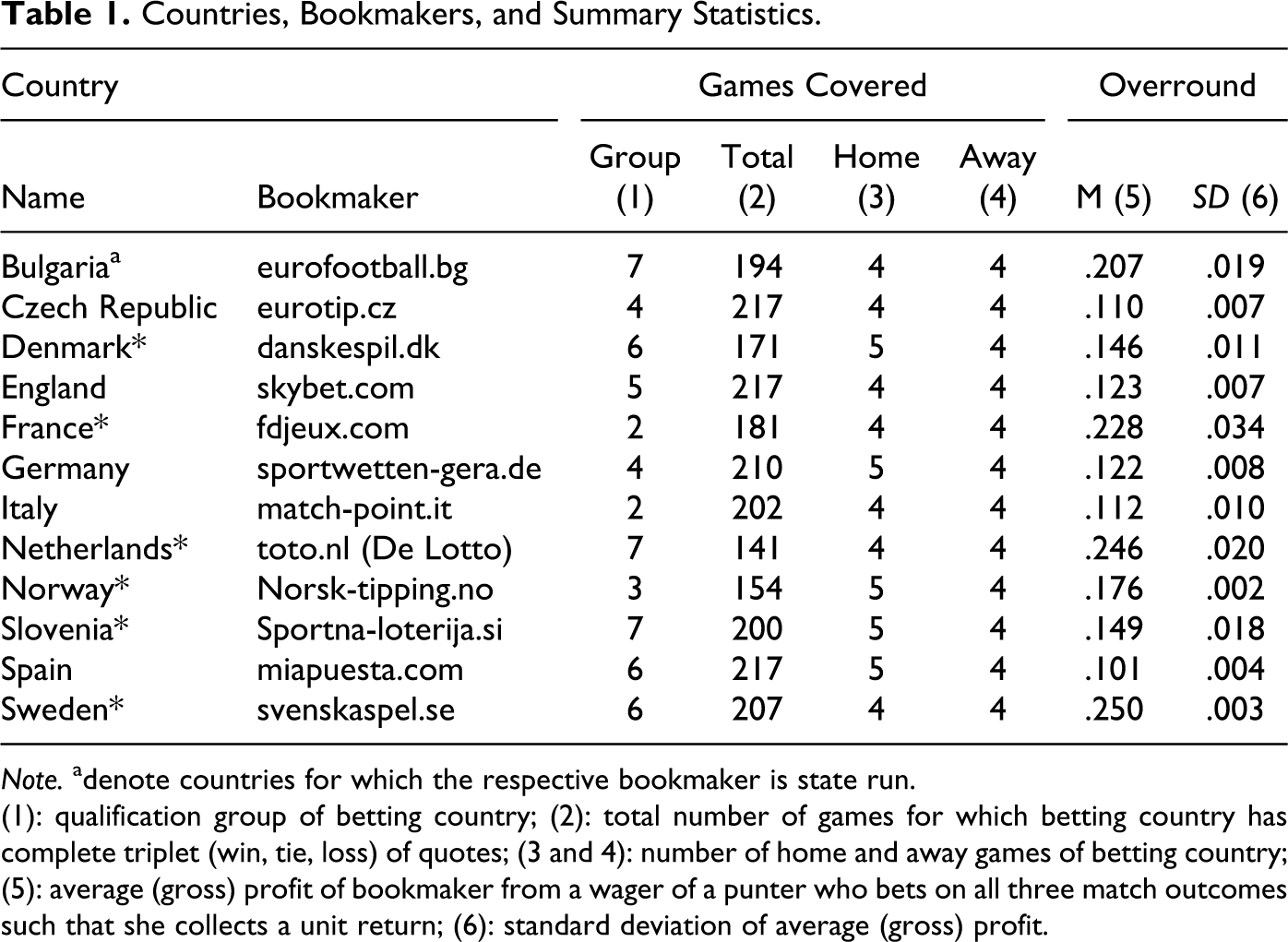
Note. adenote countries for which the respective bookmaker is state run.
(1): qualification group of betting country; (2): total number of games for which betting country has complete triplet (win, tie, loss) of quotes; (3 and 4): number of home and away games of betting country; (5): average (gross) profit of bookmaker from a wager of a punter who bets on all three match outcomes such that she collects a unit return; (6): standard deviation of average (gross) profit.
For each country in our sample, we observe a total of eight to nine home and away matches (Columns 3 and 4), that is, games in which the national team takes part. Columns 5 and 6 report means and standard deviations of the so-called overround which can be taken as a measure of a bookmaker’s gross margin. The overround is defined as the expected (gross) profit a bookmaker makes from a wager of a punter who bets on all three match outcomes such that she collects an expected unit return. For a given match, the overround is equal to the sum of the inversed betting odds minus one. As is evident, overrounds differ significantly between bookmakers in different countries (Column 5) and are largest (as was to be expected) for state-run bookmakers, but vary hardly across games for individual bookmakers (Column 6). The first finding supports our assumption of nationally separated online betting markets, as such marked differences in (gross) profits across countries could not persist if betting markets were unified. The last finding, in turn, suggests that bookmakers seek to realize a specific gross margin. It also implies that the overround is not used by bookmakers as a means to price potential variation across games in either outcome uncertainty or bettor sentiment. Note that average transaction costs (overrounds) are sizable. These costs may discourage financially focused bettors so that leisure bettors tend to be overrepresented in the market. The latter type of bettors is likely to be more susceptible to sentiment biases. 17
Measures for our primary outcome of interest considered in the theoretical analysis, the probability of win for a national team, can be obtained from the respective odds offered for win of the home team in home games and of the away team in away games. As odds offered to bettors also contain the overround, however, they need to be adjusted first so as to obtain the underlying probabilities for the respective outcomes as marketed by bookmakers. Specifically, the implied probability of win for the home team (aH) and the probability of win for the away team (aA) can be calculated from the quotes bookmaker j offers on match i as the inverse of the quote for the respective outcome, adjusted by the sum of all inverse quotes for the three potential match outcomes: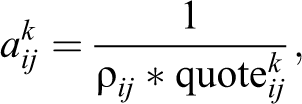
Results
To investigate whether betting behavior in any of our 12 European countries sampled is subject to a national sentiment bias, we run separate regressions for home (k = H) and away games (k = A) of the following type:
As shown in Table 2
, which contains the regression output for the probability of win for home teams, we obtain an
Ordinary Least Squares (OLS) Estimates for Winning Probability in Home Games.
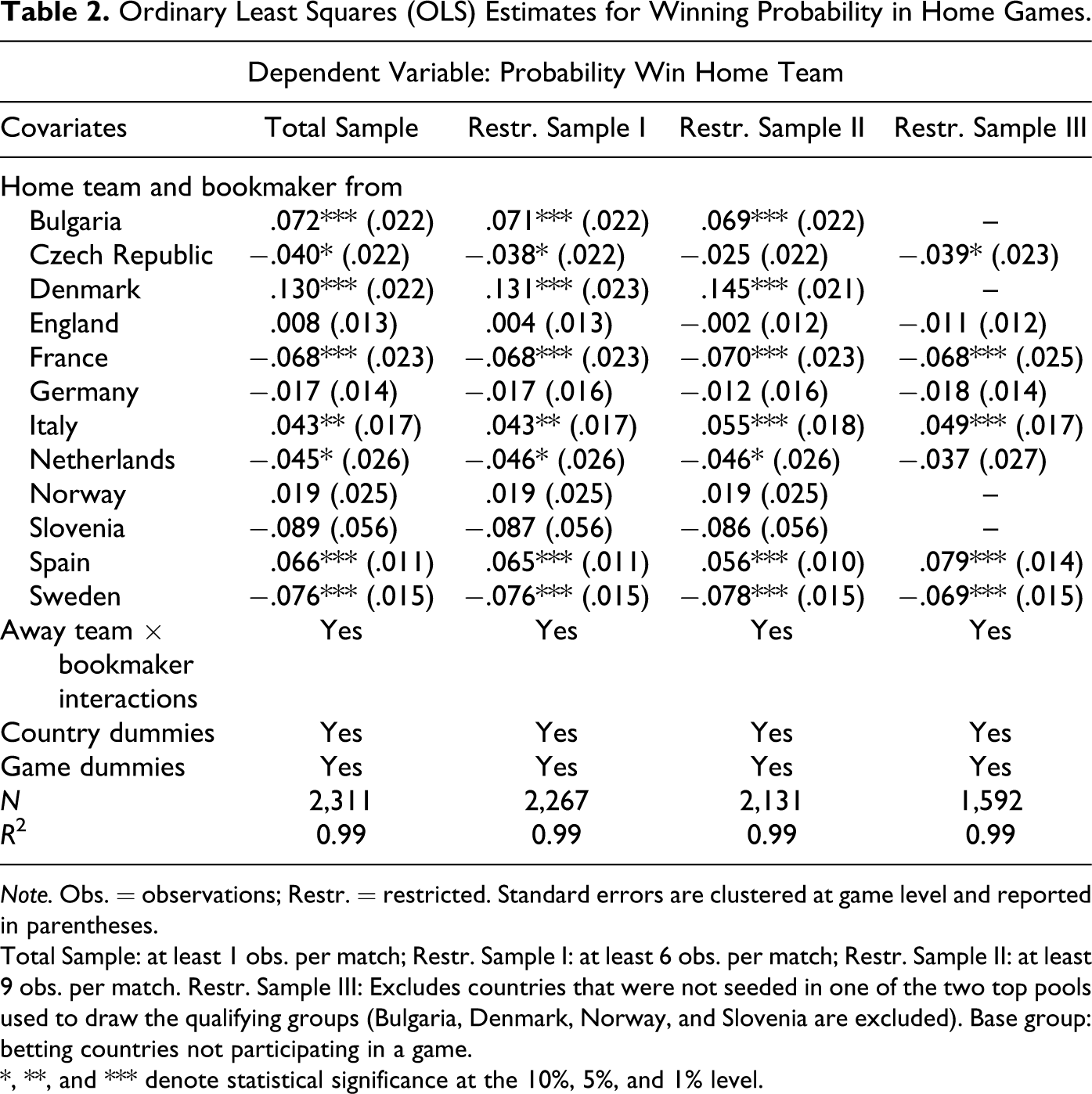
Note. Obs. = observations; Restr. = restricted. Standard errors are clustered at game level and reported in parentheses.
Total Sample: at least 1 obs. per match; Restr. Sample I: at least 6 obs. per match; Restr. Sample II: at least 9 obs. per match. Restr. Sample III: Excludes countries that were not seeded in one of the two top pools used to draw the qualifying groups (Bulgaria, Denmark, Norway, and Slovenia are excluded). Base group: betting countries not participating in a game.
*, **, and *** denote statistical significance at the 10%, 5%, and 1% level.
Following our theoretical discussion in the Theoretical Considerations section, the empirical finding of a downward bias in the probability for home win in France, Sweden, and the Netherlands suggests that national sentiment in these countries primarily expresses itself in terms of committed bettors that only consider betting on the home team if at all (loyalty bias). Bettors in these countries hence do not—or only to a very limited degree—overrate the winning chances of their home team. The positive biases found for Bulgaria, Denmark, Italy, and Spain can potentially be explained with reference to both types of sentiment biases. Bettors may only consider bets on their home team and/or overrate the winning chances of their national team in home games relative to the chances as they are on average marketed in countries not participating in a game. If the loyalty bias were generally negative, however, bettors' perceptions of the winning chances of their national team would have to be significantly upward biased for a positive bias to be in the interest of a profit-maximizing bookmaker. In this case, the magnitude of the bias in the odds for win is again informative about the respective strengths of the two biases. Specifically, the level of overconfidence will ceteris paribus increase the degree to which odds are biased upward. Overall, our regression results for home matches indicate that prices of own national teams are biased in 8 of the 12 countries. 21 The magnitude of the estimated biases is nonnegligible and range, in absolute terms, from 4.0% in the Czech Republic to 13.0% in Denmark. Yet, the biases generally fall short of the overround charged by the bookmaker and cannot be profitably exploited. Relative to the overround, the estimated bias is largest in Denmark (0.130 relative to an overround of 0.146) and Spain (0.066 relative to an overround of 0.101).
Rerunning the same regressions, but now with the probabilities for win in an away game as implied by quotes set, we get results that are qualitatively identical for countries exhibiting the largest upward or downward bias in home games (Table 3). Specifically, in Denmark (Sweden and France) implied probabilities for win of the away team are again biased upward (downward). More generally, the estimated coefficients for own national teams have the same sign in away and home matches in virtually all countries. Only for Germany, we obtain a negative but statistically insignificant coefficient for home games but a statistically significant upward bias for away matches. 22 Thus, for a given bookmaker the deviations in prices for win of the own national team display largely consistent patterns across home and away matches. However, there are also some differences observable, in particular with respect to the level of significance of the estimated coefficients. For Bulgaria, for instance, we still find a positive coefficient on the interaction term of the country identifiers and the dummies for away game status but the estimate is no longer statistically significant. Likewise, Dutch bettors, who in home games are faced with more favorable odds for win of the own team, are not confronted with a statistically significant bias in away games of their national team.
Ordinary Least Squares (OLS) Estimates for Winning Probability in Away Games.
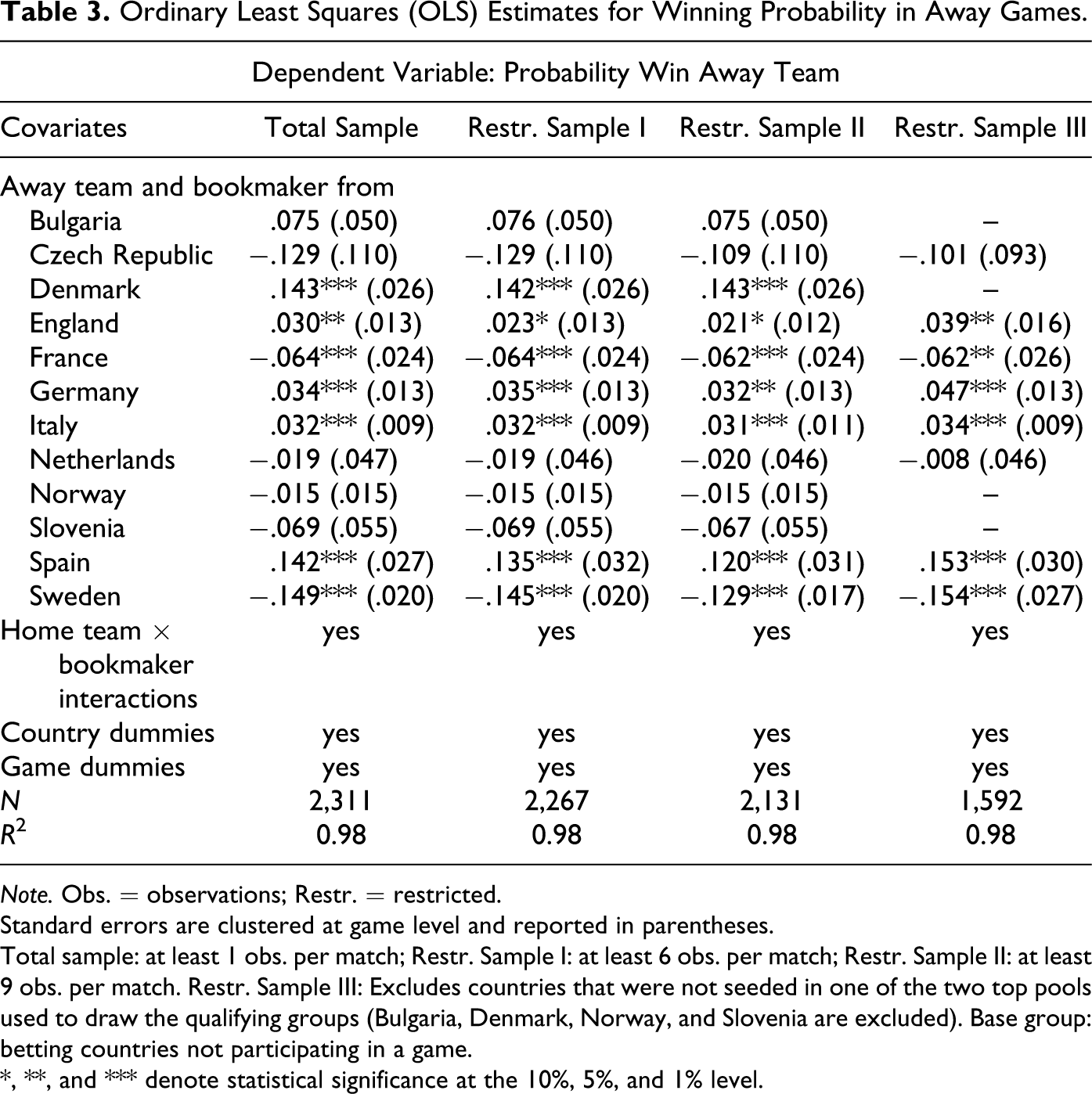
Note. Obs. = observations; Restr. = restricted.
Standard errors are clustered at game level and reported in parentheses.
Total sample: at least 1 obs. per match; Restr. Sample I: at least 6 obs. per match; Restr. Sample II: at least 9 obs. per match. Restr. Sample III: Excludes countries that were not seeded in one of the two top pools used to draw the qualifying groups (Bulgaria, Denmark, Norway, and Slovenia are excluded). Base group: betting countries not participating in a game.
*, **, and *** denote statistical significance at the 10%, 5%, and 1% level.
Table 4 summarizes the qualitative findings of our baseline regressions. Entries along its main diagonal are comprised of countries that display consistent patterns regarding the presence or absence and direction of biases in odds marketed for win of own national teams across both home and away games. Eight of the twelve countries in our sample, and hence the majority, belongs to this group. The remainders (off-diagonal entries) are countries in which probabilities for win of the national team are biased upward or downward in home or in away games, but not in both. Not for a single country does the bias change its sign across away and home matches. Overall, we find evidence for systematic biases in the rating of own national teams in 9 of the 12 countries in our sample, 23 with incidences of a positive bias outnumbering those of a negative bias.
Summary of Results From Baseline Regressions.
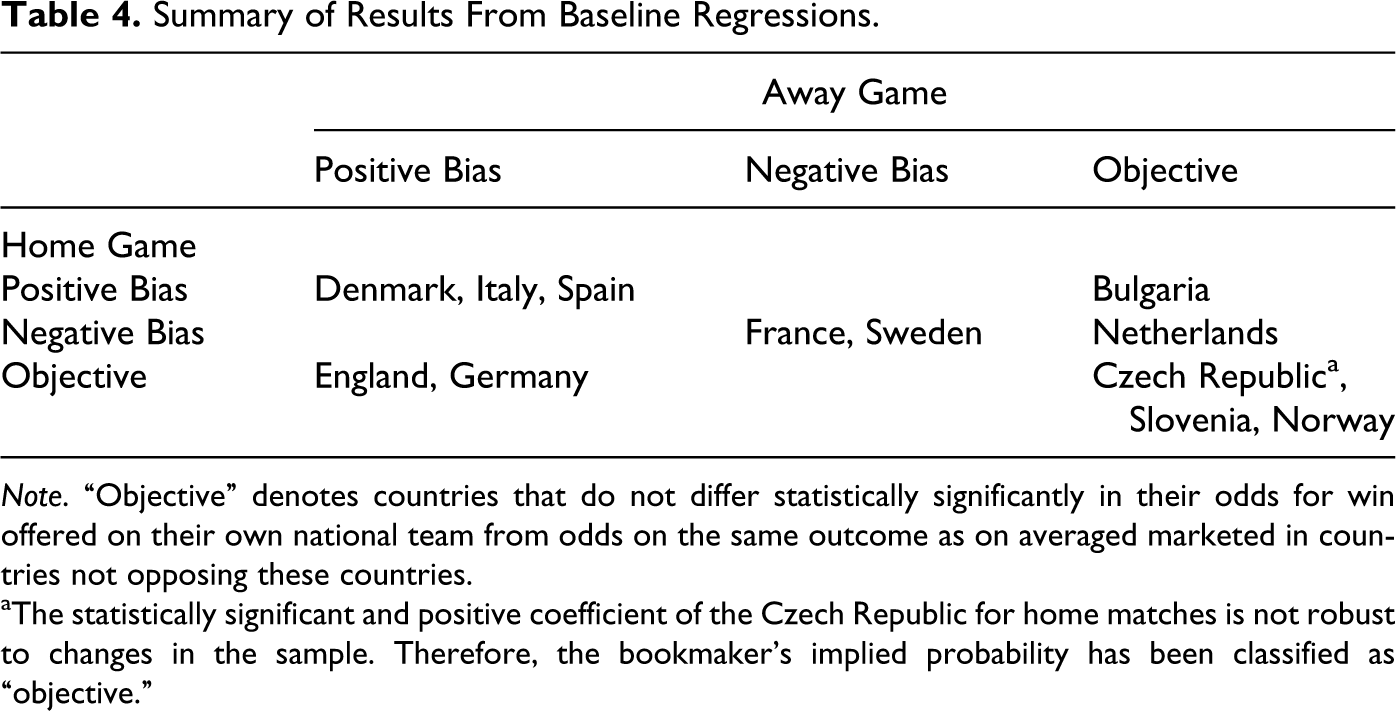
Note. “Objective” denotes countries that do not differ statistically significantly in their odds for win offered on their own national team from odds on the same outcome as on averaged marketed in countries not opposing these countries. aThe statistically significant and positive coefficient of the Czech Republic for home matches is not robust to changes in the sample. Therefore, the bookmaker’s implied probability has been classified as “objective.”
Discussion and Further Robustness Checks
Our empirical analysis provides evidence for systematic (and consistent across home and away games) deviations in the pricing of win outcomes for own national teams in the qualification to the UEFA Euro 2008. Such intercountry deviations have not been noted before in the economics literature, neither for online wagering, nor for wagering markets more generally. This shortcoming is easily explained. Most economic studies on sports wagering are confined to the analysis of only a single country or bookmaker—and hence simply lack a control group that allows to identify the effect of national sentiment on domestic prices. Our findings may hence have more general implications for the existing literature on pricing behavior in betting markets. Moreover, they may well be of importance also for other markets in which assets are traded, such as financial markets.
As shown in our theoretical model, the observed systematic deviations or biases in the pricing of own national teams can be explained by cross-country differences in the prevalence and magnitude of national bettor sentiments that affect wagering. Unfortunately, like most studies on wagering markets, we do not have data on actual betting volumes. Such data would allow us to identify whether a perception or a loyalty bias of domestic bettors can explain particular incidences of more favorable odds offered by a domestic bookmakers for games of the own national team. Our model assumes that the loyalty bias keeps bettors from wagering against their own national team. If indeed the case, the own national team should attract an overproportional part of the betting volume. Another fruitful area for further research is why national sentiment on wagering markets appears to vary considerably in importance across European countries, both in magnitude and in kind. This question, which naturally arises from our findings, requires further cross-country examinations in other areas of economic activity, investigations that however are beyond the scope of this article. Analysis of direct (survey-based) measures of national sentiment could also be useful to identify and explain country-specific behavioral patterns. Finally, it would be interesting to explore whether the systematic biases in the pricing of own national teams can also be observed in betting markets with lower transactions costs than those reported in our study. As noted before, low transaction costs might primarily attract financially focused bettors that may be less susceptible to sentiment biases. 24
Are there potential explanations other than national sentiment for our results? Foremost, it is important to stress that our empirical findings of systematic deviations in the pricing of own national teams cannot be accounted for by prominent biases long researched in the economics literature on wagering markets. The biases we find are different from the favorite-long shot bias according to which favorites tend to be overbet and longshots underbet. Nor do they reflect mere home team advantage, as it is differences across bookmakers in the odds for a particular outcome of a specific game that we consider (we consider home and away games separately in the empirical analysis). Biases also do not resemble simple patterns of overall country performance in the qualification to the UEFA Euro 2008. Quotes for win of the Swedish team, for instance, have been favorable in Sweden (i.e., the implied probability for win was downward biased) but the team safely qualified as second best in its group. Spanish bettors, in contrast, were faced with less favorable odds, although their national team also qualified safely for the Euro finals in Austria/Switzerland.
Estimated biases also do not fit a simple national–private bookmaker divide. 25 In any case, the bookmakers dummies we use throughout our empirical analysis control for any match-invariant bookmaker (and country) characteristics, such as average bettor income and bookmaker efficiency, and thus also for private and public ownership. Similarly, the use of game dummies, and the fact that we recorded the odds of all bookmakers in random order in the morning of the very day that games were played, controls for any public information available that is relevant for (predicting) game outcomes, including team characteristics, past performances, potential favorite and underdog status, and the importance of a game for a country’s qualification.
Our findings are also unlikely to be explainable by an information advantage of domestic bettors regarding the likely performance of their own national team. First, and more generally, it is unlikely that there exists a great deal of inside information in football that does not cross national borders. In professional leagues, and especially in international football, matches attract a large audience and are covered extensively in the media (Kuypers, 2000). Moreover, information about the participating teams and the odds marketed in other countries can be easily obtained online (and, in case of team statistics, are often provided directly by the bookmaker). Second, we show that the winning probabilities of national teams are persistently over- or underestimated in their home countries. To be able to explain such persistent biases, however, information advantages of domestic over foreign bettors would also have to be persistent over time, that is, nontransitory. This is unlikely. Qualification games spread over several months. Foreign bettors, as a consequence, had ample time to correct or update their information on a national team. 26 Third, and most importantly, the empirical evidence for our sample suggests that the observed deviations in the pricing of own national teams do not carry additional information (over and above the quotes posted by neutral bookmakers) that helps to predict match outcomes. 27
We checked the robustness of our results to changes in both the regression specification and the estimation sample. Checks of the former type include the inclusion of country-specific time trends across qualification rounds, and the use of identifiers for games of teams that are in the same group as the respective betting country. Changes in the latter dimension include the restriction of the estimation sample to games in which at least one of the betting countries participated and to games not involving teams in the same qualification group as the betting country unless the latter itself represents the home or away team. None of these checks changed our results materially. The near statistically significant negative bias for Slovenia in home games in our baseline regressions at times turned significant, while the weakly statistically significant positive bias for England in away games occasionally got insignificant. Detailed regression outputs of these robustness checks can be obtained from the authors upon request.
Conclusion
National sentiment may be of importance for individual consumption and investment choices but has been little researched by economists. The small existing literature on the issue has produced evidence that consumers tend to favor domestic brands (Shankarmahesh, 2006) and that the degree of patriotism in a country affects the investment in domestic companies (Morse & Shive, 2011). Furthermore, studies on wagering markets have provided evidence that bettor sentiment affect prices set by bookmakers. So far, however, studies in this area have been confined to the analyses of a single bookmaker or country (Forrest & Simmons, 2008, Franck, Erwin, & Nüesch, 2010; Levitt, 2004).
This article has provided a first theoretical treatment of how national sentiment may bias across countries odds for win marketed for own national teams in sports competitions. Based on a unique data set of online betting odds from 12 European countries for qualification games to the UEFA Euro 2008, we furthermore analyzed empirically differences in odds for win offered across countries for evidence of systematic biases in the pricing of own national teams. We found several countries to exhibit such biases in pricing behavior. Biases were mostly positive and appeared more often in home games than away games. As shown in our theoretical model, positive biases can potentially be explained by either a perception bias or a loyalty bias of domestic bettors. Negative biases, in turn, can be explained by the latter type of bettor sentiment provided domestic bettors respond strongly to changes in bookmaker probabilities.
In the growing economics literature on sports betting, our study is the first to have analyzed wagering markets in a cross-country context, and the first to have noted the existence of systematic cross-country differences in the pricing of own national teams. The underlying determinants of these cross-country differences warrant further research. In particular, future research needs to explore why national sentiments seem to express themselves so differently across wagering markets in Europe. Another fruitful extension to our study would be the analysis of further markets to see whether national sentiment influences behavior also in other areas of the economy and whether prices follow similar patterns across countries as those found in our analysis of the online wagering market on European football.
Footnotes
Authors' Note
This article has benefited from comments by two anonymous referees, Ronald Bachmann, Thomas Siedler, Martin Spieβ, Thorsten Vogel, participants of the 2009 meeting of the American Economic Association, the 2008 meeting of the European Economic Association, the 2008 Conference on Economics and Psychology of Football, and research seminars of the Berlin Network of Labour Market Research (BeNA), at the RWI and the Humboldt University of Berlin. A previous version of this article was circulated under the title “Against All Odds? National Sentiment and Wagering on European Football.”
Declaration of Conflicting Interests
The authors declared no potential conflicts of interest with respect to the research, authorship, and/or publication of this article.
Funding
The authors received no financial support for the research, authorship, and/or publication of this article.