







Abstract
This study examines predictions based on the job search model and estimates the overpayment within the labor market in Nippon Professional Baseball using stochastic frontier analysis. The empirical results indicate that more experienced players demand a higher reservation salary, and the effect increases at a decreasing rate. In the overpayment analysis, it is found that international players receive preferential labor market treatment. Moreover, from the analysis of team-level overpayments, payment wastage in terms of a team’s overpayment in a resource-abundant team within a large market (e.g., the Tokyo Giants) results in that team not being the most successful.
Keywords
Introduction
People often complain about the stratospheric salaries of professional athletes, especially when buying tickets to a game or examining a cable bill. In 2010, the average salary for a Major League Baseball player was $3.01 million which was 63.75 (3,014,572/47,284) times the average salary of a U.S. worker. In the same year, professional baseball players in Japan were paid an average salary of $420,879 which was 12.45 (420,879/33,805) times the average salary of a Japanese worker. 1 When compared to the general population of workers, professional baseball players receive extremely high salaries for their working effort. Because their pay is not commensurate with their working effort, athletes are often viewed as being overpaid.
Estimating levels of overpayment has received substantial attention in labor economics. Former analyses of overpayment have focused on specific demographic differences in salary. The early work of Becker (1957) introduced the notion of racial discrimination to explain the phenomenon of White workers being paid above their productivity levels. Subsequently, this specific form of overpayment, however, has been widened as part of a more general understanding of labor market imperfections. Lippman and McCall (1976) and Mortensen (1988) argued that such imperfections in the labor market are due to incomplete information. 2 The seminal work of Burdett and Mortensen (1998) showed that individual wages are increasing and concave in experience and that equilibrium search can generate wage dispersion. More recently, Stevens (2004) subsequently demonstrated why, in the framework of Burdett and Mortensen (1998), firms increase profit by offering contracts which increase the wage paid with tenure. He proposed that paying based on tenure is profitable to the firm as rewarding loyalty reduces a worker’s quit incentive and the firm can then pay lower wages for short tenures to better extract the search rents of new hires.
Potential workers adopt a reservation wage strategy, where the reservation wage is defined as the lowest job offer that a worker is prepared to accept, to decide the job choices. Any firm, at least in the short run, will perform more optimally if the actual wage equals the worker’s reservation wage. However, as you can see in the real world, the fact that real wages exceed reservation wages can be explained by efficiency wage theory or the on-the-job-search model. 3 The former argues that wages, at least in some markets, are determined by more than supply and demand. Specifically, it points to the incentive for managers to pay their employees more than the market-clearing wage in order to increase worker productivity or efficiency. The latter indicates that the threat of losing part of the job match surplus by employers enlarges the overpayment. Burdett and Mortensen (1998) pointed out that allowing employed workers to look for a better position while employed forces firms to compete with one another in their search for new employees, which leads them to implement differentiated salary policies. Burdett’s and Mortensen’s idea brings forceful insights as to why large firms pay better than small firms and why senior workers are better paid than junior workers.
Much of the current work on reservation wages has focused on the theoretical analysis of the job search equilibrium and the conditions necessary for changes in the optimal reservation wage strategy, but the empirical evidence on reservation wages and overpayment is limited. Hofler and Murphy (1994) have completed empirical work which estimates the distinction between worker’s reservation wages and actual wage rates. This has been developed further by Webb, Watson, & Hinks (2003) who used a stochastic frontier model (hereafter, SFM) to estimate wage overpayment in UK financial services during the 1990s, finding levels of overpayment to be high at around 30%.
One of the major difficulties encountered in the studies of reservation wages and overpayments in most industries arises from the lack of detailed data for workers' characteristics and payments. The company and personnel data required for the statistical analysis are usually commercial secrets. Therefore, performing an empirical analysis is indeed challenging. Fortunately, the sports industry does not have such data limitations. Professional sports leagues publicly release data on each player’s salary and performance. In the case of the Nippon Professional Baseball (hereafter, NPB) league, all of the players' salary data concerned with their respective performance and team performance have been preserved for decades. This provides a good opportunity to examine the issue of reservation salary and overpayment in labor economics.
The number of international players in the NPB has increased rapidly over the past decade. On average, 4.26% of NPB players were foreigners in the period from 2000-2008. The ratio of international players increased steadily from 2.21% in the 2000 season to 6.55% in the 2008 season. The upsurge in international players in professional sports inspires the question of whether differentials in reservation salary exist by nationality. In this article, data from professional baseball in Japan as well as the panel SFM approach are used to investigate the reservation salary. Some predictions in the job search model such as the effects of player tenure and position on reservation salary can be tested. Then, the degree of overpayment is calculated by the SFM with maximum likelihood (hereafter, ML) estimations for each player. These players' overpayments are classified into different categories, according to league, team, nationality, and position. Different level comparisons of overpayment provide policy implications for team managers in the NPB. Finally, the link between a team’s overpayments and its performance is tested. Even though there is no formal or direct connection in theory, some interesting phenomena are found to be present in the empirical evidence.
The remainder of this article is organized as follows. Literature Review of Efficiency Analysis in Sports Economics section provides a short overview of the relevant literature on sports economics. In Professional Baseball in Japan and Empirical Methodology section, the data and empirical methodology facilitating this study are explained. Our main empirical results are then presented and discussed in Results and Discussion section, and the main findings and conclusions are summarized in Conclusion section.
Literature Review of Efficiency Analysis in Sports Economics
Almost all relevant articles on input–output analysis in sports economics have focused on the discussion of production processes. Rottenberg (1956) was the first to apply theories of labor economics to the analysis of production processes in Major League Baseball (MLB). He proposed that “a baseball team, like any other firm, produces its product by combining factors of production.” The operation of a professional sports team could be represented by a production function. Later, Scully (1974) followed the principles of labor economics to investigate the relationship between the wages and marginal revenue product of individual players in MLB empirically.
After these two articles, a number of studies examined production functions in professional sports, such as baseball (Jewell & Molina, 2004; Porter & Scully, 1982), basketball (Hofler & Payne, 2006; Scott, Long, & Somppi, 1985; Zak, Huang, & Siegfried, 1979), football (Carmichael, Thomas, & Ward, 2000; Dawson, Dobson, & Gerrard, 2000a; Espita-Escuer & Garcia-Cebrian, 2004), hockey (Kahane, 2005), rugby (Carmichael & Thomas, 1995), and American football (Hadley, Poitras, Ruggiero, & Knowles, 2000). Production output measures such as winning percentages and points won can be seen as being either directly relevant to a team’s objective (win-maximizing hypothesis), or indirectly relevant as one factor influencing team revenue and profits (profit-maximizing hypothesis). Most commonly, studies that estimate team production functions have adopted a season as the time period. Therefore, winning percentages and the actual number of wins have usually been used to represent output (see, e.g., Hofler & Payne, 2006; Jewell & Molina, 2004). Some other studies have used alternative measures of team output such as points won (Barros & Garcia-del-Barrio, 2008; Espita-Escuer & Garcia-Cebrian, 2004), attendance (Barros & Leach, 2006), and revenues (Haas, 2003).
As to the input factors for the production function in professional sports, player performance is regarded as a common input for estimating a team’s production function. For example, Porter and Scully (1982) included team batting and team pitching performance as inputs. They used a managerial efficiency learning curve to estimate efficiencies in professional baseball in the United States. An alternative approach is to include as inputs measures of player talent. For example, in their study of English soccer, Dawson, Dobson, and Gerrard (2000b) included measures such as player career league experiences, player age, and goals scored by players in the previous season. Other studies like Haas (2003) used players' salaries, coaches' salaries, and stadium utilization rates as inputs.
The main issue of management in the process of production is team efficiency for input–output transformation. Therefore, many studies analyze managerial contributions using an efficiency model. Apart from player quality, the main input that many studies have sought to include has been managerial quality. In some studies, this has involved developing measures of managerial quality (like a coach’s salary, age, and experience, etc.) to be incorporated together with player performance or quality measures in the team production function (see, e.g., Haas, 2003; Kahane, 2005; Kahn, 1993,). In other studies, a fixed effect in the panel data is used to represent a manager effect, with the effect on team performance being identified by managers changing between teams (e.g., Borland & Lye, 1996; Dawson et al., 2000a). However, in line with other previous studies, the estimates of managerial efficiency in Dawson, Dobson, and Gerrard (2000a) are only partially correlated with team performance.
From the literature review, while many articles have worked on the issue of team efficiency, few have focused on the player’s efficiency. Hadley and Ruggiero (2006) is one of the exceptions. 4 Moreover, a dearth of studies on the analysis of reservation salaries in professional sports, which was proposed by Hofler and Murphy (1994), has been noted. Since the investigation of reservation salaries in the matching literature (Mortensen, 1988) as well as the link between overpayment and team performance are important but have been little discussed, the analysis of these issues is the main purpose of this article.
Professional Baseball in Japan and Empirical Methodology
Baseball is the most popular sport in Japan, and the country’s national team is one of the best teams in the world. The professional baseball association, the NPB, was organized in 1950 and won the first (2006) and second (2009) World Baseball Classic championships. Like the MLB, the NPB has two leagues. They are the Central and Pacific Leagues, and each consists of six teams. 5
Free agency in the MLB was founded in 1976, and the Japanese professional baseball league started free agency in November 1993. The qualification for MLB free agency was 6-years' tenure in the league, but NPB free agency required 8-years' tenure on a team. 6 Differing from the MLB, there are two categories of free agency for domestic and international players in the NPB. Domestic players qualifying for free agency can only move to other NPB teams, while international players qualifying for free agency are free to try their luck abroad as well.
In order to investigate reservation salary and compare overpayment among teams operating under different production groups, SFM is usually employed in the literature. 7 Stochastic frontier analysis was first introduced by Aigner, Lovell, and Schmidt (1977), Meeusen and van den Broeck (1977), and Battese and Corra (1977). It is widely used to estimate individual efficiency scores. The basic idea focuses on an additive error term consisting of a noise and an inefficiency term. Most often the assumption of a half-normal distributed inefficiency term is applied. The natural estimation method is ML estimation because of the parametric assumptions. In order to estimate the reservation salary levels and overpayment more precisely, this article extends the SFM to consider panel data. Panel data sets enable us to control for fixed unobserved individual heterogeneity. The parameterization of time effects follows Battese and Coelli (1992). The idiosyncratic error term is assumed to have a normal distribution, and the panel-specific effect is the random inefficiency term.
Empirical research on the worker’s production function has long been hindered by the lack of available data, especially individual labor data. By contrast, the NPB has preserved all the relevant data for all employees in terms of their respective salaries and characteristics over decades and this offers a good opportunity to examine the problem of overpayment in the sports industry. In this study, the unbalanced panel data on the salaries and performances of 663 players in 14 teams for the years 2000 through 2008 are collected to investigate the reservation salary issue and calculate player overpayment. 8
Model Specifications
A well-established economic approach, the SFM, is employed in order to address the inherent problems of overpayments in the NPB. The steps of the empirical methodology are presented as follows. First, the model of reservation salary, where the reservation salary is defined as the lowest salary for which workers are prepared to work, is constructed. Second, after controlling key factors in the salary regression of the SFM, the estimations of overpayments are calculated. Therefore, the analyses of whether players in different leagues, teams, and even nationalities, are overpaid can proceed.
The empirical analysis is based on Hofler and Murphy (1994). According to the job search model, the equilibrium condition for the reservation wage is determined by the rule, whereby the marginal benefits of search (i.e., the possibilities of receiving a higher wage) equal the marginal costs of searching (i.e., worker’s time and forgone earnings). Since in professional sports a job search is not costly and the job market has almost complete information, the reservation salary is not mainly determined by differences in the information possessed by employers and employees, but by factors like a player’s characteristics (human resources). The general approach adopted here is based on the hedonic salary equation that relates earnings to human capital attributes. The stochastic frontier technique provides a method of obtaining the minimum, rather than the mean, value of the dependent variable (salary) for individual i as Equation 1:

Based on Mincer’s (1974) human capital earnings function, the variables of human capital attributes (Hit ) for professional baseball players include the player’s tenure (TEN) in the league, player’s square term of tenure (SQTEN), height (Height), weight (Weight), dummies for the player’s way of pitching (PIT) and hitting (HIT), and the player’s position dummies (POS). 10 An important variable, that is, education, in Mincer’s equation is dropped from the list of regressors because of the job specialty.
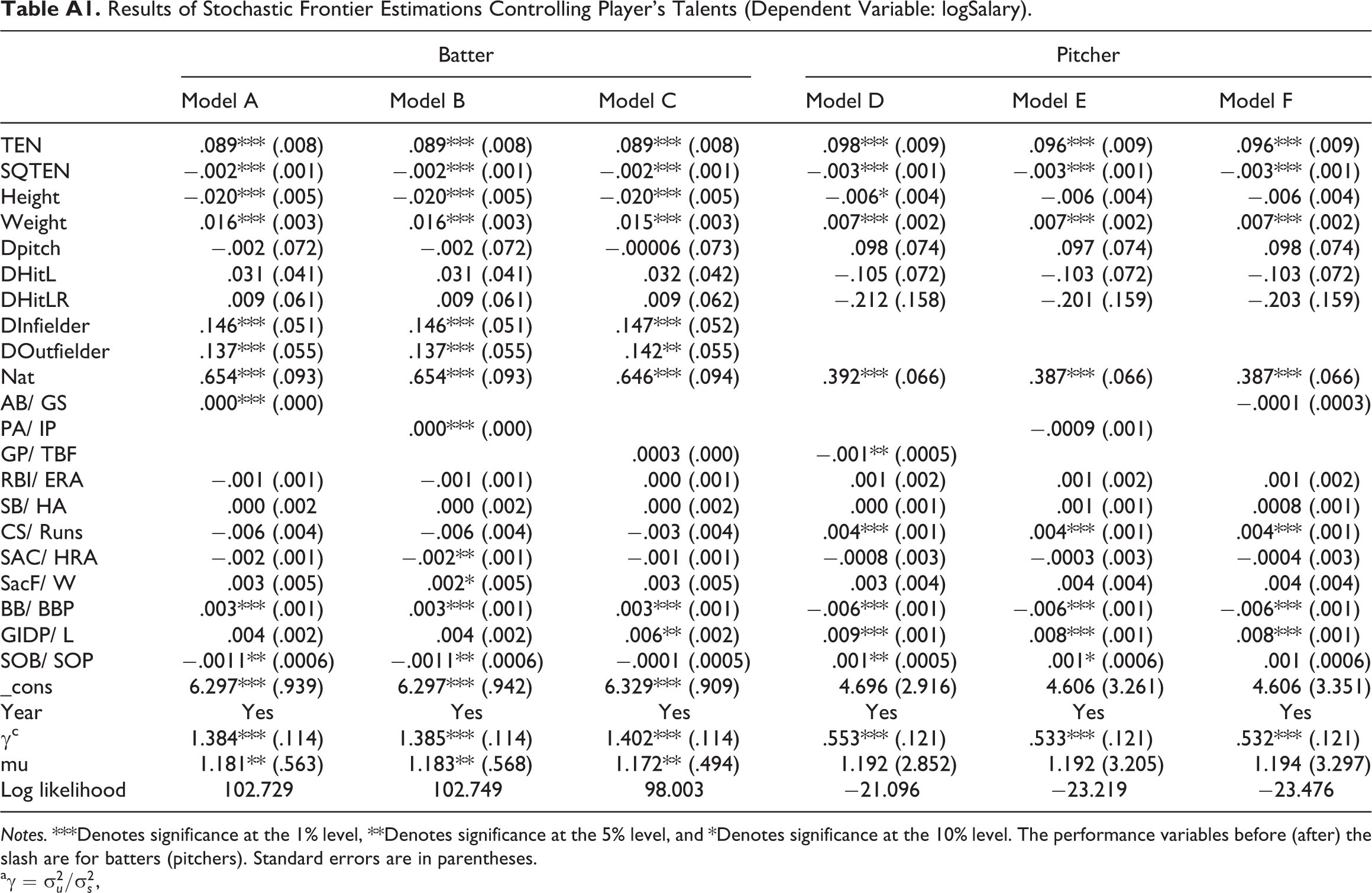
The player’s performance (Per) includes the batters' and pitchers' parts. For a comprehensive investigation, all of the player’s performance indices (18 indices for batters and 16 for pitchers) are collected in the data set. They are used to control for differences in talent. Batters' indices include games played (GP), runs batted in (RBI), home runs (HR), total bases (TB), and so on. Pitchers' indices include Wins (W), games started (GS), home runs allowed (HRA), strikeouts (SO), wild pitches (WP), and so on. The details of the variable definitions and the data description are listed in Table 1 .
Descriptive Statistics of the Data (n = 2,442).
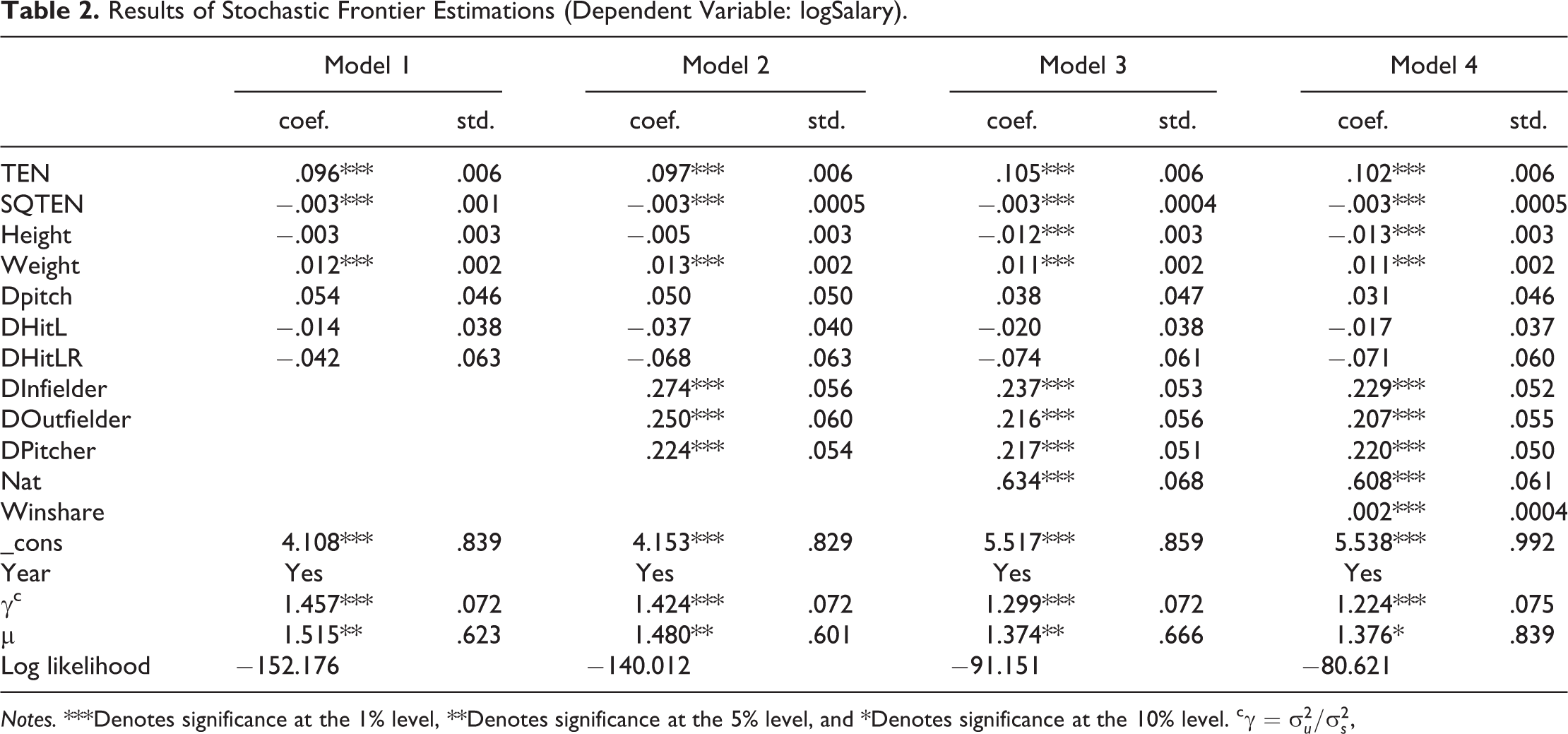
Note. aThe unit is a million Yen, and the average exchange rate during the data period (2000-2008) was 1US$ = 114.5822 Yen.
In order to fully utilize the batter’s and pitcher’s information without losing the degrees of freedom, one index measuring batters and pitchers at the same time is needed. However, the indices for measuring a professional baseball player’s performance are numerous. The measurement is challenged. The win share which is proposed by James and Henzler (2002) to unify the unit of measurement between pitchers and hitters is used. The introduction of the win share is included in the Appendix A.
The coefficients of α1s in Equation 1 are the elasticities of human capital attributes, for example, TEN, for the reservation salary, and the inputs are intuitively regarded as positive in the production function. In a job search model, Burdett and Mortensen (1998) pointed out that senior workers are better paid than junior workers. In addition, according to human capital theory, the accumulation of tenure increases a worker’s production efficiency, and the rate of increase decreases as time passes. Therefore, tenure is expected to increase the reservation salary at a decreasing rate. The effect of TEN is expected to be positive, and SQTEN is expected to be negative.
Some players have less input (player’s human capital and talent) but obtain more output (salary). This indicates that these players are overpaid. Therefore, the player’s overpayment can be measured by the technical inefficiency in the SFM. In order to estimate the overpayment for player i at time t, the conditional error (f(u|ϵ)) is assumed to be distributed half-normally. The conditional expectation of the one-side error can be expressed as in Kumbhakar and Lovell (2000, see p. 78 for the details):
Overpayment measures the differential between the reservation salary and a salary on the estimated frontier. Therefore, the larger a player’s overpayment, the more technical inefficiency there is in the SFM. In the same structural setting of these input variables for each player, each player’s overpayment in the league can be calculated. The degree of overpayment for different positions, teams, leagues, and even nationalities can be compared. The comparison for different levels of overpayment reveals the policy implications for team executives.
Results and Discussion
The empirical results for the SFM in Equation 1 are listed in Table 2 . Model 1 is the basic model with the human capital attributes. Model 2 adds the position dummies and Model 3 includes the dummies of position and nationality. Model 4 is the complete regression which controls for talent differences based on actual performance statistics. From the table, it is shown that the coefficients of γ are significant for all models, which confirms that the SFM is applicable to the analysis. As to the coefficients of α1, the coefficient of tenure (TEN) is positively significant and its square term (SQTEN) is negatively significant in relation to the reservation salary for Models 1–4. NPB players exhibit a quadratic relationship between reservation salary and tenure. This indicates that a player’s reservation salary increases at a decreasing rate as tenure increases, which corresponds with expectations.
Results of Stochastic Frontier Estimations (Dependent Variable: logSalary).
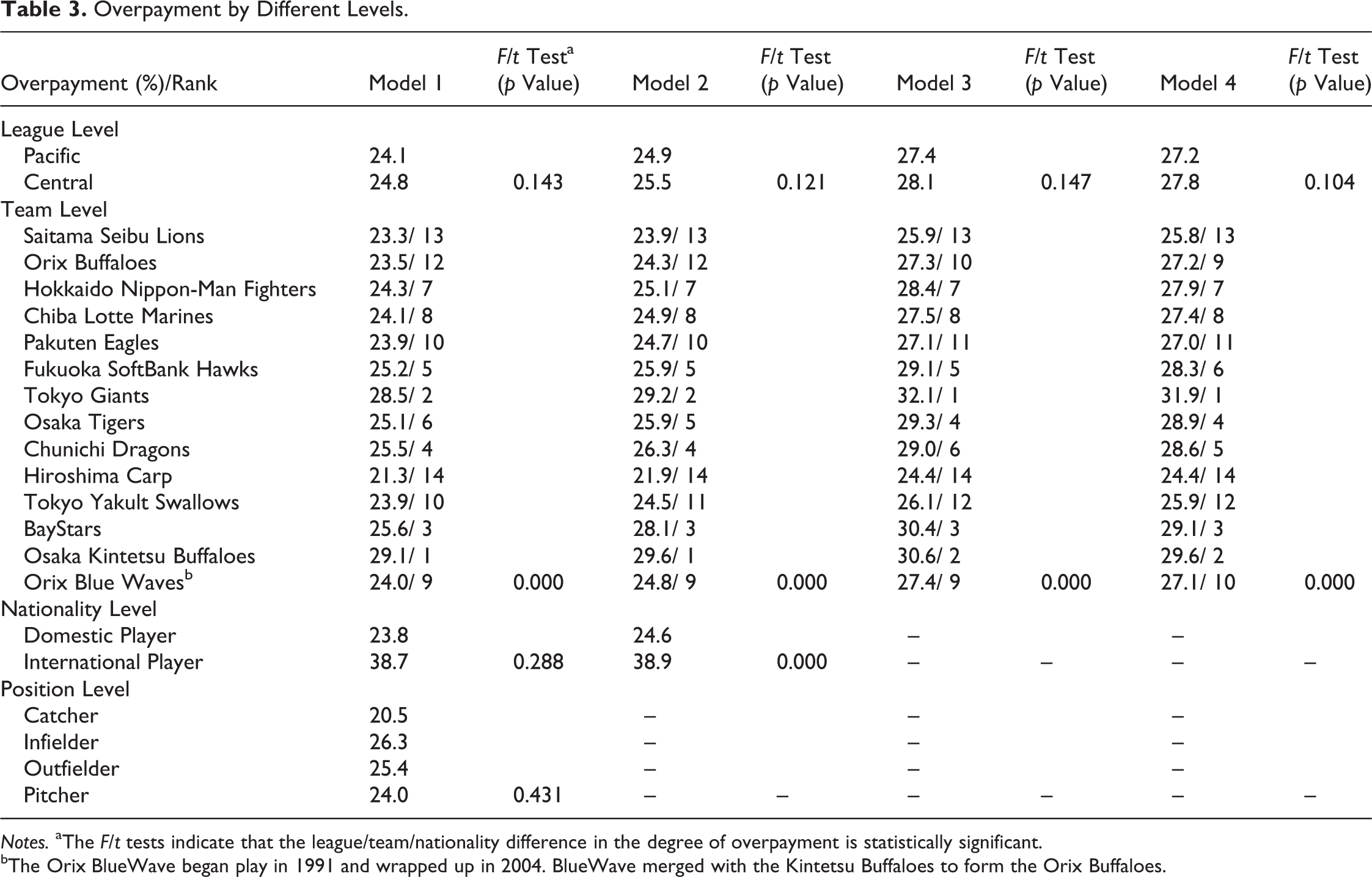
Notes. ***Denotes significance at the 1% level, **Denotes significance at the 5% level, and *Denotes significance at the 10% level. cγ =
The elasticities of human capital attributes in regard to reservation salary are all inelastic. Taking the coefficient of the variable TEN in Model 1 as an example, the elasticity of tenure on the reservation salary is about 0.096 and indicates that a 1-year increase in tenure could lead to a 0.096% increase in the player’s reservation salary.
In Models 2–4, the coefficients for infielder, outfielder, pitcher, and international player are highly significant. This shows that infielders, outfielders, and pitchers have higher reservation salaries than catchers. Compared to a catcher, an infielder has a marginal effect that ranges from a 0.229% to 0.274% increase in reservation salary. Likewise, compared to a catcher, the ranges of the premium of outfielders' and pitchers' reservation salaries are 0.207–0.250% and 0.217–0.224%, respectively. In addition, an international player’s reservation salary is higher than that of a Japanese player. The significant coefficient shows that an international player obtains a 0.608–0.634% increase in reservation salary compared to a Japanese player. 11
Workers with more experience and workers in professional/skillful occupations demand higher salaries, so there are higher reservation salaries for them. This is one of the important predictions in job search theory. The former conclusion can easily be found in the empirical results of the tenure effect in Table 2. The effect of workers in professional/skillful occupations may also reveal some interesting results from the evidence. That is, if the prediction is sustained, this may indicate that infielders, outfielders, and pitchers are more professional/skillful than catchers in the NPB labor market, even though all are positions in an extraordinary profession.
The evidence of the nationality effect in Table 2 shows that international players need higher salaries to work in Japan. This can be explained by international players' costs of search, that is, foregone earnings, being higher in their country. In the nationality distribution of international players in the NPB, the main foreign players come from America (56.41%). The nationality distribution of international players in the NPB is presented in Figure 1 . The average player’s salary in the MLB from 2000-2008 was about 2.64 million dollars (Jane, 2010), and the amount was 6.6 times greater than that in the NPB. Therefore, the nationality effect can be easily investigated in the regression and the international players are found to fare better relative to Japanese players in terms of their reservation salary (0.608–0.634%). Besides, workers who have more choices regarding their work place have higher bargaining power. Better bargaining power brings a higher reservation salary. In the regulations for free agents in the NPB, domestic players qualifying for free agency can only move to other NPB teams, while international players are free to move to any teams in the world. Thus, the reservation salaries for international players are higher than those for local players as they are auctioned in the free market.
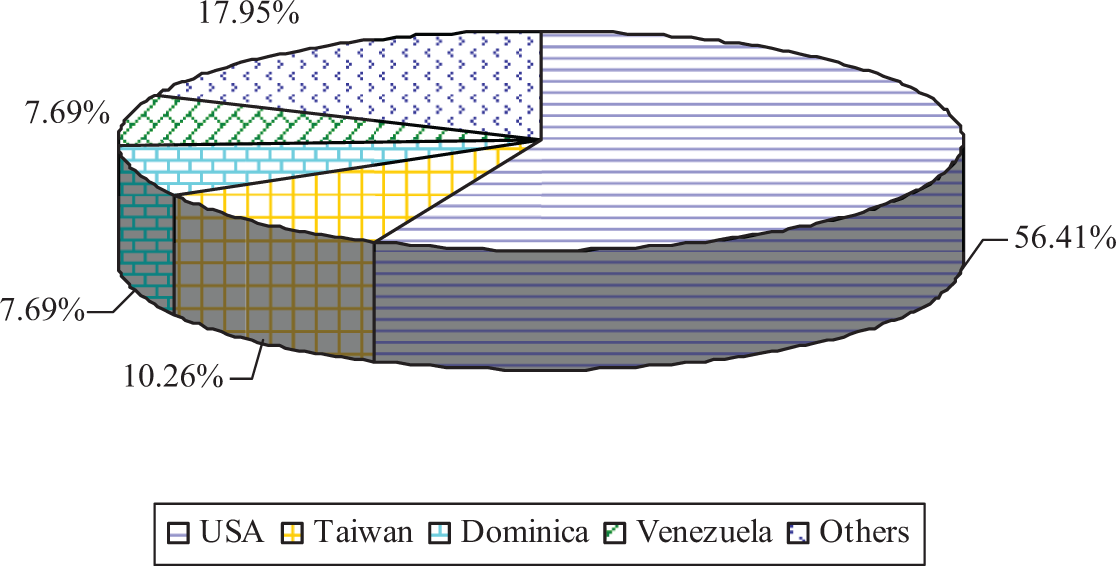
Nationality distribution of international players in the Nippon Professional Baseball (NPB).
Table 3 presents the estimates of the degree of overpayment and its rank by levels of league, team, nationality, and position. The team difference in the degree of overpayment is statistically significant and quite remarkable. The Tokyo Giants and Osaka Kintetsu Buffaloes take turns taking the lead in the four models. Taking the Tokyo Giants as an example, an average Giants player is overpaid 28.5–32.1% compared to what he could have earned if he had found a perfect match with the employer. In other words, player’s reservation salaries are, on an average, 28.5–32.1% below their potential salaries. For other teams, such figures range from 21.3% to 30.6%.
Overpayment by Different Levels.
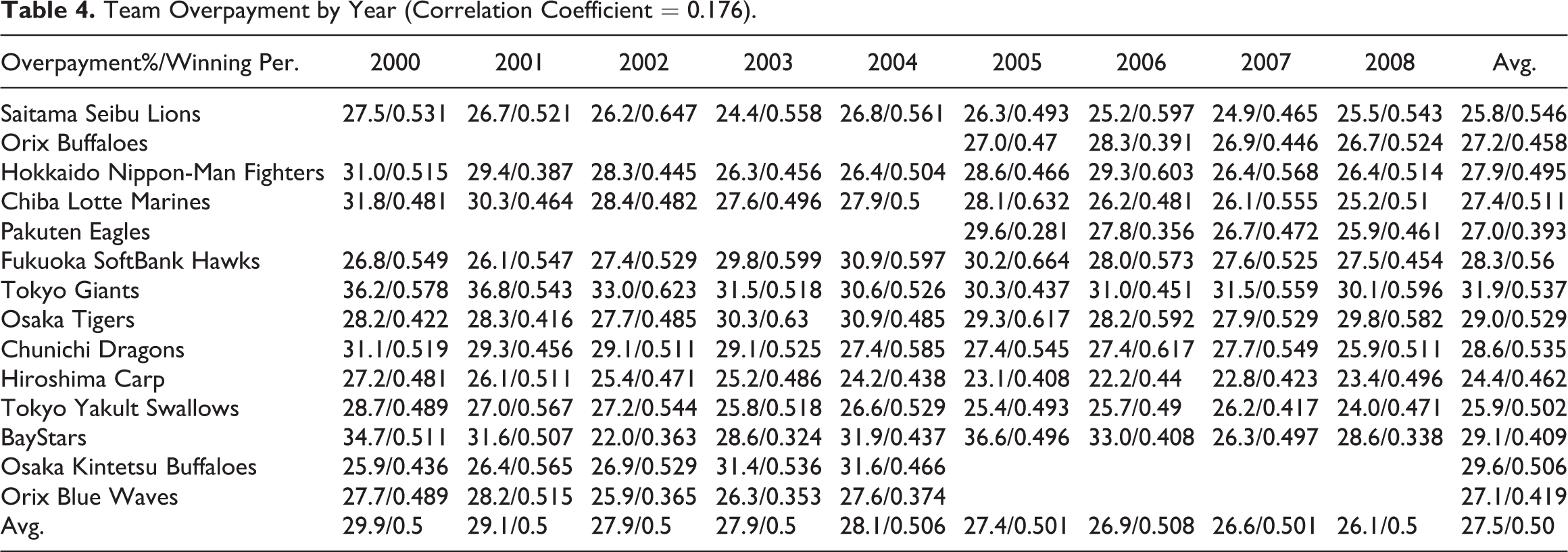
Notes. aThe F/t tests indicate that the league/team/nationality difference in the degree of overpayment is statistically significant.
bThe Orix BlueWave began play in 1991 and wrapped up in 2004. BlueWave merged with the Kintetsu Buffaloes to form the Orix Buffaloes.
The nationality difference in the degree of overpayment is statistically significant in the estimation of Model 2. Compared with how much a player can earn in a perfect-match labor market, the overpayment for international players and domestic players are 38.9% and 24.8% of potential salary, respectively. This indicates that foreign players achieve a 14.1% greater overpayment than their domestic teammates. Finally, the statistics for league and position levels are not significant.
Few articles have focused on the issue of nationality salary preference. 12 In some ways, the evidence of nationality overpayment supports the executive’s preference for international (MLB) players. Other than the executive’s preference, the asymmetric information between employer and employee is also a major contributing factor to nationality-based overpayment. The famous hypothesis of the winner’s curse argues that teams may overestimate the marginal revenue that players bring in the free agent market (Eschker, Perez, & Siegler, 2004). Specifically, when international players have no baseball experience in Japan, the NPB teams lack comparative information regarding their true value and are apt to overestimate their talent, tending to pay a higher salary.
Due to a lack of direct research on overpayment in professional sports, the bold assertions which affect the results of team-level overpayment are difficult to substantiate. However, the estimation for team overpayments per year and its correlation with team performance may provide a meaningful management policy for team executives. The full model in the SFM (Model 4) is used to estimate the overpayment as calculated by Equation 2. The results are presented in Table 4 .
Team Overpayment by Year (Correlation Coefficient = 0.176).
The analysis in Table 4 is closest in spirit to Jewell and Molina (2004), who estimated the correlation between relative efficiency and predicted wins to see if an MLB team’s production function is generally related to its ability to efficiently produce wins. 13 The empirical results in Jewell and Molina (2004) suggested that there seems to be no obvious correlation between predicted wins and relative efficiency (the correlation coefficient was only 0.12). They concluded that an MLB team’s production function is generally unrelated to its ability to efficiently produce wins. This article calculated the correlation coefficient between the overpayment and winning percentage and found a fairly low correlation coefficient (0.176) between overpayment and an NPB team’s winning percentage. That is, the most overpaid teams may not be among the top ranking teams. The evidence supports the conclusion that: “a NPB team’s waste of overpayment in the production function is generally unrelated to its actual wins.” Take the most overpaid team, the Tokyo Giants, as an example. The Giants have many productive resources, but the team with the best performance for the period from 2000-2008 is the Seibu Lions. That is, the Giants have wasted some of their resources in overpayment and this has resulted in their not being the most successful baseball team in Japan.
Conclusions
This article provides a review of the literature on sporting production functions. It examines the reservation salary level and estimates the degree of overpayment by stochastic frontier methodology. The unbalanced panel data on the salaries and performances of 663 players in 14 teams for the years 2000 through 2008 were collected, enabling an investigation of the job search model and the relationship between overpayment and team performance. The main conclusions are as follows.
First, the evidence supports the predictions of job search theory. More experienced players demand higher salaries, so their reservation salary is higher. The effect increases at a decreasing rate. Moreover, infielders, outfielders, and pitchers have higher reservation salaries than catchers. A pitcher has a 0.217–0.224% increase in reservation salary compared to a catcher. If the predictions of job search theory that “workers in professional/skillful occupations demand higher salaries/reservation salary” is sustained, this may indicate that infielders, outfielders, and pitchers are more professional/skillful than catchers, even though all positions are in the extraordinary profession of baseball.
Second, international players' reservation salaries are higher than those of Japanese players. An international player receives a 0.608–0.634% increase in reservation salary compared to a Japanese player. This can be explained by the international player’s job search cost, that is, foregone earnings, being higher in his or her country.
Third, as to the overpayment analysis, international players receive preferential labor market treatment. This specific form of overpayment results from labor market frictions that develop due to incomplete information regarding international players. This may indirectly provide evidence of nationality-based salary discrimination in professional baseball. In addition, the results support the hypothesis of a winner’s curse. For the team-level overpayments, players in large teams (e.g., the Tokyo Giants, Osaka Kintetsu Buffaloes, etc.) are more overpaid than players from small teams. The results correspond to the prediction of salary policies between large and small firms in the job search model (see Burdett & Mortensen, 1998).
Finally, a fairly low correlation coefficient (0.176) is found between overpayment and an NPB team’s winning percentage. Payment wastage in terms of a team’s overpayment in a resource-abundant team within a large market (e.g., the Tokyo Giants) results in that team not being the most successful. From the concept of competitive balance, the implication that a team’s overpayment does not correlate with wins/losses is not a bad thing for a league.
Footnotes
Appendix A
Notes
Acknowledgements
Jane is grateful to the National Science Council for its financial support (NSC 99-2410-H-128-009). Jane would like to thank the editor and the anonymous referees for their helpful comments on the manuscript. All remaining errors are my own.
Declaration of Conflicting Interests
The author declared no potential conflicts of interest with respect to the research, authorship, and/or publication of this article.
Funding
The author received no financial support for the research, authorship, and/or publication of this article.