







Abstract
A recent study finds that Olympic Games host countries experience significant positive, lasting effects on exports. They interpret their results as an indication that countries use the hosting of such events to signal openness and competitiveness. The authors challenge these empirical findings on the grounds that a comparison of structurally different and nonmatching groups of countries might suffer from a selection bias. The authors demonstrate that with an appropriate matching and treatment methodology, the significant Olympic effect disappears.
Introduction
Rose and Spiegel (RS, 2011) find that Olympic Games host countries experience significant positive, lasting effects on exports. Their results do not only hold for the actual hosts but also for countries that unsuccessfully bid for the Olympic Games. RS interpret their results as an indication that countries use such events to signal openness and economic competitiveness (i.e., a signal effect). We challenge the empirical findings of RS because they compare Olympic nations such as the United States, Japan, Germany, Canada, Italy, Spain, and Australia, which have been among the leading export nations for centuries, to all other nations. Their comparison of structurally different, nonmatching groups might suffer from a selection bias. We demonstrate that with an appropriately applied matching and treatment methodology, the RS Olympic export effect disappears.
To illustrate the structural differences between the subsamples, Figure 1 displays indices (1950 = 100) of the logarithms of real exports. The solid line depicts the average exports of the summer Olympics host countries, which clearly outperforms the dashed line depicting the average exports of nonhosts. 1 The dotted line shows the average exports of the Organization for Economic Cooperation and Development (OECD) member states of 2006, excluding Olympic hosts. Note that the export development of the founding members of the OECD (1961) does not significantly differ. 2
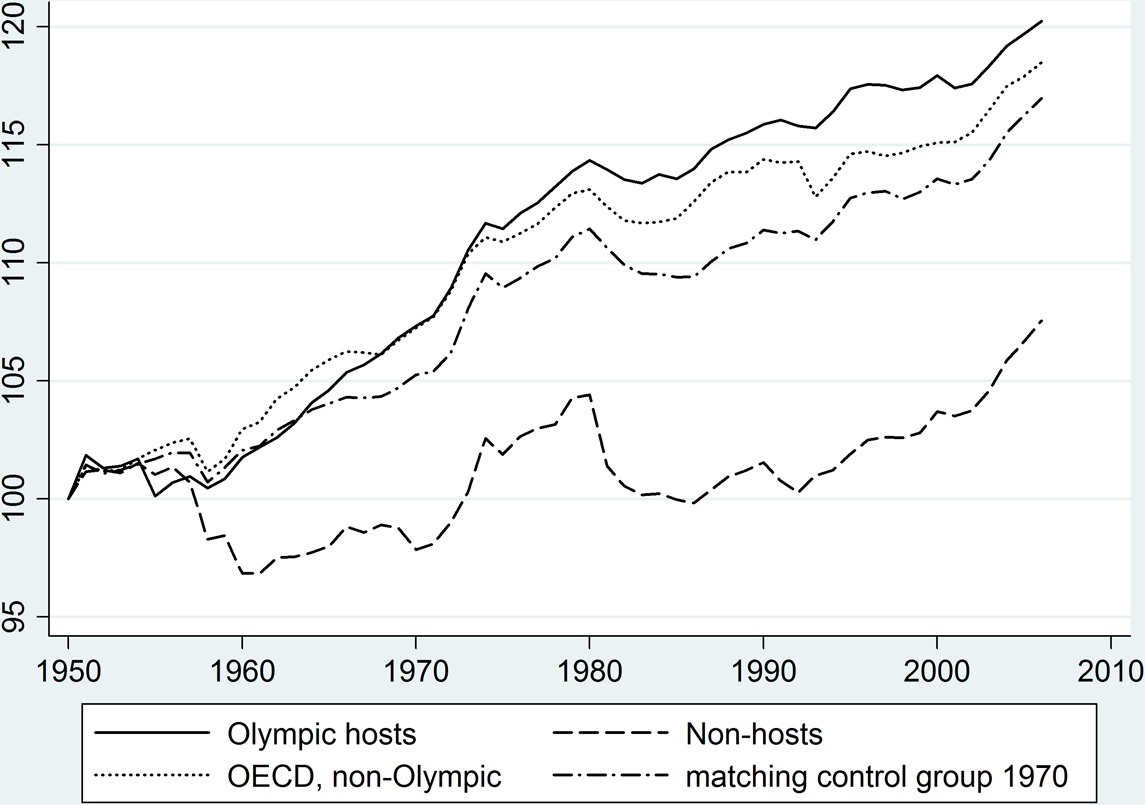
Indexed real log exports.
Empirical Strategy
Overall, it seems plausible that Olympic host countries are structurally different from the majority of the rest of the world. To overcome this problem, we employ the matching strategy of Rosenbaum and Rubin (1983) and estimate propensity scores, that is, the probability of being part of a treatment group given a set of covariates. We use these estimations to systematically discriminate between Summer Olympic Games host countries (i.e., the treatment group) and nonhost countries (i.e., the control group). Only countries that are otherwise structurally similar are included in the subsequent analysis. The covariates included in the propensity score estimation should affect both the outcome variable (i.e., exports) and the participation in the treatment (i.e., Olympic hosts), and they should either be measured before the treatment or be time-invariant (Caliendo & Kopeinig, 2008, p. 38). Note also that matching would not be possible if these covariates perfectly predicted the assignment into the treatment or the control group. 3 In our case, we aggregate the RS data to obtain a single export observation for each country i in year t. 4 We estimate the propensity scores using the logs of both the output and the population of the exporting country as covariates, fulfilling the balancing property. 5
We first estimate propensity scores for 1950; this is the first year of the RS data sample, which ranges from 1950 to 2006. This is also before the competition dates of the first Olympic Games included in the RS investigation (Olympic Summer games of 1952 in Helsinki, Finland). Thus, no treatment effects should be incorporated. For t = 1950, the values in the data set for four Olympic hosts are missing (namely, Union of Soviet Socialist Republics [USSR], Germany, Korea, and Greece), and the number of available nonhost countries is 44. Nineteen countries fulfill our common support condition, including the eight Olympic host countries. 6 We repeat the procedure for two further reference years, where data on more countries are available. For 1970, there are observations for all hosts except for the USSR. The nonhost group includes 106 countries, and 34 countries fulfill the common support condition. For 2000, data on all hosts are available. In that year, the nonhost group consists of 163 countries, while the common support condition is fulfilled by 37 countries. 7
Apart from restricting our analysis to different subsamples of matching countries, we use the same investigation strategy as RS by employing an augmented version of the gravity model. Using RS’s data set of single observations for each country i’s exports to country j at each year t, we regress the logs of distance and output, an additional set of covariates, and an Olympic effect variable on the logarithms of exports of the country. The covariates include the log of the populations of both countries and a set of dummy variables that control, among other things, for common borders, common language, regional trade agreements, and common currency. The Olympic effect variable is a dummy variable that takes a value of 1 for the exporting country starting in the year it hosted the Olympic Games. For sensitivity analysis, we follow RS by alternatively estimating different combinations of year, dyadic, and country-specific fixed effects, and country-specific linear time trends.
Results
Table 1 reports the regression results for the Olympic effect coefficient if we restrict the RS method to the countries that fulfill the common support condition in 1950 (Row #2), 1970 (Row #3), and 2000 (Row #4). For ease of comparison, Row #1 displays the RS results, which we were able to replicate. As the dependent variable is estimated in logarithms, the RS estimate of .33 in Row #1, Column (a) would translate into a permanent Olympic effect on exports of about exp(.33) − 1 = 39%. However, with the single exception of specification (d) (i.e., fixed-year effects and country-specific export trends), no significant positive effects are measurable if the Olympic hosts are compared to matching groups of countries, avoiding a selection bias. For the sample restricted to those countries on the common support in t = 1950 and the specifications (a) and (f), even significant negative effects can be found. If the analysis is restricted to those countries on the common support in t = 1970 (Row #3) and t = 2000 (Row #4), where the data are the most complete, the majority of the effects is insignificant and around zero, with coefficients often below one standard deviation. Specification (d) is again an exception.
The Olympic Effect, Diverging Control Groups, and Methods
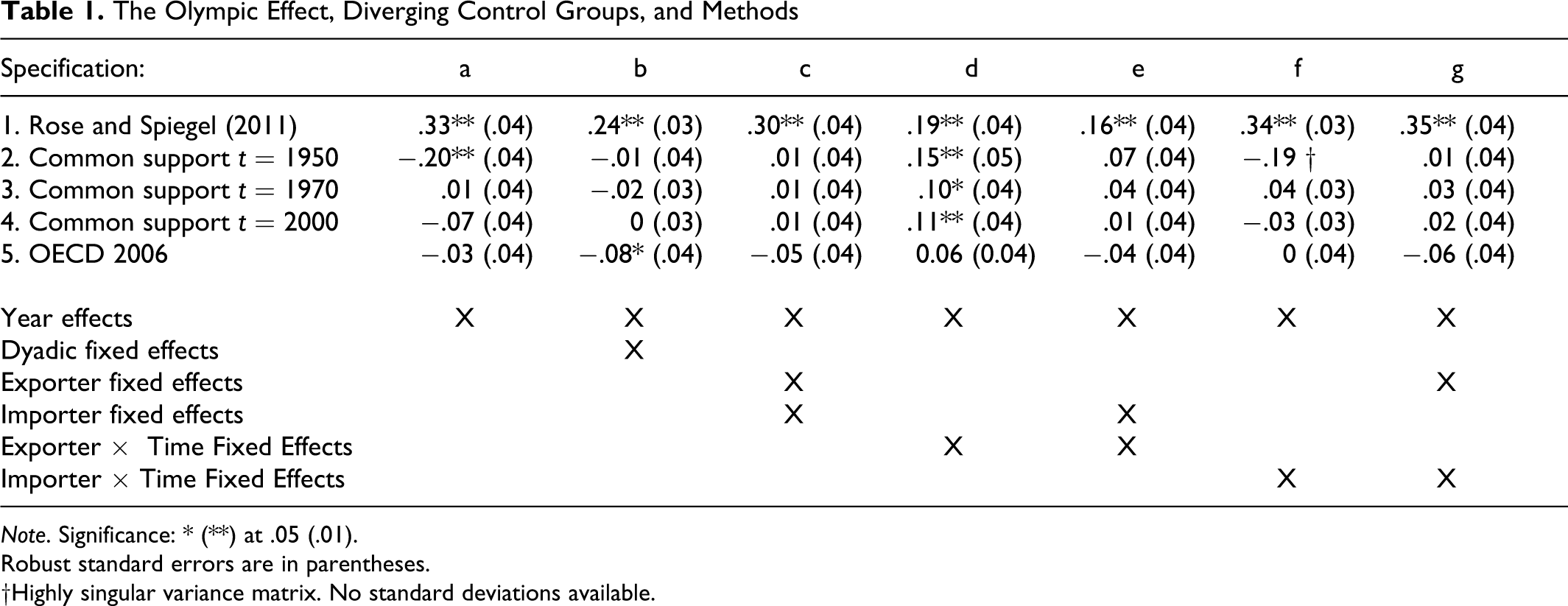
Note. Significance: * (**) at .05 (.01).
Robust standard errors are in parentheses.
†Highly singular variance matrix. No standard deviations available.
For readers who mistrust complex data selection methods as treatment and matching procedures, we alternatively compare the Olympic OECD countries with the non-Olympic OECD countries, which can be reasonably assumed to be structurally alike. Again, no significant, positive effects on exports are found (Row #5).
Figure 1 might help clarify the striking difference between the results. RS compare Olympic countries (solid line) to all other countries (dashed line). As mentioned above, this implies a comparison of Olympic nations, such as the United States, Japan, Germany, Canada, Italy, Spain, and Australia, to some of the world’s most disadvantaged nations. Instead, we compare Olympic countries to structurally similar countries, such as other OECD countries or control groups identified by empirical matching strategies.
As mentioned above, RS find that their results do not only hold for actual hosts but also for countries that unsuccessfully bid for Olympic Games, leading them to the interpretation that countries use the Games (and similar events) to signal openness and increasing economic competitiveness (signal effect). However, when controlling for the structural similarities/dissimilarities of countries, again we did not find any systematically significant, positive effects for the bidding countries. 8
RS regress, among other variables, Olympic dummies on export performance, which implies the test “Olympic Games → competiveness.” RS interpret their results as a signal effect, which implies a reverse hypothesis of “competiveness → (bidding for) Olympic Games,” which is debatable because these results would be based on tests that regress export performance and other determinants on (the probability of) bidding for the Olympic Games. On the basis of the RS results, policy makers might thus believe that they can increase their country’s exports by organizing the games or by bidding for them. There might be good reasons to bid for the Olympic Games, but our results provide a warning that the hopes for export growth should not part of rational motivations.
Footnotes
Acknowledgment
The authors thank Andrew K. Rose for providing the data as well as the STATA do-file for the base case regressions.
Declaration of Conflicting Interests
The authors declared no potential conflicts of interest with respect to the research, authorship, and/or publication of this article.
Funding
The authors received no financial support for the research, authorship, and/or publication of this article.