







Abstract
Qualification in track and field events involves runners competing against individuals within their heat and runners in other heats. Given that the heats are run sequentially, runners in each heat have different information about their competitors. Using data on track and field events from 2001-2011, this article examines whether an individual’s placement in a specific heat and their peers affect their performance and qualification probability. Results indicate that runners’ times and qualification are correlated with the abilities of their peers as well as heat-specific fixed effects. In addition, these effects differ according to runner ability.
Introduction
At major International Association of Athletics Federations (IAAF) track and field events, such as the World Championships in Athletics and the Olympic Games, the 5,000-m event is typically set up as a tournament where runners compete separately in two or three heats to determine qualification for the final. Two types of qualification occur in these events. 1 Runners who advance by place (termed place qualifiers) finish in a predetermined position (e.g., the five fastest finishers) in their heat. Runners who advance by time (termed time qualifiers) are those who did not advance by place but who have one of the fastest times of all remaining entrants, regardless of the heat.
This contest structure is of interest for three reasons. First, the contest is sequential in nature. Runners in the first heat compete and a set number of place qualifiers are determined. At this time, no time qualifiers have advanced. Next, the second heat is run and additional place qualifiers are determined as well as the time qualifiers based on a comparison of times from both heats. 2 The second reason the structure is of particular interest is that competitors have asymmetric information. In a tournament with two heats, runners in the second heat have information about the times that will allow them to advance by time, in addition to information about simultaneous competitors. Finally, because qualification occurs as a rank-order tournament, the competition also provides the potential to study peer effects as well as strategic interaction.
It is important to consider the subtle distinction between peer effects and strategic interaction. As used in this article, peer effects are meant to capture the effect that a particular peer group has on a runner’s performance. It is unclear whether the presence of high-performing athletes will positively influence a runner’s performance or whether the presence of high-performing runners discourages a runner enough to negatively affect performance. As considered in this research, the makeup of a runner’s competition is considered a peer effect. An econometric difficulty (discussed below) in estimating this peer effect is the possibility of an unobservable factor influencing the performance of all runners. An example of this unobservable factor is the strategic interaction between the athletes. It is expected in a footrace that rewards competitors based on relative performance that runners will behave strategically. The strategies are not necessarily quantifiable in a race, but their presence is expected. Because runners in the second heat of a tournament have more information, it is possible that the strategic behavior differs across the timing of the heat.
The literature examining tournament structure has suggested that sequential competitions, or competitions with information lags, can engender competition. Using data on the major IAAF events from 2001-2011, this study sets out to examine how an individual’s performance in a 5,000-m race is affected by the timing of an individual’s heat and by peer effects, both within heat and across heats during a given year. Results indicate that the individual runner’s ability is the most consistent predictor of performance and qualification. In the preferred models estimating runners’ performances, runner’s times are positively affected by the abilities of runners within their heats. While peer effects appear to matter, unobserved heat-specific effects are also extremely important. Runners with slower abilities have reduced probability of qualification, time qualification, and place qualification, and peer effects matter for time qualification. Running in a heat with slower runners decreases the probability of qualifying by time, but the presence of slower runners in the other heats increases the probability of time qualification. Finally, the heat results differ according to the ability of the runner. Higher ability runners are more likely to qualify from heats run after Heat 1 while slower runners are more likely to qualify if located in Heat 1.
Tournaments
Before discussing the empirical methodology and data, some additional discussion regarding the tournament is required. In the 5,000-m contest, runners have two opportunities to qualify for the finals. The first way to qualify for the final in a heat with N runners is by finishing in the top δ of the heat (where 1 ≤ δ ≤ N), so that δ runners qualify from each heat. This type of qualification is referred to as a place qualification and is similar to a rank-order tournament where relative performance, not absolute performance, of the runners in each heat determines qualification. However, those who do not finish in the top δ of the heat can still qualify for the finals if their finishing time from their heat is fast enough. 3 Specifically, runners from Heat h (where h = 1, 2, or 3) who did not qualify (Nh − δ) have their times compared with runners from Heat j (where j = 1, 2, or 3 and h ≠ j) who did not qualify (Nj − δ). Runners whose times rank as the λ fastest, qualify for the finals, where 1 ≤ λ ≤ ∑(Nh − δ). This type of qualification is referred to as a time qualification and is similar to the losers’ stage of a double elimination tournament.
To illustrate the nature of the tournament analyzed in this article, Table 1 below provides the times and qualifiers from the 2011 World Championships event. The tournament was set up as two heats with 20 entrants in Heat 1 and 21 entrants in Heat 2. 4 The top five finishers in each heat were place qualifiers and the five fastest times of nonplace qualifiers were compared to determine time qualification.
2011 Tournament.
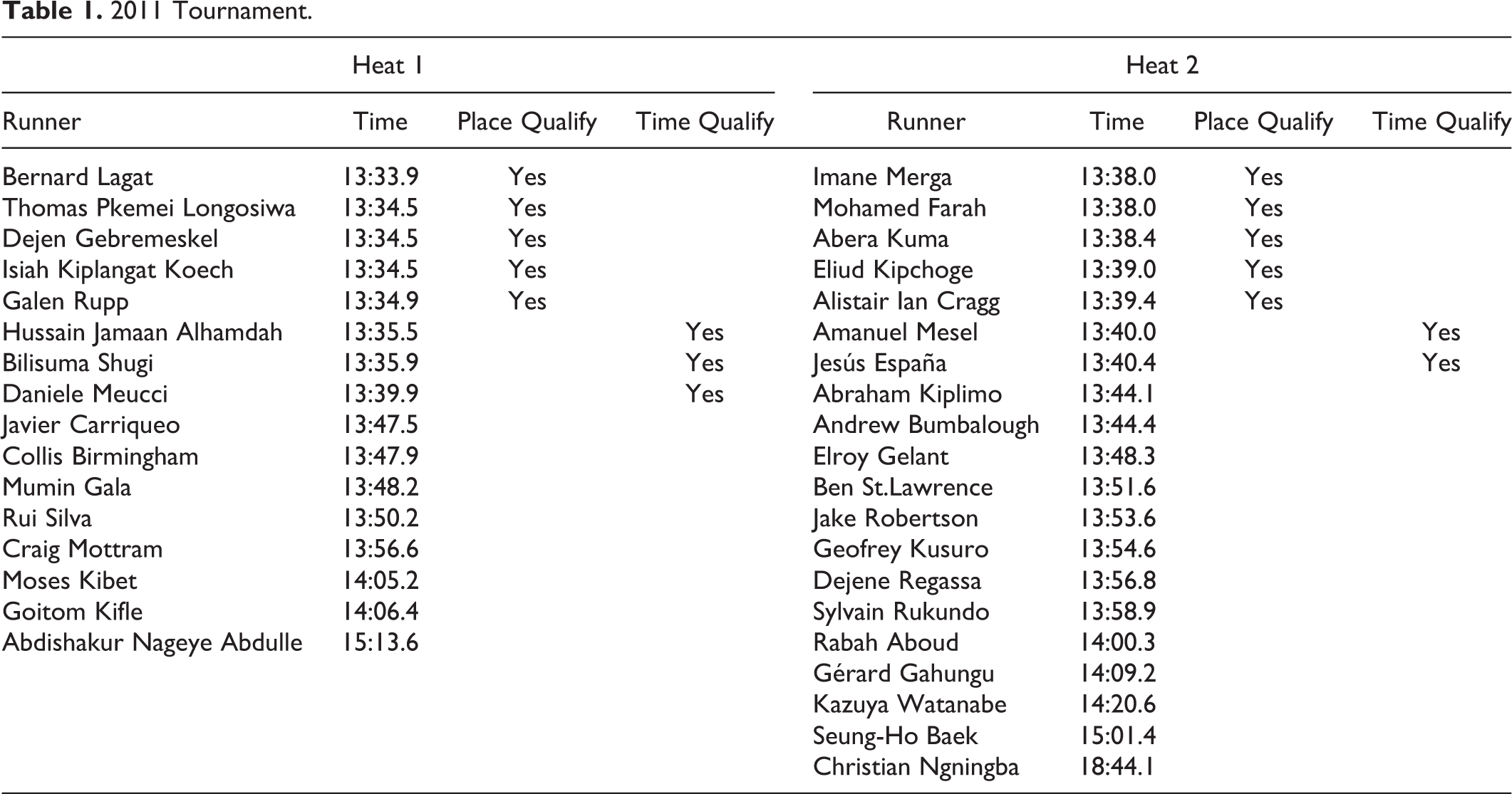
One of the unique aspects of the contest is that runners in each heat have different information about their competitors at the time of their race. The information differs in nature as well as in the timing. Prior to the competition, runners have identical information about the composition of the entire field and how the runners are divided between heats. Runners in each heat also have current information about how runners in their heat are performing. Runners in Heat 1 use information about the performance of within-heat peers as well as expectations about how runners in subsequent heats will perform in determining their effort. Those who finish in the top δ of their heat then qualify. However, for the runners who do not finish in the top δ, their competition for reaching the finals is now the individuals from other heats who also finished outside the top δ. Because the times for this second stage of the tournament are not determined by another round of heats, runners have different information. Runners in Heat 2 use information about the performance of within-heat peers as well as actual performances from runners in Heat 1 in determining their effort. 5 Runners know the times of the fastest nonqualifiers in heats prior to their heat but they do not know times from subsequent heats. Thus, runners in the last heat have more information about what time will be needed to qualify, while runners in the first heat have very little information, other than how competitors from their heat perform as well as information about the abilities of runners from subsequent heats.
To illustrate the perception that a runner (Galen Rupp) competing in the second heat of a two heat qualifying tournament has an advantage, consider the following quote from an Oregonian article (Goe, 2012) about the 5,000-m qualifying heats at the 2012 Olympics: Runners in the second heat had a significant advantage in the qualifying format. Because they already had the results of the first 5,000-m semifinal, they went into action Wednesday knowing exactly what was necessary. Rupp and Oregon Project coach Alberto Salazar huddled before the race to make sure Rupp understood the variables. Rupp kept an eye on the stadium clock and shut down on the home straight, strolling in with a sixth-place finish and a time of 13:17.56.
In addition to the difference in the timing of the information, the nature of the information varies. Runners in Heat 2 will know whether the first heat was a particularly strong or weak performance. A relatively strong first heat might alter the performance of runners in Heat 2. Runners in Heat 1 will not have this type of information.
Literature
Many factors are important in determining the performance of a competitor in a contest. Consequently, there is a relatively large body of literature that this research uses to build the empirical model. First, research on tournament theory is considered in helping understand the relationship between the structure of the tournament and the performance of the competitors. Second, because performance is relative based in the tournaments described here, the influence of peers is extremely important. As such, the literature examining peer effects is consulted.
Research on tournament theory has long investigated the relationship that tournament structure has on a competitor’s behavior, including effort and performance. Szymanski (2003) reviews much of the research on tournament theory and how the research has evolved into applying the concepts to questions of sports economics. 6 Much of the research (building on Lazear & Rosen, 1981) has assumed that homogeneous competitors in a rank-order tournament make simultaneous decisions about effort. The literature then expands this initial model to examine tournaments with heterogeneous competitors (Sunde, 2009), multiple stage tournaments (Gilsdorf & Sukhatme 2008a, 2008b; Rosen, 1986), and sequential tournaments (Brown & Minor, 2011; Jost & Kräkel, 2005).
The literature examining tournament theory is large and the findings are diverse, but it is important to understand some general predictions. As initially shown in Lazear and Rosen (1981), in tournaments with homogeneous competitors, effort is increased as the size of the prize is increased. Much of the empirical work on tournament design in sporting contests has investigated this result. While this is not the primary question of this research, it still provides important insights into the determinants of an athlete’s performance. The most widely known results on the empirical relationship between prize structure and performance are from individual sports, including golf (Ehrenberg & Bognanno, 1990a, 1990b; Orszag, 1994), running (Frick & Prinz, 2007; Lynch & Zax, 2000; Maloney & McCormick, 2000), and tennis (Gilsdorf & Sukhatme 2008a, 2008b). Other important empirical findings are that effort is highest in tournaments with homogeneous competitors (Sunde, 2009) and that effort increases in multiple stage tournaments where prize differentials increase through stages.
In the tournament described here, decisions are not only made sequentially, but they are also made with different information. Jost and Kräkel (2005) show that in sequential move tournaments, the first mover may choose an effort that is sufficiently high to discourage effort from subsequent competitors. 7 It is also possible that the second mover in a sequential tournament exhibits relatively high effort. While runners in the first heat have less information and may choose increased effort as a result, it is also the case that runners in subsequent heats have more information, so may put forth increased effort. Consider a two-heat tournament. Suppose the fastest nonqualifier from heat completed the race with a time of 13 min and 30 s. Runners in the second heat then know that if they run faster than 13 min and 30 s they can qualify for the finals as a time qualifier or a place qualifier, depending on their finishing place in their heat. Knowledge of the specific time necessary for qualification may then provide incentive for increased effort.
Perhaps most closely related to the tournament here is the model in Brown and Minor (2011). The model in Brown and Minor is described as a “sequentially resolved elimination tournament.” This implies a multiple stage tournament where matches in each stage occur sequentially rather than simultaneously. Brown and Minor’s primary motivation for this structure is to examine what impact knowledge of later stage competitors has on current effort. While this is not the primary interest in this article, the first stage portion of the model is still important for this article. Of particular interest to this study is Proposition 1 from Brown and Minor. They show in their model that if a relatively weak competitor wins the first match in the first stage of a tournament, then it is more likely that the stronger competitor wins the second match of the first stage. This result indicates that the information about future competitors may influence current behavior. Brown and Minor also show that runners in the first match of the first stage of a tournament make decisions about effort based on expectations regarding their future competitors.
In addition to the relationship between tournament structure and performance, one other aspect of tournaments is explored. Runners within a heat are making simultaneous decisions about effort, which presents the potential for peer effects to play a role in choosing a strategy. In addition, runners are making decisions about effort based on expectations about how competitors in other heats will perform. A large body of empirical work on peer effects exists. Much of this work has examined peer effects in schooling (Ammermueller & Pischke, 2006; Angrist & Lang, 2004) and in job performance (Bandiera, Barankay, & Rasul, 2009; Mas & Moretti, 2009). To identify peer effects, random assignment of peers is important. When this is not the case, much of the empirical work has focused on the identification strategy. 8
A recent paper by Guryan, Kroft, and Notowidigdo (2009) tested for peer effects in professional golf tournaments and found that a playing partner’s performance has very little impact on a player’s own performance. However, in a rank-order tournament, the strategic decision about how much effort to exert is potentially impacted by other runners within the heat, depending on the transmission of information or the objective function of the athletes. In Brown (2011), results indicate that golfers consistently perform better (shoot lower scores) in tournaments with higher average quality. This suggests that peers influence behavior even if their performance is not immediately observed. Golfers appear to play better if they are in stronger tournament.
Background and Data
Data from this project are collected from the IAAF. The IAAF is responsible for overseeing many track and field events, the most well known of which are the Olympic Games and the World Championships in Athletics. 9 Since 1991, the IAAF has held the World Championships biennially and the Olympics have been held every 4 years since 1912. At each of these major events since 2001, the 5,000-m run has been set up as a tournament where runners compete separately in two or three heats to determine qualification for the final.

Variable Definitions.
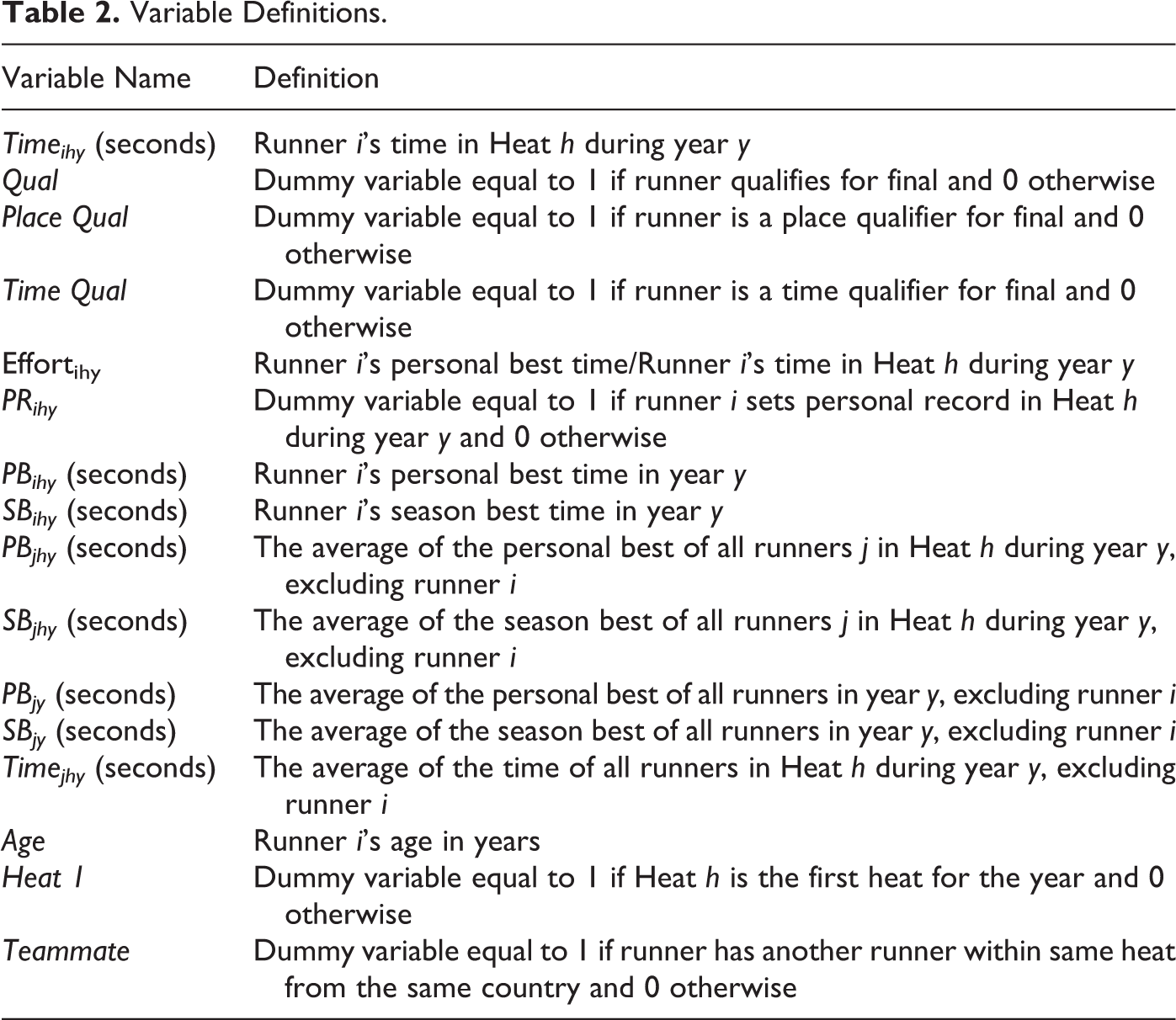
Summary Statistics.
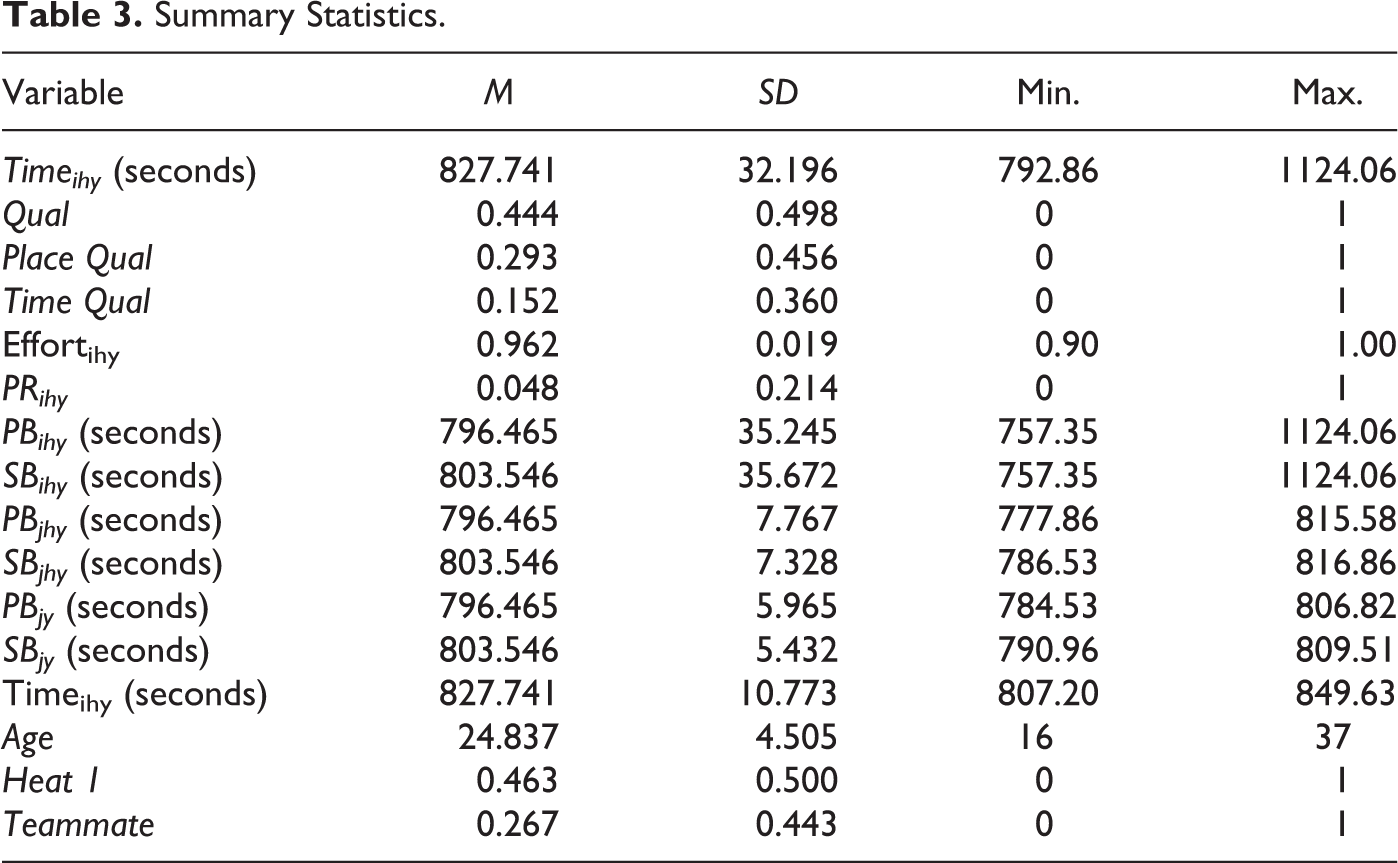
The average time of the race (Timeihy ) is, on average, below the runner’s personal and season best times. This suggests that runners, on average, do not run to the best of their ability in the qualifying heats of a tournament. As seen in Table 3, the runners ran an average of 103% of their personal best time. Perhaps this maximum effort is held until the final. Roughly 46% of runners ran in the first heat of the year and just over 44% of runners qualified for the finals. Of the qualifiers, almost two thirds qualified because of place. Finally, the average runner is nearly 25 years old, but ages range from 16 to 37 years, and roughly 27% of runners had another runner from their country racing in their heat.
Additional examination of the data may provide some guidance for the econometric specifications. As seen in Figure 1, there are not large differences in times across heats by prerace rank, where prerace rank is an ordinal ranking based on personal best times.
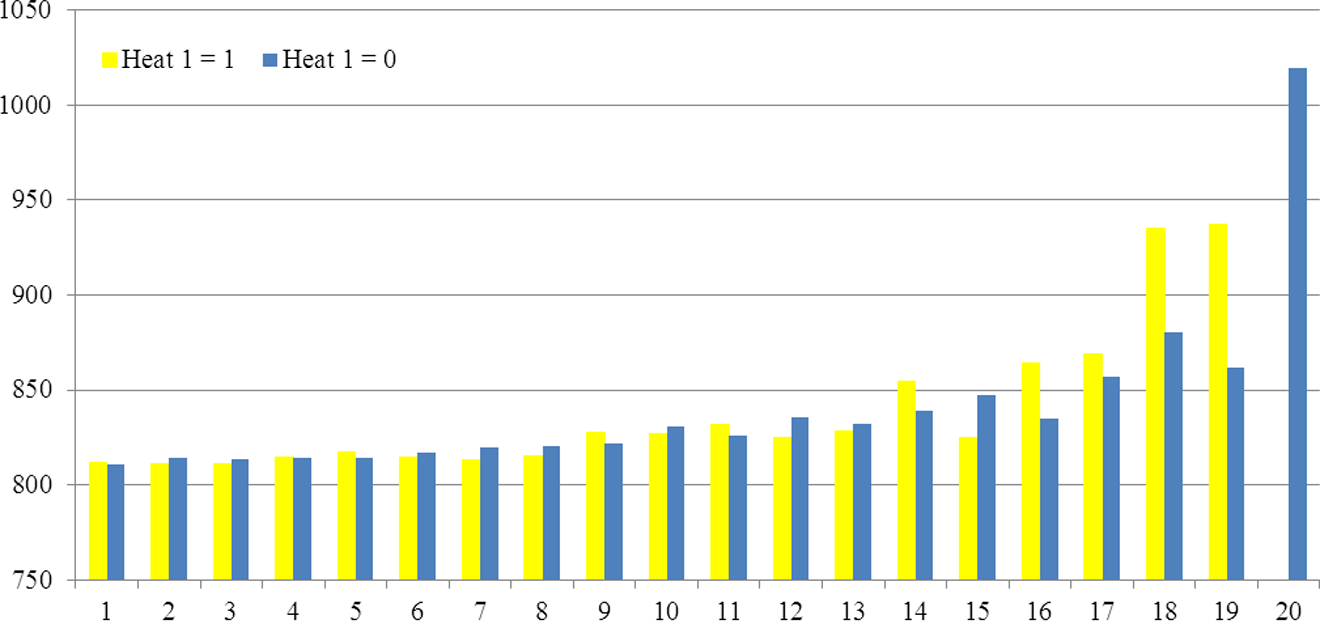
Average time (in seconds) by heat and prerace rank.
Tournament theory suggests that runners may put forth increased effort under various tournament structures. Figure 2 displays (by heat and prerace rank) the percentage of runners that ran a personal best time. As seen in Table 3, this rarely occurs, but it more often occurs in the second heat. It is clear that lower ranked runners are the runners who are likely to set personal records.
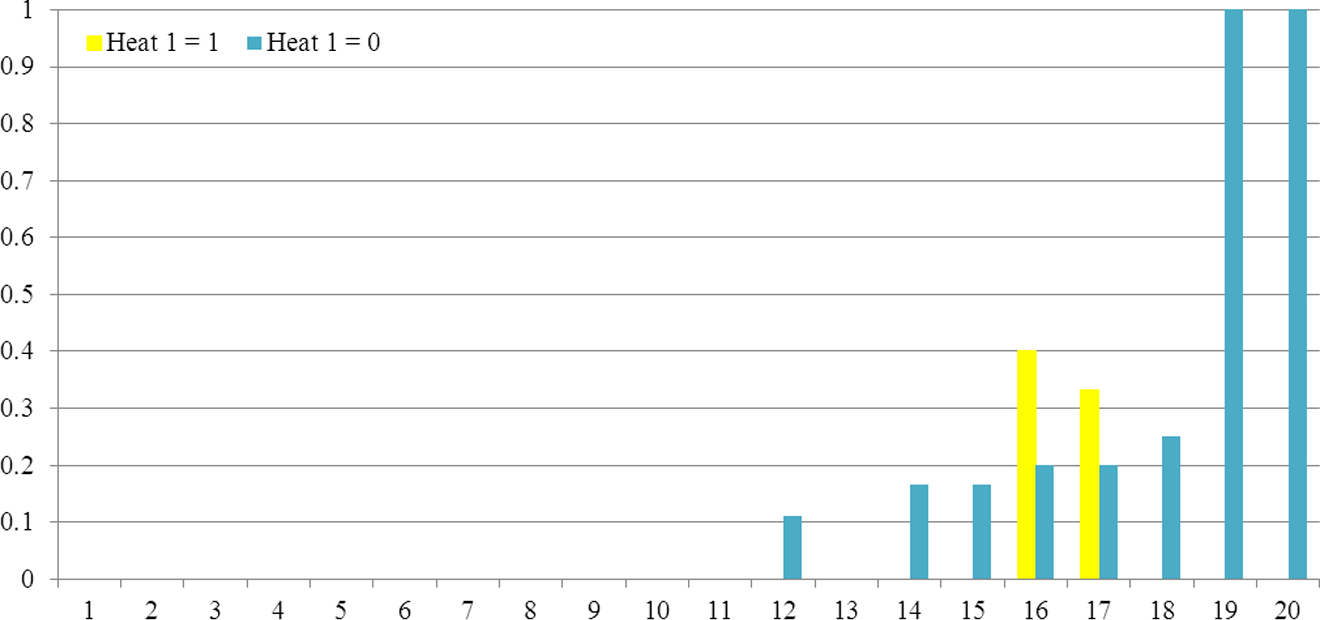
Probability of personal best (PB) time by heat and prerace rank.
These runners are potentially more likely to take on a risky strategy given how unlikely it is that these runners will qualify or win the final. This pattern is also displayed in Figure 3. Few runners put forth their best effort in the heats, but slower runners put forth more relative effort.
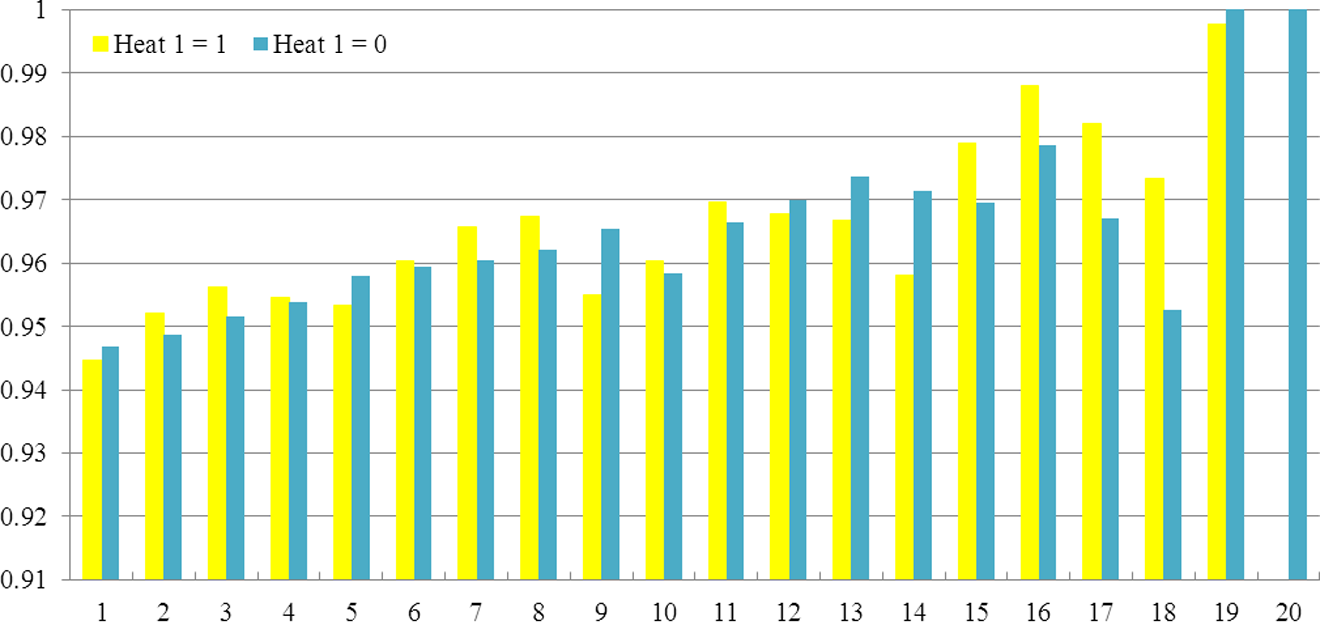
Relative effort (PB/Time) by heat and prerace rank.
In addition to looking at effort and time, it is important to examine the relationship between the probability of qualification and heat (Figure 4).
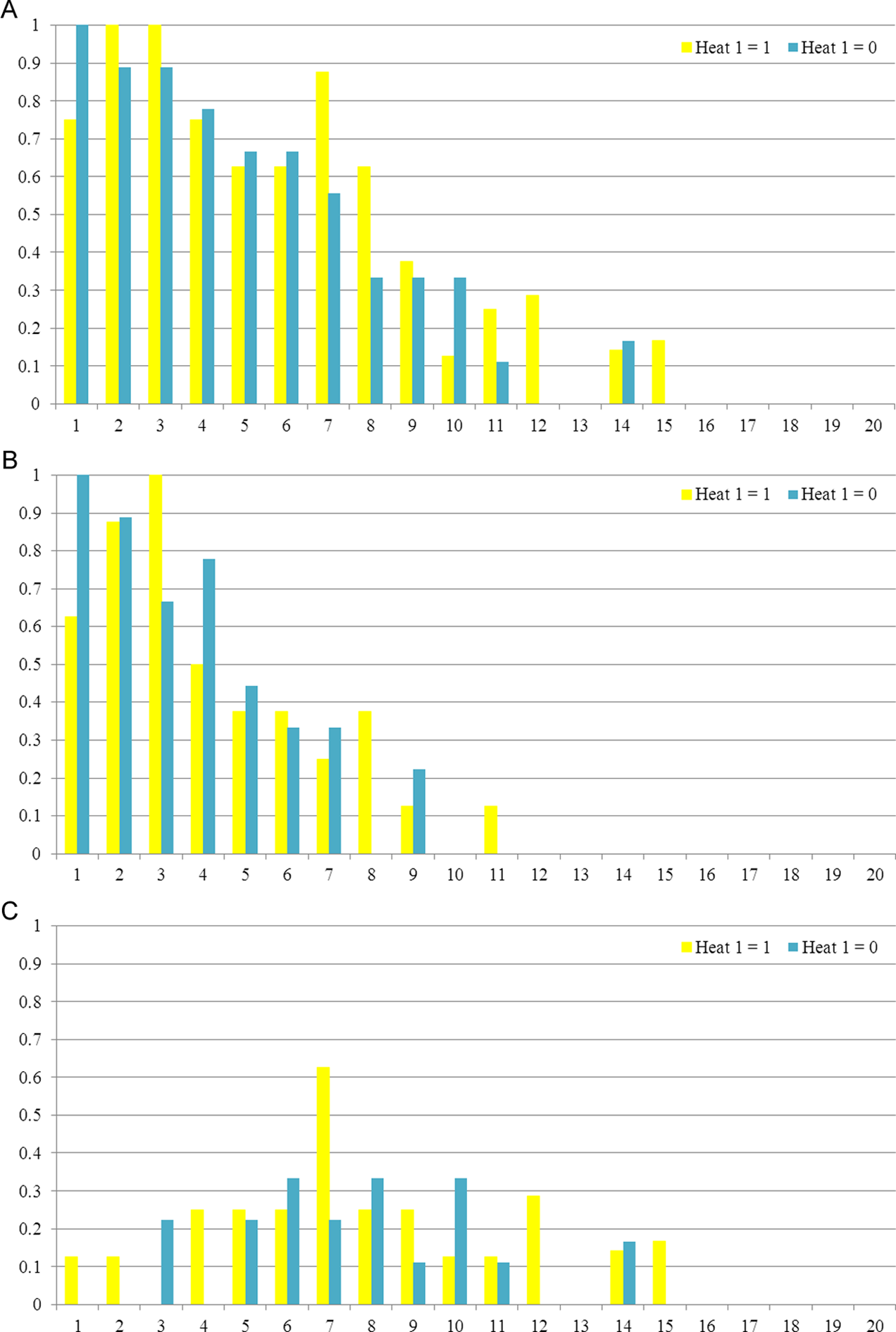
A. Probability of qualification by heat and prerace rank. B. Probability of place qualification by heat and prerace rank. C. Probability of time qualification by heat and prerace rank.
Econometric Strategy
Building upon the predictions from theoretical models, the primary interest of this article is to empirically estimate how an individual’s performance in a 5,000-m race is affected by the timing of an individual’s heat and by peer effects, both within heat and across heats during a given year. To examine this, the following estimating equation is proposed:
Performanceihy
is measured using a runner’s time, as described in Table 2. Abilityi
is a measure of runner i’s ability and
The Heat 1 dummy variable is included because of the hypothesis that runners behave differently with different information, or across heats. Additional variables are needed to control aspects of the races that may vary across time, but not across heats, such as weather. For this reason, the year dummy variables are included. Finally, runners in Heat 1 during a given year might face common shocks, such as strategic interaction, that vary across years, so a set of interacted heat and year dummy variables are included to control for specific heats.
Before estimation, some important econometric issues need to be addressed. As is well known in the literature estimating peer effects, some difficulties exist when attempting to identify causal peer effects, particularly when nonrandom assignment of peers occurs. In Equation 1, Performanceihy
and
Another potential solution to the problem is to regress a runner’s time on a measure of peer quality, or ability, rather than on other runners’ times (Ammermueller & Pischke, 2009). Because the measure of peer ability is determined prior to the race, the variables will not experience common shocks. This leads to estimation of the following form
where
Another important econometric issue is the clustering of the data. Because runners in a specific heat are behaving strategically, their outcomes are correlated. In addition, clustering of standard errors is appropriate given runners are competing under similar conditions, such as weather and time of day. If this correlation is not taken into consideration, then the standard errors will be incorrectly estimated. As a result, models are estimated using standard errors clustered by heat.
Performance Results
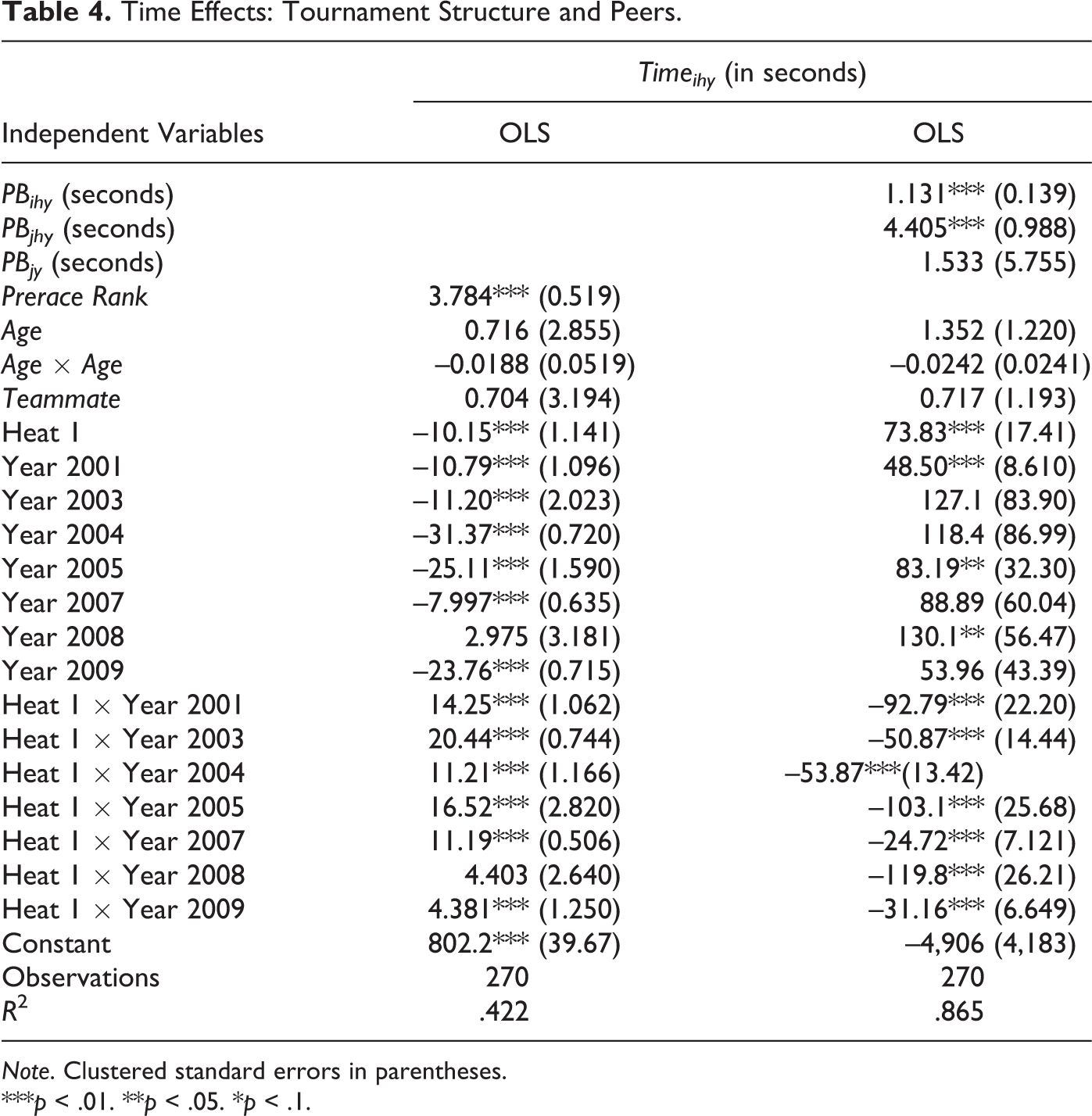
Table 4 provides baseline ordinary least squares (OLS) regression estimates of Equation 2 where heat-specific fixed effects are included and the peer effects occur through competitors’ abilities. Results are presented using time as the measure of performance. 13 In addition, a runner’s ability is measured using personal best times and a ranking of personal best times (prerace rank). 14
Time Effects: Tournament Structure and Peers.
Note. Clustered standard errors in parentheses.
***p < .01. **p < .05. *p < .1.
Before discussing specific results, some general results are worth noting. First, the runner’s ability, measured either with personal best time or ranking, is positively associated with the runner’s time. Second, the average personal best of a runner’s within-heat peers is positively correlated with a runner’s time. Finally, while there is not a consistent Heat 1 effect across years, heat-specific fixed effects are important in determining a runner’s performance.
In both time regressions, the runner’s ability is statistically important. A one second slower best time is associated with a tournament time that is roughly one second slower, and an increase in the prerace rank of the runner is associated with a time that is almost four seconds slower. The peer effect suggests a positive correlation between a runner’s time and the runner’s within-heat peers’ average abilities. 15 A 1-s slower average personal best time of peers is associated with a time that is nearly 4.5 s slower. There does not appear to be a statistically significant across-heat, within-year peer effect.
To examine the effect of Heat 1 on a runner’s performance requires some additional discussion because of the interactions. By interacting year dummy variables and the Heat 1 dummy variable, the coefficient estimates of the interaction terms represent the extent to which the difference in performance between Heat 1 and later heats changes as the years change, all compared to the reference group 2011. The coefficient estimate on “Heat1 × Year 2009” is then interpreted as the difference in performance of being in Heat 1 versus Heat 2 in 2009 as compared to the difference in 2011. 16 The interaction coefficient estimate is statistically significant, but the direction of the relationship varies across years. As seen in Figure 5, relative to 2011, times in Heat 1 are faster on average during some years but in other years, runners run slower in Heat 1. As initially described from descriptive statistics, the performance of runners does appear to vary across heats during a given year but the pattern is not consistent across years. This indicates that some unobserved common shock within a heat is an important determinant of performance. As discussed earlier, it is possible that this unobserved determinant is the strategic interaction that occurs during the race. While the subtle difference between peer effects and strategic interaction is difficult to disentangle, the inclusion of the peer abilities variable best represents peer effects and the strategic interactions are most likely part of the unobserved heat effect. As described in Brown and Minor (2011), it is also possible that a first heat that is run at a slow (fast) pace, which increases (decreases) the likelihood that lower skilled runners qualify, impacts the performance in the second heat. As a result, it is not surprising that the Heat 1 effect varies across years.
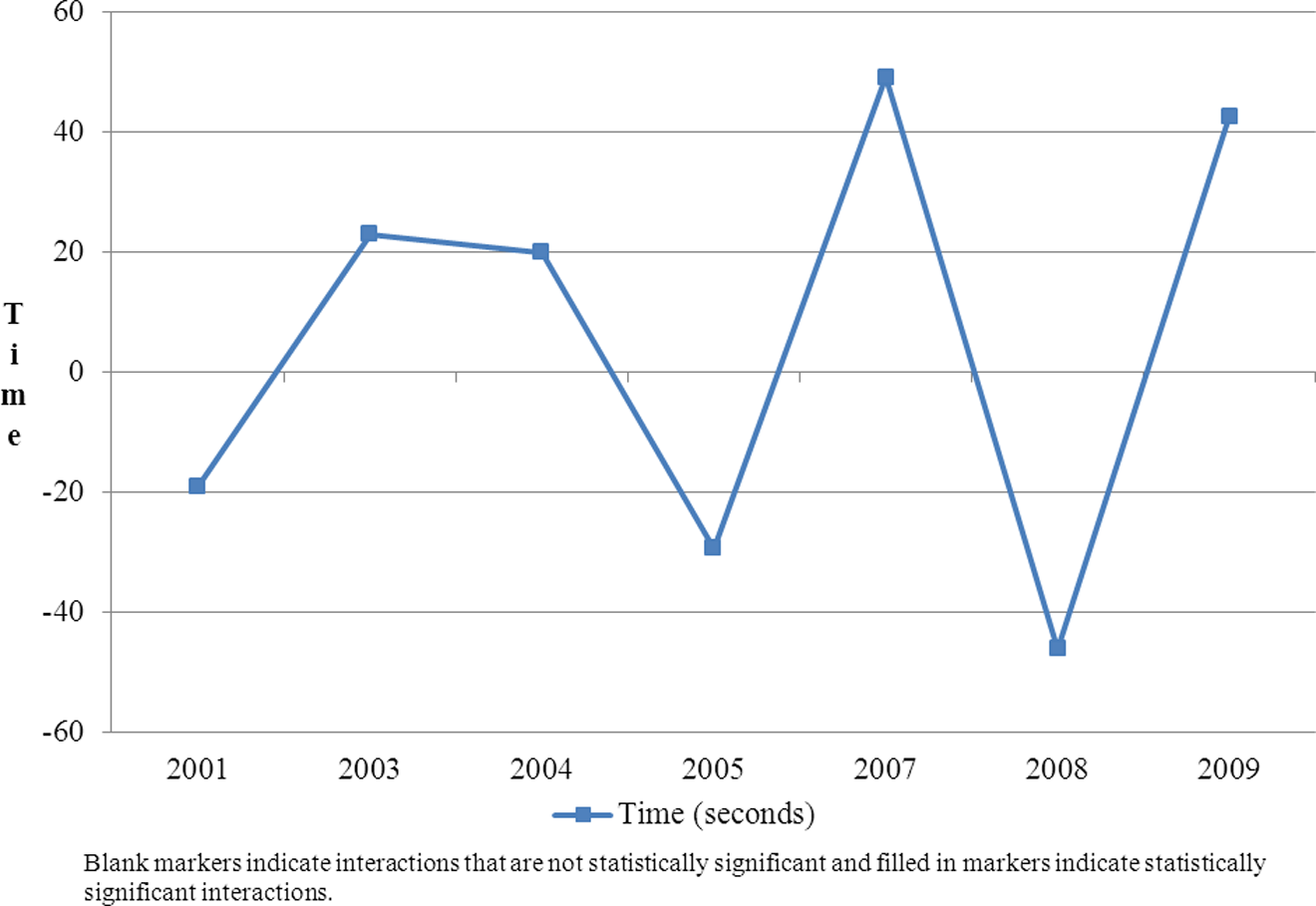
Heat 1 effect.
Qualification
To further investigate the effects of tournament structure and peer effects on runner performance, an additional investigation is considered here. Results from above suggest that a heat-specific shock may be contributing to the difference across heats. Additional models are estimated to examine the effects of tournament structure and peers on the probability of qualifying for the final. As a result, an estimation of Equation 2 is proposed with Qualihy as the dependent variable where Qualihy is a dummy variable equal to 1 if runner i in Heat h during year y qualified for the finals and 0 otherwise. Additional models separately estimate the probabilities of qualifying as a place qualifier (Place Qual) and a time qualifier (Time Qual).
Table 5 below presents probit model estimations. Several interesting results appear. First, and not surprisingly, runners with slower abilities, as measured by personal best times, have reduced probability of qualification, time qualification, and place qualification. Second, peer effects, as measured by competitors’ abilities, plays an important role in time qualification. Third, heat-specific fixed effects are also most important for qualification.
Qualification Effects: Tournament Structure and Peers.
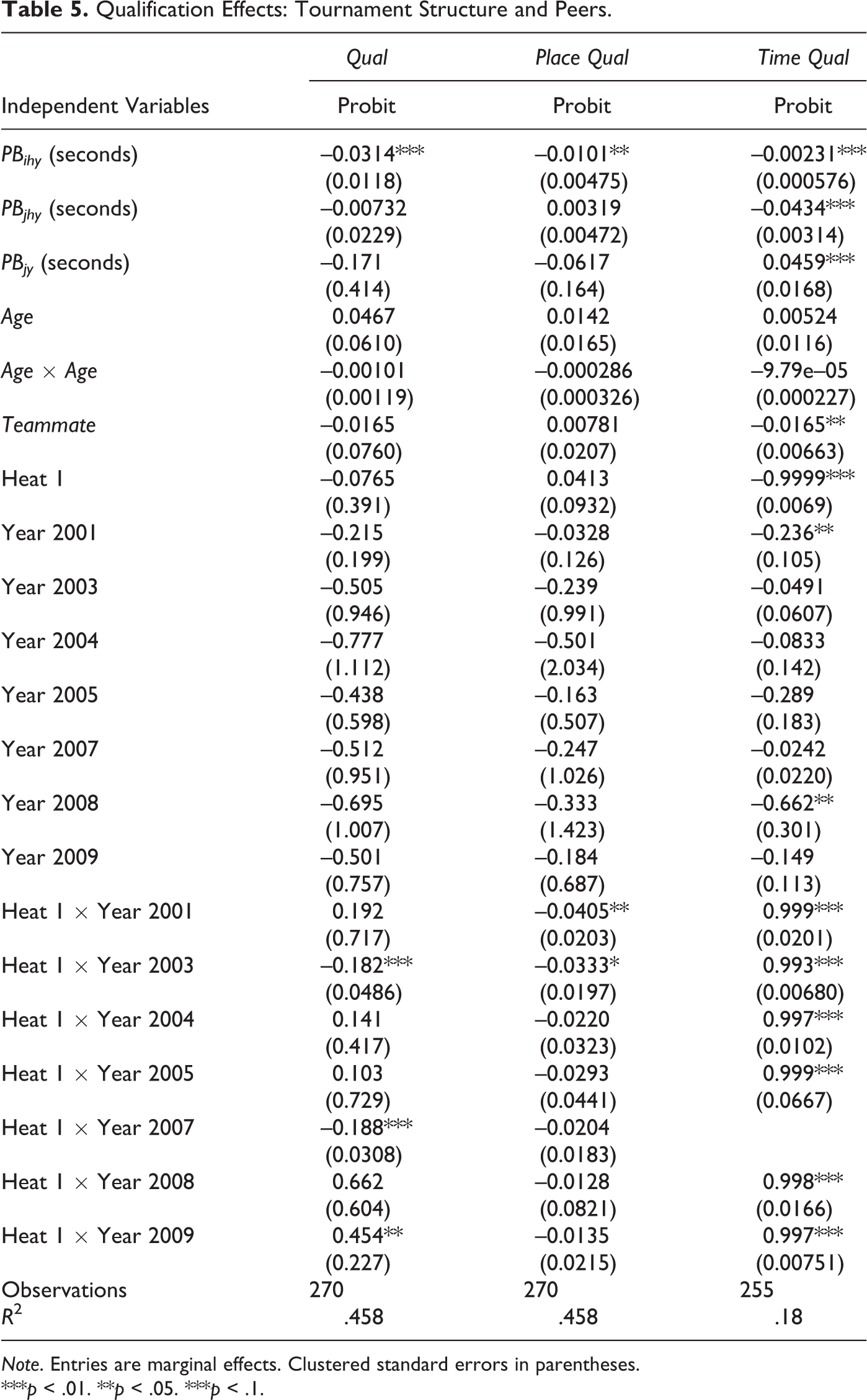
Note. Entries are marginal effects. Clustered standard errors in parentheses.
***p < .01. **p < .05. ***p < .1.
Once again, the heat in which the runner competes plays an important role, perhaps because of the strategic behavior that occurs within any given heat. Here, the coefficient estimate on “Heat1 × Year 2009” is then interpreted as the difference in probability of qualification of being in Heat 1 versus Heat 2 in 2009 as compared to the difference in 2011. 17 Similar to the effect of the heat on times, the relationship between the heat and probability of qualification, relative to 2011, varies over time as well as across type of qualification. While not all interactions are statistically significant, as seen in Figure 6, running in Heat 1 increases the probability of qualifying for 5 of the 7 years, while the other 2 years, competing after Heat 1 increases the probability. Perhaps not surprisingly, the results from the place qualification estimation indicate little evidence of strategic interaction playing a significantly different role across heats. Since the place qualification is not dependent on performance in other heats, it is not surprising that placement in a specific heat is not very important.
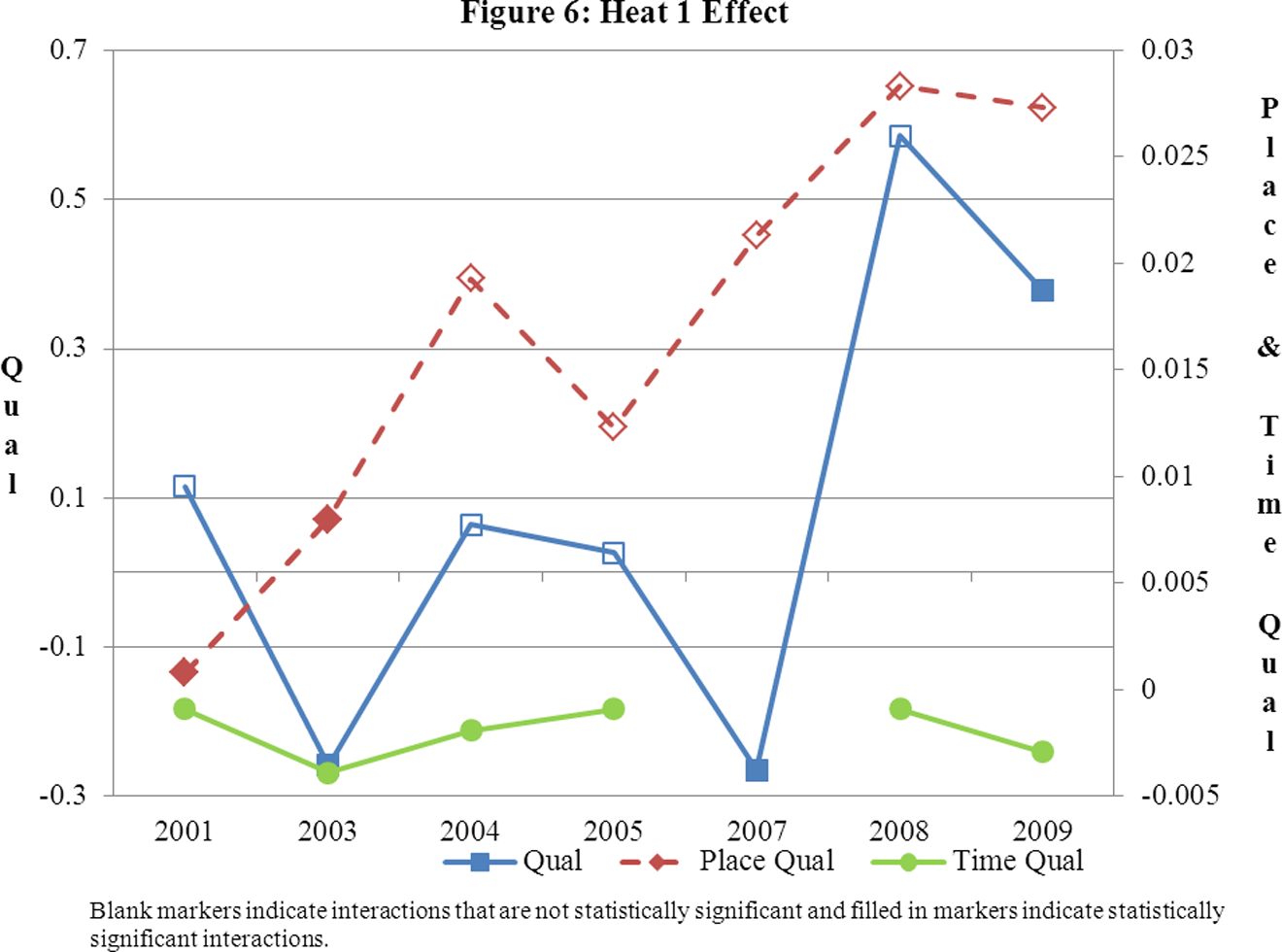
Heat 1 effect.
Some of the more interesting results are found in the time qualification model. First, a slower runner is less likely to qualify by time. Second, peer effects are important. Running in a heat with slower runners decreases the probability of qualifying by time, but the presence of slower runners in the other heats increases the probability of time qualification. As seen in Figure 6, the heat-specific fixed effect is statistically significant. Relative to the difference in 2011, runners are less likely to time qualify from Heat 1. 18
Differential Runner Effects
The final investigation here examines whether the heat effect differs according to the ability of the runner. It is possible that the heat would have the largest effect on the marginal runners. The fastest runners are likely to run a fast time and qualify regardless of their heat. The slowest runners are the ones most likely to pursue a risky strategy of very high effort in hopes of qualification. Thus, it is the marginal qualifiers who are most likely to behave strategically. To examine whether runners are affected differently, an interaction model is estimated. This involves estimations similar to Equation 2:
where yihy is either Qual or PR. The interaction Dh × PreraceRank will allow us to determine whether the heat effect differs based on runner ability. To allow for the possibility that the relationship is not strictly linear, models are also estimated with a quadratic interaction term.
Results from probit and linear probability models are included in Table 6. As seen in the first two columns of estimates, qualification probabilities are negatively correlated with rank. In addition, the probability of setting a personal record is positively correlated with rank. As seen in Table 6 and Figure 7, there does appear to be a differential effect. 19 By interacting the Heat 1 dummy variable with the prerace rank variable, the coefficient estimates of the linear interaction terms examine the relationship between the probabilities of qualification or setting a personal record in Heat 1, relative to this relationship in subsequent heats. As seen in Figure 7, faster runners are more likely to qualify from heats after Heat 1. Once the rank gets to fifth place, the probability of qualifying for the final is higher in Heat 1, but this relationship begins to deteriorate at higher rankings as seen in the quadratic estimation. Even though slower runners are more likely to qualify from Heat 1 as opposed to later heats, the probability of setting a personal best time for slower runners is higher in heats run after Heat 1. Both of these results seem to match the descriptive statistics from Figures 2 and 4.
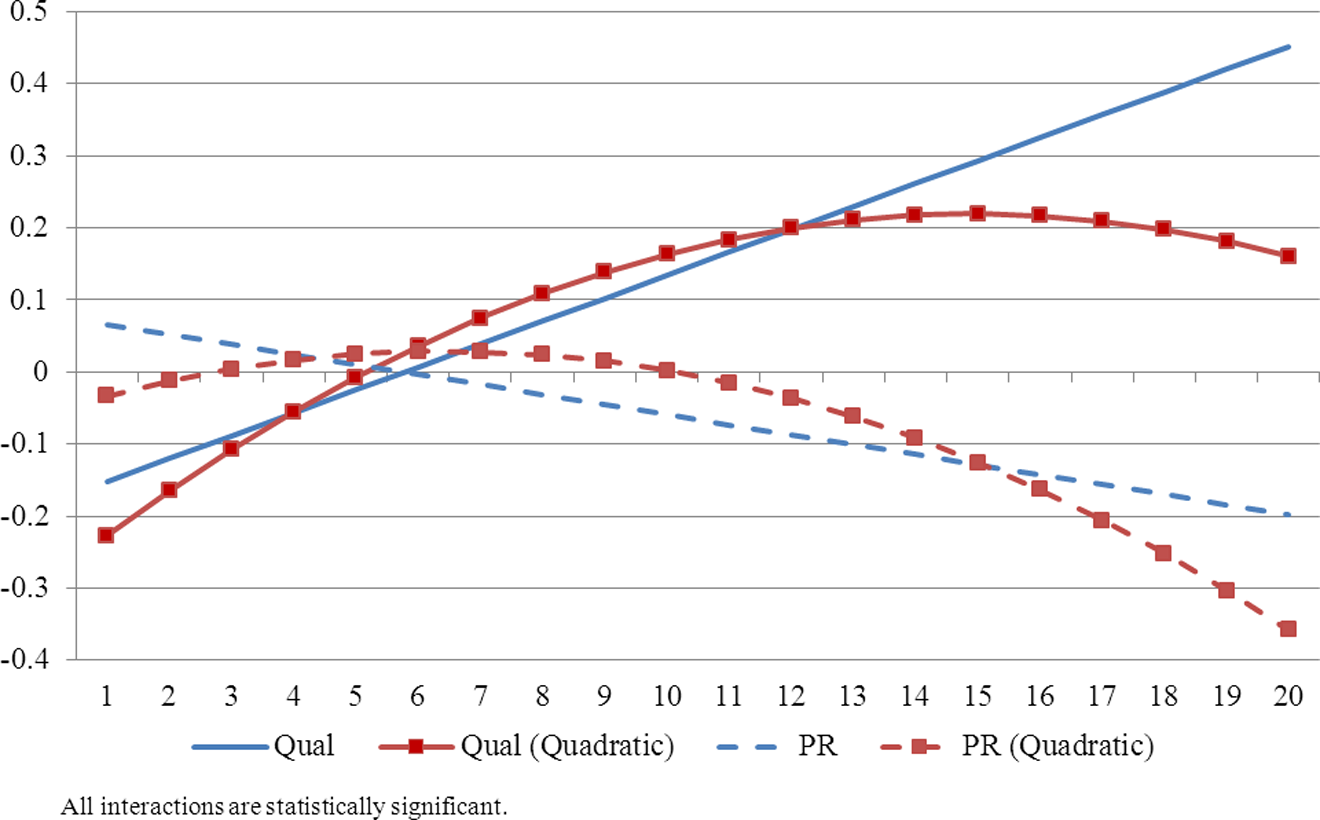
Heat 1 effect (by prerace rank).
Interaction Models.
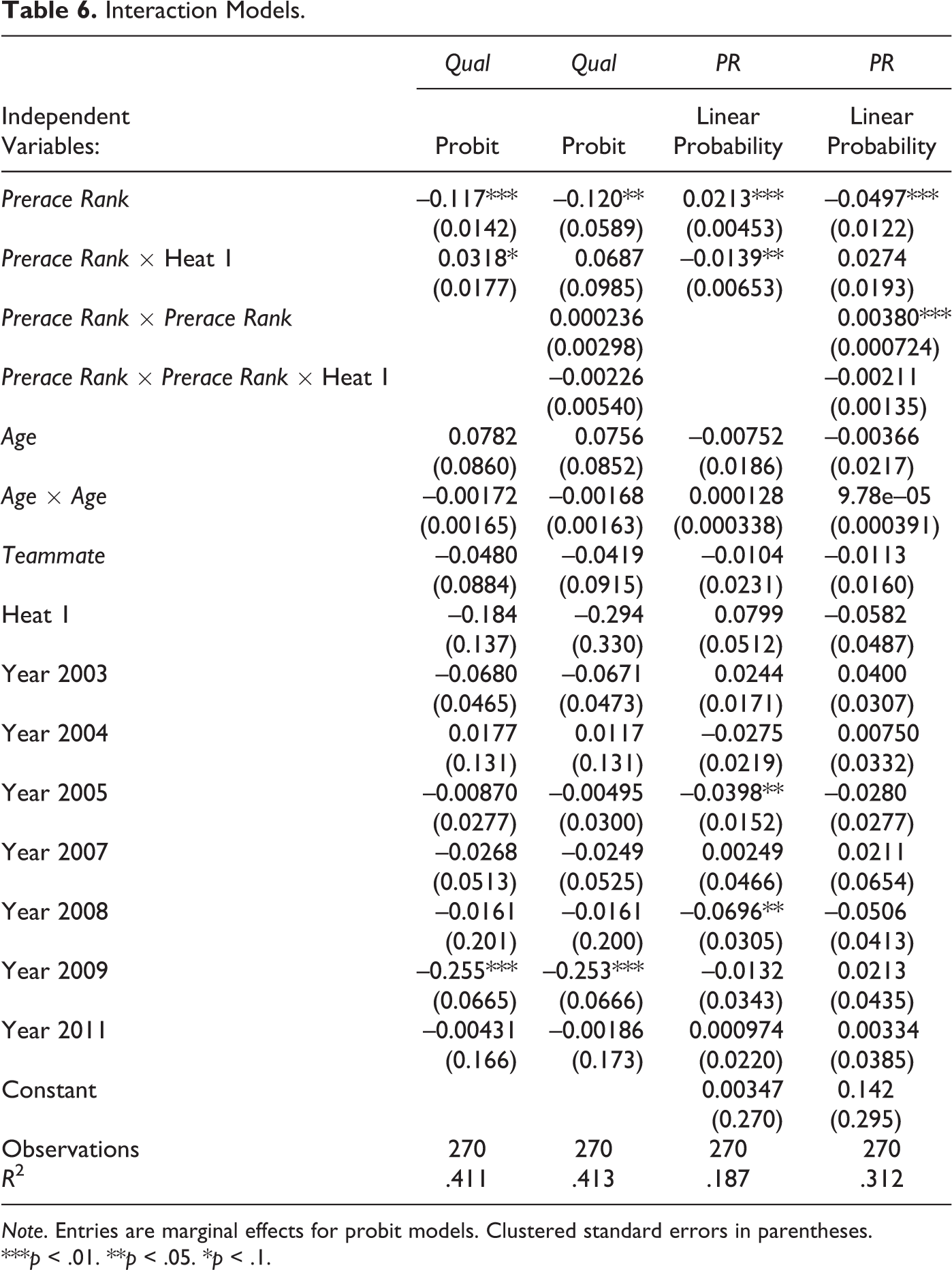
Note. Entries are marginal effects for probit models. Clustered standard errors in parentheses.
***p < .01. **p < .05. *p < .1.
Discussion
Using data on the major IAAF events from 2001-2011, this article set out to examine the effects of tournament structure and peers on individual runners’ performances in 5,000-m races. Results here indicate that the heat and peers play important roles in a runner’s performance and qualification. Results from the econometric specification indicate that the performance of runners does differ across heats during a given year, but the pattern of variation is not consistent throughout the years. This indicates that some unobserved common shock within a heat is an important determinant of performance. It is possible that this unobserved determinant is the strategic interaction that occurs during the race.
In addition to the heat-specific effects, an individual runner’s ability is the most consistent predictor of performance and qualification for the finals in a tournament. Peer effects, as measured by peer abilities, also play an important role in a runner’s performance as measured by time. Peer effects, within and across heat, are also important in determining time qualification, but not place qualification. The presence of slower ability runners in a heat decreases the likelihood that a runner will time qualify, but the presence of slower runners in the other heats increases the probability of time qualification.
The final analysis in this research considered whether the heat-specific effects differed according to a runner’s ability. It is possible that the strategic behavior of a runner differs based upon the ability of the runner. The heat-specific effects do vary based upon runner ability. Higher ability runners are more likely to qualify from heats run after Heat 1 while slower runners are more likely to qualify if located in Heat 1.
The research here is interesting for a few reasons. First, estimates of peer effects in this situation including examinations of observed peers and unobserved peers. Results here indicate that the observed peers (within heat competitors) are important and unobserved peers (across heat competitors) are not as important. While not examined here, future research might consider what is referred to as the “superstar” effect. The superstar effect is a theory which suggests that the presence of an exceptionally strong competitor in a rank-order tournament decreases the performance of other competitors. As described in Brown (2011), professional golfers’ scores were consistently higher (nearly 1 stroke) in tournaments during which Tiger Woods entered while playing well. Additional research might consider what impact a superstar (both within and across heat) may have on performance and qualification in track and field tournaments.
Another reason this research is of interest is because of the sequential nature of the tournament. Tournament theory has shown that sequential games can stimulate competition (Jost & Kräkel, 2005). While results here do indicate a heat-specific fixed effect, the results here do not support the hypothesis that there is a first mover advantage or disadvantage in the sequential tournament. The results from the heat-specific fixed effects might lead to speculation that strategic interaction occurs within any given heat, but the strategic behavior in Heat 1 is not consistent across time. It appears that the strategic interaction sometimes causes the first heat to be run at a relative fast pace while other times the strategic interaction within a heat causes subsequent heats to be faster. The sequential nature does appear to affect different ability runners differently. Slower runners have a better chance of qualification if they run in Heat 1, but they have a better chance of setting a personal record if they run after Heat 1. Slower runners are expected to take on riskier strategies, so these results are not necessarily surprising.
Footnotes
Declaration of Conflicting Interests
The author declared no potential conflicts of interest with respect to the research, authorship, and/or publication of this article.
Funding
The author received no financial support for the research, authorship, and/or publication of this article.