







Abstract
Without dealing with the pure juridical discussions and arguments about a sports league as a single entity, I discuss only the economic consequences of the single entity idea, which I consider only as an attempt to shun North American antitrust laws or E.U. competition laws, in order to monopolize the product market, the player labor market, and the media markets. However, economists know that monopolies are reducing welfare. So who needs that single entity?
Introduction
In his well-known article in the Quarterly Journal of Economics, “The Peculiar Economics of Professional Sports,” Neale (1964) wrote that sports teams produce an indivisible product from the separate processes of two or more firms, which he called the inverted joint product. This is the opposite of joint production where one single production process in a firm has two production outputs.
Indeed, one team (firm) cannot produce the product that is a game or a championship. Furthermore, some cooperation between teams is necessary to organize a game or the championship. So, the argument goes, not the team but the league is the firm; it’s a natural monopoly.
This idea of a single entity league did not meet with general agreement among economists, to say the least. Justifying the single entity status of a league based only on Neale’s peculiar economics is overhasty and jumping to conclusions (see Haddock, Jacobi, & Sag, 2013; Roberts, 1984). It can only justify a joint venture of independent firms. Notwithstanding Neale’s peculiarities of the industry, the team is still the firm, and the U.S. antitrust laws and E.U. competition laws also apply to professional sports leagues. To quote the famous National Football League (NFL) commissioner Pete Rozelle: “Every league action, and every league decision, can be characterized as an antitrust issue.”
In this contribution, we will not deal with the juridical discussions and arguments regarding the single entity idea of a sports league, we will only concentrate on the economic consequences.
A Pretext to Create Monopolies
In our opinion, the single entity idea is just an attempt to shun North American antitrust laws or EU competition laws and to create unnecessary monopolies in almost every possible market in the sports industry. Economic theory shows that monopolies cause welfare losses and reduce social welfare. Sports leagues only try to concentrate power in the hands of a few big shots, who also do not shrink from violating basic human rights, and from widespread corruption (see Kistner, 2012). A single entity league creates not only a monopsonistic player labor market but also local monopolies in product markets. Leagues have also monopolized the market of broadcast rights, which, in most cases, creates a monopoly on the downstream market of televised sports as well.
Monopsonistic Player Market
A single entity league creates a monopsonistic player market, where players are exploited and also not allowed to move to another team, which is a violation of the basic right of an employee to choose his employer.
The league, being the employer of all the players, who are then allocated over the teams, is the only demander on the player labor market. If the monopoly league is a nondiscriminating profit maximizer, it is facing an upward-sloping market supply curve of talent, in setting the wage level that maximizes profits.
Starting from the following single-league revenue and cost functions:

Because the league is the sole demander of playing talent, it faces the market supply of talent which is an upward sloping function of the salary level:
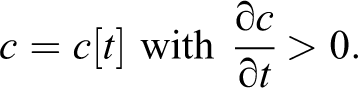
In a profit-maximizing league, the optimality condition states that playing talent is hired until marginal revenue equals marginal cost (MC), the optimality condition can be written as:

This can be illustrated graphically. This single employer and demander of talent are facing the market supply of talent, which is upward sloping, as shown in Figure 1. Given that the demand for talent of a profit maximizer is determined by the marginal revenue curve MR, talent will be hired until marginal revenue equals MC. If a monopsonist wants to hire one more talent, he has to pay a higher salary to that extra talent because the market supply curve is upward sloping. But in case of nondiscrimination, that same higher salary level has to be paid to all talents that were previously hired. This will increase the MC of talent by much more than just the salary of the extra playing talent. As a consequence, the MC of talent can be represented in Figure 1 by an upward sloping curve, above and steeper than the market supply curve. Equalizing MR and MC, a profit maximizer will hire
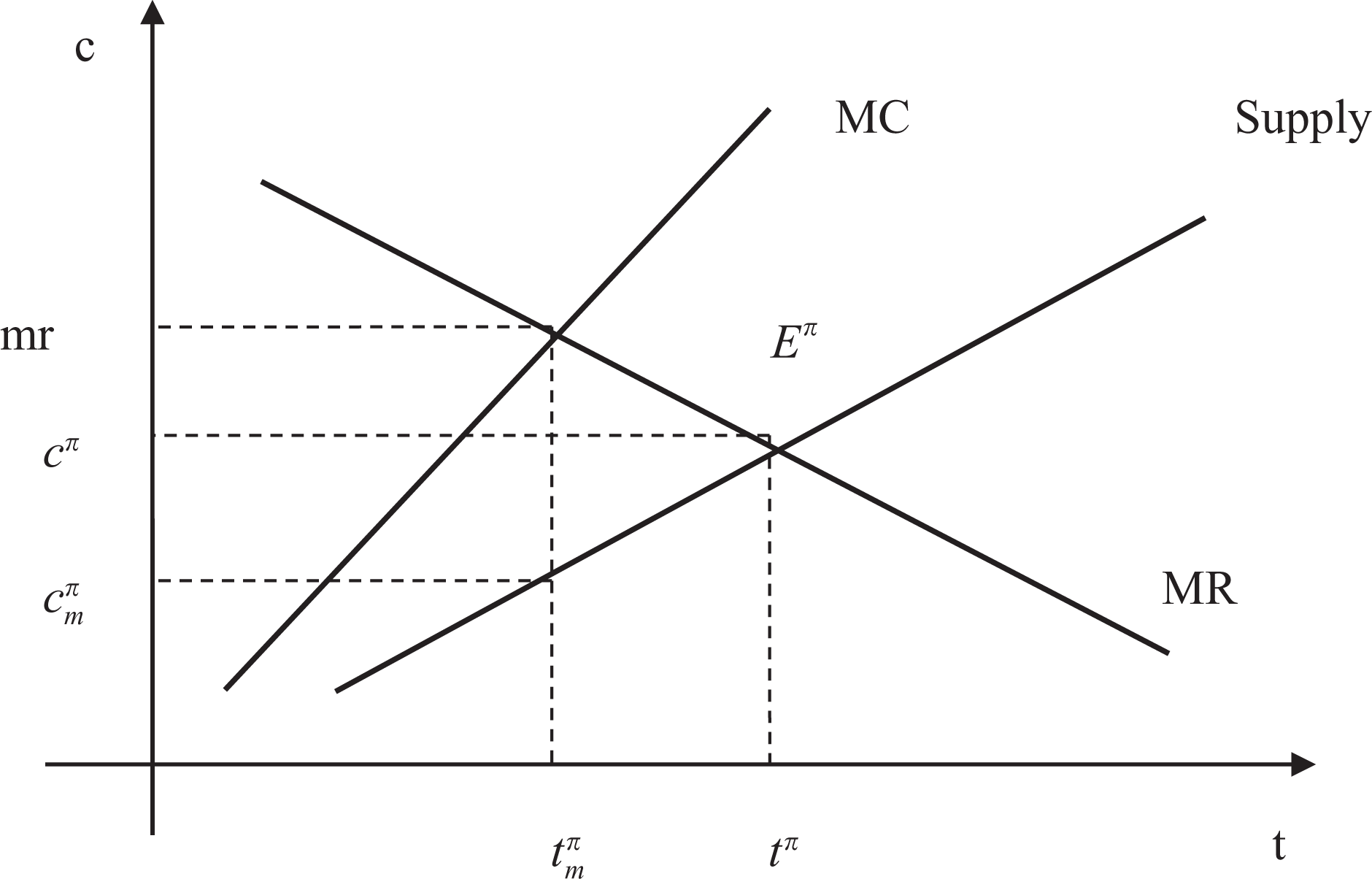
Monopsony under profit maximization.
If the single-entity league is not interested in maximizing profits but in maximizing league quality; that is, the league’s aim is to maximize its total playing talents under the breakeven constraint, it will not exploit, but rather overpay players. Given the breakeven constraint
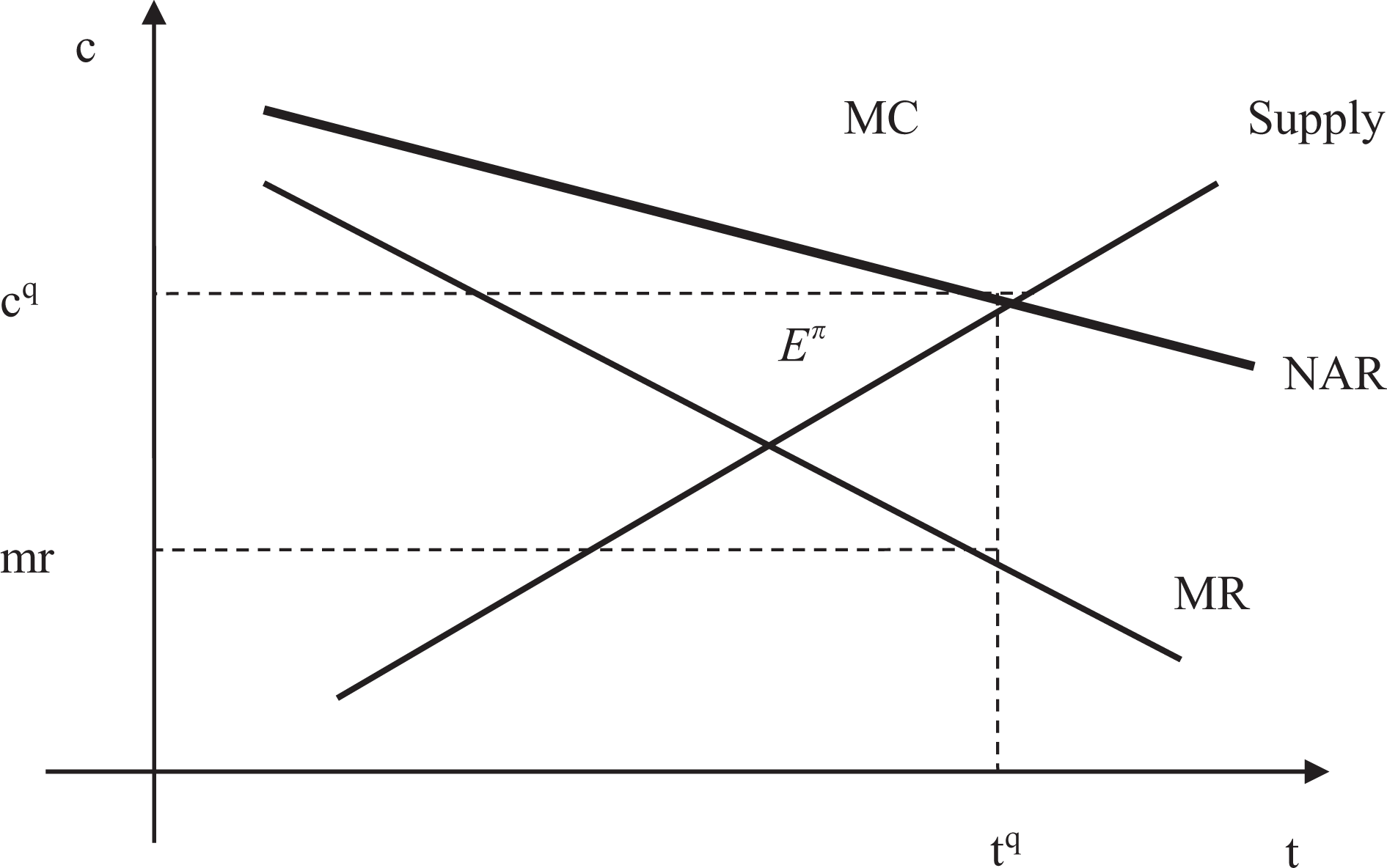
Monopsony under quality maximization.
Local Monopolies in the Product Market
Not only are players not allowed to play for the team of their choice, also teams are not allowed to move to another town by the league’s franchise relocation restrictions. It follows that, in the absence of promotion and relegation in a closed league, local monopolies are created where ticket prices can be set above welfare optimal levels.
As every introductory economics course shows, a monopolist charges a higher price compared with the competitive price in a free market. This is shown in the well-known Figure 3, where the profit-maximizing monopoly price p1 is much higher than the competitive price p2, reducing also the number of spectators from q2 to q1.
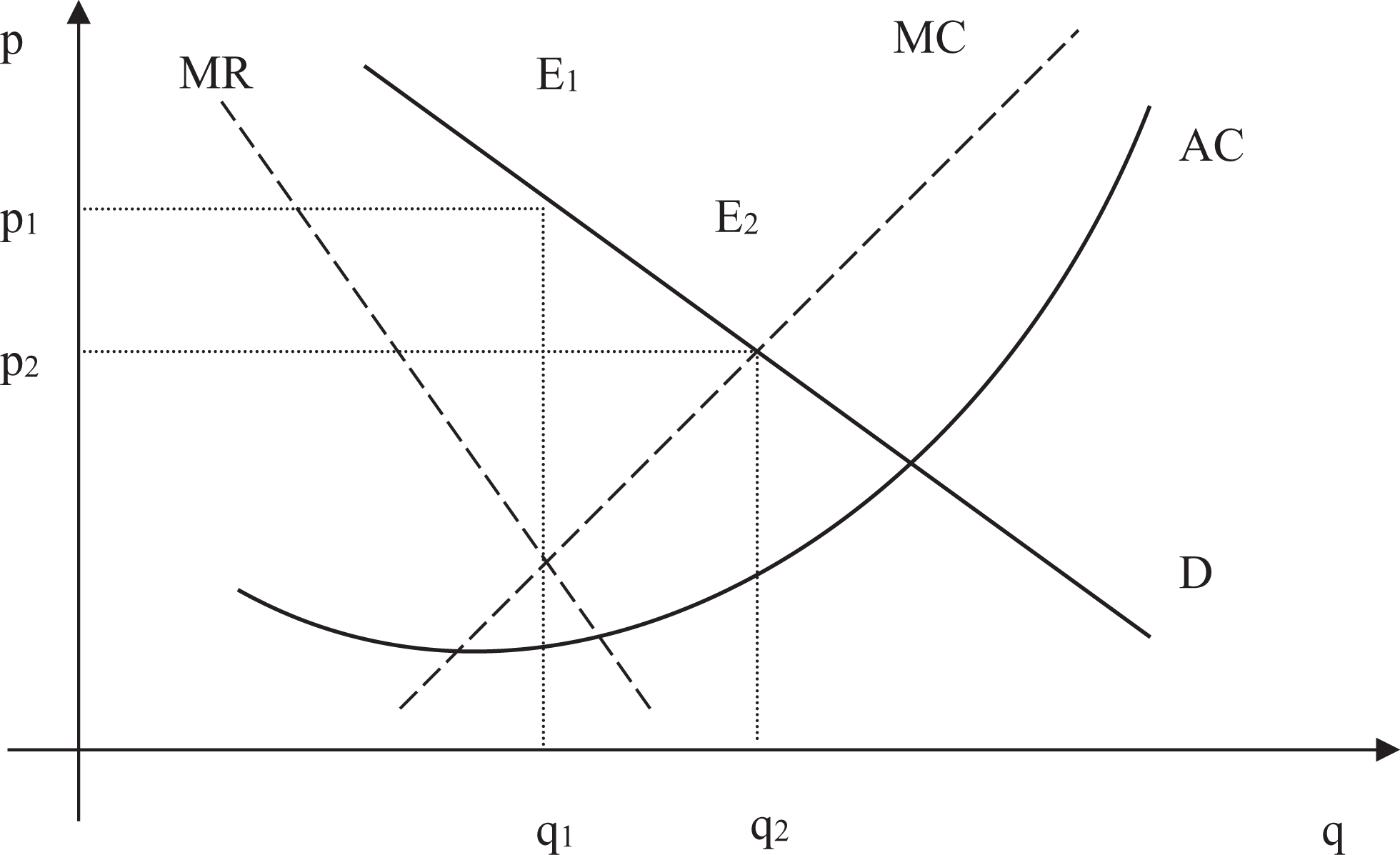
Monopoly price setting.
It goes without saying that this practice is not advantageous to spectators. Furthermore, the franchise relocation restrictions also create dynasties; that is, teams in large markets that have a permanent advantage over teams in smaller markets.
An unbalanced between-season competition, where always the same teams end on top, year after year, is not what most sports fans prefer, as shown by Krautmann and Hadley (2004) among others.
Nonoptimal League Size
The monopolization is not the only malpractice of the single-entity league on the product market. The league will also limit the number of teams that can enter the product market. In its decision about league size, it will defend the interests of the insider teams who try to keep the outsiders at bay. In particular, if revenues are shared among teams, the insiders prefer a lower number of teams (see Noll, 2003). Kahn (2007) concludes from his analysis that the welfare optimum will be closer to the free market equilibrium than to the monopoly league’s decision about the league size. Because each supporter wants to watch his home team playing in the highest division, it is obvious that it will please more spectators if more teams enter the top division.
A simple model can show that, even without revenue sharing, the league size, as decided by the league as a group of insider teams, is much lower than the optimal league size.
Assume the following linear demand function for the league championship:

So, the optimal price is
So, total revenue is

A crucial variable in this revenue function is the quality of the league. We assume that the quality depends on both the number of teams in the league and the number of talents:

The impact of the number of teams in the league has a positive but decreasing marginal affect on quality because more teams, and therefore, also more players, will lower the average quality of the teams.
The number of teams that maximize the share of every insider team, given a fixed MC c of an extra team in the league, is found by the maximization of
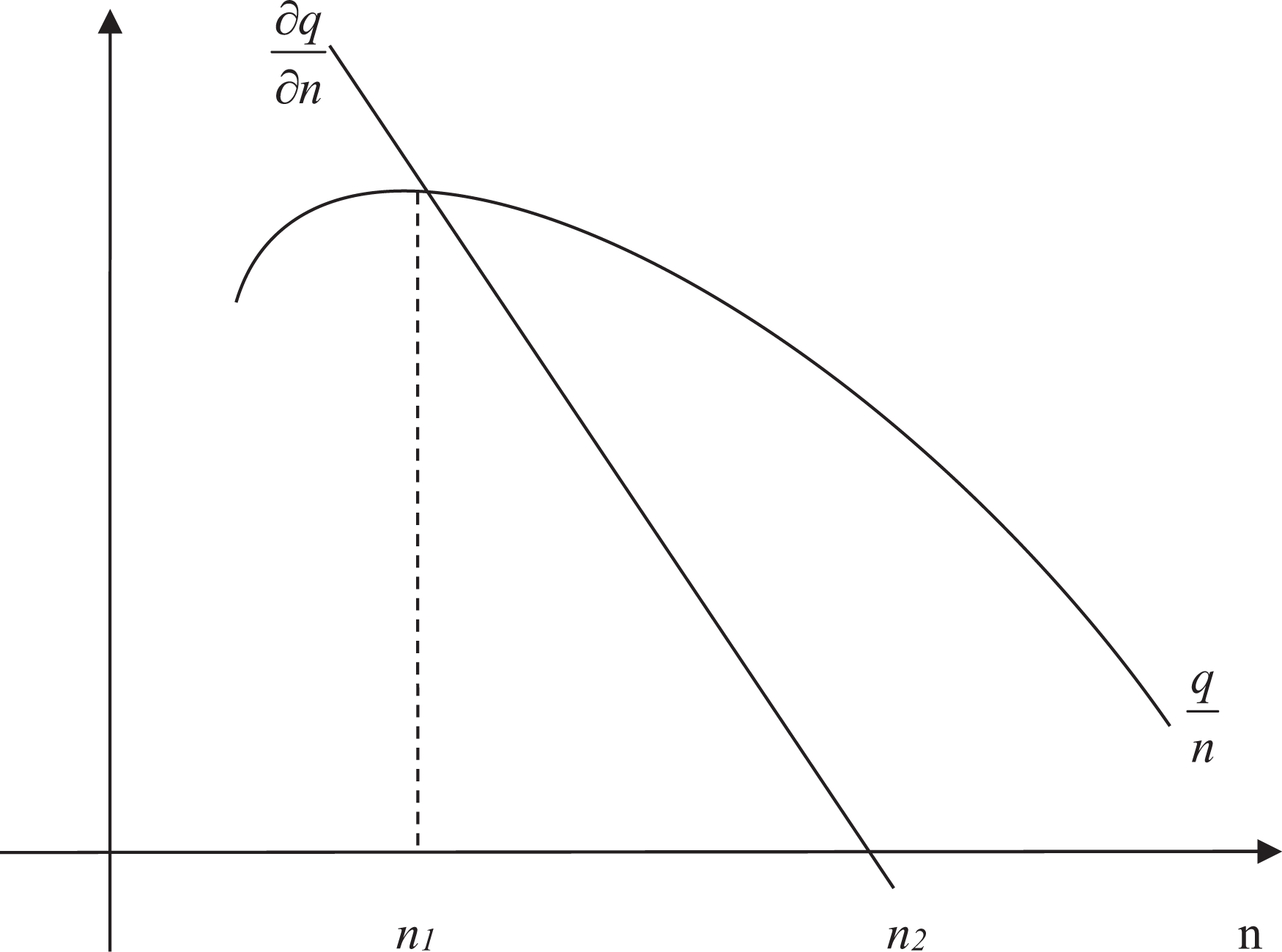
The optimal league size.
However, in this approach, only the interests of the insider teams are taken into account, neglecting the interests of the outsider teams, as well as the spectators’ preferences.
The optimal league size from a more welfare-economic approach can be found where the sum of total league revenue (3) and the consumer surplus
Unnecessary Monopolies in Media Markets
In most countries on both sides of the Atlantic, sports leagues, also without a single entity status, are monopolizing the market of television rights. Whereas the sale of broadcast rights can also be left to the individual teams in a more competitive market, the monopolization is the only choice in a single-entity league. This way, the rights of all championship games are sold collectively by the league to the highest bidding television channel that gets the exclusive rights to broadcast the games. So, the monopolization of the market of broadcast rights creates another monopoly in the downstream market of televised sport. Again, the disadvantages of these monopolizations for the TV spectators are obvious: They have to pay too high a price for watching the games on television, and the supply of televised games is reduced in order to maximize profits.
The arguments to justify the monopolization of media markets are that more broadcast money can be collected by the league and that a reasonable competitive balance is necessary to keep spectators interested in the championship. If the first argument can be correct, the second is false.
It can indeed be expected that the monopolization of the broadcast rights by the league will raise more money than the decentralized sale of the broadcast rights by the individual teams. Also, the transaction costs of a centralized sale are lower.
The competitive-balance argument is false because the money can also be distributed if the broadcast rights are collected individually by the teams. The league should then tax the individual broadcast revenues of the teams and redistribute the money among all teams. It is not the way the broadcast money is collected that affects the competitive balance, it is the way the TV money is distributed. An empirical analysis by Peeters (2011) for European football shows that there is no connection between competitive balance in the European national football leaguess and the collective or individual selling of the broadcast rights. Kesenne (2009), starting from a theoretical Nash equilibrium model, shows that the individual selling of broadcast rights and a performance-related redistribution of the money offers the best guarantee to improve competitive balance in a profit-maximization league. In a win-maximization league, the best arrangement is the individual selling of the broadcast rights and equal sharing of the rights (see Kesenne, 2015).
Conclusion
The single entity status of a league has nothing but undesirable consequences, in particular for supporters and players. Only to the extent that the sports industry is somewhat peculiar, cooperation between the clubs (the firms), which is forbidden in other industries, can be allowed. But all unnecessary monopolies that sports leagues have created should be forbidden.
A recent decision of the U.S. Supreme Court, called “American Needle Inc. vs. NFL,” might have signed the end of the single entity view of a sports league. NFL teams are not only sporting competitors but also competitors to attract fans. On May 24, 2010, the Supreme Court unanimously reversed a decision of the U.S. Court of Appeals for the Seventh Circuit that held that the teams of the NFL were a “single entity” exempt from the first section of the Sherman Act. NFL had collectively licensed their intellectual property to Reebok as the exclusive producer of headwear bearing the trademarks of the NFL teams. Also European courts have adopted a similar position.
Footnotes
Declaration of Conflicting Interests
The author declared no potential conflicts of interest with respect to the research, authorship, and/or publication of this article.
Funding
The author received no financial support for the research, authorship, and/or publication of this article.