







Abstract
This article shows that under certain circumstances, an increase in doping sanctions can decrease the number of participants in the competition. The model, which is based on a work of Haugen, is formulated as a two-stage game in which agents first decide whether to participate in a competition and second whether to use an illicit but effective drug when competing. If initially low sanctions are increased but do not prevent a certain overall level of doping, then the payoff for all athletes is reduced, which, in turn, reduces their willingness to participate in the competition.
Introduction
In literature it has been shown that doping constitutes a type of prisoner’s dilemma for athletes (see, e.g., Bird & Wagner, 1997; Haugen, 2004). Each athlete finds it optimal to dope to gain an advantage over the opponents, and eventually all athletes end up doped. Hence, nobody has gained an advantage, but the additional risk of being caught makes all athletes worse off than without doping. Apart from seeing this as a mechanism that explains the existence of doping, 1 one can interpret the results in the following way: It can also be in the interest of the athletes to have policies in place that prevent doping, since they are better off if nobody dopes.
This relates to one of three reasons Buechel, Emrich, and Pohlkamp (2014) mention, why it is socially desirable to reduce the extent of doping: first, doping can cause health problems for athletes. Second, athletes serve as role models, which interferes with being doped and breaking the rules of the game. And third, closely related to the former argument, sport may become uninteresting if athletes systematically violate the rules.
In this article, another negative aspect of doping lies at the center of attention: Doping can constitute an entry barrier for athletes. This is already noted in other articles (e.g., Preston and Szymanski, 2003), but there costs are the key argument: Athletes from rich countries can afford doping more easily, while athletes from poorer countries are disadvantaged due to missing money. However, even if pecuniary costs of pursuing a performance-enhancing drug are neglected, the existence and usage of doping may still keep athletes from participating in the competition. We will show that this repelling effect can even be enhanced if doping sanctions are increased mildly. This may reduce the number of competitors, which implies that either experienced high-performance athletes 2 abstain from competition or young talents decide against entering the sports.
To proof our point, we extend the performance-enhancing drug game of Haugen (2004). 3 While Haugen considers a two-player game, we generalize the competition to n players and additionally let the n agents decide simultaneously whether to enter the competition or not. Entry—or more precisely, participation—is costly since it involves training, equipment, and opportunity costs, but costs are such that each of the n agents would join a fair and clean competition. Now if doping sanctions are too low to hinder doping, the athletes’ expected payoff is already lower than in a doping-free competition (according to the prisoner’s dilemma described before). If sanctions are increased but are still too low to reduce the amount of doping substantially, the expected payoff for athletes is decreased even further since either (i) an agent does not dope but still risks losing to a doped opponent or (ii) an agent continues to dope to remain competitive but is fined higher if caught. The decreased expected payoff lowers the incentives to participate in the nonclean competition and—depending on participation costs—can detain the agents from entry.
It is intuitively clear that an athlete who declines doping is more reluctant to enter if doping is present. What might not be obvious is the fact that even if negative health effects and moral costs are neglected, low doping sanctions can still discourage the participation, and that this effect can be starker if doping sanctions are increased only mildly.
The model presented in this article constists of two stages, which are depicted in Figure 1a. In a first stage, the participation stage, the athletes decide on entering the competition. In the second stage, the competition stage (or the performance-enhancing drug game), the athletes decide on the usage of doping before competing against each other and receiving their payoffs. The model is solved backward: First, the competition stage is solved in second section. Contingent on these results, we analyze the participation decision of the agents in third section and show that increasing sanctions can reduce the number of competitors. The results and implications are then discussed in fourth section followed by the conclusion in fifth section. Deferred calculations can be found in the appendix.
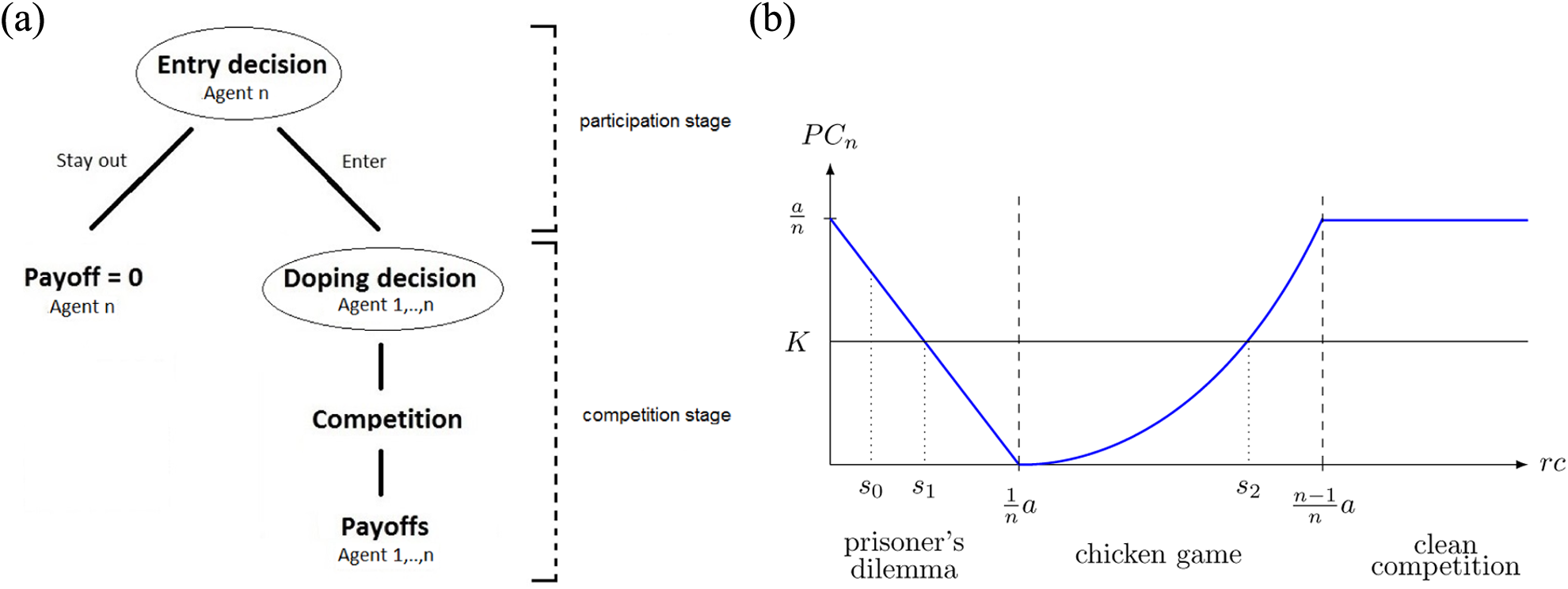
(a) Sequences of the model: The participation stage is followed by the competition stage (performance-enhancing drug game). (b) Payoff from the competition stage: The expected payoff
The Performance-Enhancing Drug Game
In Haugen (2004), the performance-enhancing drug game for two players was proposed. We first generalize the game to n players, which seems more realistic. Building on the outcome, we let the agents decide simultaneously whether to participate or not.
In the performance-enhancing drug game—to which we also refer as competition—n athletes compete against each other for a prize a. They are equally likely to win in the first place, but all of them have access to an effective performance-enhancing drug: Taking this drug—referred to as doping—ensures victory if none of the competitors takes it as well. If more than one athlete dopes, the winning probabilities of the drugged athletes are equal, while the nondrugged athletes have no chance of winning. There is also a risk involved in taking the drug: With probability r, a doped athlete is caught and fined an amount c. We refer to the quantity rc as doping sanctions.
The competition is a single shot game, that is, there is only one round played. The risk-neutral athletes decide simultaneously on whether to dope or not. Furthermore, perfect information is assumed (i.e., the agents know everything mentioned above).
For this game, the payoff structure is quite simple as the game is symmetric. Let n be the number of athletes and denote the strategies by

To solve the model, we assume that the agents choose the payoff-maximizing strategy. The assumption that athletes dope if the expected benefits exceed the costs is standard in literature (e.g., Berentsen & Lengwiler, 2004; Buechel, Emrich, & Pohlkamp, 2014; Eber, 2008; Frenger, Pitsch, & Emrich, 2011; Kirstein, 2014; Maennig, 2002). A recent article challenges the assumption that payoffs influence the doping behavior in the often claimed straightforward manner: Frenger, Pitsch, and Emrich (2012) provide evidence that the absolute value of prize money influences the doping affinity, but that the unequal payouts due to the final ranking (the so-called spreads) have no significant influence on the doping decision. However, in a simplified game-theoretic framework, it is not clear that the payoff a should be interpreted as the height of the prize spread (compared to the zero payoff in case of loosing) instead of interpreting it as the level of absolute prize money. Furthermore, the prize a does not necessarily refer to prize money only. It may be interpreted as a sum of material benefits (e.g., prize money and endorsements) and immaterial benefits (e.g., fame and prestige), which may trigger different behavior than winnings only. We therefore assume that the model at hand is a valid model for doping behavior, keeping in mind that there is research potential for more sophisticated formulations.
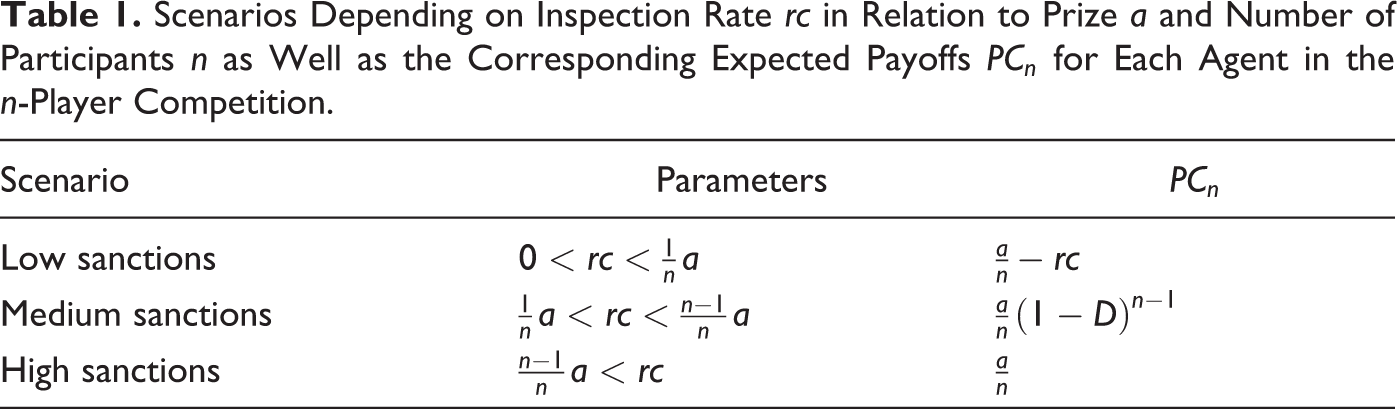
For the analysis of the competition, we distinguish three qualitatively different scenarios, depending on the sanctions rc, on the prize a, and on the number of competitors n. The scenarios are displayed in Table 1. The second column shows for which sanction levels rc the respective scenario occurs. In the third column,
Scenarios Depending on Inspection Rate rc in Relation to Prize a and Number of Participants n as Well as the Corresponding Expected Payoffs
Nash Equilibria of the Performance-Enhancing Drug Game
In this subsection, we identify the Nash equilibria of the competition. We refer to the expected payoff of agent in the Nash equilibrium of the n-player competition as
Low sanctions
It is easily seen that there exists a unique Nash equilibrium in which all agents dope (

This corresponds to a n-player prisoner’s dilemma, in which all athletes would be better off if nobody doped, but, still, the rational strategy for every agent is to use the performance-enhancing drug.
Medium sanctions
Under medium sanctions, the nature of the game changes and it does not constitute a prisoner’s dilemma any more. If all athletes dope, then all of them receive a negative expected payoff. On the other side, if nobody dopes, then there is an incentive to deviate (i.e., dope) to increase the expected payoff. The resulting game constitutes an n-player chicken game.
Assume an outcome in which k agents choose

Clearly, any k athletes can be the doping ones. The number of possible combinations is given by the binomial coefficient
These pure Nash equilibria have also been noted by Haugen, Nepusz, and Petróczi (2013). Furthermore, there exist equilibria in mixed strategies. In a mixed strategy, each agent randomizes the doping behavior, for example, the agent tosses a coin with certain probabilities for doping and not doping. We want to emphasize that there is always an equilibrium in which all players mix their strategies. This equilibrium will turn out to be the relevant one.
Let D be the probability of an agent to choose

The right-hand side yields a polynomial in D of degree
As in the mixed equilibrium the expected payoffs for doping and for not doping have to coincide (otherwise the agent would prefer the pure strategy that yields a higher payoff), we can easily derive the payoff. Assume that an agent does not dope, then the agent either receives zero payoff if any of the opponents is doped or receives

High sanctions
In this case, there exists a unique Nash equilibrium, in which all agents decline taking performance-enhancing drugs (
Fierce Competition and Equilibrium Selection for Medium Sanctions
As pointed out above, there exist several Nash equilibria for medium sanctions, which disturbs the analysis of the game. One would prefer to have a single equilibrium at hand to understand the effects of doping on the participation decisions. For the equilibrium selection, there are theoretical approaches on how to find the most reasonable equilibrium, see Harsanyi and Selten (1988) as well as experimental approaches to study which equilibrium is obtained. We quickly review some of the experimental works and then use the assumption of a fierce competition to rule out all but one equilibrium.
For medium sanctions, the structure of the game is an n-player generalization of the “chicken game” (see, e.g., Fink, Gates, & Humes, 1988). The chicken game constitutes a classical anti-coordination game, in which all players prefer a minimum number of players to cooperate, but for each player, it is optimal to not cooperate. Here, cooperating corresponds to
Some examples of empirical findings include the importance of risk attitude and framing studied by de Heus et al. (2010). The results show that players cooperate more often if the outcome of defection is presented as additional gain, but cooperate less often if the outcome of defection is presented as loss. Holm (2000) shows that in the chicken game, people, independent of their own sex, tend to behave more “hawkish” if they know that their counterpart is female. A more qualitative approach is taken by Butler, Burbank, and Chisholm (2011), who conduct an experiment with several games, among them the chicken game, and afterward interview the participants about their motives and feelings.
The question which of the equilibria is attained in the n-player drug game is closely related to the possibilities of (mis-)coordination among athletes. In experiments, there is often a coordination mechanism implemented, for example, the possibility of one- or two-way message sending (see, e.g., Bornstein & Gilula, 2003). Let us analyze whether coordination for a pure Nash equilibrium is possible in the performance-enhancing drug game and whether it is desired by the athletes.
First, note that it is very likely that the athletes can communicate with each other in some way. Athletes are familiar with their (possible) opponents and are able to deliver at least one-way messages via the media. Clearly, none of the athletes would publicly announce that he or she will dope. One could only announce to never use performance-enhancing drugs at all. The question is whether this is particularly credible. It is rather the case that all athletes claim to be clean. And even if the announcement is credible, then it is not very useful for the athlete: The chicken game structure causes the opponents to exploit that knowledge immediately. All multiple equilibria consisting of pure strategies imply that at least one athlete dopes. Hence, the athlete that stays clean and says so right from the beginning will surely lose the competition because one of the opponents will be doped. 4 Similar arguments hold true for equilibria, in which only some of the athletes mix their strategies.
What remains is the equilibrium in which all athletes mix their strategies, which builds on the assumption of fierce competition among athletes. We assume that each of the athletes is not only willing but eager to win. Their attitude is spread among competitors and via the media. Granting an opponent higher chances for winning is not an option for the athletes. The assumption excludes coordination in pure strategies as argued above and implies that an equilibrium will be attained in which all players mix. This seems reasonable not only due to the assumption of fierce competition but also due to the difficulties a large number of players would have when coordinating on any other equilibrium that favors some while disadvantaging others.
Participating in the Performance-Enhancing Drug Game
After having identified the Nash equilibria of the n-player doping game as given in Table 1, we examine the entry decision of the agents. The participation decision is modeled as a game on top of the competition, as shown in Figure 1a. An agent can decide to either participate in the competition or stay out. If the agent decides to enter, he or she has to pay entry costs
Note that in the following, we do not analyze the entire participation game in the sense that we derive and characterize all equilibira explicitly. One reason is that this cannot be done analytically since the probability D is not given in a closed form. A second reason is that the participation game can result in a chicken game structure and one would need further assumptions about which equilibrium will be attained. We avoid this since it is not required in order to derive our main result. We want to focus on the following: We show how a mild increase in doping sanctions can lead to a decreased number of athletes participating in the competition.
To this end, we assume that low doping sanctions are in place, that is,
For the participation costs K, we assume the following:

This assumption implies that all n players enter the competition under the initial sanction level rc and facilitates the presentation of the results. Since initially low sanctions are in place, the competition constitutes a prisoner’s dilemma and the payoff structure of the participation game is similar to the one of the doping game. The agents can choose between participating in the competition,

Again, we search for a Nash equilibrium. From Assumption 5, it follows that
We now show that if the sanctions are increased to a certain level, participation of all n agents does not constitute a Nash equilibrium any more. More precisely, we show that if increased sanctions rc lie between the following boundaries:

then the payoff
Case A: Increased Sanctions Result in Prisoner’s Dilemma
In case the increased sanctions fulfill the following:

competition under

which implies that for the range of sanctions, the payoff is lower than the participation costs K. In particular, (
Case B: Increased Sanctions Result in Chicken Game
In case the increased sanctions fulfill the following,

the competition results in a chicken game (this is proven in the appendix). The payoff

Hence (
The two cases discussed can also be observed in Figure 1b. The thick line indicates the payoff
Results and Discussion
In the last section, we have seen that for low sanctions
Which of the possible equilibria is attained is debatable. One can argue that an equilibrium in which all agents mix their entry strategy 6 will be most likely, since it is difficult for n agents to coordinate on a pure equilibrium. In this case, the probability of entry for all agents would be less than one. This implies that well-experienced athletes (incumbents) as well as young talents (entrants) are less likely to enter the competition. On the other hand, if one thinks that a pure equilibrium is more reasonable, one can speculate about which agents would chose to stay out, for example, young talents who have not gained any experience as high-performance athletes so far or more experienced athletes. The model itself cannot answer this question, however, it is clear that in the pure equilibria the number of participants is also reduced, even with probability one.
The main driver for the result is that the increase in sanctions is not enough to avoid a certain amount of doping in the sport but punishes usage of doping more severely. Therefore, the competitors’ payoff is reduced either (i) due to higher fines when doping and being caught (Case A and partly Case B from before) or (ii) due to an increased probability of loosing if one does not dope while the opponents do (Case B).
When considering the payoff function in Figure 1b again, one sees that for sanctions
Finally, we focus on one of model features and discuss how the results are affected in a more general setting. Recall that the competition is modeled as a one-shot game. Although this is quite standard in literature (see, e.g., Berentsen, Bruegger, & Loertscher, 2008; Eber, 2008; Haugen, 2004; Ryvkin, 2013), there are some limitations to this approach. In real world, athletes are more likely to participate in a repeated game (i.e., in several competitions). However, past rounds of the doping game do not have an impact on the current round. The agents took their decisions and received their payoffs in the past, but for the current participation game formulation, their strategies are unaffected. On the other side, the doping game could be played several times after the participation decision of the agents has been taken. Considerations on the extension of the underlying doping game to a finitely or infinetely repeated game (mainly for two players but also for
Conclusions
The aim of this article is to point out the peculiar effect that increasing doping sanctions can have on the number of athletes: Increasing low doping sanctions only mildly can lower incentives to participate as high-performance athletes and can lead to fewer athletes participating in competitions. The underlying mechanism is quite intuitive: First, doping sanctions are too low to prevent doping. If then doping sanctions are increased but are still too low to hinder the prevalence of doping, the expected payoff for an athlete is reduced due to one of the following reasons: either (i) the athlete continues to dope to remain competitive but is punished more severely when being caught or (ii) the athlete does not dope but is likely to lose to a doped opponent since sanctions are too low to ensure a clean competition. This reduced payoff may fall below the participation costs, which would then keep athletes from participating in the contest. As a result, either experienced athletes turn their back to the sports or new talents decide against becoming high-performance athletes.
The model also implies that the repelling effect disappears if sanctions are increased beyond a certain threshold. In particular, if doping sanctions are sufficiently high, participating in competitions becomes more attractive for athletes again. The participation barrier for the competition is minimized if the anti-doping policies can guarantee a clean competition.
Footnotes
Appendix
Acknowledgments
The author would like to thank Wieland Müller for discussion as well as two anonymous referees for their valuable comments that have improved the article significantly.
Declaration of Conflicting Interests
The author(s) declared no potential conflicts of interest with respect to the research, authorship, and/or publication of this article.
Funding
The author(s) received no financial support for the research, authorship, and/or publication of this article.