







Abstract
We develop a theoretical model of ex post doping audits and analyze their effects on an athlete’s doping decision. In our model, the doping agency can store doping samples and retest them at a later point. We show that there is a doping minimizing storage and retesting mix for the doping agency and that storing doping samples will reduce the athletes’ doping intensity. Furthermore, there is a threshold for the agency’s antidoping budget. If the budget exceeds this threshold, inefficiencies in the antidoping battle will occur and, depending on the agency’s objective, the athletes’ doping incentives may even increase.
Keywords
In many contest-like situations such as promotion tournaments or application tests, participants have incentives to cheat. Sports provide such incentives for fraudulent behavior, especially due to the high amount of prize money and the extremely competitive environments. In the sports sector, cheating includes a wide range of illicit behaviors, including match fixing, sabotage, and doping (see, e.g., Preston & Szymanski, 2003). In this article, we will focus exclusively on doping.
Doping is an omnipresent problem. It is an issue for recreational athletes using asthma inhalators and hay fever medicine to boost their performance as well as sport superstars using sophisticated doping programs to enhance their potential even further. For athletes, doping provides a tempting opportunity to surpass their natural potential. Furthermore, doping may be a cheaper substitute for extraordinary training methods in particular cases. However, the abuse of doping bears, besides the risk of being caught, serious health side effects. By exceeding their natural physical capabilities due to doping, athletes can reach their limit of endurance and die from exhaustion during competition. For instance, the British professional cyclist Tom Simpson had overused doping and died from exhaustion. Furthermore, doping can harm the body’s own processes. Many athletes of the former German Democratic Republic (GDR), who underwent systematic government sanctioned doping died early, and many female athletes had to change their sex, as a consequence of the testosterone they consumed (see Savulescu, Foddy, & Clayton, 2004). In contrast to the benefits of doping, the side effects of doping seem to be neglected by some athletes. In a survey conducted by the American doctor Bob Goldmann with 198 U.S. athletes at Olympic level, more than half of the athletes responded yes to the question, whether they would take a drug, which will make them win in every contest in the next 5 years but will kill them after these 5 years (see Andrews, 1998).
Thus, on the one hand, doping harms the athlete’s current and prospective health and does not necessarily change the individual chances of winning if all the athletes are doped. On the other hand, doping is not accepted by society as it skews the odds of winning and may result in the wrong, that is, not the hardest working athlete, winning the competition. Over the last decades, organizations like the International Olympic Committee (IOC), national antidoping agencies, and since 1999 the World Anti-Doping Agency (WADA) have tried to restrict doping by implementing a more complex doping test system and by continually adopting new techniques to detect prohibited drugs. 1 As a consequence, many doping scandals emerged which even led to some famous athletes being convicted of doping such as Justin Gatlin and Lance Armstrong.
One piece of circumstantial evidence that finally led to Lance Armstrong’s doping conviction by the United States Anti-Doping Agency (USADA) and Union Cycliste Internationale (UCI) was the retesting in 2005 of a doping sample from his 1999 Tour de France victory. Due to technical progress, in 2005, the doping enforcers were able to prove that erthropoyetin was present in this doping sample. As a consequence of these ex post doping convictions, retesting of doping samples became more and more common. IOC’s current “Anti-Doping Rules applicable to the Olympic Games Rio 2016” explicitly state that “all samples may be stored and may be subject to further analyses at any time [.]” by either the IOC or WADA (see IOC Anti-Doping Rules for Rio 2016—Olympics).
However, how such retests might influence the interaction between athletes and doping authorities, and at which point retests should be conducted, has not been analyzed so far. The purpose of this article is to shed light on these issues. We develop a model focusing on retesting of doping samples and analyzing the effects in a professional sports environment. 2 Our model assumes that the doping agency will announce an antidoping strategy consisting of a retesting probability and a retesting point of time of existing doping samples, whereas the athlete will maximize her payoff considering this testing procedure. We will analyze the implications of such a retesting scheme and examine the effects on the athlete’s individual doping decision.
The existing economic literature on doping is spread widely. 3 Our model is related to the strand of literature that deals with antidoping strategies for doping authorities. Arguably, the closest paper to our model is Kräkel (2007), who introduces the idea of ex ante and ex post doping tests. He analyzes a contest between two athletes and the different effects of ex ante and ex post doping on the athletes’ legal effort. It is shown that ex post audits lead to lower legal effort by athletes than ex ante audits. Our article transfers the idea of ex post audits to the bilateral 4 relation between an athlete and a doping authority. Moreover, we modify the idea of ex post audits and enable the doping authority to postpone the audits to an arbitrary point after the competition and to reanalyze doping tests with state-of-the-art techniques. Similar to our article, Kirstein (2014) analyzes the influence of different audit strategies on doping incentives. In his model, the punishment of two competing athletes is not based on doping tests but on imperfect signals. He finds that the degree of compliant behavior is maximized by only charging fines if the signal implies doping abuse. In contrast to our model, it is predicted that an increase in the fine for doping will not increase doping compliance. Implicitly our article is related to Buechel, Emrich, and Pohlkamp (2014). They analyze the doping enforcement problem from a sports event organizer’s point of view and elaborate the organizer’s clash of interest in the antidoping battle. The organizer’s incentive to conduct doping tests might be biased due to spectators losing interest in the event that a doping scandal emerges. Buechel et al. (2014) suggest that establishing transparent testing schemes weakens the organizer’s conflict of interest, since it allows the spectators to express their support for doping tests. Thus, spectators are also interested in a clean sports environment and therefore advocate doping tests. Our model provides an example of how such transparent antidoping measurements could be implemented. 5
Closing the Research Gap
Although all these models use different approaches to illustrate the doping decision process, most models lead to an equilibrium with doping. This result corresponds with the abuse of doping in reality. However, doping agencies nowadays already generally store doping tests, and this has not been considered in the literature. Furthermore, the existing literature fails to explain the incentives of a doping agency to store doping samples. In our model, we allow the doping agency to postpone audits to a certain point after the competition. At the point of retesting, the doping agency is able to reopen doping samples and to analyze these tests with state-of-the-art techniques and knowledge. Technical progress will enable the doping enforcer to detect drugs that the doping authority could not prove at the time of the initial doping test.
Additionally, doping is usually defined as a drug that increases the chance of winning in a one-shot game. This approach neglects the long-term effects of doping. As long as the athlete is not convicted of doping, she will be more successful and consequently generate higher profits with doping due to her artificially enhanced skill. This holds even if the other athletes also participate in doping since she will still be more competitive in contests if she dopes rather than stays clean. In our model, the long-term effect of doping is considered to be the continuous benefits from doping. Consequently, athletes and managers have an incentive to invest in very sophisticated doping programs and to explore modern methods to disguise the signs of doping abuse. As a consequence, the doping agency might not be able to convict an athlete immediately of doping. The possibility of retesting the doping sample with more modern techniques at a later point may turn the tide in the agency’s favor. So, even if the athlete knows that the doping agency cannot prove that doping occurred with the initial test, she cannot eliminate the possibility that the drug may be detected at a later point in the second test. Since the athletes with the best results can be sure to be tested at specific events such as the Olympics or World Championships, the introduction of systematic retesting of doping samples would affect all top athletes and skew their doping decisions.
Last, in contrast to other models, we do not model doping as a binary choice but as a continuous one. The athlete does not only decide whether to dope or to stay clean, but she also decides with which intensity she dopes. 6 Although the athlete might not have the medical knowledge to estimate exactly the interdependences between her amount of doping and her performances, she can at least assume that more doping will lead to higher performance compared to a low doping intake.
Model
Consider a situation where first a doping agency announces its antidoping strategy and second an athlete reacts according to this announcement. The aim of the doping agency is to minimize the extent of doping, while the athlete tries to maximize her payoff. For the sake of simplicity and because it is not the focus of our model, we will exclude a doping test immediately after the competition from modeling. 7 We assume that some drugs cannot be discovered today, but that they may be discovered in future, given the technological advance in testing technology. Thus, the doping agency stores the doping samples and will test them again at some point T in the future with probability q. The athlete is able to drug herself to improve her performance. Doping is a continuous variable, reflecting the athlete’s doping intensity, which will be denoted by x.
Figure 1 shows the order of decisions in the model. The model consists of two stages: The doping agency sets and announces T and q. The athlete chooses the doping level x.

Stages of the model.
We assume that the probability p(x, T) of detecting a doped athlete increases with the doping intensity x and with the time of retesting T. Obviously, the higher the drug intake, the easier it is to detect the drug. Regarding T, the longer the agency is willing to wait, the better the drug detection technology will be and so the higher the probability of being tested positive.
For the sake of simplicity and tractability, we will assume that both effects of the doping intensity x and the time of retesting T on the probability p(x, T) are linear:

where γ is the athlete’s maximum possible doping intake and β is the period of time it will take for all necessary technical advances in doping detection to occur. Consequently, the smaller the β, the faster the retest validity will increase. We assume γ, β > 0 and

Obviously, if either the doping intensity or the storage time is zero, the doping test will be negative. On the other hand, if the athlete takes the maximum amount of doping and the agency postpones the retest until all technical progress took place, that is, γ = x, β = T, the retest will be positive with probability 1. In all other cases, retests will not necessarily convict a doped athlete.
We solve the model by backward induction. In the second stage, the athlete selects her expected profit-maximizing doping intensity, taking the doping agency’s antidoping strategy into account. Doping will increase her expected profit due to greater success in contests and higher sponsorship. α denotes the athlete’s doping efficiency parameter. When α increases, the gains from doping are higher. On the other hand, the abuse of doping opens up the possibility of being convicted of doping and being punished with a fine F. The athlete’s continuous discounting rate is denoted by r. The athlete’s profit function is given by:
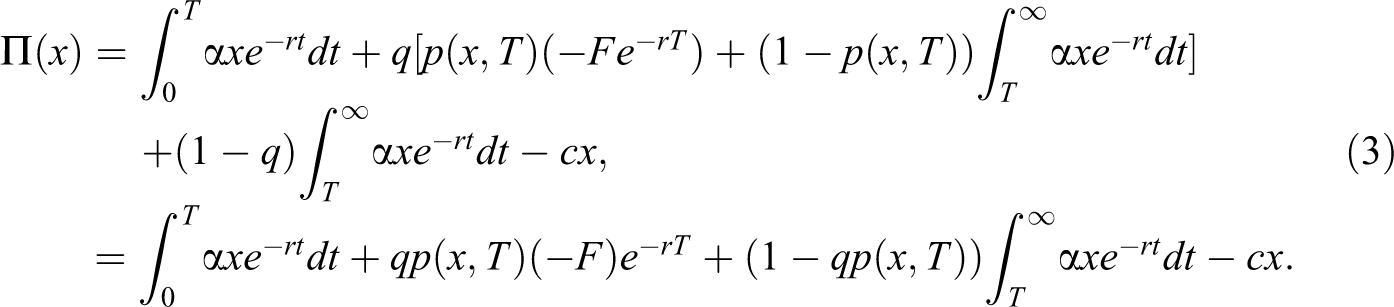
The first term denotes the athlete’s profit before the doping test at T which increases with the doping intensity x and the exogenous doping efficiency parameter α. If the athlete is tested positive with a probability p(x, T), she has to pay a fine F and will not receive any further profits due to her damaged reputation. This case is illustrated in the second term. If the athlete is tested negatively
Rearranging of the athlete’s profit equation (3) yields the following:

The athlete will maximize her expected profit with respect to her doping intensity x. The maximization approach yields:

Equation 5 characterizes the athlete’s profit-maximizing doping intensity considering the agency’s choice of T and q.
The necessary condition to make the athlete use doping is illustrated by the following equation:

Only if the expected gain from doping is greater than the doping costs, that is, the perpetuity of all doping gains overcompensates the costs of doping, does the athlete have an incentive to dope.
For reasons of clarity, we will abbreviate the necessary condition and the factor

Consequently, the athlete’s reaction function can be written as:

The sufficient condition for doping abuse is shown in the following equation:

The fine for doping F in relation to the doping efficiency α must be sufficiently small to induce doping. Obviously, if the fine is very high and the benefits of doping are very small, the athlete will have no incentive to dope. Vice versa, if the benefit from doping is relatively high compared to the fine, the athlete will have incentives to abuse doping. For our further calculations, we assume that equations (6) and (9) hold.
Given the athlete’s reaction function, the agency aims to minimize the athlete’s doping incentives in the first stage of the model. The agency faces an exogenous budget constraint and has to split this limited budget M, M > 0, between the cost of retesting samples k1 at point T and the costs of storing doping samples k2 which accrue during the period from 0 to T. We assume k1 > 0 and k2 > 0. Algebraically, the agency’s minimization problem is characterized by:

The agency minimizes the doping intensity x with respect to q and T subject to its budget constraint. The agency discounts its costs continuously with the discount rate r. Rearranging the budget constraint with respect to q yields:

After inserting Equation 11 in Equation 8, we obtain x as a function of the agency’s choice of T:

A minimizing approach of the doping intensity in Equation 12 with respect to T would not derive a specific analytical solution as a result of continuously discounting of the expected profits of the athlete. However, it is necessary to discount continuously such that the influence of the future profits on the marginal doping decision of the athlete is correctly modeled. Therefore, in order to avoid a numerical solution, we apply the first-degree Taylor approximation of e−rT to obtain a less restrictive general result. The Taylor approximation is given by

The application of Taylor’s polynomial in Equation 12 yields

After approximating e−rT by a first-degree Taylor polynomial, we try to find a minimum of x depending on T. The minimum of the above equation can be found at

which yields

The optimal doping retest point T* only depends on the overall budget M of the agency and on the periodic storage cost k2. It is easy to see, the higher the budget, the longer the agency will store doping samples. Contrary higher storing costs will reduce the storing time of doping samples. T* is independent of the doping efficiency parameter α and independent of the fine F. Furthermore, T* is also independent of the actual testing costs k1, although these costs are discounted and therefore later testing will decrease the present value of the testing cost. The rate of technical progress β has also no influence on T*.
Before inserting T* into q, we also apply the first-degree Taylor approximation of e−rT in Equation 11. The application of the Taylor polynomial yields

Next, we determine q*(T*) by inserting Equation 16 in Equation 11. q(T*) is given by

q(T*) depends on the testing cost k1, the storage cost k2, the discount rate r, and the agency’s budget M. q(T*) is independent of the athlete’s doping efficiency parameter α and is independent of the fine F. Additionally, the doping retesting probability is independent of the parameter c, β, and γ.
Given T*, we can derive the athlete’s doping intensity by inserting T* into Equation 5. We obtain

The athlete’s doping intensity decision depends on the agency’s storage and control costs and on the agency’s budget and on the fine for doping. The intensity is strictly greater zero, that is, the athlete dopes if equations (6) and (9) hold. Finally, x* and T* can be inserted in the probability function p(x, T). So, the probability function of being tested positive can be derived for further analysis. Inserting x* and T* yield

The probability of being tested positive depends on every parameter of the agency as well as on every parameter of the athlete. So, every action or change in the parameters influences the specific value of p*(x*, T*).
Comparative Statics
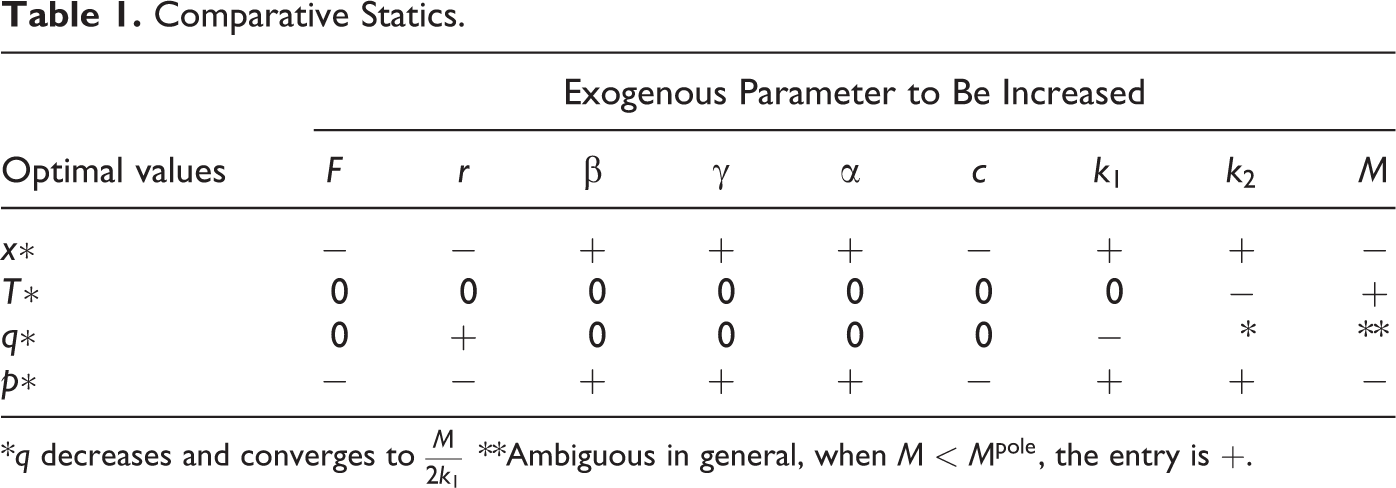
In this section, we will analyze the influence of our model’s exogenous parameters on the athlete’s doping decision and on the agency’s antidoping strategy. Table 1 summarizes the effects of changes in our exogenous parameters on our endogenous variables x*, T*, and q* and on the probability function p*(x*, T*), whereas the subsequent subsections focus on the intuition behind these effects.
Comparative Statics.
*q decreases and converges to
**Ambiguous in general, when M < Mpole, the entry is +.
Fine F
We start with the effects of an increase in the fine for doping. The result agrees with most of the results in the existing literature that a higher fine will decrease doping intensity. Obviously, getting caught will become more costly for the athlete and she will consequently reduce her doping intensity. Since a higher fine decreases x*, the probability of being tested positive p*(x*, T*) is also decreased by a higher fine. Consequently, if x* is decreased by a higher fine, p*(x*, T*) will also be decreased by an increase in the fine.
Discount Rate r
The discount rate influences x*, p*(x*, T*), and q*. First, a higher discount rate lowers x*, as the benefit of future activities is lower from a present perspective. Consequently, the discounted benefit from doping decreases, which makes doping less attractive. The effects of r on p*(x*, T*) and q* are contrary. A higher discount rate increases the retesting probability q*, since future testing will be cheaper for the doping agency. On the other hand, p*(x*, T*) decreases with r, because a higher discount rate will lower the athletes’ doping incentives and therefore lead to fewer positive doping retests.
Scale Parameters β and γ
The scale parameters β and γ both have a similar influence on the athlete’s doping intensity. An increase in either of these parameters will increase the athlete’s doping intensity. Intuitively, a higher maximum amount of doping which the athlete could take, γ, or a higher β, which represents a slower improvement of doping detection technologies, will increase the athlete’s doping intensity. In line with this result, an increase in γ or β will also increase the probability of positive tests p*(x*, T*). Obviously, a higher drug intake will lead to more positive doping tests.
Doping Efficiency α and Doping Costs c
The parameter α and c influence x and p*(x*, T*) in opposite ways. An increase in α makes doping more attractive for the athlete, since the gains of doping become higher. Therefore, an increase in α will increase x* and analogously p*(x*, T*). On the contrary, higher doping costs will obviously decrease doping incentives. Therefore, an increase in c decreases x* and p*(x*, T*).
Costs k1, k2
An increase in costs influences all endogenous variables. The influence of higher storage costs on the agency’s point of retesting T* is rather obvious. Unsurprisingly, the agency will retest the doping samples earlier since higher storage costs will make waiting more expensive. T* is not affected by an increase in retesting costs. The athlete’s doping intensity increases as both costs become higher. Higher testing costs k1 or higher storage costs k2 will make the agency reduce doping tests and the storage time. As a result of fewer and earlier doping tests, the athlete will increase her doping intensity since the probability of being caught decreases. Surprisingly, the probability of being tested positive p* increases in both costs. These results seem to be counterintuitive, as the athlete should have an advantage over the agency due to the agency’s higher costs, so the probability p* should change in the athlete’s favor. However, if testing costs k1 and storage costs k2 increase, the athlete’s doping intensity will increase, too. So, higher costs will lead to a higher doping intensity which will increase the probability of positive tests p*. Last, we analyze the influence of a cost increase on the testing probability q*. It is straightforward that higher testing costs will decrease the agency’s testing probability. However, the analysis of the effect of higher storage costs on q* is more sophisticated. If k2 goes to infinity, q* decreases and converges to the fixed value

Consequently, higher storage costs will reduce the retest probability up to a specific value.
Budget M
An increase in the agency’s budget also influences all endogenous variables in our model. A higher budget will enable the agency to obtain more reliable doping tests by storing the doping samples longer. The athlete will anticipate this, and she will therefore reduce her doping intensity. Consequently, x* decreases if M increases. The effect of M on the agency’s time of retesting T* is also quite evident. A higher budget enables the agency to store doping samples longer, since storage becomes relatively cheaper. Consequently, T* will increase if M is increased. Due to the athlete’s smaller doping abuse caused by an increase in M, p*(x*, T*) decreases with M.
In order to determine the effect of the budget M on the retesting probability q*, we will analyze the situation algebraically:
We let q* be a function of the budget of the agency M: q*(M).
q*(M) has a pole at

q* always increases in M, since

Analyzing the second derivative shows that q* increases overproportionally in M on the left-hand side of the pole and increases less than proportionally on the right-hand side of the pole.

The second derivative is positive only if

Consequently, higher budget will always increase the retest probability, but for smaller M than Mpole, the retest probability will increase overproportionally to M, whereas for bigger M than Mpole, the retest probability will increase less than proportionally to M.
The agency’s critical budget

From Equation 26 follows that
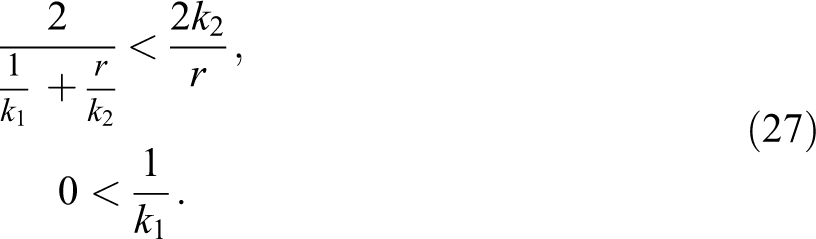
If k1 is greater than zero and cannot reach an infinite value, Equation 27 always holds and
Furthermore, all
Discussion
In the model section, we have seen that doping does not occur under all circumstances. If the doping costs c are sufficiently high, the athlete’s optimal doping intensity x will be zero. Furthermore, a sufficiently high fine F will also prevent doping. However, in our model and arguably in reality, the fine is not an element that the doping agency controls. First, it is not only the national doping agencies that are responsible for enacting antidoping laws but also the national legislatures. The doping agencies are in particular responsible for the rules governing sports and the national legislature for civil and criminal consequences of doping. Even if the legislature and the agency are willing to prevent doping by issuing draconic fines, this remains only a theoretical solution of the doping problem since fines for doping have to be proportional to fines for other offenses. Therefore, especially if doping is highly profitable, it might not be possible to raise the fines sufficiently to deter athletes from doping. 8 A similar problem is observable in the literature on tax evasion, where in theory sufficiently high fines could also prevent tax evasion, but where in practice such high fines are neither desired nor feasible. 9
We have shown that the athlete’s doping intensity has a minimum for T and an interior solution for q, which means that there is a doping minimizing storage period and retesting probability. Hence, in our model, retesting of doping samples will not only per se reduce doping compared to a situation without storing of doping samples, but moreover there is one efficient mix of storage and retesting to minimize doping. Thus, national governments and also international sports federations should provide additional money to enable doping agencies to store and reanalyze doping samples. Due to a smaller amount of doping, caused by strict ex post audits, health care cost of illegal doping consumption could be reduced and counterbalance the social costs of ex post audits.
Furthermore, we found a critical threshold for the agencies’ exogenous budget M. If the agency’s budget is below the critical threshold
However, this is true for our theoretical model, but doping agencies do not spend their budget for storing and testing. For instance, the agency could use excessive budget to invest in better testing facilities or more doping research. Consequently, the clear cut threshold from our model has to be modified to reflect reality. Nevertheless, as a policy implication, an agency’s budget should only be increased if the current budget is sufficiently small, that is, under the threshold, or if there are other reasonable antidoping investment opportunities Otherwise, a further increase will either lead to a shift from an efficient antidoping strategy to an inefficient strategy with an excessively long storage time or it will lead to a waste of public funds caused by the underutilization of the additional budget.
Our model and the corresponding results are based on the assumption of a rational athlete. However, some athletes may overestimate the importance of short-run success in relation to the long-term negative consequences of doping, whereas others might be so competitive that they only care about winning and do not consider negative consequences at all (see Andrews, 1998). If this is the case, the rationality of athletes might be bounded by the complexity and tractability of the doping decision or influenced by an athlete’s biased cognition. Nevertheless, the assumption of a rational athlete would still be a suitable benchmark for the athlete’s doping decision. Even athletes, who decide rationally that they do not want to cheat, could be pressured to abuse doping by their national federations or sponsors. Therefore, the rationality of athletes may have limits and may also depend on additional parameters. Effects of such limitations and dependencies could be engaged by further research. Besides the issue of limited rationality of athletes, our ex post audits’ approach opens further research fields for future venues:
First, our model excludes the competition between homogeneous or heterogeneous athletes. Consequently, the effects and implications of ex post audits in a contest setting will be subject to future investigations.
Second, considering the increasing costs of sophisticated antidoping mechanisms, one might argue that the benefits of these programs are outweighed by its costs. If this is indeed the case, the question arises whether the funding of such antidoping programs by public resources remains desirable. Further research putting emphasis on the cost–benefit analysis of ex post audits is necessary.
Third, WADA and IOC would need support from national governments and their subordinated national doping agencies to implement an extensive storing and retesting program as suggested by our model. However, national governments might have incentives to neglect their delegated antidoping duties, that is, no storing or retesting of doping samples, to give their national athletes an advantage over other athletes. This behavior would make a mockery of the antidoping program. Consequently, the issue how to motivate all national governments and national doping agencies to conduct a faithful antidoping program needs further elaboration. The principal agent model could be a heuristic setting to reflect the complex relationships between WADA, governments, and national doping agencies. 10
Conclusion
The aim of this article is to analyze how ex post doping retests affect athletes’ doping decision. We can draw three conclusions concerning this issue.
The first conclusion is that a doping-minimizing retesting scheme, that is, a doping minimizing interior point of retesting and a retesting probability, exists. Consequently, antidoping enforcement via a structured retesting algorithm will be more promising than antidoping enforcement by purely randomized retests.
Second, the doping intensity is decreased if the agency is able to conduct doping retests. Therefore, doping agencies have incentives to store and to reanalyze doping samples. The underlying intuition is straightforward. Without later retesting, the agency cannot detect modern doping drugs with the initial doping test. Since retesting enables the agency to identify doped athletes, the athletes will reduce their doping abuse.
The third conclusion is that in our setting, raising the doping agency’s budget to fight against doping will not always lead to a decrease in doping. Therefore, expanding an antidoping agency’s budget is not a panacea against doping abuse. This result rooted in a fact that a higher budget will always postpone the retesting of doping samples to a later point. Between the initial test and retest, a doped athlete will earn more money than a clean athlete. Therefore, under certain circumstances, a higher budget indirectly increases the athlete’s doping incentives. In line with this result, we found that under most circumstances, even with retesting the agency is not able to prevent doping completely.
Footnotes
Ackowledgment
We are grateful to Julio R. Robledo, Kasim Music, Annika Sauer, Nina Ismael, Arne Aarnink, Mario Hörbe and two anonymous referees for helpful comments.
Declaration of Conflicting Interests
The author(s) declared no potential conflicts of interest with respect to the research, authorship, and/or publication of this article.
Funding
The author(s) received no financial support for the research, authorship, and/or publication of this article.